Blog List

Thursday, 18 February 2016

Borassus Flabellifer

In Indonesia the leaves were used in the ancient culture as paper, known as "lontar". Leaves of suitable size, shape, texture, and maturity were chosen and then seasoned by boiling in salt water with turmeric powder, as a preservative. The leaves were then dried. When they were dry enough, the face of the leaf was polished with pumice, cut into the proper size, and a hole made in one corner. Each leaf made four pages. The writing was done with a stylus and had a very cursive and interconnected style. The leaves were then tied up as sheaves.


Asian palmyra (Borassus flabellifer).JPG
Borassus flabellifer
Trunk 
The stalks are used to make fences and also produce a strong, wiry fiber suitable for cordage and brushes. The black timber is hard, heavy, and durable and is highly valued for construction. In Cambodia, the trunks are also used to make canoes.
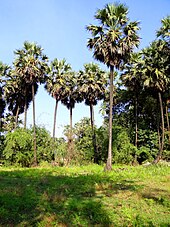

Sugar palm as seen in Mumbai,India

Cultivation 
 Borassus flabellifer has a growth pattern, very large size, and clean habits that make it an attractive ornamental tree, cultivated for planting in gardens and parks as landscape palm species.

Cultural symbolism
1) The palmyra tree is the official tree of Tamil Nadu. Highly respected in Tamil culture, it is called "karpaha Veruksham" ("celestial tree") because all its parts have a use. Panaiveriyamman, named after panai, the Tamil name for the Palmyra palm, is an ancient tree deity related to fertility linked to this palm. This deity is also known as Taalavaasini, a name that further relates her to all types of palms.


Borassus flabellifer in Cambodia, 1965.

2) The palm is also common in Thailand, especially in the northeast or Isaan area, where it is a prevailing part of the landscape.
- Wikipedia


Palm Sugar

Borassus flabellifer, the Asian palmyra palmtoddy palm, or sugar palm, is native to the Indian subcontinent and Southeast Asia, including NepalIndiaBangladeshSri LankaCambodiaLaosBurmaThailandVietnamMalaysiaIndonesia and the Philippines.

Description 
Borassus flabellifer is a robust tree and can reach a height of 30 metres (98 ft). The trunk is grey, robust and ringed with leaf scars; old leaves remain attached to the trunk for several years before falling cleanly. The leaves are fan-shaped and 3 m (9.8 ft) long, with robust black teeth on the petiole margins. Like all Borassus species, B. flabellifer is dioecious with male and female flowers on separate plants. The male flowers are less than 1 cm long and form semi-circular clusters, which are hidden beneath scale-like bracts within the catkin-like inflorescences


Fruits of Borassus flabelliferVietnam.
The fruits are black to brown with sweet, fibrous pulp and each seed is enclosed within a woody endocarp. Young palmyra seedlings grow slowly, producing only a few leaves each year (establishment phase), but at an as yet undetermined time, they grow rapidly, producing a substantial stem. 


Nungu drink, Tamil Nadu
The ripened fibrous outer layer of the palm fruits can also be eaten raw, boiled, or roasted. Bengali People have perfected the art of making various sweet dishes with the yellowish viscous fluidic substance obtained from a ripe palm fruit. 


Leaves
The Borassus flabellifer leaves are used for thatchingmatsbasketsfanshatsumbrellas, and as writing material. All the literature of the old Tamil was written in preserved Palm leaves also known as Palm-leaf manuscript - Wikipedia
  Male tree with flower


Corn Starch


Corn Starch Diet
Corn kernels are the source of corn starch. Photo Credit Jupiterimages/Photos.com/Getty Images

Corn starch, a thickening agent, is used in place of flour in foods as diverse as pancakes, soups and cookies. Corn starch benefits weight-loss diets because the amount required is half that of flour -- simply because cornstarch contains no gluten, and it is gluten, states Perfect Pantry, that hinders flour's thickening action. For anyone with gluten allergies or celiac disease, cornstarch is ideal for recipes.

Corn Starch Science
Corn starch is created by grinding the endosperm of the yellow corn kernel. Structurally, corn starch is a polymer, made up of long chains of atoms that exhibit interesting physical properties related to its use as a thickener. Little Shop describes the chains of atoms as allowing a creeping, oozing action of a cornstarch liquid being slowly poured, but the fast your pour, the firmer the mixture becomes. If you push onto the liquid, it actually hardens. Corn starch's sensitive nature sometimes makes cooking with it an unusual experience, says Perfect Pantry, since its relationship with water is so perplexing 
- www.lifestrong.com


Corn Starch Benefits for Illness


Corn Starch Diet


If you have celiac disease or gluten allergies you may benefit from corn starch diets. The National Institutes of Diabetes and Digestive and Kidney Disease describes celiac disease, a permanent, auto-immune digestive disorder, as gluten's creating a toxic environment in the small intestine, leading to intestinal tissue damage and malnutrition. Wheat allergies are considered more temporary, and gluten intolerance is not immune-related. In any of these conditions, corn starch helps to alleviate symptoms.

Corn starch diets can alleviate some digestive problems.Photo Credit jeans, belly and hand image by Vasiliy Koval from Fotolia.com


Corn Starch Diet


Corn starch pancakes have no flour whatsoever. Checkers' recipe calls for two eggs; 25 ml, or 5 tsps., of olive oil; 220 ml, or 1 cup, of corn starch; and approximately 1/2 cup water. The mixture will resemble regular pancake batter but the corn starch will exert its thickening action in the cooking pan, so these pancakes are robust - www.lifestrong.com
Corn starch pancakes have slightly thicker texture. Photo Credit pancakes 5 image by samantha grandy from Fotolia.comCorn Starch Breakfast


Wednesday, 17 February 2016

Major Biomass Resources

Taking into account the growing energy consumption and domestic energy supply constraints, Malaysia has set sustainable development and diversification of energy sources, as the economy’s main energy policy goals. The Five-Fuel Strategy recognises renewable energy resources as the economy’s fifth fuel after oil, coal, natural gas and hydro. Being a major agricultural commodity producer in the region Malaysia is well positioned amongst the ASEAN countries to promote the use of biomass as a renewable energy source

Biomass feedstock has long been identified as a sustainable source of renewable energy particularly in countries where there is abundant agricultural activities. Malaysia has tremendous biomass and wood waste resources available for immediate exploitation. This energy potential of biomass wastes is yet to be exploited properly in the country. Intensive use of biomass as renewable energy source could reduce dependency on fossil fuels and significant advantage lies in reduction of net carbon dioxide emissions to atmosphere leading to less greenhouse effect. However, increased competitiveness will require advances in technologies for converting this biomass to biofuel efficiently and economically.

Major Biomass Resources

  • Agricultural crops e.g. sugarcane, cassava, corn
  • Agricultural residues e.g. rice straw, cassava rhizome, corncobs
  • Woody biomass e.g. fast-growing trees, wood waste from wood mill, sawdust
  • Industrial wastes e.g. rice husks from rice mills, molasses and bagasse from sugar refineries, residues from palm oil mills
  • Municipal solid waste
  • Livestock manure
Malaysia is the world’s leading exporter of palm oil, exporting more than 13.75 million tonnes of palm oil in 2007. The extraction of palm oil from palm fruits results in a large quantity of waste in the form of empty fruit bunches shells and fruit fibre. In 2004, more than 25 million tons of oil palm biomass was generated. Apart from palm biomass waste, two other products from this industry can mitigate climate change – palm biogas and biofuel. Processing crude palm oil generates a foul-smelling effluent that, when treated using anaerobic processes, releases biogas. 

Rice husk is another important agricultural biomass resource in Malaysia with very good energy potential for power cogeneration. An example of its attractive energy potential is biomass power plant in the state of Perlis which uses rice husk as the main source of fuel and generates 10 MW power to meet the requirements of 30,000 households - www.bioenergyconsult.com


Biomass Potentials

Sustainable and renewable natural resources such as biomass can supply potential raw materials for energy conversion. In Indonesia, they comprise variable-sized wood from forests (i.e. natural forests, plantations and community forests that commonly produce small-diameter logs used as firewood by local people), woody residues from logging and wood industries, oil-palm shell waste from crude palm oil factories, coconut shell wastes from coconut plantations, as well as skimmed coconut oil and straw from rice cultivation.

There are 39 palm oil plantations and mills currently operating in Indonesia, and at least eight new plantations are under construction. Most palm oil mills generate combined heat and power from fibres and shells, making the operations energy self –efficient. However, the use of palm oil residues can still be optimized in more energy efficient systems.

Other potential source of biomass energy can also come from municipal wastes. The quantity of city or municipal wastes in Indonesia is comparable with other big cities of the world. Most of these wastes are originated from household in the form of organic wastes from the kitchen. At present the wastes are either burned at each household or collected by the municipalities and later to be dumped into a designated dumping ground or landfill. 

Although the government is providing facilities to collect and clean all these wastes, however, due to the increasing number of populations coupled with inadequate number of waste treatment facilities in addition to inadequate amount of allocated budget for waste management, most of big cities in Indonesia had been suffering from the increasing problem of waste disposals - www.bioenergyconsult.com


List of Foods High in Soluble Fiber


List of Foods High in Soluble Fiber
pears are an excellent source of soluble fiber Photo Credit Kathleen C Petersen/iStock/Getty Images

Dietary fiber is found in fruits, vegetables and grains and should be included as part of a healthy diet. There are two forms of dietary fiber: soluble and insoluble fiber. Both are essential for your health and digestion. The role of soluble fiber in digestion is to attract water which turns it into a gel and slows digestion. Soluble fiber is proven to lower cholesterol and decrease the risk of heart disease.

Grains


List of Foods High in Soluble Fiber
Barley is high is soluble fiber 
Photo Credit Åžafak OÄŸuz/iStock/Getty Images
Oat, bran and barley are highest in soluble fiber. Oatmeal provides a total of 4 grams of dietary fiber per serving. Of the 4 grams of dietary fiber, 2 grams are soluble fiber. Bran provides 6 grams of dietary fiber per one-quarter cup. One serving of bran cereal provides up to 3 grams of soluble fiber. Barley, bulgur, whole wheat spaghetti and wheat germ contain 4 grams of dietary fiber including 1 gram of soluble fiber - www.lifestrong.com

 Nuts and Seeds


List of Foods High in Soluble Fiber
almonds have about 1 gram of soluble fiber per serving Photo Credit Katie Nesling/iStock/Getty Images

Peanuts have the most soluble fiber per serving for nuts. In one-quarter cup of dry roasted peanuts, you will get 1 gram of soluble fiber and a total of 3 grams of dietary fiber. Almonds and Brazil nuts both have at least 1 gram of soluble fiber per serving. Flax seeds provide almost 7 grams of soluble fiber in one-third cup, one of the richest sources available you can add to entrees or sprinkle on cereal. Sesame seeds and sunflower seeds both provide 2.5 grams of soluble fiber, 
Beans , Lentils and Peas


List of Foods High in Soluble Fiber
lentils are have more soluble fiber than beans and peas Photo Credit studiocascella/iStock/Getty Images

Lentils provide the most dietary fiber per serving compared to beans and peas. In just one-half cup of lentils, you get 8 grams of dietary fiber, including 1 gram of soluble fiber. However, beans contain the most soluble fiber per serving. Lima beans, baked beans and kidney beans provide 3 grams of soluble fiber per one-half cup serving. Navy beans, also high in soluble fiber, provide 2 grams per serving. Most peas provide 1 gram of soluble fiber per serving.


Fruits and Vegetables


List of Foods High in Soluble Fiber
there are 3 grams of soluble fiber in a peach
Photo Credit Liv Friis-Larsen/iStock/Getty Images

Several fruits and vegetables are excellent sources of both dietary fiber and soluble fiber. One large pear has the highest soluble fiber content, with 3 grams per peach. Apples, blueberries, plums, strawberries, fresh and dried apricots, bananas, oranges, cherries, dates, peaches, dried prunes, raisins, cantaloupe, grapefruits, grapes and pineapple are all good sources of soluble fiber. Vegetables containing at least 1 gram of soluble fiber per serving include parsnips, carrots, brussels sprouts, baked potato with skin, spinach, squash, string beans, cabbage, baked sweet potato, turnips, broccoli, kale and zucchini.
www.lifestrong.com


Cassava Foods

Is Cassava a Source of High-Calorie Foods?


Is Cassava a Source of High-Calorie Foods?
Cassava root on a plate. Photo Credit LRArmstrong/iStock/Getty Images

Cassava plants produce fleshy roots that are high in carbohydrates and low in both fat and protein. The cassava roots can be bitter and even poisonous if eaten raw. Correctly prepared and detoxified, cassava can be used much like a potato due to its high-starch content and is often eaten baked or fried. This moderate-calorie root is also known as tapioca and can be found in puddings and other baked goods

Calories
One cup of raw cassava contains 330 calories. When prepared as a 1-oz. serving of chips, about 23, the cassava contains 147 calories. The FDA considers foods that are between 100 and 400 calories per serving to be moderate-calorie foods.

Fat
A serving of raw cassava contains 0.5 g fat. When prepared as chips, a 1-oz. serving provides 7.4 g fat. The difference in fat content is primarily due to the oils used to fry the cassava when making chips. The chips contain about 2.5 g saturated fat, making up 12.5 percent of your daily recommended saturated fat intake. Keep your saturated fat intake to fewer than 20 g per day to help reduce the risks of heart disease.

Carbohydrates
Cassava are made primarily of carbohydrates. A serving of raw cassava contains 78 g carbohydrates. One ounce of cassava chips provide about 20 g carbohydrate. Consume about 45 to 60 g carbohydrates per meal to help manage blood sugar levels. If you are diabetic, monitor your intake of other carbohydrate-containing foods when eating cassava to help avoid high blood sugar levels.

Protein
A 1-cup serving of cassava provides 2.8 g protein. Cassava chips contain even less protein at 0.38 g per serving. A study by Kevin Stephenson, et al., and published in the February 2010 issue of "Nutrition Journal," found inadequate protein intake in children who consumed cassava as a dietary staple. Dietary protein interventions were recommended to help promote healthy growth and development. The body needs protein to function properly. Include other protein containing foods at meals when consuming cassava.
For more information please visit website: www.lifestrong.com

Biomass Resources

Being an agricultural country, Vietnam has very good biomass energy potential. Agricultural wastes are most abundant in the Mekong Delta region with approximately 50% of the amount of the whole country and Red River Delta with 15%. Major biomass resources includes rice husk from paddy milling stations, bagasse from sugar factories, coffee husk from coffee processing plants in the Central Highlands and wood chip from wood processing industries. Vietnam has set a target of having a combined capacity of 500 MW of biomass power by 2020, which is raised to 2,000 MW in 2030.

Rice husk and bagasse are the biomass resources with the greatest economic potential, estimated at 50 MW and 150 MW respectively. Biomass fuels sources that can also be developed include forest wood, rubber wood, logging residues, saw mill residues, sugar cane residues, bagasse, coffee husk and coconut residues. Currently biomass is generally treated as a non-commercial energy source, and collected and used locally. Nearly 40 bagasse-based biomass power plants have been developed with a total designed capacity of 150 MW but they are still unable to connect with the national grid due to current low power prices. Five cogeneration systems selling extra electricity to national grid at average price of 4UScents/kWh.

Biogas energy potential is approximately 10 billion m3/year, which can be collected from landfills, animal excrements, agricultural residues, industrial wastewater etc. The biogas potential in the country is large due to livestock population of more than 30 million, mostly pigs, cattle, and water buffalo. Although most livestock dung already is used in feeding fish and fertilizing fields and gardens, there is potential for higher-value utilization through biogas production. It is estimated that more than 25,000 household biogas digesters with 1 to 50 m3, have been installed in rural areas.

For more information please visit website: www.bioenergyconsult.com

Biomass

Thailand’s annual energy consumption has risen sharply during the past decade and will continue its upward trend in the years to come. While energy demand has risen sharply, domestic sources of supply are limited, thus forcing a significant reliance on imports.

To face this increasing demand, Thailand needs to produce more energy from its own renewable resources, particularly biomass wastes derived from agro-industry, such as bagasse, rice husk, wood chips, livestock and municipal wastes.
The major biomass resources in Thailand include the following:
  • Woody biomass residues from forest plantations
  • Agricultural residues (rice husk, bagasse, corn cobs, etc.)
  • Wood residues from wood and furniture industries    (bark, sawdust, etc.)
  • Biomass for ethanol production (cassava, sugar cane, etc.)
  • Biomass for biodiesel production (palm oil, jatropha oil, etc.)
  • Industrial wastewater from agro-industry
  • Livestock manure
  • Municipal solid wastes and sewage
Thailand’s vast biomass potential has been partially exploited through the use of traditional as well as more advanced conversion technologies for biogas, power generation, and biofuels. Rice, sugar, palm oil, and wood-related industries are the major potential biomass energy sources. The country has a fairly large biomass resource base of about 60 million tons generated each year that could be utilized for energy purposes, such as rice, sugarcane, rubber sheets, palm oil and cassava.

Biomass has been a primary source of energy for many years, used for domestic heating and industrial cogeneration. For example, paddy husks are burned to produce steam for turbine operation in rice mills; bagasse and palm residues are used to produce steam and electricity for on-site manufacturing process; and rubber wood chips are burned to produce hot air for rubber wood seasoning.

For more information please visit website: www.bioenergyconsult.com


Rice Husk Properties

Properties of Rice Husk

Recent interest on the environmental impact of polymer-based materials has lead to the development of new products prepared with recycled polymers and/or containing biodegradable materials. Lignocellulosic plastic composites constitute an important set within this kind of materials showing several advantages over traditional mineral-filled plastic composites: low density, low production costs, biodegradability, renewability, etc. Stiffness, hardness and dimensional stability of plastics have also been improved by incorporation of lignocellulosic fillers .

However, the use of agro-fibers shows some drawbacks such as degradation at relatively low temperature due to the presence of cellulose and hemicellulose. This early thermal degradation limits the allowed processing temperature to less than 200 ºC and restricts the type of thermoplastics that can be used with agro-fibres to some commodity plastics such as PE, PP, PVC and PS[3]. Natural fiber/PP composites have been used in automotive applications and recently they have been investigated for using in construction, such as building profiles, decking, railing products, etc.1,4
Other factors should be taken into account when designing composites made of lignocellulosic fibers for specific applications, among them its poor resistance to moisture5. Outdoor applications have raised the interest on this property since moisture absorbed by the composite led to dimensional changes and to decreasing mechanical performance4. These negative effects can be reduced if the fibers are encapsulated in the plastic with good adhesion between the fibers and the matrix. The addition of a compatibilizer has been a useful tool for achieving such adhesion. Maleic anhydride-grafted PP (MAPP) is the most common compatibilizer used to improve interfacial adhesion for bio-fillers/apolar thermoplastic matrices even so new alternatives are being currently studied.

Rice husk (RH) is one of the major agricultural residues produced as a by-product during rice processing. Usually it has been a problem for rice farmers due to its resistance to decomposition in the ground, difficult digestion and low nutritional value for animals8. According to Marti-Ferrer the lignin and hemicellulose contents of rice husk are lower than wood whereas the cellulose content is similar. For this reason RHF can be processed at higher temperatures than wood. Therefore, the use of rice husk in the manufacture of polymer composites is attracting much attention.

The group of Kim, in Korea, has published many studies dealing with PP-rice husk composites9-14. They observed that tensile and impact strengths (notched and unnotched specimens) decreased with increasing filler loading while the elastic modulus increased9,11. The thickness swelling and the absorption of water were shown to slightly increase as the filler loading increased, but this was to a negligible extent as compared with wood-based composites. Despite the low properties of the composites the researchers concluded that rice husk flour could be utilized as a biodegradable filler to minimize environmental pollution9. Addition of PPMA as coupling agent improved the water absorption properties10. In other studies the researchers verified improvements in thermal stability, dynamic mechanical properties, tensile properties and crystallinity with addition of MAPP.

Despite of the great interest on lightweight materials few studies have focused on determining the density of natural fibers-filled polymer composites. In the present study we used a thermoplastic polymer as matrix (PP) and rice husk flour (RHF) as filler to prepare composites. PP modified with maleic anhydride (MAPP) was used as coupling agent. The objective of the work was to explore the effect of RHF loading and the presence of MAPP on the density, mechanical properties and water absorption behavior of the composites.

For more information please visit website: www.scielo.br


Advantages and Disadvantages of Fasting for Runners

Author BY   ANDREA CESPEDES  Food is fuel, especially for serious runners who need a lot of energy. It may seem counterintuiti...