Blog List

Tuesday, 23 February 2016

WOOD FIBERS

Wood fibers are usually cellulosic elements that are extracted from trees and used to make materials including paper.
The end paper product (paper, paperboard, tissue, cardboard, etc.) dictates the species, or species blend, that is best suited to provide the desirable sheet characteristics, and also dictates the required fibre processing (chemical treatment, heat treatment, mechanical "brushing" or refining, etc.).
In North America, virgin (non-recycled) wood fiber is primarily extracted from hardwood(deciduous) trees and softwood (coniferous) trees. Wood fibers can also be recycled from used paper materials.
Wood fibers are treated by combining them with other additives. They are then processed into a network of wood fibers, which constitutes the sheet of paper.


- Wikipedia 

FIBER

Fiber or fibre (from the Latin fibra ) is a natural or synthetic substance that is significantly longer than it is wide. Fibers are often used in the manufacture of other materials. The strongest engineering materials often incorporate fibers, for example carbon fiber and ultra-high-molecular-weight polyethylene.
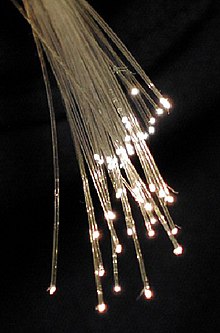

A bundle of optical fibers
Synthetic fibers can often be produced very cheaply and in large amounts compared to natural fibers, but for clothing natural fibers can give some benefits, such as comfort, over their synthetic counterparts.
Natural fibers develop or occur in the fiber shape, and include those produced by plants, animals, and geological processes. They can be classified according to their origin:


  • Vegetable fibers are generally based on arrangements of cellulose , often with lignin: examples include cottonhempjuteflaxramiesisal, bagasse and banana. Plant fibers are employed in the manufacture of paper and textile (cloth), and dietary fiber is an important component of human nutrition.
  • Wood fiber, distinguished from vegetable fiber, is from tree sources. Forms include ground wood, lacebark, thermomechanical pulp (TMP), and bleached or unbleached kraft or sulfite pulps. Kraft and sulfite (also called sulphite) refer to the type of pulping process used to remove the lignin bonding the original wood structure, thus freeing the fibers for use in paper and engineered wood products such as fiberboard.
  • Animal fibers consist largely of particular proteins. Instances are silkworm-silk, spidersilk, sine, catgutwoolsea silk and hair such as cashmere woolmohair and angora, fur such as sheepskin, rabbit, mink, fox, beaver, etc.
  • Mineral fibers include the asbestos group. Asbestos is the only naturally occurring long mineral fiber. Six minerals have been classified as "asbestos" including chrysotile of the serpentine class and those belonging to the amphibole class: amosite, crocidolite, tremolite, anthophyllite and actinolite. Short, fiber-like minerals include wollastoniteand palygorskite.
  • Biological fibers also known as fibrous proteins or protein filaments consist largely of biologically relevant and biologically very important proteins, mutations or other genetic defects can lead to severe diseases. Instances are collagen family of proteins, tendonmuscle proteins like actin, cell proteins like microtubules and many others, spider silk, sinewand hair etc.

Man-made Fibers 

Man-made fibers or chemical fibers are fibers whose chemical composition, structure, and properties are significantly modified during the manufacturing process. Man-made fibers consist of regenerated fibers and synthetic fibers.

Semi-synthetic Fibers 

Semi-synthetic fibers are made from raw materials with naturally long-chain polymer structure and are only modified and partially degraded by chemical processes, in contrast to completely synthetic fibers such as nylon (polyamide) or dacron (polyester), which the chemist synthesizes from low-molecular weight compounds by polymerization (chain-building) reactions. The earliest semi-synthetic fiber is the cellulose regenerated fiber, rayon. Most semi-synthetic fibers are cellulose regenerated fibers.

Cellulose Fibers 
Cellulose fibers are a subset of man-made fibers, regenerated from natural cellulose. The cellulose comes from various sources: rayon from tree wood fiber, Modal from beech trees, bamboo fiber from bamboo, seacell from seaweed, etc. In the production of these fibers, the cellulose is reduced to a fairly pure form as a viscous mass and formed into fibers by extrusion through spinnerets. Therefore, the manufacturing process leaves few characteristics distinctive of the natural source material in the finished products.
Some examples are:
Historically, cellulose diacetate and -triacetate were classified under the term rayon, but are now considered distinct materials.
Synthetic Fibers 


Synthetic come entirely from synthetic materials such as petrochemicals, unlike those man-made fibers derived from such natural substances as cellulose or protein.
Fiber classification in reinforced plastics falls into two classes: (i) short fibers, also known as discontinuous fibers, with a general aspect ratio (defined as the ratio of fiber length to diameter) between 20 to 60, and (ii) long fibers, also known as continuous fibers, the general aspect ratio is between 200 to 500.
Mineral Fibers 

Mineral fibers can be particularly strong because they are formed with a low number of surface defects, asbestos is a common one. 

Polimer Fibers


  • Polymer fibers are a subset of man-made fibers, which are based on synthetic chemicals (often from petrochemical sources) rather than arising from natural materials by a purely physical process. These fibers are made from:
    • polyamide nylon
    • PET or PBT polyester
    • phenol-formaldehyde (PF)
    • polyvinyl chloride fiber (PVC) vinyon
    • polyolefins (PP and PE) olefin fiber
    • acrylic polyesters, pure polyester PAN fibers are used to make carbon fiber by roasting them in a low oxygen environment. Traditional acrylic fiber is used more often as a synthetic replacement for wool. Carbon fibers and PF fibers are noted as two resin-based fibers that are not thermoplastic, most others can be melted.
    • aromatic polyamids (aramids) such as TwaronKevlar and Nomex thermally degrade at high temperatures and do not melt. These fibers have strong bonding between polymer chains
    • polyethylene (PE), eventually with extremely long chains / HMPE (e.g. Dyneema or Spectra).
    • Elastomers can even be used, e.g. spandex although urethane fibers are starting to replace spandex technology.
    • polyurethane fiber
    • Elastolefin
  • Coextruded fibers have two distinct polymers forming the fiber, usually as a core-sheath or side-by-side. Coated fibers exist such as nickel-coated to provide static elimination, silver-coated to provide anti-bacterial properties and aluminum-coated to provide RF deflection for radar chaff. Radar chaff is actually a spool of continuous glass tow that has been aluminum coated. An aircraft-mounted high speed cutter chops it up as it spews from a moving aircraft to confuse radar signals.

Microfibers
Microfibers in textiles refer to sub-denier fiber (such as polyester drawn to 0.5 denier). Denier and Dtex are two measurements of fiber yield based on weight and length. If the fiber density is known, you also have a fiber diameter, otherwise it is simpler to measure diameters in micrometers. Microfibers in technical fibers refer to ultra fine fibers (glass or meltblown thermoplastics) often used in filtration. Newer fiber designs include extruding fiber that splits into multiple finer fibers. Most synthetic fibers are round in cross-section, but special designs can be hollow, oval, star-shaped or trilobal. The latter design provides more optically reflective properties. Synthetic textile fibers are often crimped to provide bulk in a woven, non woven or knitted structure. Fiber surfaces can also be dull or bright. Dull surfaces reflect more light while bright tends to transmit light and make the fiber more transparent.
Very short and/or irregular fibers have been called fibrils. Natural cellulose, such as cotton or bleached kraft, show smaller fibrils jutting out and away from the main fiber structure.
- Wikipedia 

COPRA

Copra is the dried meat, or dried kernel, of the coconutused to extract coconut oil. The earliest evidence of the extracting and use of coconut oil from copra is in early Tamil literature from the 1st century AD. The word originated from the Malayalam word KopparaCoconut oil is extracted from it and this has made copra an important agricultural commodity for many coconut-producing countries. It also yields coconut cake, which is mainly used as feed for livestock.


Whole dry coconuts, kept for sale in Ulsoor Market, Bangalore, India

Production 
Copra has traditionally been grated and ground then boiled in water to extract coconut oil. It was used by Pacific island cultures and became a valuable commercial product for merchants in the South Seas and South Asia in the 1860s. This 19th-century copra trading inspired Robert Louis Stevenson's 1893 novella The Beach of Falesá, based on his experiences in Samoa.[3] Nowadays, the process of coconut oil extraction is performed by crushing copra to produce coconut oil (70%); the by-product is known as copra cake or copra meal (30%).

Making copra – removing the shell, breaking it up, drying – is usually done where the coconut palms grow. Copra can be made by smoke drying, sun drying, or kiln drying. Sun drying requires little more than racks and sufficient sunlight. Halved nuts are drained of water, and left with the meat facing the sky; they can be washed to remove mold-creating contaminants. 


Coconuts sun-dried in KozhikodeKerala for making copra

After two days the meat can be removed from the shell with ease, and the drying process is complete after three to five more days (up to seven in total). Sun drying is often combined with kiln drying, eight hours of exposure to sunlight means the time spent in a kiln can be reduced by a day and the hot air the shells are exposed to in the kiln is more easily able to remove the remaining moisture. 

This process can also be reversed, partially drying the copra in the kiln and finishing the process with sunlight. There are advantages and disadvantages in both – starting with sun drying requires careful inspection to avoid contamination with mold while starting with kiln-drying can harden the meat and prevent it from drying out completely in the sun. In India, small but whole coconuts can be dried over the course of eight months to a year, and the meat inside removed and sold as a whole ball. Meat prepared in this fashion is sweet, soft, oily and is cream-colored instead of being white. Coconut meat can be dried using direct heat and smoke from a fire, using simple racks to suspend the coconut over the fire. The smoke residue can help preserve the half-dried meat but the process overall suffers from unpredictable results and the risk of fires.

Copra production begins on coconut plantations. Coconut trees are generally spaced 9 m (30 ft) apart, allowing a density of 100-160 coconut trees per hectare. A standard tree bears around 50-80 nuts a year, and average earnings in Vanuatu (1999) were US$0.20 per kg (one kg equals 8 nuts)—so a farmer could earn approximately US$120 to US$320 yearly for each planted hectare. Copra has since more than doubled in price, and was last quoted at US$540 per ton in the Philippines on a CIF Rotterdam basis (US$0.54 per kg) by the Financial Times on 9 November 2012.

In the Philippines, copra is collected as dried "cups" (the meat from one-half of a coconut), which are shipped in large burlap bags. At the shipping point (typically, a dock) the copra is sampled by driving a small metal tube into the bag at several points, thus perforating the cups and collecting small amounts of copra within the tubes. Those samples are measured for aflatoxin contamination. If within standards the bag is shipped. This method leaves the risk that many cups are missed by the random sampling—and seriously contaminated copra might be missed. Because so many small producers are involved, it is impractical to monitor all the farms and drying sites (which is where aflatoxin contamination occurs). The Philippines government continues to work on developing methods for the testing, safety, and minimisation of aflatoxins.

Animal Feed
Copra meal is used as fodder for horses and cattle. Its high oil and protein levels are fattening for stock.[6][7] The protein in copra meal has been heat treated and provides a source of high-quality protein for cattle, sheep and deer, because it does not break down in the rumen.
Coconut oil can be extracted using either mechanical expellers or solvents (hexane). Mechanically expelled copra meal is of higher feeding value, because it contains typically 8-12% oil, whereas the solvent-extracted copra meal contains only 2-4% oil. Premium quality copra meal can also contain 20-22% crude protein, and <20ppb aflatoxin.
High-quality copra meal contains <12% non structural carbohydrate (NSC),which makes it well suited for feeding to horses that are prone to ulcersinsulin resistance, colictying up, and acidosis.
- Wikipedia 

COCONUT PRODUCTION IN KERALA

Coconut production in Kerala plays an important role in the state economy and culture of Kerala in southwestern India. Kerala is actually named after the coconut tree with "Kera" meaning Coconut tree and "Alam" meaning land so means "Land of Coconut Trees". Various terms like Copra and Coir are derived from the native Malayalam language.

A man collecting coconuts in Kerala
By the late 1970s it accounted for some 68% of total production in India and at one stage some 899, 198 hectares were reportedly under cultivation. Today Kerala produces roughly 45% of India's coconuts, with some 92% of total production lying in the southern Indian states and Kerala's neighbours. The Coconut Development Board which plays an important role in the development of coconut production in India has its headquarters in Kochi, Kerala. One problem which poses a major threat to production in Kerala is Root wilt disease.
Uses
In Kerala, the coconut tree is called as "Kalpa Vriksham" which essentially means all parts of a Coconut tree is useful some way or other. Cocus nucifera dominate the landscape in many parts, rising up to a height of 25m, and bearing over 50 fruits on average in a year. The trees have many uses; their leaves are used to make sheds, baskets, and doormats, the husk for making coir, the shell for making ladles and spoons, and fruits used for making hair oil or for eating. Coconut is a staple ingredient in many Kerala dishes and coconut oil is widely consumed and used to make drinks such as coconut toddy and dishes such as appam.Coconut is also used for making coconut paste which is essential for making traditional curryes.
A number of places in Kerala such as Thiruvananthapuram, KochiKumarakomParavur,  Mararikulam and Periyar offer coconut tours to visitors in their plantations, providing an insight into coconut cultivation in Kerala.

NATURAL FIBRES

The IYNF was intended to cover a wide range of natural fibres, of animal and vegetable origin, and with uses ranging from luxurious apparel to traditional and non-traditional industrial uses.

Aims
The IYNF ( International Year Natural Fibres ) was expected to raise the profile of such natural fibres. Observance of the Year was based on cooperation among producers of natural fibres to emphasise the positive qualities of natural fibres.
  • to raise awareness and stimulate demand for natural fibres;
  • to encourage appropriate policy responses from governments to the problems faced by natural fibre industries;
  • to foster an effective and enduring international partnership among the various natural fibres industries; and
  • to promote the efficiency and sustainability of the natural fibres industries.


Plant Fibres 
Plant fibres include seed hairs, such as cotton; stem (or bast) fibres, such as flax and hemp; leaf fibres, such as sisal; and husk fibres, such as coconut.
  • Abaca, once a favoured source of rope, abaca shows promise as an energy-saving replacement for glass fibres in automobiles
  • Coir, a coarse, short fibre extracted from the outer shell of coconuts, coir is found in ropes, mattresses, brushes, geotextiles and automobile seats
  • Cotton, pure cellulose, cotton is the world's most widely used natural fibre and still the undisputed "king" of the global textiles industry
  • Flax, one of nature's strongest vegetable fibres, flax was also one of the first to be harvested, spun and woven into textiles
  • Hemp, recent advances in the "cottonization" of hemp fibre could open the door to the high quality clothing market
  • Jute, the strong threads made from jute fibre are used worldwide in sackcloth - and help sustain the livelihoods of millions of small farmers
  • Ramie, white, with a silky lustre, is one of the strongest natural fibres, similar to flax in absorbency and density
  • Sisal, too coarse for clothing, is replacing glass fibres in composite materials used to make cars and furniture


Animal Fibres 
Animal fibres include wool, hair and secretions, such as silk.
  • Alpaca wool, is used to make high-end luxury fabrics, with world production estimated at around 5 000 tonnes a year
  • Angora wool, the silky white wool of the Angora rabbit is very fine and soft, and used in high quality knitwear
  • Camel hair, the best fibre is found on the Bactrian camels of Mongolia and Inner Mongolia, and baby camel hair is the finest and softest
  • Cashmere wool, is exceptionally soft to the touch owing to the structure of its fibres and has great insulation properties without being bulky
  • Mohair, white, very fine and silky, mohair is noted for its softness, brightness and receptiveness to rich dyes
  • Silk, developed in ancient China, where its use was reserved for royalty, silk remains the "queen of fabrics"
  • Wool, limited supply and exceptional characteristics have made wool the world's premier textile fibre

- Wikipedia 

SYNTHETIC FIBER

Synthetic Fiber 

Synthetic fibers or fibres are the result of extensive research by scientiststo improve on naturally occurring animal and plant fibers. In general, synthetic fibers are created by extruding fiber forming materials through spinnerets into air and water, forming a thread. Before synthetic fibers were developed, artificially manufactured fibers were made from polymers obtained from petro chemicals. These fibers are called synthetic or artificial fibers. Some fibers are manufactured from plant-derived cellulose.

Early Experiments

Joseph Swan invented the first synthetic fiber in the early 1880s. His fiber was drawn from a cellulose liquid, formed by chemically modifying the fiber contained in tree bark. The synthetic fiber produced through this process was chemically similar in its potential applications to the carbon filament Swan had developed for his incandescent light bulb, but Swan soon realized the potential of the fiber to revolutionise textile manufacturing. In 1885 he unveiled fabrics he had manufactured from his synthetic material at the International Inventions Exhibition in London.


Joseph Swan created the first synthetic fiber.

The next step was taken by Hilaire de Chardonnet, a French engineer and industrialist, who invented the first artificial silk, which he called "Chardonnet silk". In the late 1870s, Chardonnet was working with Louis Pasteur on a remedy to the epidemic that was destroying French silk worms. Failure to clean up a spill in the darkroom resulted in Chardonnet's discovery of nitrocellulose as a potential replacement for real silk. Realizing the value of such a discovery, Chardonnet began to develop his new product, which he displayed at the Paris Exhibition of 1889. Unfortunately, Chardonnet's material was extremely flammable, and was subsequently replaced with other, more stable materials.

Commercial Products 
The first successful process was developed in 1894 by English chemist Charles Frederick Cross, and his collaborators Edward John Bevan and Clayton Beadle. They named the fiber "viscose", because the reaction product of carbon disulfide and cellulose in basic conditions gave a highly viscous solution of xanthate. The first commercial viscose rayon was produced by the UK company Courtaulds Fibers in 1905. The name "rayon" was adopted in 1924, with "viscose" being used for the viscous organic liquid used to make both rayon and cellophane. A similar product known as cellulose acetate was discovered in 1865. Rayon and acetate are both artificial fibers, but not truly synthetic, being made from wood.
Nylon was first synthesized by Wallace Carothers at DuPont.
Nylon, the first synthetic fiber, was developed by Wallace Carothers, an American researcher at the chemical firm DuPont in the 1930s. It soon made its debut in the United States as a replacement for silk, just in time for the introduction of rationing during World War II. Its novel use as a material for women's stockings overshadowed more practical uses, such as a replacement for the silk in parachutes and other military uses like ropes.
The first polyester fiber was introduced by John Rex Whinfield and James Tennant Dickson, British chemists working at the Calico Printers' Association, in 1941. They produced and patented the first polyester fibre which they named Terylene, also known as Dacron, equal to or surpassing nylon in toughness and resilience. ICI and DuPont went on to produce their own versions of the fibre.


Description 
Synthetic fibers are made from synthesized polymers or small molecules. The compounds that are used to make these fibers come from raw materials such as petroleum based chemicals or petrochemicals. These materials are polymerized into a long, linear chemical that bond two adjacent carbon atoms. Differing chemical compounds will be used to produce different types of fibers.
Synthetic fibers account for about half of all fiber usage, with applications in every field of fiber and textile technology. Although many classes of fiber based on synthetic polymers have been evaluated as potentially valuable commercial products, four of them - nylonpolyesteracrylic and polyolefin - dominate the market. These four account for approximately 98 percent by volume of synthetic fiber production, with polyester alone accounting for around 60 per cent.[10]
There are several methods of manufacturing synthetic fibers but the most common is the Melt-Spinning Process. It involves heating the fiber until it begins to melt, then you must draw out the melt with tweezers as quickly as possible. The next step would be to draw the molecules by aligning them in a parallel arrangement. This brings the fibers closer together and allows them to crystallize and orient. Lastly, is Heat-Setting. This utilizes heat to permeate the shape/dimensions of the fabrics made from heat-sensitive fibers.

Advantages 
Synthetic fibers are more durable than most natural fibers and they readily pick-up different dyes. In addition, many synthetic fibers offer consumer-friendly functions such as stretching, waterproofing and stain resistance. Sunlight, moisture and oils from human skin cause the all fibers to break down and wear away. Natural fibers are much more sensitive than synthetic blends. This is mainly because natural products are biodegradable. Natural fibers susceptible to larval insect infestation. Synthetic fibers are not a good food source for fabric-damaging insects.
Compared to natural fibers, many synthetic fibers are more water resistant and stain resistant. Some are even specially enhanced to withstand damage from water or stains. Some fabrics are also designed to stretch in specific ways, which makes them more comfortable to wear.
Cotton is resource intensive: it takes a lot of water to farm cotton. Wool sheep also need water, and a lot of grazing land in order to survive, thus it is claimed by some that although synthetic fiber production does involve some carbon emissions, the environmental footprint of many fibers is much lower.

Disadvantages
Most of synthetic fibers' disadvantages are related to their low melting temperature:
  • Synthetic fibers burn more readily than natural.
  • Prone to heat damage. Melt relatively easily.
  • Prone to damage by hot washing.
  • More electrostatic charge is generated by rubbing than with natural fibres.
  • Not skin friendly, so it is uncomfortable for long wearing.
  • Allergenic to some people.
  • Non-biodegradable in comparison to natural fibres.
  • Do not absorb sweat during summers.


Common synthetic fibers
Common synthetic fibers include:
Specialty synthetic fibers include:

Other synthetic materials used in fibers include:
Modern fibers that are made from older artificial materials include:
In the horticulture industry synthetics are often used in soils to help the plants grow better. Examples are:
  • expanded polystyrene flakes
  • urea-formaldehyde foam resin
  • polyurethane foam
  • phenolic resin foam

- Wikipedia 

Advantages and Disadvantages of Fasting for Runners

Author BY   ANDREA CESPEDES  Food is fuel, especially for serious runners who need a lot of energy. It may seem counterintuiti...