Blog List

Wednesday, 24 February 2016

ORIENTED STRAND BOARD

Oriented strand board (OSB), also known as sterling board, sterling OSB, aspenite, and smartply in British English, is an engineered wood particle board formed by adding adhesives and then compressing layers of woodstrands (flakes) in specific orientations. It was invented by Armin Elmendorf, California US in 1963 OSB Pate OSB may have a rough and variegated surface with the individual strips of around 2.5 × 15 cm (1" × 6"), lying unevenly across each other and comes in a variety of types and thicknesses.


OSB is easily identifiable by its characteristic wood strands

Uses

OSB is a material with high mechanical properties that make it particularly suitable for load-bearing applications in construction. The most common uses are as sheathing in walls, flooring, and roof decking. For exterior wall applications, panels are available with a radiant-barrier layer pre-laminated to one side; this eases installation and increases energy performance of the building envelope. OSB also sees some use in furniture-production.


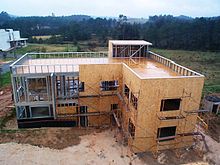
OSB is used in housing construction.

Manufacturing
Oriented strand board is manufactured in wide mats from cross-oriented layers of thin, rectangular wooden strips compressed and bonded together with wax and synthetic resin adhesives (95% wood, 5% wax and resin). The resin types typically used include Phenol formaldehyde (PF), melamine fortified Urea Formaldehyde (MUF) or isocyanate (PMDI), all of which are moisture resistant binders. In Europe, it is common to use a combination of binders, typically PMDI would be used in the core and MUF in the face layers and this has the advantage of reducing press cycles whilst imparting a bright appearance to the surface of the panel.
OSB in production before gluing in a thermal press
The layers are created by shredding the wood into strips, which are sifted and then oriented on a belt or wire cauls. The mat is made in a forming line. Wood strips on the external layers are aligned to the panel's strength axis, while internal layers are perpendicular. The number of layers placed is determined partly by the thickness of the panel but is limited by the equipment installed at the manufacturing site. Individual layers can also vary in thickness to give different finished panel thicknesses (typically, a 15 cm layer will produce a 15 mm panel thickness). The mat is placed in a thermal press to compress the flakes and bond them by heat activation and curing of the resin that has been coated on the flakes. Individual panels are then cut from the mats into finished sizes. Most of the world's OSB is made in the United States and Canada in large production facilities. The largest production facilities can make over 1,000,000 square feet (93,000 square metres) of OSB per day.
Related Products

Materials other than wood have been used to produce products similar to oriented strand board. Oriented structural straw board is an engineered board that is made by splitting straw and formed by adding P-MDI adhesives and then hot compressing layers of straw in specific orientations. Strand board can also be made from bagasse.

Properties
Adjustments to the manufacturing process can impart differences in thickness, panel size, strength, and rigidity. OSB panels have no internal gaps or voids, and are water-resistant, although they do require additional membranes to achieve impermeability to water and are not recommended for exterior use. The finished product has properties similar to plywood, but is uniform and cheaper. When tested to failure, OSB has a greater load-bearing capacity than milled wood panels. It has replaced plywood in many environments, especially the North American structural panel market.
OSB, closeup of corner
While OSB does not have a continuous grain like a natural wood, it does have an axis along which its strength is greatest. This can be seen by observing the alignment of the surface wood chips.
All wood-based structural use panels can be cut and installed with the same ease and types of equipment used with solid wood.
Safety and Health
The resins used to create OSB have raised questions regarding the potential for OSB to emit volatile organic compounds (VOCs) such as formaldehyde. Urea-formaldehyde is more toxic and should be avoided in anything you put in your home. Phenol-formaldehyde products are considered to be relatively hazard-free. Some newer types of OSB, so-called "New-generation" OSB panels, use isocyanate resins that do not contain formaldehyde and are considered non-volatile when cured. Industry trade groups assert that formaldehyde emissions from North American OSB are "negligible or nonexistent".
Some manufacturers treat the wood chips with various borate compounds which are toxic to termites, wood boring beetles, molds, and fungi, but not mammals in applied doses.
Types
Four grades of OSB are defined in EN 300 in terms of their mechanical performance and relative resistance to moisture:
  • OSB/1 – General purpose boards and boards for interior fitments (including furniture) for use in dry conditions
  • OSB/2 – Load-bearing boards for use in dry conditions
  • OSB/3 – Load-bearing boards for use in humid conditions
  • OSB/4 – Heavy-duty load-bearing boards for use in humid conditions

- Wikipedia 

MEDIUM DENSITY FIBERBOARDS

Medium-density fiberboard (MDF) is an engineered wood product made by breaking down hardwood or softwood residuals into wood fibres, often in a defibrator, combining it with wax and a resin binder, and forming panels by applying high temperature and pressure. MDF is generally denser than plywood. It is made up of separated fibres, but can be used as a building material similar in application to plywood. It is stronger and much denser than particle board.


A sample of MDF

The name derives from the distinction in densities of fiberboard. Large-scale production of MDF began in the 1980s, in both North America and Europe.

Physical Properties

Over time, the term MDF has become a generic name for any dry process fibre board. MDF is typically made up of 82% wood fibre, 9% urea-formaldehyde resin glue, 8% water and 1% paraffin wax and the density is typically between 500 kg/m3 (31 lb/ft3) and 1,000 kg/m3 (62 lb/ft3). The range of density and classification as lightstandard, or highdensity board is a misnomer and confusing. The density of the board, when evaluated in relation to the density of the fibre that goes into making the panel, is important. A thick MDF panel at a density of 700–720 kg/m3 may be considered as high density in the case of softwood fibre panels, whereas a panel of the same density made of hard wood fibres is not regarded as so. The evolution of the various types of MDF has been driven by differing need for specific applications.

Manufacture
In Australia and New Zealand, the main species of tree used for MDF is plantation-grown radiata pine; but a variety of other products have also been used, including other woods, waste paper and fibres.
The trees are debarked after being cut. The bark can be sold for use in landscaping or burned in on-site furnaces. The debarked logs are sent to the MDF plant, where they go through the chipping process. A typical disk chipper contains 4–16 blades. Any resulting chips that are too large may be re-chipped; undersized chips may be used as fuel. The chips are then washed and checked for defects.
The chips are then compacted using a screw feeder, are heated/steamed for 30–120 seconds to soften the wood, then joined with liquefied wax and fed into a defibrator. The defibrator maintains a high pressure and temperature while grinding the wood chips into a pulp.
From the defibrator, the pulp enters a blowline, where it is joined with resin, often urea-formaldehyde. The wax improves moisture resistance and the resin initially helps reduce clumping, but ultimately is the primary binding agent. The material dries quickly when it enters an expansion chamber and expands into a fine, fluffy and lightweight fibre that is stored until needed at the forming line.
Dry fibre gets sucked into the top of a pendistor, which evenly distributes fibre into a uniform mat below it, usually of 230–610 mm thickness. The mat is pre-compressed and either sent straight to a continuous hot press or cut into large sheets for a multi-opening hot press. The hot press activates the bonding resin and sets the strength and density profile.
After pressing, MDF is cooled in a star dryer or cooling carousel, trimmed and sanded. In certain applications, boards are also laminated for extra strength.
The Environmental Impact of MDF has greatly improved over the years. Today, many MDF boards are made from a variety of materials. These include other woods, scrap, recycled paper, bamboo, carbon fibres and polymers, forest thinning and sawmill off-cuts.
As manufacturers are being pressured to come up with greener products, they have started testing and using non-toxic binders. New raw materials are being introduced. Straw and bamboo are becoming popular fibres because they are a fast-growing renewable resource.

Comparisons with natural woods

MDF does not contain knots or rings, making it more uniform than natural woods during cutting and in service. However, MDF is not entirely isotropic, since the fibres are pressed tightly together through the sheet. Typical MDF has a hard, flat, smooth surface that makes it ideal for veneering, as there is no underlying grain to telegraph through the thin veneer as with plywood. A so-called "Premium" MDF is available that features more uniform density throughout the thickness of the panel.
MDF may be glued, doweled or laminated. Typical fasteners are T-nuts and pan-head machine screws. Smooth-shank nails do not hold well, and neither do fine-pitch screws, especially in the edge. Special screws are available with a coarse thread pitch, but sheet-metal screws also work well. Like natural wood, MDF may split when wood screws are installed without pilot holes.
Benefits

  • Is an excellent substrate for veneers.
  • Some varieties are less expensive than many natural woods
  • Isotropic (its properties are the same in all directions as a result of no grain), so no tendency to split
  • Consistent in strength and size
  • Shapes well.
  • Stable dimensions (won't expand or contract like wood)
  • Easy to finish (i.e., paint)

Drawbacks

  • Denser than plywood or chipboard (the resins are heavy)
  • Low grade MDF may swell and break when saturated with water.
  • May warp or expand if not sealed.
  • May release formaldehyde, which is a "known human carcinogen" and may cause allergy, eye and lung irritation when cutting and sanding associated with nasal sinus cancer and nasopharyngeal cancer, and possibly with leukaemia in June 2004.
  • Dulls blades more quickly than many woods
  • Though it does not have a grain in the plane of the board, it does have one into the board. Screwing into the edge of a board will generally cause it to split in a fashion similar to delaminating.
  • Subject to significant shrinkage in low humidity environments.
  • Trim (i.e. baseboards) comes pre-primed, but this is insufficient for fine finish painting. Painting with latex paints is difficult due to rapid water absorption. Most finishes appear uneven and nail holes tend to pucker.

Applications

MDF is often used in school projects because of its flexibility. Slatwall Panels made from MDF are used in the shop fitting industry.

Safety Concerns
When MDF is cut, a large quantity of dust particles are released into the air. It is important that a respirator is worn and that the material is cut in a controlled and ventilated environment. It is a good practice to seal the exposed edges to limit the emissions from the binders contained in this material.
Formaldehyde resins are commonly used to bind together the fibres in MDF, and testing has consistently revealed that MDF products emit free formaldehyde and other volatile organic compounds that pose health risks at concentrations considered unsafe, for at least several months after manufacture. Urea-formaldehyde is always being slowly released from the edges and surface of MDF. When painting, it is a good idea to coat all sides of the finished piece in order to seal in the free formaldehyde. Wax and oil finishes may be used as finishes but they are less effective at sealing in the free formaldehyde.
Whether these constant emissions of formaldehyde reach harmful levels in real-world environments is not yet fully determined. The primary concern is for the industries using formaldehyde. As far back as 1987, the U.S. EPA classified it as a "probable human carcinogen" and, after more studies, the WHO International Agency for Research on Cancer (IARC), in 1995, also classified it as a "probable human carcinogen". Further information and evaluation of all known data led the IARC to reclassify formaldehyde as a "known human carcinogen" associated with nasal sinus cancer and nasopharyngeal cancer, and possibly with leukaemia in June 2004.

Veneer MDF

Veneered MDF provides many of the advantages of MDF with a decorative wood veneer surface layer. In modern construction, spurred by the high costs of hardwoods, manufacturers have been adopting this approach to achieve a high quality finishing wrap covering over a standard MDF board. One common type uses oak veneer.  Making veneered MDF is a complex procedure, which involves taking an extremely thin slice of hardwood (approx 1-2mm thick) and then through high pressure and stretching methods wrapping them around the profiled MDF boards. This is only possible with very simple profiles because otherwise when the thin wood layer has dried out, it will break at the point of bends and angles.

- Wikipedia 

PLYWOOD

Plywood is a sheet material manufactured from thin layers or "plies" of wood veneer that are glued together with adjacent layers having their wood grain rotated up to 90 degrees to one another. It is an engineered wood from the family of manufactured boards which includes medium-density fiberboard (MDF) and particle board (chipboard).


Softwood plywood made from spruce.

All plywoods bind resin and wood fibre sheets (cellulose cells are long, strong and thin) to form a composite material. This alternation of the grain is called cross-graining and has several important benefits: it reduces the tendency of wood to split when nailed at the edges; it reduces expansion and shrinkage, providing improved dimensional stability; and it makes the strength of the panel consistent across all directions. There is usually an odd number of plies, so that the sheet is balanced—this reduces warping. Because plywood is bonded with grains running against one another and with an odd number of composite parts, it is very hard to bend it perpendicular to the grain direction of the surface ply.

Structural Characteristic

A typical plywood panel has face veneers of a higher grade than the core veneers. The principal function of the core layers is to increase the separation between the outer layers where the bending stresses are highest, thus increasing the panel's resistance to bending . As a result, thicker panels can span greater distances under the same loads. In bending, the maximum stress occurs in the outermost layers, one in tension, the other in compression. Bending stress decreases from the maximum at the face layers to nearly zero at the central layer. Shear stress, by contrast, is higher in the center of the panel, and zero at the outer fibers.

Types

Different varieties of plywood exist for different applications:


Average-quality plywood with 'show veneer'

Softwood Plywood
Softwood panel is usually made either of cedar , Douglas fir or spruce, pine and fir (collectively known as spruce-pine-fir or SPF) or redwood and is typically used for construction and industrial purposes.
Birch plywood
The most common dimension is 1.2 by 2.4 metres (3 ft 11 in × 7 ft 10 in) or the slightly larger imperial dimension of 4 feet × 8 feet. Plies vary in thickness from 1.4 mm to 4.3 mm. The number of plies depends on the thickness and grade of the sheet but at least three are required as the minimum odd number of plies. Roofing can use the thinner 5/8" (15 mm) plywood. Sub floors are at least 3/4" (18 mm) thick, the thickness depending on the distance between floor joists. Plywood for flooring applications is often tongue and groove. This prevents one board from moving up or down relative to its neighbor, so providing a solid feeling floor when the joints do not lie over joists. T&G plywood is usually found in the 1/2" to 1" (12–25 mm) range.
High-quality concrete pouring plate in plywood
Hardwood Plywood

Hardwood plywood is made out of wood from angiosperm trees and used for demanding end uses. Hardwood plywood is characterized by its excellent strength, stiffness and resistance to creep. It has a high planar shear strength and impact resistance, which make it especially suitable for heavy-duty floor and wall structures. Oriented plywood construction has a high wheel-carrying capacity. Hardwood plywood has excellent surface hardness, and damage- and wear-resistance

Tropical Plywood

Tropical plywood is made of mixed species of tropical wood. Originally from the Asian region, it is now also manufactured in African and South American countries. Tropical plywood is superior to softwood plywood due to its density, strength, evenness of layers, and high quality. It is usually sold at a premium in many markets if manufactured with high standards. Tropical plywood is widely used in the UK, Japan, United States, Taiwan, Korea, Dubai, and other countries worldwide. It is the preferred choice for construction purposes in many regions due to its low cost. However, many countries’ forests have been over-harvested, including the Philippines, Malaysia and Indonesia, largely due to the demand for plywood production and export.

Aircraft Plywood
High-strength plywood also known as aircraft plywood, is made from mahogany and/or birch, and uses adhesives with increased resistance to heat and humidity. It was used for several World War II fighter aircraft. Although the British-built Mosquito, bomber, nicknamed "The Wooden Wonder", was constructed of a plywood monocoque, this was formed in moulds from individual veneers of birch, balsa and birch, rather than machined from pre-laminated plywood sheets.
Structural aircraft-grade plywood is more commonly manufactured from African mahogany or American birch veneers that are bonded together in a hot press over hardwood cores of basswood or poplar or from European Birch veneers throughout. Basswood is another type of aviation-grade plywood that is lighter and more flexible than mahogany and birch plywood but has slightly less structural strength. Aviation-grade plywood is manufactured to a number of specifications including those outlined since 1931 in the Germanischer Lloyd Rules for Surveying and Testing of Plywood for Aircraft and MIL-P-607, the latter of which calls for shear testing after immersion in boiling water for three hours to verify the adhesive qualities between the plies and meets specifications.
Decorative Plywood ( overlaid plywood)

Usually faced with hardwood, including ash, oak, red oak, birch, maple, mahogany, Philippine mahogany (often called lauan, luan or meranti and having no relation to true mahogany), rosewood, teak and a large number of other hardwoods.

Flexible Plywood
Flexible plywood is designed for making curved parts, a practice which dates back to the 1850s in furniture making.
Aircraft grade plywood, often Baltic birch, is made from 3 plies of birch, as thin as 1/16" thick in total, and is extremely strong and light. At 3/8" thick, mahogany 3-ply "wiggle Board" or "Bendy Board" come in 4' x 8' sheets with a very thin cross grain central ply and two thicker exterior plies, either long grain on the sheet, or cross grain. Wiggle board is often glued together in two layers once it is formed into the desired curve, so that the final shape will be stiff and resist movement. Often, decorative wood veneers are added as a surface layer.
In the UK single ply sheets of veneer were used to make stovepipe hats in Victorian times, so flexible modern plywood is sometimes known there as "Hatters Ply", although the original material was not strictly plywood, but a single sheet of veneer.
Marine Plywood

Marine plywood is manufactured from durable face and core veneers, with few defects so it performs longer in both humid and wet conditions and resists delaminating and fungal attack. Its construction is such that it can be used in environments where it is exposed to moisture for long periods. More recently, tropical producers have become dominant in the marine plywood market. Okoumé from Gabon is now the accepted  standard for marine plywood, even though the wood is not very resistant to rot and decay. Each wood veneer will be from tropical hardwoods, have negligible core gap, limiting the chance of trapping water in the plywood and hence providing a solid and stable glue bond. It uses an exterior Water and Boil Proof (WBP) glue similar to most exterior plywoods.
Marine plywood can be graded as being compliant with BS 1088 , which is a British Standard for marine plywood. There are few international standards for grading marine plywood and most of the standards are voluntary. Some marine plywood has a Lloyd's of London stamp that certifies it to be BS 1088 compliant. Some plywood is also labeled based on the wood used to manufacture it. Examples of this are Okoumé or Meranti.
Marine plywood is frequently used in the construction of docks and boats. It is much more expensive than standard plywood: the cost for a typical 4-foot by 8-foot 1/2-inch thick board is roughly $125 U.S. or around $3.50 per square foot, which is two to three times as expensive as standard plywood, depending on grade.

Other Plywoods

Other types of plywoods include fire-retardant, moisture-resistant, wire mesh, sign-grade, and pressure-treated. However, the plywood may be treated with various chemicals to improve the plywood's fireproofing. Each of these products is designed to fill a need in industry.

Production
Plywood production requires a good log, called a peeler, which is generally straighter and larger in diameter than one required for processing into dimensioned lumber by a sawmill. The log is laid horizontally and rotated about its long axis while a long blade is pressed into it, causing a thin layer of wood to peel off (much as a continuous sheet of paper from a roll). An adjustable nosebar, which may be solid or a roller, is pressed against the log during rotation, to create a "gap" for veneer to pass through between the knife and the nosebar. The nosebar partly compresses the wood as it is peeled; it controls vibration of the peeling knife; and assists in keeping the veneer being peeled to an accurate thickness. In this way the log is peeled into sheets of veneer, which are then cut to the desired oversize dimensions, to allow it to shrink (depending on wood species) when dried. The sheets are then patched, graded, glued together and then baked in a press at a temperature of at least 140 °C (284 °F), and at a pressure of up to 1.9 MPa (280 psi) (but more commonly 200 psi) to form the plywood panel. The panel can then be patched, have minor surface defects such as splits or small knot holes filled, re-sized, sanded or otherwise refinished, depending on the market for which it is intended.
Plywood for indoor use generally uses the less expensive urea-formaldehyde glue, which has limited water resistance, while outdoor and marine-grade plywood are designed to withstand moisture, and use a water resistant phenol-formaldehyde glue to prevent delamination and to retain strength in high humidity.
Anti fungal additives such as Xyligen may sometimes be added to the glueline to provide added resistance to fungal attack.
The adhesives used in plywood have become a point of concern. Both urea formaldehyde and phenol formaldehyde are carcinogenic in very high concentrations. As a result, many manufacturers are turning to low formaldehyde-emitting glue systems, denoted by an "E" rating ("E0" possessing the lowest formaldehyde emissions). Plywood produced to "E0" has effectively zero formaldehyde emissions.
In addition to the glues being brought to the forefront, the wood resources themselves are becoming the focus of manufacturers, due in part to energy conservation, as well as concern for natural resources. There are several certifications available to manufacturers who participate in these programs. Programme for the Endorsement of Forest Certification(PEFC) Forest Stewardship Council (FSC), Leadership in Energy and Environmental Design(LEED), Sustainable Forestry Initiative (SFI), and Greenguard are all certification programs that ensure that production and construction practices are sustainable. Many of these programs offer tax benefits to both the manufacturer and the end user.
Grades

Grading rules differ according to the country of origin. Most popular standard is the British Standard (BS) and American Standard (ASTM). Joyce (1970), however, list some general indication of grading rules:
GradeDescription
AFace and back veneers practically free from all defects.
A/BFace veneers practically free from all defects. Reverse veneers with only a few small knots or discolorations.
A/BBFace as A but reverse side permitting jointed veneers, large knots, plugs, etc.
BBoth side veneers with only a few small knots or discolorations.
B/BBFace veneers with only a few small knots or discolorations. Reverse side permitting jointed veneers, large knots, plugs, etc.
BBBoth sides permitting jointed veneers, large knots, plugs, etc.
C/DFor structural plywood, this grade means that the face has knots and defects filled in and the reverse may have some that are not filled. Neither face is an appearance grade, nor are they sanded smooth. This grade is often used for sheathing the surfaces of a building prior to being covered with another product like flooring, siding, concrete, or roofing materials.
WGGuaranteed well glued only. All broken knots plugged.
XKnots, knotholes, cracks, and all other defects permitted.
WBPWeather and Boil Proof used in Marine Ply. Designation replaced by EN 314-3.
JPIC Standards
GradeDescription
BB/CCFace as BB, back as CC. BB as very little knots of less than 1/4 inches, slight discoloration, no decay, split and wormholes mended skillfully, matched colors, no blister, no wrinkle. Most popular choice for most applications.
Applications

Plywood is used in many applications that need high-quality, high-strength sheet material. Quality in this context means resistance to cracking, breaking, shrinkage, twisting and warping.
Exterior glued plywood is suitable for outdoor use, but because moisture affects the strength of wood, optimal performance is achieved in end uses where the wood's moisture content remains relatively low. On the other hand, subzero conditions don't affect plywood's dimensional or strength properties, which makes some special applications possible.
Plywood is also used as an engineering material for stressed-skin applications. It has been used for marine and aviation applications since WWII. Most notable is the British de Havilland Mosquito bomber, which was primarily made using a moulded sandwich of two layers of birch plywood around a balsa core. Plywood was also used for the hulls in the hard-chine Motor Torpedo Boats (MTB) and Motor Gun Boats (MGB) built by the British Power Boat Company and Vosper's. Plywood is currently successfully used in stressed-skin applications. The American designers Charles and Ray Eames are known for their plywood-based furniture, as is Finnish Architect Alvar Aalto and his firm Artek, while Phil Bolger has designed a wide range of boats built primarily of plywood. Jack Köper of Cape Town designed the plywood Dabchick sailing dinghy, which as of 2015 is still sailed by large numbers of teenagers.
Plywood is often used to create curved surfaces because it can easily bend with the grain. Skateboard ramps often utilize plywood as the top smooth surface over bent curves to create transition that can simulate the shapes of ocean waves.

Softwood plywood Application Edit

Typical end uses of spruce plywood are:
  • Floors, walls and roofs in home constructions
  • Wind bracing panels
  • Vehicle internal body work
  • Packages and boxes
  • Fencing
There are coating solutions available that mask the prominent grain structure of spruce plywood. For these coated plywoods there are some end uses where reasonable strength is needed but the lightness of spruce is a benefit e.g.:
  • Concrete shuttering panels
  • Ready-to-paint surfaces for constructions

Hardwood and Plywood Application

Phenolic resin film coated (Film Faced) plywood is typically used as a ready-to-install component e.g.:
  • Panels in concrete form work systems
  • Floors, walls and roofs in transport vehicles
  • Container floors
  • Floors subjected to heavy wear in various buildings and factories
  • Scaffolding materials
("Wire" or other styles of imprinting available for better traction)
Birch plywood is used as a structural material in special applications e.g.:
  • Wind turbine blades
  • Insulation boxes for liquefied natural gas (LNG) carriers

Smooth surface and accurate thickness combined with the durability of the material makes birch plywood a favorable material for many special end uses e.g.:
  • High-end loud speakers
  • Die-cutting boards
  • Supporting structure for parquet
  • Playground equipment
  • Furniture
  • Signs and fences for demanding outdoor advertising
  • Musical instruments
  • Sports equipment

Tropical Plywood Application 
Tropical plywood is widely available from the South-East Asia region, mainly from Malaysia and Indonesia. Tropical plywood boasts premium quality, and strength. Depending on machinery, tropical plywood can be made with high accuracy in thickness, and is a highly preferable choice in America, Japan, Middle East, Korea, and other regions around the world.
  • Common plywood
  • Concrete panel
  • Floor base
  • Structure panel
  • Container flooring
  • Lamin board
  • Laminated veneer lumber (LVL)

Coconut Oil for Acne - The Right Choice for Problem Skin

Coconut oil is not just tasty. It has anti-parasitic, antibacterial and anti-fungal properties. Due to its numerous benefits, coconut oil considered one of the most wholesome base oils. Though most people use it for cooking, do not hesitate using it outside your kitchen. It is an awesome cosmetic product that can do wonders to your skin. Regular usage of coconut oil will make your skin healthier and will help eliminate a number of skin disorders. Indeed, it is a miraculous remedy for people suffering from various skin conditions, including acne. Let`s examine how coconut oil can help cure acne.

How to Choose the Right Coconut Oil?
Before we start discussing how coconut oil can prevent and treat acne, it is crucial to determine what kind of coconut oil to choose. If you intend using coconut oil for facial skin care, always opt for organic, unrefined extra virgin oil. The main aim here is to treat your skin with the original, untouched oil derived from the coconut flesh. This is the only way to get all benefits of this base oil.

Unlike most natural oils we use for cooking and skin care, coconut oil comes in the solid from and looks more like a butter than oil. Thus, before applying it to the face, make sure you melt it.

Does Coconut Oil Clog Pores?

coconut oil for acne

Many people suffering from acne avoid using base oils, as they believe oils will clog pores and make breakouts even worse. This is not true. Coconut oil has amassing antibacterial properties and therefore is an excellent remedy for the acne prone skin. However, to get the desired result and avoid undesired after- effects, the oil should be used in moderation. There is no need rubbing tons of oil into your face. Otherwise, you may get the reverse effect - greasy skin and clogged pores. When used wisely, this base oil can work wonders for your acne prone skin.

How Coconut Oil Can Cure Acne?
Organic coconut oil contains two essential elements - capric and lauric acid which makes it a good remedy for treating acne. Lauric acid is known for its antibacterial properties and is extremely effective against various bacteria, including bacteria causing acne. This is why coconut oil is widely used as a natural remedy for acne. Lauric acid is also found in breast milk, which means it can be produced in the human body and therefore is easily recognized by the body and is ideal for skin treatment. At the same time, coconut oil is rich in proteins and vitamin E. These components boost cellular function and promote skin renewal. All of this proves that you can use this coconut oil for acne scars treatment.

How to Use Coconut Oil for Acne Treatment?
Now that we have discovered all benefits of coconut oil for acne treatment, it is time to discuss how to use it to avail all these benefits and relieve your skin from acne. The treatment starts with the purchase of organic extra virgin coconut oil. This base oil is available online and in most grocery stores.

As mentioned before, coconut oil comes in solid form. Take a small amount of oil (about the size of a pea) and hold it between fingers until it dissolves and gets liquid. Do not use too much, as the excessive amount of oil can clog your pores. Once the oil is dissolved, apply it to your face and neck area. Apply the oil in circular motions. Coconut oil is quickly absorbed by the skin and will not leave greasy appearance.

Coconut oil is really amazing. It is affordable and effective and can make wonders to your skin. When applied regularly and wisely, it will make your skin clean and glowing.

- www.coconut-info.net

Coconut Oil for Eczema - Learn Many Different Ways of Treatment

Unfortunately, nowadays more and more people suffer from itchy rashes on skin, which may be scaly, red, leathery or dry. Such an inflammation on the skin is known to be eczema. There are numerous reasons for eczema and many different ways of treatment. But before treating eczema you should know for sure what causes it. Unless you determine what caused it, the disease will remind itself again and again. Generally, some components of perfume, some metals used in jewelry, some chemicals used in cosmetics as well as fabric softeners, latex balloons, bandages and gloves cause eczema in many cases.

So when you determined the root cause of your disease and prevented your skin from contacting it, you can start treatment. Certainly, only professional dermatologist may consult you and prescribe special hydrating chemical products for affected and inflammated skin.

How to Use Coconut Oil for Eczema
Human`s immune system is able to overcome the disease by itself, but still that may take too long time and even more: eczema may leave scarring. So it is evident that the disease requires special treatment. The majority of people who suffered eczema completely agree that organic coconut oil for eczema is the best thing to relieve the symptoms. It both stops the flaking and itching, and prevents you from suffering it again. That is possible, of course, if you stop contacting the things that provoke eczema. The great benefit is that coconut oil can be applied together with the medical hydrators that your doctor prescribed you. And those who used these products together really noted amazing results.

Coconut Oil for Eczema

Normally, you need to apply some oil directly on the affected area and put a loose bandage over it. But don`t forget to give your skin access to fresh air and to sunlight. For people suffering from severe eczema, coconut oil can be used as well. Furthermore, coconut oil is being applied for babies who suffer eczema. It is recommended to apply oil for the affected skin area three or four times a day and before sleep.

The main thing you should keep in mind: make sure that the oil you bought is a real virgin organic coconut oil. It has to be pure, without any added chemicals and odorants. Taking into account that the product is 100% natural, you can use it not only externally but internally as well. You can take it in pure form or add to drinks, it won`t provoke weight gain

Positive Side Effects that Coconut Oil Provide Your Body With
Strengthens Immune System - coconut oil will help you to prevent catching colds and viruses in cold weather.

Detoxifies your Body - coconut oil cleanse the body from various impurities and toxins. As a result result you get a well-balanced digestive system.

Dissolve Kidney Stones - coconut oil break kindey stones down and reduces likelihood of emerging problems in your kidney and gallbladder.

Heals Bruises Faster - the tissue that is underneath your bruise end up getting repaired at a faster rate.
So both scientific researches and people`s reviews show that using coconut oil for eczema shows good results. Moreover, in theory it is really perfect: it both moisturizes the damaged skin and kills off microbial infections. But there exist individual cases when coconut oil should not be used. In order to find out if it is appropriate for you, apply it on a small skin area and wait for half an hour. If there doesn`t appear any irritation you can apply it on larger areas.

- www.coconut-info.net

What Is Coconut Oil Good For - Exploring Coconut Oil Uses

Not every food is proud to hold the title of the "superfood". Indeed, the list of superfoods is quite short and one of the most notable products in this list is coconut oil. This natural oil is known for its unique combination of fatty acids that have amazing health benefits.

What is coconut oil good for? This short article will help you discover the main health benefits of this natural oil.

Unique combination of fatty acids contained in coco oil has amazing medical properties. It is rich in saturated fats which help improve immune system, increase metabolic rate and energy level. Do not be afraid of saturated fats, as not all of them are harmful. Contrary to a popular belief, saturated fats can be very wholesome.

Saturated fats found in coco oil have nothing in common with fats found in products like steak or cheese. These are Medium Chain Triglycerides or simply said, fatty acids of a medium length. What is the difference between long and medium chain fatty acids? The difference is huge and substantial. These two types of fatty acids are metabolized differently and therefore have different effects on the body.

Medium chain fatty acids are the quickest source of energy for your body. They are quickly digested by the body and are never stored as unwanted body fat. Besides, they help prevent the development of several brain disorders.

Coconut oil is rich in vitamins and minerals. It has powerful antibacterial, antiviral and antifungal properties and can fight a number of diseases, including influenza and colds. Besides, regular consumption of coconut oil helps prevent the development severe diseases including diabetes, cardiovascular diseases and several types of cancer. The latest scientific researches show that populations that consume lots of coconuts are the healthiest people on earth. Many of them do not even know about the existence of heart diseases.

Coconut Oil Uses

Coconut oil helps fight with obesity. This is a magic effect of medium chain fatty acids processing, which is followed by the increase of energy expenditure. The more energy the body burns during the day, the more fat is burnt. Do not forget about healthy diet and sport, however.

Coconut oil has excellent moisturizing effect. It suits all types of skin and hair and helps avoid a number of skin and hair problems. It helps get rid of acne, moisturizes dry skin and decreases greasiness of skin. Moreover, this natural oil is known for its anti-aging effect, which means it prevents the appearance of early wrinkles.

Hair will also benefit from coconut oil treatment. Coco oil helps eliminate the problem of dry scalp and dandruff, nourishes hair roots, stops hair loss and also helps fight with split ends. Regular usage of coconut oil will increase hair growth and will make your hair soft, silky and healthy.
Now let's talk about coconut oil uses.

First of all, it is a perfect substitute to butter and sunflower oil and therefore can be used in cooking and baking. Just dress the salad with a small amount of coconut oil and your body will get necessary amount of nutrients.

When it comes to hair and skin treatment, coco oil can be applied directly on skin or hair. You can apply it alone, or with the addition of essential oils and other natural ingredient, like egg-yolk or honey. Saying short, it is a perfect base for homemade masks.

Indeed, uses of coconut oil, as well as its benefits are numerous and diverse. However, to avail all these benefits you need to know what oil to choose. Always opt for organic extra virgin oil. Forget about refined staff, because it is not able to provide health benefits you need.

- www.coconut-info.net

Advantages and Disadvantages of Fasting for Runners

Author BY   ANDREA CESPEDES  Food is fuel, especially for serious runners who need a lot of energy. It may seem counterintuiti...