Blog List

Saturday, 27 February 2016

How to Cut Out Gluten

Gluten is a protein found in some grains, such as rye, barely, wheat and semolina. In people with celiac disease, gluten causes inflammation in the small intestine that damages the digestive tract and interferes with nutrient absorption. Other people may be unable to consume gluten due to an intolerance or allergy to the protein. Although you can cut out most gluten by avoiding all foods that contain rye, barley and wheat, gluten is present in small amounts in a large number of foods. To completely eliminate gluten from your diet, you'll need to work with a nutritionist to create a list of all foods with gluten.


How to Cut Out Gluten

A salmon sandwich. Photo Credit Lisovskaya/iStock/Getty Images

Step 1

Read labels carefully when shopping and before eating, and stick to foods that claim to have been manufactured in a dedicated gluten-free facility. Gluten is often hidden in the ingredients list, and some foods that do not directly contain gluten may have been produced in a factory that makes wheat products. Some food additives also contain the protein. Ingredients to avoid include barley, spelt, malt, teriyaki sauce, soy sauce, MSG, vegetable protein, smoke flavors, artificial colors, caramel color and hydrolyzed plant protein. You should also avoid spice mixes, seasonings and gravies unless they are labeled gluten-free.

Step 2

Choose baking flour with a "gluten-free" label. Many types of bread, waffle and muffin mixes, pizza crusts and other foods are available without gluten.

Step 4

Cook with gluten-free pasta. Many specialty and whole food stores carry pastas made from amaranth, corn, quinoa and rice.

Step 5

Eliminate processed foods, breaded meats, ready-to-eat cereals and multiple ingredient products from your diet. Many of these contain gluten. Even frozen meats, such as chicken breasts or turkey, may have gluten in a solution they are injected with.

Step 6

Choose single ingredient foods whenever possible, such as whole fruits, vegetables, fish, lean meat, rice and potatoes.

Step 7

Watch out for non-food sources of gluten. Some lipsticks, toothpastes and medications contain gluten. According to the Gluten Free Society's website, many vitamin supplements are made with grain bases and should be avoided unless they specifically say they are gluten free.

Coconut Cholesterol

Coconuts are included in the classification of fruits. They are mainly drupes, which are simply fruits that contain a fibrous shell, which is hard around the seed of the fruit. Some other drupes include mangoes, olives and peaches. Although coconuts are a fruit, you would see that coconuts are quite in fatty substances, primarily saturated fat. Nevertheless, you should remember that just because they contain fat, they are not necessarily good for you.

Cholesterol
You should understand the composition of raw coconut, which will help you determine whether they actually contain. One cup of raw coconut tends to contain around 28 g of fat. A tablespoon of coconut oil contains around 13.6 g of fat. Coconut oil and flesh does not contain cholesterol, but the shred contain contains some saturated fat. Cholesterol in coconut is not contained. Therefore, those diets that have high amounts of saturated fat tend to increase the risk for a huge number of heart diseases. Therefore, never exceed the 10 percent of calorie intake for saturated fats, especially if you have a cholesterol problem.

Despite this, remember that the different types of coconut products can actually help decrease cholesterol. These include coconut flakes, which actually help decrease the cholesterol levels in those people who have high cholesterol. Coconut flakes are manufactured through coconut flower, which have both soluble and insoluble fiber, which may actually decrease cholesterol levels.

coconut cholesterol

In India, it has been found out that virgin coconut oil can actually decrease the cholesterol. When people consumed coconut oil, they actually had their cholesterol level lowered. There are of course, certain kinds of good and bad cholesterol level, and coconut oil and other products actually increased the good cholesterol levels. These are known as HDL. Even though virgin oil also has huge number of unsaturated fats, there has been enough evidence to prove that it is not that high in bad cholesterol.

You should also remember that coconut oil actually raises HDL more than it increases LDL, so in a way it actually is able to make your cholesterol ratio better. However, remember that it does depend upon how your doctor has determined your cholesterol ratio, in order to determine the risk for any kind of heart disease. Therefore, while coconut oil is high in cholesterol, it may actually provide you more good than harm.

Furthermore, remember that coconut oil has always been proved to be better than trans fats and butter, so in that regard, this may be a better option for your needs. However, you should also understand that it is not as good as liquid vegetable oils, which actually proves to be much better. However, it has also been found by different doctors than it would prove to be a better alternative than animal fats.

Since it is saturated fats, you need to understand that this should be limited in your diets, so make sure that if you want some extremely healthy benefits to your diet, you should switch to unsaturated fats from saturated fats. You also need to understand that the LDL (bad cholesterol) is also increased through this product, which means that you should always take care of the different products that you consume, especially if you have a risk of coronary heart disease. There is substantial debate over this issue, which has not come up to any agreement.

Conclusion
So, when there is no agreement in the medical field over this, you may be stumped as to what you should do. Do not worry first of all, and go to your doctor. The doctor will be able to tell you the right kind of amount that you should be consuming, if there is a risk of heart disease.

- www.coconut-info.net

Can You Eat Sliced American Cheese on a Gluten-Free Diet?

Gluten is a protein found in certain grains like wheat, barely and rye. People with celiac disease or gluten sensitivity have to be careful to avoid all gluten in foods, especially those with "hidden" gluten. It is easy to find foods containing wheat by reading ingredients labels; however, many additives in processed foods may contain gluten from sources other than wheat.

Can You Eat Sliced American Cheese on a Gluten-Free Diet?

Label reading is an essential skill for those needing to avoiding gluten. Photo Credit Creatas Images/Creatas/Getty Images


Gluten in Cheese

Natural aged cheeses made from real milk are usually gluten-free; however, some processed cheeses may contain gluten. American cheese is generally gluten-free, according to the Jackson Siegelbaum Gastroenterology website. Still, you should always check the ingredients label of the particular cheese you are purchasing. Avoid cheeses with vegetable gum or food starch, which are likely to contain gluten. Also, check the label for preservatives that are not defined as a gluten-free sources. If you are unsure whether a product contains gluten, check the manufacturer's website for additional information.
www.livestrong.com

List of Foods With Gluten in Them


List of Foods With Gluten in Them
Symptoms such as digestive distress, joint pain and headaches will only disappear once all the gluten has been removed from your diet. Photo Credit Jupiterimages/Polka Dot/Getty Images

Gluten intolerance and celiac disease -- an autoimmune reaction to ingesting gluten -- affect millions of Americans. Gluten is a protein found in common grains including wheat and rye, but it can be found in a long list of other cereal grains, along with a number of processed foods. If you are recovering your health from a lifetime of eating gluten, it is extremely important to completely eliminate it from your diet in order to reap the full benefits of going gluten-free.


Grains with Gluten

List of Foods With Gluten in Them
Bread contains wheat which is gluten. Photo Credit Medioimages/Photodisc/Photodisc/Getty Images
Most people are aware that gluten is found in wheat. It is also found in ancient forms of wheat including spelt, kamut and einkorn. Other grains that contain gluten are rye, triticale and barley. Because wheat can go by numerous names, scan food labels for ingredients such as semolina, bulgur, durum flour, farina and bran. Foods that may contain wheat and other glutinous grains include bread, pasta, cakes, candies, beer, matzo, gravy, many sauces -- including soy sauce -- french fries, seasoned snack foods, soup bases, processed lunch meat and salad dressing. Read labels carefully and talk to restaurant staff about gluten-free options.

Gluten-Containing Additives


List of Foods With Gluten in Them
Processed foods can contain additives with gluten. Photo Credit Ryan McVay/Photodisc/Getty Images

There are a number of food additives that contain gluten or may be made from wheat or another problem grain. Processed foods are chock-full of these potential gluten-laden additives, so scan labels thoroughly or simply avoid processed foods. Watch out for malt syrup, caramel color/flavor, artificial color/flavor, stabilizers, enzymes, vegetable protein and vegetable starch -- according to celiac.com, many of these ingredients may be derived from gluten-containing grains, and the only way to know for sure in many cases is to contact the manufacturer. Gluten expert and integrative medicine doctor Amy Myers, M.D., also suggests avoiding citric acid, dextrins, flavorings, glucose syrup and maltodextrin, which may or may not contain gluten.

Cross-Contamination

List of Foods With Gluten in Them
Toasters are a common place for cross-contamination. Photo Credit Jupiterimages/Goodshoot/Getty Images
Another issue to take into account when trying to completely avoid gluten in the issue of cross-contamination -- safe foods can come into contact with gluten anywhere from the manufacturing process to the kitchen. Top culprits for gluten contamination include kitchen equipment such as grill tops and toasters, which can contaminate gluten-free foods easily in the process of preparation. Steamed vegetables in restaurants are often cooked using water leftover from cooking pasta. Some gluten-free grains such as oats and quinoa can become cross-contaminated with gluten in the manufacturing process -- look for certified gluten-free products that are tested for gluten content.

Quick Tips

List of Foods With Gluten in Them
Cooking at home with fresh ingredients is the best way to eliminate gluten.Photo Credit Pixland/Pixland/Getty Images
Preparing meals in your own clean kitchen with whole foods ingredients is the optimal way to eliminate gluten from your diet entirely. There are also a number of restaurants, bakeries, food companies and grain suppliers that now cater to those sensitive to gluten by keeping it out of their kitchens and manufacturing processes. While the list of foods that potentially contain gluten may seem daunting, American culture seems to be catching up with the gluten-free lifestyle by offering more options than ever before.
- www.livestrong.com

LOGGING

Logging is the cutting, skidding, on-site processing, and loading of trees or logs onto trucks or skeleton cars.
In forestry the term logging is sometimes used in a narrow sense concerning the logistics of moving wood from the stump to somewhere outside the forest usually a sawmill or a lumber yard. However, in common usage, the term may be used to indicate a range of forestry or silviculture activities.
A mountain ash (Eucalyptus regnans) being felled using springboards, c. 1884–1917, Australia
Illegal logging refers to what in forestry might be called timber theft by the timber mafia. It can also refer to the harvesting, transportation, purchase, or sale of timber in violation of laws. The harvesting procedure itself may be illegal, including using corrupt means to gain access to forests; extraction without permission or from a protected area; the cutting of protected species; or the extraction of timber in excess of agreed limits.
Clearcut logging is not necessarily considered a type of logging but a harvesting or silviculture method, and is simply called clearcutting or block cutting. In the forest products industry logging companies may be referred to as logging contractors, with the smaller, non-union crews referred to as "gyppo loggers".
Cutting trees with the highest value and leaving those with lower value, often diseased or malformed trees, is referred to as high grading.  It is sometimes called selective logging, and confused with selection cutting, the practice of managing stands by harvesting a proportion of trees.
McGiffert Log Loader in East Texas, USA circa 1907
Logging usually refers to above-ground forestry logging. Submerged forests exist on land that has been flooded by damming to create reservoirs. Such trees are logged using underwater logging or by the lowering of the reservoirs in question. Ootsa Lake and Williston Lake in British Columbia,  Canada are notable examples where timber recovery has been needed to remove inundated forests.

Clear Cutting

Clearcutting, or clearfelling, is a method of harvesting that removes essentially all the standing trees in a selected area. Depending on management objectives, a clearcut may or may not have reserve trees left to attain goals other than regeneration, including wildlife habitat management, mitigation of potential erosion or water quality concerns. Silviculture Objectives for clearcutting, (for example, healthy regeneration of new trees on the site) and a focus on forestry distinguish it from deforestation . Other methods include shelterwood cutting, group selective, single selective, seed-tree cutting patch cut, and retention cutting.


Log transportation

Logging Methods

The above operations can be carried out by different methods, of which the following three are considered industrial methods:


The Washington Iron Works Skidder in Nuniong is the only one of its kind in Australia, with donkey engine, spars, and cables still rigged for work.

Tree-length Logging / Stem only Harvesting (SOH)

Whole-tree Logging (WTL)

Trees and plants are felled and transported to the roadside with top and limbs intact.There have been advancements to the process which now allows a logger or harvester to cut the tree down, top, and delimb a tree in the same process. This ability is due to the advancement in the style felling head that can be used. The trees are then delimbed, topped, and bucked at the landing. This method requires that slash be treated at the landing. In areas with access to cogeneration facilities, the slash can be chipped and used for the production of electricity or heat. 


Logging in Hungary

Full-tree harvesting also refers to utilization of the entire tree including branches and tops. This technique removes both nutrients and soil cover from the site and so can be harmful to the long term health of the area if no further action is taken, however, depending on the species, many of the limbs are often broken off in handling so the end result may not be as different from tree-length logging as it might seem.


Cable logging in French Alps (cable grue Larix 3T)

Cut-to-length Logging

Cut-to-length logging is the process of felling, delimbing, bucking, and sorting (pulpwood sawlog, etc.) at the stump area, leaving limbs and tops in the forest. Harvesters fell the tree, delimb, and buck it, and place the resulting logs in bunks to be brought to the landing by a skidder or forwarder. This method is routinely available for trees up to 900 mm (35 in) in diameter. Harvesters are employed effectively in level to moderately steep terrain. Harvesters are highly computerized to optimize cutting length, control harvesting area by GPS, and utilize price lists for each specific log to archive most economical results during harvesting.


Hardwood logs transported down the Suriname River, Suriname, South America in 1955

Transporting Logs

Felled logs are then generally transported to a sawmill to be cut into lumber, to a paper mill for paper pulp or for other uses, for example, as fence posts. Many methods have been used to move logs from where they were cut to a rail line or directly to a sawmill or paper mill. The cheapest and historically most common method is making use of a river's current to float floating tree trunks downstream, by either log driving or timber rafting. Some logs sink because of high resin content; these are called deadheads.) To help herd the logs to the mill, in 1960 the Alaskan Lumber and Pulp Mill had a specially designed boat that was constructed of 1 12 inch (38 mm) steel. In the late 1800s and the first half of the 1900s, the most common method was the high-wheel loader, which was a set of wheels over ten feet tall that the log or logs were strapped beneath. Oxen were at first used with the high-wheel loaders, but in the 1930s tractors replaced the oxen. In 1960 the largest high wheel loader was built for service in California. 


Timber rafting in Joensuu canal in 2009

Called the Bunyan Buggie, the unit was self-propelled and had wheels 24 feet (7.3 m) high and a front dozer blade that was 30 feet (9.1 m) across and 6 feet (1.8 m) high. Log transportation can be challenging and costly since trees are often far from roads or watercourses. Road building and maintenance may be restricted in National Forests or other wilderness areas since it can cause erosion in riparian zones. When felled logs sit adjacent to a road, heavy machinery may simply lift logs onto trucks. Most often, special heavy equipment is used to gather the logs from the site and move them close to the road to be lifted on trucks. Many methods exist to transport felled logs lying away from roads.


Paperwood awaiting transfer

Cable logging involves a yarder, which pulls one or several logs along the ground to a platform where a truck is waiting. When the terrain is too uneven to pull logs on the ground, a skyline can lift logs off the ground vertically, similar to a ski lift.  Heli-logging which uses heavy-lift helicopters to remove cut trees from forests by lifting them on cables attached to a helicopter, may be used when cable logging is not allowed for environmental reasons or when roads are lacking. It reduces the level of infrastructure required to log in a specific location, reducing the environmental impact of logging. Less mainstream or now for the most part superseded forms of log transport include horses, oxen, or balloon logging.


Timberjack Harvester at work

Safety Considerations
Logging is a dangerous occupation. In the United States, it has consistently been one of the most hazardous industries. In 2008, the logging industry employed 86,000 workers, and accounted for 93 deaths. This resulted in a fatality rate of 108.1 deaths per 100,000 workers that year. This rate is over 30 times higher than the overall fatality rate. Loggers work with heavy, moving weights, and use tools such as chainsaws and heavy equipment on uneven and sometimes steep or unstable terrain. Loggers also deal with severe environmental conditions, such as inclement weather and severe heat or cold. An injured logger is often far from professional emergency treatment.
Traditionally, the cry of "Timber!" developed as a warning alerting fellow workers in an area that a tree is being felled, so they should be alert to avoid being struck. The term "widow maker" for timber that is neither standing nor fallen to the ground demonstrates another emphasis on situational awareness as a safety principle.
In British Columbia, Canada, the BC Forest Safety Council was created in September 2004 as a not-for-profit society dedicated to promoting safety in the forest sector. It works with employers, workers, contractors, and government agencies to implement fundamental changes necessary to make it safer to earn a living in forestry.
The risks experienced in logging operations can be somewhat reduced, where conditions permit, by the use of mechanical tree harvesters, skidders, and forwarders.
- Wikipedia 

HARDWOOD TIMBER PRODUCTION

Hardwood timber production is the process of managing stands of deciduous trees to maximize woody output. The production process is not linear because other factors must be considered, including marketable and non-marketable goods, financial benefits, management practices, and the environmental implications of those management practices.
Forests include market and non-market products. Marketable products include goods that have a market price. Timber is the main one, with prices that range from a few hundred dollars per thousand board feet (MBF) to several thousand dollars for a veneer log. Others include grazing/fodder, specialty crops such as mushrooms or berries, usage fees for recreation or hunting, and biomass. Forests also provide some non-market values which have no current market price. Examples of non-market goods would be improving water quality, air quality, aesthetics, and carbon sequestration. 
The more biodiverse the hardwood-forest ecosystem, the more challenges and opportunities its managers face. Managers aim for sustainable forest management to keep their cash crop renewing itself, using silvicultural practices that include harvesting, promoting regeneration, controlling insects and disease, fertilizing, applying herbicide treatments, and thinning. Fertilization can increase the growth rate and amount of plant material, thus possibly increasing the number of wildlife that can inhabit a site. Invasive species control maintains an area's structure and native composition.
But management can also harm the ecosystem; for example, machinery used in a timber harvest can compact the soil, stress the root system, reduce tree growth, lengthen the time needed for a stand to mature to harvestability. Machinery can also damage the understory, disturbing wildlife habitat and prevent regeneration.
- Wikipedia 

FORESTRY

Forestry is the science and craft of creating, managing, using, conserving, and repairing forests and associated resources to meet desired goals, needs, and values for human benefit. Forestry is practiced in plantations and natural stands. The science of forestry has elements that belong to the biological, physical, social, political and managerial sciences.
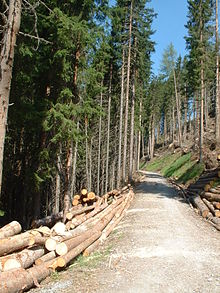

Forestry work in Austria
Modern forestry generally embraces a broad range of concerns, in what is known as multiple-use management, including the provision of timber, fuel wood, wildlife habitat, natural water quality management, recreation, landscape and community protection, employment, aesthetically appealing landscapes, biodiversity management, watershed management, erosion control and preserving forests as 'sinks' for atmospheric carbon dioxide. A practitioner of forestry is known as a forester.
Forest ecosystems have come to be seen as the most important component of the biosphere and forestry has emerged as a vital applied science craft and technology.
Forestry is an important economic segment in various industrial countries. For example, in Germany, forests cover nearly a third of the land area, wood is the most important renewable resource, and forestry supports more than a million jobs and about billion in yearly turnover.
History Background
The preindustrial age has been dubbed by Werner Sombart and others as the 'wooden age', as timber and firewood were the basic resources for energy, construction and housing. The development of modern forestry is closely connected with the rise of capitalism, economy as a science and varying notions of land use and property.
A deciduous beech forest in Slovenia
Roman Latifundiae, large agricultural estates, were quite successful in maintaining the large supply of wood that was necessary for the Roman Empire. Large deforestations came with respectively after the decline of the Romans. However already in the 5th century, monks in the then Byzantine Romagna on the Adriatic coast, were able to establish stone pine plantations to provide fuelwood and food. This was the beginning of the massive forest mentioned by Dante Alighieri in his 1308 poem Divine Comedy
Similar sustainable formal forestry practices were developed by the Visigothsin the 7th century when, faced with the ever increasing shortage of wood, they instituted a code concerned with the preservation of oak and pine forests. The use and management of many forest resources has a long history in China as well, dating back to the Han Dynasty and taking place under the landowning gentr . A similar approach was used in Japan. It was also later written about by the Ming Dynasty Chinese scholar XuGuangxi (1562–1633).
In Europe, land usage rights in medieval and early modern times allowed different users to access forests and pastures. Plant litter and resin extraction were important, as pitch (resin) was essential for the caulking of ships, falking and hunting rights, firewood and building, timber gathering in wood pastures, and for grazing animals in forests. The notion of "commons" (German "Allemande") refers to the underlying traditional legal term of common land. The idea of enclosed private property came about during modern times. However, most hunting rights were retained by members of the nobility which preserved the right of the nobility to access and use common land for recreation, like fox hunting.
Early Modern Forestry Departments

Systematic management of forests for a sustainable yield of timber is said to have begun in the German states in the 14th century, e.g. in Nuremberg, and in 16th-century Japan. Typically, a forest was divided into specific sections and mapped; the harvest of timber was planned with an eye to regeneration. As timber rafting allowed for connecting large continental forests, as in south western Germany, via Main, Neckar, Danube and Rhine with the coastal cities and states, early modern forestry and remote trading were closely connected. Large firs in the black forest were called „Holländer“, as they were traded to the Dutch ship yards. Large timber rafts on the Rhine were 200 to 400m in length, 40m in width and consisted of several thousand logs. The crew consisted of 400 to 500 men, including shelter, bakeries, ovens and livestock stables. Timber rafting infrastructure allowed for large interconnected networks all over continental Europe and is still of importance in Finland. 

Starting with the sixteenth century, enhanced world maritime trade, a boom in housing construction in Europe and the success and further Berggeschrey (rushes) of the mining industry increased timber consumption sharpely. The notion of 'Nachhaltigkeit', sustainability in forestry, is closely connected to the work of Hans Carl von Carlowitz (1645 - 1714), a mining administrator in Saxony. His book Sylvicultura oeconomica, oder haußwirthliche Nachricht und Naturmäßige Anweisung zur wilden Baum-Zucht (1713) was the first comprehensive treatise about sustainable yield forestry. In the UK, and to an extend in continental Europe, the enclosure movement and the clearances favored strictly enclosed private property. The Agrarian reformers, early economic writers and scientists tried to get rid of the traditional commons. At the time, an alleged tragedy of the commons together with fears of a Holznot, an imminent wood shortage played a watershed role in the controversies about cooperative land use patterns.
Timber harvesting is a common component of forestry
The practice of establishing tree plantations in the British Isles was promoted by John Evelyn, though it had already acquired some popularity. Louis XIV's minister Jean-Baptiste Colbert's oak Forest of Tronçais, planted for the future use of the French Navy  matured as expected in the mid-19th century: "Colbert had thought of everything except the steamship," Fernand Braudel observed. In parallel, schools of forestry were established beginning in the late 18th century in Hesse, Russia, Austria-Hungary,Sweden, France and elsewhere in Europe.
Forest Conversation and Early Globalization

During the late 19th and early 20th centuries, forest preservation programs were established in British India, the United States, and Europe. Many foresters were either from continental Europe (like Sir Dietrich Brandi), or educated there (like Gifford Pinchot). Sir Dietrich Brandis is considered the father of tropical forestry, European concepts and practices had to be adapted in tropical and semi aride climate zones. The development of plantation forestry was one of the (controversial) answers to the specific challenges in the tropical colonies. The enactment and evolution of forest laws and binding regulations occurred in most Western nations in the 20th century in response to growing conservation concerns and the increasing technological capacity of logging companies. Tropical forestry is a separate branch of forestry which deals mainly with equatorial forests that yield woods such as teak and mahogany.

Mechanization

Forestry mechanization was always in close connection to metal working and the development of mechanical tools to cut and transport timber to its destination. Rafting belongs to the earliest means of transport. Steel saws came up in the 15th century. The 19th century widely increased the availability of steel for whipsaws and introduced Forest railways and railways in general for transport and as forestry customer. Further human induced changes, however, came since World War II, respectively in line with the '1950s-syndrome'. The first portable chainsaw were invented in 1925 in Germany, but large impact of mechanization in forestry started after World War II. Forestry Harvesters are among the most recent developments.

Forestry Today

Today a strong body of research exists regarding the management of forest ecosystems and genetic improvement of tree species and varieties. Forestry also includes the development of better methods for the planting, protecting, thinning,  controlled burning, felling, extracting, and processing of timber. One of the applications of modern forestry is reforestation,  in which trees are planted and tended in a given area.
A modern sawmill
Trees provide numerous environmental, social and economic benefits for people. In many regions the forest industry is of major ecological, economic, and social importance. Third-party certification systems that provide independent verification of sound forest stewardship and sustainable forestry have become commonplace in many areas since the 1990s. These certification systems were developed as a response to criticism of some forestry practices, particularly deforestation in less developed regions along with concerns over resource management in the developed world.  Some certification systems are criticized for primarily acting as marketing tools and lacking in their claimed independence.
In topographically severe forested terrain, proper forestry is important for the prevention or minimization of serious soil erosion or even landslides. In areas with a high potential for landslides, forests can stabilize soils and prevent property damage or loss, human injury, or loss of life.
Public perception of forest management has become controversial, with growing public concern over perceived mismanagement of the forest and increasing demands that forest land be managed for uses other than pure timber production, for example, indigenous rights, recreation, watershed management, and preservation of wilderness, waterways and wildlife habitat. Sharp disagreements over the role of forest fires, logging, motorized recreation and other issues drives debate while the public demand for wood products-continues to increase.
Foresters

Foresters work for the timber industry,  government agencies, conservation groups, local authorities, urban parks boards, citizens' associations, and private landowners. The forestry profession includes a wide diversity of jobs, with educational requirements ranging from college bachelor's degrees to PhDs for highly specialized work. Industrial foresters plan forest regeneration starting with careful harvesting. Urban foresters manage trees in urban green spaces. Foresters work in tree nurseries growing seedlings for woodland creation or regeneration projects. Foresters improve tree genetics.  Forest engineers develop new building systems. Professional foresters measure and model the growth of forests with tools like geographic information systems. Foresters may combat insect infestation, disease, forest and grassland-wildfire,  but increasingly allow these natural aspects of forest ecosystems to run their course when the likelihood of epidemics or risk of life or property are low. Increasingly, foresters participate in wildlife conservation planning and watershed protection. Foresters have been mainly concerned with timber management, especially reforestation, maintaining forests at prime conditions, and fire control.


Foresters of UACh in the Valdivian forests of San Pablo de Tregua,Chile

Forestry Plans
Foresters develop and implement forest management plans relying on mapped resource inventories showing an area's topographical features as well as its distribution of trees (by species) and other plant cover. Plans also include landowner objectives, roads, culverts, proximity to human habitation, water features and hydrological conditions, and soils information. Forest management plans typically include recommended silvicultural treatments and a timetable for their implementation.
Forest management plans include recommendations to achieve the landowner's objectives and desired future condition for the property subject to ecological, financial, logistical (e.g. access to resources), and other constraints. On some properties, plans focus on producing quality wood products for processing or sale. Hence, tree species, quantity, and form, all central to the value of harvested products quality and quantity, tend to be important components of silvicultural plans.
Good management plans include consideration of future conditions of the stand after any recommended harvests treatments, including future treatments (particularly in intermediate stand treatments), and plans for natural or artificial regeneration after final harvests.
The objectives of landowners and leaseholders influence plans for harvest and subsequent site treatment. In Britain, plans featuring "good forestry practice" must always consider the needs of other stakeholders such as nearby communities or rural residents living within or adjacent to woodland areas. Foresters consider tree felling and environmental legislation when developing plans. Plans instruct the sustainable harvesting and replacement of trees. They indicate whether road building or other forest engineering operations are required.
Agriculture and forest leaders are also trying to understand how the climate change legislation will affect what they do. The information gathered will provide the data that will determine the role of agriculture and forestry in a new climate change regulatory system.
Forestry as Science

Over the past centuries, forestry, was regarded as a separate science. With the rise of ecology and environmental science, there has been a reordering in the applied sciences. In line with this view, forestry is one of three primary land-use sciences. The other two are agriculture and agroforestry.  Under these headings, the fundamentals behind the management of natural forests comes by way of natural ecology. Forests or tree plantations, those whose primary purpose is the extraction of forest products, are planned and managed utilizing a mix of ecological and agroecological principles.

History of Forestry Education
The first dedicated forestry school was established by Georg Ludwig Hartig at Hungen in the Wetterau,  Hesse, in 1787, though forestry had been taught earlier in central Europe, including at the University of Giessen,  in Hesse-Darmstadt.
In Spain, the first forestry school was the Forest Engineering School of Madrid (Escuela Técnica Superior de Ingenieros de Montes) founded in 1844.
The first in North America, the Biltmore Forest School, was established near Asheville, North Carolina, by Carl A. Schenck on September 1, 1898, on the grounds of George W. Vanderbilt's  Biltmore Estate. Another early school was the New York State College of Forestry, established at Cornell University, just a few weeks later, in September 1898. Early 19th century North American foresters went to Germany to study forestry. Some early German foresters also emigrated to North America.
In South America, the first forestry school was established in Brazil, in Viçosa,  Minas Gerais, in 1962, and moved the next year to become a faculty at the Federal University of Paraná, in Curitiba.
Forestry Education today
Today, forestry education typically includes training in general biology,  botany,  genetics,  soil science,  climatology, hydrology, economics and forest management,. Education in the basics of sociology and political science is often considered an advantage.
Prescribed burning is used by foresters to reduce fuel loads
In India, forestry education is imparted in the agricultural universities and in Forest Research Institutes (deemed universities). Four year degree programmes are conducted in these universities at the undergraduate level. Masters and Doctorate degrees are also available in these universities.
In the United States, postsecondary forestry education leading to a Bachelor's degree or Master's degree is accredited by the Society of American Foresters.
In Canada the Canadian Institute of Forestry awards silver rings to graduates from accredited university BSc programs, as well as college and technical programs.
In many European countries, training in forestry is made in accordance with requirements of the Bologna Process and the European Higher Education Area.
The International Union of Forest Research Organizations is the only international organization that coordinates forest science efforts world-wide.
- Wikipedia 

Advantages and Disadvantages of Fasting for Runners

Author BY   ANDREA CESPEDES  Food is fuel, especially for serious runners who need a lot of energy. It may seem counterintuiti...