The Curculionidae comprise the family of the "true" weevils (or "snout beetles"). It is one the largest animal families, with 5,489 genera and 86,100 species described worldwide.
It also includes the bark beetles as subfamily, Scolytinae which are modified in shape in accordance with their wood-boring lifestyle. They do not much resemble other weevils, so they were traditionally considered a distinct family, Scolytidae. The family also includes the ambrosia beetles, of which the present-day subfamily Platypodinae was formerly considered the distinct family Platypodidae.
Description
They are recognized by their distinctive long snouts and geniculate antennae with small clubs; beyond that, curculionids have considerable diversity of form and size, with adult lengths ranging from 1 to 40 mm (0.04 to 1.57 in).
Weevils are almost entirely plant feeders, and most species are associated with a narrow range of hosts, in many cases only living on a single species. With so many species to classify and over 400 genera, the taxonomy of this family is quite complicated, and authors disagree on the number and placement of various subfamilies, tribes, and subtribes.
Phylogeny and Systematics
The phylogeny of the group is complex; with so many species, a spirited debate exists about the relationships between subfamilies and genera. A 1997 analysis attempted to construct a phylogeny based mainly on larval characteristics.

A true weevil
Almost two dozen subfamilies, are recognized by some authors even when merging those that are certainly invalid. Others, however, recognize a lesser number – the only subfamilies that are almost universally considered valid are the Baridinae, Cossoninae, Curculioninae, Cyclominae, Entiminae, Molytinae. Platypodinae and Scolytinae. The various proposed taxonomic, schemes typically recognize as many additional subfamilies again, but little agreement is seen between authorities about which. In particular, the delimitation of the Molytinae has proven difficult.

Compound of a Cyrtotrachelus, in acryl
The subfamilies considered valid by at least some authors today:
- Bagoinae (sometimes in Molytinae)
- Baridinae
- Brachycerinae (disputed)
- Ceutorhynchinae (sometimes in Baridinae, Curculioninae or Molytinae)
- Conoderinae (sometimes in Baridinae)
- Cossoninae
- Cryptorhynchinae (sometimes in Curculioninae)
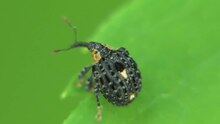 Play mediaCionus tuberculosus (Curculioninae)
 - Curculioninae – flower weevils, acorn and nut weevils
- Cyclominae
- Dryophthorinae (disputed)
- Entiminae – broad-nosed weevils
- Erirhininae (sometimes in Brachycerinae)
- Gonipterinae (sometimes in Curculioninae)
- Hyperinae (sometimes in Molytinae)
- Lixinae (sometimes in Molytinae)
- Mesoptiliinae (sometimes in Molytinae)
- Molytinae
- Orobitidinae (sometimes in Baridinae)
- Platypodinae – typical ambrosia beetles
- Raymondionyminae (sometimes in Brachycerinae)
- Scolytinae – bark beetles
- Xiphaspidinae (sometimes in Baridinae
References
- ^ http://www.gbif.org/species/116196879
- ^ Adriana E. Marvaldi (1997). "Higher level phylogeny of Curculionidae (Coleoptera: Curculionoidea) based mainly on larval characters, with special reference to broad-nosed weevils", (PDF). Cladistics 13 (4): 285–312. doi:10.1111/j.1096-0031.1997.tb00321.x.
External Links
- Media related to Curculionidae at Wikimedia Commons
 Data related to Curculionidae at Wikispecies
- Images of Curculionidae species found in New Zealand
On the University of Florida / Institute of Food and Agricultural Sciences, Featured Creatureswebsite:
- Anthonomus eugenii, pepper weevil
- Cylas formicarius, sweetpotato weevil
- Chalcodermus aeneus, cowpea curculio
- Cosmopolites sordidus, banana root borer
- Eudociminus mannerheimii, cypress weevil
- Eurhinus magnificus
- Gerstaeckeria spp.
- Metamasius callizona, Mexican bromeliad weevil
- Metamasius hemipterus sericeus, silky cane weevil,
- Metamasius mosieri, Florida bromeliad weevil
- Naupactus (=Graphognathus) spp., whitefringed beetles
- Oxyops vitiosa, melaleuca weevil
- Pantomorus cervinus, Fuller rose weevil
- Pseudocneorhinus bifasciatus, twobanded Japanese weevil
- Rhynchophorus cruentatus, palmetto weevil
- Sphenophorus venatus, hunting billbug
- Conotrachelus nenuphar, plum curculio from the Ohio State University
- Orchestes pallicornis, apple flea weevi, from Michigan State University
Other University web pages on economically important curculids:
- Wikipedia


.jpg)