Blog List

Wednesday, 9 March 2016

SECONDARY GROWTH

In plant science, secondary growth refers to the growth that results from cell division in the cambia or lateral meristems and that causes the stems and roots to thicken, while primary growth is growth that occurs as a result of cell division at the tips of stems and roots, causing them to elongate, and gives rise to primary tissue. Secondary growth occurs in most seed plants, but monocots usually lack secondary growth. If they do have secondary growth, it differs from the typical pattern of other seed plants.
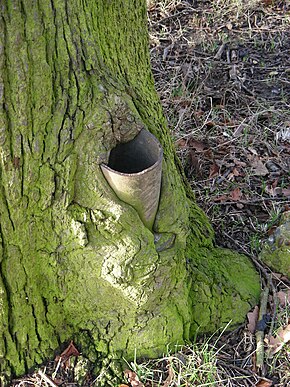

Secondary growth thickens the stem and roots typically making them woody. Obstructions such as this metal post and stubs of limbs can be engulfed.

Laterals Meristerms
In many vascular plants, secondary growth is the result of the activity of the two lateral meristems, the cork cambium and vascular cambium. Arising from lateralmeristems, secondary growth increases the girth of the plant root or stem, rather than its length. As long as the lateral meristems continue to produce new cells, the stem or root will continue to grow in diameter. In woody plants, this process produces woody and shapes the plant into a tree with a thickened trunk.
Diagram of secondary growth in a tree showing idealised vertical and horizontal sections. New wood is added in each growth season by the lateral meristems, the cork cambium and vascular cambium.
Because this growth usually ruptures the epidermis of the stem or roots, plants with secondary growth usually also develop a cork cambium. The cork cambium gives rise to thickened cork cells to protect the surface of the plant and reduce water loss. If this is kept up over many years, this process may produce a layer of cork. In the case of the cork oak it will yield harvestable cork.
In Non-woody  Plants

Secondary growth also occurs in many nonwoody plants, e.g. tomato, potato tuber, carrot taproot and sweet potato tuberous root. A few long-lived leaves also have secondary growth.
Abnormal Secondary Growth
Abnormal secondary growth does not follow the pattern of a single vascular cambium producing xylem to the inside and phloem to the outside as in ancestral lignophytes. Some dicots have anomalous secondary growth, e.g. in Bougainvillea a series of cambia arise outside the oldest phloem.
Ancestral monocots lost their secondary growth and their stele has changed in a way it could not be recovered without major changes that are very unlikely to occur. Monocots either have no secondary growth, as is the ancestral case, or they have an "anomalous secondary growth" of some type, or, in the case of palms, they enlarge their diameter in what is called a sort of secondary growth or not depending on the definition given to the term. Palm trees increase their trunk diameter due to division and enlargement of parenchyma cells, which is termed "primary gigantism" because there is no production of secondary xylem and phloem tissues, or sometimes "diffuse secondary growth". In some other monocot stems with anomalous secondary growth, a cambium forms, but it produces vascular bundles and parenchyma internally and just parenchyma externally. Some monocot stems increase in diameter due to the activity of a primary thickening meristem, which is derived from the apical meristem. The Euglossa hyacinthina is one bee species that builds their nests on the apical meristem.
Palms (in the picture Roystonea regia palm) increase their trunk diameter by means of division and enlargement of parenchyma tissue, without a real secondary growth (production of secondary vascular strands -secondary xylem and phloem tissues- with the consecuent enlargement of the canopy and root system).

References

  1. Thompson, N.P. and Heimsch, C. 1964. Stem anatomy and aspects of development in tomato. American Journal of Botany 51: 7-19. 
  2. ^ Ewers, F.W. 1982. Secondary growth in needle leaves of Pinus longaeva (bristlecone pine) and other conifers: Quantitative data. American Journal of Botany 69: 1552-1559. 
  3. a b c James D. Mauseth, 2003. Botany: An Introduction to Plant Biology, Third Edition.
  4. ^ Esau, K. and Cheadle, V.I. 1969. Secondary growth in bougainvillea. Annals of Botany33: 807-819. [3]
  5. ^ MG Simpson (2005) "Arecaceae (Palmae)" In: Plant Systematics. p.185: "...Plant sex is variable, and secondary growth is absent..."
  6. ^ Esau, K. 1977. Anatomy of Seed Plants. New York: Wiley
  7. ^ Augusto, S. C.; Garófalo, C. A. (2004-11-01). "Nesting biology and social structure of Euglossa (Euglossa) townsendi Cockerell (Hymenoptera, Apidae, Euglossini). Insectes Sociaux 51 (4): 400–409. doi:10.1007/s00040-004-0760-2. ISSN 0020-1812.

- Wikipedia 

Why Are Pineapples Good for You?

Pineapple is a highly versatile fruit that you can enjoy as a dessert or a pick-me-up, include in salads, main courses and cakes or use as a garnish for meats and vegetables. It's available fresh year-round and is sold canned, frozen, candied and juiced. Pineapple is good for you, because it supplies a significant amount of vitamin C, potassium and manganese. The golden-yellow fruit also is free of fat and low in sodium. It is a source of fiber and also contains an enzyme associated with healing and preventing certain major maladies.
Why Are Pineapples Good for You?
Fresh pineapple whole and cut on white background. Photo Credit Alexey Ilyashenko/iStock/Getty Images

Vitamins and Key Minerals

While many people associate vitamin C with oranges, pineapples offer almost as much in an equivalent serving. One cup of pineapple chunks has 78.9 mg of vitamin C, compared with 87.7 mg in a typical navel orange. The same size serving of pineapple also supplies 180 mg of potassium, which will help get you toward the Institute of Medicine's recommended intake of 4.7 g a day. Pineapples are particularly high in manganese, with 1.53 mg in a cup of chunks. The Institute of Medicine recommends between 1.6 and 2.3 mg a day, depending on age and gender. The body needs manganese for normal growth. The mineral also helps to break down fats, carbohydrates and proteins.

Fat and Sodium

Pineapples are naturally fat-free and low in sodium. One cup of pineapple chunks contains 2 mg of sodium, which is negligible. The USDA urges Americans to consume less than 2,300 mg of sodium a day, and the American Heart Association says those with high blood pressure or other heart-related ailments should restrict their intake to less than 1,500 mg a day.

Bromelain

Fresh pineapples are the sole source of bromelain, a combination of protein-digesting enzymes that fight inflammation in the body. Bromelain is "particularly effective in reducing inflammation associated with infection and injuries," according to the University of Maryland Medical Center. Experts there note that researchers have seen indications that bromelain might help treat wounds and burns, sinus inflammation, indigestion, arthritis, asthma and infection. However, much of this research has been in animals. The University of Maryland notes that the level of bromelain in a pineapple is not sufficient to have a medicinal effect. Talk with your physician before taking bromelain or any other supplement.

Warnings

Don't use fresh or frozen pineapple in gelatin mixtures because a natural enzyme prevents them from setting. Canned pineapple won't cause the problem. If you haven't eaten pineapple before, be aware that a small number of people suffer an allergic reaction to the fruit. You may experience hives, itching, swelling or eczema. Wheezing, nasal congestion or trouble breathing, as well as lightheadedness, dizziness or fainting, are also possible. If the conditions become extreme, or if you have difficulty swallowing or breathing, a rapid pulse, loss of consciousness or a blue color in the skin and nails, seek emergency medical care.
www.livestrong.com

How to Make Nachos Using Shredded Cheese

It is easy to make nachos with cheese sauce because the cheese is already melted and will spread to cover the chips. With shredded cheese, you may not get as much coverage if you do not spread it properly. The type of cheese also matters because some cheeses are more oily than creamy when they melt. Additionally, if you use the wrong heat source, you risk burning the chips as you melt the cheese. But there is a way to make creamy, gooey, well-covered nachos using shredded cheese without scorching.
How to Make Nachos Using Shredded Cheese
Take your time when melting shredded cheese for nachos. Photo Credit merc67/iStock/Getty Images

Step 1

Combine the shredded American and Mexican blend in a bowl. The American provides a creamy melt while the Mexican blend provides the sharp flavor of cheddar and Monterrey Jack.

Step 2

Put one layer of tortilla chips on the plate with the lip. The plate is flat enough to spread the chips out while the lip keeps them from sliding off the edge.

Step 3

Sprinkle a handful of the cheese blend on top of the chips. Layer more chips on top.

Step 4

Continue sprinkling and layering until you have used up all the cheese. The top layer of your nachos should be the cheese.

Step 5

Microwave the nachos on high in 10-second increments. Rotate the plate a quarter turn after each blast. The cheese will melt quickly so you may only need two or three passes. If you have a rotating microwave, you do not need to manually turn the plate.

Step 6

Remove the nachos from the microwave and garnish with jalapenos, if desired.

Vitamins & Minerals in Pineapple

Most fruits and vegetables are chock full of vitamins and minerals, and pineapple is no exception. Due to the abundance of these vitamins and minerals, as well as the presence of bromelain, an enzyme found in pineapples that may have additional health benefits, pineapple is a good choice to help you meet the recommended five servings per day of fruits and vegetables -- whether you choose fresh, frozen or canned pineapple.

Vitamins & Minerals in Pineapple

Pineapple is high in vitamin C. Photo Credit pineapple image by Maria Brzostowska from <a href='http://www.fotolia.com'>Fotolia.com</a>

Nutrition Facts

One cup of fresh pineapple chunks provides you with 40 percent of the daily value for vitamin C, 10 percent for thiamin, 8 percent for vitamin B6, 6 percent for magnesium and 4 percent for folate, iron, riboflavin and niacin. Pineapple is also a good source for manganese and copper. A cup of pineapple contains only 80 calories, provides 2 g of fiber and 1 g of protein; it doesn't contain any fat.

Possible Health Benefits

Your body uses the manganese in pineapple for bone health and energy production. Thiamin also helps with energy production and vitamin C works as an antioxidant. Bromelain may help reduce the side effects from cancer treatments, treat diarrhea, reduce inflammation and improve digestion; it may also help treat burns, according to the American Cancer Society, although more research is needed to determine its effectiveness for these conditions.

Maximizing Vitamins and Minerals

Fresh pineapple may have slightly more vitamins and minerals than canned or frozen pineapple. Vitamin C is one example, since processing can affect nutrient levels and vitamin C is particularly sensitive to these effects. However, frozen pineapple may be preferable to fresh if the pineapple has not been picked recently. The longer a fruit or vegetable sits around before being used, the lower its vitamin and mineral content. Many frozen fruits are frozen right after harvesting, so they maintain most of their nutrients.

Safety Concerns

Pineapple is safe for most people in the amounts normally consumed. However, bromelain can interact with amoxicillin and tetracycline, so you may want to avoid eating pineapple if you are on these medications. Pineapple juice from pineapples that aren't ripe can cause you to vomit, and eating too much pineapple can cause your mouth and cheeks to swell, according to Drugs.com. Consuming large amounts of bromelain may also cause side effects including nausea, diarrhea, skin rashes and vomiting.
www.livestrong.com

How Long Do You Have to Work Out to Burn Off the Calories from Potato Chips?

Potato chips make a satisfying snack food—crispy, salty and flavorful, thanks to the deep-fried preparation. However, eating potato chips can cause problems for your fitness and health routines because they’re loaded with fat and calories. Depending on your body weight and exercise intensity, you can definitely plan to work out hard and long in order to burn off the calories from potato chips. Preventing this situation by choosing healthier alternatives could be a smarter move.
How Long Do You Have to Work Out to Burn Off the Calories from Potato Chips?
A pile of potato chips. Photo Credit elioxuni/iStock/Getty Images

Calories and Working Out

Even when you’re not working out, your body requires a certain amount of calories to complete basic functions like breathing, pumping your heart and maintaining cells, according to the University of New Mexico. When you exercise, your body needs extra calories to complete functions like running, lifting weights, swimming or performing yoga postures. In this way, calories from food you consume—for example, a bag of potato chips—becomes fuel to complete those functions. The more you work out, the more calories you’ll burn. Conversely, if you continually munch on potato chips without working out, you’ll be stuck with those extra calories in the form of accumulated fat on your body.

The Basic Chip

Calorie amount will vary depending on what brand or type or potato chip you’ve eaten. However, one example of the amount of calories for a 1-ounce serving of potato chips—about 15 chips—might include 160 calories, according to Frito Lay.com. Of those 160 calories, 90 calories come from fat, making this a high-fat snack. In fact, a 1-ounce portion of potato chips might also pack 10 grams of fat, or 16 percent of the recommended amount based on a 2,000-calorie daily diet plan.

Body Weight Matters

How long you’ll have to work out to burn off roughly 160 calories partly depends on your body size and the type of activity you select, according to Harvard Health Publications. For example, a 125-pound person would have to complete 30 minutes of low-impact aerobics in order to burn approximately 160 calories, whereas a 155-pound person would burn 205 calories performing the same activity in the same amount of time. A 155-pound person could burn about 160 calories performing 30 minutes of calisthenics, while a 185-pound person could burn over 160 calories performing 30 minutes of water aerobics. In general, the more vigorous the workout, the faster you’ll burn off the potato chips. Examples of high-energy workouts include running, skin diving, playing competitive soccer, and speed skating, according to NutriStrategy.

Skip the Chips

One way to reduce your workout includes reducing your portion size; that is, eating a smaller handful of potato chips, according to the U.S. Department of Agriculture. But you can also swap out healthier alternatives to potato chips to avoid lengthier workouts. Examples include baked apple slices, baked taro root slices, baked sweet potatoes, or baked kale leaves, according to Time Magazine.
www.livestrong.com

How Many Calories Are in a Potato Chip?

How Many Calories Are in a Potato Chip?

Homemade potato chips in a glass bowl. Photo Credit Belyaevskiy/iStock/Getty Images

If you enjoy the salty crunch of potato chips, knowing the caloric value of the snack helps you stay within your meal plan. Some brands of chips, such as those that are popped instead of fried, provide a healthier alternative to traditional chips. You don't need to eat a whole bag of chips to enjoy the taste; eating just a handful prevents you from consuming too many calories.

A High-Calorie Snack

Although the sizes and weights of potato chips vary, 11 to 13 chips typically make up 1 ounce. One ounce of plain, salted potato chips has 154 calories, according to the U.S. Department of Agriculture. An ounce of plain, unsalted potato chips has 152 calories. Barbecue chips have 137 calories per ounce, while cheese-flavored chips have 141 calories per ounce. Regardless of their flavor, single potato chips typically have about 11 to 14 calories per chip, on average. If you seek a lower-calorie alternative, look for chips that are popped rather than fried. For example, a 1-ounce serving of original-flavor Popchips consists of 23 chips and has 120 calories. As such, individual Popchips have about 5 calories per chip.
www.livestrong.com

The Nutrition of Melted Cheese

Cheese melted over chips to make nachos, added to a casserole or included in a dip is a high-calorie, high-fat indulgence. Melted cheese is a source of bone-building calcium and phosphorus but also provides high amounts of cholesterol and sodium. Before making melted cheese a regular part of your diet, understand the impact it may have on your nutrition intake.
The Nutrition of Melted Cheese
A melted cheese slice on a burger. Photo Credit GeorgeDolgikh/iStock/Getty Images
Density
Melted cheese contains more fat and calories than shredded or diced cheese because there is no air taking up space in each serving. For example, a cup of diced cheddar cheese weighs 132 g, a cup of shredded cheddar cheese weighs 113 g and a cup of melted cheddar weighs 244 g. By melting cheese, you get more cheese per serving – and more of the calories and nutrients.

Calories and Macronutrients

One cup of melted cheddar cheese contains 983 calories. Cheese is low in carbohydrates, with a cup of melted cheddar offering just 3 g. You also get 61 g of protein by consuming a cup of melted cheddar. Of the 81 g of fat, 51 g are saturated. The American Heart Association recommends limiting saturated fat intake to less than 7 percent of total daily calories. For a 2,000 calorie diet, this is just 15 g per day.

Additional Nutrition Information

Although melting the cheese concentrates the calories and fat, it also concentrates the nutrition. One cup of melted cheddar provides 176 percent of the recommended dietary allowance for calcium, based on a 2,000-calorie diet. It also provides 125 percent for phosphorus, 49 percent for vitamin A, 54 percent for riboflavin, 48 percent for selenium, 51 percent for zinc and 34 percent for vitamin B-12. Melted cheese contains smaller amounts of additional vitamins and minerals, including 17 percent for magnesium, 10 percent for pantothenic acid, 11 percent for folate, 9 percent for vitamin B-6, 9 percent for vitamin K, 7 percent for vitamin D and 9 percent for iron.

Cholesterol and Sodium Concerns

One cup of melted cheese provides 256 mg of cholesterol – nearly a full day’s worth. The American Heart Association recommends sticking to 300 mg of cholesterol or less each day to protect heart health. If you have been diagnosed with high cholesterol, you are advised to stay below 200 mg daily. The cup of melted cheddar also provides 1,515 mg of sodium. The Institute of Medicine encourages limiting sodium consumption to 1,500 mg per day.

Considerations

Other types of cheese may have slightly different nutrition information when melted because they have different nutrition information when shredded. Part-skim mozzarella is slightly lower in fat and calories than cheddar, for example. If your recipe calls for melted cheese, measure it before melting and stick to moderate 1- to 1 1/2-oz. portion sizes to keep calories and saturated fat in check.
www.livestrong.com

FIGURE (WOOD)

In wood, figure refers to the appearance of wood, as seen on a longitudinal surface (side-grain): a "figured wood" is not plain.
typically figured red gum table
The figure of a particular piece of wood is, in part, due to its grain and, in part, due to the cut, or to innate properties of the wood. A few of the tropical hardwoods, like the rosewoods, may have quite spectacular figure.
mountain ash floor, showing some fiddleback figure
Types of figure include "bear scratches," bird's eye, blister, burl, curl, ribbon curl, dimple, fiddleback, flame, wide flame, "ghost", pin stripe, quilted, spalted and tiger stripe.
- Wikipedia 

WOOD GRAIN

Wood grain is the longitudinal arrangement of wood fibers or the pattern resulting from this.

Definination

R. Bruce Hoadley wrote that grain is a "...confusingly versatile term..." including the direction of the wood cells (straight grain, spiral grain), surface appearance or figure, growth-ring placement (vertical grain), plane of the cut (end grain, quarter sawn, flat sawn, etc.), rate of growth (narrow grain), relative cell size (open grain), and other meanings.


The weathered trunk of a lodgepole pine tree showing an extremely spiral grain

Physical Aspects
Perhaps most important physical aspect of wood grain in woodworking is the grain direction or slope (e.g. against the grain). The two basic categories of grain are straight and cross grain. Straight grain runs parallel to the longitudinal axis of the piece. Cross grain deviates from the longitudinal axis in two ways, spiral grain or diagonal grain. The amount of deviation is called the slope of the grain.
Sketch of A—Quarter-sawn & B—flat-sawn
In describing the application of a woodworking technique to a given piece of wood, the direction of the technique may be:
  • with the grain (easy; giving a clean result)
  • against the grain (heavy going; giving a poor result such as chipping or tear-out)
  • across the grain (direction of cut is across the grain lines, but the plane of the cut is still aligned with them)
  • end grain (at right angles to the grain, for example trimming the end of a plank)
Grain alignment must be considered when joining pieces of wood, or designing wooden structures. For example, a stressed span is less likely to fail if tension is applied along the grain, rather than across the grain. Grain direction will also affect the type of warping seen in the finished item.
typically figured red gum table
In describing the alignment of the wood in the tree a distinction may be made. Basic grain descriptions and types include:
  • straight - grain which runs in a single direction, parallel to the axis of the tree
  • spiral - grain which spirals around the axis of the tree
  • interlocked - grain which spirals around the axis of the tree, but reverses its direction for periods of years resulting in alternating directions of the spiral grain.

Aesthetic Aspects
In its simplest aesthetic meaning, wood grain is the alternating regions of relatively darker and lighter wood resulting from the differing growth parameters occurring in different seasons (i.e., growth rings) on a cut or split piece of wood.
mountain ash floor, showing some fiddleback figure
Special grain alignments produce figure in wood. Their rarity often promotes the value of both the raw material, and the finished work it becomes a part of. These include:
The way a given piece of wood has been sawn affects both its appearance and physical properties:
  • flat-grain: flat-sawn, slab-sawn, plain sawn, bastard-sawn, or sawn "through and through".
  • edge grain: quarter-sawn or rift-sawn or straight-grained, and
  • end grain: the grain of wood seen when it is cut across the growth rings.
Strictly speaking, grain is not always the same as the "figure" of wood.
There is irregular grain in burr wood or burl wood, but this is result of very many knots.
References

  1. grain, n.1". def 15. Oxford English Dictionary Second Edition on CD-ROM (v. 4.0) © Oxford University Press 2009
  2. ^ "grain.", def. 7. Dictionary.com Unabridged. Random House, Inc. 13 Jan. 2015. <Dictionary.com http://dictionary.reference.com/browse/grain.
  3. a b Hoadley, R. Bruce. "Glossary." Understanding Wood: A Craftsman's Guide to Wood Technology. Newtown, Conn.: Taunton, 1980. 265. Print.
  4. ^ Wood Movement, WoodworkDetails.com.
  5. ^ Punmia, B.C., Ashok Kumar Jain, and Arun Kumar Jain. Basic civil engineering: for B.E. / B.Tech first year courses of various universities including M.D.U. and K.U., Haryana. New Delhi: Laxmi Publications, 2003. 78. Print.

- Wikipedia 

GRAIN FILLER

grain filler or paste wood filler is a woodworking product that is used to achieve a smooth-textured wood finish by filling pores in the wood grain. It is used particularly on open grained woods such as oak,mahogany and walnut where building up multiple layers of standard wood finish is ineffective or impractical.

Composition

Grain fillers generally consist of three basic components; a binder a bulking agent and a solvent. The binder is wood finish, and in the case of oil-based fillers is typically a blend of oil and varnish. In the case of water-based fillers, it is acrylic or urethane. The type of binder influences the type of solvent used; oil-based fillers usually use mineral spirits, while water-based fillers use water. Both types of filler use silica as a bulking agent as it resists shrinking and swelling in response to changes in temperature and humidity. Other binders may include quartz powder, wood flour, and talc.

Use
Woodworkers will use a grain filler before applying other finishes to open grained woods to achieve a "full finish", which is mirror-like. Woods such as ash, oak, mahogany and walnut fallinto this category, while tight grained woods such as maple and cherry can achieve a full finish with just a few coats of finish.
Before application, the surface is sanded and puttied to conceal surface imperfections, which would otherwise be made far more obvious by the grain filler. The filler is brushed on both with and against the wood grain and the excess is scraped off. After some drying, the woodworker typically uses a piece of burlap to remove more excess.
References

  1. a b "Understanding Grain Fillers". Woodsmith (Des Moines, Iowa: August Home Publishing Co.) 30 (179): 46–47. October 2008. ISSN 0164-4114, OCLC 4713102.
  2. a b Simmons, Mac. "Filling wood grains with a paste wood filler. Amateur Woodworker. Archived from the original, on 2008-06-30. Retrieved 2008-11-01.
  3. ^ MacDonald, Nancy (2013). Woodworking. Cengage Learning. p. 896.
  4. a b Finishes & Finishing Techniques. Taunton Press. 1999-11-01. pp. 13–16. ISBN 1-56158-298-0.

- Wikipedia 

Advantages and Disadvantages of Fasting for Runners

Author BY   ANDREA CESPEDES  Food is fuel, especially for serious runners who need a lot of energy. It may seem counterintuiti...