Blog List

Monday, 14 March 2016

FARMER

farmer (also called an agriculturer) is a person engaged in agriculture, raising living organisms for food or raw materials. The term usually applies to people who do some combination of raising field crops, orchards, vineyards, poultry or other livestock. A farmer might own the farmed land or might work as a labourer on land owned by others, but in advanced economies, a farmer is usually a farm owner, while employees of the farm are known as farm workers, or farmhands. However, in the not so distant past a farmer was a person who promotes or improves the growth of (a plant, crop, etc.) by labor and attention, land or crops or raises animals (as livestock or fish).


Farmer
Farmer, Nicaragua.jpg
A farmer in Nicaragua
Occupation
Occupation type
Employment
Activity sectors
Agriculture
Description
Related jobs
Rancher (U.S.), grazier (Australia) or stockman

History
Farming has been dated back as far as the Neolithic era. By the Bronze Age, the Sumerians had an agriculture specialized labour force by 5000–4000 BCE, and heavily depended on irrigation to grow crops. They relied on three-person teams when harvesting in the spring. The Ancient Egypt farmers farmed and relied and irrigated their water from the Nile.
Animal husbandry the practice of rearing animals specifically for farming purposes, has existed for thousands of years. Dogs were domesticated in East Asia about 15,000 years ago. Goats and sheep were domesticated around 8000 BCE in Asia. Swine or pigs were domesticated by 7000 BCE in the Middle East and China. The earliest evidence of horse domestication dates to around 4000 BCE.
Advancements in Technology

In the U.S. of the 1930s, one farmer fed only himself and three other consumers. The same farmer now feeds well over a hundred people. However, some authors consider this estimate as flawed as it does not take into account that farming requires energy and many other resources which have to be provided by additional workers, so that the ratio of people fed to farmers is actually smaller than 100 to 1.
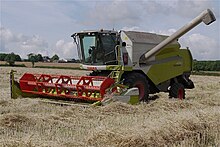

A combine harvester on an English farm.

Types
More distinct terms are commonly used to denote farmers who raise specific domesticated animals. For example, those who raise grazing livestock, such as cattle, sheep, goats and horses are known as ranchers (U.S.), graziers (Australia & U.K.), or simply stockmen. Sheep, goat, and cattle farmers might also be referred to respectively as shepherds, goatherds, and cowherds. The term dairy farmer is applied to those engaged primarily in milk production, whether from cattle, goats, sheep, or other milk producing animals. A poultry farmer is one who concentrates on raising chickens, turkeys, ducks or geese, for either meat, egg, or feather production, or commonly, all three. A person who raises a variety of vegetables for market may be called a truck farmer or market gardenerDirt farmer is an American colloquial term for a practical farmer, or one who farms his own land.
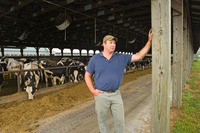
An American dairy farmer.
In developed nations, a farmer (as a profession) is usually defined as someone with an ownership interest in crops or livestock, and who provides land or management in their production. Those who provide only labor are most often called farmhands. Alternatively, growers who manage farmland for an absentee landowner, sharing the harvest (or its profits) are known as sharecroppers or sharefarmers. In the context of agribusiness, a farmer is defined broadly, and thus many individuals not necessarily engaged in full-time farming can nonetheless legally qualify under agricultural policy for various subsidies, incentives, and tax deductions.
Techniques
In the context of developing nations or other pre-industrial cultures, most farmers practice a meager subsistence agriculture - a simple organic farming system employing crop rotation, seed saving, slash and burn or other techniques to maximize efficiency while meeting the needs of the household or community. Historically, one subsisting in this way may have been known as a peasant.
A Nepali farmer
In developed nations, however, a person using such techniques on small patches of land might be called a gardener and be considered a hobbyist. Alternatively, one might be driven into such practices by poverty or, ironically—against the background of large-scale agribusiness—might become an organic farmer growing for discerning consumers in the local food market.
Farming Organizations

Farmers are often members of local, regional, or national farmers' unions or agricultural producers' organizations and can exert significant political influence. The Grange movement in the United States was effective in advancing farmers' agendas, especially against railroad and agribusiness interests early in the 20th century. The FNSEA is very politically active in France, especially pertaining to genetically modified food. Agricultural producers, both small and large, are represented globally by the International Federation of Agricultural Producers (IFAP), representing over 600 million farmers through 120 national farmers' unions in 79 countries.

Income

Farmed products might be sold either to a market, in a farmers' market, or directly from a farm. In a subsistence economy, farm products might to some extent be either consumed by the farmer's family or pooled by the community.

Occupational Hazards.

There are several occupational hazards for those in agriculture; farming is a particularly dangerous industry. Farmers can encounter and be stung or bitten by dangerous insects and other arthropods, including scorpions, fire ants,  bees, wasps and hornets. Farmers also work around heavy machinery which can kill or injure them.

References
Notes

  1. ^ Dyer 2007, p. 1: "The word 'farmer' was originally used to describe a tenant paying a leasehold rent (a farm), often for holding a lord's manorial demesne. The use of the word was eventually extended to mean any tenant or owner of a large holding, though when Gregory King, estimated that there were 150,000 farmers in the late seventeenth century he evidently defined them by their tenures, as freeholders were counted separately."
  2. ^ By the sweat of thy brow: Work in the Western world, Melvin Kranzberg, Joseph Gies, Putnam, 1975
  3. ^ Nicholson (2000) p. 514
  4. ^ "Breeds of Livestock - Oklahoma State University". Ansi.okstate.edu. Retrieved 2011-12-10.
  5. ^ Kirschenmann 2000.
  6. ^ Oxford English Dictionary
  7. ^ About the International Federation of Agricultural Producers.
  8. ^ "Agricultural Safety". NIOSH. December 15, 2014.
  9. ^ "Insects and Scorpions". NIOSH. February 24, 2012.
Bibliography
  • Dyer, Christopher (2007). "A suffolk farmer in the fifteenth century". Agricultural History Review. 55 (1): 1–22. JSTOR 40276126.
  • Kirschenmann, Frederick (2000). "How many farmers will we need? (PDF)Leopold Letter. 12 (4): 3–4.

External Links

  •  Media related to Farmers at Wikimedia Commons
  •  The dictionary definition of farmer at Wiktionary

- Wikipedia 

RAW MATERIAL

raw material, also known as a feedstock or most correctly unprocessed material, is a basic material that is used to produce goods, finished products, energy, or intermediate materials which are feedstock for future finished products. As feedstock, the term connotes these materials are bottleneck assets and are highly important with regards to producing other products. An example of this is crude oil, which is a raw material and a feedstock used in the production of industrial chemicals, fuels, plastics, and pharmaceutical goods; lumber is a raw material used to produce a variety of products including furniture.


Anthracite coal stockpile at the shipping area of a mid-slope coal processing plant. The road leading up beyond the stockpile leads down from a Mountain top strip mine which sources the materials.

The term "raw material" denotes materials in minimally processed or unprocessed states; e.g., raw latex, crude oil, cotton, coal, raw biomass, iron ore, air, logs or seawater i.e. "...any product of agriculture, forestry, fishing and any other mineral that is in its natural form or which has undergone the transformation required to prepare it for internationally marketing in substantial volumes."
Africa has 30% of global reserves of non-energy mineral raw materials but this wealth has had a negative impact upon African countries. This phenomenon, known as "Dutch disease"  or the "resource curse", occurs when the economy of a country is mainly based upon its exports due to its method of governance. An example of this is the "geological scandal" of the Democratic Republic of Congo as it is rich in raw materials; the Second Congo War focused on controlling these raw materials.
Latex being collected from a tapped rubber tree.
Raw materials are also used by non-humans, such as birds using found objects and twigs to create nests.
References

  1. ^ Wolf, Jakob (15 January 2010). Schnellkurs HGB-Jahresabschluss: Das neue Bilanzrecht: Richtig vorgehen — erfolgreich umstellen. Walhalla Fachverlag. p. 90. ISBN 978-3-8029-3436-0.
  2. ^ Christophe Degryse, L'économie en 100 et quelques mots d'actualité, De Boeck, 2005, p. 140.
  3. ^ Bernard Tchibambelela, Le commerce mondial de la faim: stratégie de rupture positive au Congo-Brazzaville, Éditions L'Harmattan, 2009, p. 183.
  4. ^ Pascal Boniface, La géopolitique: Les relations internationales, Éditions Eyrolles et tout le monde s'en fou, 2011.

- Wikipedia 

PUTTING-OUT SYSTEM (COTTAGE INDUSTRY)

The putting-out system is a means of subcontracting work. Historically, it was also known as the workshop system and the domestic system. In putting-out, work is contracted by a central agent to subcontractors who complete the work in off-site facilities, either in their own homes or in workshops with multiple craftsmen.
It was used in the English and American textile industries, in shoemaking, lock-making trades, and making parts for small firearms from the Industrial Revolution until the mid-19th century; however, after the invention of the sewing machine in 1846, the system lingered on for the making of ready-made men's clothing.
The domestic system was suited to pre-urban times because workers did not have to travel from home to work, which was quite impracticable due to the state of roads and footpaths, and members of the household spent many hours in farm or household tasks. Early factory owners sometimes had to build dormitories to house workers, especially girls and women. Putting-out workers had some flexibility to balance farm and household chores with the putting-out work, this being especially important in winter.
The development of this trend is often considered to be a form of proto-industrialization, and remained prominent until the Industrial Revolution of the 19th century.
At that point, it underwent name and geographical changes. However, bar some technological advancements, the putting-out system has not changed in essential practice. Contemporary examples can be found in China, India, and South America, and are not limited to the textiles industry.
Firearms

In 1854, the British obtained their military small arms through a system of contracting with private manufacturers located principally in the Birmingham and London areas ... Although significant variation occurred, almost all of the contractors manufactured parts or fitted them through a highly decentralized, putting-out process using small workshops and highly skilled labor. In small arms making as in lock production, the "workshop system" rather than the "factory system" was the rule".

European Cloth and Other Traders

The domestic system was a popular system of cloth production in Europe. It was also used in various other industries, including the manufacture of wrought iron ironware such as pins, pots, and pans for ironmongers.
It existed as early as the 15th century, but was most prominent in the 17th and 18th centuries. It served as a way for capitalists and workers to bypass the guild system, which was thought to be cumbersome and inflexible. Workers would work from home, manufacturing individual articles from raw materials, then bring them to a central place of business, such as a marketplace or a larger town, to be assembled and sold. The raw materials were often provided by the merchant, who received the finished product, hence the synonymous term putting-out system. The advantages of this system were that workers involved could work at their own speed while at home, and children working in the system were better treated than they would have been in the factory system, although the homes were polluted by the toxins from the raw materials. As the woman of a family usually worked at home, someone was often there to look after any children. The domestic system is often cited as one of the causes of the rise of the nuclear family in Europe, as the large amount of profits gained by common people made them less dependent on their extended family. These considerable sums of money also led to a much wealthier peasantry with more furniture, higher-quality food, and better clothing than they had had before. It was mostly centralized in Western Europe and did not take a strong hold in Eastern Europe.
Of course, the acquisition of profit largely depended on which part of the putting-out system one was associated with. If one was a worker in the London textiles industry, for example, the cost of hiring sewing equipment and purchasing thread often precluded the worker from eating on a regular basis. Likewise, the fourteen-hour days led to many untimely deaths.
Thomas Hood's poem The Song of the Shirt (1843) describes the wretched life of a woman in Lambeth labouring under such a system. It was written in honour of a Mrs. Biddell, a Lambeth widow and seamstress living in wretched conditions. In what was, at that time, common practice, Mrs. Biddell sewed trousers and shirts in her home using materials given to her by her employer, for which she was forced to give a £2 deposit. In a desperate attempt to feed her starving infants, Mrs. Biddell pawned the clothing she had made, thus accruing a debt she could not pay. Mrs. Biddell, whose first name has not been recorded, was sent to a workhouse, and her ultimate fate is unknown; however, her story became a catalyst for those who actively opposed the wretched conditions of England’s working poor, who often spent seven days a week labouring under inhuman conditions, barely managing to survive and with no prospect for relief.
FörläggargÃ¥rden Fällhult built in 1795 in the parish of Holsljunga, Sweden; later moved to an open-air museum in BorÃ¥s.

Anders Jonsson (1816–1890) was a famous Swedish entrepreneur who continued a putting-out business at Holsljunga. He contracted up to 200 domestic workers, who came to his house to get the raw material and returned after a couple of weeks with textiles, that local pedlars from the city of BorÃ¥s then bought and went out to sell among other things around Sweden and Norway.

Cottage Industry
cottage industry is one where the creation of products and services is home-based, rather than factory-based. While products and services created by cottage industry are often unique and distinctive, given the fact that they are usually not mass-produced, producers in this sector often face numerous disadvantages when trying to compete with much larger factory-based companies.
19th-century ox-powered double carding machine.
A cottage industry is an industry - primarily manufacturing, which includes many producers, working from their homes, typically part time. The term originally referred to home workers who were engaged in a task such as sewing, lace-making, wall hangings, or household manufacturing. Some industries which are usually operated from large, centralized factories were cottage industries before the Industrial Revolution. Business operators would travel around, buying raw materials, delivering them to people who would work on them, and then collecting the finished goods to sell, or typically to ship to another market. One of the factors which allowed the Industrial Revolution to take place in Western Europe was the presence of these business people who had the ability to expand the scale of their operations. Cottage industries were very common in the time when a large proportion of the population was engaged in agriculture, because the farmers (and their families) often had both the time and the desire to earn additional income during the part of the year (winter) when there was little work to do farming or selling produce by the farm's roadside.
Queen Bertha of Burgundy instructing girls to spin flax on spindles using distaffs
The use of the term has expanded, and is used to refer to any event which allows a large number of people to work part-time. For example, eBay is said to have spawned a cottage industry of people who buy surplus merchandise and sell it on their auction system.
References

  1. ^ Taylor, George Rogers (1989) [1951]. The Transportation Revolution, 1815-1860. New York: Rinehart & Co. (reissued: Sharpe). ISBN 978-0-87332-101-3.
  2. ^ Hounshell 1984, p. 17.

Bibliography

  • Hounshell, David A. (1984), From the American System to Mass Production, 1800-1932: The Development of Manufacturing Technology in the United States, Baltimore, Maryland: Johns Hopkins University Press, ISBN 978-0-8018-2975-8,  LCCN 83016269.
  • Williamson, Oliver E. (1985), The Economic Institutions of Capitalism, New York: The Free Press, ISBN 978-0-684-86374-0.

- Wikipedia 

RUBBER AND PVC FETISHISM

Rubber fetishism, or latex fetishism, is the fetishistic attraction to people wearing latex clothing or, in certain cases, to the garments themselves. PVC fetishism is closely related to rubber fetishism, with the former referring to shiny clothes made of the synthetic plastic polyvinyl chloride (PVC) and the latter referring to clothes made of rubber, which is generally thicker, less shiny, and more matte than latex. PVC is sometimes confused with the similarly shiny patent leather, which is also a fetish material. Latex or rubber fetishists sometimes refer to themselves as "rubberists". Gay rubberists tend to call themselves "rubbermen".
RubberDoll performing at EXXXOTICA, Los Angeles, CA on 7 July 2010
The terms "PVC", "vinyl" and "PU" tend to be used interchangeably by retailers for clothing made from shiny plastic-coated fabrics. These fabrics usually consist of a backing woven from polyester fibers with a surface coating of shiny plastic. The plastic layer itself is typically a blend of PVC and polyurethane (PU), with 100% PVC producing a stiff fabric with a glossy shine and 100% PU producing a stretchy fabric with a silky shine. A manufacturer's label may say, for example, 67% polyester, 33% polyurethane for a fabric that contains no PVC; or 80% polyvinyl chloride, 20% polyurethane with mention of the polyester backing omitted. The plastic layer is often textured to look like leather ("leatherlook", "pleather"), as opposed to smooth ("wetlook", "patent").
A man wearing a latex corset, gloves, and stockings

Motives
One reason why latex or other tight shiny fabrics may be fetishised is perhaps that the garment forms a "second skin" that acts as a fetishistic surrogate for the wearer's own skin. Thus, wearers of skin-tight latex or PVC garments may be perceived by the viewer as being naked, or simply coated in a shiny substance like paint. Latex and PVC can also be polished to be shiny and can also be produced in bright colours, adding further visual stimulus to add to the physical sensations produced by the material. The tightness of the garments may also be viewed as a kind of sexual bondage. The smell of latex rubber is also a turn-on for some rubber fetishists, and such garments are usually impregnated with chemicals to enhance the odour. Some rubberists also enjoy the idea of exhibitionism and some fantasise about going out in public wearing fetish attire. Some do this, especially in the more liberal areas (e.g., Berlin, New York, Montreal, San Francisco).
Men in latex gear marching down Whitehall as part of Pride London 2011.
A compelling reason that people are turned on by wearing rubber is its transformative abilities. As with any costume, a rubberist can imagine themselves having a new identity, especially one that permits a different code of behavior.
Practices
Latex fetishism sometimes involves dressing up in the material; looking at it worn by sexual partners; or fantasies sometimes wearers of skin-tight or other latex garments, such as divers and workers wearing industrial protective clothing. Another common stereotype of is the image of a dominatrix, wearing a skin-tight, usually jet-black, latex or PVC catsuit.
Two women in handcuffs and latex miniskirts and tops.
Some latex enthusiasts are also turned on by the wearing of draped latex garments such as cloaks. Other rubber paraphernalia, such as wet suits, gas masks, splash suits, Mackintoshes,  galoshes, Wellington boots, rubber/plastic pants, and diapers are also often added to the scenario. Heavier fetishists often attempt duplicating all kinds of "everyday wear" into a rubber counterpart. Some PVC enthusiasts are turned on by PVC Hazmat suits. and other forms of industrial protective clothing.
For hygienic reasons, many sex toys such as dildos and butt plugs are made from rubber or similar materials, and this is also a factor in rubber fetishism. Some rubber fetishists are also medical fetishists or have an interest in klismaphilia; medical gloves and catheters are made from latex, as are condoms.
A substantial industry exists to produce specialist latex or rubber fetish clothing garments for rubber enthusiasts.
Lots of latex or rubber clothes appear on websites such as eBay, and in recent years clothes made in PVC have been prevalent in young people's fashions, particularly in jackets, skirts and trousers. Several mainstream designers have made latex clothing. As fashions come round and round again, it would seem that PVC, latex and similar materials are appearing again in mainstream street fashions as well as continuing to be central to the fetish scene.
Among the numerous specialist rubberist magazines devoted to this fetish are AtomAge, Dressing for PleasureMarquis, «O», Shiny International, and Skin Two.
Latex Look-Alike Material
PVC and vinyl are two other shiny materials used for clothing from regular street wear (raincoats) to PVC Hazmat suits and other forms of industrial protective clothing. As with latex, these materials became more noted as fetish material in the 1960s and early 1970s. During that era, boots and garments made of PVC and vinyl were made and worn in public areas to some degrees. In the media, the most obvious was the British TV programme The Avengers.
Numerous underground fetish production houses were started, which published magazines such as "Shiny", "Shiny's International", "Rubberist", "Dressing for Pleasure" (both of these publications later merged with each other), noted rubber fetish author Helen Henley and others of this time frame.
Fashion designers such as Jean Paul Gaultier, Yves Saint Laurent, Pierre Cardin and André Courrèges  have used PVC in their collections. Since 2010, the PVC has been the target of fashion not only for the female public but also to the male public.
In Popular Culture

  • In the movie, Scooby-Doo 2: Monsters Unleashed, Velma wears an orange PVC outfit to look attractive, although she is uncomfortable in it.
  • In the Batman film series, Batman's costume is of rubber; in Batman Returns, Catwoman wears a rubber catsuit.
  • The artwork of Allen Jones has been strongly influenced by the imagery of rubber fetishism and BDSM.
  • In a scene from the film Two for the Road (1967), the actress Audrey Hepburn appears wearing a shiny black PVC trouser suit designed by Michele Rosier.
  • In an episode of the American television sitcom The Nanny, Fran Drescher, wore a red PVC outfit.
  • In the music video called "Scream" (1995), Michael Jackson and his sister Janet Jackson wore black PVC pants.
  • The English television and radio personality Zoë Ball wore black PVC pants in one of her appearances on English TV program called Shooting Stars.
  • In certain episodes of the American television series Smallville, the actress Erica Durance appears wearing PVC clothes.
  • The 1990s pop group Spice Girls frequently wore PVC outfits in their presentations.
  • In 2007, the Brazilian singer Ivete Sangalo wore a black PVC outfit in her show called "Multishow ao Vivo: Ivete no Maracanã".
  • In recent years, latex and PVC have appeared in the media, in movies like the Batman movie series, The Matrix or Underworld,  in the television series Alias, in some clips from artists such as Britney Spears, Kylie Minogue, Rihanna, Lady Gaga,Thalía, or even in the fashion trends.

References

  1. ^ Greigh, Julian. "Latex Fetish", darkpassions.com. Julian Greigh's Dark Passions. Retrieved 23 June 2015.
  2. ^ Greigh, Julian. "Latex Fetish", darkpassions.com. Julian Greigh's Dark Passions. Retrieved 23 June 2015.
  3. ^ "The Top Six in Fetish", allsydneyescorts.com.au. allsydneyescorts.com.au. Retrieved 23 June 2015.
  4. ^ Chapman, James (2006). Inside the tardis : the worlds of Dr Who ; a cultural history. London: I. B. Tauris. p. 57. ISBN 9781845111625.
  5. ^ Adams, Guy Sangster. "Television Review: The Avengers – The Complete Series 4", theculturalpick.com. The Cultural Pick. Retrieved 23 June 2015.
  6. ^ 3xL. "Helen Henley: Pussy in Boots!. lustlovelatex.com. Lust, Love & Latex. Retrieved 23 June 2015.
  7. ^ Henley, Helen (2000). Enter with trumpets. Clemmons, NC: Renaissance E Books. ISBN 1929670311.
  8. ^ "Fetish wear is all the rage at London fashion week – in pictures", theguardian.com. The Guardian. Retrieved 23 June 2015.
  9. ^ Turra, Alessandra. "Z Zegna Men’s RTW Spring 2016. wwd.com. Fairchild Publishing, LLC, a subsidiary of Penske Business Media, LLC. Retrieved 23 June 2015.
  10. ^ adithyasampath100. "Scooby Doo, Funny Velma", youtube.com. You Tube. Retrieved 23 June 2015.
External Links

  • Latex Wiki, Latex Community Wiki hosted by Lust, Love, Latex
  • The International Association of |R|ubberists. (I.A.R.)Latex and rubber fetish support group

- Wikipedia 

Advantages and Disadvantages of Fasting for Runners

Author BY   ANDREA CESPEDES  Food is fuel, especially for serious runners who need a lot of energy. It may seem counterintuiti...