Plant breeding is the art and science of changing the traits of plants in order to produce desired characteristics. Plant breeding can be accomplished through many different techniques ranging from simply selecting plants with desirable characteristics for propagation, to more complex molecular techniques (see cultigen and cultivar).
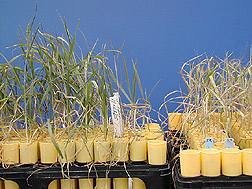
The Yecoro wheat (right) cultivar is sensitive to salinity, plants resulting from a hybrid cross with cultivar W4910 (left) show greater tolerance to high salinity
Plant breeding has been practiced for thousands of years, since near the beginning of human civilization. It is practiced worldwide by individuals such as gardeners and farmers, or by professional plant breeders employed by organizations such as government institutions, universities, crop-specific industry associations or research centers.
International development agencies believe that breeding new crops is important for ensuring food security by developing new varieties that are higher-yielding, disease resistant, drought-resistant or regionally adapted to different environments and growing conditions.
History
Plant breeding started with sedentary agriculture and particularly the domestication of the first agricultural plants, a practice which is estimated to date back 9,000 to 11,000 years. Initially early farmers simply selected food plants with particular desirable characteristics, and employed these as progenitors for subsequent generations, resulting in an accumulation of valuable traits over time.
Gregor Mendel's experiments with plant hybridization led to his establishing laws of inheritance. Once this work became well known, it formed the basis of the new science of genetics, which stimulated research by many plant scientists dedicated to improving crop production through plant breeding.
Modern plant breeding is applied genetics, but its scientific basis is broader, covering molecular biology, cytology, systematics, physiology, pathology, entomology, chemistry, and statistics (biometrics). It has also developed its own technology.
Classical Plant Breeding
One major technique of plant breeding is selection, the process of selectively propagating plants with desirable characteristics and eliminating or "culling" those with less desirable characteristics.
Another technique is the deliberate interbreeding (crossing) of closely or distantly related individuals to produce new crop varieties or lines with desirable properties. Plants are crossbred to introduce traits/genes from one variety or line into a new genetic background. For example, a mildew-resistant pea may be crossed with a high-yielding but susceptible pea, the goal of the cross being to introduce mildew resistance without losing the high-yield characteristics. Progeny from the cross would then be crossed with the high-yielding parent to ensure that the progeny were most like the high-yielding parent, (backcrossing). The progeny from that cross would then be tested for yield (selection, as described above) and mildew resistance and high-yielding resistant plants would be further developed. Plants may also be crossed with themselves to produce inbred varieties for breeding. Pollinators may be excluded through the use of pollination bags.
Classical breeding relies largely on homologous recombination between chromosomes to generate genetic diversity. The classical plant breeder may also make use of a number of in vitro techniques such as protoplast fusion, embryo rescue or mutagenesis (see below) to generate diversity and produce hybrid plants that would not exist in nature.
Traits that breeders have tried to incorporate into crop plants include:
- Improved quality, such as increased nutrition, improved flavor, or greater beauty
- Increased yield of the crop
- Increased tolerance of environmental pressures (salinity, extreme temperature, drought)
- Resistance to viruses, fungi and bacteria
- Increased tolerance to insect pests
- Increased tolerance of herbicides
- Longer storage period for the harvested crop
Before World War 11
Successful commercial plant breeding concerns were founded from the late 19th century. Gartons Agricultural Plant Breeders in England was established in the 1890s by John Garton, who was one of the first to commercialize new varieties of agricultural crops created through cross-pollination. The firm's first introduction was Abundance Oat, one of the first agricultural grain varieties bred from a controlled cross, introduced to commerce in 1892.
In the early 20th century, plant breeders realized that Mendel's findings on the non-random nature of inheritance could be applied to seedling populations produced through deliberate pollinations to predict the frequencies of different types. Wheat hybrids were bred to increase the crop production of Italy during the so-called "Battle for Grain" (1925–1940). Heterosis was explained by George Harrison Shull. It describes the tendency of the progeny of a specific cross to outperform both parents. The detection of the usefulness of heterosis for plant breeding has led to the development of inbred lines that reveal a heterotic yield advantage when they are crossed. Maize was the first species where heterosis was widely used to produce hybrids.
Garton's catalogue from 1902
Statistical methods were also developed to analyze gene action and distinguish heritable variation from variation caused by environment. In 1933 another important breeding technique, cytoplasmic male sterility (CMS), developed in maize, was described by Marcus Morton Rhoades. CMS is a maternally inherited trait that makes the plant produce sterile pollen. This enables the production of hybrids without the need for labor-intensive detasseling.
These early breeding techniques resulted in large yield increase in the United States in the early 20th century. Similar yield increases were not produced elsewhere until after World War II, the Green Revolution increased crop production in the developing world in the 1960s.
After World War 11
Following World War II a number of techniques were developed that allowed plant breeders to hybridize distantly related species, and artificially induce genetic diversity.
When distantly related species are crossed, plant breeders make use of a number of plant tissue culture techniques to produce progeny from otherwise fruitless mating. Interspecific and intergeneric hybrids are produced from a cross of related species or genera that do not normally sexually reproduce with each other. These crosses are referred to as Wide crosses. For example, the cereal, triticale is a wheat and rye hybrid. The cells in the plants derived from the first generation created from the cross contained an uneven number of chromosomes and as result was sterile. The cell division inhibitor colchicine was used to double the number of chromosomes in the cell and thus allow the production of a fertile line.
In vitro-culture of Vitis (grapevine), Geisenheim Grape Breeding Institute.
Failure to produce a hybrid may be due to pre- or post-fertilization incompatibility. If fertilization is possible between two species or genera, the hybrid embryo may abort before maturation. If this does occur the embryo resulting from an interspecific or intergeneric cross can sometimes be rescued and cultured to produce a whole plant. Such a method is referred to as Embryo Rescue. This technique has been used to produce new rice for Africa, an interspecific cross of Asian rice (Oryza sativa) and African rice (Oryza glaberrima).
Hybrids may also be produced by a technique called protoplast fusion. In this case protoplasts are fused, usually in an electric field. Viable recombinants can be regenerated in culture.
Chemical mutagens like EMS and DMS, radiation and transposons are used to generate mutants with desirable traits to be bred with other cultivars - a process known as Mutation Breeding. Classical plant breeders also generate genetic diversity within a species by exploiting a process called somaclonal variation, which occurs in plants produced from tissue culture, particularly plants derived from callus. Induced polyploidy, and the addition or removal of chromosomes using a technique called chromosome engineering may also be used.
When a desirable trait has been bred into a species, a number of crosses to the favored parent are made to make the new plant as similar to the favored parent as possible. Returning to the example of the mildew resistant pea being crossed with a high-yielding but susceptible pea, to make the mildew resistant progeny of the cross most like the high-yielding parent, the progeny will be crossed back to that parent for several generations (See backcrossing). This process removes most of the genetic contribution of the mildew resistant parent. Classical breeding is therefore a cyclical process.
With classical breeding techniques, the breeder does not know exactly what genes have been introduced to the new cultivars. Some scientists therefore argue that plants produced by classical breeding methods should undergo the same safety testing regime as genetically modified plants. There have been instances where plants bred using classical techniques have been unsuitable for human consumption, for example the poison solanine was unintentionally increased to unacceptable levels in certain varieties of potato through plant breeding. New potato varieties are often screened for solanine levels before reaching the marketplace.
Modern Plant Breeding
Modern plant breeding may use techniques of molecular biology to select, or in the case of genetic modification, to insert, desirable traits into plants. Application of biotechnology or molecular biology is also known as molecular breeding (see: Molecular breeding).

Modern facilities in molecular biology have converted classical plant breeding to molecular plant breeding
Step of Plants Breeding
The following are the major activities of plant breeding:
- Collection of variation
- Selection
- Evaluation
- Release
- Multiplication
- Distribution of the new variety
Marker Assisted Selection
Sometimes many different genes can influence a desirable trait in plant breeding. The use of tools such as molecular markers or DNA fingerprinting can map thousands of genes. This allows plant breeders to screen large populations of plants for those that possess the trait of interest. The screening is based on the presence or absence of a certain gene as determined by laboratory procedures, rather than on the visual identification of the expressed trait in the plant.
Reverse Breeding and Double Haploid (DH)
A method for efficiently producing homozygous plants from a heterozygous starting plant, which has all desirable traits. This starting plant is induced to produce doubled haploid from haploid cells, and later on creating homozygous/doubled haploid plants from those cells. While in natural offspring genetic recombination occurs and traits can be unlinked from each other, in doubled haploid cells and in the resulting DH plants recombination is no longer an issue. There, a recombination between two corresponding chromosomes does not lead to un-linkage of alleles or traits, since it just leads to recombination with its identical copy. Thus, traits on one chromosome stay linked. Selecting those offspring having the desired set of chromosomes and crossing them will result in a final F1 hybrid plant, having exactly the same set of chromosomes, genes and traits as the starting hybrid plant. The homozygous parental lines can reconstitute the original heterozygous plant by crossing, if desired even in a large quantity. An individual heterozygous plant can be converted into a heterozygous variety (F1 hybrid), without the necessity of vegetative propagation but as the result of the cross of two homozygous/doubled haploid lines derived from the originally selected plant. patent.
Genetic Modification
Genetic modification of plants is achieved by adding a specific gene or genes to a plant, or by knocking down a gene with RNAi to produce a desirable phenotype. The plants resulting from adding a gene are often referred to as transgenic plants. If for genetic modification genes of the species or of a crossable plant are used under control of their native promoter, then they are called cisgenic plants. Sometimes genetic modification can produce a plant with the desired trait or traits faster than classical breeding because the majority of the plant's genome is not altered.
To genetically modify a plant, a genetic construct must be designed so that the gene to be added or removed will be expressed by the plant. To do this, a promoter to drive transcription and a termination sequence to stop transcription of the new gene, and the gene or genes of interest must be introduced to the plant. A marker for the selection of transformed plants is also included. In the laboratory, antibiotic resistance is a commonly used marker: Plants that have been successfully transformed will grow on media containing antibiotics; plants that have not been transformed will die. In some instances markers for selection are removed by backcrossing with the parent plant prior to commercial release.
The construct can be inserted in the plant genome by genetic recombination using the bacteria Agrobacterium tumefaciens or A. rhizogenes, or by direct methods like the gene gun or microinjection. Using plant viruses to insert genetic constructs into plants is also a possibility, but the technique is limited by the host range of the virus. For example, Cauliflower mosaic virus (CaMV) only infects cauliflower and related species. Another limitation of viral vectors is that the virus is not usually passed on the progeny, so every plant has to be inoculated.
The majority of commercially released transgenic plants are currently limited to plants that have introduced resistance to insect pests and herbicides. Insect resistance is achieved through incorporation of a gene from Bacillus thuringiensis (Bt) that encodes a protein that is toxic to some insects. For example, the cotton bollworm, a common cotton pest, feeds on Bt cotton it will ingest the toxin and die. Herbicides usually work by binding to certain plant enzymes and inhibiting their action. The enzymes that the herbicide inhibits are known as the herbicides target site. Herbicide resistance can be engineered into crops by expressing a version of target site protein that is not inhibited by the herbicide. This is the method used to produce glyphosate resistant crop plants (See Glyphosate).
Genetic modification of plants that can produce pharmaceuticals (and industrial chemicals), sometimes called pharming, is a rather radical new area of plant breeding.
Issues and concerns
Modern plant breeding, whether classical or through genetic engineering, comes with issues of concern, particularly with regard to food crops. The question of whether breeding can have a negative effect on nutritional value is central in this respect. Although relatively little direct research in this area has been done, there are scientific indications that, by favoring certain aspects of a plant's development, other aspects may be retarded. A study published in the Journal of the American College of Nutrition in 2004, entitled Changes in USDA Food Composition Data for 43 Garden Crops, 1950 to 1999, compared nutritional analysis of vegetables done in 1950 and in 1999, and found substantial decreases in six of 13 nutrients measured, including 6% of protein and 38% of riboflavin. Reductions in calcium, phosphorus, iron and ascorbic acid were also found. The study, conducted at the Biochemical Institute, University of Texas at Austin, concluded in summary: "We suggest that any real declines are generally most easily explained by changes in cultivated varieties between 1950 and 1999, in which there may be trade-offs between yield and nutrient content".
The debate surrounding genetically modified food during the 1990s peaked in 1999 in terms of media coverage and risk perception, and continues today - for example, "Germany has thrown its weight behind a growing European mutiny over genetically modified crops by banning the planting of a widely grown pest-resistant corn variety."The debate encompasses the ecological impact of genetically modified plants, the safety of genetically modified food and concepts used for safety evaluation like substantial equivalence. Such concerns are not new to plant breeding. Most countries have regulatory processes in place to help ensure that new crop varieties entering the marketplace are both safe and meet farmers' needs. Examples include variety registration, seed schemes, regulatory authorizations for GM plants, etc.
Plant breeders' rights is also a major and controversial issue. Today, production of new varieties is dominated by commercial plant breeders, who seek to protect their work and collect royalties through national and international agreements based in intellectual property rights. The range of related issues is complex. In the simplest terms, critics of the increasingly restrictive regulations argue that, through a combination of technical and economic pressures, commercial breeders are reducing biodiversity and significantly constraining individuals (such as farmers) from developing and trading seed on a regional level. Efforts to strengthen breeders' rights, for example, by lengthening periods of variety protection, are ongoing.
When new plant breeds or cultivars are bred, they must be maintained and propagated. Some plants are propagated by asexual means while others are propagated by seeds. Seed propagated cultivars require specific control over seed source and production procedures to maintain the integrity of the plant breeds results. Isolation is necessary to prevent cross contamination with related plants or the mixing of seeds after harvesting. Isolation is normally accomplished by planting distance but in certain crops, plants are enclosed in greenhouses or cages (most commonly used when producing F1 hybrids.)
Role of plant breeding in organic agriculture
Critics of organic agriculture claim it is too low-yielding to be a viable alternative to conventional agriculture. However, part of that poor performance may be the result of growing poorly adapted varieties. It is estimated that over 95% of organic agriculture is based on conventionally adapted varieties, even though the production environments found in organic vs. conventional farming systems are vastly different due to their distinctive management practices. Most notably, organic farmers have fewer inputs available than conventional growers to control their production environments. Breeding varieties specifically adapted to the unique conditions of organic agriculture is critical for this sector to realize its full potential. This requires selection for traits such as:
- Water use efficiency
- Nutrient use efficiency (particularly nitrogen and phosphorus)
- Weed competitiveness
- Tolerance of mechanical weed control
- Pest/disease resistance
- Early maturity (as a mechanism for avoidance of particular stresses)
- Abiotic stress tolerance (i.e. drought, salinity, etc...)
Currently, few breeding programs are directed at organic agriculture and until recently those that did address this sector have generally relied on indirect selection (i.e. selection in conventional environments for traits considered important for organic agriculture). However, because the difference between organic and conventional environments is large, a given genotype may perform very differently in each environment due to an interaction between genes and the environment (see gene-environment interaction). If this interaction is severe enough, an important trait required for the organic environment may not be revealed in the conventional environment, which can result in the selection of poorly adapted individuals. To ensure the most adapted varieties are identified, advocates of organic breeding now promote the use of direct selection (i.e. selection in the target environment) for many agronomic traits.
There are many classical and modern breeding techniques that can be utilized for crop improvement in organic agriculture despite the ban on genetically modified organisms. For instance, controlled crosses between individuals allow desirable genetic variation to be recombined and transferred to seed progeny via natural processes. Marker assisted selection can also be employed as a diagnostics tool to facilitate selection of progeny who possess the desired trait(s), greatly speeding up the breeding process. This technique has proven particularly useful for the introgression of resistance genes into new backgrounds, as well as the efficient selection of many resistance genes pyramided into a single individual. Unfortunately, molecular markers are not currently available for many important traits, especially complex ones controlled by many genes.
Addressing global food security through plant breeding
For future agriculture to thrive there are necessary changes which must be made in accordance to arising global issues. These issues are arable land, harsh cropping conditions and food security which involves, being able to provide the world population with food containing sufficient nutrients. These crops need to be able to mature in several environments allowing for worldwide access, this is involves issues such as drought tolerance. These global issues are achievable through the process of plant breeding, as it offers the ability to select specific genes allowing the crop to perform at a level which yields the desired results.
Minimal Land Degradation
Land degradation is a major issue, as it can negatively impact the capability of the land to be productive. Poor agricultural management has a huge impact on the degradation of soil worldwide and it is Africa and Asia that are most affected. Through education and development of modified plants, these statistics can be reduced and agricultural land can become more productive. Plant breeding allows for an increase in yield with out the extra strain on the land. The genetically modified, Bt white maize, was introduced to South Africa and was surveyed in 33 large commercial farms and 368 small landholders properties and in both cases a higher yield was recorded.
Increased yield without expansion
With an increasing population, the production of food needs to increase with it. It is estimated that a 70% increase in food production is needed by 2050 in order to meet the Declaration of the World Summit on Food Security. But with the natural degradation of agricultural land, simply planting more crops is no longer a viable option. Therefore, new varieties of plants need to be developed through plant breeding that generates an increase of yield without relying on an increase in land area. An example of this can be seen in Asia, where food production per capita has increased twofold. This has been achieved through not only the use of fertilisers, but through the use of better crops that have been specifically designed for the area.
Breeding for increase nutritional value
Plant breeding can contribute to global food security as it is a cost-effective tool for increasing nutritional value of forage and crops. Improvements in nutritional value for forage crops from the use of analytical chemistry and rumen fermentation technology have been recorded since 1960; this science and technology gave breeders the ability to screen thousands of samples within a small amount of time, meaning breeders could identify a high performing hybrid quicker. The main area genetic increases were made was in vitro dry matter digestibility (IVDMD) resulting in 0.7-2.5% increase, at just 1% increase in IVDMD a single Bos Taurus also known as beef cattle reported 3.2% increase in daily gains. This improvement indicates plant breeding is an essential tool in gearing future agriculture to perform at a more advanced level.
Breeding for tolerance
Plant breeding of hybrid crops has become extremely popular worldwide in an effort to combat the harsh environment. With long periods of drought and lack of water or nitrogen stress tolerance has become a significant part of agriculture. Plant breeders have focused on identifying crops which will ensure crops perform under these conditions; a way to achieve this is finding strains of the crop that is resistance to drought conditions with low nitrogen. It is evident from this that plant breeding is vital for future agriculture to survive as it enables farmers to produce stress resistant crops hence improving food security.
Participatory plant breeding
The development of agricultural science, with phenomenon like the Green Revolution arising, have left millions of farmers in developing countries, most of whom operate small farms under unstable and difficult growing conditions, in a precarious situation. The adoption of new plant varieties by this group has been hampered by the constraints of poverty and the international policies promoting an industrialized model of agriculture. Their response has been the creation of a novel and promising set of research methods collectively known as participatory plant breeding. Participatory means that farmers are more involved in the breeding process and breeding goals are defined by farmers instead of international seed companies with their large-scale breeding programs. Farmers' groups and NGOs, for example, may wish to affirm local people's rights over genetic resources, produce seeds themselves, build farmers' technical expertise, or develop new products for niche markets, like organically grown food.
References
- ^ Breeding Field Crops. 1995. Sleper and Poehlman. Page 3
- ^ Piperno, D. R.; Ranere, A. J.; Holst, I.; Iriarte, J.; Dickau, R. (2009). "Starch grain and phytolith evidence for early ninth millennium B.P. maize from the Central Balsas River Valley, Mexico". PNAS 106 (13): 5019–5024. doi:10.1073/pnas.0812525106. PMC 2664021 PMID 19307570.
- ^ Deppe, Carol (2000). Breed Your Own Vegetable Varieties. Chelsea Green Publishing.|page=237-244
- ^ "Plant breeding".
- ^ Spring Seed Catalogue 1899, Gartons Limited
- ^ Noel Kingsbury (2009). Hybrid: The History and Science of Plant Breeding. University of Chicago Press. p. 140.
- ^ Suzie Key, Julian K-C Ma, and Pascal MW Drake (1 June 2008). "Genetically modified plants and human health. Journal of the Royal Society of Medecine. pp. 290–298. Retrieved 11 March 2015.
- ^ Davis, D.R.; Epp, M.D.; Riordan, H.D. (2004). "Changes in USDA Food Composition Data for 43 Garden Crops, 1950 to 1999". Journal of the American College of Nutrition 23(6): 669–682. doi:10.1080/07315724.2004.10719409.
- ^ Costa-Font, J.; Mossialos, E. (2007). "Are perceptions of ‘risks’ and ‘benefits’ of genetically modified food (in)dependent?". Food Quality and Preference 18: 173–182. doi:10.1016/j.foodqual.2005.09.013.
- ^ Connoly, Kate (2009-04-14). "Germany deals blow to GM crops".The Guardian.Retrieved 2009-06-25.
General
- Borem, A.; Miranda, G. V. Melhoramento de Plantas. 5ª. ed. Viçosa: Editora UFV, 2009. v. 1. 543 p.
- Borem, A. (Org.). Domesticação e Melhoramento: espécies amazônicas1. ed. Visconde do Rio Branco: Suprema Grafica e Editora, 2009. (in press)v. 1. 588 p.
- Borem, A. (Org.); Caixeta, E. T. (Org.) . Marcadores Moleculares. 2a.. ed. Visconde do Rio Branco: Suprema Grafica e Editora, 2008. v. 1. 532 p.
- Borem, A.; Condori, M.; Miranda, G. V. Mejoramiento de Plantas (in Spanish). 1. ed. Viçosa: Editora UFV, 2008. v. 1. 438 p.
- McCouch, S. (2004). "Diversifying Selection in Plant Breeding. PLoS Biol 2 (10): e347. doi:10.1371/journal.pbio.0020347 PMC 521731 PMID 15486582.
- Briggs, F.N. and Knowles, P.F. 1967. Introduction to Plant Breeding. Reinhold Publishing Corporation, New York.
- Gepts, P. (2002). "A Comparison between Crop Domestication, Classical Plant Breeding, and Genetic Engineering. Crop Science 42 (6): 1780–1790. doi:10.2135/cropsci2002.1780.
- The Origins of Agriculture and Crop Domestication - The Harlan Symposium.
- news@nature.com. 1999 Are non-GM crops safe?.
- Schlegel,Rolf (2009) Encyclopedic Dictionary of Plant Breeding, 2nd ed. (ISBN 9781439802427), CRC Press, Boca Raton, FL, USA, pp 584
External Links
- Wikipedia