Blog List

Saturday, 26 March 2016

SPORE

In biology, a spore is a unit of asexual reproduction that may be adapted for dispersal and for survival, often for extended periods of time, in unfavorable conditions. By contrast, gametes are units of sexual reproduction. Spores form part of the life cycles of many plants, algae, fungi and protozoa. Bacterial spores are not part of a sexual cycle but are resistant structures used for survival under unfavourable conditions. Myxozoan spores release amoebulae into their hosts for parasitic infection, but also reproduce within the hosts through the pairing of two nuclei within the plasmodium, which develops from the amoebula.
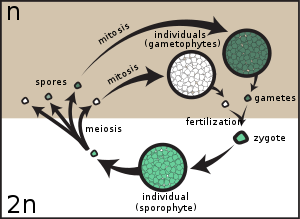

Spores produced in a sporic life cycle.
Spores are usually haploid and unicellular and are produced by meiosis in the sporangium of a diploid sporophyte. Under favourable conditions the spore can develop into a new organism using mitotic division, producing a multicellular gametophyte, which eventually goes on to produce gametes. Two gametes fuse to form a zygote which develops into a new sporophyte. This cycle is known as alternation of generations.
The spores of seed plants however, are produced internally and the megaspores, formed within the ovules and the microspores are involved in the formation of more complex structures that form the dispersal units, the seed sand pollen grains.
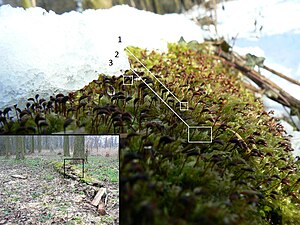

Fresh snow partially covers Rough-stalked Feather-moss (Brachythecium rutabulum), growing on a thinned hybrid black poplar (Populus x canadensis). The last stage of the moss lifecycle is shown, where the sporophytes are visible before dispersion of their spores: the calyptra (1) is still attached to the capsule (2). The tops of the gametophytes (3) can be discerned as well. Inset shows the surrounding, black poplars growing on sandy loam on the bank of a kolk, with the detail area marked.
Definition
The term spore derives from the ancient Greek word σπορά spora, meaning "seed, sowing," related to σπόρος sporos, "sowing," and σπείρειν speirein, "to sow."
In common parlance, the difference between a "spore" and a "gamete" (both together called gonites) is that a spore will germinate and develop into a sporeling, while a gamete needs to combine with another gamete to form a zygote before developing further.
The chief difference between spores and seeds as dispersal units is that spores are unicellular, while seeds contain within them a multicellular gametophyte that produces a developing embryo, the multicellular sporophyte of the next generation. Spores germinate to give rise to haploid gametophytes, while seeds germinate to give rise to diploid sporophytes.
Classification of spore-producing organisms

Vascular plant spores are always haploid. Vascular plants are either homosporous (or isosporous) or heterosporous. Plants that are homosporous produce spores of the same size and type. Heterosporous plants, such as seed plants, spikemosses, quillworts, and some aquatic ferns produce spores of two different sizes: the larger spore (megaspore) in effect functioning as a "female" spore and the smaller (microspore) functioning as a "male".

Classification of spores


Asci of Morchella elata containing ascospores.

Spores can be classified in several ways:
By Spore Producing Structures


In plants, microspores and in some cases megaspores, are formed from all four products of meiosis.
In fungi and fungus-like organisms, spores are often classified by the structure in which meiosis and spore production occurs. Since fungi are often classified according to their spore-producing structures, these spores are often characteristic of a particular taxon of the fungi.
  • Sporangiospores: spores produced by a sporangium in many fungi such as zygomycetes.
  • Zygospores: spores produced by a zygosporangium, characteristic of zygomycetes.
  • Ascospores:  spores produced by an ascus, characteristic of ascomycetes.
  • Basidiospores: spores produced by a basidium, characteristic of basidiomycetes.
  • Aeciospores:  spores produced by an aecium in some fungi such as rusts or smuts.
  • Urediniospores: spores produced by a uredinium in some fungi such as rusts or smuts.
  • Teliospores: spores produced by a telium in some fungi such as rusts or smuts.
  • Oospores: spores produced by an oogonium, characteristic of oomycetes.
  • Carpospores: spores produced by a carposporophye, characteristic of red algae.
  • Tetraspores: spores produced by a tetrasporophyte, characteristic of red algae.


In contrast, in many seed plants and heterosporous ferns, only a single product of meiosis will become a megaspore (macrospore), with the rest degenerating.
By Function

  • Chlamydospores: thick-walled resting spores of fungi produced to survive unfavorable conditions.
  • Parasitic fungal spores may be classified into internal spores, which germinate within the host, and external spores, also called environmental spores, released by the host to infest other hosts.

By Origin During Life Cycle

  • Meiospores: spores produced by meiosis, they are thus haploid and give rise to a haploid daughter cell(s) or a haploid individual. Examples are the precursor cells of gametophytes of seed plants found in flowers angiosperms) or cones (gymnosperms and the zoospores produced from meiosis in the sporophytes of algae such as Ulva.
    • Microspore: meiospores that give rise to a male gametophyte, (pollen in seed plants).
    • Megaspores (or macrospores): meiospores that give rise to a female gametophyte, (in seed plants the gametophyte forms within the ovules).
  • Mitospores (or conidiaconidiospores): spores produced by mitosis; they are characteristic of Ascomycetes. Fungi in which only mitospores are found are called "mitosporic fungi" or "anamorphic fungi", and are previously classified under the taxon Deuteromycoth (See Teleomorph, anamorph and holomorph).,
By Mobility
Spores can be differentiated by whether they can move or not.
  • Zoospores: mobile spores that move by means of one or more flagella, and can be found in some algae and fungi.
  • Aplanospores: immobile spores that may nevertheless potentially grow flagella.
  • Autospores:  immobile spores that cannot develop flagella.
  • Ballistospores: spores that are actively discharged from the body of the fungal fruiting body. Most basidiospore are also ballistospores, and another notable example is spores of Pilobolus.
  • Statismospores: spores that are not actively discharged from the fungal fruiting body. Examples are puffballs.

Anatomy

Under high magnification, spores can be categorized as either monolete spores or trilete spores. In monolete spores, there is a single line on the spore indicating the axis on which the mother spore was split into four along a vertical axis. In trilete spores, all four spores share a common origin and are in contact with each other, so when they separate, each spore shows three lines radiating from a center pole.

Spore Tetrads and Trilete Spores

Envelope-enclosed spore tetrads are taken as the earliest evidence of plant life on land, dating from the mid-Ordovician (early Llanvirn, ~470 million years ago), a period from which no macrofossils have yet been recovered. Individual trilete spores resembling those of modern cryptogamic plants first appeared in the fossil record at the end of the Ordovician period.

Dispersal
In fungi, both asexual and sexual spores or sporangiospores of many fungal species are actively dispersed by forcible ejection from their reproductive structures. This ejection ensures exit of the spores from the reproductive structures as well as travelling through the air over long distances. Many fungi thereby possess specialized mechanical and physiological mechanisms as well as spore-surface structures, such as hydrophobins, for spore ejection. These mechanisms include, for example, forcible discharge of ascospores enabled by the structure of the ascus and accumulation of osmolytes in the fluids of the ascus that lead to explosive discharge of the ascospores into the air. The forcible discharge of single spores termed ballistospores involves formation of a small drop of water (Buller's drop), which upon contact with the spore leads to its projectile release with an initial acceleration of more than 10,000 g. Other fungi rely on alternative mechanisms for spore release, such as external mechanical forces, exemplified by puffballs. Attracting insects, such as flies, to fruiting structures, by virtue of their having lively colours and a putrid odour, for dispersal of fungal spores is yet another strategy, most prominently used by the stinkhorns.
File:Fungus spore ejection.ogg
Spores being ejected by fungi.
In Common Smoothcap moss (Atrichum undulatum), the vibration of sporophyte has been shown to be an important mechanism for spore release.
In the case of spore-shedding vascular plants such as ferns, wind distribution of very light spores provides great capacity for dispersal. Also, spores are less subject to animal predation than seeds because they contain almost no food reserve; however they are more subject to fungal and bacterial predation. Their chief advantage is that, of all forms of progeny, spores require the least energy and materials to produce.
In the spikemoss Selaginella lepidophylla, dispersal is achieved in part by an unusual type of diaspore, a tumbleweed.
References

  1. ^ Spore FAQ.
  2. ^ "Myxozoa." Tree of Life web project. Ivan Fiala 10 July 2008. Web. 14 Jan. 2014. <http://tolweb.org/Myxozoa/2460>.
  3. ^ Microsporidia (Protozoa): A Handbook of Biology and Research Techniques at the Wayback Machine (archived June 26, 2008). modares.ac.ir
  4. ^ Gray, J.; Chaloner, W. G.; Westoll, T. S. (1985). "The Microfossil Record of Early Land Plants: Advances in Understanding of Early Terrestrialization, 1970–1984". Philosophical Transactions of the Royal Society B 309 (1138): 167–195. Bibcode:1985RSPTB.309..167G. doi:10.1098/rstb.1985.0077. JSTOR 2396358.
  5. ^ Wellman, C.H., Gray, J. (2000). "The microfossil record of early land plants". Philosophical Transactions of the Royal Society B 355 (1398): 717–732. doi:10.1098/rstb.2000.0612. PMC 1692785  PMID 10905606.
  6. ^ Steemans, P.; Herisse, A. L.; Melvin, J.; Miller, M. A.; Paris, F.; Verniers, J.; Wellman, C. H. (2009). "Origin and Radiation of the Earliest Vascular Land Plants". Science 324 (5925): 353–353. Bibcode:2009Sci...324..353. doi:10.1126/science.1169659. ISSN 0036-8075. PMID 19372423.
  7. ^ Trail F. (2007). "Fungal cannons: explosive spore discharge in the Ascomycota". FEMS Microbiology Letters 276 (1): 12–8. doi:10.1111/j.1574-6968.2007.00900.x. PMID 17784861 .
  8. ^ Pringle A, Patek SN, Fischer M, Stolze J, Money NP. (2005). "The captured launch of a ballistospore". Mycologia 97 (4): 866–71. doi:10.3852/mycologia.97.4.866. PMID 16457355.
  9. ^ Johansson, Lönnell, Sundberg and Hylander (2014) Release thresholds for moss spores: the importance of turbulence and sporophyte length. Journal of Ecology, n/a-n/a.
  10. ^ "False Rose of Jericho – Selaginella lepidophyllaFalse Rose of Jericho – Selaginella lepidophylla". Plant- and Flower guide. February 2009. Retrieved 1 February 2010.

- Wikipedia 

Nutritional Value for Raw Carrot Juice

Sweet and brilliantly orange carrots are delicious cooked or raw. And while you might not think of it at first, fresh juice made from raw carrots is another way to get most of the nutritional benefits of raw carrots in a drinkable format. The dietary fiber of raw carrots, however, is not available in juice, because it is filtered out during the juicing process. It takes 3 cups of chopped raw carrot to make 1 cup of raw carrot juice, which is rich in a number of vitamins and minerals.


Nutritional Value for Raw Carrot Juice
A small cup of carrot juice. Photo Credit al62/iStock/Getty Images
Strong Bones and Teeth
Calcium is essential for strong bones and teeth. It is also necessary for muscular and blood vessel contractions, and it enables your nerves to carry messages between areas of your body. Calcium also helps release various enzymes and hormones that play a role in virtually every bodily function. The daily recommended amount of calcium is 1,000 milligrams for adult men and women, increasing to 1,200 milligrams for women over 51 years of age, and 1,300 milligrams for pregnant and nursing women. A 1-cup serving of raw carrot juice offers 127 milligrams of calcium, about 9.8 to 12.7 percent of the daily recommendation of calcium.

Vitamin E

Vitamin E provides support to your immune system, and it helps with red blood cell production. It dilates blood vessels, reducing the risk of blood clots, and it is also a natural antioxidant, protecting your body from damage from free radicals. Free radicals that build up in your body — they are formed as your body metabolizes food and fats — can speed up the aging process, as well as cause cell death and damage, increasing your risk of developing heart disease or cancer. A 1-cup serving of raw carrot juice has 2.5 milligrams of vitamin E. This provides 16.7 of the recommended intake for adult men and women, including pregnant women, and 13 percent of the recommended intake for breastfeeding women.


Vitamin A

Vitamin A helps with cellular differentiation, and it is crucial for keeping your eyesight healthy. It also keeps your mucous membranes healthy, as well as helping in healing wounds and providing support to your immune system. Like vitamin E, vitamin A is a natural antioxidant, protecting your body from damage from free radicals. Carrots are particularly rich in vitamin A, with a 1-cup serving of raw carrot juice providing 3,206 micrograms. This is well over 100 percent of the daily dietary intake of vitamin A for all adults, including pregnant and breastfeeding women.

Rich in Vitamin K

Vitamin K is essential for blood coagulation, earning it the nickname as the “clotting vitamin.” Stored in your liver and fat tissue, it also helps your body absorb and use calcium, making it important for maintaining healthy bones and teeth. The daily adequate intake of vitamin K is 90 micrograms for adult women and 120 micrograms for adult men. A 1-cup serving of raw carrot juice has 51 micrograms of vitamin K, providing 43 percent to 57 percent of the daily AI for adults.
www.livestrong.com

How to Cook Chicken Breasts & Carrots in the Oven With Foil

For a simple, healthy meal that leaves little cleanup, bake a chicken breast and chopped carrots in an aluminum foil packet. Chicken and carrots are a healthy meal choice, with a 3-ounce chicken breast containing only 165 calories and 5 grams of fat, but plenty of protein, magnesium, selenium, zinc, iron and several B vitamins. Similarly, one medium carrot contains about 30 calories and supplies generous quantities of beta carotene and potassium.


How to Cook Chicken Breasts & Carrots in the Oven With Foil
A white bowl of chicken and carrots. Photo Credit Elena_Danileiko/iStock/Getty Images
Step 1
Preheat the oven to 400 degrees Fahrenheit.

Step 2

Cut two 18- to 20-inch square pieces of heavy-duty aluminum foil for each chicken breast. Put one piece of foil on top of the other.

Step 3

Rub each chicken breast with olive oil. Place the chicken in the center of the foil.

Step 4

Peel and dice one or two fresh carrots for each chicken breast. Arrange the carrot pieces around the chicken breast. You can also use frozen or canned carrots.

Step 5

Sprinkle the chicken breasts and carrots with sea salt and black pepper. You can also sprinkle the chicken and carrots with seasonings such as garlic powder, cayenne pepper or chili powder.

Step 6

Bring the edges of the aluminum foil together. Fold the foil securely to make a packet around the chicken and vegetables.


Step 7

Place the foil packets on a baking sheet.

Step 8

Bake the chicken and carrots for 25 minutes, and then open the top of the packet. Return the packet to the oven for an additional five minutes.

How to Cook Pre-Sliced Ham

Pre-sliced ham can mean one of two things: ham slices or a full ham cut to aid in carving. Ham steak is individual ham slices cut to varying thicknesses. Utilizing these slices provides an economical way to enjoy ham without purchasing a whole roast. Spiral hams are pre-sliced without cutting all the way through the meat. This provides a guide and head start when it comes time to carve.


How to Cook Pre-Sliced Ham
There are various ways to cook pre-sliced ham. Photo Credit evgenyb/iStock/Getty Images
Pan-Fry

Step 1

Preheat a skillet at medium.

Step 2

Place the slices of ham on the bottom of the skillet and season as desired. For example, add a glaze or sprinkle on garlic powder. There is no need to use oil in the skillet when frying ham steak. As the ham heats, the juices in the meat will prevent sticking.

Step 3

Fry the slices on each side for five minutes or until the ham browns thoroughly.

Broil Slices

Step 1

Turn the broiler on and allow it to preheat.

Step 2

Lay the ham slices out on a broiler pan and season or glaze the pieces.

Step 3

Broil the slices on a rack three inches removed from the heat. Let them cook three to five minutes on each side.


Full Spiral Ham

Step 1

Preheat the oven to 275 degrees Fahrenheit.

Step 2

Place the ham into a large roasting pan. Add seasonings or a glaze to the ham surface.

Step 3

Bake the ham in the oven for 15 minutes per pound. For example, if baking a eight-pound ham, leave it in the oven for two hours.

Step 4

Stick a meat thermometer into the center of a thick area of the ham. When the internal temperature reaches 160 degrees Fahrenheit, remove the pan from the oven and let the ham cool before finishing the carving.

SPECIES COMPLEX

This article is about a group of very similar species. For "species-group names" in zoological nomenclature, see International Code of Zoological Nomenclature. For individuals of different species grouping together, see Mutualism (biology)#Service-service relationships.
"Cryptic species" redirects here. For the principles of hiding, see Crypsis. For a supposed creature whose existence is not scientifically recognized, see Cryptid.
"Physiologic race" redirects here. For the mycology and phytopathology informal classification, see Race (biology) § Physiological race.

The butterfly genus Heliconius contains some species extremely difficult to tell apart.
In biology, a species complex is a group of closely related species that are very similar in appearance to the point that the boundaries between them are often unclear. Terms sometimes used synonymously but with more precise meanings are: cryptic species for two or more species hidden under one species name, sibling speciesfor two cryptic species that are each other's closest relative, and species flock for a group of closely related species living in the same habitat. As informal taxonomic ranks, species groupspecies aggregate, and superspecies are also in use.
Two or more taxa once considered conspecific (of the same species) may later be subdivided into infraspecific taxa (taxa within a species, such as bacterial strains or plant varieties but this is not a species complex.
A species complex is in most cases a monophyletic group with a common ancestor, although there are exceptions. It may represent an early stage after speciation, but may also have been separated for a long time period without evolving morphological differences. Hybrid speciation can be a component in the evolution of a species complex.
Species complexes exist in all groups of organisms. They are identified by the rigorous study of differences between individual species, making use of minute morphological details, tests of reproductive isolation or DNA-based methods such as molecular phylogenetics or DNA barcoding. The existence of extremely similar species may cause local and global species diversity to be underestimated. Recognizing similar but distinct species is important for disease and pest controls  and in conservation biology, although drawing dividing lines between species can be inherently difficult.
Definition
A species complex is typically considered as a group of close, but distinct species. Obviously, the concept is closely tied to the definition of a species. Modern biology understands a species as "separately evolving metapopulation lineage but acknowledges that the criteria to delimit species. may depend on the group studied. Thus, many species defined traditionally, based only on morphological similarity, have been found to comprise several distinct species when other criteria, such as genetic differentiation or reproductive isolation were applied.
Six light brown treefrogs, labelled A to E
At least six treefrog species make up the Hypsiboas calcaratusfasciatus species complex.
A more restricted use applies the term to close species between which hybridisation occurred or is occurring, leading to intermediate forms and blurred species boundaries.
Picture showing two mushrooms with red caps on a meadow
The fly agaric comprises several cryptic species, as shown by genetic data.

An adult and a young elephant bathing
The African forest elephant (shown) is the bush elephant sibling species.

A flock of differently coloured fish in a rocky setting
Mbuna cichlids form a species flock in Lake Malawi.
Some authors apply the term also to a species with intraspecific variability, which might be a sign of ongoing or incipient speciation examples are ring species or species with subspecies, where it is often unclear if these should be considered separate species.

Included Concept

Several terms are used synonymously for a species complex, but some of them may also have slightly different, or more narrow meanings. In the nomenclature codes, of zoology and bacteriology, no taxonomic ranks are defined at the level between subgenera and species, while the botanical code defines four ranks below genera (section, subsections, series and subseries). Different informal taxonomic solutions have been used to indicate a species complex.
Cryptic species
Also physiologic race (uncommon). This describes "distinct species that are erroneously classified (and hidden) under one species name". More generally, the term is often applied when species, even if known to be distinct, cannot be reliably distinguished based on their morphology. The usage physiologic race is not to be confused with physiological race.
Sibling species
Also aphanic species. This term, introduced by Ernst Mayr in 1942, was initially used with the same meaning as cryptic species, but later authors emphasized the common phylogenetic origin. A recent article defines sibling species as "cryptic sister species", meaning "two species that are the closest relative of each other and have not been distinguished from one another taxonomically".
Species flock
Also species swarm. This refers to "a monophyletic group of closely related species all living in the same ecosystem". Conversely, the term has also been applied very broadly to a group of closely related species than can be variable and widespread.
Superspecies
Sometimes used as an informal rank for a species complex around one "representative" species. Popularized by Bernhard Rensch and later Ernst Mayr, with the initial requirement that species forming a superspecies must have allopatric distributions. For the component species of a superspecies, allospecies was proposed.
Species aggregate
Used for a species complex, especially in plant taxa where polypoidy and apomixis are common. Historical synonyms are species collectiva, introduced by Adolf Engler, conspecies, and grex. Components of a species aggregate have been called segregates or microspecies Used as abbreviation agg. after the binomial species name.
Sensu lato
Meaning "in the broad sense", this Latin phrase is often used after a binomial species name, often abbreviated as s.l., to indicate a species complex represented by that species.

Identifications
Distinguishing close species within a complex requires the study of often very small differences. Morphological differences may be minute and only visible using adapted methods, such as microscopy. However, distinct species may sometimes have no morphological differences. In these cases, other characters, e.g. in the species' life history, behavior, physiology or karyology can be explored. As an example, territorial songs are indicative of species in the treecreepers, a bird genus with little morphological differences. Mating tests are common in some groups such as fungi to confirm the reproductive isolation of two species.
Analysis of DNA sequences is becoming increasingly standard for species recognition and may in many cases be the only useful method. Different methods are used to analyse such genetic data, for example molecular phylogenetics or DNA barcoding.Such methods have greatly contributed to the discovery of cryptic species, including such emblematic species as the fly agaric or the African elephant.

An individual of a yellow-spotted salamander
Salamandra corsica

An individual of a uniformly black salamander.
Salamandra atra

An individual of a fire salamander
Salamandra salamandra
Similarity can be misleading: The Corsican fire salamander (left) was previously considered a subspecies of the fire salamander (right), but is in fact more closely related to the uniformly black Alpine salamander (center).

Evolution and ecology
Speciation Process
Species forming a complex have typically diverged very recently from each other, allowing in some cases to retrace the process of speciation. Species with differentiated populations such as ring species are sometimes seen as an example of early, ongoing speciation, i.e. a species complex in formation. Nevertheless, similar but distinct species have sometimes been isolated for a long time without evolving differences, a phenomenon called "morphological stasis". As an examples, the Amazonian frog Pristimantis ockendeni is actually at least three different species that diverged over 5 million years ago.
Schematic phylogram with nine species, five of which form a group with short branches, separated from the others by a long branch
A species complex typically forms a monophyletic group that has diversified rather recently, as shown by the short branches between the species A–E (blue box) in this phylogenetic tree.
Stabilizing selection has been invoked as a force maintaining similarity in species complexes, especially when adaptation to special environments, such as a host in the case of symbionts, or extreme environments, constrains possible directions of evolution: In such cases, strongly divergent selection is not to be expected. Also, asexual reproduction, such as through apomixis in plants, may separate lineages without producing a great degree of morphological differentiation.
A species complex is usually a group that has one common ancestor (a monophyletic group), although closer examination can sometimes disprove this. As an example, the yellow-spotted "fire salamanders" in the genus Salamandra, formerly all classified as one species S. salamandra,are not monophyletic: the Corsican fire salamander, closest relative was shown to be the entirely black Alpine salamander. In such cases, similarity has arisen from convergent evolution.
Scheme showing morphological stasis and hybrid speciation, with species presresented by circles, their color indicating morphological similarity or dissimilarity
Possible processes explaining simiilarity of species in a species complex:
a – morphological stasis
b – hybrid speciation
Hybrid speciation can lead to unclear species boundaries through a process of reticulate evolution, where species have two parent species as their most recent common ancestor. In such cases, the hybrid species may have intermediate characters, as demonstrated e.g. in Heliconius butterflies. Hybrid speciation has been observed in various species complexes, such as insects, fungi, and plants. In plants, hybridization often takes place through polyploidization, and hybrid plant species are called nothospecies.
Range
In regards to whether or not members of a species group share a range, sources differ. A source from Iowa State University Department of Agronomy says that members of a species group usually have partially overlapping ranges but do not interbreed with each other. A Dictionary of Zoology (Oxford University Press,1999) describes a species group as complex of related species that exist allopatrically and explains that this "grouping can often be supported by experimental crosses in which only certain pairs of species will produce hybrids. "The examples given below may support both uses of the term "species group."
Often such complexes only become evident when a new species is introduced into the system, breaking down existing species barriers. An example is the introduction of the Spanish slug in Northern Europe, where interbreeding with the local black slug and red slug, traditionally considered clearly separate species that did not interbreed, shows they may be actually just subspecies of the same species.
Where closely related species coexist in sympatry, it is often a particular challenge to understand how these similar species persist without outcompeting each other. Niche partitioning is one mechanism invoked to explain this. Studies in some species complexes indeed suggest that species divergence went in par with ecological differentiation, with species now preferring different microhabitats. Similar methods also found that the Amazonian frog Eleutherodactylus ockendeni is actually at least 3 different species that diverged over 5 million years ago. A species flock may arise when a species penetrates a new geographical area and diversifies to occupy a variety of ecological niches; this process is known as adaptive radiation. The first species flock to be recognized as such was the 13 species of Darwin's finches on the Galápagos Islands described by Charles Darwin.
Practical implications

Biodiversity Estimates
It has been suggested that cryptic species complexes are very common in the marine environment.  Although this suggestion came before the detailed analysis of many systems using DNA sequence data, it has been proven correct. The increased use of DNA sequence in the investigation of organismal diversity (also called Phylogeography and DNA barcoding) has led to the discovery of a great many cryptic species complexes in all habitats. In the marine bryozoan Celleporella hyalina,  detailed morphological analyses and mating compatibility tests between the isolates identified by DNA sequence analysis were used to confirm that these groups consisted of more than 10 ecologically distinct species that had been diverging for many million years.
Evidence from the identification of cryptic species has led some to conclude that current estimates of global species richness are too low.
Disease and Pathology Control

A mosquito sitting on the tip of a finger
The Anopheles gambiae mosquito complex contains malaria vector and non-vector species.

Pests, species causing diseases, and their vectors, have direct importance for humans. When they are found to be cryptic species complexes, the ecology and virulence of each of these species needs to be reevaluated to devise appropriate control strategies. An example are cryptic species in the malaria vector Anopheles, or the fungi causing cryptococcosis. 

Conservation Biology

When a species is found to comprise in fact several phylogenetically distinct species, each of these typically have smaller distribution ranges and population sizes than reckoned before. These different species can also differ in their ecology, e.g. having different breeding strategies or habitat requirements, which has to be taken into account for appropriate management. For example, giraffe populations and subspecies differ genetically to such an extent that they may be considered species; while the giraffe as a whole is not considered threatened, considering each cryptic species separately would mean a much higher level of threat.

References

  1. ^ Ron, Santiago; Caminer, Marcel (2014). "Systematics of treefrogs of the Hypsiboas calcaratus and Hypsiboas fasciatus species complex (Anura, Hylidae) with the description of four new species". ZooKeys 370: 1–68. doi:10.3897/zookeys.370.6291. ISSN 1313-2970.
  2. a b Geml J, Tulloss RE, Laursen GA, Sasanova NA, Taylor DL. (2008). "Evidence for strong inter- and intracontinental phylogeographic structure in Amanita muscaria, a wind-dispersed ectomycorrhizal basidiomycete" (PDF)Molecular Phylogenetics and Evolution48 (2): 694–701. doi:10.1016/j.ympev.2008.04.029. PMID 18547823.
  3. a b Roca AL, Georgiadis N, Pecon-Slattery J, O'Brien SJ. (2001). "Genetic evidence for two species of elephant in Africa". Science 293 (5534): 1473–1477. doi:10.1126/science.1059936. PMID 11520983.
  4. ^ Moran P, Kornfield I. (1993). "Retention of an Ancestral Polymorphism in the Mbuna Species Flock (Teleostei: Cichlidae) of Lake Malawi (PDF)Molecular Biology and Evolution10 (5): 1015–1029.
  5. ^ Brown JK, Frohlich DR, Rosell RC. (1995). "The sweetpotato or silverleaf whiteflies: biotypes of Bemisia tabaci or a species complex?". Annual Review of Entomology 40 (1): 511–534. doi:10.1146/annurev.en.40.010195.002455.
  6. ^ De Queiroz, Kevin (2007). "Species Concepts and Species Delimitation". Systematic Biology 56 (6): 879–886. doi:10.1080/10635150701701083 ISSN 1063-5157.
  7. a b Mayr E. (1970). "Morphological species characters and sibling species". Populations, Species, and Evolution. Cambridge, MA: The Belknap Press of Harvard University Press. pp. 21–36. ISBN 0-674-69013-3.
  8. a b Horandl, E.; Greilhuber, J.; Klimova, K.; Paun, O.; Temsch, E.; Emadzade, K.; Hodalova, I. (2009). "Reticulate evolution and taxonomic concepts in the Ranunculus auricomus complex (Ranunculaceae): insights from analysis of morphological, karyological and molecular data" Taxon 58 (4): 1194–1215. PMC 2855680 PMID 20401184.
  9. ^ Moritz C, Schneider CJ, Wake DB. (1992). "Evolutionary relationships within the Ensatina eschscholtzii complex confirm the ring species interpretation". Systematic Biology41 (3): 273–291. doi:10.1093/sysbio/41.3.273.
  10. ^ Bowen BW, Bass AL, Rocha LA, Grant WS, Roberston DR. (2001). "Phylogeography of the trumpetfishes (Aulostomus): Ring species complex on a global scale". Evolution 55 (5): 1029–1039. doi:10.1111/j.0014-3820.2001.tb00619.x.

- Wikipedia 

Advantages and Disadvantages of Fasting for Runners

Author BY   ANDREA CESPEDES  Food is fuel, especially for serious runners who need a lot of energy. It may seem counterintuiti...