Blog List

Saturday, 9 April 2016

BIANTITROPICAL DISTRIBUTION

Biantitropical (or amphitropical) distribution refers to the pattern of species that exist at comparable latitudes across the equator but not in the tropics. For example, a species may be found north of the Tropic of Cancer and south of the Tropic of Capricorn, but not in between. This usually has to do with the optimal temperature for the species existing at both latitudes. How the life forms distribute themselves to the opposite hemisphere when they can't normally survive in the middle depends on the species; plants may have their seed spread through wind, animal, or other methods (dispersal) and then germinate upon reaching the appropriate climate, while sea life may be able to travel through the tropical regions in a larval state or by going through deep ocean currents with much colder temperatures than on the surface.

Plants

  • Phacelia crenulata - scorpionweed
  • Bowlesia incana - American Bowlesia
  • Osmorhiza berteroi and Osmorhiza depauperata - sweet cecily species.
  • Ruppia megacarpa.
  • Solenogyne.

Animals


References

  1. ^ Ito, Y., T. Ohi-Toma, J. Murata and Nr. Tanaka (2010) Hybridization and polyploidy of an aquatic plant, Ruppia (Ruppiaceae), inferred from plastid and nuclear DNA phylogenies. American Journal of Botany 97: 1156-1167
  2. ^ Nakamura, K., T. Denda, G. Kokubugata, P.I. Forster, G. Wilson, C.-I Peng, M. Yokota (2012) Molecular phylogeography reveals an antitropical distribution and local diversification of Solenogyne (Asteraceae) in the Ryukyu Archipelago of Japan and Australia. Biological Journal of the Linnean Society 105: 197-217

- Wikipedia

Advantages & Disadvantages of the Blood Type Diet

The key to weight loss and better health is not a low-fat plan that includes a wide variety of produce, whole grains, calcium-rich foods and lean protein, argues naturopath Peter J. D'Adamo. Instead, the key is to eat in a way that mirrors the diet of your prehistoric ancestors. D'Adamo claims your blood type indicates from whom you are descended. Type-O people should supposedly eat as the hunter-gatherers did, type B's as ancient nomads, type-A individuals as agrarian farmers and type-AB people as a combination of A and B. All have different recommended and restricted foods. Ask your doctor if the plan advised for your blood type is a healthy, balanced choice.
Advantages & Disadvantages of the Blood Type Diet
A breakfast set up with milk, tea, egg, bread and preserves on a kitchen table. Photo Credit TongRo Images/TongRo Images/Getty Images.

Discourages Processed and Refined Foods

Despite the differences D'Adamo recommends for each blood type, all followers are encouraged to eliminate processed foods and to purchase all meat, poultry, seafood and produce as close to its natural state as possible. For example, type-A individuals are advised to base their diets on fresh, organic fruits and vegetables, while those with type AB should not eat cured meats. In addition, refined grains and white sugar are discouraged for all blood types. Eating fewer processed and refined foods will lower your intake of fat, sodium and empty calories while giving you more fiber, vitamins and minerals, says the Harvard School of Public Health.
Emphasizes Some Plant-Based Eating Plans
The Physicians Committee for Responsible Medicine praises the blood type diet for encouraging people who have type-A blood to follow a primarily plant-based diet. In addition, specific fruits and vegetables are recommended as regular fare for all blood types. A study published in 2012 in the "Archives of Internal Medicine" reported that people who obtain more of their protein from plant foods than animal foods are less likely to die from cancer or heart disease.

Eliminates Categories of Foods

Type-O people following the blood type diet are instructed to avoid whole grains, while type-A individuals are told not to consume most types of dairy products. The New York University Langone Medical Center argues that advocating the elimination of whole categories of food may increase the likelihood of nutrient deficiencies. Dr. David L. Katz, the director of the Yale-Griffin Prevention Research Center, agrees, saying the blood type diet's restrictions may result in followers not getting enough fiber or calcium.

Requires Dietary Supplements

D'Adamo recommends that each blood type take a wide variety of dietary supplements. In addition, he specifically advises blood type diet followers to purchase their supplements exclusively from the line of products sold on his site. These are, allegedly, designed to meet the health needs unique to each individual's blood type. These supplements are expensive and have not been checked by the U.S. Food and Drug Administration -- there is no guarantee they contain what the label lists or that they will do what is promised.

Lacks Scientific Evidence

In 2013, a review article in the "American Journal of Clinical Nutrition" concluded that scientific studies do not support the blood type diet. A later study conducted by University of Toronto researchers and published in 2014 in the medical journal "Plos One" confirms that conclusion. In this study, data collected from more than 1,400 subjects did not support the blood type diet's premise that people who have a specific blood type will be healthier if they follow the plan's rules.
www.livestrong.com

What Fruits Can a Type 2 Diabetic Eat?

Type-2 diabetes accounts for 90 percent to 95 percent of diabetes cases in the United States, according to the Centers for Disease Control and Prevention. The disorder tends to develop in older people and those who are obese, physically inactive or have a family history of the disorder. The CDC says it can be prevented or its symptoms improved by consuming a healthy diet that includes the right types of fruits and fruit products.

What Fruits Can a Type 2 Diabetic Eat?
Monitoring blood sugar is important in type-2 diabetes. Photo Credit Click_and_Photo/iStock/Getty Images

Whole Fruits

Although all fruits are generally healthy and good sources of nutrients, vitamins and minerals, some kinds are especially beneficial for a person who already has or is hoping to avoid type-2 diabetes. These include whole fruits that are high in fiber, which can slow the rise in blood sugar after a meal. Most fruits also contain natural antioxidants, compounds that protect your body from the potentially damaging effects of free radicals. Free radicals form in your skin when you're in sunlight, in your organs as part of the digestive process or when you're exposed to toxins, such as cigarette smoke. Over time, free radicals can raise your risk of chronic diseases that include type-2 diabetes.

The Research

A study published in the August 2013 issue of the "British Medical Journal" provided detailed information about making fruit choices that could lower your risk of type-2 diabetes. The study included more than 185,000 people who took part over a 24-year period. Healthy at the start, 6.5 percent of the subjects developed type-2 diabetes over the course of the study. Those who consumed at least two servings per week of whole fruits -- especially blueberries, grapes, bananas, grapefruit and apples -- had a risk of diabetes that was up to 23 percent lower than those subjects who consumed less than a single fruit serving each month. Although the researchers didn't identify the specific fruit components responsible for this effect, they suggest that the best course is to include a variety of whole, fiber-rich fruits in your daily diet.

The Right Amount

If you consume 1,200 to 1,600 calories daily, the National Diabetes Information Clearinghouse recommends that you have two servings of fruit daily and three servings if you take in 1,600 to 2,000 calories. Examples of a single serving include 1 small apple, 1 cup of berries or half a grapefruit, while one medium banana is equivalent to two servings. Limit your consumption of dried fruits, which are healthy but contain more calories and sugar than fresh, whole fruits. You can include canned fruits, but opt for those packed in their own juice or water, and avoid any with sugar added. You can also use 1/2 cup of fruit juice as a serving, but drink it only occasionally because it's naturally high in sugar.

The Bottom Line

If you have type-2 diabetes, see your doctor or a registered dietitian for help in designing a healthy diet that's rich in the best whole-fruit choices. If you don't have the disorder and are concerned about avoiding it, it's best to eat a balanced diet that contains a variety of foods, with whole, high-fiber fruits included in one or more meals each day.
www.livestrong.com

High-Protein Breakfast & Weight Loss

High-Protein Breakfast & Weight Loss
Eating a high-protein breakfast provides a foundation for healthy weight loss.Photo Credit Digital Vision./Digital Vision/Getty Images
Eating a high-protein breakfast has various advantages for a weight loss plan. For example, it creates a feeling of fullness throughout the day, according to Foodnavigator-USA.com. The timing of a meal plays an important role in fullness, as you experience more fullness after a high-protein breakfast as compared to a high-protein lunch or dinner. Eating a quality protein meal in the morning that includes sources such as eggs and lean bacon is a better choice for a weight loss plan than eating high-carbohydrate or high-sugar foods.


Dairy Food Options

High-Protein Breakfast & Weight Loss
High-quality protein breakfast options include eggs, low-fat or skim milk, low-fat yogurt and cheese. Photo Credit Jupiterimages/Stockbyte/Getty Images
The foods you eat for breakfast influence your food choices for the rest of the day, so choosing high-protein, energy-enhancing foods will help you manage your weight, according to Reader’s Digest online. High protein foods not only help reduce the appetite, but also encourage the body to use energy to convert protein to carbohydrates. High-quality protein breakfast options include eggs, low-fat or skim milk, low-fat yogurt and cheese. These ingredients may be eaten together or individually, and they provide your body with essential minerals such as calcium, which also assists weight loss.

Meat Food Options

High-Protein Breakfast & Weight Loss
Include lean sausage in your breakfast. Photo Credit James Pauls/iStock/Getty Images
In addition to eating dairy food options that are high in calcium, it is wise to choose high-protein meats in the morning to provide your body with essential omega-3 fatty acids. According to Weightlossforall.com, adding fish such as salmon to your omelet, including lean sausage or bacon in your breakfast meal or choosing free-range, grass-fed meats helps create a well-balanced high-protein meal. These types of foods will help you sustain satiety for a longer period of time and encourage you to make healthier choices throughout the day.

How Protein Works

High-Protein Breakfast & Weight Loss
Proteins in the form of eggs, meats, dairy and other breakfast products are helpful tools in sustaining a manageable weight loss program. Photo Credit iodrakon/iStock/Getty Images
Proteins are compounds that consist of various amino acids, which provide the building blocks for every living cell in our body. Proteins in the form of eggs, meats, dairy and other breakfast products are helpful tools in sustaining a manageable weight loss program in a number of ways. According to fitFAQ.com, eating protein produces a small amount of insulin and the hormone glucagon, which stimulate the body to burn fat for energy. Protein also lowers the body’s production of cholesterol, while causing the kidney to get rid of extra salt and fluid. Additionally, protein helps you manage your blood sugar levels by counteracting the effects of insulin in your body.

Importance of Breakfast

High-Protein Breakfast & Weight Loss
Skipping breakfast can not only wreak havoc on your diet, but may also slow you down throughout the day. Photo Credit David De Lossy/Photodisc/Getty Images
Skipping breakfast can not only wreak havoc on your diet, but may also slow you down throughout the day. There are a number of reasons eating breakfast in the morning is important, according to Arthritis Today online. First, your brain needs glucose from food sources in order to function properly, so starting your day without a proper high-protein breakfast will slow brain function and energy by mid-morning. Also, eating a healthy meal in the morning helps to stabilize your LDL cholesterol levels while keeping your metabolism working at an optimal rate. Talk to your health-care provider or nutritionist for more information on the importance of breakfast.

Considerations

When choosing the time of your meals and the types of foods to eat, it is best to consider a high-protein breakfast at the start of your day. The types of foods -- whether they are dairy or meat -- are the keys to sustaining energy throughout the day, kick-starting your metabolism and maintaining overall health. Consult your health-care provider or nutritionist for more information about the benefits of eating a high-protein breakfast to encourage healthy weight loss.
www.livestrong.com

ANIMAL MIGRATION

Animal migration is the relatively long-distance movement of individuals, usually on a seasonal basis. It is found in all major animal groups, including birds, mammals, fish, reptiles, amphibians, insects, and crustaceans. The trigger for the migration may be local climate, local availability of food, the season of the year or for mating reasons. To be counted as a true migration, and not just a local dispersal or irruption  the movement of the animals should be an annual or seasonal occurrence, such as Northern hemisphere birds migrating south for the winter; wildebeest migrating annually for seasonal grazing; or a major habitat change as part of their life, such as young Atlantic salmon leaving the river of their birth when they have reached a few inches in size.

Overview


A Christmas Island red crab on its migration.
Migration can take very different forms in different species, and as such there is no simple accepted definition of migration. One of the most commonly used definitions, proposed by Kennedy is
Migratory behavior is persistent and straightened out movement effected by the animal’s own locomotory exertions or by its active embarkation upon a vehicle. It depends on some temporary inhibition of station keeping responses but promotes their eventual disinhibition and recurrence.
Migration encompasses four related concepts: persistent straight movement; relocation of an individual on a greater scale (both spatially and temporally) than its normal daily activities; seasonal ‘to-and-fro’ movement of a population between two areas; and movement leading to the redistribution of individuals within a population. Migration can be either obligate, meaning individuals must migrate, or facultative, meaning individuals can "choose" to migrate or not. Within a migratory species or even within a single population, often not all individuals migrate. Complete migration is when all individuals migrate, partial migration is when some individuals migrate while others do not, and differential migration is when the difference between migratory and non-migratory individuals is based on age or sex (for example).
The three main types of migration are pilotage, compass orientation, and true navigation.
While most migratory movements occur on an annual cycle, some daily movements are also referred to as migration. Many aquatic animals make a Diel vertical migration, travelling a few hundred metres up and down the water column, while some jellyfish make daily horizontal migrations, traveling a few hundred metres across a lake.
Irregular (non-cyclical) migrations such as irruptions can occur under pressure of famine, overpopulation of a locality, or some more obscure influence.
In Specific Group


Flocks of birds assembling before migration southwards.
Different kinds of animal migrate in different ways.
In Bird

Approximately 1,800 of the world's 10,000 bird species migrate long distances each year in response to the seasons. Many of these migrations are north-south, with species feeding and breeding in high northern latitudes in the summer, and moving some hundreds of kilometres south for the winter. Some species extend this strategy to migrate annually between the Northern and Southern Hemispheres. The Arctic tern is famous for its migration; it flies from its Arctic breeding grounds to the Antarctic and back again each year, a distance of at least 19,000 km (12,000 mi), giving it two summers every year. The average arctic tern will travel the equivalent of going around the Earth 60 times in their lifetime.

In Fish


Many species of salmon migrate up rivers to spawn.
Most fish species are relatively limited in their movements, remaining in a single geographical area and making short migrations for wintering, to spawn, or to feed. A few hundred species migrate long distances, in some cases of thousands of kilometres. About 120 species of fish, including several species of salmon, migrate between saltwater and freshwater (they are 'diadromous').
Forage fish such as herring and capelin migrate around substantial parts of the North Atlantic ocean. The capelin for example spawn around the southern and western coasts of Iceland; their larvae drift clockwise around Iceland, while the fish swim northwards towards Jan Mayen island to feed, and return to Iceland parallel with Greenland's east coast.
In the 'sardine run' billions of Southern African pilchard Sardinops sagax spawn in the cool waters of the Agulhas Bank and move northward along the east coast of South Africa between May and July.
In Insects
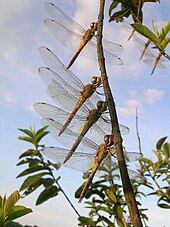

An aggregation of migratory Pantala flavescens dragonflies, known as globe skimmers, in Coorg, India
Some winged insects such as locusts and certain butterflies and dragonflies with strong flight migrate long distances. Among the dragonflies, species of Libellula and Sympetrum are known for mass migration, while Pantala flavescens,known as the globe skimmer or wandering glider dragonfly, makes the longest ocean crossing of any insect, between India and Africa. Exceptionally, swarms of the desert locust, Schistocerca gregaria, flew westwards across the Atlantic ocean for 4500 km during October 1988, using air currents in the Inter-Tropical Convergence Zone.
In some migratory butterflies, such as the monarch butterfly and the painted lady, no individual completes the whole migration. Instead the butterflies mate and reproduce on the journey, and successive generations travel the next stage of the migration.
In Other Animals
Mass migration occurs in mammals such as the Serengeti 'great migration', an annual circular pattern of movement with some 1.7 million wildebeest and hundreds of thousands of other large game animals including gazelles and zebra.
Wildebeest on the Serengeti 'great migration'
Migration is important in other mammals including Cetaceans, the whales, dolphins and porpoises. Long-distance migrations occur in some bats, notably the mass migration of the Mexican free-tailed bat between Oregon and southern Mexico.
Some reptiles and amphibians migrate.
Some crustaceans migrate, most spectacularly the Christmas Island red crab which moves en masse each year by the million.
Tracking Migrations
Scientists gather observations of animal migration by tracking their movements. Animals were traditionally tracked with identification tags such as bird rings for later recovery; no information was obtained about the actual route followed between release and recovery, and only a small fraction of tagged individuals were generally recovered. More convenient, therefore, are electronic devices such as radio tracking collars which can be followed by radio, whether handheld, in a vehicle or aircraft, or by satellite. Tags can include a GPS receiver, enabling accurate positions to be broadcast at regular intervals, but these are inevitably heavier and more expensive than devices without GPS. An alternative is the Argos Doppler tag, also called a 'Platform Transmitter Terminal' (PTT) which sends regularly to the polar-orbiting Argos satellites; using Doppler shift, the animal's location can be estimated, relatively roughly compared to GPS, but at lower cost and weight.
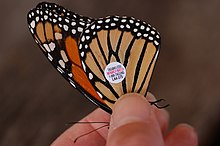
A migratory butterfly, a monarch, tagged for identification
Radio tracking tags can be fitted to insects including dragonflies and bees.
In Culture

Before the phenomenon of animal migration was understood, various folklore and erroneous explanations sprang up to account for the disappearance or sudden arrival of birds in an area. In Ancient Greece, Aristotle proposed that robins turned into redstarts when summer arrived. The barnacle goose was explained in European Medieval bestiaries and manuscripts as either growing like fruit on trees, or developing from goose barnacles on pieces of driftwood. Another example is the swallow, which was once thought, even by naturalists such as Gilbert White, to hibernate either underwater, buried in muddy riverbanks, or in hollow trees.

References

  1. a b c Hugh Dingle and V. Alistair Drake (2007). "What is migration?". BioScience 57 (2): 113–121. doi:10.1641/B570206.
  2. ^ National Geographic. Why Animals Migrate.
  3. ^ Attenborough, David (1990). The Trials of Life. London: Collins/BBCBooks. p. 123. ISBN 0-00-219940-8.
  4. ^ Kennedy, J. S. (1985). "Migration: Behavioral and ecological". In M., Rankin. Migration: Mechanisms and Adaptive Significance: Contributions in Marine Science. Marine Science Institute. pp. 5–26.
  5. ^ McLaren, I.A. (1974). "Demographic strategy of vertical migration by a marine copepod.". The American Naturalist 108 (959): 91–102. doi:10.1086/282887  JSTOR 2459738.
  6. ^ Hamner, W.M.; Hauri, I.R. (1981). "Long-distance horizontal migrations of zooplankton (Scyphomedusae: Mastigias).". Limnology and Oceanography 26 (3): 414–423. doi:10.4319/lo.1981.26.3.0414.
  7. ^ Wikisource-logo.svg Ernest Ingersoll (1920). "Migration". In Rines, George Edwin. Encyclopedia Americana.
  8. ^ Sekercioglu, C.H. (2007). "Conservation ecology: area trumps mobility in fragment bird extinctions". Current Biology 17 (8): 283–286. doi:10.1016/j.cub.2007.02.019. PMID 17437705.
  9. ^ Peter Berthold, Hans-Günther Bauer, Valerie Westhead (2001). Bird Migration: A General Survey. Oxford: Oxford University Press. ISBN 0-19-850787-9.
  10. ^ Cramp, S., ed. (1985). Birds of the Western Palearctic. pp. 87–100. ISBN 0-19-857507-6.
  11. ^ Harden Jones, F. R. Fish Migration: strategy and tactics. pp139–166 in Aidley, 1981.
  12. ^ Myers, George S. (1949). "Usage of Anadromous, Catadromous and allied terms for migratory fishes". Copeia 1949 (2): 89–97. doi:10.2307/1438482.
Further Reading
In General

  • Aidley, D.J. (1981) Animal migration, Cambridge University Press.
  • Baker, R.R. (1978) The Evolutionary Ecology of Animal Migration. Holmes & Meier Publishers.
  • Dingle, H. (1996) Migration: The Biology of Life on the Move. Oxford University Press.
  • Gauthreaux, S.A. (1980) Animal Migration, Orientation, and Navigation. Academic Press.
  • Milner-Gulland, E.J., J.M. Fryxell, and A.R.E. Sinclair (2011) Animal Migration: A Synthesis. Oxford University Press.
  • Rankin, M. (1985) Migration: Mechanisms and Adaptive Significance: Contributions in Marine Science. Marine Science Institute.
  • Riede, K. (2002) Global Register of Migratory Species. With database and GIS maps on CD.

In Specific Groups

  • Alerstam, T. (1990) Bird migration. Cambridge University Press.
  • Berthold, P. (2003) Avian migration. Springer.
  • Drake, V.A. and Gatehouse, A. G. (1995) Insect migration: tracking resources through space and time. Cambridge University Press.
  • Elphick, J. (1995) The atlas of bird migration: tracing the great journeys of the world's birds. Random House.
  • Greenberg, R. and Marra, P.P. (2005) Birds of Two Worlds: The Ecology and Evolution of Migration. Johns Hopkins University Press.
  • Harden Jones, F.R. (1968) Fish migration. St. Martin’s Press.
  • Lucas, M.C. and Baras, E. (2001) Migration of freshwater fishes. Blackwell Science.
  • McKeown, B.A. (1984) Fish migration. Timber Press.

For Children

  • Gans, R. and Mirocha, P. How do Birds Find their Way? HarperCollins. (Stage 2)
  • Marsh, L. (2010) Amazing Animal Journeys. National Geographic Society. (Level 3)

External Links


- Wikipedia 

Advantages and Disadvantages of Fasting for Runners

Author BY   ANDREA CESPEDES  Food is fuel, especially for serious runners who need a lot of energy. It may seem counterintuiti...