Blog List

Wednesday, 20 April 2016

Nutrition of Spaghetti Squash vs. Pasta

If you are searching for a healthy and low-carbohydrate pasta alternative, try substituting spaghetti squash in your favorite pasta recipe. This squash gets its name from the long spaghetti-like strands that form when you scrape its cooked flesh with a fork. Both wheat pasta and spaghetti squash offer nutritional benefits. Understanding their nutritional profiles can help you choose which option best suits your dietary needs.
Nutrition of Spaghetti Squash vs. Pasta

A plate of spaghetti squash Photo Credit razmarinka/iStock/Getty Images.

Calories

Spaghetti squash is significantly lower in calories than traditional pasta. A 1-cup serving of cooked spaghetti squash has 42 calories, while 1 cup of cooked pasta has 221 calories. If you are following a low-calorie diet, consider substituting spaghetti squash for pasta. Doing so can save you 180 calories per cup.

Carbohydrates

Carbohydrates are your body's main source of expendable energy. They are absorbed into your body as glucose, and are then converted into energy that fuels bodily and metabolic functions.

One cup of cooked pasta contains 42 grams of carbohydrates, making it a high-energy, yet high-carbohydrate option. Spaghetti squash contains 10 grams of carbohydrates per cup. If you are diabetic or following a low-carbohydrate diet, choosing spaghetti squash over pasta can significantly reduce your carbohydrate intake.
Nutrients
One cup of cooked pasta contains 8 grams of protein, 2.5 grams of fiber. Protein is a necessary macronutrient that helps support muscle strength, while fiber supports your digestive system.

Spaghetti squash has a high water content. One cup of cooked squash contains 143 grams of water. Foods high in water can increase your daily water intake. They also typically are lower in calories than foods with little or no water content. Spaghetti squash is also a good source of fiber, with 2.2 grams in a 1-cup serving. Spaghetti squash also contains beta carotene, which can help improve eye and skin health, maintain a strong immune system and can help prevent infection.


Preparation


Both pasta and spaghetti squash are quick and simple to prepare. Pasta requires only a pot of water, the pasta of your choice and a strainer. Put pasta in boiling water and cook eight to 12 minutes or until it is chewy yet firm, then drain.

To make spaghetti squash, halve a squash lengthwise. Scrape out the seeds, and then bake at 350 degrees Fahrenheit for 30 to 40 minutes. Once the squash is cool enough to handle, run a fork through the flesh to create spaghetti strands.

Top your pasta or spaghetti squash with marinara, pesto or olive oil. Add cooked vegetables, meat or cheese to your dish to increase its nutrition.
www.livestrong.com

Things You Can Eat for Breakfast If You Are on a Diet

Breakfast remains the most important meal of the day -- even if you're on a diet. People who eat breakfast everyday tend to control their weight better than non-breakfast eaters, reports H.R. Wyatt of the University of Colorado. But that doesn't mean you can start your day off with bacon and white toast and expect the weight to come off. Choosing healthy foods for breakfast while on a diet can help you shed those extra pounds and keep them off.

Things You Can Eat for Breakfast If You Are on a Diet
Healthy breakfast items on the kitchen table. Photo Credit dulezidar/iStock/Getty Images

Whole Grains

Whole grains like granola, oatmeal and whole wheat toast are ideal breakfast foods for someone on a diet. The fiber in whole grains keeps you feeling full so that you don't "cheat" on your diet and indulge on a calorie-rich snack later in the day. Including oatmeal in your low-calorie diet boosts weight loss and reduces high cholesterol levels, reports a study published in the May 2001 issue of the "Journal of Nutrition." Dieters who ate oats every day lost an average of 9 pounds over an 8-week period and decreased their total and "bad" cholesterol levels significantly.

Fruit

Try starting the day with fresh fruit like bananas, apples, melons and berries.. Fresh fruits have a low energy density. Energy density measures how many calories a food contains compared to its weight. Eating foods with a low energy density allows you to enjoy a high volume of foods without consuming too many calories.

Eggs

Some dieters shun eggs as a breakfast option as they are rich in fat. This is a mistake, according to a study found in the August 2005 "International Journal of Obesity." Overweight adults who had eggs for breakfast lost 60 percent more weight than those who dined on bagels. Eggs also offer nutritional value in the form of protein, vitamin E and vitamin B-12 -- all nutrients you need for good health.
www.livestrong.com

List of Health Benefits From Drinking Natural Juices Extracted From Raw Food

Juicing raw vegetables and fruits can be a valuable addition to an already healthy diet. As with all foods, however, natural juices aren’t miracle cures for any medical condition, and the American Cancer Society reports there’s no scientific evidence that natural juices are any healthier for you than whole foods. In some cases, you may get more health benefits from eating the whole foods instead of liquefying and drinking them.
List of Health Benefits From Drinking Natural Juices Extracted From Raw Food
Fresh juices can be a healthful addition to your diet. Photo Credit SteveMcsweeny/iStock/Getty Images.

Juices Give Your Digestive System a Rest

The benefits derived from drinking natural juices depend, in part, on the type of equipment used to make the juice. Centrifugal-force juicers -- the traditional kind sold in many stores -- remove virtually all of the fiber from the raw foods. Fiber is an important nutrient for digestive health that many Americans already consume too little of. However, this type of juicing may have health benefits for people with impaired digestion. Drinking juices made with traditional juicers gives your GI system a timeout while still providing all the vitamins, minerals and phytonutrients of fresh produce, says Dr. Sears Wellness Institute.

Blended Juices Deliver Fiber

Fresh juice made using a high-speed blender retains most of the fiber of its raw-food ingredients. Because of the fiber content, blended juices provide a slow release of nutrients into your bloodstream and can help you feel full longer. This may assist with your weight-loss efforts, reducing the number of calories you eat overall. It can also help you manage your blood sugar levels, preventing spikes and crashes that can affect your mood and energy.

Juice Ups Produce Intake

Increasing your vegetable and fruit consumption can reduce your risk of high blood pressure, heart disease and cancer. However, only 27 percent of Americans meet the daily recommendation of three or more servings of vegetables, and only a third eat the recommended two servings of fruit per day, according to a 2009 report by the Centers for Disease Control and Prevention. Juicing helps you consume more vegetables and fruits in a convenient, drinkable form. This boosts your intake of micronutrients and phytonutrients, helping to strengthen your immune system and ward off chronic illness.

Considerations About Natural Juices

If you decide to add natural juices to your regimen, drink the fresh juices directly after they are made for the best health benefits. Natural juices are subject to both bacterial growth and rapid nutrient loss, reports CNCA Health. In addition, fresh juices made primarily from fruit are high in sugar and calories and may defeat your health goals. CNCA Health also warns that juicing too much of certain vegetables, like oxalate-rich leafy greens, can impair kidney health. Eat fresh raw and cooked produce in addition to juicing -- your body absorbs some nutrients, like the beta carotene in carrots, better when the veggies are cooked and not raw.
www.livestrong.com

Ultimate Workshop Solutions

THE JEFF MILLER WOODWORKING COLLECTION - ORDER NOW!

By Popular Woodworking Editors


Format: eBook 
A woodworker's workshop is many things: a place to relax; a place to escape; and a place to create. Not all the creation results in a finished piece of furniture, though. Often the creative urge turns to improving the shop or the accuracy of the way you work while you're in it. That's what Ultimate Workshop Solutions Delivers. From better clamp storage, to the perfect miter saw stand to benches and beyond, you'll find 35 projects specifically designed to improve and organize your favorite space. These projects have been created by the editors of Popular Woodworking Magazine for your shop, and now we're pleased to share them with you. We hope many of them will soon make your ship a better place to relax and create.
For further information log on website:

http://www.shopwoodworking.com/ultimate-workshop-solutions-ebook-v7984?source=igodigital

INTRODUCTION TO WOODTURNING

Chapter 7: The effect of grain and other factors on the cut.

7.1 Introduction

In the previous chapter, in thinking about the way the tool cuts, three important factors were temporarily ignored. These are :

  • the question of grain and its direction
  • the rotation of the work-piece
  • the fact that the cutting edge is often held at an angle to the direction in which the wood is moving (the slicing cut)

7.2 The concept of grain

The cells of the wood, which take the form of hollow cylinders, join together to form strands of fibres which lie in a uniform direction which is more or less axial either to the trunk or to its offshoots. The lay of the fibres is commonly referred to as the 'grain'.


Diagram 7.1 Primary forms of cut

Diagram 7.1 shows a block of wood in which the grain is running longitudinally. Three tools are shown as if about to make cuts in the directions indicated by the arrows. These illustrate the three primary forms of cut; as defined in the common expressions of:

  • cutting along the grain (A);
  • cutting across the grain (B);
  • cutting end grain (C).
In practice of course, particularly in woodturning, there is an infinite range of variations on these cuts. Not only can any number of intermediate positions between those shown be taken up but the edge of the tool does not necessarily have to be held at 90 degrees to the direction in which the wood is moving. It should be noted that in Diagram 7.1 the wood is assumed to be stationary and the tool to be moving. Often, in woodturning both the wood and the tool are moving, but with the wood moving faster than the tool. For the purposes of analysis, in this particular context, this does not matter; all that we are concerned with here is the movement of the wood and the cutting edge in relation to each other.

7.3 Cutting along the grain

Anybody who has worked wood with a hand plane will know that it is desirable to plane with the grain. Diagram 7.2 illustrates the common situation in which the fibres of the wood lie at an angle to the edges of the wood block.
Diagram 7.2 Planing with and against the grain.

When the wood is planed with the grain any splitting between the fibres takes place above and in front of the cutting edge, which subsequently severs the fibres neatly, so leaving a clean surface, as shown in Diagram 7.3.


Diagram 7.3 Cutting with the grain  

Based on: Bruce Hoadley, Understanding Wood, The Taunton Press (1980) - p150

If an attempt is made to plane against the grain the cutting edge picks up the ends of the fibres, lifting them out of the wood, so that they break off in an irregular manner leaving a rough finish. This is illustrated in Diagram 7.4.


Diagram 7.4 Cutting against the grain 

Based on: Bruce Hoadley, Understanding Wood, The Taunton Press (1980) - p150.

7.4 Cutting end grain

When an attempt is made to cut end grain the cutting edge is forced across the ends of the fibres and there is a danger that they will be disturbed below the cut surface before they are severed (see Diagram 7.5). If the tool is allowed to pass beyond the edge of the work-piece, where the fibres have no support, a piece of wood may splinter off. When cutting end grain fine cuts need to be taken to minimise this problem.
Diagram 7.5 Cutting end grain 

Based on: Bruce Hoadley, Understanding Wood, The Taunton Press (1980) - p155.

7.5 Cutting across the grain

When cutting across the grain the wood fibres will lie parallel to the edge of the tool. As the tool penetrates the wood the fibres do not always separate cleanly in front of the edge of the tool (as illustrated in Diagram 7.6). Some of the fibres may be lifted out of the surface below the cutting edge leaving a series of parallel furrows. This affect can often be easy to see; one instance is when a parting tool has been used to cut a groove.


Diagram 7.6 Cutting across the grain

7.6 The way the work is held on the lathe and the terminology

The different ways in which the work piece can be held on the lathe affect the way the grain runs and have important implications for consideration of the way in which the wood is cut.
There are three main ways of holding the work-piece in the lathe:

  • between a drive spur in the headstock and a centre in the tailstock
  • by one end only
  • by one face only
The first of these two is commonly referred to as turning 'between centres'. The term 'spindle turning' also refers to 'between centres' work but usually in relation to a relatively slender work-piece such as a chair leg or a lamp column. Generally, however, these terms are interchangeable. It should be noted that the techniques used in spindle turning can, and frequently are, applied to a work-piece held by one end only. The stem of a goblet is a good example.

Bowl turning is usually carried out with the work piece held on one side only; nevertheless it is possible for some, if not all, of the operations to be carried out with the bowl-blank held between centres. Also, although bowls are usually made from a work-piece in which the grain is orientated at right angles to the axis of the lathe they can also be made from a piece in which the grain runs parallel to the axis. We need to use some terminology which will cover all the combinations which these possibilities allow.

When the inside of a bowl, a goblet, or any similar object, is hollowed out with the work-piece held by one end, or one side, and with the grain parallel to the axis of the lathe, this is commonly referred to as 'end grain turning'. As far as I am aware there is no common term applied to the same operation carried out where the grain is at right angles to the axis (ie on a 'normal' bowl). The term I apply to this is 'face turning'. If any of the operations on a bowl are carried out between centres then these would be described by that term, that is as work carried out 'between centres'.

7.7 The implications of rotation

If we look at a cylindrical work-piece held between centres in the lathe we may, for example, see the grain running through it at an angle as shown in the piece of wood illustrated in Diagram 7.2. Then if we rotate the work-piece half-a-turn (ie 180 degrees) the grain will, in effect, be running in the opposite direction. Thus, when turning a cylinder, the grain, as it is encountered by the cutting edge of the tool will continually be changing its direction. Whether the tool is moved from left to right, or from right to left, the cut will alternately be made with and against the grain.


Diagram 7.7 Uphill and down hill - between centres.

As soon as any shaping of the work piece takes place, however, the situation changes. Consider the vase shape shown in Diagram 7.7; for convenience, in this case, it is assumed that the grain is running parallel to the axis of the lathe. Cuts made in the direction marked 'downhill' will invariably be made with the grain and those marked 'uphill' against the grain. The terms 'uphill' and 'downhill' have been used because they have become part of the Woodturner's vocabulary. In this context, however, the terms 'up' and 'down' do not necessarily refer to tool movements related to the centre of the earth but to their relation to the work-piece. Thus a cut made downhill, ie with the grain, on a spindle turning is one made towards the central axis of the turning.


Diagram 7.8 Uphill and downhill - cutting on the rim of a bowl.

When a face turning, such as a bowl is considered the situation changes. This is illustrated in Diagram 7.8, where the grain is assumed to run at a right angle to the axis of the lathe. The arrows show that when a cut is made around the rim of a disk the grain direction is continually changing, eg (1) end grain, (2) against the grain, (3) along the grain, (4) with the grain. When the bowl shape is being formed the question of uphill or down re-emerges as shown in Diagram 7.9. Whether a cut is made uphill or downhill depends on the direction of the slope of the surface on which it is made (in relation to the axis of the lathe) and whether it is made on an inside or outside curve.


Diagram 7.9 uphill and downhill - shaping a bowl.

Similar consideration apply to an end grain turning, such as a goblet. A cut made towards the axis on the inside of the cup will be uphill, ie against the grain. A cut made on the outside of the cup, also towards the axis will be downhill, ie with the grain.
At some point, when a bowl with a well rounded shape is being turned, the effects shown in Diagram 7.9 may be outweighed by those shown in Diagram 7.8, and when the gouge is encountering end grain it may begin to pick up the fibres of the wood. Even for experienced bowl turners this can create a problem. We will look at some methods which can be used to minimise the tearing of end grain on bowls when bowl turning is considered in detail in a later chapter.

7.8 The slicing cut

In Diagram 7.10 shows a work-piece held between centres with the grain running parallel to the axis of the lathe. Two square nosed chisels, A and B, are shown positioned with their bevels in the rubbing position. It is convenient, but not important, to assume the chisels to be square nosed, but B could, in fact, be skewed. What is important is that it is assumed that the edge of chisel A is held parallel to the axis whereas that of B is held at an angle. Unless chisel A is narrow, like a parting tool, it will be very difficult, if not dangerous, to hold in that position. The reason for this is that not only will the cutting edge be in contact with the wood along its full length, it will also be parallel to the fibres of the wood; ie it will be cutting across the grain. Since both ends of the edge will be below the surface of the wood the fibres will have to be torn away at these extremities. Even if the cut can be maintained the surface left will tend to be very rough.


Diagram 7.10 The slicing cut.

The case of chisel B is very different. Because it is held obliquely to a curved surface only small portion of its edge is in contact with the wood and so it will take a relatively narrow shaving. It should also be noted that the fibres at the edges of the shaving are severed by the tool.
There is yet another factor to be considered. The direction in which the shaving is travelling is shown by the arrow in Diagram 7.10 B. It can be seen that the edge of the tool is at an oblique angle to the direction in which the shaving is travelling. This means that the wood fibres are moving along the cutting edge so producing a slicing cut. The fibres are very fine and if they and the edge of a sharp tool were greatly magnified (on a similar scale), the tool would be seen to have a jagged edge like that of a saw. The saw-like action severs the fibres still more cleanly.
In the instances I have been looking at in the above paragraphs the chisel has been positioned so that it has been cutting along the grain (ie parallel to the grain). It should be noted, however, that the slicing effect is enhanced when the cutting direction is downhill, ie when the cut is being made with the grain. When a slicing cut is combined with cutting with the grain the possibility of lifting the fibres out of the surface below the cutting edge is considerably reduced and very clean cuts are possible even on awkward material.
It should also be noted that cuts in which the edge of the tool is oblique to the direction in which the wood is moving, ie slicing cuts, can also be made with gouges in which ever circumstances they made be used, eg when cutting a cove or forming a bowl.

- Wikipedia 

SPINDLE TURNING

Spindle turning, or turning between centers, is a woodturning method referring to a piece of wood on a wood lathe that is being turned on its center axis.

Method

For spindle turning, the wood is held on the lathe either by both ends (between the headstock and tailstock) or by one end only.
Wood is generally removed by running a turning tool down the slope of the wood from a larger diameter in the wood to a smaller diameter.
Examples

Spindle turning is the method used for items such as chair and table legs, lamps, cues, bats, candlesticks etc. i.e. long and thin objects.

Notes

  1. ^ Clifford, Brian. "Woodturning - Grain and other factors". 1999. Accessed April 30, 2007.

- wikipedia

TAXODIUM DISTICHUM

Taxodium distichum (bald cypressbaldcypressbald-cypresscypresssouthern-cypresswhite-cypresstidewater red-cypressGulf-cypressred-cypress, or swamp cypress) is a deciduous conifer in the family Cupressaceae that grows on saturated and seasonally inundated soils of the Southeastern and Gulf Coastal Plains of the United States.
Taxodium distichum
Taxodium distichum NRCSMS01010.jpg
Bald cypress forest in a central Mississippi lake

Least Concern (IUCN 2.3)
Scientific classification
Kingdom:Plantae
Division:Pinophyta
Class:Pinopsida
Order:Pinales
Family:Cupressaceae
Genus:Taxodium
Species:T. distichum
Binomial name
Taxodium distichum
(L.) Rich.
Description
Taxodium distichum is a large slow-growing and long-lived tree typically reaching heights of 30–35 m (100–120 ft) and a trunk diameter of 1–2 m (3-6 ft). The bark is gray-brown to red-brown, thin and fibrous with a stringy texture, having a vertically interwoven pattern of shallow ridges and narrow furrows. The leaves are alternate and linear, with flat blades borne on the twig that are spirally arranged on the stem, but twisted at the base to lie in two horizontal ranks, 1–2 cm long and 1–2 mm broad. Unlike most other species in the family Cupressaceae, it is deciduous, losing its leaves in the winter months, hence the name 'bald'. It is monoecious (separate staminate and carpellate flowers are always found on the same plant), with male and female flowers forming on slender tassel-like structures near the edge of the branchlets. The male and female strobili are produced from buds formed in the late fall, with pollination in early winter, and mature in about 12 months. The seed cones are green maturing gray-brown, globular, and 2-3.5 cm in diameter. They have from 20 to 30 spirally arranged, four-sided scales, each bearing one or two (rarely three) triangular seeds. The number of seeds per cone ranges from 20 to 40. The cones disintegrate when mature to release the large seeds. The seeds are 5–10 mm long, the largest of any species in the cypress family, and are produced every year, but with heavy crops every three to five years. The seedlings have three to 9 (most often six) cotyledons.
The main trunks are surrounded by cypress knees.
The tallest known individual specimen, near Williamsburg, Virginia, is 44.11 m tall, and the stoutest known, in the Cat Island National Wildlife Refuge near Baton Rouge, Louisiana, has a diameter at breast height (DBH) of 521 cm. The oldest known specimen, located in Bladen County, North Carolina, is over 1,620 years old, making this one of the oldest living plants in eastern North America.
Foliage 
Cones.

Knees 
Bark.
Taxonomy

The closely related Taxodium ascendens (pond cypress) is treated by some botanists as a distinct species, while others classify it as merely a variety of bald-cypress, as Taxodium distichum var. imbricatum (Nutt.) Croom. It differs in shorter leaves borne on erect shoots, and in ecology, being largely confined to low-nutrient blackwater habitats. A few authors also treat Taxodium mucronatum as a variety of bald cypress, as T. distichum var. mexicanum Gordon, thereby considering the genus as comprising only one species.

Habitat
Range
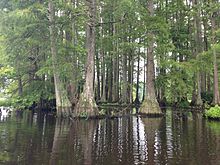

Bald cypress in Trap Pond State Park, Delaware.
The native range extends from Delaware Bay south to Florida and west to East Texas and southeastern Oklahoma, and also inland up the Mississippi and Ohio Rivers north to southern Illinois and Indiana. Mature planted specimens are seen as far north as Pittsburgh, and Ottawa, Ontario.[11] In Ottawa, in the Central Experimental Farm Arboretum, an average winter may kill back a quarter to half of new growth. Ancient bald cypress forests, with some trees more than 1,700 years old, once dominated swamps in the southeast US. The largest remaining old-growth stands are at Corkscrew Swamp Sanctuary, near Naples, Florida. and in the Three Sisters tract along eastern North Carolina's Black River. The Corkscrew trees are around 500 years of age and some exceed 40 m in height. The Black River trees were cored in 1986 by University of Arkansas dendrologists with dates ranging back to 364 AD. In the northern and more inland part of its range from Delaware and Maryland to Williamsburg, Virginia, it is found in groups growing in swamps and is accompanied by other hardwoods. In the southern parts of its range from extreme southeastern Virginia, Virginia Beach south to Florida and west to Texas, bald cypress can be found growing with loblolly pine and live oak, and it may be heavily covered in Spanish moss. This can be observed in the far northern part of its range at First Landing State Park, Virginia Beach, Virginia. From eastern North Carolina down throughout Florida and over to southeast and south Texas, bald cypress may be accompanied in forests by dwarf palmetto.
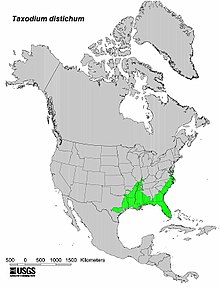

Bald cypress range.
It is native to humid climates where annual precipitation ranges from about 760 mm (in Texas) to 1630 mm (along the Gulf Coast). Although it grows best in warm climates, the natural northern limit of the species is not due to a lack of cold tolerance, but to specific reproductive requirements; further north, regeneration is prevented by ice damage to seedlings. Larger trees are able to tolerate much lower temperatures and lower humidity.
In 2012 Scuba divers discovered an underwater forest several miles off the coast of Mobile, AL in 60 feet of water. The forest contains trees that could not be dated with radiocarbon methods since they are older than 50,000 years old, thus most likely lived in the early glacial interval of the last ice age. The forest contains trees so well-preserved that when they are cut, they still smell like fresh cypress. The team, which has not yet published their results in a peer-reviewed journal, is currently studying the site. It is estimated that they have less than two years before wood-burrowing marine animals destroy the submerged forest.
Bald cypress on the Texas side of Caddo Lake
Soils and topography

Most bald cypress trees grow on flat ground on alluvial soils, usually at elevations of less than 50 m above sea level, although some stands may occur at elevations of 500 m in Texas.
Bald cypress occurs mainly along riparian (riverside) wetlands normally subject to periodic flooding by silt-rich 'brownwater' rivers, unlike the related Taxodium ascendens, which occurs in silt-poor blackwater rivers and ponds. T. distichum tolerates minor salinity, but does not grow in brackish or saline coastal waters.
Reproduction and early growth

Bald cypress is monoecious. Male and female strobili mature in one growing season from buds formed the previous year. The male catkins are about 2 mm (0.079 in) in diameter and are borne in slender, purplish, drooping clusters 7 to 13 cm (3 to 5 in) long that are conspicuous during the winter on this deciduous conifer. Pollen is shed in March and April. Female conelets are found singly or in clusters of two or three. The globose cones turn from green to brownish-purple as they mature from October to December. The cones are 13 to 36 mm (0.51 to 1.42 in) in diameter and consist of 9 to 15 four-sided scales that break away irregularly after maturity. Each scale can bear two irregular, triangular seeds with thick, horny, warty coats and projecting flanges. The number of seeds per cone averages 16 and ranges from two to 34. Cleaned seeds number from about 5600 to 18,430/kg (2,540 to 8,360/lb).


Foliage in autumn just before shedding.

Seed production and dissemination

Some seeds are produced every year, and good seed crops occur at three- to five-year intervals. At maturity, the cone scales with their resin-coated seeds adhering to them, or sometimes entire cones, drop to the water or ground. This drop of mature seeds is often hastened by squirrels, which eat bald cypress seeds, but usually drop several scales with undamaged seeds still attached to each cone they pick. Floodwaters spread the scales or cones along streams and are the most important means of seed dissemination.

Seedling development

Germination is epigeal. Under swamp conditions, germination generally takes place on a sphagnum moss or a wet-muck seedbed. Seeds will not germinate under water, but some will remain viable for 30 months under water. On the other hand, seeds usually fail to germinate on better drained soils because of the lack of surface water. Thus, a soil saturated but not flooded for a period of one to three months after seedfall is required for germination.

After germination, seedlings must grow fast enough to keep at least part of their crowns above floodwaters for most of the growing season. Bald cypress seedlings can endure partial shading, but require overhead light for good growth. Seedlings in swamps often reach heights of 20 to 75 cm (8 to 29.5 in) their first year. Growth is checked when a seedling is completely submerged by flooding, and prolonged submergence kills the seedling.


Bald cypress swamp and Spanish moss at First Landing State Park in Virginia Beach, VA.
In nurseries, Taxodium seeds show an apparent internal dormancy that can be overcome by various treatments, usually including cold stratification or submerging in water for 60 days. Nursery beds are sown in spring with pretreated seeds or in fall with untreated seeds. Seedlings usually reach 75 to 100 cm (29.5 to 39.5 in) in height during their first (and usually only) year in the nursery. Average size of 1-0 nursery-grown seedlings in a seed source test including 72 families was 81.4 cm (32.0 in) tall and 1.1 cm (0.43 in) in diameter.
Control of competing vegetation may be necessary for a year or more for bald cypress planted outside of swamps. Five years after planting on a harrowed and bedded, poorly drained site in Florida, survival was high, but heights had increased only 30 cm (12 in), probably because of heavy herbaceous competition. Seedlings grown in a crawfish pond in Louisiana, where weed control and soil moisture were excellent through June, averaged 2.9 m (9.5 ft) and 3.5 cm (1.4 in) diameter at breast height (DBH) after five years. However, a replicate of the same sources planted on an old soybean field, where weed control and soil moisture were poor, resulted in the same DBH, but a smaller average seedling height of 2.1 m (6.9 ft). When planted in a residential yard and weeded and watered, they averaged 3.7 m (12 ft) tall three years later.
Vegetative reproduction

Bald cypress is one of the few conifer species that sprouts. Thrifty sprouts are generally produced from stumps of young trees, but trees up to 60years old also send up healthy sprouts if the trees are cut during the fall or winter. However, survival of these sprouts is often poor and those that live are usually poorly shaped and do not make quality sawtimber trees. Stumps of trees up to 200 years old may also sprout, but the sprouts are not as vigorous and are more subject to wind damage as the stump decays. In the only report on the rooting of bald cypress cuttings found in the literature, cuttings from trees five years old rooted better than those from older trees.

Ecology
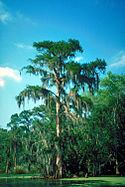

A bald cypress in the Atchafalaya Basin of Louisiana.

The seeds remain viable for less than one year, and are dispersed in two ways. One is by water; the seeds float and move on water until flooding recedes or the cone is deposited on shore. The second is by wildlife; squirrels eat seeds, but often drop some scales from the cones they harvest. Seeds do not germinate under water and rarely germinate on well-drained soils; seedlings normally become established on continuously saturated, but not flooded, soils for one to three months. After germination, seedlings must grow quickly to escape floodwaters; they often reach a height of 20–75 cm (up to 100 cm in fertilized nursery conditions) in their first year. Seedlings die if inundated for more than about two to four weeks. Natural regeneration is therefore prevented on sites that are always flooded during the growing season. Although vigorous saplings and stump sprouts can produce viable seed, most specimens do not produce seed until they are about 30 years old. In good conditions, Bald-cypress grows fairly fast when young, then more slowly with age. Trees have been measured to reach 3 m in five years, 21 m in 41 years, and 36 m in height in 96 years; height growth has largely ceased by the time the trees are 200 years old. Some individuals can live over 1,000 years. Determination of the age of an old tree may be difficult because of frequent missing or false rings of stemwood caused by variable and stressful growing environments.


Bald cypress knees in duckweed.
Bald cypress trees growing in swamps have a peculiarity of growth called cypress knees. These are woody projections from the root system project above the ground or water. Their function was once thought to be to provide oxygen to the roots, which grow in the low dissolved oxygen (DO) waters typical of a swamp (as in mangroves). However, evidence for this is scant; in fact, roots of swamp-dwelling specimens whose knees are removed do not decrease in oxygen content and the trees continue to thrive. Another more likely function is structural support and stabilization. Bald cypress trees growing on flood-prone sites tend to form buttressed bases, but trees grown on drier sites may lack this feature. Buttressed bases and a strong, intertwined root system allow them to resist very strong winds; even hurricanes rarely overturn them.
Bald cypress forest in winter, showing "knees" and (brown) high flood level, Lynches River, Johnsonville, South Carolina.
Many agents damage T. distichum trees. The main damaging (in some cases lethal) agent is the fungus Stereum taxodii, which causes a brown pocket rot known as "pecky cypress". It attacks the heartwood of living trees, usually from the crown down to the roots. A few other fungi attack the sapwood and the heartwood of the tree, but they do not usually cause serious damage. Insects such as the cypress flea beetle (Systena marginalis) and the bald cypress leafroller (Archips goyerana) (closely related to the fruit tree leafroller) can seriously damage trees by destroying leaves, cones or the bark. Nutrias also clip and unroot young bald cypress seedlings, sometimes killing a whole plantation in a short amount of time.
Conservation

In 2002, the Indiana Department of Natural Resources identified T distichum as a state protected plant with the status of Threatened.

Cultivation and uses

This species is a popular ornamental tree, grown for its light, feathery foliage and orange-brown to dull red fall color. In cultivation, it thrives on a wide range of soils, including well-drained sites where it would not grow naturally due to the inability of the young seedlings to compete with other vegetation. Cultivation is successful far to the north of its native range, north to southern Canada. It is also commonly planted in Europe, Asia and elsewhere with temperate to subtropical climates. It does, however, require hot summers for good growth; when planted in areas with cool summers oceanic climates, growth is healthy but very slow (some in northeastern England have only reached 4–5 m tall in about 50 years), and cones are not produced.
One of the oldest in Europe, was planted in the 1900s in the Arboretum de Pézanin, Burgundy, France.
Timber.
Bald cypress has been noted for its high merchantable yields. In virgin stands, yields from 112 to 196 m³/ha were common, and some stands might have exceeded 1000 m³/ha. Bald cypress swamps are some of the world's most productive ecosystems.
The odorless wood of bald cypress, closely resembling that of Cupressus spp., has long been valued for its water resistance, thus is called 'wood eternal'. Still-usable prehistoric wood is often found in swamps as far north as New Jersey, and occasionally as far as Connecticut, although it is more common in the southeast. The somewhat-mineralized wood is mined from some swamps in the southeast, and is highly prized for specialty uses such as wood carvings. Pecky cypress, caused by the fungus Stereum taxodii is used for decorative wall paneling.
The bald cypress was designated the official state tree of Louisiana in 1963. It is considered by some to be a symbol of the southern swamps.
Cypress trees can be used in the making of shingles. Joshua D. Brown, the first settler of Kerrville, Texas, made his living producing shingles from cypress trees growing along the Guadalupe River of the Texas Hill Country. Shingles produced from cypress were also one of the main industries for early pioneers in Kissimmee, Florida (near Walt Disney World). One of the main bodies of water in the area, Shingle Creek, is named in homage of their importance to the growth of the city.
References

  1. ^ Conifer Specialist Group (1998). Taxodium distichum. 2006. IUCN Red List of Threatened Species. IUCN 2006. www.iucnredlist.org. Retrieved on 12 May 2006.
  2. ^ "Taxodium distichum". Natural Resources Conservation Service PLANTS Database. USDA. Retrieved 8 December 2015.
  3. a b c Farjon, A. (2005). Monograph of Cupressaceae and Sciadopitys. Royal Botanic Gardens, Kew. ISBN 1-84246-068-4.
  4. ^ Flora of North America: Taxodium distichum
  5. a b c Gymnosperm Database: Taxodium distichum
  6. a b c http://na.fs.fed.us/pubs/silvics_manual/volume_1/taxodium/distichum.htm
  7. ^ http://www.ldeo.columbia.edu/~adk/oldlisteast/Spp/TADI.html
  8. ^ USDA Plants Profiles: Taxodium distichumTaxodium ascendens
  9. ^ Flora of North America: Taxodium
  10. ^http://www.pittsburghforest.org/userfiles/file/Lawrenceville%20Tree%20of%20the%20Month/LV_Tree_of_Month_03_Bald_Cypress.pdf.
  11. ^ Richard Hinchcliff (2007). For the Love of Trees. General Store Publishing. pp. 52–53. ISBN 978-1-897113-73-8.
  12. ^ Paul Ferguson (2008). "Searching for Methuselah" (PDF). Pocosin Press. pp. 1–3. Retrieved 21 April 2011.
  13. ^ "Primeval Underwater Forest Discovered in Gulf of Mexico". Live Science. Retrieved 11 July 2013.
  14. ^ Faulkner, Stephen P. 1982. Genetic variation of cones, seed and nursery-grown seedlings of baldcypress [Taxodium distichum (L.) Rich.] provenances. M.S. Thesis, Louisiana State University, Baton Rouge. 71 p.
  15. a b Radford, Albert E., Harry E. Ahles, and C. Ritchie Bell. 1968. Manual of the vascular flora of the Carolinas. University of North Carolina Press, Chapel Hill. 1183 p.

- Wikipedia 

Advantages and Disadvantages of Fasting for Runners

Author BY   ANDREA CESPEDES  Food is fuel, especially for serious runners who need a lot of energy. It may seem counterintuiti...