Blog List

Wednesday, 21 December 2016

Engineering Students Devise System to Track Ghost Fishing Nets

Author

Melina Sempill Watts

Melina Watts recently launched an environmental consultingfirm and is developing a new edition of Living Lightly In Our Watersheds: A Guide to Living in the Santa Monica Mountainsfor an array of cities and agencies at the Resource Conservation District of the Santa Monica Mountains, where she has raised more than $14 million to implement community-based watershed goals. She is shopping for a publisher for her environmentally-themed novel


Invention could help save hundreds of marine animals that get entangled and killed by abandoned fishing nets every year

When fishermen lose control of a fishing net or abandon a torn net at sea, the nets float around on the water surface or deep within the sea, ensnaring and killing millions of fish and marine mammals every year. Poetically called “ghost nets,” these are hardly-ethereal nets are usually made of heavy-duty nylon and hang on in the waters for years and decades causing repeated injuries and deaths of aquatic animals. Even after these nets fall to pieces, they continue to be a part of the ocean plastic pollution problem since they are ingested by birds, fish and other marine life.
Last fall, Alejandro Plasencia, Roberto Pla, and Joan Farré, a trio of student engineers in Spain invented the Rémora System to make management and recapture of ghost nets feasible. Their invention, which could help save hundreds of marine animals that get entangled and killed by abandoned fishing nets every year, was so appealing that it promptly won the James Dyson Award (an international student design award).
How does the Rémora System work? The two-part system consists of a biodegradable net attached with tags embedded with radio-frequency identification (RFID) chips, an RFID reader, and a smartphone app. The tags monitor the net's integrity and location, allowing fishermen to either find and repair the nets or declare them lost, upon which they could be collected by nonprofits or government agency involved in marine debris retrieval work.
“Those RFID tags are a game changer.” Plascencia says. The tags use low energy Bluetooth technology and have coin-sized batteries that can last up to a year. “What they do is emit a device ID over and over again, so they are perfectly reusable and recyclable,” he says. 
The nets are made of a polyethylene mixed with an additive that would cause the product to start biodegrading after four years. The engineers’ hope is that with the sped up ability to biodegrade, these new nets could reduce the amount of plastic floating around the ocean.
To help put the new products in the context of everyday practices, Plascencia explains how fishermen usually use nets these days: “Each time the net is deployed the net is pulled out thanks to a power block and then carefully folded in the ship’s deck. Many sailors have to check every inch of the 36 hectares of the net to ensure there are no missing parts and then fold it carefully on the back of the deck. If there is any missing zone in the net a knot is tied with a brightly colored plastic fabric to tag it.,” he says. “When all the fish are stored, fishermen sit on the deck and search for the plastic knots and repair the net by sewing new pieces of fabric. If the rags are too big, and complex to fix by the crew, the fishing company calls a net specialist, who usually arrives by helicopter.”
“With Rémora, fishermen can retrieve the net, or declare it as a lost net —international waters laws can’t penalize these kind of behaviors — and notify NGO’s like Healthy Seas Org which can recover the lost nets,” he says. Plasencia estimates the nets would cost 15 to 20 percent more than nets currently in use, but fishermen would ultimately save money by being able to easily locate points in the nets that need repair and thus be able to use them for longer.
illustrations of RFID tag and fishing netPhoto provided by Rémora SystemThe two-part system consists of a biodegradable net attached with tags embedded with radio-frequency identification (RFID) chips, an RFID reader, and a smartphone app.
Conservation groups from many countries — including World Wildlife Fund, Blue Planet Society, Upcycle the Gyres Society, and Fish 2.0 Org — are lining up to help try out this new system for one simple reason. As Plascencia explains: “Ghost nets not only keep on capturing fish, which has a negative impact on the fishing industry, but they also capture cetaceans like dolphins, whales and tortoise. It is in no one’s interest to have this.” 
The project’s focus has been on designing nets / RFID tags for the tuna industry. With the rates that tuna garners by the pound, especially in Japan, it may seem odd that a nonprofit is the only entity able, willing, and funded to go to pick up a lost net rather than the owners of a wealthy tuna boat fleet. However, without any legal requirements for a tuna boat to do so, there is no direct incentive for fleet owners to change current practices. The culture of “pick up your own trash” that works so well in places like Sweden and, say, preschools, has not carried over to much of the marine world — plastic debris and cast-offs from marine vessels make up to 40 percent of all plastic debris found in our oceans.
Should governments require these tags on all commercial fishing nets, the market for this product would be enormous. Logically, commercial fishermen may recognize that using this system would help them maintain the fisheries upon which their livelihoods depend. It would be incredible to have governments fund the manufacture of these tracking devices and give them away free to commercial fishermen, says Dr. Randal Orton, a marine biologist and environmental consultant based in Oxnard, California who specializes in ichthyology (the study of fish).
While the idea of an RFID tag to manage ghost nets is great, there are some hitches. For one, the engineers are college students who dreamed up the concept, so there are no factories churning out the RFID tags or the new improved nets yet. Neither have the students had the resources to conduct trial runs of their product. In the absence of field trials, it’s hard to assess how long the tag can send messages in the water or to how many meters down the messages can still be captured and read. 
Questions about how temperature speeds up or slows down the special nets’ accelerated biodegradation also remain unanswered. In any case, it’s not as if smaller particles of plastic are necessarily more benign. Biodegraded nets aren’t any more nutritious for marine life that might ingest them than other plastic debris. Besides, opinions differ on whether and how plastics can be completely biodegraded (Check out this overview from NOAA, for instance.)
Some of these issues, especially with regard to trials and marketing could be addressed swiftly. Already, two companies — the United Kingdom-based Symphony Environmental Technologies and the Belgium-based Kaneka Corporation — have offered to help with trials, manufacturing, and marketing strategies. In addition, the three inventors are looking at crowdfunding options. “But nothing definite still,“ Plascencia says, regarding next steps. “The truth is we are still trying to figure out what will be our strategy in trying to make the project become truth.”

For further information log on website :
http://www.earthisland.org/journal/index.php/elist/eListRead/engineering_students_devise_system_to_track_ghost_fishing_nets

Overpopulation – It’s All about Us

Women’s empowerment key to stemming unsustainable human population growth.

Most conversations about population begin with statistics – demographic data, fertility rates in this or that region, the latest reports on malnutrition, deforestation, biodiversity loss, climate change, and so on. Such data, while useful, fails to generate mass concern about the fundamental issue affecting the future of Earth.

photo of a cavernous shopping mall and crowd therein
© Brett Cole“In the developing world, the problem of population is seen less as a matter of human numbers than of Western overconsumption. Yet within the development community, the only solution to the problems of the developing world is to export the same unsustainable economic model fueling the overconsumption of the West.”
—Kavita Ramdas
In reality, every discussion about population involves people, the world that our children and grandchildren will live to see and the health of the planet that supports all life. In my roles as president of Population Media Center and CEO of the Population Institute, I spend most of my time in developing countries, where many of my friends and acquaintances are educated and prospering. But I also know individuals who are homeless, unemployed, or hungry. The vast majority of people in these societies, regardless of their current status, do not enjoy a safety net. They live from day to day in hopes that their economic circumstances will improve. Abstract statistics on poverty are irrelevant to families struggling to secure the food, water, and resources needed to sustain a decent life.
Those who blithely dismiss the challenges posed by population growth like to say that we could physically squeeze 7 billion people into an area the size of Texas. They don’t stop to consider the suffering already caused by overpopulation. The population debate is not about the maximum number of people that could be packed onto the planet. The crucial question is: How many people can Earth sustain, at a reasonable standard of living, while leaving room for the diversity of life to flourish? There is no precise answer to this question, but the facts overwhelmingly support one conclusion: We cannot go on the way we are going. We are already doing severe and irreparable harm to the planet. Something has to give.
If we cannot live sustainably with 7.2 billion people, how are we going to support billions more by the end of this century? The United Nations’ latest “medium-variant” projection indicates that we could have 10.9 billion people by 2100, but that may be an underestimation. Fertility rates in many parts of the world are not falling as fast as previously anticipated. In some countries, both developed and developing, fertility rates are actually on the rise again. In 2014 the global total fertility rate–the average number of children born to each woman during her lifetime–was 2.5. If this rate were to remain unchanged, demographers suggest that we could have 27 billion people on the planet by the end of the century. Given our limited inheritance of soil, water, and arable land, sustaining a global population of that size is not even remotely possible.
photo of people forcing their way into a store©Darin Oswald/Idaho Statesman“We will find neither national purpose nor personal satisfaction in a mere continuation of economic progress, in an endless amassing of worldly goods.”—Robert F. Kennedy
Human numbers and activity are already destroying the planet’s ecological integrity–running roughshod over myriad other species. But it’s not just the environmental damage we’re inflicting that should concern us. Equally appalling is how our actions threaten humanity’s future prospects. We have passed a crucial tipping point. Our quest for greater and greater material prosperity is now impoverishing future generations. The Global Footprint Network estimates that humans already use 150 percent of the Earth’s renewable capacity annually, and it estimates further that by 2030 we will need “two planets” to sustain us. Further growth simply deepens the crisis of ecological “overshoot” as we draw down Earth’s carrying capacity, and it comes at the direct expense of our own children and grandchildren. Is that any kind of way to behave?
If you care about people, you must care about what we are doing to the planet. If you care about what we are doing to the planet, you must also care about human numbers. Given a planet with infinite space and resources, population growth could, arguably, be a blessing. We do not live on such a planet. However, there was a time when the Earth and its resources appeared boundless. Some people still adhere to that anachronistic belief.
Many of us today do recognize that the Earth and its resources are limited, yet too many people still cling to the notion that modern science and technology will enable us to defy physical limits. In the Middle Ages, alchemists sought in vain for a “philosopher’s stone” that would convert base metals into gold. They never succeeded. Why? Because what they were looking for did not, and could not, exist, because its existence would have violated the physical laws governing the universe.
aerial photo of many greenhousesYann Arthus Bertrand“We are slaves in the sense that we depend for our daily survival upon an expand-or-expire agro-industrial empire – a crackpot machine – that the specialists cannot comprehend and the managers cannot manage. Which is, furthermore, devouring world resources at an exponential rate.“ —Edward Abbey
Modern-day alchemists are trying to find ways of sustaining perpetual growth in a finite and increasingly resource-constrained world, searching for a scientific or technological breakthrough that will enable us to keep growing indefinitely. Like the philosopher’s stone, it does not exist. Our faith in breakthroughs is misplaced, as amply demonstrated by the past 300 years of scientific and technological advances that have accelerated, not slowed, the degradation of the natural world. Even if scientists were to develop a relatively cheap, abundant, and clean form of energy that powered continuous economic and population growth, it would only accelerate the rate at which humanity is destroying the ecological systems that make the planet habitable. In the meantime, while we are waiting for magical breakthroughs, we are in a headlong race to extract and consume fossil fuels at whatever the cost to Earth. Scientists warn that we will fry the planet if we burn all the world’s known reserves of coal, gas, and oil, but that concern has not slowed the relentless exploration for more fossil fuels. An ever-expanding human population and rising demand for products and services makes humanity’s hunger for fossil fuels utterly insatiable.
Some cling to the notion that we can achieve sustainability by reducing consumption in the overdeveloped world. As meritorious as that idea may be, it has no critical mass of support. A growing number of political leaders are supporting the idea of “greener” or “smarter” growth, but there is not a single politician of significant stature in the world calling for slower economic growth, no growth (a steady-state economy), or de-growth. Yes, there are individuals who are trying to reduce their carbon and ecological “footprints,” but their numbers, for the moment, are dwarfed by the growing numbers of people who want to expand their ecological footprint through additional consumption.
Much of humanity, of course, desperately needs a larger share of Earth’s resources. More than 2 billion people in the world live on less than $2 per day. Nearly a billion people go to bed hungry every night. About half the people in the world do not have access to toilets or other means of modern sanitation. I do not know of anyone who would deny these people a better quality of life, but if world population continues to grow as currently projected, many, if not most, of these people will never have their most basic needs realized, let alone fulfill their aspirations. The world is not that bountiful. I wish it were, but it is not.
aerial photo of suburbiaGoogle Earth/NOAA, U.S. Navy, NGA, GEBCO“Human agriculture and industry are embedded in and supported by the natural ecosystems of earth.... Yet modern societies heedlessly displace, poison, overharvest, and directly assault natural ecosystems with little thought for their importance in their own sustenance.”—Paul and Anne Ehrlich
If we have any hope of bringing about a genuine balance between what humans demand of nature and what nature can reasonably provide for humanity, we must take crucial steps. Starting with the first step, we must devote more resources to preventing unplanned pregnancies through expanded access to contraceptives. Women everywhere should have the means to time, limit, or space their pregnancies. But greater access to contraceptives alone will not suffice. In those countries where population growth is most rapid today, girls and women lack reproductive choice; they live in traditionally male-dominated societies where large families are still the norm. Large-family norms, misinformation, and cultural barriers account for most decisions to not use contraception. If we do not enable girls to remain in school and delay marriage until adulthood, provide accurate information, and empower women in the developing world, then we will have failed countless individuals. Moreover, in the face of this humanitarian failure, fertility rate declines may continue only very slowly, or not at all – but certainly not fast enough to avoid the kind of human suffering that results when countries are overpopulated.
In many parts of the world, child marriage is still prevalent. It is estimated that some 14,000 girls become child brides each day. In some areas, particularly poor rural communities, parents require their daughters – who have not yet reached puberty – to wed men who are twice or three times their age. Child brides do not enjoy reproductive choice in any meaningful sense. Most are condemned, if they survive childbirth, to having many children, and their families are condemned, in turn, to a life of continued poverty and deprivation.
As important as it is to reduce unplanned pregnancies in the developing world, it is just as important to do so in the overdeveloped world, where the per capita consumption of resources is so much greater. Nearly half of all pregnancies in the United States are unplanned, and while America’s teenage pregnancy rate is declining, it remains the highest among industrialized nations. Shockingly, several state legislatures in recent years have slashed support for family planning, resulting in dozens of clinics having to either close their doors or limit services.
photo of stern men holding close to young girls©Stephanie Sinclair“Child Marriage happens because adults believe they have the right to impose marriage upon a child. This denies children, particularly girls, their dignity and the opportunity to make choices that are central to their lives, such ase when and whom to marry or when to have children. Choices define us and allow us to realize our potential. Child marriage robs girls of this chance.”—Archbishop Desmond Tutu and Gaca Maçhel
Because of population growth and changing diets, the world’s demand for food is projected to rise by 70 to 100 percent during the next 40 years. No one knows how we will meet that demand. Cultivated farmlands already occupy a land mass the size of South America, and ranchlands used for livestock grazing occupy a land mass the size of Africa. There’s very little arable land left; most of it is in the form of tropical forests, which if cut down to expand agriculture would accelerate biodiversity loss and further complicate efforts to rein in greenhouse gas emissions.
Water scarcity in many parts of the world has already reached crisis proportions. Demand for water is expected to outstrip supply by 40 percent within the next 20 years. As one research organization put it, we will need the equivalent of 20 Nile Rivers – which we do not have – to meet demand. By 2030, an estimated 3.9 billion people, nearly half the world’s population, will be living in areas of high water stress.
We live today in a “Catch 22” world, where addressing one urgent problem often exacerbates another. If we double food production to feed a growing world, we expand greenhouse gas emissions. If we discover and exploit more fossil fuels, we fry the planet. If we reduce our water consumption, we curtail our food production. If we grow the world’s middle class, we increase the pressure on Earth’s natural ecosystems.
There is, however, one exception to our “Catch 22” world, and that concerns population. Viewed from almost any angle, addressing population is a win-win proposition. By empowering girls and women in the developing world and expanding family planning services and information everywhere, we produce a world of good: Fertility rates decline; maternal and child health improve; food security increases; poverty decreases; education and economic opportunities expand; and degradation of the environment is curtailed.
In discussions about family planning and its many benefits, the health of nature is often an afterthought. Far too often it is overlooked entirely. We tend to see the well-being of people as somehow distinct from the well-being of Earth. Some even see the environment as being in “competition” with humans. The obvious truth, although unacknowledged by some, is that we are not separate or distinct from nature. Our hopes and our fate are inextricably linked to the fate of the natural world. We are part of a complex web of interdependent life, and our welfare depends upon the health of the whole. When life took hold on this planet it produced millions of species that have lived and evolved and produced both wondrous beauty and diversity. We modern humans are both products of and beneficiaries of that evolutionary process.
aerial photo of a giant feedlot crowded with livestock©Peter Beltra“Despite the industry’s spin, caFOs [concentrated animal feeding operations] are not the only way to raise livestock and poultry. thousands of farmers and ranchers integrate crop production, pastures, or forages with livestock and poultry to balance nutrients within their operations and minimize off-farm pollution through conservation practices and land management. … Yet these sustainable producers, who must compete with factory farms for market share, receive comparatively little or no public funding for their sound management practices.”—Martha Noble
We are, however, acting as ungrateful beneficiaries. Scientists tell us that we are exterminating our fellow plant and animal species at a rate that is a hundred or even a thousand times faster than the natural rate of extinction. Leading biologists now warn that human numbers and activity are triggering the “sixth mass extinction,” the largest since the dinosaurs were wiped out 65 million years ago.
Every year there are fresh reports about the senseless slaughter of elephants, rhinos, lions, tigers, and other “megafauna.” Some of their population decline is attributable to poachers seeking to harvest ivory or other body parts, but much of the dramatic decline has been caused by an ever-increasing loss of habitat. Many of these animals live in areas, like sub-Saharan Africa, where human fertility rates equate to a doubling of the human population every thirty or forty years.
In my college days, we were taught that, since the end of the last Ice Age about 12,000 years ago, humans have been living in the Holocene Epoch, but our impact upon the planet and its environment has become so great that some geologists today suggest we change the epoch’s name to the “Anthropocene,” or “Age of Man.” To most scientists, that development is a frightening prospect; it means that we are changing the planet–for the worse–on a global scale. Some scientists, though a distinct minority, insist that we can “manage” this change; that we can strike a balance with nature that will allow us to feed, clothe, and meet the economic aspirations of an additional 3 or 4 billion people moving forward. That line of thought reflects the worst kind of wishful thinking. Our 7.2 billion on the planet are already doing grave harm to the biosphere. Several decades ago, a cartoon character named “Pogo” made popular the oft-quoted saying: “We have met the enemy and he is us.” We might say this today in regards to the challenge the world faces, only it’s not a comic matter. If we are to reduce severe poverty, defeat hunger, and bring about a sustainable world, we must achieve change on a global scale, beyond just our consumption habits, and that change must begin with us.
While the obstacles before humanity are real, we should be careful not to overestimate the difficulty of following the path of the United Nations’ lowest population projections, which show a possible global stabilization as soon as the year 2050. Achieving this stabilization is a challenge, but it is far from an insurmountable one. The United Nations estimates that it would cost an additional $3.5 billion per year to provide contraceptive information and services to the more than 220 million women in the developing world who want to avoid a pregnancy but who are not using a modern method of contraception. (That’s less than 4 percent of what Americans spend on beer each year.) That’s a very small price to pay for a more sustainable world. Combine that investment with efforts through entertainment mass media and other means to change attitudes and behavior towards girls and women in the developing world, and we can stabilize world population at 8.3 billion and then begin a gradual reduction in the total number of humans on the planet as soon as 2050.
aerial photo of a low-lying island©Peter EssickThe island is full of holes and seawater is coming through these, flooding areas that weren’t normally flooded 10 or 15 years ago. there are projections of about 50 years [before the islands disappear]. After this, we will be drowned.—Paani Laupepa
If we can hew to the United Nations’ low variant demographic projection, by 2100 global population would be back down to 6.7 billion–more than 4 billion fewer than can be expected in the business-as-usual, medium variant projection of the human population trajectory. Such numbers may seem incomprehensible but the reality is that these two possible futures – one of 6 billion versus 10 billion humans to feed, clothe, educate, and employ – is the difference between a world of scarcity and nightmarish suffering for much of humanity and a world in which it may be possible to balance the needs of people and nature. Put another way, a population difference of 4 billion – the result of either staying complacent or working hard to share family planning tools and information around the globe – is 46 percent more than the current combined populations of North America, Central America, South America, Oceania, Europe, and Africa (roughly 2.7 billion)!
While I am deeply concerned about the future of humanity and the planet, I’m not a pessimist. It’s not too late. There are things that we can do to achieve a harmonious world and many of the steps that are required, like making contraception universally available, do not require an enormous investment of resources. Time, however, is beginning to run out.
Given the central role that population dynamics will play in determining the welfare of future generations, what the world needs today is a wake-up call. This book is that wake-up call. The photographs to follow are emotionally jarring. The thoughts expressed herein are not reassuring; they are deeply provocative. But that is the nature of wake-up calls. The way that human numbers and behavior are transforming the Earth, undermining its ability to support the human family and the rest of life, is apparent for all to see. The reality of this urgent moment calls us to think, to care, and to act.
This article is excerpted from the introduction to the new large-format book, Overdevelopment, Overpopulation, Overshoot, edited by Tom Butler and published by the Foundation for Deep Ecology

William Ryerson

William Ryerson is the CEO of the Population Institute and founder and President of Population Media Center, which has pioneered ways to use television and radio dramas to spread effective messages about family planning.


For further information log on website :
http://www.earthisland.org/journal/index.php/elist/eListRead/overpopulation-its_all_about_us

In Search of the Balkan Lynx

Author

Vanessa Nirode
Vanessa is a writer, solo traveler, cyclist, and runner based in New York City. In her spare time she works as a tailor and pattern maker for television shows and movies.

An effort to save a critically endangered wildcat is bringing together nations once divided by ethnic conflict

The Balkan Lynx, a subspecies of the Eurasian Lynx, lives predominately in eastern Albania and western Macedonia with smaller populations in Kosovo and Montenegro. Researchers believe there are 35 to 40 individuals remaining mostly in Mavrovo National Park, Macedonia. The Balkan Lynx, classified as critically endangered,  by the International Union on the Conservation of Nature, has been on the brink of extinction for almost a hundred years.

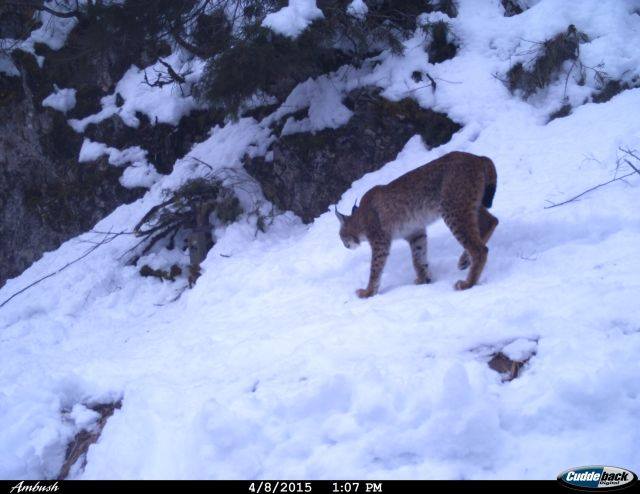
Balkan Lynx in snow

Photo by courtesy of the Balkan Lynx Recovery Project

A 2015 camera trap photo of a Balkan lynx in Mavrovo National Park, Macedonia. 

Ethnic and religious conflicts in Kosovo, Montenegro, Macedonia, and Albania left thousands dead and millions displaced. In recent years though, with the formation of the Balkan Lynx Recovery Program, the four countries have been cooperating in attempts to ensure the lynx’s survival.

These medium-sized nocturnal wildcats are elusive and shy animals. They might be living near human habitations with people not noticing or being aware of their presence for years. They are individualistic and a territorial species, occupying large tracts of lands. The home range of an adult male lynx usually varies from 100 to 400 square kilometers. Their main prey is roe deer and occasionally chamois and hares. Lynx only move to fresh terrain if these are directly connected to their existing ones, differing from wolves, for example, who will settle into completely new areas. Unbroken stretches of country and plentiful food are preconditions for the survival of lynx.

In 2010, the first lynx was radio-tagged and named Marko. Since then, ecological and environmental agencies in the Balkans have been working together within the Balkan Lynx Recovery Program to monitor the lynx, promote sustainable hunting and game conservation, raise public awareness, and strengthen cooperation in local communities.
Last fall, I took a plane bound for the land of Serbs, Croats, and Slovenes with the simple hope of possibly seeing one of these rare felines.
I arrived in Gusinje, Montenegro by a bus from Dubrovnik, Croatia. A lynx had been spotted near Gusinje in the Nacionalni Park Prokletije — a 16,630 hectare national park located in the border region between Montenegro and Albania. I found a group of local hikers that didn’t mind me following them up into the mountains on a regular basis and shared my desire to be one of the few humans to spot a lynx.
Boris (I never knew his last name) was the leader of the hikers, or at least knew the trails best. He pointed out the different animal tracks and taught me which one belonged to which animal. Together, we set up some sturdy, waterproof, trail cameras in areas where evidence of hares and deer (natural prey of the lynx) existed. Boris wasn’t officially affiliated with any government conservation group, he was just a hiker with an overwhelming desire to see a Balkan lynx.
In Montenegro’s capital city, Podgorica, I met Alexandra Aubertin of Montenegro Eco Adventures, an outfit that leads Balkan Lynx expeditions into Prokletije Park and the remote Haila Mountains. Aubertin and his team identified two specific areas where they believe the lynx would likely be present — one, a narrow corridor between Albania and Kosovo in Prokletije and the other, near the Kosovo border in the Haila Mountains. As well as placing camera traps for the lynx, their expeditions aim at building a database of fauna for the National Parks of Montenegro.
photonamePhoto Wikimedia CommonsBiology, ecology and history of the Balkan lynx are not well understood or documented, but
obvious threats have been direct persecution in the past, decline of prey populations, and loss
or fragmentation of suitable habitat.
I asked Aubertin if he thought the Balkan Lynx Recovery Program was working. One of the program’s main aims is to preserve the remaining habitats of the lynx. Another is to raise awareness among hunters and farmers and provide environmental education.
“The Balkan Lynx Recovery Program hasn’t communicated about its findings for the last few years, so I can’t answer your question on that,” Aubertin told me, “What I know is that [in my opinion] they have put very little effort in research in Montenegro compared to other countries in the Balkans.”
“The lynx hasn’t been seen very often at all in Montenegro during the past few years,” he said, “Of course, we can’t say for sure, but I’m afraid the population is not growing.”
I asked him about cooperation or efforts from local communities.
“I haven’t seen or heard about big successes in this area I am afraid,” Aubertin said, “They are still hunters. Hunting regulations in Montenegro are not well enforced and there is a lack of people and resources on the ground. But I don’t want to be pessimistic. I think we need to pursue our protection goal to save the wildlife in this area of the world.”
I took a bus from Podgorica to Skhoder, Albania. In all my memories of Skhoder, rain falls and everything is grey. I wanted to spend a couple days there before heading to Puka at the foot of the Munella Mountains.
In June of this year, the Albanian Parliament extended the countrywide hunting ban for five years, in an effort to control rampant poaching. Albania is the first country in the world to completely stop hunting. One of the main supporters of the Albanian Hunting Moratorium, is the conservation group, Protection and Preservation of Natural Environment in Albania (PPNEA). The information the PPNEA generated from the Balkan lynx project provided reliable data on the massive decline of wildlife in Albania that helped garner support for the hunting ban.
With the rediscovery of the Balkan lynx, Albania has also designated two new nature reserves in recent years: Shebenik-Jablanica National Park (in 2008) and Korab-Koritnik Nature Park (in 2011).
Aleksander Trajce (PPNEA) and other Balkan lynx researchers in Albania are collaborating with government officials to reform and modernize hunting management so that when the ban expires in 2021, hunting will be properly controlled and sustainably managed by authorities.
“What do people need to know about the Balkan Lynx Recovery Project?” I asked Trajce.
“The most important thing,” he said, “is perhaps the transnational collaboration of conservationists in a region that has been characterized by division and antagonism between countries. With the Balkan lynx project we show that when it comes to nature conservation in general and lynx conservation in particular, country borders matter very little and what is important is to ensure survival of the species on a population level. To do this conservationists from different countries have to come and work together — and for the Balkans, a region with an uneasy past and present, this is a fantastic achievement.”
Mavrovo National Park is in the North Western part of the Republic of Macedonia, at the meeting point of the nations Albania, Kosovo, and Macedonia. The park is considered by many conservationists to be the most important reproductive area of the Balkan lynx. Dime Melovski of the Macedonia Ecological Society has been part of the lynx recovery project there since the beginning. I asked him if he felt the program was working.
“That’s a good question,” he said, “The truth is that until three years ago we were quite optimistic about the whole thing. We’d just done our third intensive camera-trapping session in Mavrovo and estimated an increase in the population. After that, the relationship with the park’s authorities became strained. Long story short: we, as an NGO, complained against building hydropower plants inside the park, and the park director kicked us out. All is not lost though as we started to apply the bottom-up approach and began working with local stakeholders around the park.”
I hung around Mavrovo Park for about a week, hiking and following paw prints in the mud and snow. I sat for hours in the roots of a giant tree overlooking a valley. I imagined if I sat very still and quiet that a lynx would suddenly appear beside me or, at the very least, the ghost of my dead grandfather. One afternoon I fell asleep and dreamt there were lynx curled up next to me.
After Mavrovo, I ended up in Skopje where I met Oliver Stambolski, one of the park directors at Jasen Nature Preserve. He took me hiking in Jasen with one of the hunting guides. Lynx had been camera trapped in Jasen in 2012 and 2013 but no evidence had surfaced since then. Jasen operates under a controlled hunting code: A guide is required to hunt within the park and only a specific number of kills per species is allowed. Hunting or killing a lynx, though, is banned.
“The recovery of the lynx can only be done if local people, scientists and decision makers work together towards that goal,” Melovski of the Macedonia Ecological Society told me earlier. “There is no successful conservation strategy if one doesn’t include all this pillars of conservation! Everyone has a role and if focused correctly, we can bring back the Balkan lynx from the brink.”
Enthusiastic wildlife conservationists, both professional and amateur, emerging from the Balkan Lynx Recovery Project is indeed a very promising result. On the other hand, earnest commitments from national authorities and management units seem, at times, to be difficult to come by. The recovery of the Balkan lynx into a viable population is a long process that requires collaboration of all interest groups concerned. 
I left the region without catching a glimpse of the elusive feline, but I remain hopeful that someday I might someday, that the work of people like Melovski, Trajce, Aubertin, Stambolski,, and so many others won’t be in vain.


For further information log on website :
http://www.earthisland.org/journal/index.php/elist/eListRead/in_search_of_the_balkan_lynx

Anti GE Tree Activists Kicked Off Florida University Campus, Spied on by FBI

Author

Island Journal.Maureen Nandini Mitra photo
In addition to her work at the Journal, Maureen writes for several other magazines and online publications in the US and India. A journalism graduate from Columbia University, her work has appeared in the San Francisco Public PressThe New InternationalistSueddeutsche ZeitungThe Caravan and Down to Earth.


Colleges and universities offer little room for informed discourse on plant biotech

A few months ago, while reporting an article about genetically engineered trees for Earth Island Journal’s Autumn issue (read the story here), I had a mighty hard time locating plant biologists or genetic engineers at academic institutions who were willing to talk about the possible risks of growing GE trees in massive plantations. It seemed there was little debate over this controversial issue within the biotech community on college campuses — the very places where most of the research into GE trees is carried out.

students studying on campus green

Photo by Steve McFarland

Critics say there's little debate over this controversial issue within the biotech community on college campuses — the very places where most of the research into GE trees is carried out.

So it didn’t come as too much of a surprise when I heard that a group of environmental activists who were scheduled to make a presentation on GE trees at the University of Florida in Gainesville last month were booted off the campus, charged with trespassing, and banned from the university grounds for three years. What did come as a bit of a surprise was news that the FBI, too, was keeping tabs on the activists.

Genetically modified strains of trees like eucalyptus, pines, poplars, and fruit trees are being tested in hundreds of trial plots across the world, including the United States. In the US, except for a GE papaya tree variety that is grown commercially in Hawai‘i, there are no commercial GE tree plantations — yet. (The US Department of Agriculture is considering a proposal to grow GE eucalyptus in commercial plantations.) Some environmentalists are concerned that transgenic trees will promote industrial monoculture plantations that could have a huge impact on forest biodiversity.

The Gainesville campus GE tree presentation was part of a multi-week speaking tour, "The Growing Threat: Genetically Engineered Trees and the Future of Forests," organized by the Global Justice Ecology Project, Campaign to STOP GE Trees, and Everglades Earth First! The speakers were traveling to campuses in several southern states to raise awareness about the proposed commercial release of genetically engineered, freeze-tolerant eucalyptus trees in the US South.
The talk had been scheduled for October 28, a Monday. A conference room had been booked at the university’s McKnight Brain Institute a month in advance. But four days before the event, the institute cancelled the booking. The institute officials first said it was because they had to “give priority to brain and neuroscience related functions.” On being pressed for clarification, they said the AV equipment in the room wasn’t working and they couldn’t offer an alternative space. The university student who had booked the room checked the institute’s calendar and found that there were four other conference rooms available, but institute officials didn’t respond to his request for a new reservation by the time the weekend rolled in.
The Saturday before the event, the student and five other anti GE tree campaigners turned up at the institute and tried to enter the locked building to check whether the rooms were really unavailable. They first tried to open the door using the student’s ID card and then tried to talk staff and students into letting them in. Soon enough, cops arrived on the scene and cited the six for trespassing (read the police report here).
The activists say the police were “unnecessarily aggressive” toward them and didn’t seem interested in what they had to say. “We just wanted to see if we could go in and find someone to talk to about helping us out,” says Will Bennington, a campaigner with the Global Justice Ecology Project who was cited for trespassing.
“We tried to get creative [in looking for ways to get in], but we weren’t doing anything wrong. The long and short of it is we didn’t get in and were walking off when [the police] arrived.”
UF spokeswoman Janine Sikes says the activists “were very deceptive.” She had a third, differing reason to offer for the cancelation. “Instructional space is not available for non-university persons, groups or organizations,” she told the Journal via email. It’s not clear why the administration didn’t realize this at the time the booking was made in September, or why the various reasons cited for the cancelled bookings don’t match up.
Robbed of a venue, the activists instead gave a Skype presentation to UF Professor Bron Taylor’s environmental ethics class.  
“I wasn’t, of course, at the building where they were confronted, so I don’t know what exactly happened,” Taylor told me. “What I do know is there is a dearth of discussion on the issue of genetically modified organisms, both in the university and the world at large. And the debate doesn’t happen in a rational manner because there’s an influx of corporate money that manages the messaging.”
The University of Florida is one of the leading academic institutions researching transgenic trees. In 2011, the university’s Florida School of Forest Resources and Conservation and South Carolina-based GE tree company ArborGen won a three-year, $6.3 million grant from the US Department of Energy to develop GE loblolly pines for liquid biofuel production.
The matter, however, didn’t end here. Bennington says that four days after the Gainesville “trespass” incident, when the activists were about to start their presentation at Palm Beach State College in Boca Raton, the college provost, Dr. Bernadette Russell, turned up at the venue, called the assembled students out of the hall and informed them that the FBI had contacted her in the morning and warned her to keep an eye on the event because the activists could be “disruptive.” She then posted a security guard in the building for the entire duration of the presentation.
“It’s pretty astounding that running something as harmless as a PowerPoint presentation can draw surveillance,” Bennington says. “To be frank, we are on high alert now… We don’t really know what else to expect.”
The college administration as well as the FBI field office in Miami refused to comment on the incident, citing security protocols. But a Palm Beach State College student who had helped organize the event confirmed that Russell had indeed called the students out of the classroom and relayed the warning.
“Basically, she just said that the FBI had contacted to her in the morning because of the GE tree presentation and because some of the organizers were from Earth First!,” Lily de la Espriella, a 20-year-old environmental studies major, told me. She said the provost told her that she should check with the administration before organizing such events in the future. “I’ve helped organize other Earth First! events on campus before, but this is the first time I was asked to seek special permission,” De la Espriella says.
Bennington hopes these incidents will help show people how “the government and industry are so close” and how they join forces to quash dissent. (For a deeper look into how money influences US environmental policy, read our Autumn 2012 cover story package, The Worst Environment Money Can Buy. For more information on how corporations and law enforcement agencies are spying on environmentalists, check out our Summer 2014 cover story, Prying Eyes. ) The rest of the speaking tour, it appears, went off more or less smoothly.
Back when I was looking for plant biologists to speak with about GE trees, George Kimbrell, director of the Center for Food Safety, told me there were very few who would be willing and able to speak out against biotech in the US because agricultural and forest biotech companies, control the research through money and through patents. “Scientists are afraid,” Kimbrell said. “They are afraid of losing their grants, they are afraid of losing their ability to research.”
If the Florida incidents are any indication, this fear of losing funding extends to college and university administrations as well. As Gainesville ethics professor Taylor says, “I don’t see universities as a whole making the effort to have public debate about what’s going on behind their lab doors.”


For further information log on website :
http://www.earthisland.org/journal/index.php/elist/eListRead/anti_ge_tree_activists_kicked_off_florida_university_campus_spied_on_by_fbi

Tens of Thousands of Snow Geese May Be Dying Along the Pacific Flyway

Wildlife officials en route have no way to identify live birds exposed to toxic Berkeley Pit water in Montana

Every Halloween, birders gather at Montana’s Freezout Lake, about an hour’s drive from Great Falls. It’s an overwhelming spectacle: Up to 300,000 snow geese gather to rest after a night-long, nonstop flight of at least 400 miles from Alberta or Saskatchewan in Canada. After Freezout, there’s still about 1000 miles left before the  snow geese reach their destination, the Sacramento Wildlife Refuge in California.

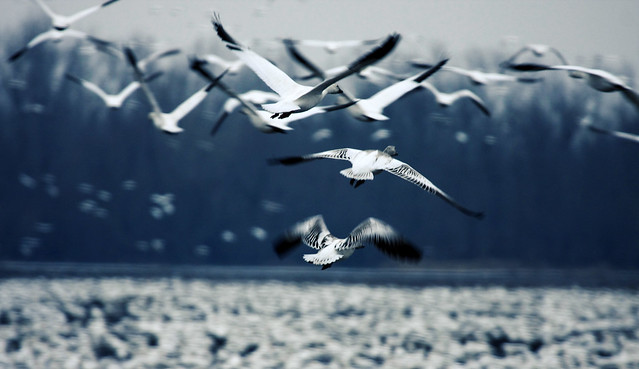
Snow geese flying

Photo by eflon/flickr

This year, the weather tricked tens of thousands of snow geese into delaying their flight south.

This year, the weather tricked tens of thousands of them — autumn was warm out West. They stayed up north a little too long. By the time the snow geese reached Freezout, the lake had lived up to its name. It had iced over. Exhausted and thirsty, the massive flock pressed on until they spotted what looked like a safe refuge. A little past dinnertime on November 28, the tired geese descended through a swirling snowstorm. They landed on the toxic soup that’s slowly filling the largest Superfund site in the United States: Butte, Montana’s Berkeley Pit, a massive hole in the ground that once used to be a copper mine.

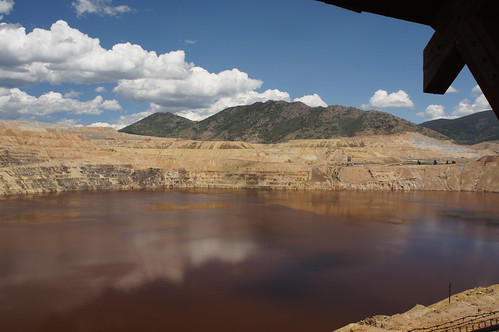
The Pit is hard to miss. It’s a mile long, a half mile wide, and 1700 feet deep. The water in the Berkeley Pit covers 700 acres, a surface area about 4/5ths the size of New York City’s Central Park. It’s 900 feet deep, and getting deeper by the day.

Thousands of migrating geese perished in the Pit in the first few hours. Where is the rest of the flock of perhaps 8,000 birds? Did they survive? Did they die nearby, or farther down the Pacific Flyway? Is there a protocol to track critical incidents that might affect birds, animals or humans? How — and how quickly — did people react?

Birdwatching: 24/7, 365

 “Employees tried urgently to keep the birds from landing,” said Mark Thompson, environmental affairs manager for Montana Resources, a company that, since 1985, has mined old tailings for copper and molybdenum, an element that’s used in glass furnace electrodes and in the petroleum industry. “Our manpower was out there all night.” Thompson paused to consider the sheer number of snow geese that overwhelmed their efforts. “The water was covered with white birds.”  For the workers, Thompson said, the battle was personal. They were trying to save the birds, but they also were attempting to fend off another public relations disaster.
It’s not the first time migrating waterfowl have perished in the Pit. In 1995, after 342 migrating snow geese landed and died there, noisemakers called Phoenix Wailers, which alternate random mechanical and natural sounds at varying durations, were installed to frighten off birds. Since that incident, there’s been a cooperative effort to haze approaching flocks, 24 hours a day, seven days a week, year round.  It’s worked pretty well — until now.
The Berkeley PitPhoto by PROTjflex2/FlickrThe Berkeley Pit, a former copper mine, where the snow geese landed in Late November, is filled with acidic water with high concentrations of heavy metals and toxic chemicals, including arsenic, cadmium, copper, zinc, sulfuric acid and molybdenum. 
 “Animals habituate,” said Janet Ellis, senior director of policy for Montana Audubon. “Flock behavior probably gave the birds a sense of security, despite the hazing.” Exhaustion and extreme thirst contributed to this latest death toll on the Pit. The snowstorm didn’t help. Another factor may have been the absence of a boat. “Hazing waterfowl is more effective on the water than it is from the shoreline,” according to US Fish and Wildlife Service public affairs and contaminant specialist Ryan Moehring.
Moehring said the Consent Decree, a part of the Superfund Site requirements, mandates that a boat is maintained in the Berkeley Pit. Part of the Pit wall collapsed in 2012, causing a tidal wave that tossed the observation boat high up on the opposite shore. Fortunately, no one was on board. Unfortunately, Moehring said, it’s too dangerous to launch another watercraft in the Pit.
By all accounts, it was unsafe to retrieve the carcasses of dead geese unless they washed up on shore. Thousands of the birds were left on the Berkeley Pit to decompose. Given the Pit water has a pH of 2.5, it’s not taking very long.
Experts also agree that drinking Pit water killed thirsty birds fairly quickly. Geese that didn’t drink themselves to death may suffer a worse fate, according to Erick Greene, an ecotoxicologist at the college of forestry and conservation at the University of Montana in Missoula. The longer a bird was on the Pit, the more copper, arsenic, cadmium, molybdenum, zinc, sulfuric acid it absorbed. These toxins present in the water present a double-whammy, Greene explains. The forms of these metals found in the Pit water are very bio-available, which means the get absorbed by living bodies quickly. They also bioaccumulate, or build up, instead of being excreted. “I would not be surprised if all these geese died before reaching their destination,” Greene said.
Greene thinks some geese, depending on exposure, could have made it out of Montana and down the flyway. But Moehring thinks they all dropped near Butte. “That water is highly toxic. Birds exposed to it aren’t going to get very far.” Moehring, a trained conservationist, said, “Trans-state, it’s not a significant concern.” A few dead geese have been found around town. Two fell in the Walmart parking lot, another in front of a nearby casino. 
That leaves many thousands of potential survivors, untraceable.
It’s a tragic death for these federally protected migratory game birds, who often mate for life. Snow geese travel in family units — mom, dad and the kids stay together for years at a time.
The Richest Hill on Earth
M and M BarPhoto by Claire BaizIn its heyday, Butte didn’t have a pit mine, and its iconic M&M
bar didn’t have a front door.
Over the last century, Butte has seen its own migration. About a hundred years ago, the city’s population was 100,000. Today, it’s under 35,000.
In the early 1900s, Butte was damn sophisticated, drawing celebrity entertainers like Charlie Chaplin, Sarah Bernhardt and Mark Twain — but this was no polite metropolis. The M&M Cigar Store was one of dozens of bars. The infamous Dumas Brothel was only one the town’s houses of ill repute. Nearly fifty years ago, a Butte native and small-time huckster parlayed his fearless talent into a shortened lifetime of broken bones and worldwide fame as a stunt performer. Butte honors that dead daredevil with a four-day party every summer. They call it “Evel Knievel Days.”
In its heyday, Butte didn’t have a pit mine—and the M&M didn’t have a front door.
Mining took place in tunnels both deep and dangerous, while the M&M served up suds, solace and friendly wagers around the clock. Like Butte, this bar, which is still open for business, has seen its share of highs and lows. In Esquire magazine in 1970, beat poet Jack Kerouac described the highlife and lowlife, and pronounced Butte's M&M “the ideal bar.”
Butte people live hard, work hard, play hard…and sometimes, they die hard. A series of mine fires in Butte’s 10,000 miles of underground tunnels culminated in the June 1917 Speculator Mine disaster, where 168 miners lost their lives. Economic suffering and offshore competition compounded Butte’s woes: Copper production in Butte faltered until the Anaconda Copper Co. opened the Berkeley Pit in 1955. Anaconda operated the mine until 1977, when they sold out to Atlantic Richfield Co. (ARCO). Before ARCO ended mining in April 1982, about a billion tons of copper, silver, gold and other commercial and precious ores had been extracted from what had been “The Richest Hill on Earth.” Within 18 months, it was declared a Superfund Site.
A Tub of Trouble
No one can drain the Pit, but cleanup efforts have slowed the spigot. A treatment plan which captures and treats inflow has helped slow rising water. Montana Resources uses the treated effluent in their mining operations at the nearby Continental open-pit copper mine.
Joe Vranka, site supervisor for the Environmental Protection Agency, says they’re doing the best they can with what he called a “legacy mine” and a “complex 150-year-old situation.” When asked if there was an end in sight, Vranka, replied, “I hope so.”
Part of the EPA plan, according to Vranka, has been to wait until the Berkeley Pit water has risen to within 50 feet of the lowest point in Butte’s water table, then begin pumping. (The pit is at the lowest point of Butte's water table. Everything drains there, until the water reaches a critical level.) It’s hoped, when Pit water flows into the long-abandoned deep mine shafts, a lack of oxygen will help dissipate some of the impurities.
Right now, the Pit water is about a hundred feet below ‘critical level.’ Despite assurances from Montana Resources that they’ll use “all the water they can get” in the future, the EPA is supervising expansion of the Horseshoe Bend water treatment plant to clean up additional Pit water, just in case.
The water level at the Berkeley Pit, Butte’s basement drain, may reach the critical point around 2022-2023.
Geese in the Pit = Canaries in a Coal Mine?
In the days before air quality devices, underground miners carried canaries down mine shafts. A single bird struggling to breathe would send humans scurrying for clean air. For Butte, the 1995 incident was the first avian warning.
But solutions are slow in coming: this chart from the EPA website summarizes the status of cleanup process, after 31 years:
EPA
EPA SUPERFUND STATUS Butte MT. 30 years later.Image courtesy of EPAEPA's chart of the Berkeley Pit's remediation status.
Parties involved in the Superfund site include ARCO (part of British Petroleum), the EPA, the State of Montana’s Department of Environmental Quality, Montana Resources Co., USFWS, Montana FWP and the state’s Bureau of Mines. Add individuals, groups, and academicians who seek input, and there’s a large group of interested parties pondering the future of the Berkeley Pit.
On the Fly(way)
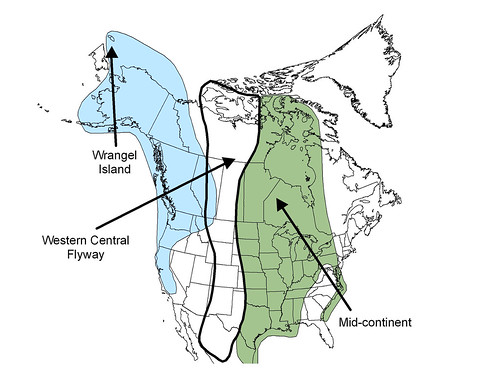
map of snow-geese-range2Map of snow geese range.
For the birds that survived Butte, the next two logical rest stops were Malheur National Wildlife Refuge in Oregon or Utah’s Bear Lake. Last Friday, no one answered five phone calls made to Malheur. Howard Browers, biologist with Utah’s Bear River Migratory Bird Refuge, had not heard of the incident, either. “We’re 90 percent frozen up, though. Those geese would not be likely to rest here anyway. Usually, if there’s a problem, there’s a woman from the Wildlife Health Office in Bozeman, Montana who contacts us.” 
The receptionist at the Sacramento Wildlife Refuge in Northern California, after hearing about the situation, said, “Wow. Let me connect you with…someone else.” On Monday, December 12, that person, Pam Bierce, an External Affairs spokesperson for FWS, called back. She’d not heard of the die-off in Butte either, but she gave me the phone number of Ryan Moehring, who had. 
Moehring assured me that he briefed co-workers from all eight districts of the US Fish and Wildlife Service. “We have weekly calls,” Moehring said. Though he acknowledged there isn’t 100 percent participation in these conference calls, and he could not identify who was on the line, he did say that FWS had “a toxicologist, a biologist, and law enforcement up there…We collected birds and sent them to the National Wildlife Health Center for necropsies.”
Whether the birds made it out alive — or not — the snow goose migration in Montana is over.
If Greene, the ecotoxicologist, is right, tens of thousands of snow geese may have dropped from the skies and been consumed by predators, scavengers, opportunistic mammals, and perhaps human hunters and their families.
If Moehring is correct, most of the affected birds would have succumbed close to Butte.
We may never know.
Around Butte, as of December 14, only anecdotal reports of dead geese had been reported, and at least one of them, found near Dillon, Mont., may not have been part of the wayward flock. All that’s certain is that ten thousand (or more) of birds spent time on the Berkeley Pit, and several thousand died there. That leaves thousands of birds, dead or alive, somewhere out West.
Cooked Goose
If there’s any silver lining in this cloud of feathers and blood, it’s that snow geese populations are, if anything, too robust. This species, which thrives on farmed grain fields, has done real damage to wetland nesting areas. “I’ve seen over a million of them in one place,” Moehring said.
Affected geese don’t come with warning tags, but Montana Fish Wildlife and Parks did issue a news release on December 8, 10 days after the incident, asking local hunters to freeze their snow geese harvest until lab tests come in. Even then, results are likely to vary, bird-to-bird. (My suggestion is that a lightweight, permanent dye is kept at the ready to be poured onto the Berkeley Pit, to mark the bellies of birds that might land there in the future.)
It’s been more than two weeks since the incident and whether the geese wound up a few miles from Butte or far down the Flyway, if they died, they’ve already become some creature’s dinner. If they haven’t fallen, they might look safe to eat.
“A hunter might not be aware that he’s taken a sick bird,” Greene said, noting that sicker birds would probably be easier to shoot, and repeating his warning that heavy metals bioaccumulate.  “I would not want to eat a cooked goose that had been in the Berkeley Pit.”
Claire Baiz
Claire Baiz is a native and lifelong Montanan who has been published in the USA Today, Untitled Magazine, The Knoxville News Sentinel, the Indy Star, The Pensacola News-Journaland the Great Falls Tribune. She is the sole featured columnist in Signature Montana Quarterly. Her fiction has been published by Molotov Cocktail and The JJ Outre Review.

For further information log on website :
http://www.earthisland.org/journal/index.php/elist/eListRead/tens_of_thousands_of_snow_geese_dying_along_pacific_flyway

Advantages and Disadvantages of Fasting for Runners

Author BY   ANDREA CESPEDES  Food is fuel, especially for serious runners who need a lot of energy. It may seem counterintuiti...