Blog List

Wednesday, 3 May 2017

POLYMER COMPOSITE MATERIALS BASED ON BAMBOO FIBRES

Author

Researcher: Ir. Eduardo Trujillo

Supervisors: Prof. Jan IvensDr. Aart Van Vuure 

PROJECT DESCRIPTION

Composites allow light-weight design and are as such environmentally friendly materials. However, there is an increasing interest in so-called renewable materials, to which category natural fibres clearly belong. Natural fibres can, if mechanical recycling into secondary applications is not feasible, be thermally recycled or if a biodegradable matrix is used, be landfilled for biodegradation. Both last options are largely CO2 neutral. Natural fibres like bamboo also require much less energy for cultivation and extraction than is used for the synthesis of glass and particularly carbon fibre, which gives them a very favorable carbon footprint. For these reasons natural fibres are emerging as good alternative reinforcing materials for the future. Nowadays exploitation and use of sustainable natural resources are a necessity and they will play a crucial role in the near future. Bamboo Guadua angustifolia, from Colombia, appears like one of these valuable resources with a high potential thanks to its excellent mechanical properties and availability. The use of its fibres has not been considered so often yet, particularly because of difficulties in extracting high quality, undamaged fibres (See figure 1).

 
Fig. 1: Technical bamboo fibres used in composite materials

OBJECTIVES

The main purpose of this project with Colombian bamboo fibres, is to develop a natural fibre composite with high mechanical properties and to present it as a new natural and renewable option to reinforce both thermoplastic and thermoset matrices, which fits into the requirements (properties, availability and cost) established in the field of reinforcements for composites. The aim is to offer an alternative for other natural and particularly synthetic fibres such as glass fibre, used nowadays for this purpose. For these reasons, the main objectives for this PhD research are:

  • To explore processing feasibility of bamboo fibre composites by different techniques and to study the resulting fibre and composite properties

  • To carry out a systematic study of the influence of processing parameters on the mechanical properties of bamboo fibres and bamboo fibre composites


BAMBOO FIBRE COMPOSITES


1. Thermoset bamboo fibre composites

Thermoset bamboo fibre composites will be characterized. Several production techniques are available to produce them (e.g. resin transfer moulding (RTM)). In order to evaluate the behaviour of bamboo fibre composites with a thermoset matrix (epoxy resin), tensile and flexural tests will be conducted with two types of fibres disposition (longitudinal and transverse) with the purpose of determining mechanical properties of the composite and the interface. (See figure 2)

2. Thermoplastic bamboo fibre composites

For bamboo/thermoplastic composites, a number of variables such as temperature, time of exposure to the consolidation temperature, pressure and polymer type, will be studied in order to optimize the composite properties. These composites will be prepared by compression moulding with different fibre distributions and different fibre volume fractions. The main production variables will be analyzed statistically by factorial design, to establish the optimum process parameters for bamboo fibre composites fabrication. Fibre treatments (as shortly described in paragraph 2.1.3) as well as matrix modifications (e.g. Maleic Anhydride grafted Polypropylene) will be applied. 

3. Continuous and discontinuous unidirectional composites

The fibre lay-out plays a significant role in the final mechanical properties of a composite. For this reason, a continuous and discontinuous unidirectional disposition of bamboo fibres in thermoset and thermoplastic composites will be evaluated. The main interest in this case, is to understand after systematic study, the impact of the fibre length and distribution on the final mechanical properties of the composite. This work will also provide useful information about the most suitable fibre overlap patterns. 

4. Composite consolidation under inert atmosphere

The overall advantages of natural fibres such as bamboo fibres are not yet exploited for high performance materials and engineering composites. Practical applications of these composites are still limited to fairly low melting temperature thermoplastics (e.g. Polypropylene). Natural fibres’ thermal stability is one of the major drawbacks since the first degradation occurs typically at low temperatures in detriment to the mechanical properties of the fibre and hence of the entire composite.

The aim of using inert atmosphere during composite processing, supported by the earlier study on single fibres, is to adapt process parameters preventing fibre damage and to expand the range of possibilities for thermoplastic matrices, without significant reduction in mechanical properties of the composite.

Fig. 2: Bamboo fibre/epoxy composite


CHARACTERISATION AND TESTING OF COMPOSITES

For all prepared composites the tensile mechanical properties (stiffness, strength and strain to failure) will be measured. Properties will also be predicted by existing composite analysis tools, based on fibre and matrix properties. Predicted results will be compared to the measured ones for further analysis.

 Fig. 3: Tensile test for UD bamboo fibre composites

Composite mechanical properties will be characterised and benchmarked against natural and synthetic fibre composites to evaluate the relative performance. 

For further details log on website :
https://www.mtm.kuleuven.be/Onderzoek/Composites/people/EfrainEduardoTrujilloDeLosRios/Polymercompositematerialsbasedonbamboofibres

Lakaran Projek

Author
by africk jinggo

lakaran2
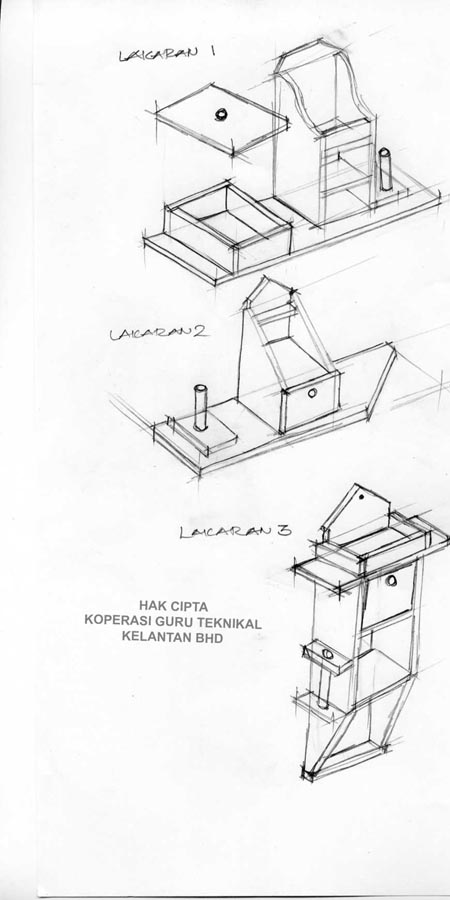
(Contoh lakaran untuk PBS…. Terima kasih kepada Koperasi Guru Teknikal Kelantan BHD)
Lakaran projek mesti dibuat pada Modul 2 (aspek2.1.i) Melakar sekurang2nya 3 reka bentuk projek. Sama juga dengan Modul 4 (aspek 4.1.iv).
Sekiranya anda seorang guru…… adakah anak2 didik kita mampu melakukan seperti/hampir seperti lakaran di atas….???. Bagi saya sudah tentu jawabnya MUSTAHIL…!!!! Tak tahu le kalau anak2 dari Sekolah2 asrama penuh atau sekolah terpilih mampu melakukannya….!!!!
Sekiranya anda seorang guru…… adakah anak2 didik kita mampu melakukan seperti/hampir seperti lakaran di atas….?? Sudah tentu banyak jawapan yang mungkin didapati…. mungkin antaranya:
1. Saya boleh buat…. senang aje…. (mungkin guru SPU tahun 1980 MPT)
2. Boleh le…. kira ok le……………… ( mungkin guru KHB 1990 MPT)
3. Boleh….tapi lama jugak berlatih (mungkin guru KHB DG41)
4. Dah cuba banyak kali… tak boleh (mungkin guru2 Pert, Srt, Pd dulu-dulu)
5. Tak boleh… tengok pun dah sakit kepala (mungkin guru2 bukan Opsyen)
6. Apa benda tu…… kena masuk U semula blajar tu… (mungkin guru2 GSTT)
AGAK-AGAKNYA YANG MANAKAH JAWAPAN YANG KELUAR DARI MULUT KITA….???
Sebenarnya bukan niat saya untuk mengata sesiapa…. tetapi sebagai renungan kita bersama! Andainya kita sebagai guru KHB, sudah menjadi tanggungjawab kita untuk memastikan pelajar kita untuk membuat lakaran….walaupun agak mustahil untuk capai kualiti seperti gambar di atas. Itu tak penting…yang lebih penting pelajar kita buat!! Apa yang digerungi ialah….. kita sendiri tak tahu nak buat lakaran…… lakaran pun gunakan pembaris…… siapa yang perlu dipersalahkan….
Akhir…….. Maka sepatutnya Guru-guru KHB seluruh Malaysia yang mempunyai kelayakan sebenar diberi……. ELAUN KRITIKAL….. INGAT……BUKAN SEMUA GURU BOLEH MENGAJAR SUBJEK KHB…!!!!!!
For further details log on website :
https://kemahiran.wordpress.com/2009/02/05/lakaran-projek/

Issues and Developments in Biotechnology: What's an Economist To Do?

Author
Susan E. Offutt and Fred Kuchler

Abstract: The spectacular nature of many of the breakthroughs In biotechnology has generated considerable publicity and has made demands on agricultural economists for ex ante assessment of potential impacts This article suggests a research agenda for evaluating the impacts of biotechnology on agricultural production It reviews the regulatory history to identify problems unique to the application of biotechnology to agriculture
Downloads: (external link)
http://purl.umn.edu/149361 (application/pdf)
Related works:
This item may be available elsewhere in EconPapers: Search for items with the same title.
Export reference: BibTeX RIS (EndNote, ProCite, RefMan) HTML/Text
Access Statistics for this article
More articles in Agricultural Economics Research from United States Department of Agriculture, Economic Research Service Contact information at EDIRC.
Series data maintained by AgEcon Search (aesearch@umn.edu).

For further details log on website :
http://econpapers.repec.org/article/agsueraer/149361.htm

Quarterly Livestock Sector Adjustments to Changes in Feed Grain Prices

Author

Abstract: A quarterly econometric model for U S agriculture is used to illustrate shortrun and longrun adjustments m major livestock subsectors resulting from changes m feed gram prices Adjustments in the different livestock subsectors differ sharply m both speed and magnitude because of underlying biological and economic constraints, feed-use efficiencies, and industry structures All livestock producers benefit from lower feed grain prices Cattle feeders, hog producers, and dairy producers appear to benefit most in the long run, whereas poultry producers and cow-calf enterprises benefit least Consumers also benefit from reduced feed grain prices because retail prices for meats are generally lower lifter an initial period of somewhat higher meat prices as current production is reduced to expand cattle and hog breeding herds
Downloads: (external link)
http://purl.umn.edu/149358 (application/pdf)
Related works:
This item may be available elsewhere in EconPapers: Search for items with the same title.
Export reference: BibTeX RIS (EndNote, ProCite, RefMan) HTML/Text
Access Statistics for this article
More articles in Agricultural Economics Research from United States Department of Agriculture, Economic Research Service Contact information at EDIRC.
Series data maintained by AgEcon Search (aesearch@umn.edu).

For further details log on website :
http://econpapers.repec.org/article/agsueraer/149358.htm

The Exchange Rate and U.S. Agricultural Exports

Author
Clark Edwards

Abstract: An export slump is one of the major problems plaguing U S agriculture Many of the world economic forces, that had turned against U S farmers m the early eighties have now changed The exchange rate is one of these forces This article presents a simulation of the disparate impacts of depreciation on importers and competing exporters, and the implications for specifying price transmission equations in international trade models Protective policies, such as tariffs and quotas, reduce the elasticity of exports with respect to a change in price
Downloads: (external link)
http://purl.umn.edu/149354 (application/pdf)
Related works:
This item may be available elsewhere in EconPapers: Search for items with the same title.
Export reference: BibTeX RIS (EndNote, ProCite, RefMan) HTML/Text
Access Statistics for this article
More articles in Agricultural Economics Research from United States Department of Agriculture, Economic Research Service Contact information at EDIRC.
Series data maintained by AgEcon Search (aesearch@umn.edu).

For further details log on website :
http://econpapers.repec.org/article/agsueraer/149354.htm

Money and Agriculture: The Dynamics of Money Financial Market-Agricultural Trade Linkages

Author

Abstract: This article investigates empirical relationships among the money supply, the interest rate, the exchange rate, the general price level, and agricultural exports and relative prices using three-and six-variable vector autoregressive models. Shocks to the money supply have little direct effect on agriculture, whereas positive interest rate, exchange rate, and general-price-level shocks have negative effects. The dynamic patterns characterizing monetary interactions with the financial variables do not preclude the possibility that monetary policies underlie the observed, interest rate and exchange rate Impacts, but the observed price-level shocks appear to be Independent ,of the money supply Agricultural exports and prices demonstrate little Impact on the macroeconomic variables.
Downloads: (external link)
http://purl.umn.edu/149342 (application/pdf)
Related works:
This item may be available elsewhere in EconPapers: Search for items with the same title.
Export reference: BibTeX RIS (EndNote, ProCite, RefMan) HTML/Text
Access Statistics for this article
More articles in Agricultural Economics Research from United States Department of Agriculture, Economic Research Service Contact information at EDIRC.
Series data maintained by AgEcon Search (aesearch@umn.edu).

For further details log on website :
http://econpapers.repec.org/article/agsueraer/149342.htm

Whole Farm Survey Data for Economic Indicators and Performance Measures

Author
James Johnson and Kenneth Baum

Abstract: The aggregate economic indicators and statistical series published by the U S Department of Agriculture provide insufficient Information for decisionmakers requesting disaggregated analyses of farm industries, farm types, or farm Sizes However, this Information can be obtained through the annual probability-based Farm Costs and Returns Survey, which uses integrated replicate sampling
Downloads: (external link)
http://purl.umn.edu/149338 (application/pdf)
Related works:
This item may be available elsewhere in EconPapers: Search for items with the same title.
Export reference: BibTeX RIS (EndNote, ProCite, RefMan) HTML/Text
Access Statistics for this article
More articles in Agricultural Economics Research from United States Department of Agriculture, Economic Research Service Contact information at EDIRC.
Series data maintained by AgEcon Search (aesearch@umn.edu).

For further details log on website :
http://econpapers.repec.org/article/agsueraer/149338.htm

Farm Family Characteristics and the Viability of Farm Households in Wisconsin, Mississippi, and Tennessee

Author
Melinda SmaleWilliam E. Saupe and Priscilla Salant

Abstract: The authors used data from sample surveys of farm households in Wisconsin, MISSISSIPPI, and Tennessee to examine the relationship of farm household Viability to human resource, farm business, and financial characteristics Viability IS measured as the ratio of farm and nonfarm Income to consumption expenses, capital replacement costs, and principal payments Households are grouped by region, gross sales, farm type, operator off-farm employment, and farm business plans Regression results indicate that factors associated with viability differ by household group Farm size is associated positively with viability only for larger full-time farmers in MISSISSIPPI and Tennessee and for households planning to leave farming
Downloads: (external link)
http://purl.umn.edu/149313 (application/pdf)
Related works:
This item may be available elsewhere in EconPapers: Search for items with the same title.
Export reference: BibTeX RIS (EndNote, ProCite, RefMan) HTML/Text
Access Statistics for this article
More articles in Agricultural Economics Research from United States Department of Agriculture, Economic Research Service Contact information at EDIRC.
Series data maintained by AgEcon Search (aesearch@umn.edu).

For further details log on website :
http://econpapers.repec.org/article/agsueraer/149313.htm

Area Frame Estimators in Agricultural Surveys: Sampling Versus Nonsampling Errors

Author
Barry L. FordJack Nealon and Robert D. Tortora

Abstract: This article describes and compares three area frame estimators used for agricultural surveys and shows the importance of sampling and nonsampling errors to both economists and statisticians Comparisons among the estimators are based on their applicability, sampling efficiency, and susceptibility to nonsamphng errors The weighted segment estimator has the widest applicability and highest precision, but it also has important nonsampling errors This article also discusses research conducted to evaluate and reduce the nonsampling errors
Downloads: (external link)
http://purl.umn.edu/149312 (application/pdf)
Related works:
This item may be available elsewhere in EconPapers: Search for items with the same title.
Export reference: BibTeX RIS (EndNote, ProCite, RefMan) HTML/Text
Access Statistics for this article
More articles in Agricultural Economics Research from United States Department of Agriculture, Economic Research Service Contact information at EDIRC.
Series data maintained by AgEcon Search (aesearch@umn.edu).

For further details log on website :
http://econpapers.repec.org/article/agsueraer/149312.htm

Public Policy and the Reemergence of International Economic Influences on U.S. Agriculture

Author
Philip L. Paarlberg and Alan J. Webb

Abstract: Recent literature on agricultural policy argues that a new market environment has emerged m the past 15 years characterized by the growing Importance of international trade, a U S agricultural sector increasingly integrated into the U S and world macroeconomy, and an increasing price variability for agricultural commodities A historical examination of the effects of trade, macroeconomic factors, and price variability on U S agriculture, however, shows that these influences are not new Changes In agricultural and macroeconomic policies In the seventies have caused these characteristics to reemerge, albeit In a somewhat different form and magnitude than in previous decades
Downloads: (external link)
http://purl.umn.edu/149305 (application/pdf)
Related works:
This item may be available elsewhere in EconPapers: Search for items with the same title.
Export reference: BibTeX RIS (EndNote, ProCite, RefMan) HTML/Text
Access Statistics for this article
More articles in Agricultural Economics Research from United States Department of Agriculture, Economic Research Service Contact information at EDIRC.
Series data maintained by AgEcon Search (aesearch@umn.edu).

For further details log on website :
http://econpapers.repec.org/article/agsueraer/149305.htm

Advantages and Disadvantages of Fasting for Runners

Author BY   ANDREA CESPEDES  Food is fuel, especially for serious runners who need a lot of energy. It may seem counterintuiti...