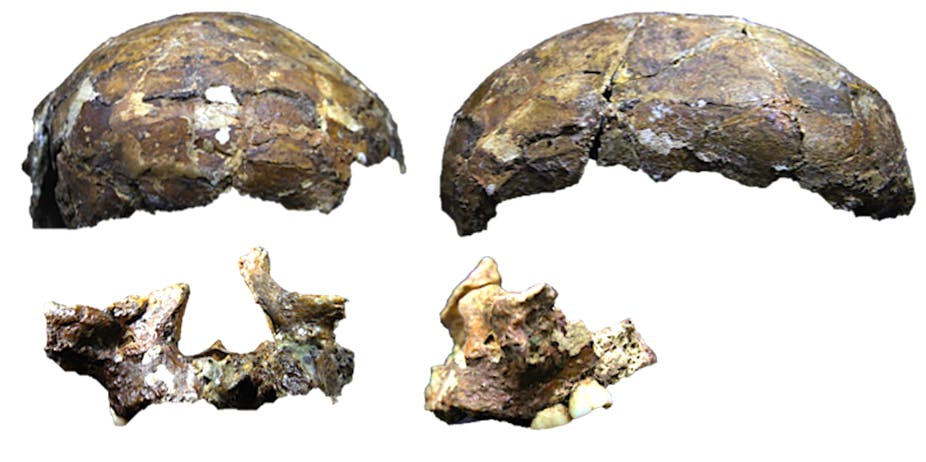
Author Darren Curnoe, Author provided The 37,000 year old Deep Skull from Niah Cave in Borneo is the oldest modern human skeleton found in island Southeast Asia. Darren Curnoe, Author provided
Thousands of years ago, the ancestors of modern humans left Africa to embark on a journey that would eventually take them across the globe. Yet we still know precious little about the momentous journeys they undertook.
Now, new research by my team and me significantly recasts how we think about the early peopling of Southeast Asia and the relationship the earliest humans had to the indigenous people of the region today.
Southeast Asia spans some 4.5 million square kilometres and is today home to roughly one tenth of the world’s population. Yet, we still know very little about their origins beyond a few thousand years ago.
This region’s ancient past has much wider importance; the early peopling of New Guinea, Australia and ultimately, the Pacific, was launched from Southeast Asia.
Yet archaeologists have found only six sets of remains dating beyond 25,000 years ago from across the region. This is the closest we’ve come to having skeletons of the first modern humans themselves.
They were scattered far and wide: found at Wadjak in Indonesia, Niah Cave in Malaysian Borneo, Callao Cave and Tabon Cave in the Philippines, Tam Pa Ling in Laos and Moh Khiew Cave in Thailand.
Strikingly, the Wadjak remains were found in 1888-90, and the Tam Pa Ling bones only uncovered in 2010. This gives a sense of just how rare and valuable early human remains are and how infrequently such discoveries are made.
First glimpses of the Deep Skull
It brings me to the famous Deep Skull, which was found by Tom Harrisson and his team almost 60 years ago in Niah Cave in Sarawak. This fossil was the focus research we published today in the journal Frontiers in Ecology and Evolution.
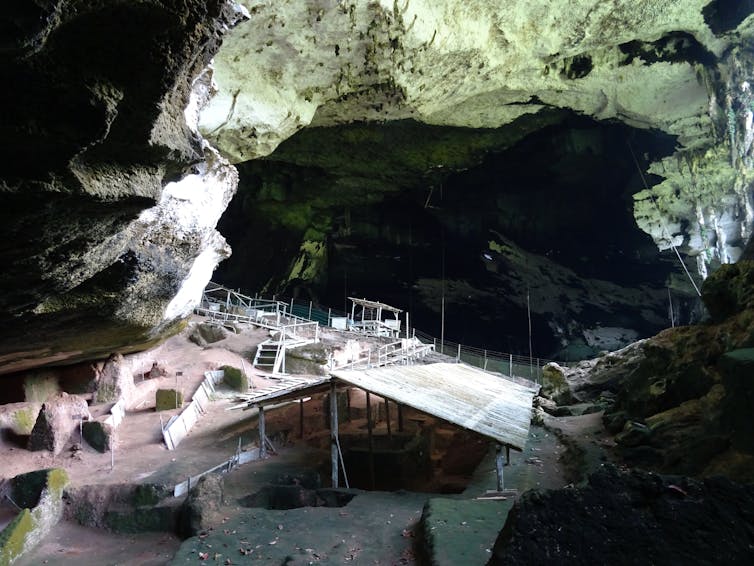
Deep Skull was recovered from the evocatively named “Hell Trench” of the great West Mouth of Niah Cave in Sarawak; the name was given to the trench due to the incredible heat endured by the excavators in the afternoon sun.
Niah Cave itself is a remarkable system of caves set in ancient limestone in northern Borneo that has supported the trade in bird nests for centuries.
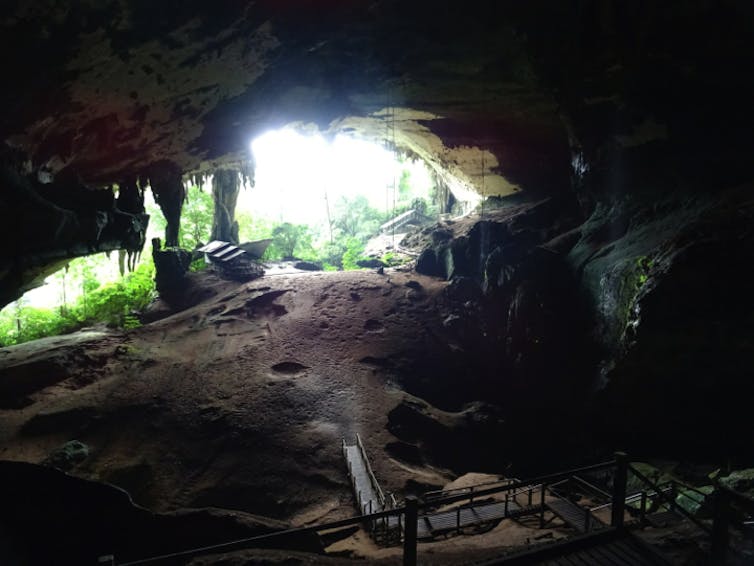
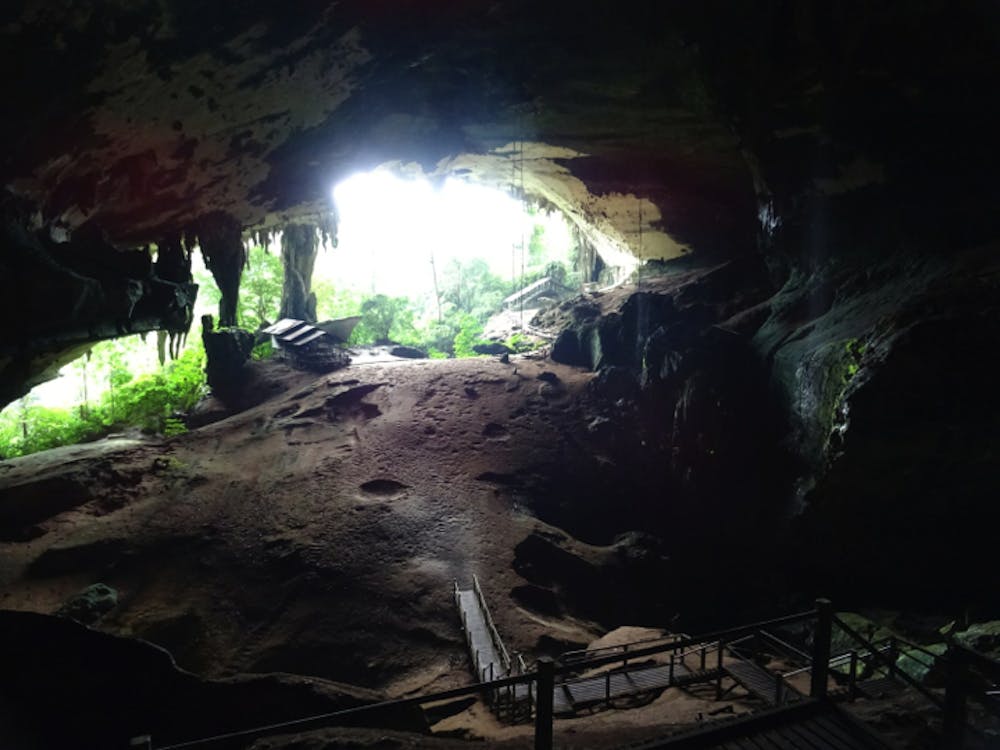
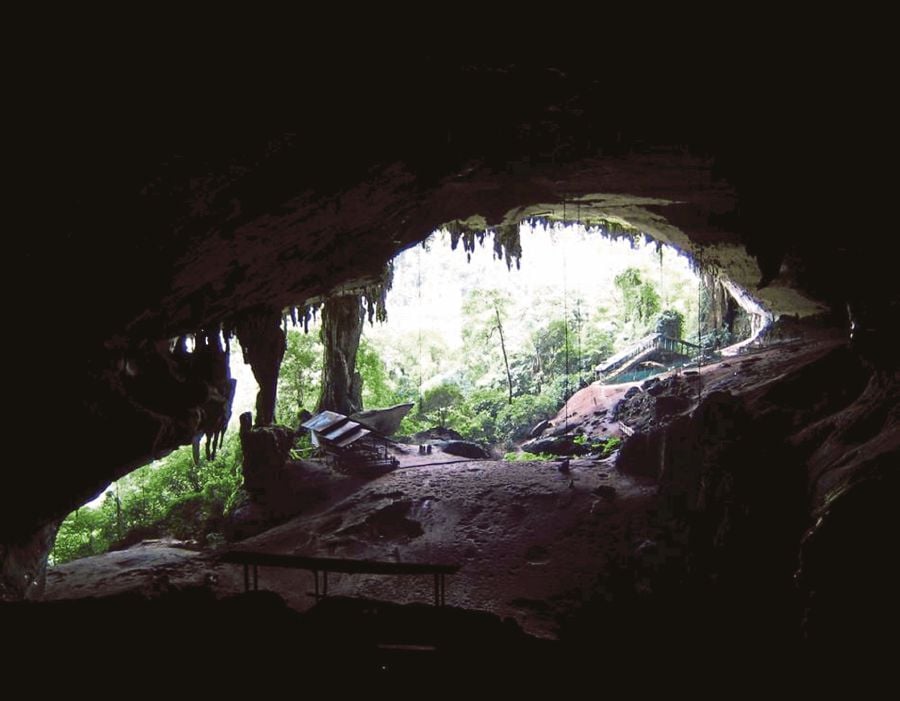
The remarkable West Mouth of Niah Cave. The excavation area of the Harrisson’s can be seen in the far distance on the right side.Darren Curnoe
The West Mouth is an incredible 244 metres wide, 61 metres high, and covers an area of around 105,000 square metres. It takes my breath away every time I visit.
Its scientific potential was first highlighted by Alfred Wallace, co-discoverer of natural selection, and frequent resident of Sarawak, who brought it to the attention of Thomas Henry Huxley way back in 1864.
But it wasn’t until the 1950s that Tom Harrisson, and eventually his partner Barbara Harrisson, began meticulous excavations at Niah Cave, lasting until the 1970s.
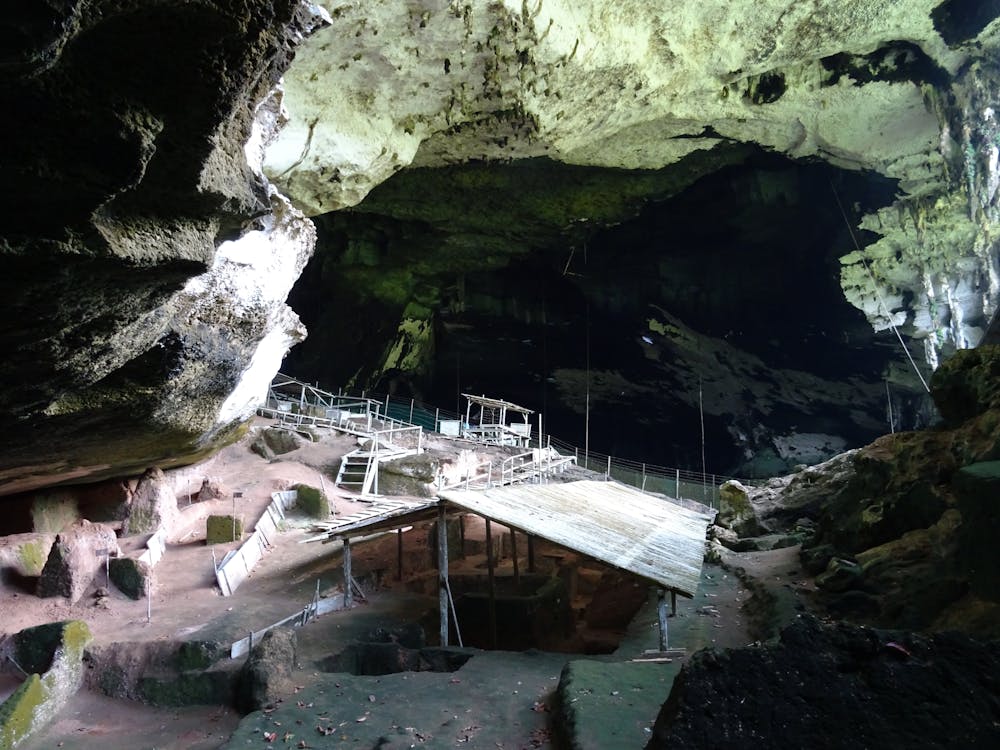
The main excavation area of the Harrison’s in the West Mouth of Niah Cave. The ‘Hell Trench’ is located beneath the roofed area.Darren Curnoe
In 1958, at the level of 101-110 inches below the surface, the Deep Skull was found in the Hell Trench. Soon after, radiocarbon dating on charcoal gave it an age of around 40,000 years old.
In the early 2000s, Graham Barker from Cambridge University reanalysed the site and its age, and through a combination of the dating of charcoal and the Deep Skull itself, they showed the skeleton to be 37,000 years old.
Don Brothwell of Cambridge University studied the Deep Skull in 1960 and concluded it belonged to an adolescent male and might represent a population of early modern humans closely related, or even ancestral, to Indigenous Australians, particularly Tasmanians.
His ideas were contentious even at the time, but have been highly influential ever since.
A fresh look at old bones
We wanted to see whether Brothwell’s ideas might be correct after so long, especially given that so few scientists have taken the trouble of going to Borneo to see the Deep Skull for themselves. Our work is the most comprehensive description and analysis done to date.
And in contrast to Brothwell, we found that the remains are most probably from a middle-aged woman rather than an adolescent male.
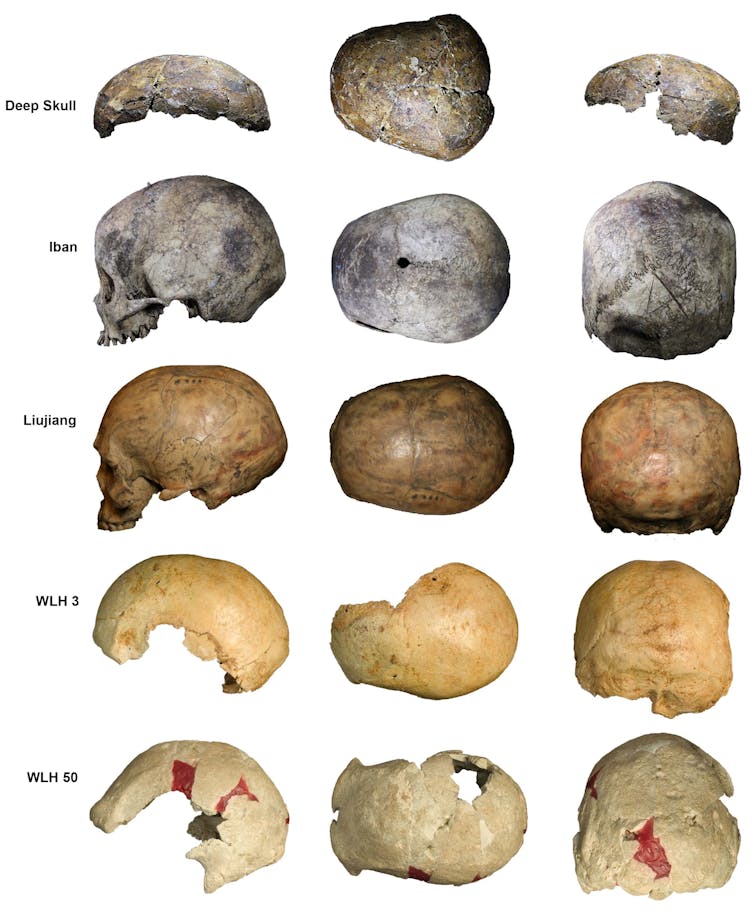
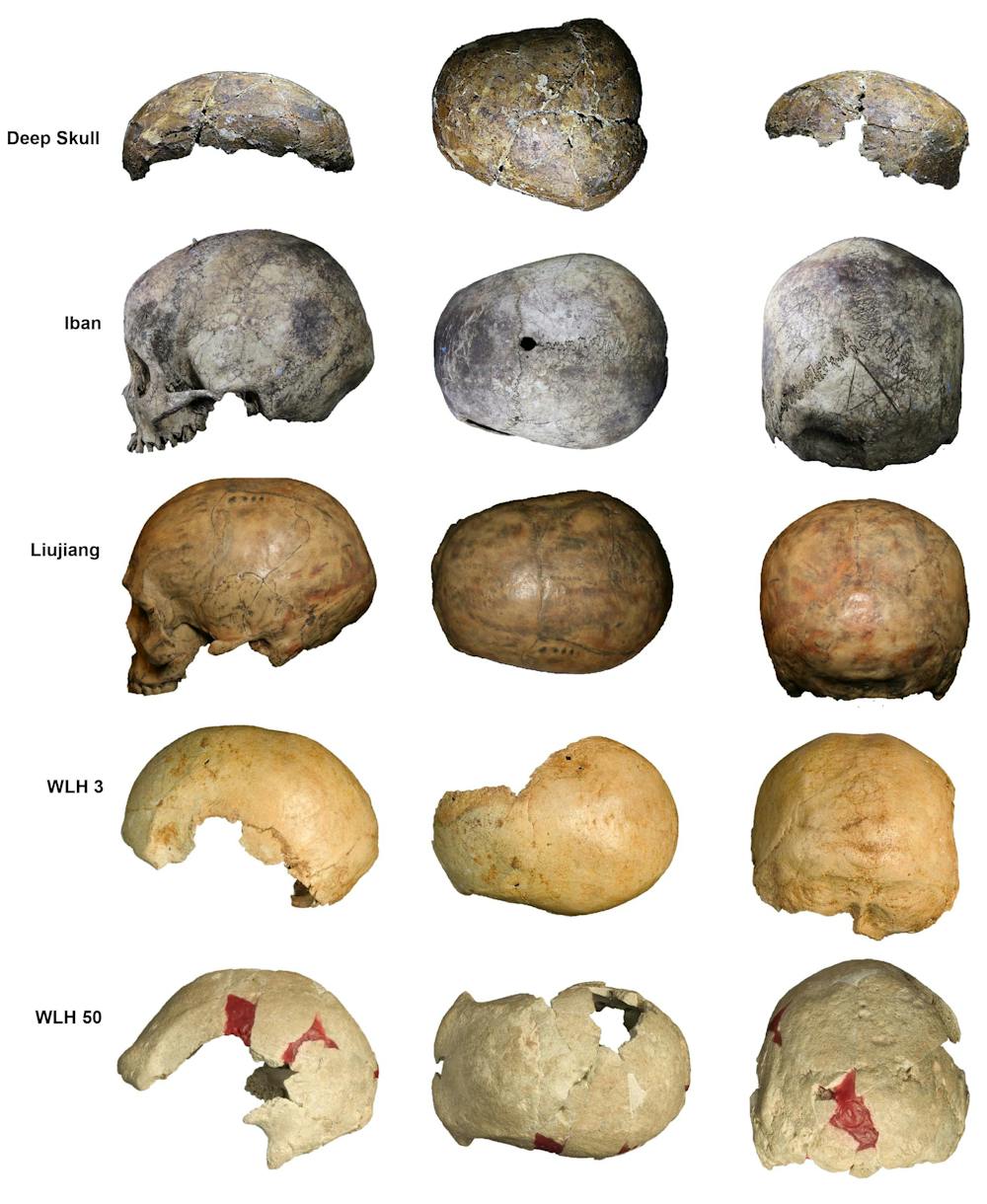
We also compared Deep Skull with other fossils and recent human populations from around the region and found very few similarities to Indigenous Australians.
Instead, it seems clear that Deep Skull most closely resembles the indigenous people of Borneo today, with their delicate features and small body size.
Deep Skull (top) compared with an Indigenous Iban cranium collected from a long-house in Sarawak, and with early modern human crania from China (Liujiang) and the Willandra Lakes in Australia (WLH3 and WLH 50).Darren Curnoe
The remains have also been a key player in the so-called “two-layer” hypothesis for the peopling of Southeast Asia.
This old idea proposes that the very earliest humans in the region were related to Indigenous Australians, but were later replaced by farmers from southern China.
If we’re right that Deep Skull is related to the indigenous people of Borneo, then these people, who are distinct from Australians, have inhabited the region for at least 37,000 years and not 3,000 years as the two-layer hypothesis would imply.
Our work finds support also in genetic studies of recent human populations across Southeast Asia, and together, they pose a serious challenge to the two-layer scenario for Borneo and islands further to the north.
It’s exciting to think that after almost 60 years, fossils such as Deep Skull still have a lot to offer in helping us to reconstruct the early prehistory of Southeast Asia, and help us answer some of the deep mysteries of how early human populations moved across the globe.
For further information log on website : https://theconversation.com/ancient-deep-skull-still-holds-big-surprises-60-years-after-it-was-unearthed-61572
Digging in Traders Cave in the iconic Niah Caves archaeological complex. Darren Curnoe excavates while Roshan Peiris observes. Credit: Mhd. S. Sauffi/Darren Curnoe
I recently led a team excavating at one of the most iconic archaeological locations in Southeast Asia, Niah Caves in Malaysia.
Over a period of three weeks, we dug through what we believe to be around 20,000 years of human history. We uncovered several human bones, the remains of large mammals (probably deer and wild cattle) and marine oyster shells indicating a period of seafood meals. Stone tools and charred rocks were also unearthed.
It was exciting and a little bit daunting to be digging at Niah Caves, given its place in both the history of archaeology and more broadly of humankind.
Famous for head hunters
Niah Caves National Park is located in the eastern part of Sarawak, a state of Malaysia that hugs the northern coastal strip of the island of Borneo.
Borneo straddles the equator, and is covered mostly by dense tropical rainforest. It's home to a remarkable variety of wildlife, including the endangered orangutan.
Sarawak also has a rich cultural heritage with almost 40 indigenous linguistic or cultural groups living there. It is an island that was famous until the 1970s for its head hunters.
It's also the place where Alfred Wallace, credited by history as the discoverer of evolution by means of natural selection, developed his ideas during the nineteenth century.
Daily Dig Diary Day 21: ancient human bones, tools and oyster shells were found at various depths. All diary postings can be seen at https://www.facebook.com/curnoeanthropologist/.
Sarawak also has an extraordinary history of human occupation. This stretches back at least 46,000 years ago, soon after the earliest modern humans settled the region after they made their long journey out of Africa.
Borneo is the island where these early people began island hopping across Southeast Asia and eventually settling New Guinea and Australia, making it crucial also to understanding ancient human history across the Australasian region.
Incredible caves
The massive Niah Caves complex sits within a large limestone hill in the centre of the national park. There are 21 caves in the main cave network with six large entrances or cave mouths. The largest cave is the West Mouth (Lobang Kualar) which is more than 60 metres high in parts.
The chambers of Niah Caves reverberate with the sounds of bats and birds known as swiftlets, which seem to fill almost every nook and cranny they have to offer. The swiftlets make highly sought after bird nests, used for traditional Chinese medicine and to make bird's nest soup. These nests are collected and traded each day by local Punan men, who scale tens of metres into the highest ceilings of the cave climbing wooden poles without safety harnesses, risking their lives in the process.
Daily Dig Diary Day 16: bamboo structures allow local men to collect birds nests from the caves. All diary postings can be seen at https://www.facebook.com/curnoeanthropologist/.
The potential of Niah Caves for informing scientific understanding of human origins was first recognised during the nineteenth century, when Wallace alerted Thomas Henry Huxley – "Darwin's bulldog" – to them. Huxley organised the first European expedition to Niah Caves, led by Alfred Hart Everett in 1878-79, but he returned to England with little to show for his efforts.
The caves had to wait almost 100 years before the first archaeological digs were done, led by Tom Harrisson from 1954, and joined soon after by his partner Barbara Harrisson. Their excavations ran for 13 years until 1967, digging in several of the caves in the Niah Caves complex and adjacent areas.
Their largest haul was found in the West Mouth, where in 1958 they unearthed the so-called "Deep Skull". This was a partial skull, and accompanying leg bones from an individual today known to be about 35,000 years old.
The Harrissons found a total of 270 sets of human skeletons in the West Mouth, but unlike Deep Skull most of them are from an early farming or Neolithic cemetery, dated between about 2,000 and 4,000 years old.
Daily Dig Diary Day 20: cremated bones in a Neolithic cemetery. All diary postings can be seen at https://www.facebook.com/curnoeanthropologist/.
Cemeteries and coffin boats
Three other teams of archaeologists have worked at Niah Caves since the Harrisons.
The first was from Malaysia, and dug in the West Mouth in the 1970s – the scientists found an Iron Age cemetery, dating between about 500 and 2,000 years old.
The second group, also from Malaysia, excavated a small area of an adjacent cave called Painted Cave and found yet more Iron Age cemeteries. This cave had also been dug earlier by the Harrissons, where they found numerous boat-shaped coffins and described dozens of paintings adorning the walls of the cave.
The final team was from Cambridge University and focused on reassessing the earlier work of the Harrissons. Among other things they provided a detailed framework for determining the age of the archaeological finds of the Harrissons using modern geological techniques.
Daily Dig Diary Day 12: boat coffins in Painted Cave. All diary postings can be seen at https://www.facebook.com/curnoeanthropologist/.
After six years of planning the project with colleagues at the Sarawak Museum Department, on the twentieth of November 2017 we began the next phase of archaeological research at Niah Caves. It was the fiftieth anniversary of the end of the Harrisson's excavations, and also the year of my fiftieth birthday.
Traders Cave
We chose to dig at a site called Traders cave, which sits outside of the Great Cave complex. We had surveyed it numerous times and had always been struck by its potential.
Traders Cave is 190 metres long, about 30 metres wide and up to 15 metres high. The Harrissons dug a small pit at the entrance to it back in 1956 but found nothing of note and gave up, focusing instead on the West Mouth.
My team included people from from Australia, Malaysia and Sri Lanka, involving archaeologists, heritage specialists and student volunteers.
Darren Curnoe digging Square A in Traders Cave. Credit: Mhd. S. Sauffi/Darren Curnoe
Across the three weeks, we dug two squares in the middle of the cave, about 20 metres apart. Each one measured one metre by one metre, and we dug each layer in small units or "spits" of five centimetres.
In the first one we dug through two metres of sediment before we stopped, to continue the work next year. In the second square, we reached a depth of 1.8 metres before we hit the limestone floor of the cave and could dig no further.
So, what did we find? In the first square, we found several human bones including fragments of skulls and part of a leg bone, across different layers. We also recovered the remains of large mammals, probably deer and wild cattle, and a whole layer of large marine oyster shells that were brought into the cave by people and probably consumed there. A number of stone tools and rocks that seemed to have been burned in fires made in the cave were also unearthed.
The second square was not nearly as rich but it did provide us with a collection of stone tools stretching across much of its nearly two metre depth.
At the moment, all of the evidence we have points to us having dug through Palaeolithic layers. Based on comparisons with the objects found by the Harrissons in the Great Cave complex, we think the Traders Cave deposits are mostly 20,000 years old or more.
Daily Dig Diary Day 8: sorting through the findings from one of the pits. All diary postings can be seen at https://www.facebook.com/curnoeanthropologist/..
Next year we'll return to dig again for at least two weeks. We plan to focus on the first square, the richest one: we'll dig until we reach the cave floor, and also open the square up, enlarging it to search for more human and animal bones and stone tools.
A major focus of our work will also be to determine the age of the finds and the sediments at Traders Cave, using as many different techniques as we can so we can be confident of their true age.
For further information log on website : https://phys.org/news/2017-12-evidence-early-humans-jungles-ofborneo.html
FURTHER studies and researches are being conducted to determine if the first human civilisation in Southeast Asia started from Sarawak’s very own background, which is the Niah Caves tucked within Miri division.
This follows the discovery of new evidence suggesting that the “Deep Skull” found in the limestone caves and archaeological site 60 years ago might belong to a local woman, instead of an indigenous Australian as concluded by researchers previously.
Assistant State Tourism, Arts and Culture Minister Datuk Lee Kim Shin said portions of the skull and jaws were discovered by the former curator of Sarawak museum, the late Tom Harrisson and his team in 1958.
It was later examined by British anthropologist Don Brothwell and concluded that it belonged to an adolescent male, who was closely related to modern indigenous Australians.
The skull was among the oldest representative of homo sapiens or modern man in Southeast Asia.
“I was informed (by the state museum director) that the skull is dated to about 42,000 years ago, which is older than the Perak man, who lived in Perak more than 12,000 years ago,” he said.
“It might be the first human in Southeast Asia but not necessarily the first human in the world,” he told the New Straits Times.
In the paleontological context or human evolution, Lee said, there were different types of hominids or man-like species found in different places and that they were termed differently.
For instance, the homo erectus (upright man or extinct species of human) stood on two feet instead of using four limbs and lived between 1.8 million to 70,000 years ago, including the Java and Peking man.
The homo neanderthalensis lived in Europe and Asia 400,000 to 28,000 years ago.
The homo sapiens or modern man, is known as the hominid with more intelligence as it had a bigger brain which evolved between 350,000 and 260,000 years ago.
The Cro-Magnon man was a homo sapiens found in a cave in France and dated to more than 30,000 years ago.
“Thus, the Cro-Magnon is among the oldest representative of humans in Western Europe while the deep skull is among the oldest in Southeast Asia. This is what we get to know.”
Lee said the discovery made by Harrisson confirmed the most important archeological sites in the world and had a main role in the development of human civilization in the region.
“It has scientific and academic significance as well as touristic appeal to visitors if further developed and publicised.
“Therefore, the state museum will resume excavation work with researchers from the University of New South Wales, Australia at the Traders Cave this year.”
It was reported that scientist Darren Curnoe of University of New South Wales had suggested that the skull belonged to an older woman and that it more closely resembled humans today from more northerly parts of Southeast Asia and could represent the ancestors of Borneo’s modern indigenous population.
For further information log on website : https://www.nst.com.my/news/nation/2018/01/322133/more-studies-niah-caves-skull
Leading a healthier lifestyle doesn’t have to be as hard as you think. Many people fear they lack willpower. In fact, I don’t like the idea of willpower; I don’t think it really works. Rather, I believe that some of us make better choices by planning ahead. Let me share with you three straightforward steps to improve your environment, consciously making choices that have long-term health benefits.
VIDEO OF THE DAY
Make Simple Changes
Start with simple changes in your immediate environment. Think simple ideas that you may or may not already unconsciously be doing: Put fruit on the kitchen counter and you’ll eat more fruit; use smaller plates and you’ll eat less; keep the TV out of the bedroom and you won’t fall asleep to the Late Show. Research proves it! As renowned researcher Brian Wansink and his colleagues demonstrated at Cornell’s Food and Brand Lab, small, obvious environmental changes have shocking and significant consequences. Their most recent research demonstrated that people who left cereal boxes out on their kitchen counters weighed on average 20 pounds more, so put away the cereal!
Set Realistic Goals
Trying to make radical changes can be difficult to maintain; setting unrealistic goals are just that — unrealistic. I don’t believe in the philosophy of “shoot for the stars and you will hit the moon” when it comes to behavioral change. Small changes, made every day, give you a feeling of accomplishment, and that will unconsciously drive up your chances of making a better choice next time.
Outsmart Yourself
Let’s talk about conscious choices so that you don’t have to rely on this so-called willpower. For example, if you struggle every morning with what to wear to work and then give up and wear the same old thing, lay out your clothes the night before. Tired by the end of the day and snapping at your children or your colleagues? Keep some nuts or other healthy snacks nearby to refuel and balance out your blood sugar in the afternoon.
You don’t need to make these small changes for long for them to add up to lasting change. Many behavioral researchers believe that if you make any change for 21 to 28 days in a row, it will stick. So, here are five easy places to start:
Swap out a salad plate for your dinner plate. Your plate will look full a lot sooner if it’s a smaller plate, and without realizing it, you’ll be eating less. We all tend to eat what’s available; research continues to bear this out in studies. But you and I don’t need a study to tell us that if we have a full plate of yummy food in front of us, we’ll probably eat it! So make your plate a bit smaller to naturally cut back on the amount of food.
Buy a pedometer. Set a baseline in your first week, and then increase it 10 percent every week till you get to 10,000 steps. The American Heart Association recommends that we all walk 10,000 steps a day; this is harder than you think for most of us. A pedometer can help you gauge how much you are actually walking.
Brush your teeth for at least a minute twice a day. Sing a song if you have to, skim your email on your phone, whatever it takes to stand there and brush your teeth. Oral health helps your overall health, not just your teeth.
Sleep at least seven hours a night. We all know where our power to make a good choice goes when we don’t get enough sleep.
Drop the processed snacks. Snacks are great and can help keep your blood sugar balanced in between meals, stabilizing your mood and energy levels. But snacks loaded in sugars, chemicals and other additives don’t actually help you at all.
Beth Ricanati, M.D. built her career bringing wellness into everyday life, especially for busy moms juggling life and children. Dr. Ricanati worked at Columbia Presbyterian's Center for Women's Health, and then at the Women's Health Center at the Cleveland Clinic in Cleveland, Ohio. In 2008, she joined the Cleveland Clinic's Wellness Institute to serve as the founding medical director of Lifestyle180, a groundbreaking lifestyle modification program to treat chronic diseases with nutrition, exercise and stress management. Now based in Southern California, recently she has written wellness content for YouBeauty.com and served as a consultant for medical projects and start-ups.
Setting resolutions at the start of a new year can be effective if you create goals that are realistic and you make them fun in some way. You might brainstorm different ways to accomplish the goal or recruit a friend to help you do it. For example, to lose 10 pounds, consider how to exercise daily, take up a new dance or martial arts class, and ask a good friend to be your workout buddy to keep you motivated.
VIDEO OF THE DAY
00:00
00:58
The idea is to maintain a healthy sense of humor: The more rigid or extreme the goal is, the less likely it will be that it will be attractive or attainable. Allow yourself to make mistakes and enjoy the process as much as reaching—or even surpassing--your new goals.
Step 1
List all the projects and goals you would like to complete during the new year. Don’t hold back: This is more of a brainstorming session to get all the ideas out onto paper for you to see them. Try not to censor yourself by limitations of time or budget--simply list the goals.
For example, a list might include: drop 15 pounds, buy a new car, take a surfing trip to Hawaii or meet new people.
Step 2
Cluster similar goals together to organize this large “wish list.” You might group all exercise- and nutrition-oriented goals together. For example, list these similar projects together: joining a running group, doing at least 30 minutes of cardio a day, biking one day a week to work, eating fish once a week and cutting back on coffee. By doing this, the goals become more defined and clear-cut and less overwhelming.
Step 3
Trim your goals to the top five most important—or desirable—goals. Think of working on these goals for the first six months of the new year, say, from January to June. If you had 15 to 20 goals on your “master list,” by tackling a few at a time and prioritizing them, it will be more likely that you accomplish these goals.
Step 4
Create a specific time frame and action plan for each goal. For example, if you want to run with a group after work, check a calendar and determine which days of the week you are most likely to have time to run with them. It might be two days a week, like Tuesdays and Saturdays. The time frame might be three months to see if you like the group and feel it is working for you. The action plan would be to join the group and see how your workouts go for a month.
Step 5
Re-evaluate after a month. After 30 days, if you find you no longer have a burning desire to learn how to crochet a poncho, drop that crafting class from your goals list. Replace it with another goal or simply use that surplus time for your other goals.
Keep your sense of humor. If your workout buddy bails on you, replace him or her or decide to use your workouts as “moving meditations.” If you need the motivation of someone else to exercise, book a trainer for a few sessions or ask a co-worker to fill in.
Tips
Consider losing weight and getting back in shape--a very common New Year's resolution--to be a lifelong goal. Rather than set yourself up for a huge fall, set realistic goals. Walk for 20 to 30 minutes a day if you are a newbie, or add a pick-up basketball game to your Saturdays.
For further information log on website : https://www.livestrong.com/article/62614-set-goals-new-year/