Blog List

Monday, 15 January 2018

Tasmanian Timber

Eucalypt Forest Life CycleEucalypt Forest Life Cycle

Eucalypt forests cover much of Tasmania and feature in most rural landscapes. Eucalypt trees and forests follow a natural biological life cycle that progresses from germination of seed, growth to maturity to over maturity and finally death and replacement. Some eucalypt species have a life span of about 250 years, whereas others live up to 400 years.

Whilst eucalypts form the dominant plant species for most Tasmanian forests, the forest ecosystem includes a variety of other plants, woody shrubs and trees, and species of insects, animals and birds. Throughout a forest’s life cycle, population densities of different flora and fauna will increase or decrease depending upon the forest’s stage of life and condition, and their own habitat requirements.


The life cycle of trees and forests may be viewed as four stages. The age at which trees change from one stage to another varies with the species of eucalypt and the site conditions.

graphic1

Stage 1: Disturbance, germination and early growth (Trees - 0 to 5 years)
Eucalypts have small seed and for effective regeneration the seed needs to be in contact with the mineral soil. Once germination occurs, eucalypts grow quickly, allowing them to establish and grow ahead of shrubs and other tree species.
Over the ages, wildfire has been the primary means of preparing the seed bed for eucalypt regeneration. These wild fires killed or damaged large areas of forest and give rise to large areas of even-aged forest. Currently, managed forests use regeneration burns on much smaller harvested coupes to create a good seedbed for regeneration.


Stage 2: Saplings and regrowth forests (Tree - 5 to approx. 100 years)
Young eucalypts increase in height very quickly. Each competes with the other for the available light, nutrients and water. Often several thousand eucalypt seeds will germinate on each hectare but only about 250 will survive to grow to maturity.
Although the tree size will vary depending on the species and site fertility, for forest of commercial timber quality, one would see trees develop to a height of 40 metres with a diameter at ground level of about 1 metre. As the tree reaches maturity, the crown widens and vertical growth slows. Some minor dieback of branches may start occur especially during dry seasons. In wet sites, trees of species that can survive and grow in the shade, such as Myrtle or Sassafras, develop as an understorey.


Stage 3: Mature trees (Trees – approx. 100 to 250 years)
At a mature stage, trees add little or no height but continue to add girth. During dry seasons there will be considerable die back in the crown and strong winds may break off branches. This allows insect and pathogens to enter. As the tree ages further, growth in girth slows and rot becomes established in the older wood at the centre of the tree. This spreads outward and upward from the ground.


Stage 4: Overmature and senescent trees (Trees - older than 250 years)
Overmature trees are subject to further loss of larger limbs and increased attack by insects and pathogens. As the centre rot of the trunk increases, the trees lose strength. Some blow over during strong winds while others collapse under their own weight. In wet eucalypt forests, the understorey species, such as Myrtle, grow and fill any space this leaves in the canopy. As this restricts eucalypt regeneration, these understorey species become and remain the dominant forest tree until wildfire or some catastrophe allows eucalypt to regenerate.
The whole cycle then begins again.


For further information log on website :
http://www.tastimber.tas.gov.au/SusArticle_View.aspx?articleid=167

Full-Cycle Life of a Forest

Contents

Three Ages of Forests
Steps to Manage the Life of an Oregon Forest
Site preparation
Reforestation
Intermediate treatment
Harvesting


Three Ages of Forests

Oregon forests have always been a mix of different aged areas of trees, distributed across the forested landscape in a mosaic pattern. It was even this way pre-European settlement before 1800. Each forested “area”—from a few acres to a couple hundred acres in size—is generally of a like “even-age,” or possible two-aged. In general terms, there are three important forest age-classes in the state’s 30 million acres of forestland: 1) young, open forests; 2) middle-aged dense forests; and 3) older complex forests.
When considering nature and the environment, maintaining a portion of forest area within each of these three ages would be desirable. This makes sense because each of these three age-classes provides their own unique and important ecosystem values that the other two cannot. Each age-class offers different tree-size structures, vegetation, aesthetics, biodiversity, aquatic life, birds, wildlife, and animals.

Let’s examine how each different forest age-class offers different types of habitat to meet the food and shelter needs for different forest animals. As forests grow from young to old, the resident wildlife will change as the habitat structure changes. Forest animals inhabit young, middle-aged or older forests, depending on their specific food and shelter needs. Some animals are found in forests of any age, while others prefer the vegetation associated only with one of the age-classes: young, middle or older.

Full Cycle Forest ImageYoung, Open Forests
Young, open forests occur following disturbances such as fire or logging. Shrubs, grasses and young trees emerge first. Zero to 15 years old
Who’s here: mountain bluebird, black bear, American goldfinch and others


Full Cycle Forest ImageMiddle-Aged Forests

The dense canopy of trees in a middle-aged forest has outgrown weaker trees and other vegetation. The canopy is full, yet some growth of ground vegetation that some animals prefer. 15 to 50 years old

Who’s here: long-toed salamander, Roosevelt elk, pacific tree frog and others

Full Cycle Forest ImageOlder Forests
Older, complex forests contain larger trees and have a layered canopy with some smaller trees too, a highly developed vegetation understory, and fallen logs and snags that provide habitat for some animals. 50+ years old or older (varies widely)
Who’s here: hoary bat, Douglas squirrel, marbled murrelet and others


Managing a large forest landscape should keep a portion of the forest area in each of all three age-classes, rather than favoring only a single age-class. Since keeping the forest in a status that includes a portion of all three age-classes is desirable for the ecosystem, we can see how active forest management in Oregon achieves good age-class diversity. A managed forest in Oregon achieves good age-class diversity in five ways:
  • Managed forests involve harvesting every few years a small percentage of the total area: keeping the life-cycle progressing from older, to young, to middle-aged, to older—and returning again!
  • Managed forests grown over a life of at least a 40 to 100-years old: “rotation” or “harvesting”
  • Managed forests across landscape include areas/blocks of each of the 3 age-classes: young, middle or older
  • Managed forests include groups of older trees from previous forest: “reserves”
  • Managed forests assure each of the 3 age-classes always is part of entire landscape
Although forest management and growing forest crops is a long-term program, often spanning 40 to 100 years in the life of an Oregon forest, forestry is not unlike growing a crop of wheat or corn. Logging, or “harvesting”, is just one management step of the full life-cycle of a managed forest. Forestry, just like farming, manages a vegetation crop using four basic steps in a life-cycle that repeats after the harvest occurs:

    1.   Site preparation
    2.   Reforestation
    3.   Intermediate treatment
    4.   Harvesting


Full Cycle Forest ImageFull Cycle Forest ImageFull Cycle Forest Image


Step 1. Site Preparation

Site preparation is preparing to establish a new young forest, immediately after harvest, and to replace those trees removed by harvest. The forest begins by planning and modifying the open site (recently harvested) to create favorable conditions for small tree “seedlings” to be planted or germinated.
  • A reforestation and site preparation prescription is carefully-planned by a forest professional (forester), to assure the successful young forest establishment thorough a several year process, which results in a “free-to-grow” young forest within 6 years after harvest (It’s the Oregon law to achieve success within 6 years).
  • At this early step of forest establishment, forest professionals (forester, silviculturist, biologist, hydrologist, soil scientist, forest engineer) evaluate the site conditions, the landowner objectives, and other resource needs, to prepare a prescription that assures the successful establishment, growth & development of the type of young forest planned.
  • Unwanted competing vegetation may need to be removed, or reduced, to create “planting spots,” where small tree seedlings can be established
  • Excessive depth and concentrations of forest woody debris, called “slash,” which may be left from harvesting, may need to be removed, or reduced, to create “planting spots,” where small tree seedlings can be established
  • Excessive amounts of flammable forest woody debris, called “slash,” which may be left from harvesting, may need to be removed, or reduced, to reduce the hazard that such fuels would subsequently ignite and burn the young forest trees
  • Order & procure tree seedlings from tree nursery
  • Crews of men & women forest workers, often using heavy equipment or tools, complete the site preparation tasks
  • Forest roads are managed to provide necessary access to conduct site preparation
  • Carefully-planned seed trees may be left during the recent harvest, for the purpose of adding natural seeding & seedling germination (adding to those planted seedlings).
Full Cycle Forest ImageFull Cycle Forest ImageFull Cycle Forest Image


Step 2. Reforestation

Reforestation is beginning a zero to 10-year old forest. Within 6 years after harvest, Oregon law requires that successful young forest trees must be established to replace those trees removed by harvest. The “Reforestation” step is the establishment of young tree seedlings that will grow into a young forest. Reforestation is most-reliably accomplished by planting one to three-year old tree seedlings (called “artificial regeneration”). However, the planted numbers of seedlings is often supplemented by the addition of tree seedlings germinated from seeds spread from nearby trees (called “natural regeneration”). And, under special and limited 
prescriptions, this natural regeneration can be the primary form of reforestation.
Full Cycle Forest Image
  • A reforestation prescription is again carefully-planned by a forester, to assure the successful young forest establishment within 6 years after harvest.
  • Within 6 years after harvest, in Oregon it’s the law that a sufficient number of well-distributed young trees must be thriving and “free-to-grow” as a young forest. That means for each site, a specified number of healthy trees must be established, be able to outgrow competing vegetation, and be able to continue growing as the dominant vegetation canopy.
  • Carefully-planned natural seedling germination may also supplement numbers and diversity of planted seedlings
  • Small tree seedlings “protected” from damages (for a few years), which may weaken or kill the trees
  • Small tree seedlings “released” from unwanted competing vegetation, which may overtop & kill the trees
  • Crews of men & women forest workers plant small tree seedlings on the prepared site
  • Forest roads are managed to provide necessary access to conduct reforestation
  • If an insufficient number of young tree seedlings are established or fail to survive, additional tree planting, protection and release may be necessary
  • These zero to 10-year old forests provide very important habitat for many species of birds, animals, and diversity of flora & fauna.
Full Cycle Forest ImageFull Cycle Forest Image


Step 3. Intermediate Treatment – Intermediate Harvest Methods

After 10 to 40 years of forest growth, the now-immature forest has become a dense stand of sapling, pole-sized, or small-timber trees. These immature trees are complete with woody tree trunks, and a closed canopy of foliage overhead. At various times, these immature forests may be ready for one or more operations, called “intermediate” harvest methods, which has the purpose of improving future growth and condition of the forest tree stand.
  • At this earl or mid-life time of the forest’s life-cycle, forest professionals (forester, silviculturist, biologist, hydrologist, soil scientist, forest engineer) evaluate the site conditions, the landowner objectives, and other resource needs—to prepare a prescription that assures the successful future growth & development into the type of mature forest planned.
  • One or several “intermediate” treatments or cutting operations may be conducted, which could adjust the density, composition, health, and structure of the forest trees.
  • Most people recognize the term “thinning,” as a common description of an intermediate treatment method.
  • There are many types of intermediate treatment methods. Refer to a description of ‘Forest Harvest Methods.’ [Link to Forest Harvest Methods]
  • Logging—or forest thinning—crews of men & women forest workers cut, remove, and/or harvest smaller or mid-size trees—following detailed guidelines that instruct which trees to cut, and which to leave uncut.
  • Forest roads are managed to provide necessary access to conduct intermediate treatments. In some instances, existing forest roads may be reconstructed or new roads built to provide important management access to & from the forest for these operations. Roads move forestry professionals, machinery, crews, supplies, and transport timber products out of the forest to markets.
  • The purpose of the intermediate treatment method is to improve the forest condition, and redirect the future growth, health, and/or forest attributes derived from the forest stand of trees.
  • Intermediate treatments include management activities that usually involve cutting a portion of the trees in the forest stand, for purposes such as thinning, weeding, cleaning, salvage, or improvement.
  • Establishing new tree regeneration (seedlings) is not typically an objective of an intermediate method.
  • Some intermediate treatment methods may cut and remove commercial timber products, such as a commercial thinning forest harvest method is conducted (logs, pulpwood).
  • Intermediate treatment methods may also adjust or enhance desired numbers and diversity of desired trees, shrubs and other vegetation.
  • Carefully-planned tree cutting is prescribed that assures the successful future growth & development of the type of mature forest planned
  • During the intermediate treatment, immature leave trees to be retained after cutting are “protected” from damages that may weaken or kill the trees
  • Immature leave trees to be retained after cutting have more growing space, freed from unwanted competing trees that may in the future overtop & kill desired leave trees
  • During the planning and conduct of intermediate treatments in Oregon, many special environmental protections occur, including tree buffers retained along streams-wetlands-lakes, riparian management requirements, forest road standards, fire precautions, smoke management rules, scenic highway buffers, and others.
  • These 10 to 40-year old immature forests provide very important habitat for many species of birds, animals, and diversity of flora & fauna. The intermediate treatments typically improve the amount of biological diversity in these immature forests.
Full Cycle Forest ImageFull Cycle Forest ImageFull Cycle Forest Image


Step 4. Harvesting

After 40 to 100 years of forest growth, the now-mature forest has become a dense stand of valuable timber “crop” trees. These mature trees are complete with tall & thick woody tree trunks, and a dense closed canopy of foliage high overhead. Depending on a range of forest conditions, growth history, and landowner objectives, these mature forests may be ready for one or more operations, called a “regeneration” harvest method, which has the purpose of harvesting and removing most or the entire tree crop. Following a harvesting operation, the forest life-cycle begins afresh, by returning to Step 1. 

Site Preparation.
  • At this mature time of the forest’s life-cycle, forest professionals (forester, silviculturist, biologist, hydrologist, soil scientist, forest engineer) evaluate the site conditions, the landowner objectives, and other resource needs—to prepare a prescription that assures the successful “regeneration” harvest, which has two primary purposes. First, the regeneration harvest purpose is to harvest and remove most or the entire mature forest tree crop. Second, the regeneration harvest plan has a second important primary purpose of creating the open forest conditions favorable to establish a new young stand of tree seedlings.
  • One or two “regeneration” harvest treatments or harvest operations may be conducted, which harvest and remove most trees in the harvested area (harvest unit), or even the entire mature forest tree crop.
  • Most people recognize the term “clearcutting,” as a common description of a regeneration harvest method used in Oregon forests. For several native Oregon tree species and site conditions, clearcutting is the most favorable regeneration harvest method. Other regeneration methods prescribed in Oregon forests include shelterwood, seed tree, and these harvest methods with reserve trees.
  • There are many types of regeneration treatment methods. Refer to a description of ‘Forest Harvest Methods.’ [Link to Forest Harvest Methods]
  • Logging crews of men & women forest workers cut, remove, and harvest the mature large or mid-size trees—following detailed guidelines that instruct which trees to cut, and which to leave uncut.
  • Forest roads are managed to provide necessary access to conduct regeneration harvest. In some instances, existing forest roads may be reconstructed or new roads built to provide important management access to & from the forest for these operations. Roads move forestry professionals, machinery, crews, supplies, and transport timber products out of the forest to markets.
  • The two purposes for the regeneration harvest method are: 1) to remove most or the entire mature forest tree crop; and 2) to create the open forest conditions favorable to establish a new young stand of tree seedlings.
  • Regeneration harvest treatments include management activities that usually involve cutting most or the entire mature forest stand, and may include additional management activities that prepare the site for tree seedling establishment—such as: piling of logging debris “slash” (tree limbs, tops, broken chunks, cut shrubs); prescribed burning of slash piles or slash on the ground; erosion control mulching/seeding; reducing unwanted vegetation; or thinning of retained young tree saplings or poles.
  • Establishing new tree regeneration (seedlings) is always an objective of a regeneration harvest method. New young tree seedlings of many native Oregon forest trees require open forest growing conditions for which to establish and grow into a tree canopy. Other Oregon tree species at least require partially-open seedling establishment conditions.
  • Regeneration harvest methods always cut and remove commercial timber products (logs, poles, pulpwood, chips, hog fuel).
  • Regeneration harvest methods may also leave extra “reserve trees,” and/or shrubs and other vegetation—to accomplish additional non-timber forest resource objectives (e.g. habitat; structure, aesthetics, riparian benefits, or diversity).
  • Carefully-planned tree cutting is prescribed that assures the successful commercial removal of the mature forest trees, and creating the open forest conditions favorable to establish a new young stand of tree seedlings.
  • During the regeneration harvest, any designated leave trees to be retained after cutting are usually “protected” from damages that may weaken or kill the trees
  • Any immature leave trees to be retained after regeneration harvest cutting have more growing space, freed from competing overstory trees that may in the future overtop & kill desired leave trees
  • During the planning and conduct of regeneration harvests in Oregon, many special environmental protections occur, including tree buffers retained along streams-wetlands-lakes, riparian management requirements, wildlife trees and downed wood retained in larger regeneration harvest areas, forest road standards, fire precautions, smoke management rules, scenic highway buffers, and others.
  • For all the years before the regeneration harvest, these 40 to 100-year old mature forests provide very important habitat for many species of birds, animals, and diversity of flora & fauna. Many regeneration harvest treatments do retain some leave trees, “reserve trees,” or other vegetation, which serves to promote improved biological diversity carried-over into the next young forest established surrounding in these leave trees.
For further information log on website :
http://www.oregonloggers.org/Forest_About_FullCycle.aspx

Sunday, 14 January 2018

Ten Top Forests For Cycling

Whether you're looking for family-friendly trails or a mountain-bike challenge, England has woods for every cyclist

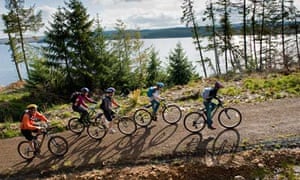
Family cycling along the Lakeside Way, Kielder Water & Forest Park, Northumberland, England.
 Family cycling along the Lakeside Way, Kielder Water & Forest Park, Northumberland. Photograph: Alamy
Cardinham Woods in Cornwall only opened its new mountain-biking trails – including the fearsomely named Bodmin Beast and Hell's Teeth – this year, but it's already becoming a favoured spot among informed and experienced mountain bikers.
Leigh Woods and Ashton Court in Bristol are perfect for a fast fix. Just moments from the city centre, they couldn't feel further from urbanity. Cycle three marked Leigh Woods trails against a stunning backdrop with views of Avon Gorge and Clifton suspension bridge.
New Forest You won't find trails for the extreme cyclist here, but you will enjoy 100 miles of traffic-free routes on flat, gravel track that is perfect for families.  Summer is an extra-special time as the adorable New Forest foals are around, but do not disturb or attempt to feed the forest ponies.
Grizedale Forest in Cumbria has ancient oak woodlands and glorious views over the Lake District and across to the Old Man of Coniston. Of the six way-marked cycling trails, only one is technical and challenging while the others follow forest roads. All include hills, though.
Kielder Forest in Northumberland (pictured below) is awesome both for its size and variety of routes. This is England's largest forest, so if you are planning to cover more than a fraction of it, you've really got to tackle it by bike.
Forest of Dean offers family routes, such as the Peregrine Path, and mountain biking in the Sallowvallets area. It doesn't promise the biggest terrain or gnarliest descents but fast, fun trails – and incredible bacon butties – have made it the English forest of choice for mountain- biking experts at Wideopen magazine.
Dalby Forest in Yorkshire is one of the best mountain-biking sites in the world. The four-mile, black-graded World Cup cycle trail is challenging, but there are less frenetic blue and green trails (graded easy and moderate), too.
Sherwood Pines mountain- bike trails range from green (easy) to orange (extreme) in the East Midlands' largest forest open to the public. Route 6 of the wonderful National Cycle Network runs right through it too, so cycle tourers get a taste of the woodland as part of a longer ride.
Bedgebury Forest in Kent has an eight-mile single track for mountain biking or a six-mile family trail, which is easy to cut short if needed. It's not possible to cycle in the National Pinetum, but take time to explore it on foot.
Hamsterley Forest in County Durham is a well-known mountain-biking spot, renowned for its downhill trails and offering technical, challenging riding. The Walney to Wear long-distance cycle route passes through this forest, too.

Since you’re here …

… we have a small favour to ask. More people are reading the Guardian than ever but advertising revenues across the media are falling fast. And unlike many news organisations, we haven’t put up a paywall – we want to keep our journalism as open as we can. So you can see why we need to ask for your help. The Guardian’s independent, investigative journalism takes a lot of time, money and hard work to produce. But we do it because we believe our perspective matters – because it might well be your perspective, too.
I appreciate there not being a paywall: it is more democratic for the media to be available for all and not a commodity to be purchased by a few. I’m happy to make a contribution so others with less means still have access to information.Thomasine F-R.
If everyone who reads our reporting, who likes it, helps fund it, our future would be much more secure. For as little as £1, you can support the Guardian – and it only takes a minute. Thank you.
For further information log on website :
https://www.theguardian.com/travel/bike-blog/2013/aug/03/cycling-ten-top-forests

Planning your visit Cycling trails


Cycling trails

Cycling trails

There are many miles of paths and tracks through Moors Valley Country Park and Forest. You are welcome to cycle on any of the gravel or tarmac paths however the best paths 
for cycling are waymarked.
Visitors are welcome to bring their own bikes from home or select from a wide selection of bikes including child bikes, trailers and tag-a-longs which can be hired from the Cycle Hire Centre.
Please Note: cycling is not permitted on the Play Trail or the Tree Top Trail, the Lookout, near the Visitor Centre or around Moors Lake. Cyclists are reminded that they should ring their bells when approaching pedestrians and horseriders and slow down when passing.
‘Forest road’ graded routes
There is a central 2-mile circuit with the option to take three additional loops to extend your ride to 7 miles. These routes follow wide gravel tracks and are waymarked with round posts with the appropriate coloured bands.
Moderate
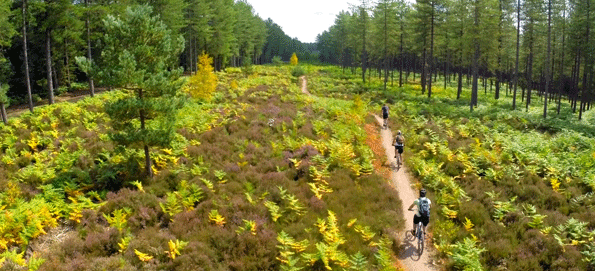
Our ‘Through the Forest’ singletrack route is recommended for cyclists with some basic off-road riding skills and is not suitable for trailers or tag-a-longs. The trail offers an exciting cycling challenge and includes technical bends and tight turns as it winds its way through the pine Forest and open heathland. The trail is edged by rocks and is waymarked with rectangular posts with blue arrows.
Challenging
The Bike Park is an exciting place for experienced cyclists to develop their skills. Designed in conjunction with local riders and the Forestry Commission, these natural elements require balance and riding skills to traverse and jump. The Pump Track is a sculptured track that includes berms and dips and encourages the rider to “pump” their way around the track with limited pedalling.
Please note: riders should be appropriately equipped and sufficiently experienced before attempting the Northshore elements which require technical ability. Only tackle jumps and other challenges if you are sure you can do them. Please read the safety advice and emergency contact information found at the entrance.
A detailed ‘Explore’ map which shows all the waymarked walk and cycle routes as well as the Trim Trail features is available to buy for £1 from the Information Point in the Visitor Centre.
We can also offer orienteering by bike on our permanent orienteering course in the forest. Cycle Orienteering map packs are available from the Information Point in the Visitor Centre; priced £3.00 each.

For further information log on website :
https://www.moors-valley.co.uk/planning-your-visit/cycling/

How to Survive a Week Without Running Water

Author
By NICOLE FAIRES

The foundation of every disaster plan is clean water.

outdoor water tap
The average American uses approximately 80 – 100 gallons of water per day, with the largest percentage of that being flushed down the toilet. Our consumption is one of the highest in the world, even when compared to many other first world countries, such as Great Britain, where the average person uses about 40 gallons per day.
Imagine for a moment that you’re like the millions of people who recently found themselves without running water for a week or more. Would you be ready to live without at least 560 gallons of water?

Related:

Where Your Water Goes

On average, your household water consumption is made up of the following uses:
Pie chart
80-100 gallons per day = about 32,000 gallons per year
Along with this, each person has a greater water cost from food, transportation, and other hidden water uses. The bulk of this ‘water footprint’ is from agriculture: livestock grazing, cotton, soybeans, wheat, fodder crops, coffee, barley and corn, for a grand total of 751,777 gallons of water per person, per year.

Factors Affecting Your Water Source

fresh, plentiful blue water
The water we use directly and indirectly every day comes from groundwater, surface water, and rainwater. Each of these sources is becoming less reliable due to climate change, an aging infrastructure, and industry.

Climate Change

According to the Environmental Protection Agency, our changing climate is altering the hydrologic cycle, changing the amount, timing, form, and intensity of precipitation. Other expected changes include the flow of water in watersheds, as well as the quality of aquatic and marine environments.
Where you live will have a big impact on how climate change will impact your water sources. With greater extremes of weather, flooding and drought, a climate that is already somewhere in the middle or colder will have greater stability.
The midwestern and northeastern United States are expected to experience the greatest temperature increases, which means extreme heat waves. Meanwhile, some areas will get much more precipitation, or far less of it. And many places will have stronger cold seasons.
In the northern US, winter is expected to get worse, but there will be less rain in the summer. The Pacific Northwest is supposed to get less precipitation overall and experience colder temperatures. Meanwhile, the South is going to be a lot drier. These changes will not be the same as small weather patterns, but will hit hard and have consequences for agriculture and health.
Clean and accessible groundwater is already becoming very valuable and harder to find. Analysis of U.S. Geological Survey has shown that water levels nationwide in the United States have dropped 64% due to fracking and agriculture, with an average decline of more than 10 feet.
Even more alarming, the declines were consistent even in wet areas, and not dependent on drought. The US Office of the Director of National Intelligence ranked water scarcity as a major threat to national security in 2016.

Aging Infrastructure

To compound the problem, the United States is using a water system nationwide that is rapidly falling apart. Thousands of cities have cast iron pipes that date back to the 1880s and many more cities have a serious lead problem. Maintaining the current water treatment and pipe system for a growing population is already stretching the economy (which we have seen in Flint, Michigan).
Replacing these systems often only happens when pipes burst and cause millions of dollars in damage—like the town of Warren, Michigan, which had to declare a state of emergency after suffering 107 breaks in a month. Despite these issues, it seems that legislation and funding just isn’t happening fast enough.

Being Prepared for a Water Emergency

washing dishes in a stream of tap water
To fully prepare for a water emergency, you’ll need to consider what factors affect the area where you live and what type of emergency you might encounter. You’ll also need to calculate how much water your family uses and how much you’ll need to replace for a short-term emergency situation.
The Federal Emergency Management Agency (FEMA) recommends one gallon per person (or pet) per day for up to two weeks—and that’s just for drinking. If you plan to cook, shower, wash dishes or clothing, you’ll need to replace considerably more than that.
Once you’ve made your calculation, consider the following solutions.

Water Purification

A reliable water purification system is vital when you’re in a situation where water is still plentiful, but it’s not clean, such as when a storm or flooding damages clean water sources or the city declares that the water isn’t safe to drink due to failed infrastructure.
Most jug-style filters don’t remove heavy metals like lead and other contaminants. The Berkey Light Water Purification System reduces the concentration of lead and other heavy metals in the water by over 97%. It also requires no electricity and can filter up to 3,000 gallons.
For compact water filters that are easy to stow, the LifeStraw Family 1.0 can filter up to 4,750 gallons of water, removing viruses, bacteria, and protozoa. The Lifestraw Personal Water Filter easily fits into emergency kits in your home or car. Each one filters 264 gallons of water.
For survival situations where contamination from heavy metals and waterborne illnesses are a threat, consider filtering by distillation. A still uses heat to turn water into steam, leaving contaminants behind. You can get a portable survival model which can even desalinate ocean water.

Storing Municipal Water

Whether or not you have a water filter on hand for drinking water, it’s wise to store water for drinking and other uses.
Unfortunately not all water storage solutions are created equally. Many plastic containers contain harmful chemicals, such as BPA. Plastic or waxed cardboard containers that once contained milk or fruit juice can encourage the growth of harmful bacteria. Glass containers aren’t ideal either, because they’re not earthquake proof and can break during a flood.
WaterBrick emergency water storage containers
Outside of purchasing bottled water, the Centers for Disease Control and Prevention (CDC) recommends using food grade containers manufactured for storing water. Containers like the WaterBrick are made from durable food grade industrial plastic and hold 3.5 gallons each. They can stack compactly into a small area, saving you a ton of space. They are also portable enough to take with you if you ever have to evacuate.
To prepare any plastic container for storage, wash thoroughly before filling, making sure to carefully rinse any soap residue from the inside of the container. Next, sanitize each container by swishing with a quarter cup of bleach mixed into one cup of water. Thoroughly rinse your container with clean water to remove all of the sanitizing solution.
If your municipality treats your tap water with chlorine, go ahead and fill your containers. If you’re storing well water or water that hasn’t been treated, add two drops of liquid household bleach for each gallon of water. Replace your stored water every six months.

Rainwater Storage

Depending on where you live and your roofing materials, rainwater storage is another viable alternative for your emergency water supply. Consider these facts:
  • For every inch of rainfall on 1,000 square feet of roof, you can collect 600 gallons of water.
  • The average home has a roof area of 1,500 square feet.
  • A desert is an area that gets less than 10 inches of water a year.
While it may not supply all of your needs, a 60-gallon rain barrel can supplement your drinking water and provide an extra supply for cooking, laundry, and washing. (If you’re unsure whether your stored rainwater is suitable for drinking, have a test kit on hand to check the water yourself.)
Combined with 16 WaterBricks, a single rain barrel could supply you with over 110 gallons of water without much storage space, enough to get a family through an entire week if combined with the water-saving solutions below. For more information on rainwater storage, read our article: Harvesting Rainwater for Residential Security.

Getting Ready to Use Less Water

In most water emergencies, you’ll need to reduce your water consumption dramatically. Since we’ve seen that most of our water gets flushed down the toilet, a Honeybucket chemical toilet or the Potty Box can take care of 26% of your water consumption.
Another 21% of your water use is in the laundry. Not only will you be wearing clothes a lot longer than you would otherwise, you’ll need to make some hard choices about some eco-friendly items. If you are using cloth diapers, cloth pads, and washable cleaning cloths and rags, you will need to keep a supply of disposable diapers, pads, sterilizing wipes, and paper towels on hand.
Scrubba Wash kit for emergency preparedness
Scrubba™ Wash Kit will allow you to do your laundry with a tiny amount of water and no washing machine. Washing clothes by hand in your bathtub or sink is laborious and doesn’t do the job effectively. The Scrubba cleans clothes in three minutes with very little water.
Keeping clean is another huge challenge without running water, yet hygiene is important in an emergency situation. Use a Simple Shower attachment to create a shower head out of a two liter bottle and keep a large supply of Action Wipes on hand to maintain a normal level of cleanliness. Action Wipes are extra large wet wipes that are safe to use on the whole body, including kids’ bodies, and have a sudsy but quick-drying cleaning solution.

Peace of Mind

Wherever you live, chances are you’ll sleep better at night if you plan ahead and secure enough water for your needs. With a few thoughtful steps, you can ensure that you and your family can weather a water emergency.
Have you been without water for a week? What was the most surprising challenge you experienced?
Pin for later:
pinterest
Author photo
~~
Nicole Faires is an urban farmer and best-selling author of books on sustainable agriculture and food policy. Originally from Montana, she now lives with her family on the West Coast. Find out more at http://deliberatelife.ca or connect with her on LinkedIn. 
For further information log on website :
http://learn.eartheasy.com/2017/09/survive-week-without-running-water/

Advantages and Disadvantages of Fasting for Runners

Author BY   ANDREA CESPEDES  Food is fuel, especially for serious runners who need a lot of energy. It may seem counterintuiti...