An ability to monitor our 'inner world' is key, say the experts.
Being self-aware is not only knowing yourself, it's knowing what others around you think of you, too. (Photo: oneinchpunch/Shutterstock)
You may have heard the term self-awareness tossed around, but what is it and why does it matter?
Being self-aware can influence how fulfilled you feel in your job and in your personal life. Daniel Goleman, who authored the 1995 New York Times bestseller "Emotional Intelligence," takes that connection much further, saying self-awareness is the key to success. He describes self-awareness as "knowing one’s internal states, preference, resources and intuitions" — and then monitoring that "inner world" information as it comes up.
If you can be as aware of your emotions and thoughts as you are of your other daily experiences — without judgment — you'll be better able to deal with new situations because you'll know yourself better. You'll be more accepting of yourself, your thoughts and your emotions, Goleman says.
But self-awareness doesn’t stop at how you see yourself. It’s also understanding and acknowledging how others see you. Tasha Eurich, an organizational psychologist and New York Times bestselling author of "Insight," explains that self-awareness has two parts – internal and external. Internal self-awareness means we can clearly see our own values, passions, thoughts, feelings and emotions. External self-awareness is clearly seeing how others see us. People who are externally self-aware tend to be better leaders.
So how do you know if you’re self-aware or not? Eurich developed a short online quizto help. The catch? You’re not the only one who has to take it. Someone who knows you well also has to answer questions about you.
In a recent TED Talk, Eurich refers to self-awareness unicorns. These are people who not only believe they are self-aware, but other people who know them would agree. Additionally, these unicorns would say they have improved their self-awareness in their lives and again, those who know them well would agree. This group made up a fraction of all the people she studied.
Thankfully, anyone can become more self-aware, as long as they’re willing to dedicate some time and effort to the cause.
How to become more self-aware
One way to gain some self-awareness is to work on your mindfulness practice. That doesn't mean meditating for an hour each morning (though that can be beneficial). In his book, "Wherever You Go, There You Are," mindfulness expert Jon Kabat-Zinn defines mindfulness as "paying attention in a particular way, on purpose, in the present moment, non-judgmentally." To do this, you have to practice being more aware of how you’re feeling without passing judgment on yourself (i.e. recognizing that you’re jealous of your co-worker’s creativity and not beating yourself up about it.)
Adds Dr. Elan Barenholz, associate professor of psychology at Florida Atlantic University, "Long-term mindfulness practices, such as meditation, can have long-term health and wellness benefits and may even lead to structural changes in the white matter of the brain, literally increasing your brain’s internal connectivity."
Eurich’s suggestion? Asking "what" instead of "why" to increase self-awareness, to avoid wallowing and see what you can do to change the situation. For example, let’s say you’ve just given a poor presentation to a client. As Eurich told Business Insiderlast May, "You might ask yourself, if you're a well-intentioned, successful person, 'Why did I go so wrong in that meeting?' or, 'Why did I mess that up?'
"What I've found, in my research and others', is that when we ask ourselves those 'why' questions, it takes us down a spiral of self-loathing. It makes us depressed; it tends to make us beat ourselves up in a non-productive way. But if we can ask the question of 'what,' that's more future-oriented. That can make all the difference in the world."
Probably the most important step on the road to self-awareness? Be a student of your own behavior. Ask other people questions about how they see you. You might be surprised. There are many reasons other people may not see us as we see ourselves. But don’t get defensive. If you try to see others’ perspectives as tools to help you better yourself, you’ll be well on your way to becoming a unicorn.
For further information log on website : https://www.mnn.com/health/fitness-well-being/stories/become-more-self-aware
A lip scrub is a good addition to your beauty regimen. (Photo: petrunjela/Shutterstock)
Have you ever lathered one of those pricey lip scrub products across your kisser and been impressed with how soft and supple your lips felt afterward? It's simple to make homemade lip scrubs too, so you can save a little money. We've come up with a few effective lip scrub formulas. Don't use them more than 3-4 times per week though, or you might strip lips of their natural moisture, making chapped lips worse.
It's most effective to exfoliate your lips at bedtime, followed by a good lip balm. And if you're more of a visual learner, scroll down to our video, which quickly leads you through these recipes!
1. Brown Sugar and Honey Scrub
Ingredients
1 tablespoon brown sugar
1 squirt of honey (just enough to mix with brown sugar and make a paste)
1 drop vanilla
Directions
Mix all ingredients together thoroughly and store up to a month in glass jar or tub with lid. Old eye cream jars work great.
To apply: Rub scrub into lips and exfoliate gently. Let it sit for a minute or two, then rinse off with warm water. Apply a generous slather of lip balm afterwards to rehydrate lips. Use 1-2 times weekly.
Mash one stick of lip palm with the back of a spoon in a small bowl. Add sugar and mix thoroughly to make a granular paste. Stir in coconut oil until paste is thinned slightly and is the consistency of thick gravelly goop. Store in glass jar with tight fitting lid up to a month.
To apply, smear a generous helping of product across lips and gently massage. Rinse off with warm water. Use 3-4 times per week.
3. Mint Lip Scrub
This minty lip scrub will leave your lips feeling tingly, fresh and plump (Photo: images72/Shutterstock)
Mix all ingredients together in a small bowl until they resemble a coarse paste. Store in a glass jar or lidded container.
To apply, hold a warm wash cloth over lips for 3-5 minutes to soften. Slather with minty scrub and let sit for 5 minutes. Wash off with a warm wash cloth and apply usual lip balm. Lips will be tingly, fresh and plump.
2 tablespoons coconut sugar (also called coco sugar or coconut palm sugar found in specialty or Asian markets)
1 tablespoon honey
Directions
Mix ingredients in a small bowl until a grainy paste forms. Store in a glass jar in the refrigerator for 2-3 weeks.
To apply, spread the coconut sugar scrub over lips and gently massage for 5 minutes, rinse thoroughly with warm water and apply a hydrating lip moisturizing product.
5. Chocolate Lip Scrub Mask
This chocolate lip cream is a sweet treat for your lips. (Photo: Liv friis-larsen/Shutterstock)
Ingredients
3 tablespoons white granulated sugar
1 tablespoon cocoa powder
2 teaspoons olive oil
1 teaspoon vanilla or almond extract
1 small drizzle of honey
Directions
Mix all ingredients together in small bowl until a gritty chocolate paste forms. If too thin, add additional sugar; if too thick, add additional olive oil and honey. Store in sealed container in the refrigerator for 2-3 weeks.
To apply, swab the lips with a thick glob of chocolate scrub masque and leave on for up to 5 minutes. Rinse off thoroughly with warm water and apply a light coating of lip balm or petroleum jelly.
We've rounded up a few of these lip scrub recipes in a visual format. Check out this quick video and learn how to make them:
For further information log on website : https://www.mnn.com/lifestyle/natural-beauty-fashion/stories/5-homemade-lip-scrub-recipes
There's a much faster way to get this chore done. (Photo: Catalin Petolea/Shutterstock)
Splitting wood is one of the least favorite tasks of woodstove owners, and even for people who are just chopping for a decorative fireplace or pit, it gets unfun very rapidly. The repetitive motion and high amount of energy required are demanding, and the concussive force from blow after blow can really set a pair of shoulders aching. As if that wasn't bad enough, you have to wrench the axe out of the wood if it doesn't split on the first try...and there's always the risk of injury.
The basic shape and design of the axe hasn't changed in, well, millennia, as attested to by archaeological discoveries from around the world. At least, that was true until an enterprising Finn decided to rethink the way we chop wood.
The result is the Vipukirves, an axe that allows people to work smart, not hard. In addition, it's safer to use than a conventional axe, and the design will turn heads even if the speed of your wood chopping skills doesn't. The Vipukirves may just become a must-have in every woodshed and handyman's truck.
What differentiates it from regular axes, and how does it work? The design is uniquely weighted, so that when you swing down, the axe acts as a lever. This transfers more force, essentially ejecting a piece of wood from the side of a large wood round, or cleanly cleaving through a smaller piece of wood. That ejection, by the way, happens at a pretty high velocity -- the axe's designers warn that the working area should be clear to avoid injuries.
When the user strikes down, the weighted axe automatically turns to the right, levering the loosened piece of wood away from the rest of the log. It drops to the left, leaving the axe in place for the next strike. This innovative design is far more reliable than conventional axes, which can sometimes be a little hairy to work with.
Users need to keep both hands on the handle for safety, control, and best results, but if they follow the basic Vipukirves directions, they'll get a high performance woodcutting experience. That might sound like a funny thing to say, but if you've ever had to chop a cord of wood or more, you know it's no joking matter. Anything to make wood chopping easier and safer is a great development in our book, and this design is intended to address common safety issues like axes bouncing back and striking the foot, as well as uncontrolled swings.
A new study warns Earth's biodiversity has fallen below the 'safe' limit. What does that mean, and why should we care?
More than half of all known species inhabit rain forests, like this one in Malaysia's Kinabalu Park. (Photo: Nokuro/Shutterstock)
"Biodiversity as a whole forms a shield protecting each of the species that together compose it, ourselves included." — E.O. Wilson, "Half-Earth"
Earth is teeming with life, from huge blue whales and redwoods to tiny bacteria, archaea and fungi. It's not just the only planet known to host any life at all; it has so many species in so many places we still aren't even sure how many there are.
We do know, however, that Earth is losing species unusually quickly at the moment. We're seeing a mass extinction event, something that's happened at least five times before on Earth, albeit never in human history — and never with human help.
Extinction is part of evolution, but not like this. Species are vanishing more quickly than any human has ever seen; the extinction rate for vertebrate animals is now 114 times higher than the historical background rate. Humans are driving this in several ways, from poaching to pollution, but the No. 1 factor is habitat loss.
This is raising deep concerns about our planet's biodiversity, which, as biologist E.O. Wilson has pointed out, is like an ecological shield for us and other species. In fact, according to a recent study, biodiversity loss has crossed the "safe" threshold in most of the world, leaving many ecosystems in danger of collapse.
A map of biodiversity loss in ecological hotspots around the world. (Image: Newbold et. al./Science)
"This is the first time we've quantified the effect of habitat loss on biodiversity globally in such detail," lead author and University College London researcher Tim Newbold says in a statement, "and we've found that across most of the world biodiversity loss is no longer within the safe limit suggested by ecologists."
Published in the journal Science, the study finds that 58 percent of Earth's land surface — an area home to 71 percent of all humans — has already lost enough biodiversity "to question the ability of ecosystems to support human societies."
That certainly sounds bad. But why is biodiversity so important? Can't technology keep civilization running, regardless of what happens to the wildlife in dwindling forests, grasslands or wetlands? Here's a closer look at why biodiversity is a big deal — and why it's in our own best interest to preserve what's left.
The red-tailed bumblebee is an important crop pollinator in Europe. (Photo: Pippa Sanderson/Shutterstock)
1. Food
About 75 percent of our food supply comes from just 12 plant species, and more than 90 percent of global livestock production comes from just 15 species of mammals and birds. That's deceptive, though, because those 27 species — along with many others that also provide food for humans — couldn't exist without help from hundreds of thousands of lesser-known species working behind the scenes.
A wide range of wildlife makes agriculture possible, including bats, bees, birds, dragonflies, frogs, ladybugs, mantises, moles, nematodes, salamanders, spiders, toads and wasps, among countless others. Of 264 crops grown in the European Union, more than 80 percent depend on insect pollinators, while bees alone boost U.S. crop revenue by more than $15 billion per year. Worldwide, bats save corn farmers about $1 billion annually by eating pests like earworm larvae.
Wildlife doesn't just protect and pollinate food; it often is our food, too. Hundreds of millions of people rely on daily protein from wild-caught fish, for example, including many fish that depend on healthy coral reefs. And while we mostly eat just a few domesticated crops today, about 7,000 plant species have been cultivated as food in human history — and their wild relatives hold a cache of genetic diversity that may prove priceless as drought or disease threaten monoculture crops.
About 70 percent of known plants with cancer-fighting properties exist only in rain forests. (Photo: soft_light/Shutterstock)
2. Health
Biodiversity is linked to human health in several ways. By having a diverse mix of plants, fungi and animals to eat, we ensure nutrition that buffers our bodies against disease and other hardships. Higher biodiversity has also been linked to lower instance of disease, with studies finding lower human rates of Lyme disease, malaria, acute respiratory infection and diarrhea around protected natural areas.
But even when we can't avoid getting sick, biodiversity still swoops in to the rescue.
Medical discoveries frequently begin with research on the biology or genetics of plants, animals, fungi and bacteria. This inspiration is especially prevalent in rain forests, biodiversity hotspots that contain half of all known species. The asthma drug theophylline comes from cacao trees, for example, and about 70 percent of plants with cancer-fighting properties occur only in rain forests. Yet medical insights can be found in other ecosystems, too, such as forests of eastern North America, where the eastern red cedar produces a compound that fights antibiotic-resistant bacteria.
"Every time a species goes extinct or genetic diversity is lost, we will never know whether research would have given us a new vaccine or drug," points out the National Wildlife Federation. And as The Economics of Ecosystems and Biodiversity (TEEB) initiative notes, "all ecosystems are a potential source of medicinal resources."
Soil biodiversity is key to the health of grasslands, like this one in Colorado. (Photo: U.S. Bureau of Land Management)
3. Ecosystem services
Food and medicine are just two of many "ecosystem services" humans can expect from biodiverse habitats. Here are a few other examples:
Clean air: From old-growth forests to ocean phytoplankton, the oxygen we breathe is generated by photosynthesizing members of ecosystems around the world. Plants also absorb a variety of pollutants from the air, and sequester the excess carbon dioxide emissions that fuel climate change.
Clean water: Forests help soil absorb more water, which can reduce flooding, limit erosion, filter out contaminants and refill aquifers. Wetlands also excel at "phytoremediation," or cleaning hazardous chemicals from water and soil. Different species bring different skills, so the more the merrier.
Healthy soil: Soil naturally bustles with lots of arthropods and microorganisms, which are easy to overlook but provide a wide range of benefits. They provide food for slightly larger creatures, help nutrients cycle through soil, boost nutrient availability to roots and enhance plant health, among other things.
Raw materials: Biodiverse ecosystems supply us with a diversity of raw materials, including wood, biofuels and plant oils that come from both wild and cultivated species. Materials from different plants offer different properties, such as harder or softer wood, or oils with varying smoke points.
As biodiversity falls below safe limits, these services are in jeopardy for a growing number of people. "Decision-makers worry a lot about economic recessions, but an ecological recession could have even worse consequences — and the biodiversity damage we've had means we're at risk of that happening," says Andy Purvis, a researcher at Imperial College London and co-author of the new study. "Until and unless we can bring biodiversity back up, we're playing ecological roulette."
Anglers work near a coral reef in Indonesia, where people rely heavily on wild fish. (Photo: Ethan Daniels/Shutterstock)
4. Resilience
One of the single most important aspects of biodiversity is that it provides insurance. According to the insurance hypothesis: "Biodiversity insures ecosystems against declines in their functioning because many species provide greater guarantees that some will maintain functioning even if others fail."
When an ecosystem has lots of different species, they can fill an array of different ecological niches, while in a monoculture they're all competing for the same niche. Biodiversity tends to increase overall rates of photosynthesis, and it also buffers the community against illness. Plant viruses often specialize in a certain species, genus or family of plants, so one viral strain can obliterate all members of a monoculture. In a biodiverse ecosystem, on the other hand, all the eggs are not in a single basket.
"Biodiversity allows for ecosystems to adjust to disturbances like extreme fires and floods," the NWF adds. "If a reptile species goes extinct, a forest with 20 other reptiles is likely to adapt better than another forest with only one reptile."
Sunrise illuminates the canopy of a rain forest in Sri Lanka. (Photo: Sergieiev/Shutterstock)
5. Ethics, aesthetics and awe
There are many practical reasons to preserve biodiversity. It saves us money and effort, protects our lives and livelihoods, and ensures we have enough to eat. It's also worth noting, however, that biodiversity is bigger than any one species, including us.
By leaving biodiversity intact, we let natural evolutionary processes continue. That's a long-term benefit beyond the scale of human lifetimes, but that doesn't mean it's not important. Evolution lets organisms adapt to environmental change, and who are we to interfere with that? Since it's possible for humans to thrive without destroying the ecosystems — and lives — around us, why destroy them? As a species capable of ruining ecosystems, we have a moral obligation not to screw everything up.
And, finally, the most basic beauty of biodiversity is the beauty itself. Spending time in nature offers many perks for people, like more creativity, better memory and faster healing. Feeling awe at the sight of nature can even reduce pro-inflammatory proteins in the body. But we don't need science to tell us that. All it takes is one step into an old-growth forest, or one paddle into an ancient estuary, to make clear that we aren't just lucky to be alive — we're lucky the world around us is, too.
For further information log on website : https://www.mnn.com/earth-matters/wilderness-resources/blogs/why-biodiversity-big-deal
Lindsay K. Campbell is a research social scientist with the USDA Forest Service. Her current research explores the dynamics of urban politics, stewardship, and sustainability policymaking.
For all the critical scholarship that is written about the harnessing of volunteer labor in caring for urban trees (see, e.g., Perkins 2009), it never squared with my experience of engaging in stewardship. Following attendance at a human geography panel on ‘powerful objects’, I came to realize that my leisure practices were missing from my research accounts. I was writing myself out of the story, focusing only on the managerial logics of the state and civil society and the biophysical capacities and needs of the trees (Campbell 2014). The missing piece was the interactions of humans with trees, and what better way to explore those than through my own, first-hand accounts?
Inspired by Jones (2014) and Pearce et al. (2015) (see the reference below), I’ll share three stories of my engagements with street trees and reforestation sites to explore affective experiences between me and the trees. I believe that these vignettes offer windows into why and how we create and maintain relations of care with the urban forest.
Encounter 1: Street trees
Though I have worked for the US Forest Service in New York City since 2002, I had never taken part in street tree care. In the past, my colleagues and I used to joke that—despite working in the world of urban natural resource management—street trees made us sleepy. We felt they were too confined, like little toy soldiers, so neatly in their tree pits, standing in linear rows. We were interested in more open spaces—both physically and from a governance perspective—so we studied the conversion of lots to community gardens, the re-appropriation of public space for community memorials, and the restoration of contaminated urban waterways through civic action (Campbell 2006; Campbell and Wiesen 2009; Svendsen and Campbell 2010). But street trees remain the primary focus for many of our researcher and manager colleagues: they are the “stars” of the urban forestry show. These are the sites of quantification and valuation and of carefully constructed managerial practices. My only substantive prior involvement with them was in a research project on young street tree mortality (Lu et al. 2010), but I had never interacted with a street tree as a steward.
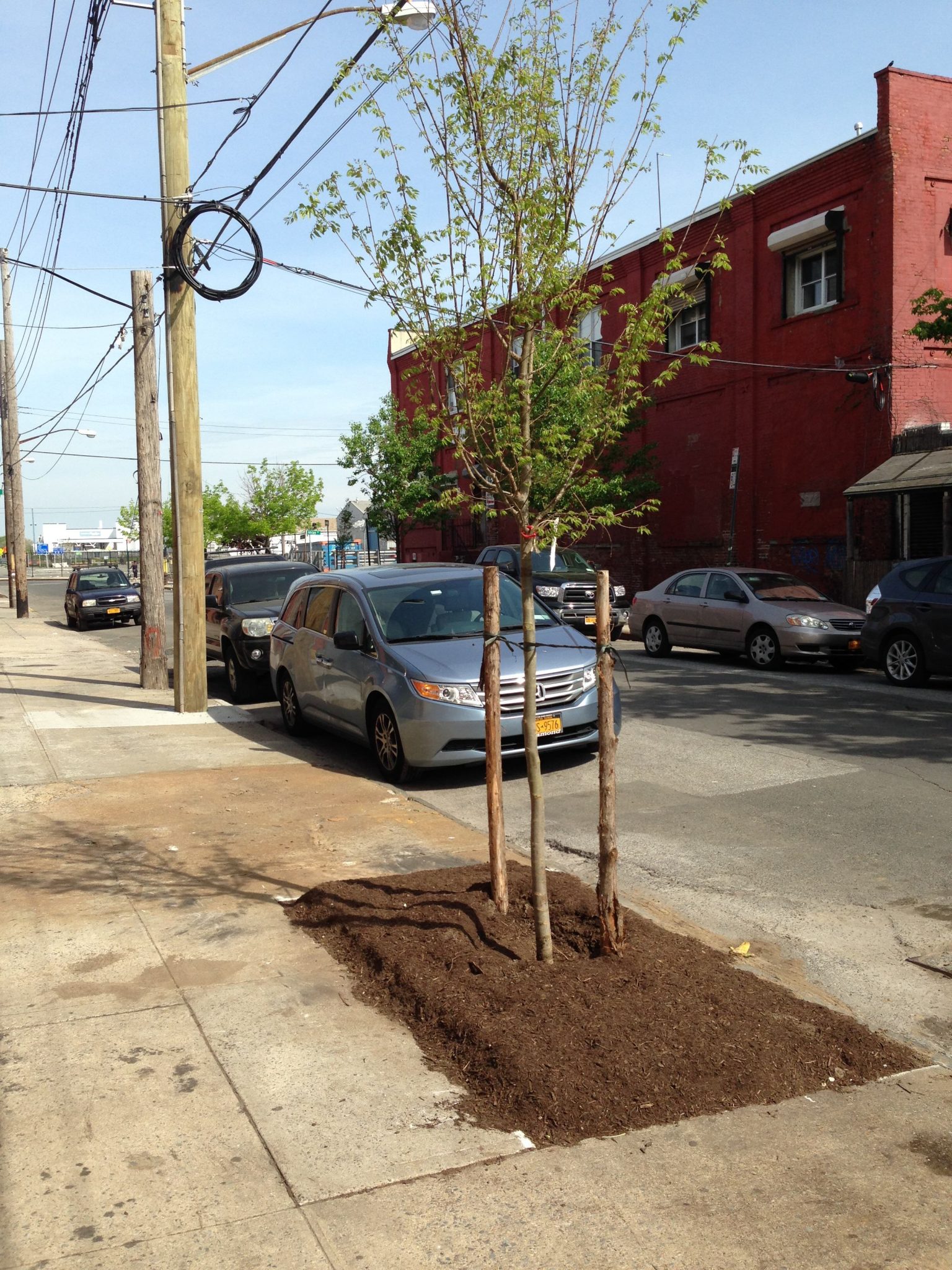
Red Hook street tree. Photo: Lindsay Campbell
This changed in the spring of 2014, when a new tree appeared in the sidewalk outside the door to my apartment, courtesy of the NYC Parks Departmentand the MillionTreesNYCcampaign. I did not request this tree via 311 (the New York City government’s service request number), nor did I know who did, but I suddenly felt excitement, ownership, and a sense of possibility. Here was my chance! To DO some of things I sat around yammering about in MillionTreesNYC Advisory Committee meetings or painstakingly studying for my dissertation. I didn’t have a yard, or a roof garden, and my prior community garden plot (in a privately owned, unlicensed site) had been overrun three times—first by mosquitoes, then by the cantankerous landowner, then by Hurricane Sandy. So I had no growing space. My partner, Ricardo, and I eagerly jumped at the chance to “adopt” this tree, writing out names on the tag attached to the trunk of this “wireless Zelkova”—so named because it was bred to perform well in the context of overhead utility wires, which few neighborhoods in New York City have, but which are prominent in my waterfront neighborhood of Red Hook, Brooklyn.
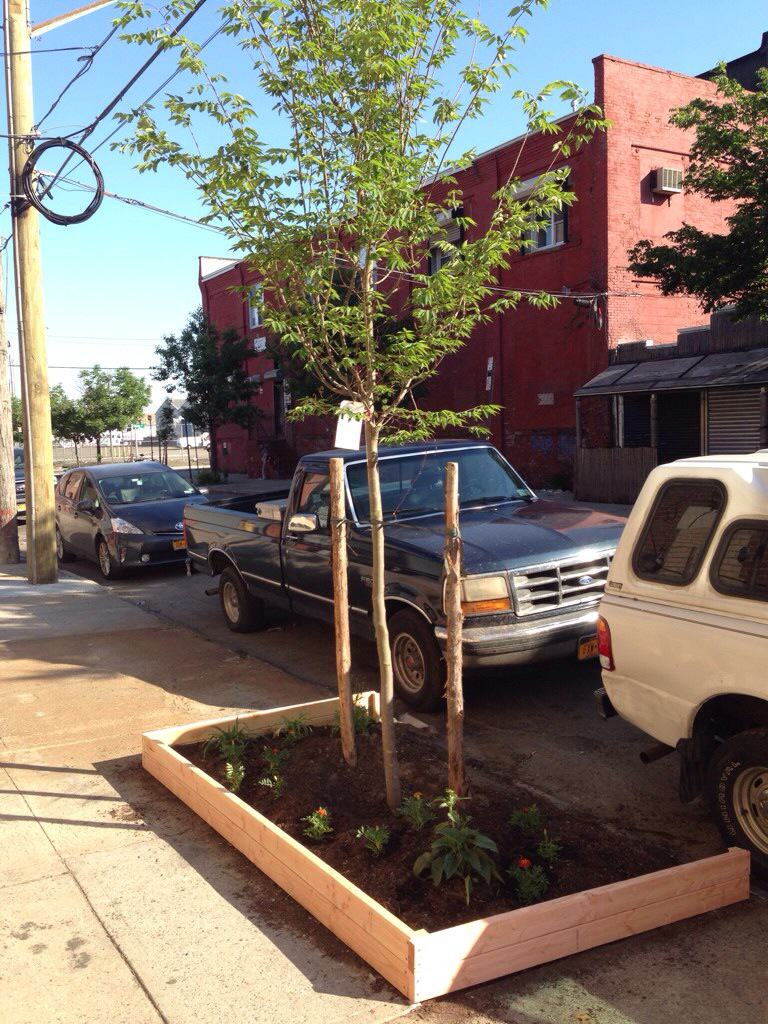
Our first step was to build a tree “guard”—essentially a frame around the 9 x 5 foot tree pit—that would both protect the tree and aesthetically demarcate our garden bed. I queried my artist friends for ideas about how to build a funky guard out of found maritime objects, signaling the waterfront connection of my neighborhood and reusing waste. But I am neither an artist nor a very good scavenger, so ultimately this involved a dreaded trip to Lowes hardware store. About $100 later, we had our lumber (FSC certified and sustainable), stakes, fasteners, and a few plants. (Some perennials, a few annuals just to get us started. From where? Who knows?). It is not lost on me that if you add up the ‘board feet’ of lumber surrounding the tree in the guard and the supportive stakes helping the young tree to get started, our little street tree’s volume of wood is dwarfed by the wood we use to protect it.
When we were outside building the guard, our downstairs neighbor came upon us with a perplexed look. She wanted to know if we had gotten permission to care for the tree. I proudly proclaimed that the tree was in the public right of way (PROW) and that the city wants us to care for trees. Ricardo silently pointed to our names on the Adopt-a-Tree tag, noting the tacit legitimacy that it gave us. I suddenly personally understood the sense of the PROW as a ‘grey area’, particularly for renters in a multi-unit building (see Rae et al. 2010). To whom did the tree “belong”? What really gave us the right to claim it? Our labor? Our capital expense? Calling ‘dibs’ on a tree tag? Once we put our meager plants in, I was shocked at how much space remained in the bed. I would have happily joined with other neighbors in planting out the garden bed a little more fully, but the rectangle did feel like a single serving size garden. The neighbor never inquired again, and the tree seemed to be “ours”.
Tree with guard and plantings. Photo: Lindsay Campbell
As our attachment deepened, we began to anthropomorphize tree a bit. We named it (uncreatively) “Tree” and talked about it like our adoptive child. As recently cohabiting, childless partners, we were joking—but only sort of. We don’t have pets. We try to keep the houseplants alive. Tree came next. Most of the work involved lugging 10 gallon buckets of water down three flights of stairs. I kept urging Ricardo to befriend our downstairs bodega guys, to ask if we could use their sink or hose hook up, but I was too nervous to ask myself. Even though I shopped there nearly daily and said my polite hellos, the whole street corner life/Jane Jacobs/social cohesion thing is a lot harder to enact in real life than it is to just read about and coo over—especially when it involves asking a favor of someone. So, instead, we lugged the buckets up and down the stairs, trying our best to meet the recommended 20 gallons of water per week in the summer, but usually not making it, and using the degree of desiccation of our marigolds as a marker for when we really needed to water.
Eventually we experienced setbacks. As someone exited their car and knocked their car door against the tree guard, they ripped out one whole side of our guard. We dutifully repaired it. This happened again a few weeks later and then Ricardo and I were really crestfallen. But when we returned from work, someone else had repaired the guard. While we are pretty sure it was our building super who was constructing a new trash shed, we preferred to think of it as some anonymous Good Samaritan. More generally, I was worried about the structural soundness of the guard overall. Looking at the completed work, it looked strikingly like a playground balance beam and was just crying out to be walked, stood, or balanced upon. Though I never witnessed it happening at our tree, I’d see this throughout the neighborhood on other tree guard sites. Also, we had a new hipster art space just two doors down, and all the parties and openings to go with it; this led to a rise in the foot traffic and cigarette butts we encountered on the street. Most mornings I would stoop to clean the accumulated garbage out of the pit. Further, my former roommate was dog-sitting and he informed me that “Ginger just loves the new bathroom outside!” Horrified, I explained that the dog urine was bad for the tree and our little plants, and he really should curb her. Yet, when I helped out by walking Ginger one day, I couldn’t bring myself to stop her from crouching on the bit of available dirt that she scurried to—it just felt like she had to scratch her feet in the dirt, and making her crouch on the concrete didn’t respect her dog-hood. But, I still didn’t let her use our tree. So we made a sign: “Please keep tree healthy—no butts or mutts.”
The big setback came on a fall morning in 2014 when I was awoken to the sound of jack hammers. As I left for work, I opened the door to see three of my building owner’s contractors operating a bobcat, tearing out the sidewalk. The tree guard was ripped out, Tree’s dirt was splayed about, and chunks of concrete mounded on the corner. Ricardo asked the workers to replace the guard when their work on the sidewalk was done, and they assured us they would.
A few days and one angry email to my landlord later, the guard was indeed restored. We breathed a sigh of relief: Tree was safe and protected—for now.
Encounter 2: Reforestation sites
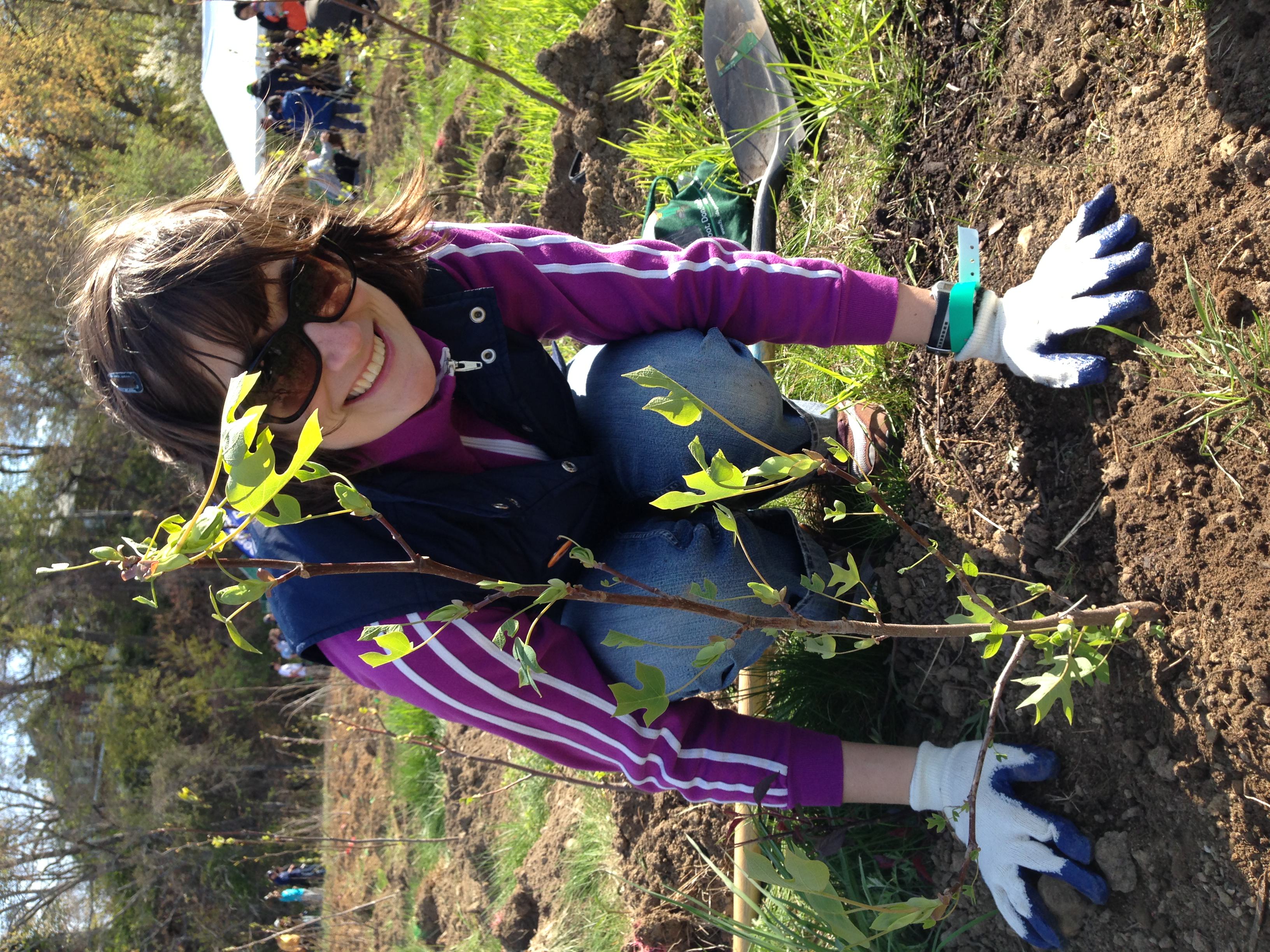
Planting Trees
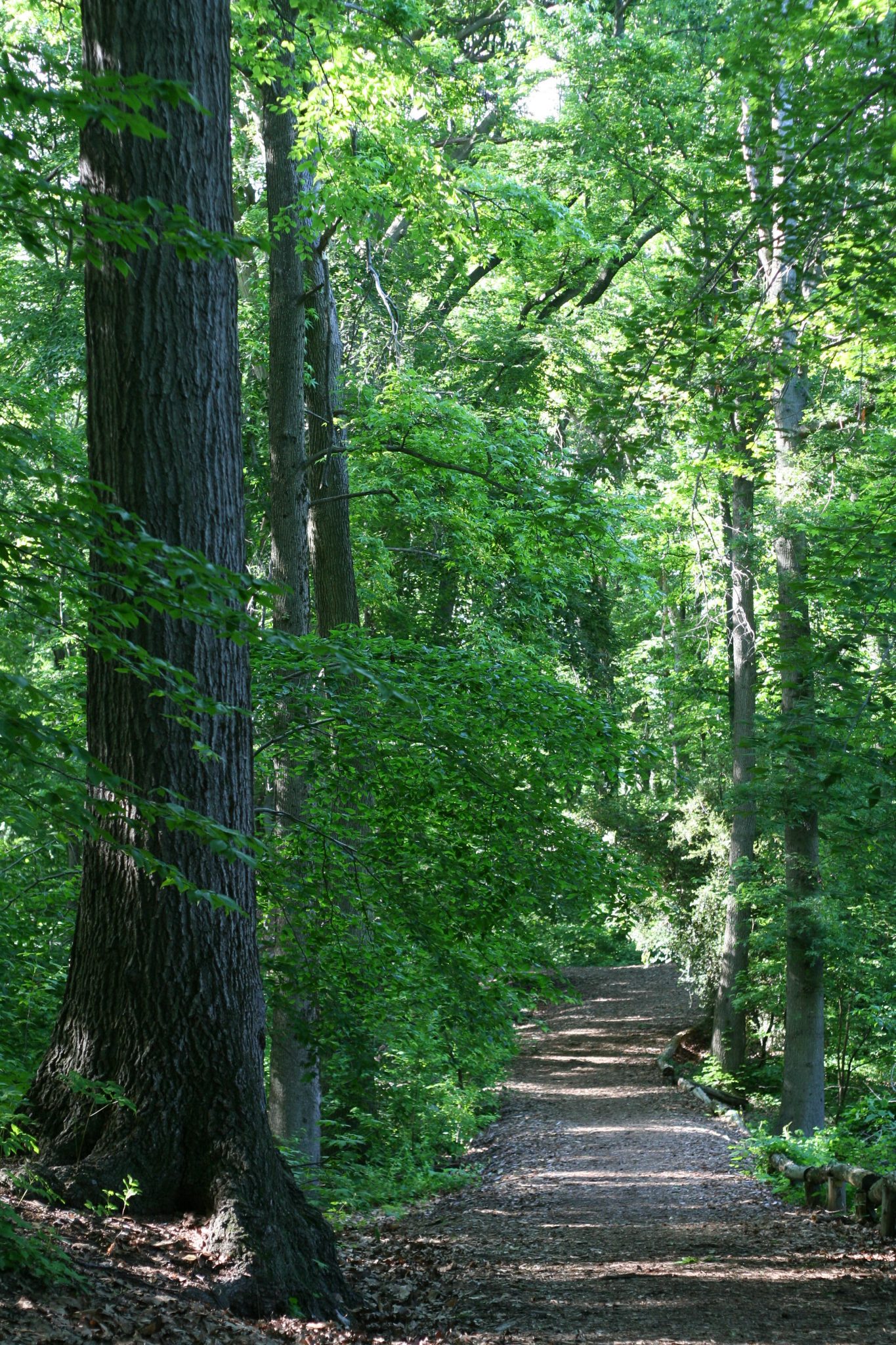
I headed out to Alley Pond Park in northeastern Queens, NY on a spring day in 2013 for my first urban afforestation planting experience. I knew Alley Pond from my work as being one of the sites that the NYC Parks Department natural resource folks were most proud of—closed canopy, tall trees, wide mulch and dirt paths—you really get the feeling of the forest in Alley Pond. But like so many of New York City’s ‘natural areas’, it is highly patchy and variable across space, criss-crossed and subdivided by a spaghetti of deep-Queens major roadways—the Cross Island Parkway, the Grand Central Parkway, and the Long Island Expressway.
Alley Pond Park Trails. Photo: Sadia Butt
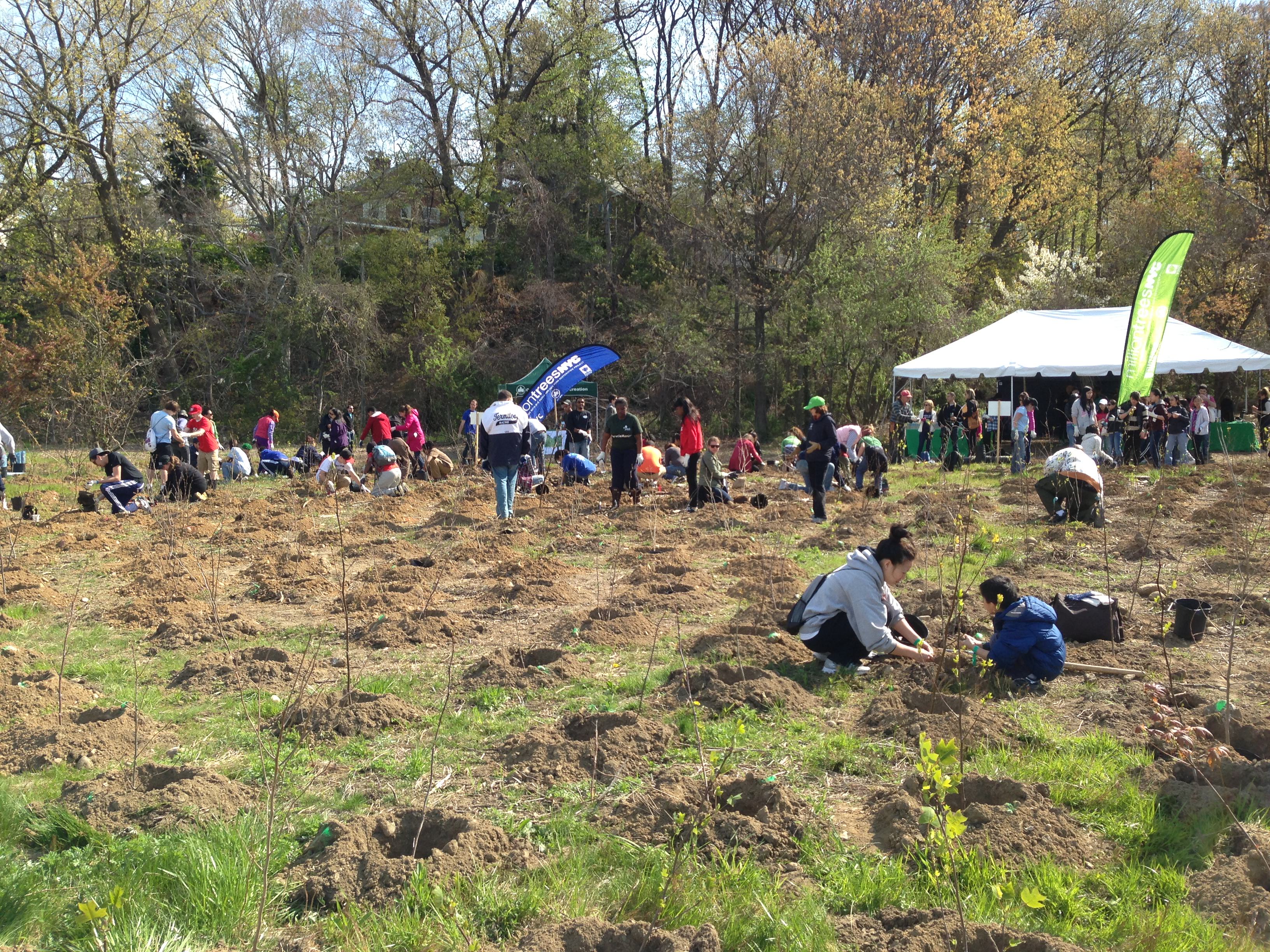
The corner of Alley Pond that we approached that day in which to ‘plant a forest’ was unfamiliar to me, and didn’t look much like the soaring, large canopy trees I’d seen in other sections. It was just a wide open, slightly sloping field, pockmarked with hundreds of holes and young trees at the ready. As I set to work, it felt so satisfying to fill the holes, nestling each tree comfortably in its spot, and moving on to the next, like crossing off an item in a to-do list, or fitting in a puzzle piece.
But what I noticed more than the site that day, or even interacting with the trees, were the social dynamics at work. The first thing I felt was the energy and enthusiasm of the staff. They knew how to treat us right—a quick entry sign-in, free breakfast, coffee, garden gloves, ample tools, quick demo, and off you go! Ricardo and I got into quite a rhythm. We didn’t really talk to others while we were working—there was work to do.
We hadn’t come with a big corporate group—we lacked the matching hats or tee shirts that immediately identified those folks. But as our backs tired and we slowed down, I lifted my head up from the dirt and saw friends, co-workers, and their children. It was a great equalizer between my colleague’s seven year old son, me, and the Deputy Commissioner of the Parks Department. The suits were off, it felt familial and easy. Eating my box lunch in the sun, sitting on the ground, talking to other tree planters was probably my favorite part of the day.
The author planting trees.
Stewarding Trees
As the MillionTreesNYC campaign began to wrap up in fall 2014, the Parks Department organized large-scale stewardship days along with planting days. So, I returned to (yet another section of) Alley Pond Park in Queens to see what it was like to steward a young forest. We were greeted with some granola bars, work gloves, and told to wait. A bit less scripted than the mass plantings, this was a smaller site with a few dozen people and one BIG pile of mulch. We were sent out in groups of around ten, and those of us stragglers that came without a team or group (like Ricardo and me) had to wait for a sufficient posse to be sent out. I have to say this made me feel a little orphaned. We watched patiently as four tiny girl scouts pushed a wheelbarrow that one of us could have handled. At points, there were not enough buckets for everyone to have one. Like so many volunteer experiences, the point here was not efficiency of labor; it was about inclusion, intention, fun, and engagement. Still, I wanted to feel useful.
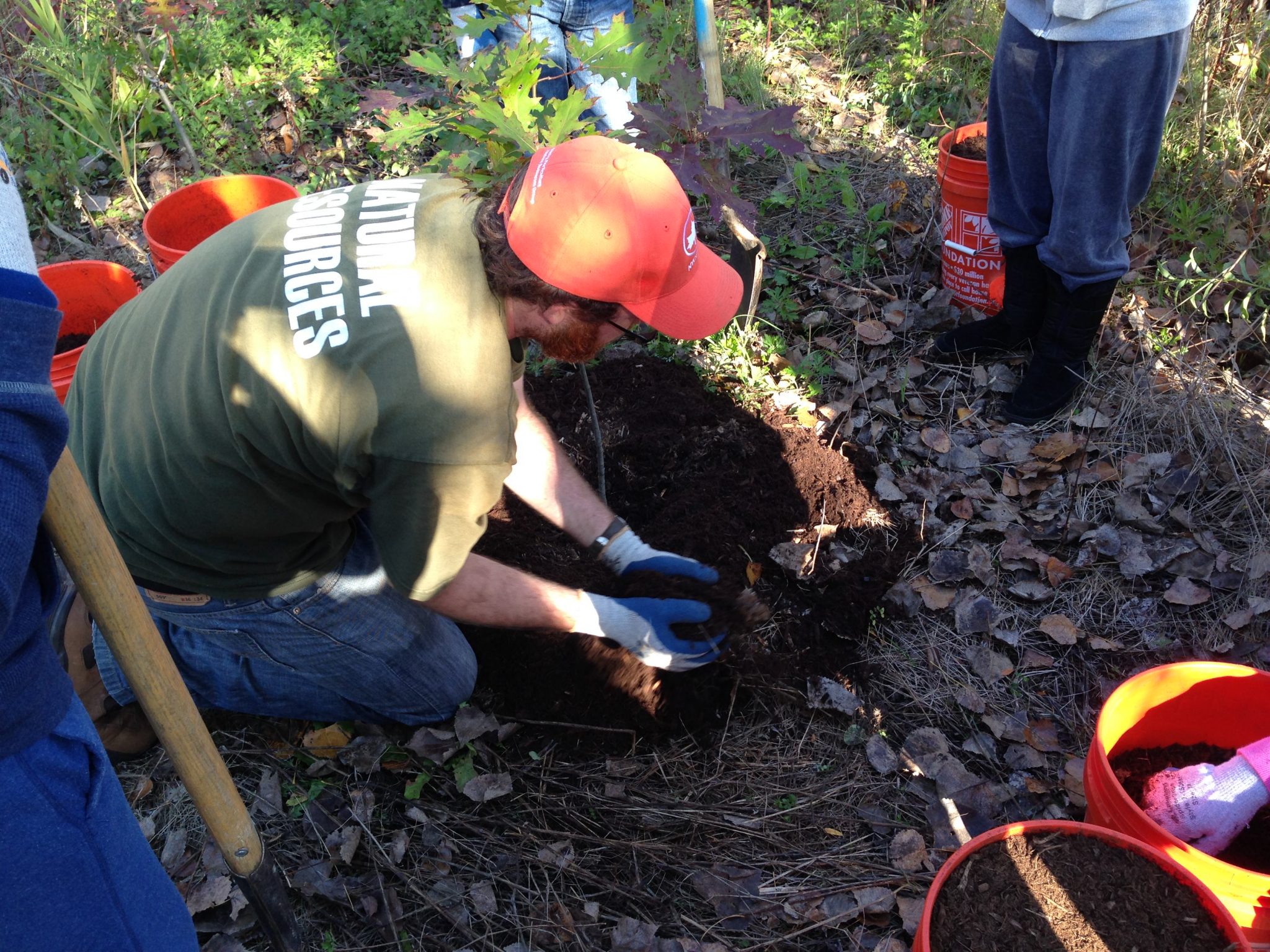
NYC Parks employee showing how to mulch a tree. Photo: Lindsay Campbell
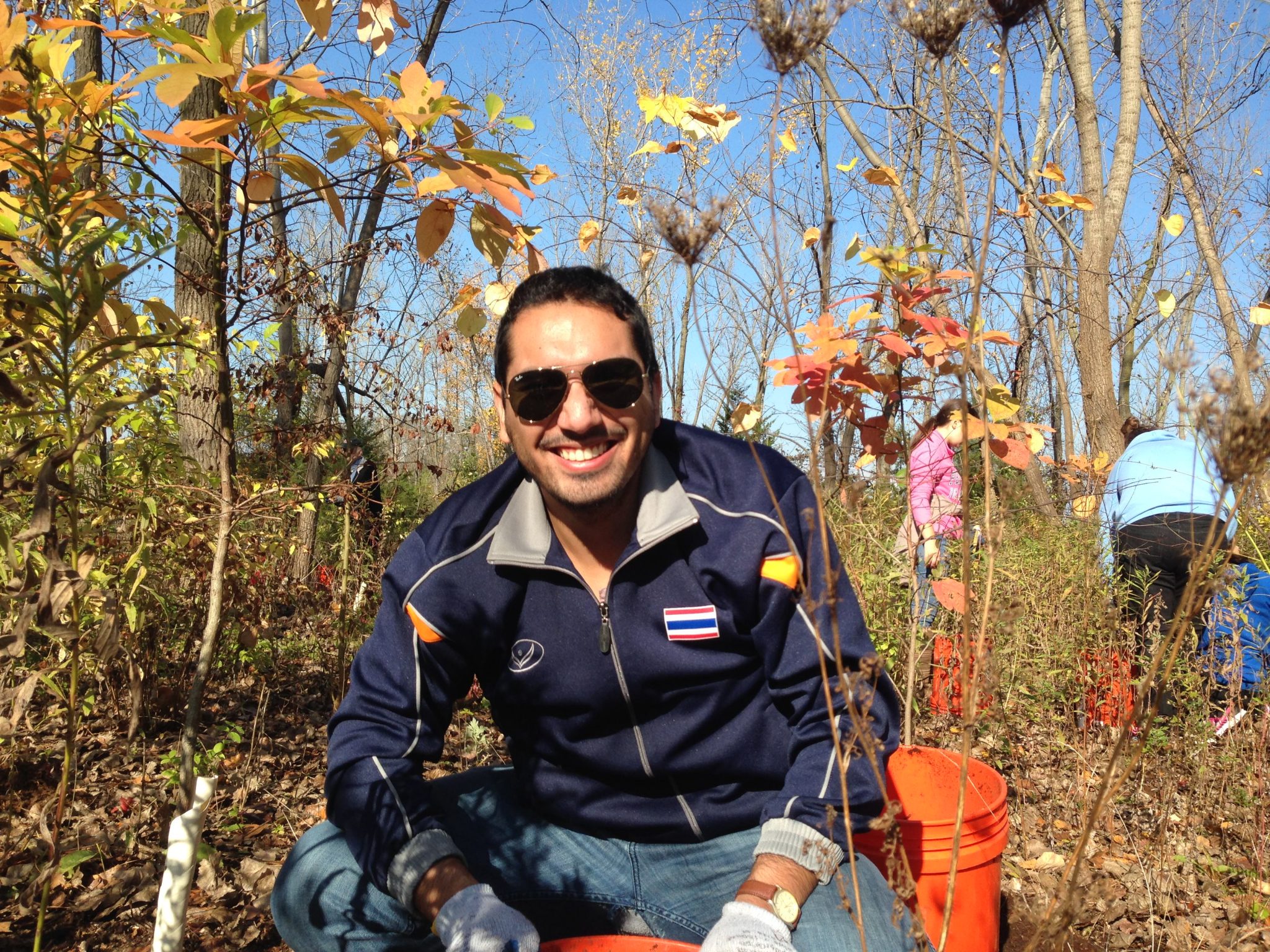
When it was our turn to go, we got a pep talk about how “planting trees is just the beginning;” Parks workers demonstrated how to properly mulch a young tree by making a donut around it. The point of this mulch was less to enhance the soil and more to help keep out weeds and give the young native tree a fighting chance against the vines, Ailanthus, and other invasives surrounding it. They didn’t expressly instruct us to pull weeds, but pull we did. Even with the gloves, I gave myself callouses from pulling so many weeds. Ricardo wrenched his back doing battle against an Ailanthus root. While I could sit in a conference room and debate novel ecosystems and the language of native versus invasive, when I was here—in the field—I was pulling out those invasives, for sure. My colleague, who has much stronger ecology chops than I do, couldn’t help but comment on the possible futility of the effort—all while she, too, was pulling weeds. Those Ailanthus trees would return. Maybe it was futile, but it was fun. It felt like we were doing good. But looking around the site, she noted the proximity to a wetland, and wondered whether these young oaks even ‘belonged’ in this site. Perhaps other species of grasses and bushes would have been more appropriate?
Ricardo stewarding trees. Photo: Lindsay Campbell
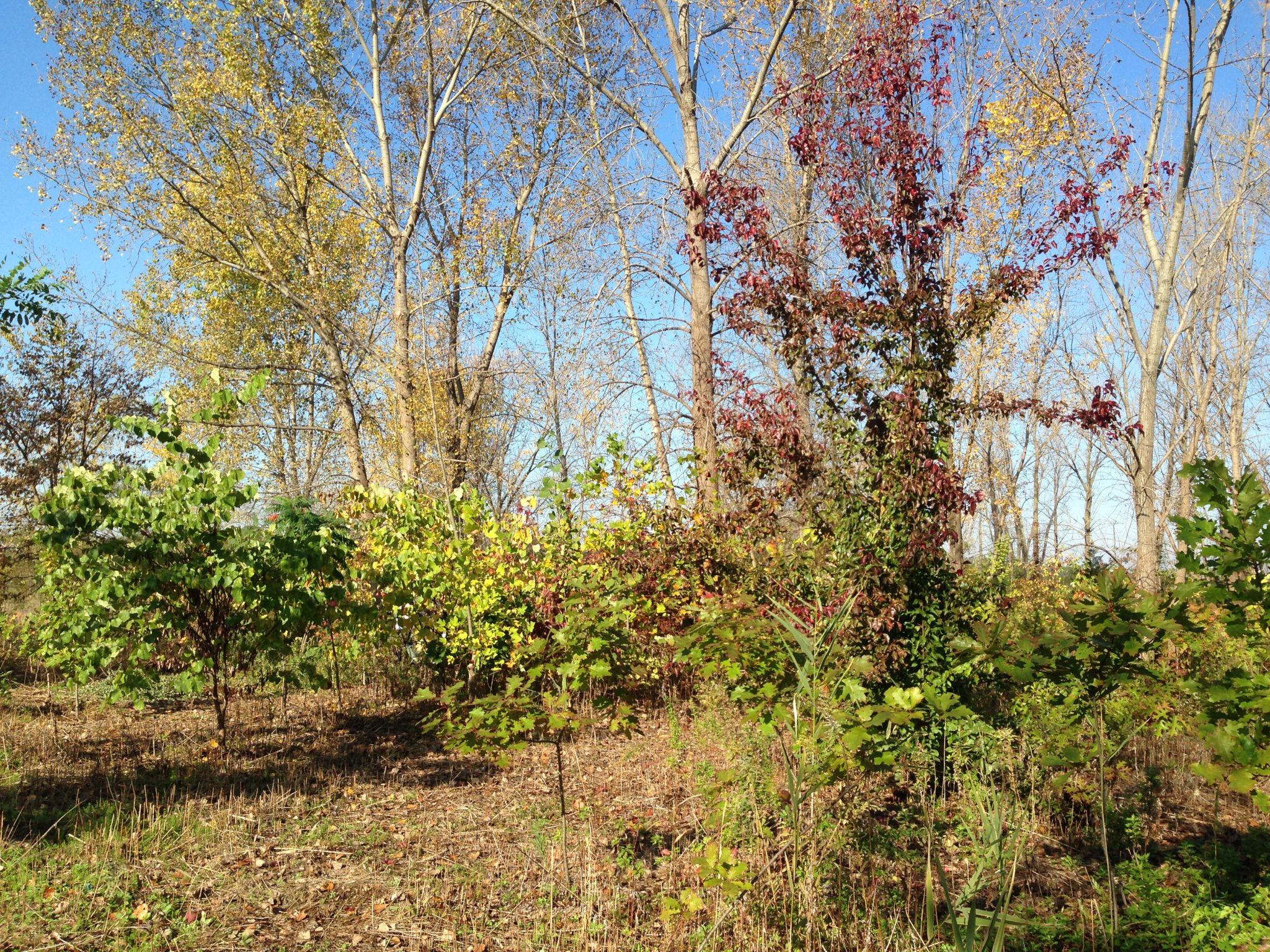
Once we cleaned out vines and weeds, we noted how far away the site was from the desired goal of ‘closing the canopy’. Talking with one of the Park workers, he mentioned that he thought it was one of the forest research sites, which meant that managers weren’t going in and planting additional trees, but were letting the forest competition play out—while still holding stewardship events like ours. I realized that—if he was right—I was the embodiment of a variable in the experimental forest plot treatments (mulch / no mulch) that some of my ecology colleagues were involved in running. We would have to wait decades for this experiment to unfold before we knew the outcomes of different treatments. Did it make sense to plant a forest in this site? Would it even work? The managers and stewards working on the site have to take these future outcomes as uncertain—as leaps of faith.
Young forest at Alley Pond Park. Photo: Lindsay Campbell
As before, the day concluded with box lunches, which we consumed while sitting on our overturned mulch buckets. Surrounded by a few dozen other New Yorkers, we chatted about the challenges of growing a forest in the city. And we went home that afternoon to plant fall bulbs around our own beloved Tree.
Concluding thoughts
By placing myself more centrally in these accounts, I present a ‘situated science’ approach to the subject of the urban forest (see Haraway 1991). Paying attention to social context, emotional ties, and affective registers tells a different tale than a remotely sensed, infrared image of urban tree canopy or the quantified accounting of ecosystem services provided by trees. These human-tree connections that we build require different methodological tools to uncover and certainly require a different understanding of what constitutes a research account. But I believe that sharing these stories helps move us towards a fuller understanding of why we create and maintain urban forests.
My relations with urban trees are complex. They are mediated by my needs, assumptions, and values. As these relations move beyond the conceptual and intellectual realms and into the physical and embodied, some of my assumptions have begun to shift:
Taking care of street trees isn’t as easy as I thought. Barriers like access to power tools and water sources are not trivial. Still, I’m willing to overcome these obstacles slowly, imperfectly, and over time. I don’t have a green thumb, I’ll learn through trial and error over the seasons as the tree and I grow together. Over the past year or so, the 45 square foot patch of land where my street tree is planted has come to occupy a much larger space in my mind and heart. I care for Tree, I fawn over Tree. I feel pride when I plant some new native grasses, I feel defensive when I swat off the squirrels. I feel angry when people litter or break the guard. I feel worried about whether Tree will make it through this brutal winter, as big drifts of snow mound up over the guard. I never could have predicted how much time and effort I would expend caring for Tree. But, I am also surprised by all that I have gotten in return from developing a real attachment to a piece of ground and caring for an organism situated within it.
On reforestation sites, I was surprised to learn that I like working hard, for free, on behalf of an effort greater than myself. I’ve come to understand why so many of the volunteer tree planters became repeat attendees, as my colleagues have shown in their work on the links between tree planting and civic engagement (Fisher et al. 2011, 2015). Even though the MillionTreesNYC campaign wasn’t originally conceived with a community forestry ethos, these volunteer events had evolved that way. The tree became the widget to bring people together. What mattered was what surrounded those trees: all of us.
The question remains, then, how can we build bridges between these emotional experiences and our management practices? How can we scale up from individual experiences that are deep but uneven across the population (dedicated street tree stewards) or far-reaching but isolated in time and space (one-time reforestation volunteer events)? How can we cultivate attachment and stewardship but also allow attachment to inform management, decision-making, and priority-setting? What would it look like to grow a forest that is rooted in these community relations all along the way? How can we truly honor relations of care between humans and trees and set ourselves up to create more of these experiences throughout the cycle of creating and maintaining an urban forest—from site selection, to material sourcing, to installation, to maintenance, to removal and reuse?
Campbell, Lindsay K. 2014. “Constructing New York City’s urban forest: The politics and governance of the MillionTreesNYC campaign.” in Urban Forests, Trees, and Green Space: A Political Ecology. L. Anders Sandberg, Adrina Bardekjian, and Sadia Butt, Eds. Routledge Press, pp. 242-260.
Fisher, Dana L.; Connolly, James J.; Svendsen, Erika S.; and Lindsay K. Campbell. 2011. Digging Together: Why people volunteer to help plant one million trees in New York City. Environmental Stewardship Project at the Center for Society and Environment of the University of Maryland White Paper #2. 36 p. Available online here.
Haraway, D. 1991. “Situated Knowledges: The Science Question in Feminism and the Privilege of Partial Perspective.” in Simians, Cyborgs, and Women. New York: Routledge.
Jones, Owain. 2014. “(Urban) Places of Trees: Affective Embodiment, Politics, Identity, and Materiality” in Urban Forests, Trees, and Green Space: A Political Ecology. L. Anders Sandberg, Adrina Bardekjian, and Sadia Butt, Eds. Routledge Press, pp. 111-131.
Perkins, H. A. (2009). Out from the (Green) shadow? Neoliberal hegemony through the market logic of shared urban environmental governance. Political Geography, 28(7), 395–405.