Blog List

Monday, 2 May 2016

VEGAN ORGANIC GARDENING

Vegan organic gardening and farming is the organic cultivation and production of food crops and other crops with a minimal amount of exploitation or harm to any animal. Vegan gardening and stock-free farming methods use no animal products or by-products, such as bloodmeal, fish products, bone meal, feces, or other animal-origin matter, because the production of these materials is viewed as either harming animals directly, or being associated with the exploitation and consequent suffering of animals. Some of these materials are by-products of animal husbandry, created during the process of cultivating animals for the production of meat, milk, skins, furs,entertainment, labor, or companionship; the sale of by-products decreases expenses and increases profit for those engaged in animal husbandry, and therefore helps support the animal husbandry industry, an outcome most vegans find unacceptable.

Types
Veganiculture

Vegan - Organic - Agriculture / Permaculture The Future Of Farming! All Things Related To: Organic Gardening, Farming & Food Forests Free From Animals & Animal Products

Forest Gardening
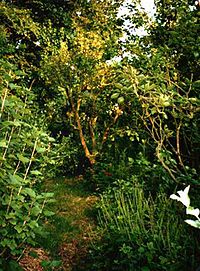
Forest gardening is a fully plant-based organic food production system based on woodland ecosystems, incorporating fruit and nut trees, shrubs, herbs, vines and perennial vegetables. Making use of companion planting, these can be intermixed to grow in a succession of layers, to replicate a woodland habitat. Forest gardening can be viewed as a way to recreate the Garden of Eden. The three main products from a forest garden are fruit, nuts and green leafy vegetables.
Robert Hart's forest garden in Shropshire, England.
Robert Hart adapted forest gardening for temperate zones during the early 1960s. Robert Hart began with a conventional smallholding at Wenlock Edge in Shropshire. However, following his adoption of a raw vegan diet for health and personal reasons, Hart replaced his farm animals with plants. He created a model forest garden from a small orchard on his farm and intended naming his gardening method ecological horticulture or ecocultivation. Hart later dropped these terms once he became aware that agroforestry and forest gardens were already being used to describe similar systems in other parts of the world.
Vegan permaculture

Vegan permaculture (also known as veganic permaculture, veganiculture, or vegaculture) avoids the use of domesticated animals. It is essentially the same as permaculture except for the addition of a fourth core value; "Animal Care." Zalan Glen, a raw vegan, proposes that vegaculture should emerge from permaculture in the same way veganism split from vegetarianism in the 1940s.Vegan permaculture recognizes the importance of free-living animals, not domesticated animals, to create a balanced ecosystem.

Veganic gardening

The veganic gardening method is a distinct system developed by Rosa Dalziell O'Brien, Kenneth Dalziel O'Brien and May E. Bruce, although the term was originally coined by Geoffrey Rudd as a contraction of vegetable organic in order to "denote a clear distinction between conventional chemical based systems and organic ones based on animal manures" The O'Brien system's principal argument is that animal manures are harmful to soil health rather than that their use involves exploitation of and cruelty to animals.
The system employs very specific techniques including the addition of straw and other vegetable wastes to the soil in order to maintain soil fertility. Gardeners following the system use soil-covering mulches and employ non-compacting surface cultivation techniques using any short-handled, wide-bladed, hand hoe. They kneel when surface cultivating, placing a board under their knees to spread out the pressure, and prevent soil compaction. Kenneth Dalziel O'Brien published a description of his system in Veganic Gardening, the Alternative System for Healthier Crops:
The veganic method of clearing heavily infested land is to take advantage of a plant's tendencies to move its roots nearer to the soil's surface when it is deprived of light. To make use of this principle, aided by a decaying process of the top growth of weeds, etc., it is necessary to subject such growth to heat and moisture in order to speed up the decay, and this is done by applying lime, then a heavy straw cover, and then the herbal compost activator…The following are required: Sufficient new straw to cover an area to be cleared to a depth of 3 to 4 inches.
The O'Brien method also advocates minimal disturbance of the soil by tilling, the use of cover crops and green manures, the creation of permanent raised beds and permanent hard-packed paths between them, the alignment of beds along a north-south axis, and planting in double rows or more so that not every row has a path on both sides. Use of animal manure is prohibited.
Vegan Biodynamic Argiculture
The german agricultural researcher Maria Thun (1922 - 2012) developed vegan equivalents to the traditional, animal based biodynamic preparations. As a reaction to the BSE scandal in Europe she started researching plant based preparations, using tree barks as replacement for animal organs as sheath for the preparations.
In particular in Italy, there is a movement of vegan biodynamic farming, represented by farmers such as Sebastiano Cossia Castiglioni and Cristina Menicocci.
There are many other methods currently used and under development
Practices
Soil fertility is maintained by the use of green manures, cover crops, green wastes, composted vegetable matter, and minerals. Some vegan gardeners may supplement this with human urine from vegans (which provides nitrogen) and 'humanure' from vegans, produced from compost toilets. Generally only waste from vegans is used because of the expert recommendation that the risks associated with using composted waste are acceptable only if the waste is from animals or humans having a largely herbivorous diet.
Veganic gardeners may prepare soil for cultivation using the same method used by conventional and organic gardeners of breaking up the soil with hand tools and power tools and allowing the weeds to decompose.
Notes

  1. ^ "Different ways to garden veganically". Veganic Agriculture Network. 7 August 2011.
  2. a b "Growing without cruelty - the vegan organic approach". The Vegan Society.
  3. ^ Kip Bellairs (7 May 2011). "Forest Gardening in a Nutshell", Veganic Agriculture Network.
  4. ^ Graham Bell (2004). The Permaculture Garden, p.129, "The Forest Garden…This is the original garden of Eden. It could be your garden too."
    • Also see Rob Hopkins (foreword), Martin Crawford (2010). Creating a Forest Garden: Working with Nature to Grow Edible Crops, p.10 "Perhaps what Hart created was the closest to what we imagine the Garden of Eden as being."
    • Helmut Lieth (1989). Tropical Rain Forest Ecosystems: Biogeographical and Ecological Studies, p.611 "Important food plants, such as sago-producing palms, fruit-producing trees and medicinal plants were purposefully aggregated and tended in convenient places. Eventually, the forest garden, a kind of Garden of Eden, emerged. These jungle gardens on good soils of easy access required little maintenance and hardly any hard work."
    • Dave Jacke and Eric Toensmeier (2005). Edible Forest Gardens - Volume One, p.1
    • Robert Hart (1996). Forest Gardening: Cultivating and Edible Landscape, p.80
  5. ^ Patrick Whitefield (2002). How to Make a Forest Garden. p. 5.
  6. ^ Robert Hart (1996). Forest Gardening. p. 45.
  7. ^ Robert Hart (1996). Forest Gardening. pp. 28 and 43.
  8. a b "Introduction to Permaculture - Compatibility with Veganic Agriculture". Veganic Agriculture Network.
  9. a b Zalan Glen (2009). "From Permaculture to Vegaculture" (PDF). The Movement for Compassionate Living - New Leaves (issue no.93): 18–20.
  10. ^ Dalziel O'Brien, Kenneth, Veganic Gardening, 1986, page 9
  11. ^ Veganic Gardening, Kenneth Dalziel O'Brien, page 16
  12. ^ http://www.telegraph.co.uk/news/obituaries/9146710/Maria-Thun.html
  13. ^ Maria Thun: Bäume, Hölzer und Planeten. 2nd edition (2008). page 144 - 146. Note: this chapter was published the first time in the second edition, it cannot be found in the first edition. Unfortunately, there is no english translation, but this book contains a number of useful photographs so it might still be worth it.
  14. ^ http://www.prnewswire.com/news-releases/biodynamics-without-the-cow-horn-171019541.html
  15. ^ http://www.veganitaly.com/
  16. ^ "North Carolina Cooperative Extension, Soil Preparation".

References and further reading


  • Growing Green: Organic Techniques for a Sustainable Future by Jenny Hall and Iain Tolhurst. Vegan Organic Network publishing, 2006, ISBN 0-9552225-0-8. Available in the US from Chelsea Green Publishing, ISBN 978-1-933392-49-3.
  • Growing Our Own: A Guide to Vegan Gardening by Kathleen Jannaway. Movement for Compassionate Living publishing, 1987. ASIN B001OQ7G8S.
  • Plants for a Future: Edible and Useful Plants for a Healthier World by Ken Fern. Hampshire: Permanent Publications, 1997. ISBN 1-85623-011-2.
  • Veganic Gardening- The Alternative System for Healthier Crops by Kenneth Dalziel O'Brien. Thorsons Publishing, 1986, ISBN 0-7225-1208-2.

Wikipedia 

5 Tips for Handling Insecurity

Free yourself from thoughts that inhibit your growth.
Free yourself from thoughts that inhibit your growth. Photo Credit alexemanuel/iStock/Getty Images
Insecurities can creep in on any aspect and in any stage of life. Whether an event in your early childhood marked you, or a circumstance in your adult life scarred you, insecurity can hinder your ability to fully express yourself and instead encourage you to hide under a shell. But fear not, these barriers can be removed. Like the English poet W.C. Henley wrote, become a “Master of your Fate and Captain of Your Soul” by recognizing and applying the power you have to control your thoughts and face your fears.

1. Choose Your Thoughts Wisely

Are your thoughts taking you where you want to go?
Are your thoughts taking you where you want to go? Photo Credit tetmc/iStock/Getty Images
In his book “What to Say When you Talk To Yourself,” behavioral researcher & psychologist Shad Helmstetter introduces the idea that each one of us is programmed from birth on. “Leading researchers have found that as much as 75% or more of our programming may be negative or working against us.” Despite that, you have the power to give your mind the right directions to do the right thing. If you don’t, it will continue to respond to the negative programming that you have been giving it (possibly without even being aware of it).
James Messina, author of “Tools for Personal Growth,” suggests taking a rational approach to each problem you face so that you are no longer inhibited by debilitating fears or beliefs. To do so, try to avoid taking yourself too seriously, and cultivate a healthy and humorous belief in yourself to help you overcome your need for acceptance and approval.

2. Remember That You Create Your Own Reality

How you view yourself directly influences your reality.
How you view yourself directly influences your reality. Photo Credit cranach/iStock/Getty Images
Remember Helen Keller? The world-renowned author who became deaf and blind shortly after birth? Despite her great misfortune, she overcame her difficulties and authored her way into the pages of history. Personal-success writer Napoleon Hill describes how “her entire life served as evidence that no one is ever defeated until defeat has been accepted as a reality.” Past failures don’t define you, in reality they can get you closer to success… if you let them.
To break the barrier of self-doubt that can contribute to your feelings of insecurity, Messina recommends placing yourself in a vulnerable position. It can sound scary, but that is where growth can come from. Breaking out of your “shell” requires letting go of past hurts (real or imagined, self-inflicted or inflicted by others) and moving on with your life. Reward yourself for who you are and capitalize on your strengths, attributes, skills and competencies. In the words of Gloria Steinem, “without self-esteem, the only change is an exchange of masters; with it, there is no need for masters.”

3. Cultivate the Habit of Excellence

Anything can be achieved if you set your mind to it.
Anything can be achieved if you set your mind to it. Photo Credit Catalin` Grigoriu/iStock/Getty Images
Another way to overcome your insecurity is by examining the habits and patterns that shape your day-to-day. Charles Duhigg, author of “The Power of Habit: Why We Do What We Do in Life and Business,” describes the processes within our brains as a three-step loop: a cue, a routine, and a reward. When a habit emerges, your brain is actually no longer fully participating in the making of your decisions.
Keep in mind, habits aren’t your destiny. “Unless you deliberately fight a habit — unless you find new routines — the pattern will unfold automatically.” Understanding how your habits work and breaking them into its components can help you fiddle with them to eventually change them. What patterns do you seek to change in your life?

4. Practice Assertive Behavior and Gain Courage

Face your fears.
Face your fears. Photo Credit German-skydiver/iStock/Getty Images
As with anything, practice makes perfect. Messina recommends that practicing assertive behavior in your life can help you earn respect and the acknowledgment of your rights. “Arouse the courage to take small steps in learning to experience success and overcoming your lack of belief in yourself. Once you experience success, you can build upon on it to gain the courage to act out of a strong conviction in your self-goodness and self-worth.”
Take a look at the vicious cycles in your life, and focus on transforming them into virtuous cycles. If you open yourself up to the possibility of success and accomplishment, if you visualize or make a prophecy of winning at life, your energy is focused in the direction of overcoming your insecurity.

5. Talk to Yourself in Terms of Self-Esteem and Self-Worth


Love yourself, and your insecurities will have nothing to feed on.
Love yourself, and your insecurities will have nothing to feed on. Photo Credit Ondine32/iStock/Getty Images

Keep in mind the importance of being constant. Like Kobe Bryant, who starts his daily training in the basketball court at 4 a.m., it is the cumulative force of your daily actions that shapes your character. In the words of Hill, “All external solutions are temporary. Without constant attention and effort, even the most exciting success breakthroughs run their course and eventually end up on our list of good ideas and good intentions.” Talk to yourself constantly in terms of self-esteem and self-worth, and eventually you can reprogram your thoughts and brain patterns to leave your insecure self behind.
www.livestrong.com

The New Bandsaw Box Book

THE WOODWORKING DESIGN COLLECTION - ORDER NOW!

Techniques and Patterns for the Modern Woodworker

By David Picciuto


Format: Paperback 
No woodworking project is more fun to make than a box. Requiring little material and offering lots of challenges, making a wooden box results in a satisfyingly functional project that is proudly used and displayed or given as a gift that will be cherished for years. It's no wonder boxes rank as the most popular woodworking project by beginners and advanced craftsman alike. David Picciuto, aka The Drunken Woodworker, is a huge fan of making boxes, especially with his trusty bandsaw. His Bandsaw Box You Tube videos and his Weekly Woodworking Round-up are must see viewing among the woodworking community. In his first book, The New Bandsaw Box Book: Techniques and Patterns for the Modern Woodworker, David presents a collection of beautiful boxes that can be easily made with a bandsaw, considered by most woodworkers as the most important, versatile, and easy to use stationary tool in the workshop. Each project is captured in a modern and fresh step-by-step style that makes learning easy while David's engaging manner keeps the information accessible and light. In keeping with the younger, artisan mindset that is infiltrating the woodworking community, David concludes with his "raises a glass" toast that matches the perfect craft beer to compliment the wood and style of each completed project.

For further information log on website:

http://www.shopwoodworking.com/the-new-bandsaw-box-book?source=igodigital

TROPICAL CLIMATE

tropical climate is a climate typically found within the tropics, while a few locations outside the Tropics are considered to have a tropical climate. In the Köppen climate classification it is a non-arid climate in which all twelve months have mean temperatures of at least 18 °C (64 °F). Unlike the subtropics, where there are significant variations in day length and temperature to various degrees, with season, tropical temperature remains relatively constant throughout the year and seasonal variations are dominated by precipitation.


Locations of tropical climates, with subtypes.
  Af—Tropical rainforest climate.
Template:Lgee
  Aw—Tropical savanna climate.


Intertropical Convergence Zone vertical velocity at 500 hPa, July average in units of pascals per second. Ascent (negative values) is concentrated close to the solar equator; descent (positive values) is more diffuse.
Subtypes

Within the tropical climate zone there are distinct varieties based on precipitation:
  • Tropical monsoon climate (Am): This type of climate, most common in South and Central America, results from the monsoon winds which change direction according to the seasons. This climate has a driest month (which nearly always occurs at or soon after the "winter" solstice for that side of the equator) with rainfall less than 60 mm, but more than (100 − [total annual precipitation {mm}/25]).
    • Examples:
      • Abidjan, Ivory Coast
      • Cairns, Queensland, Australia 
      • Chittagong, Bangladesh
      • Guanare, Portuguesa, Venezuela
      • Huế, Thừa Thiên–Huế, Vietnam
      • Jakarta, Indonesia
      • Macapá, Amapa, Brazil
      • Miami, United States
      • Port Harcourt, Rivers State, Nigeria
      • Puerto Ayacucho, Amazonas, Venezuela
      • Sinop, Mato Grosso, Brazil
      • Yangon,  Myanmar

  • Tropical wet and dry or savanna climate (Aw): These climates generally have a pronounced dry season, with the driest month having precipitation less than 60 mm and also less than (100 − [total annual precipitation {mm}/25]).


Beach in Naples, Florida lined with coconut trees is an example of a tropical climate. Although it lies in the subtropics over a hundred miles north of the tropic of cancer, the warm waters of the Gulf of Mexico give it a monthly mean temperature never under 18 °C (64 °F), classifying its climate as tropical.

  • Examples:
    • Innisfail, Australia
    • Barquisimeto, Venezuela
    • Cartagena, Colombia
    • Ciudad Guayana, Venezuela
    • Dar es Salaam, Tanzania
    • Darwin, Northern Territory, Australia
    • Dili, East Timor
    • Fortaleza, Ceará, Brazil
    • Ho Chi Minh City, Vietnam
    • Honolulu, Hawaii, United States
    • Jijoca de Jericoacora, Ceará, Brazil
    • Kaohsiung, Taiwan
    • Kupang, Indonesia
    • Lagos, Lagos State, Nigeria
    • Medellín, Colombia
    • Mumbai, Maharashtra, India
    • West Palm Beach, United States
    • Fort Lauderdale, United States
    • Naples, Florida, United States
    • Fort Myers, Florida, United States
    • Port-au-Prince, Haiti
    • Rio de Janeiro, Rio de Janeiro, Brazil
    • Valencia, Venezuela
    • Veracruz, Veracruz, Mexico

Note that, in this scheme, many places within the tropics do not have a tropical climate: for example, the Sahara Desert. Mountaintops within the tropics, e.g. Mount Kenya, can be cold. However, like lowlands in the tropics (and unlike cold winter temperate zone regions), there is little seasonal variation of temperature in alpine regions of the tropics.

Intertropical Convergence Zone

Because of the effect of sun angle on climate most areas within the tropics are hot year-round, with diurnal variations in temperature exceeding seasonal variations. Seasonal variations in tropical climate are dominated by changes in precipitation, which are in turn largely influenced by the tropical rain belt or Intertropical Convergence Zone (ITCZ), a portion of the Hadley cell. The ITCZ is shown, for July average, in the graphic. Areas of ascending air have heavy rainfall; areas of descending air are dry. The ITCZ somewhat follows the solar equator throughout the year, but with geographical variations, and in some areas (India) is heavily influenced by local large-scale monsoons.

References

  1. a b c McKnight, Tom L; Hess, Darrel (2000). "Climate Zones and Types: The Köppen System". Physical Geography: A Landscape Appreciation. Upper Saddle River, NJ: Prentice Hall. pp. 205–211. ISBN 0-13-020263-0.
  2. ^ Linacre, Edward; Bart Geerts (1997). Climates and Weather Explained. London: Routledge. p. 379. ISBN 0-415-12519-7.
  3. ^ "CHAPTER 7: Introduction to the Atmosphere". physicalgeography.net. Retrieved 2008-07-15.

Wikipedia 

Advantages and Disadvantages of Fasting for Runners

Author BY   ANDREA CESPEDES  Food is fuel, especially for serious runners who need a lot of energy. It may seem counterintuiti...