Blog List

Wednesday, 9 August 2017

Bamboo scaffolding

From Wikipedia, the free encyclopedia
Bamboo scaffolding can reach great heights, here it was used to construct the Four Seasons Hotel Hong Kong.
Bamboo scaffolding is a type of scaffolding made from bamboo and widely used in construction work for centuries. Many famous landmarks, notably The Great Wall of China, were built using bamboo scaffolding.[1][2]

History[edit]

It was first introduced into the building industry in Hong Kong immediately after colonization in the 1800s.[3][4] It was widely used in the building of houses and multi-story buildings (up to four stories high) prior to the development of metal scaffolding.[5][6] It was also useful for short-term construction projects, such as framework for temporary sheds for Cantonese Opera performances.[7] There are three types of scaffolding in Hong Kong: 1. Double-row scaffold; 2. Extended Bamboo scaffolding; 3. Shop signs of Bamboo Scaffolding.

Gradual decline[edit]

In 2013, there were 1,751 registered bamboo scaffolders and roughly 200 scaffolding companies in Hong Kong.[8] The use of bamboo scaffolding is diminishing due to shortages in labor and material. Despite the lack of labor force and material, recently the safety problem has become another serious concern.[9]
The labor shortage may be due to the reluctance of younger generations to become scaffolders. “They even think that it’s a dirty and dangerous job. They are not going to do that kind of work,” said Yu Hang Flord, who has been a scaffolder for 30 years and later became the director of Wui Fai Holdings, a member of the Hong Kong and Kowloon Scaffolders General Merchants Association. “They refuse to step in, although we give them high pay. They are scared of it. Young generations do not like jobs that involve hard work.” Another reason fewer people are becoming scaffolders is that new recruits need to undergo training with the Hong Kong Construction Industry Council in order to acquire a license. Older scaffolders generally learned in apprenticeships, and may have been able to gather more hands-on experience.[10]
Material shortages are also a contributing factor to the decline. The bamboo scaffolding material was imported from mainland China. Bamboo—which matures after three years to the wide diameter and thick skin perfect for scaffolding—came from the Shaoxing area in Guangdong. Over the past two decades, firms have had to look to Guangxi instead. The industry's fear is that one day supplies will be blocked due to export embargoes and environmental concerns. Attempts to import bamboo from Thailand, or switch to synthetic or plastic bamboo, have so far proved unsuccessful.
In many African countries, notably Nigeria, bamboo scaffolding is still used in small scale construction in urban areas. In rural areas,the use of bamboo scaffolding for construction is common. In fact, bamboo is an essential building and construction commodity in Nigeria; the bamboo materials are transported on heavy trucks and trailers from rural areas (especially the tropical rain forest) to cities and to the northern part of Nigeria.
Some of the structures in relaxation and recreation centres both in urban and rural areas of Nigeria are put in place using bamboo materials. This is not for reasons of poverty (especially in the cities) but to add more aesthetics to these centres. Bamboo materials are still used in the construction of some bukas (local restaurants) in rural areas.[11][12]

Specifications[edit]

content about specifications
  • Double-row Scaffold
Only double-row bamboo scaffold is allowed to use for working at height.
  • Nylon Mesh
The perimeter of bamboo scaffold shall be covered by nylon mesh against falling objects. The lapping of nylon mesh should be at least 100mm wide.
  • Access and Egress
Suitable means of access shall be provided from the building or ground level to the scaffold such as gangway, stairs and ladder etc.
  • Catch Fan
Sloping catch fan shall be erected at a level close to the first floor and at not more than 15 metres vertical intervals to give minimum horizontal protection coverage of 1500mm. Large catch fan shall be erected at specific location to protect the public and/ or workers underneath.
  • Platform of Catch Fan or Receptacle
A suitable receptacle, which covered with galvanized zinc sheet, should be provided within each catch-fan to tap falling objects.
  • Steel Bracket
Steel brackets shall be provided for supporting the standard of scaffold at about six floor intervals. The horizontal distance between steel brackets is about 3 metres.
  • Putlogs
Mild steel bars or similar materials are required to tie any structure to maintain the bamboo scaffold in its position on every floor. The distance of adjacent putlogs is about 3 to 4 metres.
  • Working Platform
Every working platform shall be of at least 400mm wide and be closely boarded by planks. The edges of working platform shall be protected by not less than 2 horizontal bamboo members of the scaffold at intervals between 750mm to 900mm and suitable toe-boards with not less than 200mm high.
  • Special Scaffold
All scaffolds of height excess 15 metres shall be designed by Engineer.The Engineer shall be responsible for the design of special scaffolds.
  • Competent Examiner
They should complete a formal training in bamboo scaffolding work or hold trade test certificate on bamboo scaffolding and have at least 10 years of relevant experience.
  • Trained Worker
They should complete a formal training in bamboo scaffolding work or hold trade test certificate on bamboo scaffolding and have at least 3 years of relevant experience.

Uses in construction[edit]

A fulcrum supports this bamboo scaffolding in Hong Kong.
Scaffolding is a temporary structure to support people and materials when constructing or repairing building exteriors and interiors.[14] In bamboo scaffolding, plastic fibre straps and bamboo shoots together form a solid and secure scaffold structure without screws.[15] Bamboo scaffolding does not need to have a foundation on the ground as long as the scaffolding has a fulcrum for structural support.[16]
Bamboo scaffolding is mostly seen in developing Asian countries such as IndiaBangladeshSri Lanka, and Indonesia.[citation needed]

Cultural usage[edit]

Chinese opera theatres[edit]

Chinese Opera is one of the world's "Intangible Cultural Heritages". One of bamboo scaffolding's main alternative uses is in drama theatres. The flexibility and convenience of this type of scaffolding suits stages set up for temporary use and also separates the audience from the performers.
Respecting and promoting the traditional cultures of Chinese Opera, a huge event called the West Kowloon Bamboo Theatre has been held at the West Kowloon Waterfront Promenade annually since 2012.

Yu Lan Ghost Festival[edit]

Stages are built from bamboo scaffolding for the live Chinese operas and Chiu Chow–style dramas performed during every Yu Lan Ghost Festival to worship ghostly ancestors.

Cheung Chau Bun Festival[edit]

Bamboo scaffolds and bun towers in Cheung Chau
The bamboo tower used in the famous Bun Scrambling Competition during the Cheung Chau Bun Festival on the island of Cheung Chau is constructed out of bamboo scaffolding.[17] Nine thousand buns, representing fortune and blessing, are supported on the fourteen-meter tall bamboo tower in front of the Pak Tai Temple. For the Piu Sik Parade, bamboo stands and racks are used to hold the young costumed performers above the crowds.

See also[edit]

References[edit]

  1. Jump up^ Malm, Sara (8 March 2013). "How did that get past health and safety! To this day, Hong Kong's ultra-modern skyscrapers are built with scaffolding made out from bamboo"Daily Mail. Retrieved 12 February 2015.
  2. Jump up^ "Bewitched by bamboo"http://www.chinadaily.com.cnChina Daily. Retrieved 12 February 2015. External link in |website= (help)
  3. Jump up^ "Why is Hong Kong last frontier for bamboo scaffolders?"http://www.scmp.comSouth China Morning Post. Retrieved 12 February 2015. External link in |website= (help)
  4. Jump up^ "Bamboo Scaffolding"http://industrialhistoryhk.org. The Industrial History of Hong Kong. Retrieved 12 February 2015. External link in |website= (help)
  5. Jump up^ Hoh, Erling (31 May 2001). "In Hong Kong, way to the top is bamboo scaffold"Chicago Tribune. Retrieved 12 February 2015.
  6. Jump up^ "Bamboo Scaffolding in HK Sees Looming Threat"http://journalism.hkbu.edu.hk. HKBU Journalism Department. Retrieved 12 February 2015. External link in |website= (help)
  7. Jump up^ Lee, Hong Lam. "Evolution of bamboo scaffolding for building construction in Hong Kongfrom the 1960s to the present day"http://hub.hku.hkThe University of Hong Kong. Retrieved 12 February 2015. External link in |website= (help)
  8. Jump up^ "Hong Kong's 'spiders' stick to bamboo scaffolding"The Independent. independent.co.uk. 21 November 2009. Retrieved 12 February 2015.
  9. Jump up^ [1] Bamboo Scaffolding in HK Sees Looming Threat
  10. Jump up^ "Code of Practice for Bamboo Scaffolding Safety" (PDF). http://www.labour.gov.hk. Occupational Safety and Health Branch Labour Department. Retrieved 12 February 2015. External link in |website= (help)
  11. Jump up^ unpublished journals on The Use of Bamboo in Nigeria by Olaiya Festus, Adult Education Department, University of Ado Ekiti,November 2011.
  12. Jump up^ http://ww.academia.edu/7351624/SCAFFOLDING_PRACTICES_IN_SOME_SELECTED_CITIES_OF_NIGERIA_A_SURVEY_OF_REQUIREMENTS_AND_PROSPECTS_FOR_SPECIALIZED_SUB-CONTRACTORS_BY
  13. Jump up^ http://www.hkicm.org.hk/pdf/HKICM-PNCM2-TW01.pdf
  14. Jump up^ "Guidance Notes on Bamboo Scaffold ing Safety" (PDF). http://www.archsd.gov.hk. Hong Kong Architectural Services Department. Retrieved 12 February 2015. External link in |website= (help)
  15. Jump up^ "Why do they still use bamboo scaffolding in Hong Kong?"http://hk-magazine.com. HK Magazine. Retrieved 12 February 2015. External link in |website= (help)
  16. Jump up^ "Guidelines on the Design and Construction of Bamboo Scaffolds" (PDF). http://www.bd.gov.hk. Hong Kong Buildings Department. Retrieved 12 February 2015. External link in |website= (help)
  17. Jump up^ "Ready, steady, dough! Annual Cheung Chau bun scramble delivers parade to chew over"http://www.scmp.comSouth China Morning Post. Retrieved 12 February 2015. External link in |website= (help)

External links[edit]

  1. Jump up^ http://www.hkicm.org.hk/pdf/HKICM-PNCM2-TW01.pdf

For further information log on website :
https://en.wikipedia.org/wiki/Bamboo_scaffolding

What is the scaffolding?

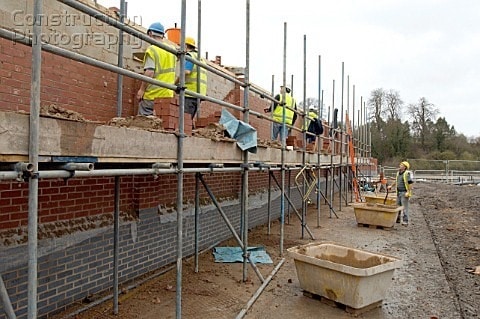
Scaffolding is a temporary structure to support the original structure as well as workmen used it as a platform to carry on the construction works. Types of scaffolding varies with the type of construction work. Scaffolding is made up of timber or steel. It should be stable and strong to support workmen and other construction material placed on it.

Types of Scaffolding used in Construction:

Following are types of Scaffolding in construction:
  1. Single scaffolding
  2. Double scaffolding
  3. Cantilever scaffolding
  4. Suspended scaffolding
  5. Trestle scaffolding
  6. Steel scaffolding
  7. Patented scaffolding

Single Scaffolding:

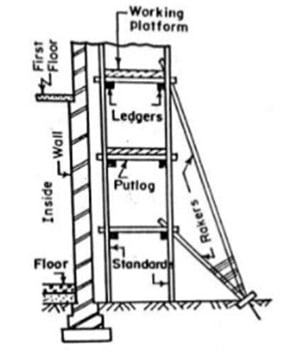
Single scaffolding is generally used for brick masonry and is also called as brick layer’s scaffolding. Single scaffolding consists of standards, ledgers, putlogs etc., which is parallel to the wall at a distance of about 1.2 m. Distance between the standards is about 2 to 2.5 m. Ledgers connect the standards at vertical interval of 1.2 to 1.5 m. Putlogs are taken out from the hole left in the wall to one end of the ledgers. Putlogs are placed at an interval of 1.2 to 1.5 m.
Single Scaffolding in Construction

Double Scaffolding:

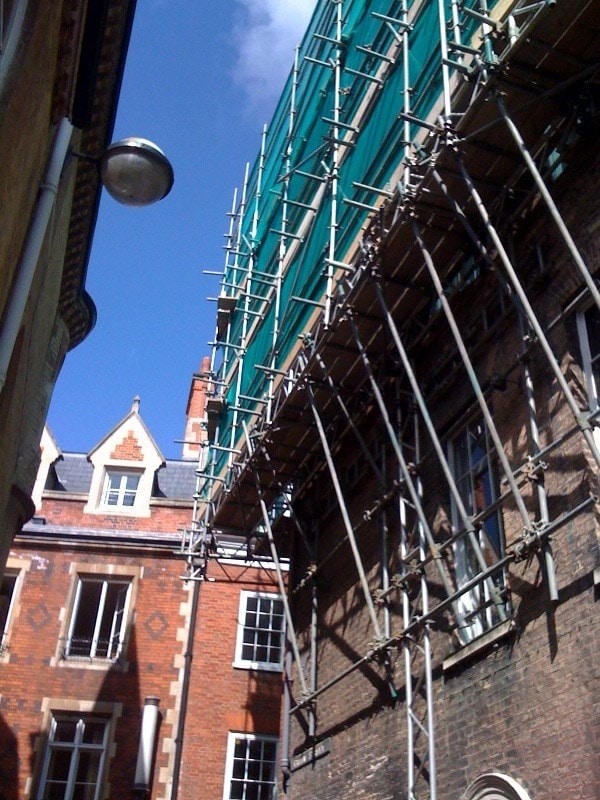
Double Scaffolding is generally used for stone masonry so, it is also called as mason’s scaffolding. In stone walls, it is hard to make holes in the wall to support putlogs. So, two rows of scaffolding is constructed to make it strong. The first row is 20 – 30 cm away from the wall and the other one is 1m away from the first row. Then putlogs are placed which are supported by the both frames. To make it more strong rakers and cross braces are provided. This is also called as independent scaffolding.
Types of Scaffolding - Double Scaffolding

Cantilever Scaffolding:

This a type of scaffolding in which the standards are supported on series of needles and these needles are taken out through holes in the wall. This is called single frame type scaffolding. In the other type needles are strutted inside the floors through the openings and this is called independent or double frame type scaffolding. Care should be taken while construction of cantilever scaffolding.
Generally cantilever scaffoldings are used under conditions such as
  • When the ground does not having the capacity to support standards,
  • When the Ground near the wall is to be free from traffic,
  • When upper part of the wall is under construction.
Types of Scaffolding - Cantilever Scaffolding

Suspended Scaffolding:

In suspended scaffolding, the working platform is suspended from roofs with the help of wire ropes or chains etc., it can be raised or lowered to our required level. This type of scaffolding is used for repair works, pointing, paintings etc..
Suspended Scaffolding

Trestle Scaffolding:

In Trestle scaffolding, the working platform is supported on movable tripods or ladders. This is generally used for work inside the room, such as paintings, repairs etc., up to a height of 5m.
Trestle Scaffolding

Steel Scaffolding:

Steel scaffolding is constructed by steel tubes which are fixed together by steel couplers or fittings. It is very easy to construct or dismantle. It has greater strength, greater durability and higher fire resistance. It is not economical but will give more safety for workers. So, it is used extensively nowadays.
Steel Scaffolding

Patented Scaffolding:

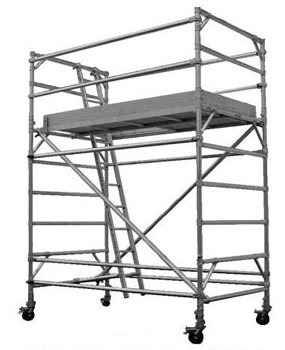
Patented scaffoldings are made up of steel but these are equipped with special couplings and frames etc., these are readymade scaffoldings which are available in the market. In this type of scaffolding working platform is arranged on brackets which can be adjustable to our required level.
Patented Scaffolding

For further information log on website :
https://theconstructor.org/building/types-of-scaffolding-in-construction/11845/

Purpose of Scaffolding

Author
by Anonymous

Purpose-of-Scaffolding
Have you ever noticed the structure around a building under construction? These temporary structures are called scaffolding. They are used to support people and hold materials that are to be used for construction or repair of buildings and other structures. They aid safety of the workmen and allow access to areas that are difficult to reach. They are constructed by using metal tubes with metal platforms or with bamboos and wooden planks in different countries.

Scaffolding has been around since ancient times as historians have found evidence of the Egyptians using scaffolding to construct their pyramids. In today’s construction industry, governments in the different countries have rules that they require construction companies to adhere in construction of scaffolding. The main purpose of a scaffold is to provide a safe place to work and a safe access to the materials needed. Many construction companies adhere to these regulations very strictly to avoid any accidents or mishaps.

The tubes used to construct scaffolds are either aluminum or steel although some scaffolds use tubes made up of a mixture of materials. Aluminum tubes are generally light weight as compared to other materials. They are also more flexible which means they are less resistant to force. This can be a disadvantage if not used in a proper way. Construction companies usually buy these tubes in long lengths and then cut them down to smaller sizes according to their needs.

The three basic elements of scaffolding are standards, ledgers and transoms. The tubes used to construct the scaffolds are also known as the standards or uprights. They run throughout the entire structure and ensure that it stands upright. They also transfer the entire weight of the structure to the ground on a square base plate so as to spread the load. Ledgers are the tubes that are horizontal and connecting to the vertical tubes to hold the structure firmly. Transoms are placed on the ledgers at right angles to give the structure more strength. All these different components ensure that the structure is strong and firm to hold weight and ensure safety.

For further details log on website :
http://www.thegreenbook.com/purpose-of-scaffolding.htm

This ancient building material could fuel a future infrastructure boom

Author


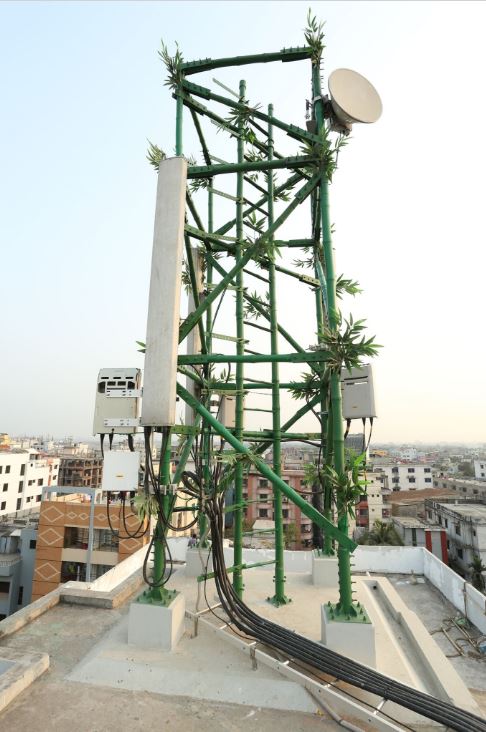
Bangladesh's capital city became home to the world's first cell tower constructed entirely out of bamboo — proof that emerging Asia can simultaneously tackle two of its most pressing concerns: infrastructure investment and renewable resources.
Developed by Malaysian infrastructure services firm edotco and the Bangladesh University of Engineering, the tower took just 12 days to build, versus 28 days for a traditional steel structure, and consumed less energy to manufacture.
Bamboo boasts a low carbon footprint as it produces oxygen and captures carbon dioxide during cultivation, while sourcing for steel causes scarring to landscapes from the mining of natural resources, edotco CEO Suresh Sidhu explained. The plant takes just six months to regenerate and can be re-harvested every three years without any environmental damage, he added.
The company intends to roll out more bamboo structures as proof of concepts in other parts of Dhaka this year and will gradually expand to other markets where the firm is present, such as Myanmar and Sri Lanka.
"We hope this (tower) will inspire infrastructure companies to focus on renewable materials," Sidhu told CNBC.
Abundant throughout Asia, especially China, bamboo has long been a go-to building material for construction players drawn to its tensile strength, light weight, low cost and mass quantities. In 2007, mainland China built the world's first truck-safe bamboo road bridge, which allows a maximum load of 90 tons, according to China Daily.
One of the potential drawbacks of bamboo in construction is its susceptibility to termites, mold attacks and other adverse climate conditions, but eco-friendly treatment processes such as borax coating can help.
While bamboo design has taken off globally — in 2008, Mexico City's Nomadic Museum was the world's largest bamboo structure — it's especially relevant for developing Asia.
A volunteer prepares bamboo poles while building makeshift school buildings in Champi, Kathmandu Valley, Nepal, on May 29, 2015.
Prashanth Vishwanathan / Bloomberg / Getty Images
A volunteer prepares bamboo poles while building makeshift school buildings in Champi, Kathmandu Valley, Nepal, on May 29, 2015.
The region will have to spend $26 trillion on public works by 2030 to maintain economic growth, according to a recent Asian Development Bank report, and industry players believe the use of sustainable building materials for public projects is a practical long-term solution to the region's infrastructure deficit.
Going green can create a win-win situation for economic development as it benefits industrialization, expansion of trade and productivity, the United Nations told a gathering of Asia's least developed nations last month. And as Asian heavyweights such as India and China promise to reduce their carbon emissions over the next 15 years as part of the Paris Agreement, renewables will be key.
"Bamboo's use in infrastructure projects will reduce carbon emissions considerably without compromising on development," said Neelam Manjunath, principal architect at Bangalore-based Manasaram Architects and a reputed bamboo advocate.
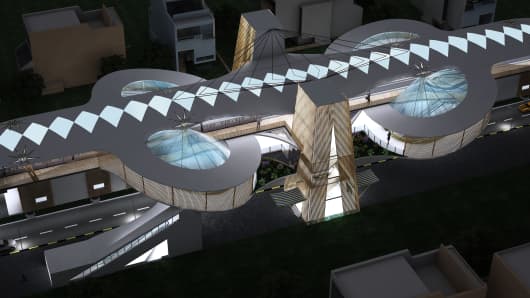
Her firm has incorporated the crop for various public infrastructure projects throughout India, including a bus shelter and metro station in Bangalore as well as a bridge and public toilets in New Delhi.
A mock-up of a Bangalore metro station to be built out of bamboo, designed by Manasaram Architects.
Mansaram Architects
A mock-up of a Bangalore metro station to be built out of bamboo, designed by Manasaram Architects.
Not only is bamboo one of the world's fastest growing plants, with some species growing up to 1.2 meters in a day, it's also well-suited for urban disasters, Manjunath pointed out.
"People don't die because of disasters, but because of buildings collapsing on them. Bamboo buildings are lighter and don't cause fatalities. Because of their sheer strength, bamboo buildings are also serviceable for much longer in the face of volatile weather."
Two expats in Bali, Indonesia have taken bamboo design to a new level: Among the island's rice paddies is a school campus built out of fifty plus bamboo structures.
Co-founded by John and Cynthia Hardy, the 23-acre facility known as The Green School, is one of Asia's largest bamboo structures and its curriculum focuses on holistic learning, particularly entrepreneurship and green living.
The Green School's design can be imitated throughout the globe, Hardy stressed in a 2010 TED talk. "Is this doable in your community? We believe it is. Green School is a model we built for the world."
For further details log on website :
https://www.cnbc.com/2017/04/19/bamboo-in-construction-a-green-alternative-that-could-fuel-an-asian-boom.html

Hydrolysis of cellulosic bamboo biomass into reducing sugars via a combined alkaline solution and ionic liquid pretreament steps

Author
Samuel KassayeKamal K. Pant and Sapna Jain
Renewable Energy, 2017, vol. 104, issue C, pages 177-184

Abstract: Dilute acid hydrolysis of cellulosic biomass is not only controlled by the reaction conditions such as temperature, concentration of acidic catalyst and hydrolysis time but also by changing the physical aspects of the reaction media. Therefore, overcoming the insolubility of cellulose by the use of effective solvent without having to derivatize their basic functional groups is of tremendous advantage in the utilization of lignocellulosic biomass. Ionic liquids are considered as the most suitable solvents to dissolve cellulosic biomass and overcome the recalcitrant nature of lignocellulosic biomass. This study investigates the valorisation of bamboo biomass regenerated from alkaline solution and ionic liquid pretreament steps followed by dilute sulphuric acid hydrolysis. Lignin removal from the biomass as a result of pretreatment steps was analysed by crystallinity index determination, surface morphology and thermal stability analysis. The solid biomass materials were characterized using FTIR, XDR, SEM, TGA and Elemental analysis techniques to investigate the effect of the pretreatment steps on the properties of the original bamboo biomass. Alkaline treatment was found to be effective against lignin and hemicellulose removal. However, it did not remove the complexity of the cellulosic portion of the biomass with equal success. The crystallinity of the recovered cellulosic biomass could be effectively reduced by using the ionic liquid pretreatment. Investigation revealed that the yield of total reducing sugars increased to 64% after alkaline solution pre-treatment in comparison to only 30% yield of reducing sugar in the untreated biomass sample. After both pretreatment steps, the yield of reducing sugar further increased to 80%.
Keywords: Bamboo biomassPretreatmentIonic liquidTRS yield (search for similar items in EconPapers)
Date: 2017
References: View references in EconPapers View complete reference list from CitEc
Citations Track citations by RSS feed

Downloads: (external link)
http://www.sciencedirect.com/science/article/pii/S0960148116310874
Full text for ScienceDirect subscribers only

Related works:
This item may be available elsewhere in EconPapers: Search for items with the same title.

Export reference: BibTeX RIS (EndNote, ProCite, RefMan) HTML/Text
Persistent link: http://EconPapers.repec.org/RePEc:eee:renene:v:104:y:2017:i:c:p:177-184
Access Statistics for this article
Renewable Energy is currently edited by Soteris A. Kalogirou and Paul Christodoulides
More articles in Renewable Energy from Elsevier
Series data maintained by Dana Niculescu (repec@elsevier.com).


For further details log on website :
http://econpapers.repec.org/article/eeerenene/v_3a104_3ay_3a2017_3ai_3ac_3ap_3a177-184.htm

Regional Disparities in Profitability of Rice Production: Where Small Farmers Stand?

Author
A. Amarender Reddy
Indian Journal of Agricultural Economics, 2015, vol. 70, issue 3

Abstract: Economic liberalisation policies introduced since the early 1990s helped in accelerating growth of the economy, but it also increased farmers’ distress especially among marginal and small farmers in the backward states. The accelerated farm mechanisation, increased share of purchased inputs, fluctuation in prices and higher wage rates increased the vulnerability of small farmers than large farmers. In this context, historical inverse relationship between farm size and productivity has changed into positive one, with larger farms getting the advantage of large scale mechanisation and technology. The paper revisits the farm size and productivity debate at the state level by using unit level data of cost of cultivation for rice crop. The paper has found that, there is convergence of yield of rice across states mainly helped by convergence in fertiliser, irrigation and farm machinery use. However, there was widening gap between bottom 25 per cent and top 25 per cent (based on farm size) of the farmers in terms of yields, gross returns, profitability. The condition of tenant-small farmers was more precarious due to high land rents (50 per cent of total cost). The share of loss making farms is 17 per cent among bottom 25 per cent of the farmers compared to only 3 per cent among top 25 per cent of the farmers. The distress of small farms is aggravated by higher risk in profitability. Most of the farmers in states like Punjab, Haryana, Andhra Pradesh, Tamil Nadu and Gujarat are getting reasonable profits, while farmers of Maharashtra, Jharkhand, Assam, Bihar and Orissa are earning meagre profits. Use of modern inputs (farm machinery use and fertiliser use) helped in increasing profitability, while use of traditional inputs (animal labour and manure) are associated with losses. There was a convergence in the use of modern inputs across states, which have the potential to reduce inter-state disparities in profits and yields. The regression results show that there was a positive relation between farm size and profitability after controlling for state structural variables and input use.
Keywords: Economic liberalisationFarmer’s distress.Community/Rural/Urban DevelopmentCrop Production/IndustriesFarm ManagementQ11Q12Q16 (search for similar items in EconPapers)
Date: 2015
References: View references in EconPapers View complete reference list from CitEc
Citations Track citations by RSS feed

Downloads: (external link)
http://purl.umn.edu/230051 (application/pdf)

Related works:
This item may be available elsewhere in EconPapers: Search for items with the same title.

Export reference: BibTeX RIS (EndNote, ProCite, RefMan) HTML/Text
Persistent link: http://EconPapers.repec.org/RePEc:ags:inijae:230051
Access Statistics for this article
More articles in Indian Journal of Agricultural Economics from Indian Society of Agricultural Economics Contact information at EDIRC.
Series data maintained by AgEcon Search (aesearch@umn.edu).


For further details log on websit :
http://econpapers.repec.org/article/agsinijae/230051.htm

Optimising Irrigation Water Use in Punjab Agriculture: Role of Crop Diversification and Technology

Author
Baljinder KaurKamal Vatta and R.S. Sidhu
Indian Journal of Agricultural Economics, 2015, vol. 70, issue 3

Abstract: A linear programming model has been formulated to suggest the optimal cropping pattern for maximising net returns and ensuring significant savings of groundwater with the aim of sustaining groundwater use in the Punjab agriculture. The dominance of paddy-wheat crop rotation has led to overexploitation of ground water resulting in rapid decline of water table in the entire state. The existing ground water draft for irrigation is 3.41 m ha m whereas the annual ground water availability is 2.03 m ha m, indicating a deficit of 1.38 m ha m of groundwater resources – a case of severe water imbalance in state. Diversifying agriculture towards less water consuming crops and use of resource conservation technologies is of utmost importance. The present study attempts to suggest a diversification plan for achieving water sustainability. The results revealed that a shift of area under maize and basmati in plan –I, resulted into a significant water saving of 8 per cent. The water saving amounted to 16.16 per cent when new crop activities, like paddy sown directly in the fields, i.e. resource conservation practices (DSR) technology and paddy sown by conventional method but irrigation scheduled by the use of tensiometer were introduced without any adverse impact on productivity.
Keywords: Water sustainabilityCrop plansTechnology.Crop Production/IndustriesEnvironmental Economics and PolicyLand Economics/UseQ15Q16Q25 (search for similar items in EconPapers)
Date: 2015
References: View references in EconPapers View complete reference list from CitEc
Citations Track citations by RSS feed

Downloads: (external link)
http://purl.umn.edu/230064 (application/pdf)

Related works:
This item may be available elsewhere in EconPapers: Search for items with the same title.

Export reference: BibTeX RIS (EndNote, ProCite, RefMan) HTML/Text
Persistent link: http://EconPapers.repec.org/RePEc:ags:inijae:230064
Access Statistics for this article
More articles in Indian Journal of Agricultural Economics from Indian Society of Agricultural Economics Contact information at EDIRC.
Series data maintained by AgEcon Search (aesearch@umn.edu).


For further details log on website:
http://econpapers.repec.org/article/agsinijae/230064.htm

Advantages and Disadvantages of Fasting for Runners

Author BY   ANDREA CESPEDES  Food is fuel, especially for serious runners who need a lot of energy. It may seem counterintuiti...