Compost (or is organic matter that has been decomposed and recycled as a fertilizer and soil amendment. Compost is a key ingredient in organic farming. At the simplest level, the process of composting simply requires making a heap of wetted organic matter known as green waste (leaves, food waste) and waiting for the materials to break down into humus after a period of weeks or months. Modern, methodical composting is a multi-step, closely monitored process with measured inputs of water, air, and carbon- and nitrogen-rich materials. The decomposition process is aided by shredding the plant matter, adding water and ensuring proper aeration by regularly turning the mixture. Worms and fungi further break up the material. Bacteria requiring oxygen to function (aerobic bacteria) and fungi manage the chemical process by converting the inputs into heat, carbon dioxide and ammonium. The ammonium (NH4) is the form of nitrogen used by plants. When available ammonium is not used by plants it is further converted by bacteria into nitrates (NO3) through the process of nitrification.
Compost is rich in nutrients. It is used in gardens, landscaping, horticulture and agriculture. The compost itself is beneficial for the land in many ways, including as a soil conditioner, a fertilizer, addition of vital humus or humic acids and as a natural pesticide for soil. In ecosystems, compost is useful for erosion control, land and stream reclamation, wetland construction, and as landfill cover (see compost uses ). Organic ingredients intended for composting can alternatively be used to generate biogas through anaerobic digestion.

A community-level composting plant in a rural area in Germany
Terminology
The term "composting" is used worldwide with differing meanings. Some composting textbooks narrowly define composting as being an aerobic form of decomposition, primarily by microbes. An alternative term to composting is "aerobic digestion", which in turn is also referred to as "wet composting".
For many people, composting is used to refer to several different types of biological process. In North America, "anaerobic composting" is still a common term for what much of the rest of the world and in technical publications people call "anaerobic digestion ". The microbes used and the processes involved are quite different between composting and anaerobic digestion.
Ingredients
Carbon, Nitrogen, Oxygen and Water
Composting organisms require four equally important ingredients to work effectively:
- Carbon — for energy; the microbial oxidation of carbon produces the heat, if included at suggested levels.
- High carbon materials tend to be brown and dry.
- Nitrogen — to grow and reproduce more organisms to oxidize the carbon.
- High nitrogen materials tend to be green (or colorful, such as fruits and vegetables) and wet.
- Oxygen — for oxidizing the carbon, the decomposition process.
- Water — in the right amounts to maintain activity without causing anaerobic conditions.
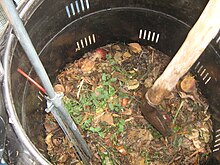
Home compost barrel in the Escuela Barreales, Santa Cruz, Chile.
Certain ratios of these materials will provide beneficial bacteria with the nutrients to work at a rate that will heat up the pile. In that process much water will be released as vapor ("steam"), and the oxygen will be quickly depleted, explaining the need to actively manage the pile. The hotter the pile gets, the more often added air and water is necessary; the air/water balance is critical to maintaining high temperatures (135°-160° Fahrenheit / 50° - 70° Celsius) until the materials are broken down. At the same time, too much air or water also slows the process, as does too much carbon (or too little nitrogen).
Materials in a compost pile.
The most efficient composting occurs with an optimal carbon:nitrogen ratio of about 10:1 to 20:1. Rapid composting is favored by having a C/N ratio of ~30 or less. Theoretical analysis is confirmed by field tests that above 30 the substrate is nitrogen starved, below 15 it is likely to outgas a portion of nitrogen as ammonia. If nitrogen needs to be increased, it has been suggested to add 0.15 pounds of actual nitrogen per three bushels (3.75 cubic feet) of lower nitrogen material. [For those not familiar with these types of units: 0.64g/L or 640 grams of actual nitrogen per cubic meter.] Two to 3 pounds of organic nitrogen supplement (blood meal, manure, bonemeal, alfalfa meal) per 100 pounds of low nitrogen materials (for example, straw or sawdust), supplies generally ample nitrogen and trace minerals in high carbon mixes.
Nearly all plant and animal materials have both carbon and nitrogen, but amounts vary widely, with characteristics noted above (dry/wet, brown/green). Fresh grass clippings have an average ratio of about 15:1 and dry autumn leaves about 50:1 depending on species. Mixing equal parts by volume approximates the ideal C:N range. Few individual situations will provide the ideal mix of materials at any point. Observation of amounts, and consideration of different materials as a pile is built over time, can quickly achieve a workable technique for the individual situation.
Food scraps compost heap.
Animal Manure and Bedding
On many farms, the basic composting ingredients are animal manure generated on the farm and bedding. Straw and sawdust are common bedding materials. Non-traditional bedding materials are also used, including newspaper and chopped cardboard. The amount of manure composted on a livestock farm is often determined by cleaning schedules, land availability, and weather conditions. Each type of manure has its own physical, chemical, and biological characteristics. Cattle and horse manures, when mixed with bedding, possess good qualities for composting. Swine manure, which is very wet and usually not mixed with bedding material, must be mixed with straw or similar raw materials. Poultry manure also must be blended with carbonaceous materials - those low in nitrogen preferred, such as sawdust or straw.
Microorganisms
With the proper mixture of water, oxygen, carbon, and nitrogen, micro-organisms are allowed to break down organic matter to produce compost. The composting process is dependent on micro-organisms to break down organic matter into compost. There are many types of microorganisms found in active compost of which the most common are:
- Bacteria - The most numerous of all the microorganisms found in compost. Depending on the phase of composting, mesophilic or thermophilic bacteria may predominate.
- Actinobacteria - Necessary for breaking down paper products such as newspaper, bark etc.
- Fungi - Molds and yeast help break down materials that bacteria cannot, especially lignin in woody material.
- Protozoa - Help consume bacteria, fungi and micro organic particulates.
- Rotifers - Rotifers help control populations of bacteria and small protozoans.
In addition, earthworms not only ingest partly composted material, but also continually re-create aeration and drainage tunnels as they move through the compost.
A lack of a healthy micro-organism community is the main reason why composting processes are slow in landfills with environmental factors such as lack of oxygen, nutrients or water being the cause of the depleted biological community.
Phases of Composting
Under ideal conditions, composting proceeds through three major phases:
- An initial, mesophilic phase, in which the decomposition is carried out under moderate temperatures by mesophilic microorganisms.
- As the temperature rises, a second, thermophilic phase starts, in which in decomposition is carried out by various thermophilic bacteria under high temperatures.
- As the supply of high-energy compounds dwindles, the temperature starts to decrease, and the mesophiles once again predominate in the maturation phase.
Human Waste
Human waste (excreta) can also be added as an input to the composting process, like it is done in composting toilets, as human waste is a nitrogen-rich organic material.
People excrete far more water-soluble plant nutrients (nitrogen, phosphorus, potassium) in urine than in feces. Human urine can be used directly as fertilizer or it can be put onto compost. Adding a healthy person's urine to compost usually will increase temperatures and therefore increase its ability to destroy pathogens and unwanted seeds. Urine from a person with no obvious symptoms of infection is much more sanitary than fresh feces. Unlike feces, urine does not attract disease-spreading flies ( such as house flies or blow flies,) and it does not contain the most hardy of pathogens, such as parasitic worm eggs. Urine usually does not stink for long, particularly when it is fresh, diluted, or put on sorbents.
Urine is primarily composed of water and urea. Although metabolites of urea are nitrogen fertilizers, it is easy to over-fertilize with urine, or to utilize urine containing pharmaceutical (or other) content, creating too much ammonia for plants to absorb, acidic conditions, or other phytotoxicity.
Humanure
"Humanure" is a portmanteau of human and manure, designating human excrement (feces and urine) that is recycled via composting for agricultural or other purposes. The term was first used in a 1994 book by Joseph Jenkins that advocates the use of this organic soil amendment. The term humanure is used by compost enthusiasts in the US but not generally elsewhere. Because the term "humanure" has no authoritative definition it is subject to various uses; news reporters occasionally fail to correctly distinguish between humanure and sewage sludge or "biosolids".
Uses
Compost is generally recommended as an additive to soil, or other matrices such as coir and peat, as a tilth improver, supplying humus and nutrients. It provides a rich growing medium, or a porous, absorbent material that holds moisture and soluble minerals, providing the support and nutrient in which plants can flourish, although it is rarely used alone, being primarily mixed with soil, sand, drit, bark chips, vermiculite, perlite, or clay granules to produce loam. Compost can be tilled directly into the soil or growing medium to boost the level of organic matter and the overall fertility of the soil. Compost that is ready to be used as an additive is dark brown or even black with an earthy smell.
Generally, direct seeding into a compost is not recommended due to the speed with which it may dry and the possible presence of phytotoxins that may inhibit germination, and the possible tie up of nitrogen by incompletely decomposed lignin. It is very common to see blends of 20–30% compost used for transplanting seedlings at cotyledon stage or later.
Composting can destroy pathogens or unwanted seeds. Unwanted living plants (or weeds) can be discouraged by covering with mulch/compost. The "microbial pesticides in compost may include thermophiles and mesophiles, however certain composting detritivores such as black soldier fly larvae and redworms also reduce many pathogens. Thermophilic (high-temperature) composting is well known to destroy many seeds and nearly all types of pathogens (exceptions may include prions). The sanitizing qualities of (thermophilic) composting are desirable where there is a high likelihood of pathogens, such as with manure.

A homemade compost tumbler
Overview
In addition to the traditional compost pile, various approaches have been developed to handle different composting processes, ingredients, locations, and applications for the composted product.
Food waste - after three years

A modern compost bin constructed from plastics
There is a large number of different composting systems on the market, for example:
- At the household level: Composting toilet, container composting, vermicomposting
- At the industrial composting (large scale): Aerated Static Pile Composting, vermicomposting, windrow composting etc.
Vermicomposting
Vermicompost is the product or process of composting through the utilization of various species of worms, usually red wigglers, white worms, and earthworms, to create a heterogeneous mixture of decomposing vegetable or food waste (excluding meat, dairy, fats, or oils), bedding materials, and vermicast. Vermicast, also known as worm castings, worm humus or worm manure, is the end-product of the breakdown of organic matter by species of earthworm. Vermicomposting is widely used in North America for on-site institutional processing of food waste, such as in hospitals and shopping malls This type of composting is sometimes suggested as a feasible indoor home composting method. Vermicomposting has gained popularity in both these industrial and domestic settings because, as compared with conventional composting, it provides a way to compost organic materials more quickly (as defined by a higher rate of carbon-to-nitrogen ratio increase) and to attain products that have lower salinity levels that are therefore more beneficial to plant mediums.
The earthworm species (or composting worms) most often used are red wigglers (Eisenia fetida or Eisenia andrei), though European nightcrawlers (Eisenia hortensis or Dendrobaena veneta) could also be used. Red wigglers are recommended by most vermiculture experts, as they have some of the best appetites and breed very quickly. Users refer to European nightcrawlers by a variety of other names, including dendrobaenas, dendras, Dutch Nightcrawlers, and Belgian nightcrawlers.
Containing water-soluble nutrients, vermicompost is a nutrient-rich organic fertilizer and soil conditioner in a form that is relatively easy for plants to absorb. Worm castings are sometimes used as an organic fertilizer. Because the earthworms grind and uniformly mix minerals in simple forms, plants need only minimal effort to obtain them. The worms' digestive systems also add beneficial microbes to help create a "living" soil environment for plants.
Rotary screen harvested worm castings
Vermicompost tea in conjunction with 10% castings has been shown to cause up to a 1.7 times growth in plant mass over plants grown without.
Researchers from the Pondicherry University discovered that worm composts can also be used to clean up heavy metals. The researchers found substantial reductions in heavy metals when the worms were released into the garbage and they are effective at removing lead, zinc, cadmium, copper and manganese.
Hügelkultur (raised garden beds or mounds)
The practice of making raised garden beds or mounds filled with rotting wood is also called "Hügelkultur" in German. It is in effect creating a Nurse log that is covered with dirt.
Benefits of hügelkultur garden beds include water retention and warming of soil. Buried wood becomes like a sponge as it decomposes, able to capture water and store it for later use by crops planted on top of the hügelkultur bed.
An almost completed Hügelkultur bed; the bed does not have dirt on it yet.
The buried decomposing wood will also give off heat, as all compost does, for several years. These effects have been used by Sepp Holzer to enable fruit trees to survive at otherwise inhospitable temperatures and altitudes.
Black Soldier Fly Larvae Composting
Black Soldier Fly (Hermetia illucens) larvae have been shown to be able to rapidly consume large amounts of organic waste when kept at 31.8°C, the optimum temperature for reproduction. Enthusiasts have experimented with a large number of different waste products and some even sell starter kits to the public.
Cockroach Composting
Cockroach composting is another insect-mediated composting method. In this case the adults of any number of cockroach species (such as the Turkestan cockroach or Blaptica dubia) are used to quickly convert manure or kitchen waste to nutrient dense compost. Depending on species used and environmental conditions, excess composting insects can be used as an excellent animal feed for farm animals and pets.
Bokashi
Bokashi is a method that uses a mix of microorganisms to cover food waste to decrease smell. It derives from the practice of Japanese farmers centuries ago of covering food waste with rich, local soil that contained the microorganisms that would ferment the waste. After a few weeks, they would bury the waste.
Most practitioners obtain the microorganisms from the product Effective Microorganisms (EM1), first sold in the 1980s. EM1 is mixed with a carbon base (e.g. sawdust or bran) that it sticks to and a sugar for food (e.g. molasses). The mixture is layered with waste in a sealed container and after a few weeks, removed and buried.
Inside a recently started bokashi bin. The aerated base is just visible through the food scraps and bokashi bran.
Newspaper fermented in a lactobacillus culture can be substituted for bokashi bran for a successful bokashi bucket.
Compost Tea
Compost teas are defined as water extracts brewed from composted materials and can be derived from aerobic or anaerobic processes. Compost teas are generally produced from adding one volume of compost to 4-10 volumes of water, but there has also been debate about the benefits of aerating the mixture. Field studies have shown the benefits of adding compost teas to crops due to the adding of organic matter, increased nutrient availability and increased microbial activity. They have also been shown to have an effect on plant pathogens.
Composting Toilets
A composting toilet does not require water or electricity, and when properly managed does not smell. A composting toilet collects human excreta which is then added to a compost heap together with sawdust and straw or other carbon rich materials, where pathogens are destroyed to some extent. The amount of pathogen destruction depends on the temperature (mesophilic or thermophilic conditions) and composting time. A composting toilet tries to process the excreta in situ although this is often coupled with a secondary external composting step. The resulting compost product has been given various names, such as humanure and EcoHumus.
A composting toilet can aid in the conservation of fresh water by avoiding the usage of potable water required by the typical flush toilet. It further prevents the pollution of ground water by controlling the fecal matter decomposition before entering the system. When properly managed, there should be no ground contamination from leachate.
Composed and Land- filling
As concern about landfill space increases, worldwide interest in recycling by means of composting is growing, since composting is a process for converting decomposable organic materials into useful stable products. Composting is one of the only ways to revitalize soil vitality due to phosphorus depletion in soil. Industrial scale composting in the form of in-vessel composting, aerated static pile composting, and anaerobic digestion takes place in most Western countries now, and in many areas is mandated by law. There are process and product guidelines in Europe that date to the early 1980s (Germany, the Netherlands, Switzerland) and only more recently in the UK and the US. In both these countries, private trade associations within the industry have established loose standards, some say as a stop-gap measure to discourage independent government agencies from establishing tougher consumer-friendly standards. The USA is the only Western country that does not distinguish sludge-source compost from green-composts, and by default in the USA 50% of states expect composts to comply in some manner with the federal EPA 503 rule promulgated in 1984 for sludge products. Compost is regulated in Canada and Australia as well.
Industrial System
Industrial composting systems are increasingly being installed as a waste management alternative to landfills, along with other advanced waste processing systems. Mechanical sorting of mixed waste streams combined with anaerobic digestion or in-vessel composting is called mechanical biological treatment and are increasingly being used in developed countries due to regulations controlling the amount of organic matter allowed in landfills.Treating biodegradable waste before it enters a landfill reduces global warming from fugitive methane ; untreated waste breaks down anaerobically in a landfill, producing landfill gas that contains methane, a potent greenhouse gas.

A large compost pile that is steaming with the heat generated by thermophilic microorganisms
Vermicomposting, also known as vermiculture, is used for medium-scale on-site institutional composting, such as for food waste from universities and shopping malls. It is selected either as a more environmentally friendly choice than conventional methods of disposal, or to reduce the cost of commercial waste removal.
Large-scale composting systems are used by many urban areas around the world. Co-composting is a technique that combines solid waste with de-watered biosolids, although difficulties controlling inert and plastics contamination from municipal solid waste makes this approach less attractive. The World's largest MSW co-composter is the Edmonton Composting Facility in Edmonton, Alberta, Canada, which turns 220,000 tonnes of residential solid waste and 22,500 dry tonnes of biosolids per year into 80,000 tonnes of compost. The facility is 38,690 meters2 (416,500 ft2) in area, equivalent to 4½ Canadian football fields, and the operating structure is the largest stainless steel building in North America, the size of 14 NHL rinks. In 2006, the State of Qatar awarded Keppel Seghers Singapore, a subsidiary of Keppel Corporation to begin construction on a 275,000 tonne/year Anaerobic Digestion and Composting Plant licensed by Kompogas (de) Switzerland. This plant, with 15 independent anaerobic digestors will be the world's largest composting facility once fully operational in early 2011 and forms part of the Qatar Domestic Solid Waste Management Center, the largest integrated waste management complex in the Middle East.
Another large MSW composter is the Lahore Composting Facility in Lahore, Pakistan, which has a capacity to convert 1,000 tonnes of municipal solid waste per day into compost. It also has a capacity to convert substantial portion of the intake into Refuse-derived fuel (RDF) materials for further combustion use in several energy consuming industries across Pakistan e.g., in cement manufacturing companies where it is used to heat up the Cement Kiln systems. This project has also been approved by the Executive Board of the United Nations Framework Convention on Climate Change (UNFCCC) for reduction of emission of methane gas into the climate and has been registered with a capacity of reducing 108,686 metric tonnes CO2 equivalent per annum.
Related Technologies
Anaerobic digestion is another possible process for converting organic waste into a useful produce (biogas). In central Europe, anaerobic digestion is now more common than composting as a process for treating organic waste. The two processes can also be used in combination: sewage sludge is often anaerobically digested first, followed by a composting process before selling or giving away the compost to farmers.
History
Composting as a recognized practice dates to at least the early Roman Empire since Pliny the Elder (AD 23-79). Traditionally, composting involved piling organic materials until the next planting season, at which time the materials would have decayed enough to be ready for use in the soil. The advantage of this method is that little working time or effort is required from the composter and it fits in naturally with agricultural practices in temperate climates. Disadvantages (from the modern perspective) are that space is used for a whole year, some nutrients might be leached due to exposure to rainfall, and disease-producing organisms and insects may not be adequately controlled.
Composting was somewhat modernized beginning in the 1920s in Europe as a tool for organic farming. The first industrial station for the transformation of urban organic materials into compost was set up in Wels, Austria in the year 1921. Early frequent citations for propounding composting within farming are for the German-speaking world Rudolf Steiner, founder of a farming method called biodynamics, and Annie Francé-Harrar, who was appointed on behalf of the government in Mexico and supported the country 1950–1958 to set up a large humus organization in the fight against erosion and soil degradation.
In the English-speaking world it was Sir Albert Howard who worked extensively in India on sustainable practices and Lady Eve Balfour who was a huge proponent of composting. Composting was imported to America by various followers of these early European movements by the likes of J.I. Rodale (founder of Rodale Organic Gardening), E.E. Pfeiffer (who developed scientific practices in biodynamic farming), Paul Keene (founder of Walnut Acres in Pennsylvania), and Scott and Helen Nearing (who inspired the back-to-the-land movement of the 1960s). Coincidentally, some of the above met briefly in India - all were quite influential in the U.S. from the 1960s into the 1980s.
There are many modern proponents of rapid composting that attempt to correct some of the perceived problems associated with traditional, slow composting. Many advocate that compost can be made in 2 to 3 weeks. Many such short processes involve a few changes to traditional methods, including smaller, more homogenized pieces in the compost, controlling carbon-to-nitrogen ratio (C:N) at 30 to 1 or less, and monitoring the moisture level more carefully. However, none of these parameters differ significantly from the early writings of Howard and Balfour, suggesting that in fact modern composting has not made significant advances over the traditional methods that take a few months to work. For this reason and others, many modern scientists who deal with carbon transformations are sceptical that there is a "super-charged" way to get nature to make compost rapidly.
In fact, both sides are right to some extent. The bacterial activity in rapid high heat methods breaks down the material to the extent that pathogens and seeds are destroyed, and the original feedstock is unrecognizable. At this stage, the compost can be used to prepare fields or other planting areas. However, most professionals recommend that the compost be given time to cure before using in a nursery for starting seeds or growing young plants. The curing time allows fungi to continue the decomposition process and eliminating phytotoxic substances.
Many countries such as Wales and some individual cities such as Seattle and San Francisco require food and yard waste to be sorted for composting.
Kew Gardens in London has one of the biggest non-commercial compost heaps in Europe.
- Wikipedia


.jpg)