Blog List

Tuesday, 19 April 2016

Can You Boil Carrots to Make Baby Food?

If you enjoy making homemade food for your baby, you might wonder which foods are appropriate and which you should wait a little longer to present. Carrots are a common baby food, and you can boil fresh ones to prepare a highly nutritious meal or side dish for your little one. The nutrients present in carrots are numerous and making homemade boiled carrot baby food will give your baby the health benefits they have to offer.


Can You Boil Carrots to Make Baby Food?
Close-up of woman slicing carrot. Photo Credit mareciok/iStock/Getty Images.

Healthy Eating

Your baby relies on a variety of vitamins and minerals in foods to grow and develop normally. The nutrients present in vegetables such as carrots support your little one's growth and health and should be offered on a daily basis. When you serve your baby a variety of vegetables, she is more likely to get all the vitamins and minerals she requires each day. Pureed vegetables are one way to help your baby get exactly what she needs.

Benefits

A serving of boiled and pureed carrots supplies your baby with a small amount of fiber, which your little one needs for a healthy digestive system. The beta-carotene found in carrots is what gives them their vibrant orange hue. Beta-carotene is a plant form of vitamin A, which your baby needs for healthy eyes and white blood cells. Plenty of vitamin A also might boost your baby's immune system so she gets sick less often.


How To

Rinse and peel four to five large carrots. Slice the raw carrots into small pieces using a sharp knife. Place the carrots in a medium-size saucepan and cover with water. Place the saucepan over medium-high heat and bring to a boil. Boil the carrots for 10 to 15 minutes, or until easily pricked with the tip of a sharp knife. Remove the carrots from the heat and drain. Cool the carrots and puree in a blender until smooth. Portion into individual storage containers and place in the refrigerator or freezer until ready to serve.

Tips

Do not add salt to your baby's boiled carrots. Your baby will learn to like the taste of foods more easily if you do not add salt. If your little one does not seem to enjoy the taste of carrots, add a sprinkle of cinnamon or cloves to the boiled carrots when you puree them in the blender. If your baby has tried other fruits and vegetables, consider adding those to the carrots to enhance the flavor. Apples, peas, pears or green beans pair well with the sweet flavor of carrots. Keep offering carrots to your baby even if she will not eat them. It can take your baby up to 15 times of trying a food before she is willing to eat it.
www.livestrong.com

PITCHER PLANTS

Pitcher plants are several different carnivorous plants which have modified leaves known as pitfall traps—a prey-trapping mechanism featuring a deep cavity filled with digestive fluid liquid. The traps of what we consider to be "true" pitcher plants are created from modified leaves; however they are not simply folded into a tube, and the process is far more complicated. 


Pitcher of Nepenthes distillatoria?A: Honey-gland from attractive surface of lid. B: Digestive gland from interior of pitcher, in pocket-like depression of epidermis, opening downwards. C: Traverse section same.
Types of pitcher plants

The term "pitcher plant" generally refers to members of the Nepenthaceae and Sarraceniaceae families, but similar pitfall traps are employed by the monotypic Cephalotaceae and some members of the Bromeliaceae. The families Nepenthaceae and Sarraceniaceae are the most species-rich families of pitcher plants.


Pitcher plants growing in a bog in Pennsylvania.
The Nepenthaceae contains a single genus, Nepenthes, containing over 100 species and numerous hybrids and cultivars. In these Old World pitcher plants, the pitchers are borne at the end of tendrils, that extend from the midrib of an otherwise unexceptional leaf. 'Old world' pitcher plants (genus: Nepenthes) are typically characterized as having reduced and symmetrical pitchers with a comprehensive waxy coating on the surface of the inner pitcher wall. The plants themselves are often climbers, accessing plants (Sarraceniaceae), which comprise three genera, are ground-dwelling herbs whose pitchers arise from a horizontal rhizome. In this family, the entire leaf forms the pitcher, as opposed to Nepenthaceae where the pitcher arises from the terminal portion of the leaf. The species of the genus Heliamphora, which are popularly known as marsh pitchers (or erroneously as sun pitchers), have a simple rolled-leaf pitcher, at the tip of which is a spoon-like structure that secretes nectar. They are restricted to areas of high rainfall in South America. The North American genus Sarracenia are the trumpet pitchers, which have a more complex trap than Heliamphora, with an operculum, which prevents excess accumulation of rainwater in most of the species. The single species in the Californian genus Darlingtonia is popularly known as the cobra plant, due to its possession of an inflated "lid" with elegant false-exits, and a forked "tongue", which serves to ferry ants and other prey to the entrance of the pitcher. The species in the genus Sarracenia readily hybridise, making their classification a complex matter.
Scanning electron micrograph of a pitcher's inner surface
The Cephalotaceae is a monotypic family with but one genus and species, Cephalotus follicularis. This species has a small (2–5 cm) pitcher similar in form to those of Nepenthes. It occurs in only one location in southwestern Australia.
A few species of bromeliads (Bromeliaceae), such as Brocchinia reducta and Catopsis berteroniana, are known or suspected to be carnivorous. Bromeliads are monocots and given that they all naturally collect water where their leaves meet each other, and that many collect detritus, it is not surprising that a few should have been naturally selected to develop the habit into carnivory by the addition of wax and downward-pointing hairs.
The purple pitcher plant, Sarracenia purpurea, is the floral emblem of the province of Newfoundland and Labrador, Canada.

Nepenthes pitchers hang from tendrils. 
North American Pitcher plants belong to the genus Sarracenia.


Cobra lilies (Darlingtonia californica) use window-like areolae to lure insects into their hollow leaves. 
The Albany Pitcher Plant is the only member of the Australian genus Cephalotus.
Feeding behavior
Foraging, flying or crawling insects such as flies are attracted to the cavity formed by the cupped leaf, often by visual lures such as anthocyanin pigments, and nectar bribes. The rim of the pitcher (peristome) is slippery, when moistened by condensation or nectar, causing insects to fall into the trap. Pitcher plants may also contain waxy scales, protruding aldehyde crystals, cuticular folds, inward and downward pointing (retrorse) hairs, or guard-cell-originating lunate cells on the inside of the pitcher to ensure that insects cannot climb out. The small bodies of liquid contained within the pitcher traps are called phytotelmata. They drown the insect, and the body of it is gradually dissolved. This may occur by bacterial action (the bacteria being washed into the pitcher by rainfall) or by enzymes secreted by the plant itself. Furthermore, some pitcher plants contain mutualistic insect larvae, which feed on trapped prey, and whose excreta the plant absorbs. Whatever the mechanism of digestion, the prey items are converted into a solution of amino acids, peptides, phosphates, ammonium and urea, from which the plant obtains its mineral nutrition (particularly nitrogen and phosphorus). Like all carnivorous plants, they all grow in locations where the soil is too poor in minerals and/or too acidic for most plants to survive. Rather than relying on photosynthetic glucose to survive, pitcher plants supplement available nutrients and minerals (which plants normally obtain through their roots) with the constituents of their insect prey.
Mature plants of Nepenthes lowii attract tree shrews (Tupaia montana), which feed on nectar that the plant produces but also defecate into the pitcher, providing nitrates and other nutrients. The plant and tree shrew have a symbiotic relationship. The rim of N. lowii is not slippery so that tree shrews can easily get in and out, and it provides more nectar than other pitcher plants. The shape of the pitcher rim and the position of the nectar ensure that the animal's hindquarters are over the rim while it feeds.
Evolution of the form

It is widely assumed pitfall traps evolved by epiascidiation (infolding of the leaf with the adaxial or upper surface becoming the inside of the pitcher), with selection pressure favouring more deeply cupped leaves over evolutionary time. The pitcher trap evolved independently in three eudicot lineages and one monocot lineage, representing a case of convergent evolution. Some pitcher plant families (such as Nepenthaceae) are placed within clades consisting mostly of flypaper traps, indicating that some pitchers may have evolved from the common ancestors of today's flypaper traps by loss of mucilage.

References

  1. a b Krol, E.; Plancho, B.J.; Adamec, L.; Stolarz, M.; Dziubinska, H.; Trebacz, K (2011). "Quite a few reasons for calling carnivores 'the most wonderful plants in the world". Annals of Botany 109 (1): 47–64. doi:10.1093/aob/mcr249.
  2. ^ Moran, J.A.; Clarke, C.M. (100BC). "The carnivorous syndrome in Nepenthes pitcher plants: the current state of knowledge and potential future directions". Plant Signaling and Behavior 5 (6): 644–648. doi:10.4161/psb.5.6.11238. PMC: 3001552. PMID 21135573. Check date values in: |date= (help)
  3. ^ Bauer, Ulrike, et al. "Form Follows Function: Morphological Diversification And Alternative Trapping Strategies In Carnivorous Nepenthes Pitcher Plants."Journal Of Evolutionary Biology 25.1 (2012): 90-102. MEDLINE with Full Text.
  4. ^ Ellison, A.M.; Bulter, E.D.; Hicks, E.J.; Naczi, R.F.C.; Calie, P.J.; Bell, C.D. Davis, C.C. (2012). "Phylogeny and biogeography of the carnivorous plant family Sarraceniaceae". PLoS ONE 7 (6): e39291. doi:10.1371/journal.pone.0039291. Cite uses deprecated parameter |coauthors= (help)
  5. ^ McAlpine, D.K. (1998). "Review of the Australian stilt flies (Diptera: Micropezidae) with a phylogenetic analysis of the family". Invertebrate Taxonomy 12 (1): 55–134. doi:10.1071/IT96018.
  6. ^ Pitcher Plant Doubles as Toilet
  7. a b Albert, V.A.; Williams, S.E.; Chase, M.W. (1992). "Carnivorous Plants: Phylogeny and Structural Evolution". Science 257 (5076): 1491–1495. doi:10.1126/science.1523408. PMID 1523408.
  8. ^ Owen Jr, T.P.; Lennon, K.A. (1999). "Structure and Development of Pitchers from the Carnivorous Plant Nepenthes alta (Nepenthaceae)". American Journal of Botany 86 (10): 1382–1390. doi:10.2307/2656921. PMID 10523280.
  • Public Domain This article incorporates text from a publication now in the public domain: Chisholm, Hugh, ed. (1911). "Pitcher Plants". Encyclopædia Britannica (11th ed.). Cambridge University Press.
[1].
Further Reading

  • Juniper, B.E., R.J. Robins & D.M. Joel (1989). The Carnivorous Plants.  Academic Press, London.
  • Schnell, D. (2003). Carnivorous Plants of the United States and Canada. Second Edition. Timber Press, Oregon, U.S.A. [2]
  1. ^ http://gardenofeaden.blogspot.co.uk/2010/02/how-does-pitcher-plant-attract-catch.html
  2. ^ http://www.thenakedscientists.com/HTML/questions/question/2797/

- Wikipedia 

Popular Woodworking's Shaker Furniture Projects

By Editors of Popular Wood Working Magazine: Megan Fitzpatrick, Glen D. Huey, Malcolm Huey, Robert W. Lang, Kerry Pierce, Christopher Schwarz, Troy Sexton, Steve Shanesy, Jim Stuard, David Thiel


Format: eBook 
Other available formats: PAPERBACK

You'll love Popular Woodworking's Shaker Furniture Projects if you:

  • Are a fan of the crisp and simple lines in Shaker Furniture.
  • Want to fill your home with furniture that will last a lifetime.
  • Would like to learn more about advanced techoniques involved with horology, joinery and more.
  • Like furniture that is relatively easy to build.
Fill your home with gorgeous Shaker furniture for every room! Popular Woodworking's Shaker Furniture Projects includes 31 projects varying from large pieces, like a Press Cupboard, to smaller projects like traditional hanging shelves. Well made Shaker Furniture will go well with just about any home and will never go out of style. While there are several projects a beginner could take on, there are also a great deal of projects that will challenge an experienced woodworker. Let the editors of Popular Woodworking Magazine present some of their best Shaker pieces in this invaluable guide.

In Popular Woodworking's Shaker Furniture Projects, you'll find projects for:

  • Tables
  • Cabinets and Chests
  • Seating
  • Clocks
  • A Workbench
  • A Firewood Box, Step stool, and Shelves
Order Popular Woodworking's Shaker Furniture Projects today and learn to make timeless Shaker furniture to fill every room in your home.
For more information log on website:

http://www.shopwoodworking.com/popular-woodworking-shaker-furniture-projects-group?source=igodigital

What Is a Good Daily Workout Routine?

According to the Centers for Disease Control and Prevention (CDC), adults need at least 150 minutes of moderate physical activity or 75 minutes of vigorous activity each week, along with a minimum of twice-weekly strength-training sessions. While this may seem like a large time commitment for some people, workouts can be broken up into shorter sessions – even as little as 10 minutes – without losing their effectiveness. For a person wanting a daily exercise plan, spacing weekly cardio and strength-training activities into smaller sessions each day can help you meet the minimum requirements and your own fitness goals.
What Is a Good Daily Workout Routine?

Man swimming laps Photo Credit Randolph Jay Braun/iStock/Getty Images.

Cardio Activities

Cardio exercise that increases your breathing and heart rate makes up a key component of your daily fitness routine. Whether you choose to keep it low impact with brisk walking or lap swimming, or kick it into high gear with kickboxing or mountain biking, the goal is to get moving every day. Keeping the CDC's guidelines in mind, plan your activities to meet or exceed these minimums. For instance, you could walk for 25 minutes each day, or jog for 20 minutes four days per week. If you enjoy aerobics, you could do two 30-minute sessions of fast-paced aerobics on nonconsecutive days, along with a 15-minute cycling session.

Strength-Training Exercises

Strength-training exercises build and tone muscles, and while these can be performed as part of a daily routine, it’s important not to work the same muscle groups back to back. For example, if you focus on your core one day, don’t plan on doing a series of crunches or situps the next day. Alternate your target muscle groups, and aim for one to three sets of eight to 12 repetitions for each exercise. Common strength-training exercises include pushups, pullups, crunches, squats and lunges.

Flexibility

Flexibility is another major fitness component, and you can bookend your regular daily workouts with flexibility work. At the beginning of each workout, whether it’s cardio or strength training, warm up your body with five minutes of light activity, such as walking or jogging in place, and gentle stretches. After exercising, spend about five minutes doing the same light activity performed in the warm up, but add an additional five minutes for active stretching. Stretch each major muscle group for 15 to 30 seconds, starting with your neck and working your way down your body. Don’t bounce; rather, hold the stretch with your muscles fully engaged but not to the point of pain.

Putting It All Together

Now that you have the basic components for developing your own unique workout, you can begin to piece together a daily fitness plan that works within your schedule. Map out each day to determine which activities -- cardio, strength training or both -- will be included. If possible, alternate cardio and strength-training days, but if you do have to include both in the same day, try to keep the cardio at a moderate level to lessen your chance of muscle fatigue during the strength portion. Be sure to include adequate time for warming up and cooling down with flexibility work, and total your cardio times for the week to see if you’re meeting the CDC minimums.
www.livestrong.com

PINGUICULA

Pinguicula, commonly known as the butterworts, is a genus of carnivorous plants that use sticky, glandular leaves to lure, trap, and digest insects in order to supplement the poor mineral nutrition they obtain from the environment. Of the roughly 80 currently known species, 12 are native to Europe, 9 to North America and some in northern Asia. The largest number of species is in South and Central America.
Butterwort
Pinguicula moranensis.jpg
Pinguicula moranensis
Scientific classification
Kingdom:Plantae
(unranked):Angiosperms
(unranked):Eudicots
(unranked):Asterids
Order:Lamiales
Family:Lentibulariaceae
Genus:Pinguicula
L.
Etymology

The name Pinguicula is derived from a term coined by Conrad Gesner, who in his 1561 work entitled Horti Germaniae commented on the glistening leaves: "propter pinguia et tenera folia…" (Latin pinguis, "fat"). The common name "butterwort" reflects this characteristic.

Characteristics

The majority of Pinguicula are perennial plants. The only known annuals are P. sharpii, P. takakii,  P. crenatiloba and P. pumila. All species form stemless rosettes.

Habit
Butterworts can be divided roughly into two main groups based on the climate in which they grow; each group is the further subdivided based on morphological characteristics. Although these groups are not cladistically supported by genetic studies, these groupings are nonetheless convenient for horticultural purposes.
Winter rosette of Pinguicula cyclosecta (non-carnivorous).
Tropical butterworts either form somewhat compact winter rosettes composed of fleshy leaves or retain carnivorous leaves year-round. Temperate species often form tight buds (called hibernacula) composed of scale-like leaves during a winter dormancy period. During this time the roots (with the exception of P. alpina) and carnivorous leaves wither. Temperate species flower when they form their summer rosettes while tropical species flower at each rosette change.
Many butterworts cycle between rosettes composed of carnivorous and non-carnivorous leaves as the seasons change, so these two ecological groupings can be further divided according to their ability to produce different leaves during their growing season. If the growth in the summer is different in size or shape to that in the early spring (for temperate species) or in the winter (tropical species), then plants are considered heterophyllous; whereas uniform growth identifies a homophyllous species.
Summer rosette of Pinguicula cyclosecta (carnivorous).
This results in four groupings:
  • Tropical butterworts: species which do not undergo a winter dormancy but continue to alternately bloom and form rosettes.
    • Heterophyllous tropical species: species that alternate between rosettes of carnivorous leaves during the warm season and compact rosettes of fleshy non-carnivorous leaves during the cool season. Examples include P. moranensis, P. gypsicola and P. laxifolia.
    • Homophyllous tropical species: these species produce rosettes of carnivorous leaves of roughly uniform size throughout the year, such as P. gigantea.
  • Temperate butterworts: these plants are native to climate zones with cold winters. They produce a winter-resting bud (hibernaculum) during the winter.
    • Heterophyllous temperate species: species where the vegetative and generative rosettes differ in shape and/or size, as seen in P. lutea and P. lusitanica.
    • Homophyllous temperate species: the vegetative and generative rosettes appear identical, as exhibited by P. alpina, P. grandiflora and P. vulgaris.

Roots

The root system of Pinguicula species is relatively undeveloped. The thin, white roots serve mainly as an anchor for the plant and to absorb moisture (nutrients are absorbed through carnivory). In temperate species these roots wither (except in P. alpina) when the hibernaculum is formed. In the few epiphytic species (such as P. lignicola), the roots form anchoring suction cups.

Leaves and carnivory


A fly trapped on a butterwort leaf. Glandular hairs are visible.
The leaf blade of a butterwort is smooth, rigid, and succulent, usually bright green or pinkish in colour. Depending on species, the leaves are between 2 and 30 cm.(1-12") long. The leaf shape depends on the species, but is usually roughly obovate, spatulate or linear.
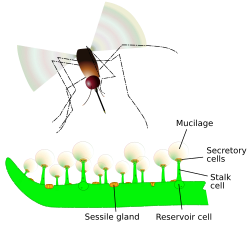
Vector graphic of the trapping and digestive features of a Pinguicula leaf 

Like all members of the family Lentibulariaceae, butterworts are carnivorous. In order to catch and digest insects, the leaf of a butterwort uses two specialized glands which are scattered across the leaf surface (usually only on the upper surface, with the exception of P. gigantea and P. longifolia ssp. longifolia). One is termed a peduncular gland, and consists of a few secretory cells on top of a single stalk cell. These cells produce a mucilagenous secretion which forms visible droplets across the leaf surface. This wet appearance probably helps lure prey in search of water (a similar phenomenon is observed in the sundews). The droplets secrete limited amounts of digestive enzymes, and serve mainly to entrap insects. On contact with an insect, the peduncular glands release additional mucilage from special reservoir cells located at the base of their stalks. The insect will begin to struggle, triggering more glands and encasing itself in mucilage. Some species can bend their leaf edges slightly by thigmotropism, bringing additional glands into contact with the trapped insect. The second type of gland found on butterwort leaves are sessile glands which lie flat on the leaf surface. Once the prey is entrapped by the peduncular glands and digestion begins, the initial flow of nitrogen triggers enzyme release by the sessile glands. These enzymes, which include amylase, esterase, phosphatase, protease and ribonuclease break down the digestible components of the insect body. These fluids are then absorbed back into the leaf surface through cuticular holes, leaving only the chitin exoskeleton of the larger insects on the leaf surface.
The holes in the cuticle which allow for this digestive mechanism also pose a challenge for the plant, since they serve as breaks in the cuticle (waxy layer) that protects the plant from desiccation. As a result, most butterworts live in humid environments.


Flower of P. vulgaris.
Butterworts are usually only able to trap small insects and those with large wing surfaces. They can also digest pollen which lands on their leaf surface. The secretory system can only function a single time, so that a particular area of the leaf surface can only be used to digest insects once.

Flowers
As with almost all carnivorous plants, the flowers of butterworts are held far above the rest of the plant by a long stalk, in order to reduce the probability of trapping potential pollinators. The single, long-lasting flowers are zygomorphic, with two lower lip petals characteristic of the bladderwort family and a spur extending from the back of the flower. The calyx has five sepals, and the petals are arranged in a two-part lower lip and a three-part upper lip. Most butterwort flowers are blue, violet or white, often suffused with a yellow, greenish or reddish tint. P. laueana and the newly described P. caryophyllacea are unique in having a strikingly red flowers. Butterworts are often cultivated and hybridized primarily for their flowers.
The flower of a hybrid butterwort.
The shape and colors of butterwort flowers are distinguishing characteristics which are used to divide the genus into subgenera and to distinguish individual species from one another.
Fruit and seed
The round to egg-shaped seed capsules open when dry into two halves, exposing numerous small (0.5–1 mm), brown seeds. If moisture is present the silique closes, protecting the seed and opening again upon dryness to allow for wind dispersal. Many species have a net-like pattern on their seed surface to allow them to land on water surfaces without sinking, since many non-epiphytic butterworts grow near water sources. The haploid chromosome number of butterworts is either n = 8 or n = 11 (or a multiple thereof), depending on species. The exception is P. lusitanica, whose chromosome count is n = 6.

Vegetation propagation

As well as sexual reproduction by seed, many butterworts can reproduce asexually by vegetative reproduction. Many members of the genus form offshoots during or shortly after flowering (e.g.P. vulgaris), which grow into new genetically identical adults. A few other species form new offshoots using stolons (e.g.P. calyptrata, P. vallisneriifolia), while others form plantlets at the leaf margins (e.g.P. heterophylla, P. primuliflora).

Distribution
Butterworts are distributed throughout the northern hemisphere (map). The greatest concentration of species, however, is in humid mountainous regions of Central America (including Mexico) and South America, where populations can be found as far south as Tierra del Fuego. Australia is the only continent without any native butterworts.
Pinguicula distribution.
Butterworts probably originated in Central America, as this is the center of Pinguiculadiversity – roughly 50% of butterwort species are found here.
The great majority of individual Pinguicula species have a very limited distribution. The two butterwort species with the widest distribution - P. alpina and P. vulgaris - are found throughout much of Europe and North America. Other species found in the United States include P. caerulea, P.ionantha, P. lutea, P. macroceras, P. planifolia, P. primuliflora, P. pumila, and P. villosa.
Habitat
In general, butterworts grow in nutrient-poor, alkaline soils. Some species have adapted to other soil types, such as acidic peat bogs (ex. P. vulgaris,  P. calyptrata, P. lusitanica), soils composed of pure gypsum (P. gypsicola and other Mexican species), or even vertical rock walls (P. ramosaP. vallisneriifolia and most of the Mexican species). A few species are epiphytes (P. casabitoana, P. hemiepiphytica, P. lignicola). Many of the Mexican species commonly grow on mossy banks, rock, and roadsides in oak-pine forests. Pinguicula macroceras ssp. nortensis has even been observed growing on hanging dead grasses. P. lutea,grows in pine flatwoods. Other species, such as P. vulgaris, grow in fens. Each of these environments is nutrient-poor, allowing butterworts to escape competition from other canopy-forming species, particularly grasses and sedges.
P. macroceras ssp. nortensisgrowing on a wet rock wall in northern California.
Butterworts need habitats that are almost constantly moist or wet, at least during their carnivorous growth stage. Many Mexican species lose their carnivorous leaves, and sprout succulent leaves, or die back to onion-like "bulbs" to survive the winter drought, at which point they can survive in bone-dry conditions. The moisture they need for growing can be supplied by either a high groundwater table or by high humidity or high precipitation. Unlike many other carnivorous plants that require sunny locations, many butterworts thrive in part-sun or even shady conditions.
P. leptoceras in alpine grassland in Südtirol, Italy.
Conservation status

The environmental threats faced by various Pinguicula species depend on their location and on how widespread their distribution is. Most endangered are the species which are endemic to small areas, such as P. ramosa, P. casabitoana, and P. fiorii. These populations are threatened primarily by habitat destruction. Wetland destruction has threatened several US species. Most of these are federally listed as either threatened or endangered, and P. ionantha is listed on CITES appendix I, giving it additional protection.

Botanical History
The first mention of butterworts in botanical literature is an entry entitled Zitroch chrawt oder smalz chrawt ("lard herb") by Vitus Auslasser in his 1479 work on medicinal herbs entitled Macer de Herbarium. The name Zittrochkraut is still used for butterworts in Tirol, Austria.
In 1583, Clusius already distinguished between two forms in his Historia stirpium rariorum per Pannoniam, Austriam: a blue-flowered form (P. vulgaris) and a white-flowered form (Pinguicula alpina). Linnaeus added P. villosa and P. lusitanica when he published his Species Plantarum in 1753. The number of known species rose sharply with the exploration of the new continents in the 19th century; by 1844, 32 species were known.
Pinguicula vulgaris, illustration.
It was only in the late 19th century that the carnivory of this genus began to be studied in detail. In a letter to Asa Gray dated June 3, 1874, Charles Darwin mentioned his early observations of the butterwort's digestive process and insectivorous nature. (See Gray Herbarium of Harvard University (103). Darwin studied these plants extensively. S. J. Casper's large 1966 monograph of the genus included 46 species, a number which has almost doubled since then. Many exciting discoveries have been made in recent years, especially in Mexico. Another important development in the history of butterworts is the formation of the International Pinguicula Study Group, an organization dedicated to furthering the knowledge of this genus and promoting its popularity in cultivation, in the 1990s.
Uses
Butterworts are widely cultivated by carnivorous plant enthusiasts. The temperate species and many of the Mexican butterworts are relatively easy to grow and have therefore gained relative popularity. Two of the most widely grown plants are the hybrid cultivars Pinguicula × 'Sethos' and Pinguicula × 'Weser'. Both are crosses of Pinguicula ehlersiae and Pinguicula moranensis, and are employed by commercial orchid nurseries to combat pests.
Butterworts also produce a strong bactericide which prevents insects from rotting while they are being digested. According to Linnaeus, this property has long been known by northern Europeans, who applied butterwort leaves to the sores of cattle to promote healing. Additionally, butterwort leaves were used to curdle milk and form a buttermilk-like fermented milk product called filmjölk (Sweden) and tjukkmjølk (Norway).
Classification

Pinguicula belong to the Bladderwort family (Lentibulariaceae), along with Utricularia and Genlisea. Siegfried Jost Casper systematically divided them into three subgenera with 15 sections.
A detailed study of the phylogenetics of butterworts by Cieslak et al. (2005) found that all of the currently accepted subgenera and many of the sections were polyphyletic. The diagram below gives a more accurate representation of the correct cladogra. Polyphyletic sections are marked with an *.
                  ┌────Clade I (Sections Temnoceras *, Orcheosanthus *, Longitubus,
                  │             Heterophyllum *, Agnata *, Isoloba *, Crassifolia)
                  │
              ┌───┤
              │   │
              │   │
       ┌──────┤   └────Clade II (Section Micranthus * = P. alpina)
       │      │
       │      │
   ┌───┤      └────────Clade III (Sections Micranthus *, Nana)
   │   │
   │   │
───┤   └───────────────Clade IV (Section Pinguicula)
   │
   │
   └───────────────────Clade V (Sections Isoloba *, Ampullipalatum, Cardiophyllum)

References
Much of the content of this article comes from the equivalent German-language Wikipedia article (retrieved March 29, 2009).
  1. a b Cieslak T, Polepalli JS, White A, Müller K, Borsch T, Barthlott W, Steiger J, Marchant A, Legendre L (2005). "Phylogenetic analysis of Pinguicula (Lentibulariaceae): chloroplast DNA sequences and morphology support several geographically distinct radiations". American Journal of Botany 92 (10): 1723–1736. doi:10.3732/ajb.92.10.1723.
  2. a b c d Legendre L (2002). "The genus Pinguicula L. (Lentibulariaceae): an overview". Acta Botanica Gallica 141 (1): 77–95.
  3. ^ Keddy, P.A., L. Smith, D.R. Campbell, M. Clark and G. Montz. 2006. Patterns of herbaceous plant diversity in southeastern Louisiana pine savannas. Applied Vegetation Science 9:17-26.
  4. ^ Keddy, P.A. 2010. Wetland Ecology: Principles and Conservation (2nd edition). Cambridge University Press, Cambridge, UK. Chapter 5.
  5. ^ Darwin C (1875). Insectivorous plants. London: John Murray. ISBN 1-4102-0174-0.
  6. a b Casper SJ (1966). Monographie der Gattung Pinguicula L. (Heft 127/128, Vol 31). Stuttgart: Bibliotheca Botanical.
  7. ^ D'Amato P (1988). The Savage Garden: Cultivating Carnivorous Plants. Ten Speed Press. ISBN 0-89815-915-6.
  8. ^ "From local food to terroir product ? - Some views about tjukkmjølk, the traditional thick sour milk from Røros, Norway". 2005-05-04. Retrieved 2008-09-04.

Further Reading

  • Barthlott W, Porembski S, Seine R, Theisen I (2004). Karnivoren. Stuttgart: Verlag Eugen Ulmer. ISBN 3-8001-4144-2.
  • Müller K, Borsch T, Legendre L, Porembski S, Theisen I, Barthlott W (2004). "Evolution of carnivory in Lamiales". Plant Biology 6 (4): 1–14. doi:10.1055/s-2004-81790. PMID 15248131.
  • Keddy, P.A. (2010). Wetland Ecology: Principles and Conservation (2nd edition). Cambridge University Press, Cambridge, UK.
  • Givnish, T. J. (1988). Ecology and evolution of carnivorous plants. In Plant–Animal Interactions, ed. W. B. Abrahamson, pp. 243–90. New York: McGraw-Hill.

- Wikipedia 

Advantages and Disadvantages of Fasting for Runners

Author BY   ANDREA CESPEDES  Food is fuel, especially for serious runners who need a lot of energy. It may seem counterintuiti...