Everything About Wood

Find the information such as human life, natural resource,agriculture,forestry, biotechnology, biodiversity, wood and non-wood materials.

Blog List

Wednesday, 14 December 2016

Bond after fire

Published Date
1 February 2017, Vol.132:210–218, doi:10.1016/j.conbuildmat.2016.11.131

Author 
  • Éva Lublóy-Viktor Hlavička 
  • Department of Construction Materials and Technologies, Budapest, Hungary
Received 13 September 2016. Revised 24 November 2016. Accepted 28 November 2016. Available online 8 December 2016. 

Highlights
  • Bond strength after tempereture loading.
  • •
    Concrete structures.
  • •
    Fire load.
  • •
    Statistical and nummerical modelling.
Abstract

Bond between concrete and reinforcement is investigated in this project after a thermal cycle at high temperature to measure bond residual properties. Six mixes were prepared with either quartzitic gravel or expanded-clay aggregates, and two types of fibers were adopted as well. Cubes were cast to measure the residual compressive strength of the various mixes and specimens reinforced with a single bar were prepared, to study the residual bond properties.

The results show that the higher the maximum temperature attained during the thermal cycle, the greater the decrease of both the compressive and bond strength. The latter, however, is more affected by the temperature than the former.

A relationship was also found between the decreasing bond strength and the decreasing compressive strength in residual conditions. This relationship was instrumental in modelling bond behavior in order to describe its response in terms of applied pull-out load versus bar slip (at the unloaded end of the bonded bar), and to make comparisons with the experimental results.

Keywords

  • Concrete
  • Reinforcement
  • Steel
  • Bond
  • Elevated temperature
  • Fire
  • Modelling

  • Fig. 1.
     Table 1
    Table 1.
     Table 2
    Table 2.
     Table 3
    Table 3.
    Fig. 2.
     Table 4
    Table 4.
    Fig. 3.
    Fig. 4.
    Fig. 5.
     Table 5
    Table 5.
    Fig. 6.
    Fig. 7.
    Fig. 8.
    Fig. 9.
    Fig. 10.
     Table 6
    Table 6.
    Fig. 11.

    .

    .
    Fig. 12.
    Fig. 13.

    .
    Fig. 14.
    Fig. 15.

    .

    .

    For further details log on website :
    http://www.sciencedirect.com/science/article/pii/S0950061816319006
    at December 14, 2016 No comments:
    Email ThisBlogThis!Share to XShare to FacebookShare to Pinterest

    Paths Forged by Man and Beast

    On Trails: An Exploration

    By Robert Moor

    Simon & Schuster, 2016, 352 pages
    “Without trails, we would be lost.” The simplicity of this statement in the prologue of Robert Moor’s first book, On Trails: An Exploration, opens the door to an in-depth study of trails, their purpose, and their meaning.

    Exploring paths forged by creatures ranging from ants to elephants to modern humans, Moor attempts to define the scientific and practical elements which combine to form trails. He goes on a quest to understand pathways across natural systems, exploring everything from deer trails in Alabama to the extensive International Appalachian Trail, sections of which cross North America and Europe.

    Moor himself is no stranger to trails. In 2009, he completed a hike on the 2,000-mile Appalachian National Scenic Trail (AT), the southern link to the International Appalachian Trail. It was this trip that sparked his deep interest in trails, and the best moments in the book come during his deep dives into what it took to hike the AT and the fascinating history of this route. 

    Conceptualized in 1921 by forester and conservationist Benton MacKaye, the AT was to be “not merely a footpath through the wilderness but a footpath of the wilderness,” a trail to connect dispersed farms and wilderness camps in the northeastern US. The AT evolved into a long-distance trail for hiking and adventure, and now stands as one of the most famous trails in the world. Asked to clarify the AT’s purpose in his later years, 92 and nearly blind, MacKaye said it was “To walk, to see, and to see what you see!”
    book cover thumbnail
    This statement gets at the heart of On Trails, which looks past simple definitions of trails to their real purpose, not only as pragmatic shortcuts from Point A to Point B, but as portals to fulfill what is desired by those who travel them. “It is impossible to fully appreciate the value of a trail until you have been forced to walk through the wilderness without one,” Moor states. 
    This becomes a good starting point to define the meaning of a “hike” as well. As the book hits its stride 200 pages in, the author outlines the criteria for a truehike: “The land must meet certain conditions: it must be both remote and reachable; it must be devoid of enemies or bandits, but also free of too many tourists or technology; and, most importantly, it must be deemed worth exploring.”
    Moor delves into the drama and intrigue of difficulties faced by hikers on the trail. In one inspired section, he details an adventure by accomplished naturalist and author Henry Thoreau as he attempts to climb Mount Katahdin at the northern terminus of the Appalachian Trail. Thoreau and his two companions turned back after experiencing heavy weather and difficult conditions, and Thoreau later wrote that it was among “the most treacherous and porous country” he ever traveled.
    Overall, Moor’s examination of how and why humans and animals make trails includes some great revelations, but the author ultimately gets distracted on side paths. For example, we lose sight of the book’s main theme during a detailed look at the history of livestock. Moor also spends too much time bogged down in the minutiae of scientific studies, and his argument that the movements of ancient marine organisms represent the earliest example of trails is not convincing. It’s a stretch to say that small creatures were developing “trails” while they were simply moving about.
    It would also have been useful for Moor to document more formally established trail systems throughout the world. One example is the National Trails System in the United States – 30 long distance trails that cover the entire country. Only two of these routes receive mention in the book, the AT and the Trail of Tears. A study of other profoundly important trails in the system, like the Nez Perce National Historic Trail, would have been more compelling than the author’s preoccupation with scientific studies. Routes like the Nez Perce Historic Trail preserve culture and history, as do many other trails around the world, several of which have been important to the survival of entire peoples.
    For readers who want to explore the endlessly fascinating world of trails, On Trails is a reasonable place to start, but it’s just a beginning. 
    —BILL BUCK

    For further information log on website :
    http://www.earthisland.org/journal/index.php/eij/article/paths_forged_by_man_and_beast/
    at December 14, 2016 No comments:
    Email ThisBlogThis!Share to XShare to FacebookShare to Pinterest

    Conflicting Maps Complicate Fight Against Fires, Deforestation in Indonesia

    BY NITHIN COCA – DECEMBER 7, 2016

    Divergent land ownership claims make it difficult to hold accountable those responsible for igniting blazes, say advocates 

    Indonesia's annual fires are only getting worse, as last year’s massive event made clear. The fires alone made the country one of the world's biggest emitters of greenhouse gases in 2015, resulting in an estimated 1.6 billion tons of carbon equivalent emissions. Researchers estimate that more than 100,000 people in Indonesia and neighboring countries may have died due to the resulting particulate pollution. Since the largely preventable fires, which were caused by farmers burning forests to clear land and exacerbated by El Niño-related dryness, subsided in October 2015, there have been myriad efforts to try to prevent similar scenarios in future years. Key to the success of all of these efforts, and to the future of Indonesia's forests, may be the One Map initiative.
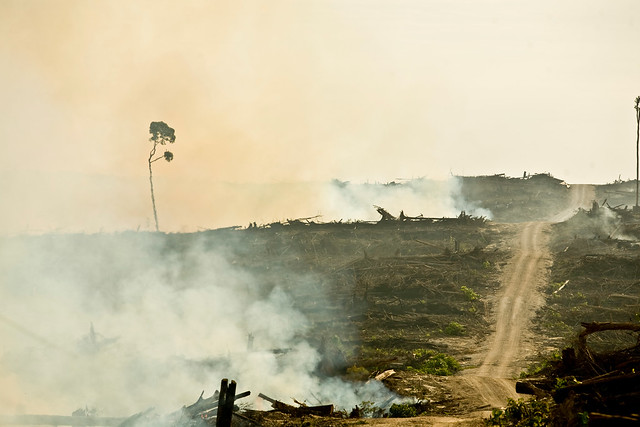
    photo of Indonesia deforestationPhoto by Rainforest Action NetworkFires in Indonesia, which are often set to clear land for palm oil and timber development, are a major contributor to global emissions. Advocates believe conflicting land ownership maps are contributing to the problem by hampering enforcement efforts.

    One Map aims to address what many activists, experts, and private companies see as a central barrier to stopping illegal deforestation and burning in Indonesia: the existence of numerous, conflicting land ownership maps among different levels of government, as well as private sector actors. Conflicting views of ownership make it nearly impossible to hold accountable those igniting blazes across the country. Not to mention that reluctance among some actors to even share their maps with the public leads to gaps in information.

    The One Map initiative aims to rectify these divergent views and fill information gaps in order to provide a foundation for anti-deforestation enforcement efforts across the country. The United States Agency for International Development, the US Forest Service International Programs, and several environmental organizations are contributing to the challenging effort.

    “The Indonesian people have a right to know what is happening on the ground,” said Longgena Ginting, strategy and analysis director with the environmental nonprofit Greenpeace Indonesia, which has been contributing to the One Map initiative, said in a statement. “The government should release the maps it has and name and shame companies that refuse to publish their own maps.”

    However, the task of creating a single, accurate map is much easier said than done. Indonesia suffered through decades of poor land management practices due to rampant corruption and a national development policy that focused on resource-driven economic growth. This led to horrific deforestation, even in so-called protected areas, and countless illegal land grabs from indigenous groups. The national government has yet to implement a 2013 Supreme Court decision blocking government actors from selling indigenous-held land and reaffirming the rights of indigenous peoples to manage the lands on which they live. 

    Environmentalists know the One Map initiative is a complicated one — they have been working on the effort for years. They came close to success in 2010 when then-President Susilo Bambang Yudhoyono's cabinet announced that it would work on releasing One Map. Though the cabinet began the project, six years later there is still no One Map. In the meantime, Indonesia has overtaken Brazil — a country with four times as much forested land — as the world leader in deforestation by total area.

    Ideally, One Map would put an end to these overlapping concessions issues and make it clear on whose land fires are being set. It would empower law enforcement, activists, and land-owners themselves to participate in land management activities by making accessible basic information about land rights and responsibilities.

    “As we don't know who owns the land, we never get anyone held responsible,” Annisa Rahmawati, forests campaigner with Greenpeace Indonesia, said.

    The severity of last year's fires made it clear to many that it was time to stop waiting for the Government to act on the One Map initiative. Earlier this year, Greenpeace Indonesia released its own version of One Map, called Kepo Hutan, which loosely translates to “Curious about Forests.” It is an online, open-source tool that collects forest concession data from various sources — including the Roundtable on Sustainable Palm Oil and companies like Asia Pulp & Paper that have released concession information — and integrates it with satellite data about fires, making it easier to understand where, and on whose land, fires are burning. While it can't be as comprehensive as One Map without access to conflicting Government maps, it is a model that shows the path forward.
    “[We wanted to] set an example for the kind of transparency we expect from the government and companies,” Rahmawati said, adding that the tool is already being used by journalists, local activists, and even businesses to monitor what is happening on the ground throughout Indonesia.
    The nonprofit World Resources Institute (WRI) is taking a different approach, working at the local level and focusing on the Indonesian province at the center of the deforestation fight: Riau. Located on the island of Sumatra, more than 50 percent of Riau’s forest cover has been lost during the last 30 years, mostly due to the rapid growth of oil palm and paper pulp plantations.
    WRI is working to figure out the origins of complex land claim conflicts in the province, and hopes that a bottom-up approach and improved clarity around local land rights will encourage buy-in from all involved parties when it comes to developing solutions. The nonprofit estimates it will take five years to complete the process and release a comprehensive One Map for Riau.
    “The thing is, everyone knows that to synchronize maps, you need to go down to the field,” said Nirarta ‘Koni’ Samadhi, the country director for WRI Indonesia. “You cannot do it by sitting at the national level.”
    “After five years, what we aspire to achieve is not simply the One Map, per se, but a new system of Government delivery that is [participatory],” Samadhi added.
    The many challenges of completing the One Map project are compounded by the urgency of the situation. The map must be accurate in order to be useful, but it must also be done quickly enough to save Indonesia’s precious tropical forests and reduce the country’s emissions. The One Map initiative is ambitious, as it must be, and many agree the sooner it can be done, the better for Indonesians, its haze-breathing neighbors, and the planet.
    Nithin Coca
    Nithin Coca is a freelance journalist who focuses on environment and economic issues in developing countries, and has specific expertise in Southeast Asia. Nithin's feature and news pieces have appeared in global media outlets including Al Jazeera, Quartz, Atlantic Cities, SciDev.Net, Southeast Asia Globe, The Diplomat, and numerous regional publications in Asia and the United States

    For further information log on website :
    http://www.earthisland.org/journal/index.php/elist/eListRead/conflicting_maps_fires_ldeforestation_indonesia
    at December 14, 2016 No comments:
    Email ThisBlogThis!Share to XShare to FacebookShare to Pinterest

    Reframing the Climate Narrative

    BY KARINA GONZALEZ

    After 11 days of sleeping no more than three hours a night during the Paris Climate negotiations last December, I was more exhausted than I’d ever been, mentally, physically, and emotionally. While running between meetings and events and press conferences, I accidentally walked into an event hosted by a tech company. The speaker claimed to have the solution to climate change. This process he explained, “involves using filters, chemical reactions, and other special materials to collect greenhouse gases like carbon dioxide” from the atmosphere.

    photo of a young woman
    The speaker followed the same template the United Nations often uses, viewing greenhouse gases as the only problem. This mindset isolates the direct causes of climate change and does not address the broader systemic problems that allow climate change to exist in the first place. It uses CO2 emissions as the agreed upon value, the number to minimize, and the metric upon which to base policy. It makes decisions by the numbers.
    Doing this creates three problems: The unmeasurable and the qualitative are devalued; the metric applied perpetuates existing biases and power relationships; and it promotes the illusion of predictability and control that obscures the likelihood of unintended consequences.

    This approach sits comfortably in our culture, which tries to solve problems by isolating the direct causes of issues rather than addressing the broader systemic problems that allow these problems to exist in the first place. As the war on crime, the war on drugs, and the war on terror demonstrate, causation is seldom linear. Crime, drugs, and terrorism are symptoms of deeper, systemic disharmony and addressing their direct causes in isolation cannot and will not be successful.

    Climate change is like this too.

    On December 12, 2015, the final day of the Paris Climate talks, I decided not to head to the Le Bourget Conference Center, where the negotiations were taking place, but rather, to attend the D12 climate march in Paris. Thousands of people from all over the world flooded the city streets to demonstrate that no matter what heads of state decided, we would continue organizing for climate justice. At that moment, I felt as if we were finally a big, beautiful, unified movement. 

    I was filled with enormous hope as the much-awaited final agreement draft was released. Surrounded by cameras, police, and chanting marchers, I read through the draft on my smartphone. My feelings of hope quickly turned to despair as I read more and more of the text. Though it mentioned the importance of keeping global warming under 1.5 degrees Celsius, the limited commitments from countries still added up to well over 3 degrees of warming. 

    I spent most of my time in Paris like this: oscillating between excessive hope and deep despair, feeling simultaneously more disempowered and empowered than I’d ever felt in my entire life. 

    The way we’ve dealt with climate change in these international negotiating spaces emphasizes the global over the local, the distant over the immediate, the measurable over the qualitative. This oversight is part of the same mentality that is at the root of the climate crisis to begin with. It is the mentality that sacrifices what is precious, sacred, and immediate for a distant end. It is the mentality of instrumentalism that values other beings and the Earth itself in terms of their utility. It is the hubris of believing we can predict and control the consequences of our actions. 

    Climate change is multifactorial; it cannot be addressed by linear strategies for reducing CO2emissions. I am not arguing that we shouldn’t work to reduce direct emissions, but rather that technological approaches on their own cannot solve the problem. The problem lies in our relationship with each other and the Earth. Climate change is simply a symptom of this relationship.

    This is why I focus my activism on fossil fuel divestment. Never in the 22 years of international climate negotiations has there been a single proposal to limit fossil fuel production. This is a testament to the current narrative around climate change, which sees climate as an issue of regulating and trading greenhouse gases. Divestment aims to reframe the climate narrative as a moral problem. In normal politics, efforts like these – that sacrifice what is sacred for a distant end – are a sad but necessary price of doing business. In a moral crisis, they’re intolerable. 

    Karina Gonzalez is a student leader of Fossil Free North Arizona University, and a 2016 Brower Youth Award Winner.

    For further information log on website :
    http://www.earthisland.org/journal/index.php/eij/article/reframing_the_climate_narrative/
    at December 14, 2016 No comments:
    Email ThisBlogThis!Share to XShare to FacebookShare to Pinterest

    Crop Responses to Nitrogen

    Published Date
    pp 2661-2681

    • Author 
    • Gilles Lemaire 

    Definition

    A prerequisite for the analysis of crop responses to nitrogen (N) is the determination of the plant nitrogen content and repartition. How much N is incorporated within plants and crops? Within which plant tissue? For which physiological function? Thus, according to the answers to these questions, it is possible to determine a critical plant nitrogen status as the minimum plant N concentration that allows the maximum plant (or crop) growth rate. It has been demonstrated that this critical plant N concentration decreases as plant grows as the result of an ontogenetic plant architecture development leading to a dilution of N compounds within increasing proportion of free-N compounds as plant gets bigger. This N dilution process can be formulated through a negative power relationship between plant N concentration and crop mass. This critical N dilution curve allows the discrimination of situations of N deficiency (below the curve) and situa ...
    This is an excerpt from the content

    References

    1. 1.
      Angus JF (2001) Nitrogen demand and supply in Australian agriculture. Aust J Exp Agr 41:277–288CrossRef
    2. 2.
      Eikhout B, Bouwman AF, Zeijts VH (2006) The role of nitrogen in world food production and food sustainability. Agric Ecosyst Environ 116:4–14CrossRef
    3. 3.
      London JG (2005) Nitrogen study fertilizes fears of pollution. Nature 433:791CrossRef
    4. 4.
      Beman JM, Arrigo K, Matson PM (2005) Agricultural runoff fuels large phytoplankton blooms in vulnerable areas of the ocean. Nature 434:211–214CrossRef
    5. 5.
      Ramos C (1996) Effect of agricultural practices on the nitrogen losses in environment. In: Rodriguez-Barrueco C (ed) Fertilizer and environment. Kluwer, Dordrecht, pp 335–361
    6. 6.
      Stulen I, Perez-Soba M, De kok LJ, Van Der Eerden (1998) Impact of gaseous nitrogen deposition on plant functioning. New Phytol 139:61–70CrossRef
    7. 7.
      Cassman KG (2007) Climate change, biofuels, and global food security. Environ Res Lett 2:11–12CrossRef
    8. 8.
      Addiscott TM, Withmore AP, Powlson DS (1991) Farming, fertilizers and nitrate problem. CAB International, Wallingford, p 170
    9. 9.
      Hirel B, Lemaire G (2005) From agronomy and ecophysiology to molecular genetics for improving nitrogen use efficiency in crops. J Crop Imp 15:213–257CrossRef
    10. 10.
      Evans JR (1983) Nitrogen and photosynthesis in the flag leaf of wheat (Triticum aestivum L.). Plant Physiol 72:297–302CrossRef
    11. 11.
      Lawlor DW (1995) Photosynthesis, productivity and environment. J Exp Bot 46:1449–1461CrossRef
    12. 12.
      Lawlor DW, Konturri M, Young AT (1989) Photosynthesis by flag leaves of wheat in relation to protein, ribulose biphosphate carboxylase activity and nitrogen supply. J Exp Bot 40:43–52CrossRef
    13. 13.
      Werger MJA (1991) Leaf nitrogen distribution and whole canopy photosynthetic carbon gain in herbaceous stands. Vegetatio 97:11–20
    14. 14.
      Nakano HM, Mae T (1997) The effects of elevated partial pressure of CO2 on the relationship between photosynthetic capacity and N content in rice leaves. Plant Physiol 115:191–198
    15. 15.
      Makino A, Mae T, Ohira K (1988) Differences between wheat and rice in the enzymic properties of ribulose-1, 5-biphosphate carboxylase/oxygenase and the relationship to photosynthetic gas exchange. Planta 174:30–38CrossRef
    16. 16.
      Theobald JC, Mitchell RAC, Parry MAJ, Lawlor DW (1998) Estimating the excess investment in ribulose-1, 5-bisphophate carboxylase/oxygenase in leaves of spring wheat grown under elevated CO2. Plant Physiol 118:945–955CrossRef
    17. 17.
      Sage RF (1987) The nitrogen use efficiency of C3 and C4 plants. I- Leaf nitrogen, growth, and biomass partitioning in Chenopodium album (L.) and Amaranthus retroflexus (L.). Plant Physiol 84:954–958CrossRef
    18. 18.
      Lawlor DW, Boyle FA, Keys AJ, Kendall AC, Young AT (1988) Nitrate nutrition and temperature effects on wheat: a synthesis of plant growth and nitrogen uptake in relation to metabolic and physiological processes. J Exp Bot 39:329–343CrossRef
    19. 19.
      Millard P (1988) The accumulation and storage of nitrogen by herbaceous plants. Plant Cell Environ 11:1–8CrossRef
    20. 20.
      Avice JC, Ourry A, Lemaire G, Volenec JJ, Boucaud J (1997) Root protein and vegetative storage protein are key organic nutrients for alfalfa shoot regrowth. Crop Sci 37:1187–1193CrossRef
    21. 21.
      Ourry A, McDuff JH, Ougham H (1996) The relationship between mobilisation of N reserves and changes in translatable messages following defoliation in Lolium temulentum L. and Lolium perenne L. J Exp Bot 47:739–747CrossRef
    22. 22.
      Lemaire G, Khaity M, Onillon B, Allirand JM, Chartier M, Gosse G (1992) Dynamics of accumulation and partitioning of N in leaves, stems and roots of lucerne in dense canopy. Ann Bot 70:429–435
    23. 23.
      Grindlay DJC, Sylvester-Bradley R, Scott RK (1995) The relationship between canopy green area and nitrogen in the shoot. In: Lemaire G, Burns IG (eds) Diagnostic procedures for crop N management. INRA Publication, Paris, pp 53–60, INRA-Editions, Collection “Les Colloques”
    24. 24.
      Lemaire G, van Oosterom E, Jeuffroz MH, Gastal F, Massignan A (2008) Crop species present different qualitative types of response to N deficiency during their vegetative growth. Field Crop Res 105:253–265CrossRef
    25. 25.
      McAdam JW, Volenec JJ, Nelson CJ (1989) Effects of nitrogen on mesophyll cell division and epidermal cell elongation in tall fescue leaf blades. Plant Physiol 89:549–556CrossRef
    26. 26.
      Gastal F, Nelson CJ (1994) Nitrogen use within growing leaf blade of tall fescue. Plant Physiol 105:191–197
    27. 27.
      Fricke W, McDonald AJS, Matson-Djos L (1997) Why do leaves and leaf cells of N-limited barley elongate at reduced rates? Planta 202:522–530CrossRef
    28. 28.
      Uhart SA, Andrade FH (1995) Nitrogen deficiency on maize. I- Effects on crop growth, development, dry matter partitioning and kernel set. Crop Sci 35:1376–1383CrossRef
    29. 29.
      Desmotes-Mainard S, Jeuffroy MH, Robin S (1999) Spike dry matter and nitrogen accumulation before anthesis in wheat as affected by nitrogen fertilizer: relationship to kernel per spike. Field Crop Res 64:249–259CrossRef
    30. 30.
      Mae T (1997) Physiological nitrogen efficiency in rice: nitrogen utilization, photosynthesis, and yield potential. In: Ando T (ed) Plant nutrition for sustainable food production and environment. Kluwer, Dordrecht, pp 51–60CrossRef
    31. 31.
      Lemaire G, Avice JC, Kim TH, Ourry A (2005) Development changes in shoot N dynamics of lucerne in relation to leaf growth dynamics as a function of plant density and hierarchical position within the canopy. J Exp Bot 56:935–943CrossRef
    32. 32.
      Lemaire G, Gastal F (2009) Quantifying crop responses to nitrogen deficiency and avenues to improve nitrogen use efficiency. In: Sadras VO, Calderini DF (eds) Crop physiology: applications for genetic improvement and agronomy. Academic/Elsevier, Amsterdam, pp 171–199
    33. 33.
      Greenwood DJ, Lemaire G, Gosse G, Cruz P, Draycott A, Neeteson JJ (1990) Decline in percentage N of C3 and C4 crops with increasing plant mass. Ann Bot 66:425–436
    34. 34.
      Lemaire G, Jeuffroy MH, Gastal F (2008) Diagnostis tool for plant and crop N status in vegetative stage. Theory and practices for crop N management. Eur J Agron 28:614–624CrossRef
    35. 35.
      Lemaire G, Gastal F (1997) N uptake and distribution in plant canopies. In: Lemaire G (ed) Diagnosis on the nitrogen status in crops. Springer, Heidelberg, pp 3–43CrossRef
    36. 36.
      Justes E, Mary B, Meynard JM, Machet JM, Thellier-Huché L (1994) Determination of a critical nitrogen dilution curve for winter wheat crops. Ann Bot 74:397–407CrossRef
    37. 37.
      Lemaire G, van Oosterom E, Sheehy J, Jeuffroy MH, Massignan A, Rossato L (2007) Is crop demand closely related to dry matter accumulation of leaf area expansion during vegetative growth? Field Crop Res 100:91–106CrossRef
    38. 38.
      Gastal F, Lemaire G (2002) N uptake and distribution in crops: an agronomical and ecophysiological perspective. J Exp Bot 53:789–799CrossRef
    39. 39.
      Lemaire G, Salette J (1984) Relation entre dynamique de croissance et dynamique de prélèvement d’azote par un peuplement de graminées fourragères. 1- Etude de l’effet du milieu. Agronomie 4:423–430CrossRef
    40. 40.
      Lemaire G, Salette J (1984) Relation entre dynamique de croissance et dynamique de prélèvement d’azote par un peuplement de graminées fourragères. 2- Etude de la variabilité entre génotypes. Agronomie 4:431–436CrossRef
    41. 41.
      Lemaire G, Cruz P, Gosse G, Chartier M (1985) Etude des relations entre la dynamique de prélèvement d’azote et la dynamique de croissance en matière sèche d’un peuplement de luzerne. Agronomie 5:685–692CrossRef
    42. 42.
      Ney B, Doré T, Sagan M (1997) The nitrogen requirement of major agricultural crops: grain legumes. In: Lemaire G (ed) Diagnosis of the nitrogen status in crops. Springer, Heidelberg, pp 107–117CrossRef
    43. 43.
      Colnenne C, Meynard JM, Reau R, Justes E, Merrien A (1998) Determination of a critical nitrogen dilution curve for winter oilseed rape. Ann Bot 81:311–317CrossRef
    44. 44.
      Sheehy JE, Dionara MJA, Mitchell PL, Peng S, Cassman KG, Lemaire G, Williams RL (1998) Critical concentrations: implications for high-yielding rice (Oryza sativa, L.) cultivars in tropics. Field Crop Res 59:31–41CrossRef
    45. 45.
      Tei F, Benincasa P, Guidici M (2002) Critical nitrogen concentration in processing tomato. Eur J Agron 18:45–56CrossRef
    46. 46.
      Plénet D, Lemaire G (1999) Relationships between dynamics of nitrogen uptake and dry matter accumulation in maize crops. Determination of critical N concentration. Plant Soil 216:65–82CrossRef
    47. 47.
      Plénet D, Cruz P (1997) The nitrogen requirement for major agricultural crops: maize and sorghum. In: Lemaire G (ed) Diagnosis of the nitrogen status in crops. Springer, Heidelberg, pp 93–106CrossRef
    48. 48.
      Duru M, Lemaire G, Cruz P (1997) The nitrogen requirement for major agricultural crops: grasslands. In: Lemaire G (ed) Diagnosis of nitrogen status in crops. Springer, Heidelberg, pp 56–72
    49. 49.
      Hardwick RC (1987) The nitrogen content of plants and the self thinning rule in plant ecology: a test of the core-skin hypothesis. Ann Bot 60:439–446
    50. 50.
      Ismande J, Touraine B (1994) N demand and regulation of nitrate uptake. Plant Physiol 105:3–7
    51. 51.
      Lejay L, Tillard P, Petit M, Olive FD, Filleur S, Daniel-Vedele F, Gojon A (1999) Molecular and functional regulation of two NO3- uptake systems by N and C status of Arabidopsis plants. Plant J 18:509–519CrossRef
    52. 52.
      Forde BG (2002) The role of long-distance signaling in plant response to nitrate and other nutrients. J Exp Bot 53:39–43CrossRef
    53. 53.
      Glass ADM, Britto DT, Kaiser BN, Kinghorn JR, Kronzucker HJ, Kumar A, Okamoto M, Rwat S, Siddiqi MY, Unkless SE, Vidmar J (2002) The regulation of nitrate and ammonium transport systems in plants. J Exp Bot 53:855–864CrossRef
    54. 54.
      Devienne-Barret F, Justes E, Machet JM, mary B (2000) Integrated control of nitrate uptake by crop growth rate and soil nitrate availability under field conditions. Ann Bot 86:995–1005CrossRef
    55. 55.
      Lemaire G, Meynard JM (1997) Use of the nitrogen nutrition index for the analysis of agronomical data. In: Lemaire G (ed) Diagnosis of the nitrogen status in crops. Springer, Heidelberg, pp 45–56CrossRef
    56. 56.
      Angus JF, Moncur MW (1985) Models of growth and development of wheat in relation to plant nitrogen. Aust J Agr Res 36:537–544CrossRef
    57. 57.
      Jeuffroy MH, Bouchard C (1999) Intensity and duration of nitrogen deficiency on wheat grain number. Crop Sci 39:1385–1393CrossRef
    58. 58.
      Lemaire G, Plénet D, Grindlay D (1997) Leaf N content as an indicator of crop N nutrition. In: Lemaire G (ed) Diagnosis on the nitrogen status in crops. Springer, Heidelberg, pp 189–199CrossRef
    59. 59.
      Farrugia A, Gastal F, Scholefield D (2004) Assessement of nitrogen status of grasslands. Grass Forage Sci 59:113–120CrossRef
    60. 60.
      Ziadi N, Bélanger G, Gastal F, Claesses A, lemaire G, Tremblay N (2009) Leaf nitrogen concentration as an indicator of corn nitrogen status. Agron J 101:947–957CrossRef
    61. 61.
      Alam MM, Ladha JK, Rahman Khan S, Harun-Ur-Rashid Khan AH, Buresh RJ (2005) Leaf color chart for managing nitrogen fertilizer in lowland rice in Bangladesh. Agron J 97:949–959CrossRef
    62. 62.
      Peng S, Garcia FV, Laza RC, Sanico AL, Visperas RM, Cassman KG (1996) Increased N-use efficiency using a chlorophyll meter on high-yielding irrigated rice. Field Crops Res 47:243–252CrossRef
    63. 63.
      Feibo W, Lianghuan W, Fuha X (1998) Chlorophyll meter to predict nitrogen side dress requirements for short-season cotton. Field Crop Res 56:309–314CrossRef
    64. 64.
      Le Bail M, Jeuffroy MH, Bouchard C, Barbotin A (2005) Is it possible to forecast the grain quality and yield of different varieties of winter wheat from minolta SPAD meter measurements? Eur J Agron 23:379–391CrossRef
    65. 65.
      Houlès V, Guérif M, Mary B (2007) Elaboration of a nutrition indicator for winter wheat blades on leaf area index and chlorophyll meter content for making nitrogen recommendations. Eur J Agron 27:1–11CrossRef
    66. 66.
      Monteith JL (1972) Solar radiation and productivity in tropical ecosystems. J Appl Ecol 9:747–766CrossRef
    67. 67.
      Bélanger G, Gastal F, Lemaire G (1992) Growth analysis of a tall fescue sward fertilized with different rates of nitrogen. Crop Sci 6:1371–1376CrossRef
    68. 68.
      Trapani N, Hall AJ (1996) Effects of leaf position and nitrogen supply on the expansion of leaves of field-grown sunflower. Plant Soil 184:331–340CrossRef
    69. 69.
      Muchow RC, Davis R (1998) Effect of nitrogen supply on the comparative productivity of maize and sorghum in a semi-arid tropical environment. II- radiation interception and biomass accumulation. Field Crop Res 18:17–30CrossRef
    70. 70.
      Bélanger G, Gastal F, Warembourg F (1994) Carbon balance on tall fescue: effects of nitrogen and growing season. Ann Bot 74:653–659CrossRef
    71. 71.
      Robson MJ, Parsons AJ (1978) Nitrogen deficiency in small closed communities of S24 ryegrass. I-Photosynthesis, respiration, dry matter production and partition. Ann Bot 42:1185–1197
    72. 72.
      Jarvis SC, McDuff JH (1989) Nitrate nutrition of grasses from steady state supplies in flowing solution culture following nitrate deprivation and/or defoliation. J Exp Bot 40:695–975CrossRef
    73. 73.
      Gastal F, Bélanger G, Lemaire G (1992) A model of the leaf extension rate of tall fescue in response to nitrogen and temperature. Ann Bot 70:437–442
    74. 74.
      Sinclair TR, Horie T (1989) Leaf nitrogen, photosynthesis, and crop radiation use efficiency: a review. Crop Sci 29:90–98CrossRef
    75. 75.
      Grindlay DJC (1997) Towards an explanation of crop nitrogen demand based on leaf nitrogen per unit leaf area. J Sci Food Agric 63:116–123
    76. 76.
      Van Keulen H, Goudrian J, Seligman NG (1989) Modelling the effects of nitrogen on canopy development and crop growth. In: Rusell G, Marshall LB, Jarvis PG (eds) Plant canopies: their growth, form and function. Cambridge University Press, Cambridge, pp 83–104CrossRef
    77. 77.
      Gastal F, Bélanger G (1993) The effects of nitrogen fertilization and the growing season on photosynthesis of fied-grown tall fescue canopies. Ann Bot 72:401–408CrossRef
    78. 78.
      Connor DJ, Hall AJ, Sadras VO (1993) Effects of nitrogen content on the photosynthetic characteristics of sunflower crops during grain filling. Aust J Plant Physiol 20:251–263CrossRef
    79. 79.
      Fischer RA (1993) Irrigated spring wheat and timing and amount of nitrogen fertilizer. II-Physiology of grain yield response. Field Crop Res 33:57–80CrossRef
    80. 80.
      Martre P, Porter JR, Jamieson PD, Triboï E (2003) Modelling grain nitrogen accumulation and protein composition to understand the sink/source regulations of nitrogen utilization in wheat. Plant Physiol 133:1959–1967CrossRef
    81. 81.
      Desmotes-Mainard S, Jeuffroy MH (2004) Effects of nitrogen and radiation on dry matter and nitrogen accumulation in spike of winter wheat. Field Crop Res 87:221–233CrossRef
    82. 82.
      Dreccer MF (2005) Nitrogen use at the leaf and canopy level: a framework to improve N use efficiency. J Crop Imp 15:97–125CrossRef
    83. 83.
      Borell A, Hammer GL (2000) Nitrogen dynamics and the physiological basis for stay-green in sorghum. Crop Sci 40:1295–1307CrossRef
    84. 84.
      Mi C, Liu J, Chen F, Zhang F, Cui Z, Liu X (2003) Nitrogen uptake and remobilization in maize hybrids differing in leaf senescence. J Plant Nutr 26:447–459CrossRef
    85. 85.
      Moll RH, Kamprath EJ, Jackson WA (1982) Analysis and interpretation of factors which contribute to efficiency of nitrogen utilization. Agron J 74:562–564CrossRef
    86. 86.
      Borell A, Garside AL, Fukaï S, Reid DJ (1998) Season nitrogen rate and plant type affect nitrogen uptake and nitrogen use efficiency in rice. Aust J Agr Res 49:829–843CrossRef
    87. 87.
      Le Gouis J, Béghin D, Heumez E, Pluchard P (2000) Genetic differences for nitrogen uptake and nitrogen utilization efficiencies in winter wheat. Eur J Agron 12:163–173CrossRef
    88. 88.
      Bertin P, Gallais A (2001) Physiological and genetic basis of nitrogen use efficiency on maize. Maydica 46:53–68
    89. 89.
      Lemaire G, Charrier X, Hébert Y (1996) Nitrogen uptake capacities of maize and sorghum crops in different nitrogen and water supply conditions. Agronomie 16:231–246CrossRef
    90. 90.
      Lemaire G, Recous S, Mary B (2004) Managing residues and nitrogen in intensive cropping systems. New understandings for efficient recovery by crops. In: Proceedings of the 4th international crop science congress, Brisbane, Australia, 2004
    91. 91.
      Laperche A, Devienne-Barret F, Maury O, Le Gouis J, Ney B (2007) A simplified conceptual model of carbon and nitrogen functioning for QTL analysis of winter wheat adaptation to nitrogen deficiency. Theor Appl Genet 113:1131–1146CrossRef
    92. 92.
      Camus-Kulandaivelu L, Veyreiras JB, Madur D, Combes V, Fourman M, Barraud S, Dubreuil P, Gouesnard B, Manicacci D, Charcosset A (2006) Maize adaptation to temperate climate: relationship between population structure and polymorphism in the Dwarf 8 gene. Genetics 172:2449–2463CrossRef
    93. 93.
      Singh U, Ladha JK, Castillo EG, Punzalan G, Tirol-Padre A, Duqueza M (1998) Genotypic variation in nitrogen use efficiency. I-medium and long-duration rice. Field Crop Res 58:35–53CrossRef
    94. 94.
      Sadras VO (2006) The N:P stoichiometry of cereal, grain legume and oilseed crops. Field Crop Res 95:13–29CrossRef
    1. Gastal F, Lemaire G (2002) N uptake and distribution in crops: an agronomical and ecophysiological perspective. J Exp Bot 53:789–799CrossRef
    2. Grindlay DJC (1997) Towards an explanation of crop nitrogen demand based on leaf nitrogen per unit leaf area. J Sci Food Agric 63:116–123
    3. Hirel B, Lemaire G (2005) From agronomy and ecophysiology to molecular genetics for improving nitrogen use efficiency in crops. J Crop Imp 15:213–257CrossRef
    4. Justes E, Mary B, Meynard JM, Machet JM, Thellier-Huché L (1994) Determination of a critical nitrogen dilution curve for winter wheat crops. Ann Bot 74:397–407CrossRef
    5. Lemaire G, Gastal F (1997) N uptake and distribution in plant canopies. In: Lemaire G (ed) Diagnosis on the nitrogen status in crops. Springer, Heidelberg, pp 3–43CrossRef
    6. Lemaire G, Gastal F (2009) Quantifying crop responses to nitrogen deficiency and avenues to improve nitrogen use efficiency
    7. Lemaire G, Jeuffroy MH, Gastal F (2008) Diagnostis tool for plant and crop N status in vegetative stage. Theory and practices for crop N management. Eur J Agron 28:614–624CrossRef
    8. Lemaire G, Recous S, Mary B (2004) Managing residues and nitrogen in intensive cropping systems. New understandings for efficient recovery by crops. In: Proceedings of the 4th international crop science congress, Brisbane, Australia, 2004
    9. Lemaire G, van Oosterom E, Jeuffroz MH, Gastal F, Massignan A (2008) Crop species present different qualitative types of response to N deficiency during their vegetative growth. Field Crop Res 105:253–265CrossRef
    10. Lemaire G, van Oosterom E, Sheehy J, Jeuffroy MH, Massignan A, Rossato L (2007) Is crop demand closely related to dry matter accumulation of leaf area expansion during vegetative growth? Field Crop Res 100:91–106CrossRef
    11. Sinclair TR, Horie T (1989) Leaf nitrogen, photosynthesis, and crop radiation use efficiency: a review. Crop Sci 29:90–98CrossRef
    12. Sinclair TR (1998) Historical changes in harvest index crop N accumulation. Crop Sci 38:638–643CrossRef
    13. Van Keulen H, Goudrian J, Seligman NG (1989) Modelling the effects of nitrogen on canopy development and crop growth. In: Rusell G, Marshall LB, Jarvis PG (eds) Plant canopies: their growth, form and function. Cambridge University Press, Cambridge, pp 83–104CrossRef

    For further details log on website :
    http://link.springer.com/referenceworkentry/10.1007/978-1-4419-0851-3_385
    at December 14, 2016 No comments:
    Email ThisBlogThis!Share to XShare to FacebookShare to Pinterest
    Newer Posts Older Posts Home
    Subscribe to: Posts (Atom)

    Advantages and Disadvantages of Fasting for Runners

    Author BY   ANDREA CESPEDES  Food is fuel, especially for serious runners who need a lot of energy. It may seem counterintuiti...

    • Pengalaman bekerja sebagai kerani kilang.
      Assalamualaikum dan salam sejahtera chu olls.     Alhamdulillah sudah seminggu saya melalui pengalaman bermakna ini. Sebagai seorang pel...
    • MIDA- INDUSTRI BERASASKAN KAYU
      Industri berasaskan kayu di Malaysia terdiri daripada  Kayu bergergaji; Venir dan produk panel yang termasuk papan lapis dan produk ...
    • Advantages and Disadvantages of Fasting for Runners
      Author BY   ANDREA CESPEDES  Food is fuel, especially for serious runners who need a lot of energy. It may seem counterintuiti...
    • UKIRAN KAYU DALAM MASYARAKAT MELAYU
      Seni ukiran kayu di kalangan masyarakat Melayu bukan sahaja terdapat pada rumah-rumah tetapi penjelmaan dan penerapannya terdapat pada is...
    • Laboratory Assessment of Forest Soil Respiration Affected by Wildfires under Various Environments of Russia
      International Journal of Ecology Volume 2017 (2017), Article ID 3985631, 10 pages https://doi.org/10.1155/2017/3985631 Author Evgeny  ...
    • Diploma Teknologi Berasaskan Kayu
      LATARBELAKANG POLITEKNIK KOTA KINABALU Politeknik Kota Kinabalu merupakan politeknik yang ketujuh ditubuhkan oleh Kementerian Pendidikan...
    • DIPLOMA REKA BENTUK PERABUT
      Sijil Teknologi Diploma Rekabentuk Perabot Kod Kursus :  K18 ...
    • Motif, Corak dan Ragi Tenun Melayu Riau
      Author MELAYU Riau kaya dengan khazanah budayanya. Antaranya yang amat menonjol adalah motif ornamen Melayunya, yang banyak dipakai untuk ...
    • RUBBER AND PVC FETISHISM
      Rubber fetishism , or  latex fetishism , is the fetishistic attraction to people wearing latex clothing or, in certain cases, to the garme...
    • 5 Jenama Foundation Terbaik, Beli Di Farmasi Je!
      Beberapa minggu sudah, penulis pernah mencadangkan beberapa jenama maskara terbaik yang mudah didapati pada harga berpatutan dari farmas...

    nuffnang ads

    Search This Blog

    Pages

    • Home

    About Me

    Unknown
    View my complete profile

    Blog Archive

    • ▼  2018 (371)
      • ▼  June (17)
        • ▼  Jun 22 (8)
          • Advantages and Disadvantages of Fasting for Runners
          • Refeeding Syndrome After Fasting
          • The Body's Reactions to Fasting
          • What Does Fasting Do to Your System?
          • Heartburn & Fat After Fasting
          • Urban forest research in the Mediterranean: A syst...
          • Assessment of ecotourism potential of urban forest...
          • THE POTENTIAL OF URBAN FOREST PARK FOR SUSTAINABLE...
        • ►  Jun 12 (1)
        • ►  Jun 11 (2)
        • ►  Jun 05 (6)
      • ►  May (6)
        • ►  May 31 (6)
      • ►  April (75)
        • ►  Apr 30 (1)
        • ►  Apr 27 (1)
        • ►  Apr 26 (15)
        • ►  Apr 25 (10)
        • ►  Apr 24 (11)
        • ►  Apr 18 (2)
        • ►  Apr 12 (4)
        • ►  Apr 10 (5)
        • ►  Apr 09 (9)
        • ►  Apr 05 (17)
      • ►  March (65)
        • ►  Mar 27 (7)
        • ►  Mar 22 (2)
        • ►  Mar 20 (4)
        • ►  Mar 13 (14)
        • ►  Mar 12 (11)
        • ►  Mar 08 (7)
        • ►  Mar 06 (1)
        • ►  Mar 05 (1)
        • ►  Mar 01 (18)
      • ►  February (103)
        • ►  Feb 28 (25)
        • ►  Feb 27 (27)
        • ►  Feb 26 (10)
        • ►  Feb 20 (1)
        • ►  Feb 19 (9)
        • ►  Feb 09 (13)
        • ►  Feb 06 (6)
        • ►  Feb 05 (5)
        • ►  Feb 02 (7)
      • ►  January (105)
        • ►  Jan 25 (11)
        • ►  Jan 23 (5)
        • ►  Jan 16 (6)
        • ►  Jan 15 (9)
        • ►  Jan 14 (7)
        • ►  Jan 10 (1)
        • ►  Jan 09 (2)
        • ►  Jan 08 (4)
        • ►  Jan 04 (24)
        • ►  Jan 03 (2)
        • ►  Jan 02 (21)
        • ►  Jan 01 (13)
    • ►  2017 (6160)
      • ►  December (11)
        • ►  Dec 30 (11)
      • ►  November (31)
        • ►  Nov 26 (9)
        • ►  Nov 07 (8)
        • ►  Nov 06 (3)
        • ►  Nov 01 (11)
      • ►  October (345)
        • ►  Oct 31 (4)
        • ►  Oct 25 (42)
        • ►  Oct 24 (5)
        • ►  Oct 23 (15)
        • ►  Oct 22 (3)
        • ►  Oct 18 (7)
        • ►  Oct 17 (27)
        • ►  Oct 16 (14)
        • ►  Oct 15 (6)
        • ►  Oct 13 (18)
        • ►  Oct 12 (44)
        • ►  Oct 11 (57)
        • ►  Oct 09 (47)
        • ►  Oct 06 (14)
        • ►  Oct 05 (1)
        • ►  Oct 04 (13)
        • ►  Oct 03 (17)
        • ►  Oct 02 (11)
      • ►  September (186)
        • ►  Sept 29 (3)
        • ►  Sept 26 (7)
        • ►  Sept 25 (18)
        • ►  Sept 21 (29)
        • ►  Sept 20 (10)
        • ►  Sept 19 (11)
        • ►  Sept 18 (2)
        • ►  Sept 14 (19)
        • ►  Sept 13 (28)
        • ►  Sept 11 (3)
        • ►  Sept 10 (15)
        • ►  Sept 08 (5)
        • ►  Sept 06 (22)
        • ►  Sept 05 (14)
      • ►  August (158)
        • ►  Aug 29 (10)
        • ►  Aug 28 (73)
        • ►  Aug 27 (2)
        • ►  Aug 21 (4)
        • ►  Aug 18 (17)
        • ►  Aug 17 (4)
        • ►  Aug 14 (13)
        • ►  Aug 11 (5)
        • ►  Aug 10 (4)
        • ►  Aug 09 (7)
        • ►  Aug 08 (1)
        • ►  Aug 06 (3)
        • ►  Aug 04 (2)
        • ►  Aug 03 (13)
      • ►  July (290)
        • ►  Jul 26 (9)
        • ►  Jul 25 (7)
        • ►  Jul 24 (25)
        • ►  Jul 23 (5)
        • ►  Jul 21 (13)
        • ►  Jul 18 (19)
        • ►  Jul 17 (18)
        • ►  Jul 14 (17)
        • ►  Jul 13 (75)
        • ►  Jul 12 (10)
        • ►  Jul 11 (64)
        • ►  Jul 10 (26)
        • ►  Jul 09 (2)
      • ►  June (522)
        • ►  Jun 30 (1)
        • ►  Jun 27 (3)
        • ►  Jun 22 (13)
        • ►  Jun 21 (41)
        • ►  Jun 20 (3)
        • ►  Jun 19 (68)
        • ►  Jun 16 (33)
        • ►  Jun 15 (87)
        • ►  Jun 13 (25)
        • ►  Jun 12 (26)
        • ►  Jun 09 (20)
        • ►  Jun 08 (60)
        • ►  Jun 07 (54)
        • ►  Jun 06 (53)
        • ►  Jun 05 (35)
      • ►  May (684)
        • ►  May 31 (6)
        • ►  May 22 (3)
        • ►  May 21 (14)
        • ►  May 20 (12)
        • ►  May 19 (3)
        • ►  May 18 (26)
        • ►  May 17 (63)
        • ►  May 16 (27)
        • ►  May 15 (25)
        • ►  May 14 (16)
        • ►  May 07 (9)
        • ►  May 06 (26)
        • ►  May 05 (74)
        • ►  May 04 (126)
        • ►  May 03 (51)
        • ►  May 02 (153)
        • ►  May 01 (50)
      • ►  April (759)
        • ►  Apr 29 (56)
        • ►  Apr 28 (37)
        • ►  Apr 27 (67)
        • ►  Apr 26 (87)
        • ►  Apr 25 (6)
        • ►  Apr 10 (4)
        • ►  Apr 09 (5)
        • ►  Apr 08 (78)
        • ►  Apr 07 (57)
        • ►  Apr 06 (52)
        • ►  Apr 05 (53)
        • ►  Apr 04 (43)
        • ►  Apr 03 (94)
        • ►  Apr 02 (28)
        • ►  Apr 01 (92)
      • ►  March (1744)
        • ►  Mar 31 (90)
        • ►  Mar 30 (74)
        • ►  Mar 29 (58)
        • ►  Mar 28 (50)
        • ►  Mar 27 (95)
        • ►  Mar 26 (58)
        • ►  Mar 25 (98)
        • ►  Mar 24 (94)
        • ►  Mar 23 (77)
        • ►  Mar 22 (43)
        • ►  Mar 21 (54)
        • ►  Mar 20 (43)
        • ►  Mar 19 (88)
        • ►  Mar 18 (65)
        • ►  Mar 17 (63)
        • ►  Mar 16 (94)
        • ►  Mar 15 (79)
        • ►  Mar 14 (35)
        • ►  Mar 11 (10)
        • ►  Mar 10 (43)
        • ►  Mar 09 (40)
        • ►  Mar 08 (27)
        • ►  Mar 07 (40)
        • ►  Mar 06 (62)
        • ►  Mar 05 (48)
        • ►  Mar 04 (63)
        • ►  Mar 03 (54)
        • ►  Mar 02 (13)
        • ►  Mar 01 (86)
      • ►  February (715)
        • ►  Feb 28 (10)
        • ►  Feb 27 (61)
        • ►  Feb 26 (31)
        • ►  Feb 24 (22)
        • ►  Feb 23 (31)
        • ►  Feb 22 (42)
        • ►  Feb 21 (30)
        • ►  Feb 20 (42)
        • ►  Feb 19 (43)
        • ►  Feb 18 (46)
        • ►  Feb 17 (39)
        • ►  Feb 16 (39)
        • ►  Feb 15 (24)
        • ►  Feb 14 (54)
        • ►  Feb 13 (25)
        • ►  Feb 12 (78)
        • ►  Feb 10 (53)
        • ►  Feb 09 (22)
        • ►  Feb 01 (23)
      • ►  January (715)
        • ►  Jan 30 (25)
        • ►  Jan 28 (19)
        • ►  Jan 27 (36)
        • ►  Jan 26 (27)
        • ►  Jan 24 (27)
        • ►  Jan 22 (22)
        • ►  Jan 21 (58)
        • ►  Jan 20 (20)
        • ►  Jan 19 (30)
        • ►  Jan 18 (39)
        • ►  Jan 17 (26)
        • ►  Jan 16 (36)
        • ►  Jan 15 (62)
        • ►  Jan 14 (22)
        • ►  Jan 13 (20)
        • ►  Jan 12 (33)
        • ►  Jan 11 (32)
        • ►  Jan 10 (26)
        • ►  Jan 05 (11)
        • ►  Jan 04 (22)
        • ►  Jan 03 (35)
        • ►  Jan 02 (34)
        • ►  Jan 01 (53)
    • ►  2016 (6885)
      • ►  December (986)
        • ►  Dec 31 (12)
        • ►  Dec 30 (23)
        • ►  Dec 29 (15)
        • ►  Dec 28 (29)
        • ►  Dec 27 (32)
        • ►  Dec 26 (29)
        • ►  Dec 25 (39)
        • ►  Dec 24 (43)
        • ►  Dec 23 (29)
        • ►  Dec 22 (28)
        • ►  Dec 21 (46)
        • ►  Dec 20 (28)
        • ►  Dec 19 (36)
        • ►  Dec 18 (14)
        • ►  Dec 17 (24)
        • ►  Dec 16 (10)
        • ►  Dec 15 (43)
        • ►  Dec 14 (55)
        • ►  Dec 13 (38)
        • ►  Dec 12 (45)
        • ►  Dec 11 (26)
        • ►  Dec 10 (48)
        • ►  Dec 09 (34)
        • ►  Dec 08 (22)
        • ►  Dec 07 (29)
        • ►  Dec 06 (15)
        • ►  Dec 05 (45)
        • ►  Dec 04 (38)
        • ►  Dec 03 (41)
        • ►  Dec 02 (41)
        • ►  Dec 01 (29)
      • ►  November (600)
        • ►  Nov 30 (38)
        • ►  Nov 29 (36)
        • ►  Nov 28 (43)
        • ►  Nov 27 (22)
        • ►  Nov 26 (27)
        • ►  Nov 25 (39)
        • ►  Nov 24 (27)
        • ►  Nov 23 (37)
        • ►  Nov 22 (21)
        • ►  Nov 21 (32)
        • ►  Nov 20 (20)
        • ►  Nov 19 (31)
        • ►  Nov 18 (34)
        • ►  Nov 17 (29)
        • ►  Nov 16 (21)
        • ►  Nov 15 (33)
        • ►  Nov 14 (16)
        • ►  Nov 13 (3)
        • ►  Nov 12 (3)
        • ►  Nov 11 (1)
        • ►  Nov 09 (2)
        • ►  Nov 07 (14)
        • ►  Nov 04 (16)
        • ►  Nov 03 (17)
        • ►  Nov 02 (23)
        • ►  Nov 01 (15)
      • ►  October (374)
        • ►  Oct 31 (15)
        • ►  Oct 30 (2)
        • ►  Oct 29 (4)
        • ►  Oct 28 (25)
        • ►  Oct 27 (19)
        • ►  Oct 26 (16)
        • ►  Oct 25 (11)
        • ►  Oct 24 (14)
        • ►  Oct 23 (12)
        • ►  Oct 21 (14)
        • ►  Oct 20 (19)
        • ►  Oct 19 (21)
        • ►  Oct 18 (17)
        • ►  Oct 17 (15)
        • ►  Oct 16 (20)
        • ►  Oct 15 (12)
        • ►  Oct 14 (11)
        • ►  Oct 13 (21)
        • ►  Oct 12 (13)
        • ►  Oct 11 (6)
        • ►  Oct 10 (12)
        • ►  Oct 09 (17)
        • ►  Oct 08 (10)
        • ►  Oct 07 (11)
        • ►  Oct 06 (19)
        • ►  Oct 05 (13)
        • ►  Oct 03 (5)
      • ►  September (406)
        • ►  Sept 29 (6)
        • ►  Sept 28 (2)
        • ►  Sept 27 (12)
        • ►  Sept 16 (20)
        • ►  Sept 15 (34)
        • ►  Sept 14 (39)
        • ►  Sept 13 (32)
        • ►  Sept 12 (36)
        • ►  Sept 11 (18)
        • ►  Sept 10 (16)
        • ►  Sept 07 (6)
        • ►  Sept 06 (26)
        • ►  Sept 05 (14)
        • ►  Sept 04 (44)
        • ►  Sept 03 (17)
        • ►  Sept 02 (38)
        • ►  Sept 01 (46)
      • ►  August (777)
        • ►  Aug 31 (13)
        • ►  Aug 29 (22)
        • ►  Aug 28 (13)
        • ►  Aug 27 (26)
        • ►  Aug 26 (18)
        • ►  Aug 25 (14)
        • ►  Aug 24 (13)
        • ►  Aug 23 (22)
        • ►  Aug 22 (23)
        • ►  Aug 21 (20)
        • ►  Aug 20 (23)
        • ►  Aug 19 (13)
        • ►  Aug 18 (31)
        • ►  Aug 17 (36)
        • ►  Aug 16 (17)
        • ►  Aug 15 (33)
        • ►  Aug 14 (24)
        • ►  Aug 13 (28)
        • ►  Aug 12 (28)
        • ►  Aug 11 (28)
        • ►  Aug 10 (59)
        • ►  Aug 09 (33)
        • ►  Aug 08 (39)
        • ►  Aug 07 (23)
        • ►  Aug 06 (36)
        • ►  Aug 05 (23)
        • ►  Aug 04 (25)
        • ►  Aug 03 (17)
        • ►  Aug 02 (26)
        • ►  Aug 01 (51)
      • ►  July (890)
        • ►  Jul 31 (27)
        • ►  Jul 30 (31)
        • ►  Jul 29 (29)
        • ►  Jul 28 (40)
        • ►  Jul 27 (32)
        • ►  Jul 26 (16)
        • ►  Jul 25 (5)
        • ►  Jul 24 (45)
        • ►  Jul 23 (16)
        • ►  Jul 22 (42)
        • ►  Jul 21 (11)
        • ►  Jul 20 (41)
        • ►  Jul 19 (31)
        • ►  Jul 18 (35)
        • ►  Jul 17 (41)
        • ►  Jul 16 (21)
        • ►  Jul 15 (23)
        • ►  Jul 14 (38)
        • ►  Jul 13 (49)
        • ►  Jul 12 (42)
        • ►  Jul 11 (25)
        • ►  Jul 10 (48)
        • ►  Jul 09 (33)
        • ►  Jul 08 (38)
        • ►  Jul 07 (19)
        • ►  Jul 06 (10)
        • ►  Jul 05 (14)
        • ►  Jul 04 (13)
        • ►  Jul 03 (20)
        • ►  Jul 02 (26)
        • ►  Jul 01 (29)
      • ►  June (1003)
        • ►  Jun 30 (29)
        • ►  Jun 29 (43)
        • ►  Jun 28 (27)
        • ►  Jun 27 (33)
        • ►  Jun 26 (49)
        • ►  Jun 25 (30)
        • ►  Jun 24 (32)
        • ►  Jun 23 (42)
        • ►  Jun 22 (38)
        • ►  Jun 21 (20)
        • ►  Jun 20 (30)
        • ►  Jun 19 (37)
        • ►  Jun 18 (15)
        • ►  Jun 17 (12)
        • ►  Jun 16 (52)
        • ►  Jun 15 (59)
        • ►  Jun 14 (49)
        • ►  Jun 13 (38)
        • ►  Jun 12 (39)
        • ►  Jun 11 (44)
        • ►  Jun 10 (22)
        • ►  Jun 09 (34)
        • ►  Jun 08 (39)
        • ►  Jun 07 (28)
        • ►  Jun 06 (38)
        • ►  Jun 05 (19)
        • ►  Jun 04 (20)
        • ►  Jun 03 (27)
        • ►  Jun 02 (27)
        • ►  Jun 01 (31)
      • ►  May (648)
        • ►  May 31 (32)
        • ►  May 30 (48)
        • ►  May 29 (46)
        • ►  May 28 (43)
        • ►  May 27 (19)
        • ►  May 26 (37)
        • ►  May 25 (29)
        • ►  May 24 (22)
        • ►  May 23 (23)
        • ►  May 22 (18)
        • ►  May 21 (18)
        • ►  May 20 (22)
        • ►  May 19 (28)
        • ►  May 18 (12)
        • ►  May 17 (24)
        • ►  May 16 (9)
        • ►  May 15 (18)
        • ►  May 14 (13)
        • ►  May 13 (16)
        • ►  May 12 (6)
        • ►  May 11 (15)
        • ►  May 10 (15)
        • ►  May 09 (25)
        • ►  May 08 (14)
        • ►  May 07 (15)
        • ►  May 06 (10)
        • ►  May 04 (21)
        • ►  May 03 (22)
        • ►  May 02 (9)
        • ►  May 01 (19)
      • ►  April (490)
        • ►  Apr 30 (7)
        • ►  Apr 29 (21)
        • ►  Apr 28 (19)
        • ►  Apr 27 (15)
        • ►  Apr 26 (12)
        • ►  Apr 25 (19)
        • ►  Apr 24 (13)
        • ►  Apr 23 (24)
        • ►  Apr 22 (24)
        • ►  Apr 21 (22)
        • ►  Apr 20 (19)
        • ►  Apr 19 (46)
        • ►  Apr 18 (24)
        • ►  Apr 17 (15)
        • ►  Apr 16 (19)
        • ►  Apr 15 (8)
        • ►  Apr 14 (19)
        • ►  Apr 13 (22)
        • ►  Apr 12 (18)
        • ►  Apr 11 (11)
        • ►  Apr 10 (13)
        • ►  Apr 09 (12)
        • ►  Apr 08 (12)
        • ►  Apr 07 (15)
        • ►  Apr 06 (16)
        • ►  Apr 05 (10)
        • ►  Apr 04 (8)
        • ►  Apr 03 (15)
        • ►  Apr 01 (12)
      • ►  March (445)
        • ►  Mar 31 (7)
        • ►  Mar 30 (10)
        • ►  Mar 29 (17)
        • ►  Mar 28 (15)
        • ►  Mar 27 (8)
        • ►  Mar 26 (11)
        • ►  Mar 25 (10)
        • ►  Mar 24 (9)
        • ►  Mar 23 (13)
        • ►  Mar 22 (9)
        • ►  Mar 21 (13)
        • ►  Mar 20 (9)
        • ►  Mar 19 (15)
        • ►  Mar 18 (14)
        • ►  Mar 17 (11)
        • ►  Mar 16 (15)
        • ►  Mar 15 (23)
        • ►  Mar 14 (26)
        • ►  Mar 13 (20)
        • ►  Mar 12 (14)
        • ►  Mar 11 (18)
        • ►  Mar 10 (27)
        • ►  Mar 09 (18)
        • ►  Mar 08 (25)
        • ►  Mar 07 (11)
        • ►  Mar 06 (15)
        • ►  Mar 05 (18)
        • ►  Mar 04 (9)
        • ►  Mar 03 (14)
        • ►  Mar 02 (7)
        • ►  Mar 01 (14)
      • ►  February (258)
        • ►  Feb 29 (22)
        • ►  Feb 28 (14)
        • ►  Feb 27 (12)
        • ►  Feb 26 (4)
        • ►  Feb 25 (17)
        • ►  Feb 24 (16)
        • ►  Feb 23 (16)
        • ►  Feb 22 (8)
        • ►  Feb 21 (23)
        • ►  Feb 20 (6)
        • ►  Feb 19 (5)
        • ►  Feb 18 (3)
        • ►  Feb 17 (9)
        • ►  Feb 16 (17)
        • ►  Feb 15 (20)
        • ►  Feb 14 (10)
        • ►  Feb 13 (17)
        • ►  Feb 11 (3)
        • ►  Feb 10 (1)
        • ►  Feb 08 (2)
        • ►  Feb 07 (5)
        • ►  Feb 05 (2)
        • ►  Feb 04 (10)
        • ►  Feb 03 (7)
        • ►  Feb 02 (1)
        • ►  Feb 01 (8)
      • ►  January (8)
        • ►  Jan 30 (4)
        • ►  Jan 10 (4)
    • ►  2013 (23)
      • ►  February (18)
        • ►  Feb 07 (1)
        • ►  Feb 06 (2)
        • ►  Feb 05 (8)
        • ►  Feb 04 (5)
        • ►  Feb 02 (1)
        • ►  Feb 01 (1)
      • ►  January (5)
        • ►  Jan 31 (4)
        • ►  Jan 30 (1)

    Report Abuse

    Follower

    Translate

    Total Pageviews

    nuffnang ads

    Nuffnang Ads

    nuffnang ads

    Nuffnang Ads

    Picture Window theme. Theme images by sndrk. Powered by Blogger.