Blog List

Friday, 4 August 2017

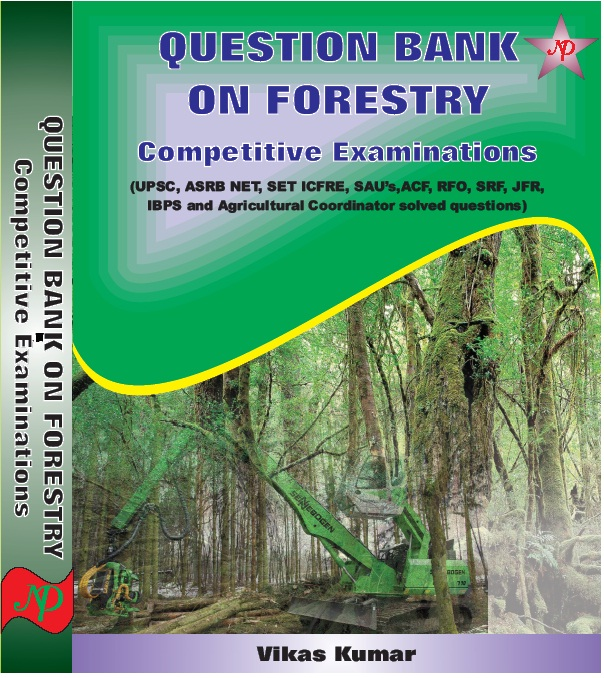
Question Bank on Forestry competitive examinations

Author
14.61 · Kerala Agricultural University

xyz

Abstract

The book is “Question Bank on Forestry for all competitive examinations”. It deals with all syllabus of general forestry for all competitive exam such as JRF, SRF, SET, ASRB, UPSC, ICFRE, SAU’s, NET, SET, FOREST GUARD, FOREST RANGER, ACF, IBPS, Agricultural Coordinator and various entrance examination of agricultural universities of forestry graduates as well as agricultural back ground. The compilation is an endeavour to present, present day relevant questions in userfriendly / systematic in more reliable way. The questions presented in this book are mostly memory based which has asked in various examination. These set of questions will give the candidates an idea about the question pattern of the above mentioned exams and will be help to those student who wants to pursue their career in Forestry and Agroforestry. 

Question bank on Forestry competitive examinations


Available from: https://www.researchgate.net/publication/284730411_Question_bank_on_Forestry_competitive_examinations [accessed Aug 3, 2017].

For further details log on website :
https://www.researchgate.net/publication/284730411_Question_bank_on_Forestry_competitive_examinations

Comparison of sapling demography of four dipterocarp species with different seed-dispersal strategies

Published Date
Received 15 June 2004, Revised 5 December 2004, Accepted 5 December 2004, Available online 14 January 2005.

https://doi.org/10.1016/j.foreco.2004.12.002

Author
YayoiTakeuchia. Numbers and letters correspond to the affiliation list. Click to expose these in author workspaceOpens the author workspaceOpens the author workspace. Author links open the author workspace.TanakaKentab. Numbers and letters correspond to the affiliation list. Click to expose these in author workspaceOpens the author workspace. Author links open the author workspace.TohruNakashizukac. Numbers and letters correspond to the affiliation list. Click to expose these in author workspaceOpens the author workspace
a
Center for Ecological Research, Kyoto University, Kamitanakami Hirano-cho, Otsu 520-2113, Japan
b
Tomakomai Experimental Forest, Hokkaido University, Takaoka, Tomakomai 053-0035, Japan
c
Research Institute for Humanity and Nature, Takashima-cho, Kamigyo-ku, Kyoto 602-0878, Japan

Abstract

To determine the relative roles of seed dispersal in regeneration, we compared the spatial distribution and demography of four co-occurring dipterocarp species with different seed dispersal strategies: two long-distance seed dispersers with winged seeds (Dipterocarpus globosus and Shorea beccariana) and two short-distance dispersers with wingless seeds (D. tempehes and S. laxa). The spatial distribution and dynamics of saplings of the four species were investigated to test whether seed dispersal confers benefits with respect to either increasing the availability of safe sites or avoiding high mortality near conspecific adults. The median distance between a sapling and the nearest conspecific adult increased with sapling size in the long-distance dispersers. The saplings of short-distance dispersers were largely aggregated near conspecific adults, and the median distance did not change with sapling size. Light- and topography-dependent mortality and density/distance-dependent mortality were observed in some size classes of saplings of both long-distance dispersers. However, the mortality of short-distance dispersers did not show clear density dependence, partly because of the low mortality. We concluded that the functions of long-distance seed dispersal, i.e., escape or colonization, differ with size in D. globosus and S. beccariana, while the short-distance seed dispersers D. tempehes and S. laxa have other mechanisms to avoid mortality.

For further details log on website :
http://www.sciencedirect.com/science/article/pii/S0378112704008448

Thursday, 3 August 2017

Composite Panels Manufactured from Bamboo and Rice Straw

Principle Investigator: Dr. Salim Hiziroglu
Other participants: Songklod Jarusombuti, Department of Forest Products,Kasetsart University Vallayuth Fueangvivat , Piyawade Bauchongkol, Worakit Soontonbura, Royal Forest Department, Bangkok, Thailand
Funded by: Agricultural Experimental Station Kasetsart University and Royal Forest Department, Bangkok, Thailand, and FAPC.
This study investigated some of the important properties of particleboard and medium density fiberboard (MDF) manufactured from non-wood underutilized species, bamboo and rice straw in Thailand. Various type of experimental panels were manufactured using different ratios of both types of raw material. Rice straw did adversely influenced panels properties. However addition of low amount of rice straw in all panels did not substantially reduced both mechanical and physical properties of the samples. Panel made from 100% bamboo resulted in the highest values.
Currently sandwich type panels, having thin layers of fiber on the faces and particles in the core of the samples are being manufactured.

Rice HarvestingBamboo Plantation
  
  
Fiberboard panel manufacturing process


For further details log on website :
http://nrem-old.okstate.edu/faculty/researchlabs/Hiziroglu/Bamboo%20Panels/BambooPanels.html

Surface Characteristics of Japanese Wood Composite Panels

Principle Investigator: Dr. Salim Hiziroglu
Other participants: Dr. Shigehiko Suzuki
Faculty of Agriculture, Shizuoka University, Japan
Funded by: Japan Society for the Promotion of Science (JSPS)
and Agricultural Experimental Station.
This study investigated surface characteristics of commercially manufactured particleboard and fiberboard panels before and after they overlaid with melamine impregnated papers. Overlaid samples exposed to 55% and 93% relative humidity and their surface roughness was evaluated using a stylus type equipment. Significant difference between roughness of the samples at initial condition and 93% relative humidity was determined. Janka hardness of the samples exposed to two humidity levels also resulted in significant difference from each other.

Overlaying Process
Average Values of roughness parameters


Typical roughness profiles of the samples

For further details log on website :
http://nrem-old.okstate.edu/faculty/researchlabs/Hiziroglu/Japan/JapanesePanels.htm

Resistance of Eastern Redcedar Panels to Damage by Termites

Principal Investigator : Dr. Salim Hiziroglu
Other participants: Dr. Brad Kard, Department of Entomology and Plant Pathology
Dr. Mark E. Payton, Department of Statistics
Funded by : Agricultural Experimental Station and FAPC.
This study investigated resistance of experimental particleboard panels manufactured from eastern redcedar (Juniperus virginiana L.) to feeding by the wood destroying eastern subterranean termite, Reticulitermes flavipes (Kollar).Eastern redcedar panels with and without foliage were exposed to foraging termites. Particles and blocks sustained some damage by feeding termites but were not equally preferred. In choice test were all particles and panels plus control samples were simultaneously available to foraging termites, radiate pine sustained 44.6% weight loss compared with 2.1 to 6.1 % weight loss for particle and blocks. It appears that redcedar panels tested exhibited moderate resistance against termite damage.
FORAGING SUBSTRATE
STERILIZED SAND AND VERMICULATE
(10:1 RATIO)
STERILE DEIONIZED WATER WAS ADDED  350 ml/1,000 g DRY MIX.

  
Testing of Termite Survival


For further details logo website:
http://nrem-old.okstate.edu/faculty/researchlabs/Hiziroglu/Termites/redcedar%20termites.htm

Structural Composite Panel Manufactured from Eastern Redcedar

Principle Investigator: Dr. Salim Hiziroglu
Funded by: Agricultural Experimental Station and FAPC.
This study addresses to use low quality eastern redcedar trees to manufacture structural panels. Laboratory type flaker at Forest Product Laboratory, Louisiana State University was employed to produce strands from 6 in long eastern redcedar sections. Initially experimental panels having strands with random distribution were manufactured. Physical and mechanical properties of the samples will be evaluated. In the second part of the study oriented strandboard panels will be produced and their properties will be tested.

Raw MaterialsFlaking Process
(Louisiana State University,
Forest Products Development Center)
  
Stranding ProcessRandomly Oriented Strandboard Forming Box
 
  
Unpressed MatPressing of the Panel
  
 
Strandboard samples

For further detail slog on website :
http://nrem-old.okstate.edu/faculty/researchlabs/Hiziroglu/Redcedar%20panels/ERC%20panels.htm

Value-added Composite Panels Manufactured from Under-utilized Species in Oklahoma

Principle Investigator : Dr. Salim Hiziroglu
Funded by: Agricultural Experimental Station and FAPC.
Eastern redcedar (Juniperus virginiana) , mesquite (Prosopis glandulosa) and osage orange (Maclura pomifera) are some of the under-utilized invasive species in Oklahoma. Currently they have very limited uses, such as shelterbelt, wind break, and fence post. This study investigated some of the important properties of experimental panels made from particles of three species and their mixture of 50 %-50% ratio. Whole-tree chipped material was used to manufacture the panels. The samples were tested for mechanical strength and physical stability properties according to the procedures defined by ASTM D-1037. Modulus of elasticity and modulus of rupture of the panels made from 100% eastern redcedar resulted in the highest bending among four types of panels. Thickness swelling of the samples ranged from 11% to 20%. All panels yielded adequate bending strength, stiffness, and internal bond strength. Based on the findings in this study, it appears that whole-tree chipped particles of three species can be used to manufacture value-added panels without having any adverse influence on panel properties.

Eastern redcedar invasionEastern redcedar logs
  
 
Harvesting of Osage Orange
 
  
Pressed panel3-layer unpressed mat
  
Bending test set-upInternal bond strength test set-up
  

For further details log on website :
http://nrem-old.okstate.edu/faculty/researchlabs/Hiziroglu/Underutilized/underutspp.htm

Value-added Wood Composite Laboratory


The Value-added Wood Composite Laboratory is located in Room 236 at the Robert M. Kerr Food & Agricultural Products Center (www.fapc.biz), Oklahoma State University. The laboratory is used to develop various types of wood composite panels such as particleboard and fiberboard, primarily from under-utilized species in Oklahoma and mid-south region and evaluate their physical and mechanical properties.

For further information please contact:
Salim Hiziroglu
Professor
303-G Agricultural Hall
Department of Natural Resource Ecology & Management
Oklahoma State University
Stillwater, Oklahoma 74078-6013
 
Phone : (405) 744-5445
Fax: (405) 744-3530
E-mail: salim.hiziroglu@okstate.edu

Dr. Salim Hiziroglu
 
Rotary-type resin mixing drum with spray gunParticleboard forming box
  
Unpressed matHot press with 24 in by 24 in (60.9 cm by 60.9 cm) platen size and 900 psi (6,201) kPa platen pressure capacity
 
  
Unpressed matPressing process
  
Pressed panelFiberboard forming box
  
Hand operated hot press with 6 in by 6 in (15.2 cm by 15.2 cm) platen size and 400 psi (2,756kPa) platen pressure capacityComTen testing system with 2,000 lb loadcell capacity
 
Hotplate to prepare internal bond strength samplesPortable stylus type surface profilometer
  
Tablesaw
 
Stereomicroscope

For further details log on website :
http://nrem-old.okstate.edu/faculty/researchlabs/Hiziroglu/WoodCompLab/WoodCompLab.htm

A COMPATIBLE ESTIMATION MODEL OF STEM VOLUME AND TAPER FOR Acacia mangium Willd. PLANTATIONS

Author
Haruni Krisnawati

Abstract

This study describes the establishment of  a compatible volume estimation model for Acacia mangium Willd on the basis of  279 felled sample trees collected from the A. mangium plantation stands in South Sumatra, Indonesia. The model comprises of  a total volume model and a stem taper model, which is compatible in the sense of  the total volume obtained by integration of  the taper model being equal to that computed by the total volume model. Several well-known total volume functions were evaluated including constant form factor, combined variable, generalized combine variable, logarithmic, generalized logarithmic and Honer transformed variables. A logarithmic model was determined to be the best and was then used as the basis for deriving the taper model. Appropriate statistical procedures were used in model fitting to account for the problems of  heteroscedasticity and autocorrelation that are associated with the construction of  volume and taper functions. The simultaneous fitting method of  the Seemingly Unrelated Regression (SUR) improved the parameter estimates and goodness-of-fit statistics while ensuring numeric consistency among the component models and reducing the total squared error obtained by an independent fitting method. The developed model can be used to estimate total stem volume, merchantable volume to any merchantability diameter limit at any height, and (possibly) height of  any diameter based on only easily measurable parameters such as diameter at breast height and total tree height for the species analysed.

Keywords


Acacia mangium, Indonesia, compatible volume, taper

Full Text:

PDF

References

Abdul-Kader, R., & Sahri, M. H. (1993). Properties and utilization. In K. Awang & D. Taylor (Eds.), Acacia mangium: Growing and utilization (pp. 225–241). Bangkok: Winrock International and FAO.
Bi, H. (1999). Predicting stem volume to any height limit for native tree species in southern New South Wales and Victoria. New Zealand Journal of Forest Science, 29, 318–331.
Bi, H., & Hamilton, F. (1998). Stem volume equations for native tree species in southern New South Wales and Victoria. Australian Forestry, 61, 275–286.
Burkhart, H. E., & Sprinz, P. T. (1984). Compatible cubic volume and basal area projection equations for thinned old-field loblolly pine plantations. Forest Science, 30, 86–93.
Bustomi, S. (1988). Tabel isi pohon lokal Acacia mangium Willd. untuk daerah Balikpapan Kalimantan Timur. Buletin Penelitian Hutan, 495, 31–38.
Byrne, J. C., & Reed, D. D. (1986). Complex compatible taper and volume estimation systems for red and loblolly pine. Forest Science, 32, 423–443.
Cecilia, R. C., Mason, E. G., Woollons, R., & Resquin, F. (2014). Volume and taper equations for P. taeda (L.) and E. grandis (Hill ex. Maiden). Agrociencia Uruguay, 18, 47–60.
Clutter, J. L. (1980). Development of taper functions from variable-top merchantable volume equations. Forest Science, 26, 117–120.
Clutter, J. L., Fortson, J. C., Pienaar, L. V, Brister, G. H., & Bailey, R. L. (1983). Timber management: A quantitative approach. New York: Wiley.
Corral-Rivas, J. J., Diéguez-Aranda, U., Rivas, S. C., & Dorado, F. C. (2007). A merchantable volume system for major pine species in El Salto, Durango (Mexico). Forest Ecology and Management, 238, 118–129.
Demaerschalk, J. P. (1973). Integrated systems for the estimation of tree taper and volume. Canadian Journal of Forest Research, 3, 90–94.
Dieguez-Aranda, U., Castedo-Dorado, F., AlvarezGonzalez, J. G., & Rojo, A. (2006). Compatible taper function for Scots pine plantations in north western Spain. Canadian Journal of Forestry Research, 36, 1190 1205.
Fang, Z., & Bailey, R. L. (1999). Compatible volume and taper models with coefficients for tropical species on Hainan Island in Southern China. Forest Science, 45, 85–100.
Fang, Z., Borders, B. E., & Bailey, R. L. (2000). Compatible volume-taper models for loblolly pine and slash pine based on a system with segmented-stem form factors. Forest Science, 46, 1–12.
Furnival, G. M. (1961). An index for comparing equations used in constructing volume tables. Forest Science, 7, 337–341.
Harbagung, & Krisnawati, H. (2009). Stem taper model for Khaya anthoteca C.DC. plantation in Pasirhantap Experimental Forest, Sukabumi, West Java (in Indonesian with English abstract). Forest and Natural Conservation Research Journal, 6(1), 13–24.
Hardiyanto, E. B., Anshori, S., & Sulistyono, D. (2004). Early results of site management in Acacia mangium plantations at PT. Musi Hutan Persada, South Sumatra, Indonesia. In E. K. S. Nambiar, J. Ranger, A. Tiarks, & T. Toma (Eds.), Site Management and Productivity in Tropical Plantation Forests (pp. 93–108). Bogor: CIFOR.
Huang, S. (1999). Ecoregion-based individual tree height-diameter models for lodgepole pine in Alberta. Western Journal of Applied Forestry, 14, 186–193.
Husch, B., Beers, T. W., & Kershaw, J. A. (2003). Forest mensuration. New Jersey: John Wiley & Sons.
Jiang, L., Brooks, J. R., & Wang, J. (2005). Compatible taper and volume equations for yellow-poplar in West Virginia. Forest Ecology and Management, 213, 399–409.
Judge, G. G., Hill, R. C., Griffiths, W. E., Lütkepohl, H., & Lee, T. C. (1988). Introduction to the theory and practice of econometrics. New York: John Wiley & Sons.
Kozak, A. (2004). My last words on taper functions. The Forestry Chronicle, 80, 507–515. Kozak, A., & Smith, J. H. G. (1993). Standards for evaluating taper estimating systems. The Forestry Chronicle, 69, 438–444.
Krisnawati, H., & Bustomi, S. (2004). Clearbole volume estimation model for sungkai (Peronema canescens) in the Forest District of Banten. Forest Research Bulletin, 644, 39–50.
Krisnawati, H., Kallio, M., & Kanninen, M. (2011). Acacia mangium Willd.: Ecology, silviculture and productivity. Bogor: CIFOR.
Krisnawati, H., & Wahjono, D. (2003). The use taper model for estimating tree stem volume of matoa (Pometia pinnata Forst.) in Halmahera, Maluku. Forest Research Bulletin, 637, 11–24.
Krisnawati, H., Wahjono, D., & Iriantono, D. (1997). Tree volume table and stem taper of Acacia mangium Willd. in Parungpanjang Seed Orchard, Bogor, West Java. Seed Technology Bulletin, 4, 12–27.
Li, R., & Weiskittel, A. R. (2010). Comparison of model forms forestimating stem taper and volume in the primary coniferspecies of North American Acadian Region. Annals Forest Science, 67, 302–520.
Martin, A. J. (1984). Testing volume equation accuracy with water displacement. Forest Science, 30, 41–50.
Max, T. A., & Burkhart, H. E. (1976). Segmented polynomial regression applied to taper equations. Forest Science, 22, 283–289.
Mc Tague, J. P., & Bailey, R. L. (1986). Simultaneous total and merchantable volume equations and a compatible function for loblolly pine. Canadian Journal of Forest Research, 17, 87–92. Munro, D. D., &
Demaerschalk, J. (1974). Taperbased versus volume-based compatible estimating systems. The Forestry Chronicle, 50, 197–199. National Research Council. (1983). Mangium and other fast-growing acacias for the humid tropics. Washington D.C.: National Academy Press.
Navar, J., & Rodriguez-Flores, F. J Dominguez Calleros, P. A. (2013). Taper functions and merchantable timber for temperate forests of northern Mexico. Annals of Forest Research, 56, 165–178.
O¨zçelik, R., & Brooks, J. R. (2012). Compatible volume and taper models for economically important tree species of Turkey. Annals of Forest Science, 69, 105–118.
Ratkowsky, D. A. (1990). Handbook of nonlinear regression. New York: Marcel Dekker Inc.
Reed, D., & Green, E. (1984). Compatible stem taper and volume ratio equations. Forest Science, 30, 977–990.
Rojo, A., Perales, X., Sánchez-Rodríguez, F., Álvarez González, J. G., & Gadow, K.V. (2005). Stem taper functions for maritime pine (Pinus pinaster Ait.) in Galicia (Northwestern Spain). European Journal of Forest Research, 124, 177– 186.
SAS Institute Inc. (2005). SAS/ETS User’s guide, version 9.1. Cary, NC: SAS Institute Inc.
Sharma, M., & Zhang, S. Y. (2004). Variableexponent taper Equations for jack pine, black spruce, and balsam fir in eastern Canada. Forest Ecology and Management, 198, 39–53.
Snowdorn, P. (1991). A ratio estimator of bias correction in logarithmic regression. Canadian Journal of Forest Research, 21, 720–724.
Sumarna, K., & Bustomi, S. (1986). Local tree volume table of Acacia mangium Willd. for the region of Subanjeriji, South Sumatra. Forest Research Bulletin, 487, 41–49.
Teshome, T. (2005). A ratio approach for predicting stem merchantable volume and associated taper equations for Cupressus lusitanica, Ethiopia. Forest Ecology and Management, 204, 171–179.
Tewari, V. P., & Kumar, V. S. K. (2003). Volume equations and their validation for irrigated plantations of Eucalyptus camaldulensis in the hot desert of India. Journal of Tropical Forest Science, 15, 136–146.
Wahjono, D., Krisnawati, H., & Bustomi, S. (1995). Local tee volume table of Acacia mangium in Labuhan Batu District, North Sumatra. Forest Research Bulletin, 589, 39–54.
Williams, M. S., & Gregoire, T. G. (1993). Estimating weights when fitting linear regression models for tree volume. Canadian Journal of Forest Research, 23, 1725–1731.
Williams, M. S., & Schreuder, H. T. (1996). Prediction of gross tree volume using regression models with non-normal error distributions. Forest Science, 42, 419–430.
DOI: http://dx.doi.org/10.20886/ijfr.2016.3.1.49-64

For further details log on website :
http://ejournal.forda-mof.org/ejournal-litbang/index.php/IJFR/article/view/641

Advantages and Disadvantages of Fasting for Runners

Author BY   ANDREA CESPEDES  Food is fuel, especially for serious runners who need a lot of energy. It may seem counterintuiti...