Blog List

Tuesday, 24 April 2018

Technical and vocational education and training (TVET) in Malaysia

Author
by StudyMalaysia 

Technical and vocational education and training (TVET) in Malaysia

What is TVET?

Technical and Vocational Education and Training (TVET) includes formal, non-formal and informal learning that prepare young people with the knowledge and skills required in the world of work. According to the United Nations Organisation for Education, Science and Culture (UNESCO), TVET has been called many names over the years – apprenticeship training, vocational education, technical education, technical-vocational education, occupational education, vocational education and training, professional and vocational education, career and technical education, workforce education, workplace education, and others.
No matter its name, the common feature of TVET as defined by UNESCO is that it involves “in addition to general education, the study of technologies and related sciences as well as the acquisition of practical skills, attitudes, understanding, and knowledge relating to occupations in various sectors of economics and social life”. In TVET, young people have the opportunity to learn from basic to advanced levels across a wide range of institutional and work settings.

Did you know?

  • TVET programmes in Malaysia are offered at certificate, diploma, and degree levels by seven ministries that include MOHE.
  • According to MOHE’s Malaysia Education Blueprint (Higher Education), there will be an increase in demand for an additional 1.3 million TVET workers by 2020 in the 12 National Key Economic Areas (NKEA) identified under the government’s Economic Transformation Programme (ETP).
  • To meet this demand, the government has increased the development expenditure given to public TVET institutions from RM 1.8 billion in 2010 to RM 2.1 billion in 2014.
  • There are over 1,000 TVET institutions in Malaysia of which 506 are public institutions.
  • Public institutions like polytechnics, community colleges, vocational colleges and other higher learning institutions can accommodate about 230,000 students.
  • In 2013, out of the 429,000 students who sat for the SPM examination, 321,000 students enrolled in higher education and training programmes, with more than 50% enrolling at TVET institutions.

Studying TVET programmes in Malaysia

TVET programmes in Malaysia are offered at certificate, diploma, and degree levels by seven ministries that include the Ministry of Higher Education (MOHE), which offers the most TVET programmes to the highest number of students.
Presently, qualifications for academic (higher education) and vocational education sectors offered by MOHE’s universities, polytechnics, and community colleges are accredited by the Malaysian Qualifications Agency (MQA), whereas skills training programmes offered by skills training institutions are accredited by the Department for Skill Development (DSD) of the Ministry of Human Resources.
Pathways for Vocational Education, Skills Training & Academic Qualifications
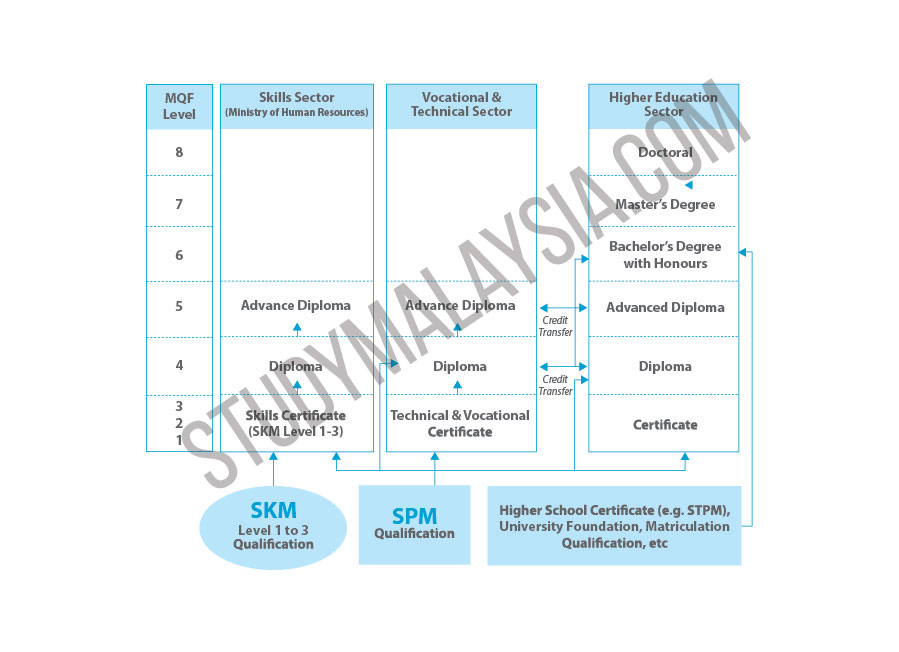
Diagram 5.1: Pathways for Vocational Education, Skills Training & Academic Qualifications
(Graphic by Challenger Concept)
The diagram above shows three pathways or sectors for school leavers, namely, the Skills sector; the Vocational and Technical sector; and the Higher Education (Academic) sector.
School leavers who have completed SPM can acquire a TVET qualification from various providers or institutions in all the three sectors. The qualifications offered range from certificate, diploma advanced diploma to bachelor’s degree levels. Qualifications from the skills sector are awarded by the Department for Skills Development (Jabatan Pembangunan Kemahiran), Ministry of Human Resources. In contrast, the qualifications from the other two sectors are awarded by the Ministry of Higher Education.
(Note: There are also a number of skills qualifications awarded by other agencies.)

Types of Skills Qualifications under the Department for Skills Development (DSD)

There are five levels of skills qualifications (Level 1 – 5) under the National Skills Qualification Framework. Here's a brief explanation of what each level means and its corresponding competencies:

Definition of Skills Qualification Level 1 to 5

Qualification AwardedCompetencies Achieved/Expected
SKM Level 1
  • Competent in performing a range of various job tasks/work activities, most of which are routine and predictable.
SKM Level 2
  • Cometent in performing a significant range of varied work activities that are being performed in a variety of contexts
  • Some of these activities are non-routine, requiring individual responsibility and autonomy
SKM Level 3
  • Requires competency in performing a broad range of varied work activities that are preformed in a variety of contexts, most of which are complex and non-routine.
Level 4: Diploma Kemahiran Malaysia, DKM (Malaysian Skills Diploma)
  • Candidates are required to be competent in performing a broad range of complex technical or professional work activities that are performed in a wide variety of contexts, and with a substantial degree of personal responsibility and autonomy.
  • In addition, the responsibility for the work of others and allocation of resources is very often present.
Level 5: Diploma Lanjutan Kemahiran Malaysia, DLKM (Malaysia Skills Advanced Diploma)
  • Participants would need to possess the necessary competence so as to be able to apply a significant range of fundamental principles and complex techniques across a wide and often unpredictable variety of contexts.
  • The prominent features of this level include:
    • A very substantial personal autonomy
    • A significant responsibility for the work of others and for the allocation of substantial resources, and
    • Personal accountabilities for analysis and diagnosis, design, planning, execution and evaluation.

Vocational Education Programmes Leading to MOE’s Vocational Education Qualifications

Vocational education is offered by educational institutions under MOE which include PAV (for UPSR leavers), vocational colleges, community colleges, polytechnics and MTUN universities. The qualifications offered include certificate, diploma, Diploma Vokasional Malaysia (DVM), advanced diploma, and bachelor’s degree (vocational education).
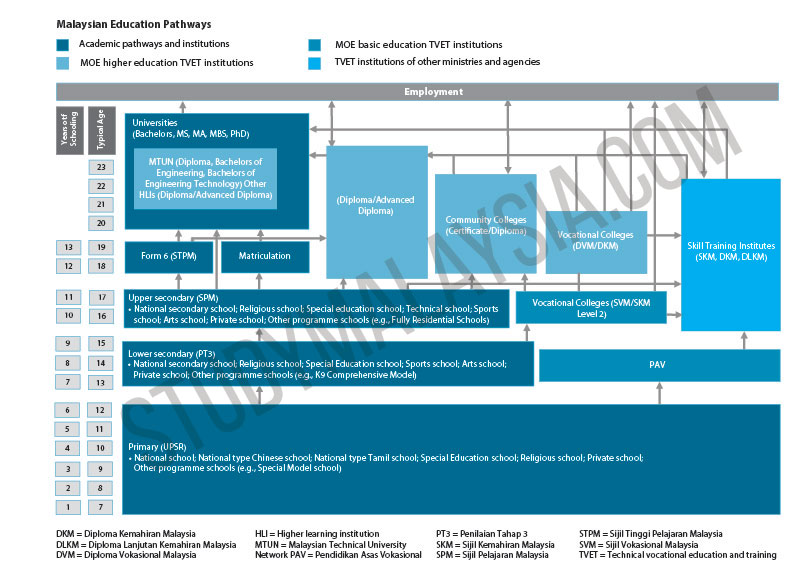
Upon completion of primary school education, UPSR (Standard 6) school leavers can opt to pursue Junior Vocation Education or Pendidikan Asas Vokasional (PAV) at public schools. Students who have completed Form 3 (PT3) have the option of pursuing the skills training pathway (at either public or private skills training institutes) that leads to 5 levels of skills qualifications within the skills sector. They can also pursue a 4-year vocational education programme at MOE’s Kolej Vokasional that leads to the award of Diploma Vokasional Malaysia, DVM. The DVM programme at Kolej Vokasional is also open to PAV graduates.
School leavers who have completed SPM can enrol at MOHE’s Kolej Komuniti, polytechnics and MTUN (Malaysia Technical University Network) for vocation education to pursue certificate, diploma and advanced diploma qualifications. The STPM/Matriculation school leavers and Diploma holders can advance to MTUN’s bachelor’s degree qualifications.
TVET providers that come under MOHE each has a specific target audience with different levels of qualifications. As an example, community colleges offer qualifications mainly at certificate level, while polytechnics offer diplomas and advances diplomas (see Table 5.3). MTUN offers both diplomas and bachelor’s degree courses.
The Various Education Pathways in Malaysia (leading to academic qualifications, vocational education qualifications and skills qualifications)
Diagram 5.3: The Various Education Pathways in Malaysia (leading to academic qualifications, vocational education qualifications and skills qualifications)
Source: Adapted from Malaysia Education Blueprint (Exhibit 4-3)

Different roles of the four types of Ministry of Higher Education TVET institutions

 Vocational collegesCommunity collegesPolytechnicsMalaysia Technical University Network (MTUN)
Target age group
  • 16 years (after From 3)
  • 18 years (after Form 5)
  • Working adults
  • 18 years (after Form 5)
18-20 years (after Form 5)
Entry requirements for type of qualificationPT3: Grades
  • D and E, pass BM for SKM2
  • A,B,C,D for SVM, Diploma(DVM)
  • SPM with 1 credit for certificate
  • Certificate for WBL Diploma
  • SPM with 3-6 credits for Diploma
  • Diploma for WBL Adv Diploma, WBL Bachelor
  • SPM with 5 credits for Diploma
  • Diploma for Adv Diploma, Bachelor
Note: SVM = Sijil Vokasional Malaysia, DVM - Diploma Vokasional Malaysia, WBL = Work Based Learning, PT3 = Peperiksaan Tahap 3, SPM = Sijil Pelajaran Malaysia

Source: This article is adapted from the Education Guide Malaysia (14th edition)
For further information log on website :
https://www.studymalaysia.com/education/top-stories/technical-and-vocational-education-and-training-in-malaysia

Anugerah Malaysia Technology Expo 2017 (MTE)

Sekalung ucapan tahniah diucapkan atas Anugerah  yang diperolehi di Malaysia Technology Expo 2017 (MTE) pada 16-18 Februari 2017 di Putra World Trade Centre Kuala Lumpur (PWTC) kepada Politeknik Sultan Salahuddin Abdul Aziz Shah (PSA) - Category Invention & Innovation Awards 2017 (1 Gold & 1 Bronze), - Category Asian Youth Innovation Awards 2017 ( 1 Gold, 1 Silver & 1 Bronze), Politeknik Tuanku Sultanah Bahiyah (PTSB) -Category Invention & Innovation Awards 2017 (1 Gold & 2 Bronze), - Category Asian Youth Innovation Awards 2017 ( 1 Gold & 1 Silver), Politeknik Ibrahim Sultan (PIS) - Category Asian Youth Innovation Awards 2017 ( 1 Gold, 2 Silver & 1 Bronze), Politeknik Kuching Sarawak (PKS) - Category Invention & Innovation Awards 2017 ( 1 Gold & 1 Bronze), Politeknik Sandakan (PSS) - Invention & Innovation Awards 2017 ( 1 Bronze & 1 Merit Award) - Catrgory Youth Innovation Awards 2017 (1 Silver) dan Politeknik Nilai (PNS) - Category Asian Youth Innovation Awards 2017 ( 1 Gold & 1 Bronze).


MTE2017
MTE20172
For further information log on website :
http://mypoliteknik.edu.my/index.php/mengenai-kami/berita-dan-hebahan/berita/594-anugerah-malaysia-technology-expo-2017-mte.html

PORTAL RASMI JABATAN PENDIDIKAN POLITEKNIK

CENTRE OF TECHNOLOGY
COT
Among the initiatives in the Polytechnic Transformation Roadmap is to set up a Centre of Technology (COT) at the Polytechnic. COT acts as a centre to mobilize knowledge, expertise and skills of the Polytechnic in specific niche areas along with other parties with theobjectives of establishing the following:
  • Fostering a culture of sharing expertise, research, innovation and quality of teaching and learning in the niche areas;
  • Strengthening collaboration with the community and industry that is related to the niche areas;
  • Encouraging writing and scholarly publication that is related to the niche areas;
  • Increasing the achievement and recognition at national and international level that is related to the niche areas; and
  • Generating income through expertise service activities, research and sharing of knowledge in the niche areas.
circle cot
List of COT Polytechnic that has been recognized:
jadual cot

For further information log on website :
https://www.mypoliteknik.edu.my/index.php/en/staf/berita/81-joomla-articles/598-ceo-faculty-polytechnics.html

Politeknik Kota Kinabalu : Wood Technology Centre ( WTEC ) Polytechnic Kota Kinabalu Sabah Malaysia


EXTRACTION OF OIL PALM STARCH: A COMPARATIVE STUDY
Potential of oil palm starch from oil palm trunk as a starch based adhesive was evaluated based on collection of starch yields (grams) using two types of steeping methods of starch extraction processes. Sodium metabisulphite (Na2S2O5) was... more
Abstrak Kajian ini bertujuan untuk memanfaatkan penggunaan sisa sabut kelapa sebagai bahan mentah dan menghasilan pasu organik sabut kelapa dengan menggunakan lateks sebagai pengikat. Pengolahan sabut kelapa sebagai bahan mentah masih... more
The aim of this study was to investigate the effect of starch based bio-adhesives application as a potential binder for particleboard manufacturing. There are four types of starch based bio-adhesives, i.e. native oil palm starch... more
The main objectives of this study were to evaluate the biodegradation behaviour of experimental particleboard panels bonded with modified 30 % of PVOH, 70 % of Oil palm starch and 3 % of nano silicon dioxide (SiO2). Boric acid at 2 % also... more
A B S T R A C T The main objectives of this study were to evaluate the biodegradation behaviour of experimental particleboard bonded with modified 30 % of PVOH, 70 % of Oil palm starch and 3 % of nano silicon dioxide (SiO2). Boric acid at... more

For further details log on website :
http://polikk.academia.edu/Departments/Centre_of_Technology_CoT_/Documents

Evaluation of properties of starch-based adhesives and particleboard manufactured from them

Author
Pages 319-336 | 
Received 10 Feb 2014, Accepted 06 Nov 2014, 
Published online: 08 Dec 2014


Abstract

The objective of this study was to evaluate some of the mechanical and physical properties of experimental particleboard panels manufactured from rubberwood (Hevea brasiliensis) bonded using oil palm starch, wheat starch, and urea formaldehyde (UF) at a density of 0.60 g/cm3. Bending characteristics, internal bond strength, thickness swelling, and water absorptions of the samples were determined based on Japanese Industrial Standard (JIS). Overall mechanical properties for natural binder oil palm starch resulted in higher values than those made from wheat starch. The highest internal-bonding strength (IB) value of 0.41 N/mm2 was determined for the samples made from oil palm starch. Dimensional stability in the form of thickness swelling of the samples made from oil palm starch had higher values, ranging from 4.24 to 22.84% than those manufactured from wheat starch. Natural adhesive showed comparable strength with panels manufactured with UF. Overall results meet the Japanese Industrial Standard (JIS) requirements except for water absorption and thickness swelling of the samples.

For further details log on website:
https://www.tandfonline.com/doi/abs/10.1080/01694243.2014.987362

Biodegradation Behaviour of Particleboard Bonded with Modified PVOH/Oil Palm Starch and Nano Silicon Dioxide

Author
Abd Karim Norani 1,2, Rokiah Hashim 2*, Othman Sulaiman 2, Salim Hiziroglu 3 Salmiah Ujang 4, and Wan Noor Aidawati Wan Nadhari 5 1Centre of Technology (CoT) Unit, Politeknik Kota Kinabalu (PKK), 88460 Kota Kinabalu, Sabah, Malaysia. 

2Division of Bioresource, Paper and Coatings Technology, School of Industrial Technology, Universiti Sains Malaysia, 11800 Penang, Malaysia. 

3Department of Natural Resource Ecology and Management, Oklahoma State University, Stillwater, OK 74078-6013, USA. 

4Bio composite and Wood Protection Programme, Forest Research Institute Malaysia (FRIM), 52109 Kepong, Selangor Darul Ehsan, Malaysia. 

5Department of Technical Foundation, Universiti Kuala Lumpur, Malaysian Institute of Chemical & Bioengineering Technology (UniKL MICET), Lot 1988, Kawasan Perindustrian Bandar Vendor, Taboh Naning, 78000 Alor Gajah, Melaka, Malaysia

Abstract
The main objectives of this study were to evaluate the biodegradation behaviour of experimental particleboard bonded with modified 30 % of PVOH, 70 % of Oil palm starch and 3 % of nano silicon dioxide (SiO2). Boric acid at 2 % was also added as a cross-linker to PVOH in modified oil palm starch to enhance decay resistant for the samples. All the particleboards were evaluated by soil burial, borer and fungal strains tests. The samples were then compared with particleboard bonded with native oil palm starch and commercial urea formaldehyde (UF). The results indicated that particleboards bonded with modified PVOH/Oil palm starch were more resistant than particleboard bonded with their native starch and thus can be used as a potential binder for green particleboard in future. The SiO2 also showed a significant effect towards modified oil palm starch as compared to their native oil palm starch and commercial binder. 

doi: 10.5829/ijee.2017.08.04.04 

INTRODUCTION

Adhesive is defined as any substance that is capable of holding materials together in a useful way by surface attachment that will prevent it from separation [1].Particleboards can be produced from any lignocellulosic materials, as long as they can contribute a proper physical, mechanical and biological resistance [2]. Phenol-formaldehyde (PF) resins and urea formaldehyde (UF) resins are commonly main binders in production of particleboard due to their high durability and fast curing adhesive [3]. With increasing crude oil prices and environmental awareness, the bio-based adhesive was started to promote as an alternative bonding agent [4]. Due to this problem, starch as a polymer of Dglucose which is stored in granules as a food source in most plants was used as a supplementary for synthetic polymers [5]. Starch is also considered as a cheap material and easier to adapt for any chemical * Corresponding author: Rokiah Hashim E-mail: hrokiah@usm.my modification thus makes it as an interesting material. Starch was used as an adhesive in variable products, as binders, sizing material, glues and pastes [6]. Recently, starch-based wood adhesive was widely used in interior applications [7]. The bonding results produced from starch based adhesive generally was formed from both mechanical interlocking and van der Waals forces. It wet a polar surface of cellulose and penetrate into pores, thus formed a strong adhesive bond [7]. While the modified starch is normally used as stabiliser or emulsifier and recently was precisely develop to be used as a binder in particleboards manufacturing [8]. Particleboards when exposed to the places with high moisture conditions, are easier to be attacked by the decay [2]. Several trials have been made to blend starch with biodegradable synthetic polymers, such as polyvinyl alcohol (PVOH) due to its biodegradable behaviour and possess excellent mechanical properties [9]. In previous study, the 30/70 PVOH/CS sample showed the highest weight loss compared to pure PVOH. 

This finding was associated with higher corn starch content in the packaging film. The PVOH, which is biodegradable due to its high hydrolysability, exhibited a higher resistance to soil burial degradation [9]. Boron / boric acid as reported in the various study was successfully accommodated as antibacterial and antifungal agents when they are mixed with polymers such as starch and PVOH [10]. The significant weight loss was reported in enzymatic degradation test on thermoplastic starch (TPS) when it is added with nano-SiO2 content up to 6 % wt [11]. Therefore the main objective of this study was to investigate the decay resistance of particleboard bonded with starch/PVOH/SiO2. Approximately 70 % of starch ratio with 30 % of PVOH and 3 % of Nano silicon dioxide (SiO2) will be compared with their native starch and commercial binder.

For further details log on website :
http://www.ijee.net/Journal/ijee/vol8/no4/4.pdf

Advantages and Disadvantages of Fasting for Runners

Author BY   ANDREA CESPEDES  Food is fuel, especially for serious runners who need a lot of energy. It may seem counterintuiti...