Ambrosia beetles are beetles of the weevil subfamilies Scolytinae and Platypodinae (Coleoptera, Curculionidae), which live in nutritional symbiosis with ambrosia fungi and probably with bacteria. The beetles excavate tunnels in dead trees in which they cultivate fungal gardens, their sole source of nutrition. After landing on a suitable tree, an ambrosia beetle excavates a tunnel in which it releases spores of its fungal symbiont. The fungus penetrates the plant's xylem tissue, digests it, and concentrates the nutrients on and near the surface of the beetle gallery. The majority of ambrosia beetles colonize xylem (sapwood and/or heartwood) of dying or recently dead trees. Species differ in their preference for different parts of trees, different stages of deterioration, in the shape of their tunnels (“galleries”). However, the majority of ambrosia beetles are not specialized to any taxonomic group of hosts, unlike most phytophagous organisms including the closely related bark beetles. One species of ambrosia beetle, Austroplatypus incompertus exhibits eusociality, one of the few organisms outside of Hymenoptera to do so.
Classification and Diversity
Until recently ambrosia beetles have been placed in independent families Scolytidae and Platypodidae, however, they are in fact some of the most highly derived weevils. There are about 3,000 known beetle species employing the ambrosia strategy.
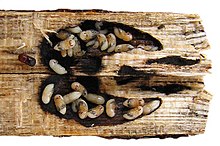
Gallery of Xylosandrus crassiusculus split open, with pupae and black fungus
Ambrosia beetles are an ecological guild, but not a phylogenetic clade. The ambrosia habit is an example of convergent evolution, as several groups evolved the same symbiotic relationship independently. The highest diversity of ambrosia beetles is in the tropics. In the Paleotropical region, hundreds of species of Xyleborini and Platypodinae are the main agent initiating dead wood decomposition. In the Neotropics, Platypodinae and Xyleborini are joined by the scolytine tribe Cortylini. Compared to the diversity in the tropics, ambrosia beetle fauna in the temperate zone is rather limited. In the Nearctic region it is dominated by a few species from Cortylini, Xyleborini and Xyloterini. In the Palearctic ecozone, significant groups are Xyloterini and Xyleborini, joined by Scolytoplatypodini in the Far East.

Dinoplatypus chevrolati from Papua New Guinea, an example of Platypodinae, another species-rich group of ambrosia beetles
The Symbiotic Relationship
Beetles and their larvae graze on mycelium exposed on the gallery walls and on bodies called sporodochia, clusters of the fungus’ spores. Most ambrosia beetle species don’t ingest the wood tissue; instead, the sawdust resulting from the excavation is pushed out of the gallery. Following the larval and pupal stage, adult ambrosia beetles collect masses of fungal spores into their mycangia and leave the gallery to find their own tree.
A few dozen species of ambrosia fungi have been described, currently in the polyphyletic genera Ambrosiella (mostly Microascales), Raffaelea, Ceratocystiopsis and Dryadomyces (from Ophiostomatales), Ambrosiozyma (yeasts), and Entomocorticium (Basidiomycota). Many more species remain to be discovered. Little is known about the bionomy or specificity of ambrosia fungi. Ambrosia fungi are thought to be dependent on transport and inoculation provided by their beetle symbionts, as they have not been found in any other habitat. All ambrosia fungi are probably asexual and clonal. Some beetles are known to acquire ("steal") fungal inoculum from fungal gardens of other ambrosia beetle species.
Evolutionary Origin
During their evolution, most scolytid and platypodid weevils became progressively more or less dependent on fungi regularly co-habiting dead trees. This evolution had various outcomes in different groups:
- Some phloem-eating bark beetles (phloeophages) are probably employing aggressive phytopathogenic fungal associates to kill live trees.
- Many of phloem-feeding bark beetles use phloem-infesting fungi as an addition to their diet. Some phloeophages became more or less dependent on such a mixed diet and evolved mycangia to transport their symbionts from maternal trees to newly infested trees. These beetles are called mycophloeophages.
- Ambrosia beetles and ambrosia fungi are thus only one end of the spectrum of the weevil-fungus association, where both the beetle and the fungus became completely dependent on each other.
Impact on Forest
This class of insects attacks living, dead, and felled trees, as well as sawlogs, green lumber, and stave-bolts, often causing serious economic loss from the pinhole and stained-wood defects caused by their brood galleries. The galleries are excavated by the parent beetles in the sound sapwood, sometimes extending into the heartwood, and the young stages feed on a fungus growth on the walls of galleries. The young depend on this ambrosia-like fungus for food, which is induced or controlled by the parent beetles.
In central British Columbia, only white spruce felled well before the onset of winter are attractive to Trypodendron lineatum (Oliv.) during the spring swarming flight (Dyer 1967). However, logs < 3 m long felled in September and May were attacked during the first spring. Previous studies showed that short log sections become attractive more rapidly than corresponding long logs.
References
- ^ Kuschel, G., R. A. B. Leschen, et al. (2000): Platypodidae under scrutiny. Invertebrate Taxonomy 14: 771-805.
Marvaldi, A. E., A. S. Sequeira, et al. (2002): Molecular and Morphological Phylogenetics of Weevils (Coleoptera, Curculionoidea): Do Niche Shifts Accompany Diversifcation? Systematic Biology 51(5): 761-785.
Duane D. McKenna, Andrea S. Sequeira, Adriana E. Marvaldi, and Brian D. Farrell. 2009. Temporal lags and overlap in the diversification of weevils and flowering plant. PNAS 106:7083-7088.
- ^ Farrell, B. D., A. S. O. Sequeira, et al. (2001): The evolution of agriculture in beetles (Curculionidae: Scolytinae and Platypodinae). Evolution 55: 2011-2027.
- ^ Malloch, D., and M. Blackwell. 1993. Dispersal biology of ophiostomatoid fungi. p. 195-206. In: Ceratocystis and Ophiostoma: Taxonomy, Ecology and Pathology. Eds., Wingfield, M.J., K.A. Seifert, and J.F. Webber. APS, St. Paul.
- ^ Hulcr, J., Cognato, A. I. 2010. Repeated evolution of theft in fungus farming ambrosia beetles. Evolution, 64 (11): 3205-3212
- ^ Paine, T. D., K. F. Raffa, et al. (1997): Interactions between scolytid bark beetles, their associated fungi and live host conifers. Annual Review of Entomology 42: 179-206.
- ^ Klepzik, K. D. and D. L. Six (2004): Bark Beetle – Fungal Symbiosis: Context Dependency in Complex Associations. Symbiosis 37: 189-205.
- ^ Beaver, R. A. (1989): Insect-Fungus Relationship in the Bark and Ambrosia Beetles. Insect-Fungus Interactions. N. Wilding, N. M. Collins, P. M. Hammond and J. F. Webber, Academic Press: 121-143.
- ^ Dyer, E.D.A. 1967. Relation of attack by ambrosia beetle (Trypodendron lineatum (Oliv.)) to felling date of spruce in central British Columbia. For. Can., Can. For. Serv., Ottawa ON, Bi-mo. Res. Notes 23(2):11.
External Links
- Images and information on the Ambrosia Symbiosis at the University of Florida.
- The MSU HISL database contains a worldwide species list of Xyleborini, a major group of ambrosia beetles, from the Catalog of Scolytidae and Platypodidae of S.L. Wood and D.E. Bright (1992)]
- A USDA-sponsored information resource and key. to the world genera of Xyleborini
- American Bark and Ambrosia Beetle.
- More information on ambrosia beetle social behaviour and fungiculture on
- Farewell to taco topping. The effects of the Redbay ambrosia beetle and laurel wilt disease
- Ambrosia beetles on the UF / IFAS Featured Creatures Web site
- Wikipedia


 The dictionary definition of larva at Wiktionary