Blog List

Wednesday, 9 March 2016

WOOD GRAIN

Wood grain is the longitudinal arrangement of wood fibers or the pattern resulting from this.

Definination

R. Bruce Hoadley wrote that grain is a "...confusingly versatile term..." including the direction of the wood cells (straight grain, spiral grain), surface appearance or figure, growth-ring placement (vertical grain), plane of the cut (end grain, quarter sawn, flat sawn, etc.), rate of growth (narrow grain), relative cell size (open grain), and other meanings.


The weathered trunk of a lodgepole pine tree showing an extremely spiral grain

Physical Aspects
Perhaps most important physical aspect of wood grain in woodworking is the grain direction or slope (e.g. against the grain). The two basic categories of grain are straight and cross grain. Straight grain runs parallel to the longitudinal axis of the piece. Cross grain deviates from the longitudinal axis in two ways, spiral grain or diagonal grain. The amount of deviation is called the slope of the grain.
Sketch of A—Quarter-sawn & B—flat-sawn
In describing the application of a woodworking technique to a given piece of wood, the direction of the technique may be:
  • with the grain (easy; giving a clean result)
  • against the grain (heavy going; giving a poor result such as chipping or tear-out)
  • across the grain (direction of cut is across the grain lines, but the plane of the cut is still aligned with them)
  • end grain (at right angles to the grain, for example trimming the end of a plank)
Grain alignment must be considered when joining pieces of wood, or designing wooden structures. For example, a stressed span is less likely to fail if tension is applied along the grain, rather than across the grain. Grain direction will also affect the type of warping seen in the finished item.
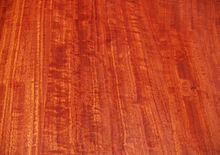
typically figured red gum table
In describing the alignment of the wood in the tree a distinction may be made. Basic grain descriptions and types include:
  • straight - grain which runs in a single direction, parallel to the axis of the tree
  • spiral - grain which spirals around the axis of the tree
  • interlocked - grain which spirals around the axis of the tree, but reverses its direction for periods of years resulting in alternating directions of the spiral grain.

Aesthetic Aspects
In its simplest aesthetic meaning, wood grain is the alternating regions of relatively darker and lighter wood resulting from the differing growth parameters occurring in different seasons (i.e., growth rings) on a cut or split piece of wood.
mountain ash floor, showing some fiddleback figure
Special grain alignments produce figure in wood. Their rarity often promotes the value of both the raw material, and the finished work it becomes a part of. These include:
The way a given piece of wood has been sawn affects both its appearance and physical properties:
  • flat-grain: flat-sawn, slab-sawn, plain sawn, bastard-sawn, or sawn "through and through".
  • edge grain: quarter-sawn or rift-sawn or straight-grained, and
  • end grain: the grain of wood seen when it is cut across the growth rings.
Strictly speaking, grain is not always the same as the "figure" of wood.
There is irregular grain in burr wood or burl wood, but this is result of very many knots.
References

  1. grain, n.1". def 15. Oxford English Dictionary Second Edition on CD-ROM (v. 4.0) © Oxford University Press 2009
  2. ^ "grain.", def. 7. Dictionary.com Unabridged. Random House, Inc. 13 Jan. 2015. <Dictionary.com http://dictionary.reference.com/browse/grain.
  3. a b Hoadley, R. Bruce. "Glossary." Understanding Wood: A Craftsman's Guide to Wood Technology. Newtown, Conn.: Taunton, 1980. 265. Print.
  4. ^ Wood Movement, WoodworkDetails.com.
  5. ^ Punmia, B.C., Ashok Kumar Jain, and Arun Kumar Jain. Basic civil engineering: for B.E. / B.Tech first year courses of various universities including M.D.U. and K.U., Haryana. New Delhi: Laxmi Publications, 2003. 78. Print.

- Wikipedia 

GRAIN FILLER

grain filler or paste wood filler is a woodworking product that is used to achieve a smooth-textured wood finish by filling pores in the wood grain. It is used particularly on open grained woods such as oak,mahogany and walnut where building up multiple layers of standard wood finish is ineffective or impractical.

Composition

Grain fillers generally consist of three basic components; a binder a bulking agent and a solvent. The binder is wood finish, and in the case of oil-based fillers is typically a blend of oil and varnish. In the case of water-based fillers, it is acrylic or urethane. The type of binder influences the type of solvent used; oil-based fillers usually use mineral spirits, while water-based fillers use water. Both types of filler use silica as a bulking agent as it resists shrinking and swelling in response to changes in temperature and humidity. Other binders may include quartz powder, wood flour, and talc.

Use
Woodworkers will use a grain filler before applying other finishes to open grained woods to achieve a "full finish", which is mirror-like. Woods such as ash, oak, mahogany and walnut fallinto this category, while tight grained woods such as maple and cherry can achieve a full finish with just a few coats of finish.
Before application, the surface is sanded and puttied to conceal surface imperfections, which would otherwise be made far more obvious by the grain filler. The filler is brushed on both with and against the wood grain and the excess is scraped off. After some drying, the woodworker typically uses a piece of burlap to remove more excess.
References

  1. a b "Understanding Grain Fillers". Woodsmith (Des Moines, Iowa: August Home Publishing Co.) 30 (179): 46–47. October 2008. ISSN 0164-4114, OCLC 4713102.
  2. a b Simmons, Mac. "Filling wood grains with a paste wood filler. Amateur Woodworker. Archived from the original, on 2008-06-30. Retrieved 2008-11-01.
  3. ^ MacDonald, Nancy (2013). Woodworking. Cengage Learning. p. 896.
  4. a b Finishes & Finishing Techniques. Taunton Press. 1999-11-01. pp. 13–16. ISBN 1-56158-298-0.

- Wikipedia 

LINOLEUM

Linoleum, also called Lino, is a floor covering made from materials such as solidified linseed oil (linoxyn), pine rosin, ground cork dust, wood flour, and mineral fillers such as calcium carbonate, most commonly on a burlap or canvas backing; pigments are often added to the materials.
The finest linoleum floors, known as 'inlaid', are extremely durable; they were made by joining and inlaying solid pieces of linoleum. Cheaper patterned linoleum came in different grades or gauges, and were printed with thinner layers which were more prone to wear and tear. High quality linoleum is flexible and thus can be used in buildings where a more rigid material (such as ceramic tile) would crack.
Linoleum from around the 1950s
History
Linoleum was invented by Englishman Frederick Walton. In 1855, Walton happened to notice the rubbery, flexible skin of solidified linseed oil (linoxyn) that had formed on a can of oil-based paint, and thought that it might form a substitute for India rubber. Raw linseed oil oxidizes very slowly; Walton accelerated the process by heating it with lead acetate and zinc sulfate. This made the oil form a resinous mass into which lengths of cheap cotton cloth were dipped until a thick coating formed. The coating was then scraped off and boiled with benzene or similar solvents to form a varnish. Walton initially planned to sell his varnish to the makers of water-repellent fabrics such as oilcloth, and patented the process in 1860. However, his method had problems; the cotton cloth soon fell apart and it took months to produce enough of the linoxyn. Little interest was shown in his varnish. In addition, his first factory burned down, and he had persistent and painful rashes.
Walton soon came up with an easier way to transfer the oil to the cotton sheets by hanging them vertically and sprinkling the oil from above, and tried mixing the linoxyn with sawdust and cork dust to make it less tacky. In 1863 he applied for a further patent, which read “For these purposes canvas or other suitable strong fabrics are coated over on their upper surfaces with a composition of oxidized oil, cork dust, and gum or resin... such surfaces being afterward printed, embossed, or otherwise ornamented. The back or under surfaces of such fabrics are coated with a coating of such oxidized oils, or oxidized oils and gum or resin, and by preference without an admixture of cork.”
Early linoleum at Tyntesfield.
At first Walton called his invention “Kampticon”, which was deliberately close to Kamptulicon, the name of an existing floor covering, but he soon changed it to Linoleum, which he derived from the Latin words “linum” (“flax”) and “oleum” (“oil”), and in 1864 established the Linoleum Manufacturing Company Ltd., with a factory at Staines, near London. The new product did not prove immediately popular, mainly due to intense competition from the makers of Kamptulicon and oilcloth, and the company operated at a loss for its first five years, until Walton began an intensive advertising campaign and opened two shops in London for the exclusive sale of Linoleum. Walton had a friend called Jerimiah Clarke who designed the linoleum patterns in particular the Grecian urn decor around the borders.
Other inventors began their own experiments after Walton took out his patent, and in 1871 William Parnacott took out a patent for a method of producing linoxyn by blowing hot air into a tank of linseed oil for several hours, then cooling the material in trays. Unlike Walton's process, which took weeks, Parnacott’s method took only a day or two, although the quality of the linoxyn was not as good. Despite this, many manufacturers opted to use the less expensive Parnacott process.
Walton soon faced competition from other manufacturers, including a company which bought the rights to Parnacott’s process, and launched its own floor covering which it named Corticine, from the Latin "cortex" "bark" or "rind". Corticine was mainly made of cork dust and linoxyn without a cloth backing, and became popular as it was cheaper than linoleum.
By 1869 Walton’s factory in Staines, England was exporting to Europe and the United States. In 1877, the Scottish town of Kirkcaldy, in Fife, became the largest producer of linoleum in the world, with no fewer than six floorcloth manufacturers in the town, most notably Michael Nairn & Co., who had been producing floorcloth since 1847.
Walton opened the American Linoleum Manufacturing Company in 1872 on Staten Island,  in partnership with Joseph Wild, the company’s town being named Linoleumville (renamed Travis in 1930). It was the first U.S. linoleum manufacturer, but was soon followed by the American Nairn Linoleum Company, established by Sir Michael Nairn in 1887 (later the Congoleum Nairn Company, and The Congoleum Corporation of America), in Kearny, New Jersey. Congoleum now manufactures sheet vinyl and no longer has a linoleum line.
Loss of Trademark Protection

Walton was unhappy with Michael Nairn & Co’s use of the name Linoleum and brought a lawsuit against them for trademark infringement. However, the term had not been trademarked, and he lost the suit, the court opining that even if the name had been registered as a trademark, it was by now so widely used that it had become generic, only 14 years after its invention. It is considered to be the first product name to become a generic term.

Use
Between the time of its invention in 1860 and its being largely superseded by other hard floor coverings in the 1950s, linoleum was considered to be an excellent, inexpensive material for high-use areas. In the late nineteenth and early twentieth centuries, it was favoured in hallways and passages, and as a surround for carpet squares. However, most people associate linoleum with its common twentieth century use on kitchen floors. Its water resistance enabled easy maintenance of sanitary conditions and its resilience made standing easier and reduced breakage of dropped china.
Other products devised by Walton included Linoleum Muralis in 1877, which became better known as Lincrusta. Essentially a highly durable linoleum wallcovering, Lincrusta could be manufactured to resemble carved plaster or wood, or even leather. It was very successful, and inspired a much cheaper imitation, Anaglypta, originally devised by one of Walton’s showroom managers.
Walton also tried integrating designs into linoleum during the manufacturing stage, coming up with granite, marbled, and jaspé (striped) linoleum. For the granite variety, granules of various colours of linoleum cement were mixed together, before being hot-rolled. If the granules were not completely mixed before rolling, the result was marbled or jaspé patterns.
Walton’s next product was inlaid linoleum, which resembled encaustic tiles, in 1882. Previously, linoleum had been produced in solid colours, with patterns printed on the surface if required. In inlaid linoleum, the colours extend all the way through to the backing cloth. Inlaid linoleum was made using a stencil type method where different-coloured granules were placed in shaped metal trays, after which the sheets were run through heated rollers to fuse them to the backing cloth. In 1898 Walton devised a process for making straight-line inlaid linoleum that allowed for crisp, sharp geometric designs. This involved strips of uncured linoleum being cut and pieced together patchwork-fashion before being hot-rolled. Embossed inlaid linoleum was not introduced until 1926.
The heavier gauges of linoleum are known as “battleship linoleum”, and are mainly used in high-traffic situations like offices and public buildings. It was originally manufactured to meet the specifications of the U.S. Navy for warship deck covering on enclosed decks instead of wood, hence the name. Most U.S. Navy warships removed their linoleum deck coverings following the attack on Pearl Harbor, as they were considered too flammable. (Use of linoleum persisted in U.S. Navy submarines. Royal Navy warships used the similar product “Corticine”.
Early in the twentieth century, a group of Dresden artists adapted the printmaking techniques for woodcut prints to linoleum, thus creating the linocut printmaking technique. Prominent artists who created linocut prints included Picasso and Henri Matisse.
Present Day
Linoleum as a floor covering has been largely replaced with polyvinyl chloride (which is often colloquially but incorrectly also called "linoleum"), which has similar properties of flexibility and durability, but which has greater brightness and translucency and which is relatively less flammable. The fire-retardant properties of PVC are due to chlorine-containing combustion products, some of which are highly toxic. Dioxins are released by burning PVC. While the polymer itself is generally considered safe, additives such as plasticizers and unintentional impurities such as free monomers are considered a hazard by some: see the health and safety section of the main PVC article for more information and references.
Unlike most vinyl flooring, the colour goes all the way through the linoleum
Because it is made of organic materials is antibacterial and purportedly non-allergenic in nature, high quality linoleum is still in use in many places (especially in non-allergenic homes, hospitals and health care facilities). Linoleum tiles can be made to various designs and inlaid with various colors to form patterns reflecting the shape and use of a room.
Linoleum is used in break dancing as an alternative to cardboard as it provides a large, slick and durable surface.
Notes

  1. a b Powell and Svendsen, p. 23
  2. ^ Beach, Edward L., Jr. “Run Silent, Run Deep” and “Dust on the Sea”.
  3. ^ Costner, Pat, (2005), "Estimating Releases and Prioritizing Sources in the Context of the Stockholm Convention", International POPs Elimination Network, Mexico.

External Links

  • "Resilient Flooring: A Comparison of Vinyl, Linoleum and Cork" : Sheila L. Jones, Georgia Tech Research Institute (Fall 1999)
  • Dominion Oilcloth and Linoleum Company illustrated catalogue, 1926

- Wikipedia 

FILLER ( MATERIAL)

Fillers are particles added to material (plastics, composite material, concrete) to lower the consumption of more expensive binder, material or to better some properties of the mixtured material. Worldwide more than 53 million tons of fillers with a total sum of approximately EUR16 billion are used every year in different application areas, such as paper, plastics, rubber, paints, coatings, adhesives and sealants. As such, fillers, produced by more than 700 companies, rank among the world's major raw materials and are contained in a variety of goods for daily consumer needs.

Types of Fillers
Formerly, fillers were used predominantly to cheapen end products, in which case they are called extenders. Among the 21 most important fillers, calcium carbonate holds the largest market volume and is mainly used in the plastics sector. While the plastic industry mostly consumes ground calcium carbonate (GCC) the paper industry primarily uses precipitated calcium carbonate (PCC) that is derived from natural minerals. Wood flour and saw dust are used as filler in thermosetting  plastic.
In some cases, fillers also enhance properties of the products, e.g. in composites. In such cases, a beneficial chemical interaction develops between the host material and the filler. As a result, a number of optimized types of fillers, nano-fillers or surface treated goods have been developed.
References

  1.  "Market Study: Fillers (3rd edition). Ceresana. January 2014. Retrieved 7 September2015.
  2. ^ Hans-Georg Elias "Plastics, General Survey" in Ullmann's Encyclopedia of Industrial Chemistry, 2005, Wiley-VCH, Weinheim. doi:10.1002/14356007.a20_543.

- Wikipedia 

WOOD FLOUR

Wood flour is finely pulverized wood that has a consistency fairly equal to sand or sawdust, but can vary considerably, with particles ranging in size from a fine powder to roughly the size of a grain of rice. Most wood flour manufacturers are able to create batches of wood flour that have the same consistency throughout. All high quality wood flour is made from hardwoods because of its durability and strength. Very low grade wood flour is occasionally made from sapless softwoods such as pine or fir.

Applications
Wood flour is commonly used as a filler, in thermosetting resins such as bakelite, and in linoleum, floor coverings. Wood flour is also the main ingredient in wood/plastic composite building products such as decks and roofs. Prior to 1920, wood flour was used as the filler in ¼-inch thick Edison Diamond Discs.
Wood flour has found a use in plugging small through-wall holes in leaking main condenser (heat exchanger) tubes at electrical power generating stations via injecting small quantities of the wood flour into the cooling water supply lines. Some of the injected wood flour clogs the small holes while the remainder exits the station in a relatively environmentally benign fashion.
Wood flour can be used as a binder in Grain filler compounds.
Source
Large quantities of wood flour are frequently to be found in the waste from woodworking and furniture companies. An adaptive reuse to which this material can be directed is composting.

References
  1.  Edison Diamond Disc information from Tim Gracyk
  • Clemons, Craig M.,Caufield, Daniel F. 2005. In: Functional fillers for plastics. Weinheim : Wiley-VCH. pages 249-270.

- Wikipedia 

WOOD WOOL

Wood wool, known primarily as excelsior in North America, is a product made of wood slivers cut from logs and is mainly used in packaging, for cooling pads in home evaporative cooling systems known as swamp coolers, for erosion control mats, and as a raw material for the production of other products such as bonded wood wool boards and used as stuffing for stuffed animals.


Excelsior, or wood wool

Terminology
In the United States the term wood wool is reserved for finer grades of excelsior. The U.S. Forest Service stated in 1948 and 1961 that, "In this country the product has no other general name, but in most other countries all grades of excelsior are known as wood wool. In the United States the name wood wool is reserved for only a small proportion of the output consisting of certain special grades of extra thin and narrow stock."
The U.S. Standard Industrial Classification Index SIC is 2429 for the product "Wood wool (excelsior)". The same term is used by the United States for the external trade number under which wood wool is monitored: HTS Number: 4405.00.00 Description: Wood wool (excelsior); wood flour.
The number 4405.00 is applied to wood wool by the World Customs Organization in the Harmonized Commodity Description and Coding System (HS).
Grades and Classification
The 1973 U.S. federal procurement specification PPP-E-911, cancelled in 1991, categorized "wood excelsior" products according to the following table of terms and dimensions:
            TABLE I.  Strand size for type I class A and B excelsior
-------------------------------------------------------------------------------
                                        Thickness of strand    Width of strand
Grade       Nomenclature                       Inch                 Inch
-------------------------------------------------------------------------------
  1         Superfine wood wool                0.006                0.020
  2         Wood wool                          0.012                0.020
  3         Extra fine                         0.015                0.031
  4         Fine                               0.018                0.031
  5         Medium                             0.021                0.041
  6         Coarse or ribbon                   0.015                0.167
-------------------------------------------------------------------------------

Applications


A patent illustrating cooling pads of excelsior
Excelsior has many applications, examples include:
  • a packaging material for cushioning.
  • a stuffing for plush toys or for real animals in taxidermy. It was traditionally used in stuffing Teddy bears and is still is for the muzzles of some collectible bears.
  • cooling padsin home evaporative cooler systems known as "swamp coolers."
  • bedding for animals and their cages. Wood wool serves cushion the animals while providing some warmth and absorbing waste. For example its found on dairies, in hutches and in cardboard boxes when shipping day-old poultry within the U.S.A.
  • when dyed green, the material can be used as an artificial grass in Easter egg baskets. This was popular before the prevalence of plastics.
  • mats and blankets for erosion control.
  • a material used in the production of cement-bonded wood wool boards.
  • when banded into a bale form, it used as an archery backstop, comparable to how a straw bale would be used for the same purpose. If protected from the elements, an excelsior archery backstop can last for many years. If sections of it wear down because of repeated targeting, the bale can be soaked liberally since it then expands and holds water, just like a dry sponge.
  • garden mulches and as a growing medium for hydroponic gardens.
Properties
Wood wool fibers can be compressed and when the pressure is removed they resume their initial volume. This is a useful property for minimizing their volume when shipping. Due to its high volume and large surface area, wood wool can be used for applications where water or moisture retention is necessary. The width of wood wool fibers varies from 1.5 to 20 mm, while their length is usually around 500 mm (depending on the production process).
In the UK there are specifications for dimensions, pH, moisture content and freedom from dust and small pieces, set by British Standard BS 2548 for wood wool for general packaging purposes. This standard was originally issued in 1954 and subsequently re-issued in 1986.
When these fibers are bonded with cement or magnesite, bonded wood wool boards are produced. Slabs of bonded wood wool are considered environmentally friendly construction and insulation materials because they do not contain organic binders.
Production
Excelsior is cut from "bolts" (round, halved, quartered, or otherwise split logs  of poplar, (for example aspen,) pine, spruce or eucalyptus. For evaporative cooler pads, the dominant source is the aspen.
Wood wool can be produced in either horizontal or vertical shredding machines.
A possible further processing option is washing, which removes dust. Wood-wool processing may involve drying to reduce moisture in compliance with local requirements, as in the UK.
Finally, wood wool can be dyed to produce a variety of colored products.
History
A different product was once known as "wood wool," as well as "pine needle-wool," or "pine wood-wool."  According to E. Littell, it was produced in Breslau, Silesia (today WrocÅ‚aw, Poland) by von Pannewich, who mentioned that in 1842 five hundred counterpanes made of it were purchased for a hospital in Vienna. The process was chemical and made use of the leaves (needles) of Scots Pine.
In England, yet another product known as wood wool was produced by the chemical breakdown of wood strips by means of sulphurous acid,  for use in such applications as absorbent material in surgical dressings. Another application of this product was use in sanitary towels, as shown in advertisements from 1885–1892 in Britain for "wood wool diapers" or "sanitary wood wool sheets". European "wood wool" was known in America in the late nineteenth century as being distinctly different from excelsior.
The wood wool that is the topic of this article is what has traditionally been known as excelsior in the United States. Fifteen U.S. patents related to "slivering machines" for producing the small wood shreds "known as excelsior" were listed in 1876. The earliest, a machine for "Manufacturing wood to be used as a substitute for curled hair in stuffing beds" was patented in the U.S. in 1842; however, the product had no specific name when the process was first patented.
The 1868 patent, "Improved capillary material for filling gas and air carburettors," was for a new use for "fibres torn from the wood by suitable machinery" to be "sold and used as filling for mattresses, its commercial name being 'excelsior'." This is the earliest description of the material by this name cited by the Oxford English Dictionary, though the term "excelsior mattress" had appeared in print as early as 1856.
In 1906, the now-common use of excelsior in the cooling pads of evaporative coolers appeared in a patent that stated, "I have found that excelsior makes a very cheap and good material for this purpose."
In the beginning of the 20th century wood wool was used as a raw material for producing wood wool panels in Europe, especially in Austria. By 1930, wood wool cement boards were being widely produced. 
In the 21st century, excelsior appears in numerous patents for erosion control and sediment control methods and devices; for example, the 2006 "Sediment control device and system."  A few late-twentieth-century patents on these uses refer to "excelsior/wood wool."
In Popular Culture
For decades, the most common use of wood wool was for packing fragile items.
  • This is seen as the packing material around the leg lamp, in the movie A Christmas Story. A photo showing the packing material is available on the Web.
  • Frankie, in John Steinback's Cannery Row, retreats to a box of excelsior when faced with stressful situations.

References

  1. ^ U.S. commodity code: Wood wool (excelsior).
  2. ^ Nelson Courtlandt Brown (1919). Forest Products, Their Manufacture and Use, J. Wiley. p. 425. ISBN 1-145-47804-2.
  3. ^ W. F Gericke (2007). Soilless Gardening. p. 38. ISBN 978-1-4067-7064-3.
  4. a b Forest Products Laboratory (1948). Excelsior manufacture — Original report dated May 1948 — Reviewed and reaffirmed 1961 (PDF). U.S. Dept of Agriculture, Forest Service.
  5. ^ U.S. Standard Industrial Classification Index SIC 2429 for "Wood wool (excelsior)"
  6. ^ HTS Number for Wood wool (excelsior).

- Wikipedia 

Advantages and Disadvantages of Fasting for Runners

Author BY   ANDREA CESPEDES  Food is fuel, especially for serious runners who need a lot of energy. It may seem counterintuiti...