Blog List

Monday, 14 March 2016

HEVEA BRASILIENSIS

Hevea brasiliensis, the Pará rubber tree, sharingatree, or, most commonly, the rubber tree, is a tree belonging to the family Euphorbiaceae. It is the most economically important member of the genus Hevea. It is of major economic importance because the milky latex extracted from the tree is the primary source of natural rubber.

Hevea brasiliensis - Köhler–s Medizinal-Pflanzen-071.jpg
Scientific classification
Kingdom:Plantae
(unranked):Angiosperms
(unranked):Eudicots
(unranked):Rosids
Order:Malpighiales
Family:Euphorbiaceae
Subfamily:Crotonoideae
Tribe:Micrandreae
Subtribe:Heveinae
Genus:Hevea
Species:H. brasiliensis
Binomial name
Hevea brasiliensis
Müll.Arg.

Rubber Tree Plantation
In the wild, the tree can reach a height of up to 100 feet (30 m). The white or yellow latex occurs in latex vessels in the bark, mostly outside the phloem. These vessels spiral up the tree in a right-handed helix which forms an angle of about 30 degrees with the horizontal, and can grow as high as 45 ft.
In plantations, the trees are generally smaller for two reasons: 1) Trees grow more slowly when they are tapped for latex, and 2) trees are generally cut after 30 years because latex production declines as trees age, and they are no longer economically viable.
Rubber tree seeds
The tree requires a tropical or subtropical climate with a minimum of about 1200 mm/yr of rainfall, and without frost. If frost does occur, the results can be disastrous for production. One frost can cause the rubber from an entire plantation to become brittle and break once it has been refined.
Latex Tapping

Harvesters make incisions across the latex vessels, just deep enough to tap the vessels without harming the tree's growth, and the latex is collected in small buckets. This process is known as rubber tapping. Latex production is highly variable from tree to tree and across clone types.
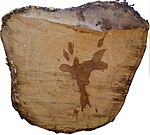

Rubber tree trunk

Wood Harvesting

As latex production declines with age, rubber trees are generally felled when they reach the age of 25 to 30 years. The earlier practice was to burn the trees, but in recent decades, the wood has been harvested for furniture making.


Latex being collected from an incised rubber tree and a bucket of collected latex

History
The Pará rubber tree initially grew only in the Amazon Rainforest. Increasing demand and the discovery of the vulcanization procedure in 1839 led to the rubber boom in that region, enriching the cities of Belém and Manaus. The name of the tree derives from Pará  the second-largest Brazilian state, the capital of which is Belém.
These trees were used to obtain rubber by the natives who inhabited its geographical distribution. The Olmec people of Mesoamerica extracted and produced similar forms of primitive rubber from analogous latex-producing trees such as Castilla elastica as early as 3600 years ago. The rubber was used, among other things, to make the balls used in the Mesoamerican ballgame. Early attempts were made in 1873 to grow H. brasilensis outside Brazil. After some effort, 12 seedlings were germinated at the Royal Botanic Gardens, Kew. These were sent to India for cultivation, but died. A second attempt was then made, some 70,000 seeds being smuggled to Kew in 1875, by Henry Wickham,  at the service of the British Empire. About 4% of these germinated, and in 1876, about 2000 seedlings were sent, in Wardian cases, to Ceylon (modern day Sri Lanka) and 22 were sent to the Botanic Gardens in Singapore. Once established outside its native country, rubber was extensively propagated in the British colonies. Rubber trees were brought to the botanical gardens at Buitenzorg, Java, in 1883. By 1898, a rubber plantation had been established in Malaya and today, most rubber tree plantations are in South and Southeast Asia, with some also in tropical West Africa.
Efforts to cultivate the tree in South America (Amazon) were unsatisfactory because of blight. The blight, called South American leaf blight, is caused by the Ascomycota, Microcyclus ulei or Pseudocercospora ulei.
Environmental Concerns
The toxicity of arsenic to insects, bacteria, and fungi has led to the heavy use of arsenic trioxide on rubber plantations, especially in Malaysia.
The majority of the rubber trees in Southeast Asia are clones of varieties highly susceptible to the South American leaf blight--Microcyclus ulei. For these reasons, environmental historian Charles C. Mann, in his 2011 book, 1493: Uncovering the New World Columbus Created, predicts that the Southeast Asian rubber plantations will be ravaged by the blight in the not-too-distant future, thus creating a potential calamity for international industry (p275-278).
Gallery

Notes

  1. ^ a b "Elastomer-The rubber tree", Encyclopaedia Britannica, 2008
  2. ^ "The Brazilian Armed Forces: Current changes, new challenges", Dreifuss, R. Armand. International Seminar Research Committee Armed Forces and Society, Romania, 2002. Retrieved August 19, 2009 from http://www.nestbrasil.com/rest/page8/files/rested1-dreyfus.pdf (p. 55)
  3. ^ "Amazon - The Animation", Greepeace Digital. Artificial Environments, n/d. Retrieved August 19, 2009 from http://www.ae-pro.com/preview.php?preid=31&pro=Amazon.
  4. ^ "Seringueira", Wikipédia, a enciclopédia livre, 2009. Retrieved 11h05min, August 19, 2009 from http://pt.wikipedia.org/w/index.php?title=Seringueira&oldid=15936263.
  5. ^ "Acre: História e etnologia", Marco António Gonçalves (Org.). Núcleo de Etnologia Indígena Laboratório de Pesquisa Social/IFCS - UFRJ, n/d. Retrieved August 19, 2009 from http://eduardoeginacarli.blogspot.com/2007_07_01_archive.html.
  6. ^ Winchester, Simon (2003). Krakatoa: The Day the World Exploded, August 27, 1883. HarperCollins. pp. 223–224. ISBN 0-06-621285-5.
  7. ^ South American Leaf Blight of rubber (Microcyclus ulei), plantwise.org
  8. ^ Erasing the Past: A New Identity for the Damoclean Pathogen Causing South American Leaf Blight of Rubber.
  9. ^ Sabina C. Grund, Kunibert Hanusch, Hans Uwe Wolf (2005), "Arsenic and Arsenic Compounds", Ullmann's Encyclopedia of Industrial Chemistry. Weinheim: Wiley-VCH, doi:10.1002/14356007.a03_113.pub2.

Further References

  • Zhang, J., Huss, V.A.R., Sun, X., Chang, K. and Pan, D. 2008. Morphology and phylogenetic position of a trebouxiophycean green algae (Chlorophyta) growing on the rubber tree, Hevea brasiliensis, with the description of a new genus and species. Eur. J. Phycol. 43(2): 185 - 193.

- Wikipedia 

GLOCHID

Glochids or glochidia (singular "glochidium") are hair-like spines or short prickles, generally barbed, found on the areoles of cacti in the sub-family Opuntioideae, Cactus glochids easily detach from the plant and lodge in the skin, causing irritation upon contact. The tufts of glochids in the areoles nearly cover the stem surfaces of some cactus species, each tuft containing hundreds of glochids; this may be in addition to, or instead of, the larger, more conspicuous cactus spines, which do not readily detach and are not generally barbed.


Glochids and spines on a species of Opuntia. The spines are the relatively large, radiating organs; the glochids are the fine prickles in the centres of the bunches

Mechanical Irritant Dermat
Reaction to the Glochidia
Most cacti possess spines, some large enough to cause serious wounds. Glochids however, though smaller, commonly induce more troublesome, more persistent, dermatological manifestations in humans. Though minute, glochids commonly are barbed and once they have penetrated the skin barbed glochids are practically impossible to dislodge without leaving scraps of foreign material in the wound.
Implantation of glochidia in the skin does sometimes cause immediate irritation, but not always, as one may deduce from the presentation of patients with granulomatous lesions around glochidia, patients who have no recollection of the penetration that caused the acute injury, even when it is clear that the injury is far from fresh. Distraction or excitement might cause the victim to overlook brushing past a cactus and picking up a few hundred barely visible glochids. In such cases, the irritant reaction may have a delayed onset. Shanon reported that brushing his axillary skin with sabra fruit resulted in no symptoms for a half hour, followed by 1½ hours of "stabbing feelings". Winer reports immediate burning sensation, redness and swelling which remained for one to three days if the spines were removed.  Depending on the exposure, widespread areas may be involved, even extending to hard palate, tongue, conjunctiva and cornea.
Glochids (Opuntia microdasys monstrose)
If the glochidia are not removed, a response may ensue that eventuates in granulomatous dermatitis. Within 24 to 72 hours there is the appearance of 2- to 5-mm, asymptomatic, domed, glistening papules, sometimes erythematous, with a central pin-point-sized black dot at the site of the injury.[3] There may be groups of these papules. Vesicles and pustules and even focal ulceration may also occur. In some instances, diagnosis can be made easily by passing the fingers over the affected area and by feeling the embedded glochidia.
Left untreated, these lesions may last as long as 9 months. A biopsy of the later lesions reveals granuloma formation with plant material embedded in the dermis. The fragments of the barbed bristles gave strongly positive reactions with PAS. The presence of a cactus granuloma lesion is often followed by post-inflammatory hyperpigmentation.
Penetrating injuries can introduce pathogenic microorganisms into the wound. Examples include Clostridium tetani and Staphylococcus aureus (from spines and thorns), Sporothrix schenckii (from rose thorns, grasses, and sphagnum moss), Mycobacterium kansasii (from blackberries), Mycobacterium marinum (from cactus spines), and Mycobacterium ulcerans (from spiky tropical vegetation).
Glochids from prickly pears (Opuntia species) can cause an extremely pruritic, papular eruption called sabra dermatitis, which can easily be confused with scabies or fiberglass dermatitis.
Sabra Dermatitis

The skin reaction of gatherers of the fruit was described in Israel and is known as "sabra dermatitis". This condition is characterized by a papular or vesicular reaction that is sometimes scabies-like. It has also been described as tinea-like and dyshidrosis-like.  The hard palate and tongue are occasionally affected. Typical areas of involvement of this irritant dermatitis include fingers, wrists, genitals, thorax, and buttocks. Biopsy of these lesions will reveal that they contain glochidia. Glochidia may be transferred to the workers' clothing and thence to other individuals. It is recommended that the fruit should be picked only when wetted, and picking should be stopped when it is windy since the glochidia can become airborne.


Sabra Dermatitis

Removal of Glochidia

If the glochidia are allowed to remain in the skin, a dermatitis may ensue that will persist for months. It may help to treat the affected area with a topical corticosteroid. However, since the presence of glochidia is the inciting factor, removal of these minute spines would seem to be a more rational approach.


Removing glochids usually have the problem that they are barbed, like the surface of this foxtail.
Glochidia may be difficult to remove. Yanking out the bristles may result in leaving one or more 20-30 micrometre sized barbs in the skin, later to be manifest by granuloma formation. Attempts to suck out the glochidia are likely to result in their attachment to the tongue. Popular methods of removing glochidia have included spreading adhesive plaster over the area and ripping it off quickly or using melted wax (hot wax sometimes employed for removing hair). Martinez et al. studied various methods of removing glochidia from rabbit skin. They evaluated tweezers, glue, facial mask, adhesive tape, package-sealing tape, and tweezing followed by glue. The most effective single method was tweezing, which removed 76% of the spines. The method using a thin layer of household glue (Elmer's Glue-All, Borden Inc) covered with gauze, allowed to dry (about 30 minutes) and then peeled off resulted in removal of 63% of the spines. Facial mask and adhesive tapes removed about 40% and 30% of the spines, respectively, and produced more retention and inflammation three days after removal than no treatment. Repeated applications of adhesive tape did not improve the results. According to Martinez, the most effective method is to first use tweezers to remove clumps of spines followed by the application and removal of household glue, resulting in removal of 95% of the spines.
Unroofing the early vesicles or pustules may permit manual extraction of the spicules. Soaking unroofed papules may allow for extrusion of the glochidia. Faster resolution may be obtained by removing the papules. A method of treatment has been described for the granulomatous papules, and involves unroofing the granulomatous papules, removing the glochidia fragments under a dissecting microscope, and subsequently soaking the wound in an antibacterial solution.
References

  1. ^ a b c d e Shanon, Jacob (1956). "Sabra Dermatitis". AMA Archives of Dermatology 74 (3): 269–75. doi:10.1001/archderm.1956.01550090043009, PMID 13361492.
  2. ^ Winer, Louis H. (1955). "Cactus Granulomas of the Skin". AMA Archives of Dermatology72 (6): 566–9. doi:10.1001/archderm.1955.03730360072010, PMID 13268063.
  3. ^ a b Schreiber, Michael M. (1971). "Cactus Granulomas of the Skin". Archives of Dermatology 104 (4): 374–9. doi:10.1001/archderm.1971.04000220032006 PMID 4107156.
  4. ^ Suzuki, Hiroyuki; Baba, Shunichi (1993). "Cactus Granuloma of the Skin". The Journal of Dermatology 20 (7): 424–7. doi:10.1111/j.1346-8138.1993.tb01311.x. PMID 8408924.
  5. ^ a b c Goodheart, Herbert P; Huntley, Arthur C (2001). "Rash after visiting Tucson". Dermatology Online Journal 7 (2): 10. PMID 12165226.
  6. ^ Plant Contact Dermatitis, Claude Benezra., George Ducombs, Yves Sell, Jean Foussereau. B.C. Decker Inc Toronto. 1985.
  7. ^ a b Vassileva, S; Stransky, L (1987). "Beruflich bedingte dyshidrosiforme Dermatitis der Hände nach Kontakt mit Kakteen. Kasuistische Mitteilung" [Occupationally-induced dyshidrosiform dermatitis of the hands following contact with cacti. Case report]. Dermatosen in Beruf Und Umwelt. Occupation and Environment (in German) 35 (6): 204–5. PMID 2964356 INIST:7582492.
  8. ^ a b Opuntia in BoDD – Botanical Dermatology Database
  9. ^ Botanical Dermatology, at eMedicine.
  10. ^ Spoerke, DG; Spoerke, SE (1991). "Granuloma formation induced by spines of the cactus, Opuntia acanthocarpa". Veterinary and Human Toxicology 33 (4): 342–4. PMID 1897129.
  11. ^ Martinez, Terry T. (1987). "Removal of Cactus Spines From the Skin". American Journal of Diseases of Children 141 (12): 1291–2. doi:10.1001/archpedi.1987.04460120053033. PMID 3687870.
  12. ^ Doctoroff, A; Vidimos, AT; Taylor, JS (2000). "Cactus skin injuries". Cutis 65 (5): 290–2. PMID 10826089.

- Wikipedia 

Sunday, 13 March 2016

AREOLE

In botany, areoles are small light- to dark-colored bumps on cacti, out of which grow clusters of spines. Areoles are important diagnostic features of cacti, and identify them as a family distinct from other succulent plants. The spines are not easily detachable, but on certain cacti, members of the subfamily Opuntioideae, smaller, detachable bristles, glochids, also grow out of the areoles and afford additional protection.
Aeroles and spines of the tree-like Pereskia grandifoli.
Areoles represent highly specialized branches on cacti. Apparently, they evolved as abortive branch buds while their spines evolved as vestigial leaves. In branched cacti, such as Opuntioidiae and the saguaro, new branches grow from areoles, because that is where the buds are. The development of the areole seems to have been an important element in the adaptation of cacti to niches in desert ecology.
Some of the Opuntioideae have spines, as well as glochids, on their areoles; some have only glochids. Structurally, the glochids seem to be bristles rather than evolved leaves. They are detachable and resemble small, sharp splinters. Unlike the spines, glochids generally are barbed and are very difficult to remove from the skin.
Evolution
The cactus family, the Cactaceae, evolved 30–40 million years ago in the Americas, originally completely separately from Africa, Europe, and Asia, although, probably within the last few million years, some species of Rhipsalis appear to have been carried to parts of Asia and Africa,  most likely by birds.
The areole was one of the unique features that cacti developed, possibly in adaptation to the ambient climate in the area in which they emerged. Accordingly, the areoles distinguish the family Cactaceae from other succulent plants both in the New World and the Old World.
Importance
For the cacti, areoles are an important evolutionary modification. They give rise to spines and glochids, which are their primary means of self-defense. In addition, because these spines arise from areoles and not directly from the plant stem, cacti can more effectively cover themselves with spines than other plants. The spines themselves can be of greater size and number.
In addition, areoles can produce spines of many different types to suit their needs. A typical areole may have one or a few long, sharp central spines, which serve as the primary defense. Beneath them are often numerous (10 or more) smaller, radial spines produced around the edge of the areole. These may serve as a secondary defense against small creatures that can get past the central spines. In some species, though, such as Cephalocereus senilis, the tangle of hairy radial spines serves to shade the plant and retain a layer of cool, humid air next to it.
Areoles contributed largely to the evolutionary success of the Cactaceae throughout the range of the family, and account for the diversification seen in the many species today.
References

  1. ^ Anderson, Edward F., The Cactus Family, Pub: Timber Press 2001 ISBN 978-0-88192-498-5

- Wikipedia 

What Is Quercetin?

Although not an essential nutrient, quercetin is a substance found in some fruits and vegetables that may provide important antioxidant effects. You can take quercetin supplements to help in treating a wide variety of health conditions, such as allergies, heart disease, prostatitis and certain eye conditions. Talk with your healthcare provider before taking quercetin tablets or capsules to discuss proper dosage and any potential health risks or interactions.
What Is Quercetin?

Person holding a glass of red wine to the sky Photo Credit amana productions inc./amana images/Getty Images

Description

Quercetin is a water-soluble substance that gives certain fruits and vegetables their coloring, explains the University of Pittsburgh Medical Center. These plant-based pigments are called bioflavonoids. Quercetin is found in small doses in beans and leafy green vegetables, but in larger amounts in onions, apples, grapefruits, red wine, buckwheat, green tea and black tea.

Benefits

Quercetin supplements may help to treat allergies, inflammation and cardiovascular diseases, as well as potentially prevent and treat cancer, says the Memorial Sloan-Kettering Cancer Center. Quercetin may also help to treat eczema, asthma, hives, prostatitis and interstitial cystitis. Some medical evidence indicates that taking quercetin supplements can help treat cataracts, certain childhood diseases, gout, edema, peptic ulcers, diabetes and retinopathy, notes the University of Michigan Health System. You can take the typical dosage of 200 to 500 milligrams of quercetin two or three times daily. For therapeutic uses, you must take a supplement, because vegetables and fruits contain only small amounts of quercetin.

Function

Quercetin contains bioflavonoids, which provide the antioxidant properties that help fight free radicals in the body. Quercetin’s bioflavonoids also suppress your body’s histamine and leukotriene production, which provide the anti-inflammatory actions and allergic reaction-fighting effects. The major constituents in quercetin may also inhibit cholesterol absorption, as well as provide antiviral and anticancer actions.

Medical Evidence

Quercetin is shown effective against numerous conditions. According to the University of Michigan Health System, studies prove quercetin's ability to fight and help treat prostatitis, allergies, asthma, heart disease, cataracts, viral infections, hay fever, gout and type 1 and type 2 diabetes. It is also shown to enhance athletic performance and treat bronchial infections that can follow intensive exercise.

Warnings

If you’re pregnant, you shouldn’t take quercetin supplements due to the potential risk of infant leukemia and possible chromosomal mutations. Also, if your doctor is conducting a test to diagnose the rare but deadly condition called neuroblastoma, keep in mind that taking quercetin supplements may cause a falsely positive test result due to their effects on homovanillic acid levels in your blood and urine.
www.livestrong.com

Maximum Dosage of Vitamin C

Vitamin C is water-soluble; meaning, it is not stored in your body. You need to consume adequate amounts of vitamin C each day to get all of the benefits it provides. Having too much vitamin C from your diet or supplements may have adverse effects. Do not consume more than the maximum recommended dosage each day.
Maximum Dosage of Vitamin C
Strawberries are an excellent source of vitamin C. Photo Credit Ablestock.com/AbleStock.com/Getty Images

Maximum Dosage

Women need around 75 mg of vitamin C daily, while men need as much as 90 mg. Since vitamin C is water soluble, your body will excrete any excess vitamin C that it doesn't need. You can safely consume up to 2000 mg, reports the Office of Dietary Supplements. Having more than 2000 mg, or 2 g, of vitamin C in your diet may cause adverse health effects.

Benefits

You may take extra vitamin C during winter months to help boost your immune system, but vitamin C has several other benefits. Vitamin C acts as an antioxidant in your body, meaning it helps fight off free radicals that damage cells and cause chronic illnesses. Your overall growth and tissue repair rely heavily on the vitamin C you consume. Collagen production cannot occur without vitamin C. You need collagen to make new skin, tendons, ligaments and cartilage. Vitamin C also helps repair and produce blood vessels and keeps vessels dilated to improve blood flow.

Negative Effects

Dosages at or over 2,000 mg, or 2 g, of vitamin C are considered a very high dosage. If you consume this much, you may have a greater risk of kidney stones, birth defects, atherosclerosis, excessive iron absorption, B-12 deficiency and erosion of dental enamel. In addition to this, consuming more than the maximum dosage of vitamin C may cause gastrointestinal problems such as bloating and diarrhea. Excessive Vitamin C intake is more commonly seen with supplementation.

Food Sources

Your body utilizes vitamin C better when it comes from food sources instead of supplements. Fruits and vegetables are naturally loaded with vitamin C. Enjoy a 6-oz. glass of orange juice, which contains 93 mg. Other fruit selections include a medium kiwi, which has 75 mg; 1/2 cup of fresh strawberries with 49 mg; or half a grapefruit, which has 39 mg. A 1/2-cup serving of raw red peppers provides 95 mg; 1/2 cup of steamed broccoli contains 39 mg; a medium baked potato has about 20 mg; and 1/2 cup of raw cauliflower florets provides 23 mg.
www.livestrong.com

Advantages and Disadvantages of Fasting for Runners

Author BY   ANDREA CESPEDES  Food is fuel, especially for serious runners who need a lot of energy. It may seem counterintuiti...