Blog List

Friday, 25 March 2016

How to Smoke a Ham Shank on a Charcoal Grill

Ham comes from the hind leg of the pig, and the shank portion is the lowest part of the whole ham. Ham shank typically comes bone-in and is available in grocery stores either "ready to eat" or "ready to cook." Ham shanks that are ready to eat are already cooked; ready-to-cook shanks require cooking for safe consumption. Make sure your ham reaches an internal temperature of approximately 145 degrees Fahrenheit. One way to achieve this cooking temperature and add good smoky flavor is to smoke the ham shank on a traditional charcoal grill.
How to Smoke a Ham Shank on a Charcoal Grill
A baked ham shank. Photo Credit oei1/iStock/Getty Images

Grill Preparation

Step 1

Place hardwood chips in water, and soak them for at least 30 minutes.

Step 2

Place the charcoal in your grill and spray it with lighter fluid -- or simply add lighter briquettes to your grill. Light them and allow them to burn until they turn white or light gray.

Step 3

Divide the lit charcoal in half, and push it against either side of the grill, creating an open space in the middle.

Step 4

Place an aluminum drip pan in the open area and pour three cups of a liquid into the pan. This liquid will help keep the air inside the grill moist and prevent the ham from drying out.

Step 5

Place a handful of soaked wood chips on both piles of charcoal, and replace the grill food grate.

Smoking

Step 1

Place your ham shank on the grate over the drip pan.

Step 2

Monitor the interior temperature of the ham shank with a meat thermometer. According to the USDA, ham must reach an internal temperature of 145 degrees Fahrenheit to be fully cooked.

Step 3

Remove the ham shank when it reaches the proper temperature, tent it loosely with aluminum foil, and allow it to rest for 10 minutes. Resting finishes the cooking process and forces the juices to reabsorb into the meat for a more tender smoked ham shank.

How to Broil or Bake a Leg of Chicken

A simple chicken breast is well known as a healthy entree, but most people don't realize that chicken legs are also a healthy choice. Dark meat chicken, found in the legs and thighs, contains iron-rich myoglobin. Dark meat also contains more zinc and B vitamins than a chicken breast and is rich in calcium and potassium. For a healthier chicken leg, remove the chicken skin. By skinning a 6-ounce serving of chicken, you save 11 grams of fat. Choose from a variety of seasonings to flavor your meal, then bake or broil for a healthy main dish.
How to Broil or Bake a Leg of Chicken
Roasted chicken leg with herbs and spices. Photo Credit Tetiana_Chudovska/iStock/Getty Images

Prepare the Chicken

Step 1

Create a seasoning mix of your choice. You can use a commercial rub mix or make your own seasonings from herbs and spices. Good flavor combinations include soy sauce, garlic, pepper and dried parsley. Alternatively, marinate chicken for up to 8 hours in a mixture of honey, Dijon mustard and curry powder. If you wish to serve the chicken with a sauce, simply coat the chicken lightly with olive oil or melted butter and season simply with salt and pepper or lemon pepper. If you like your chicken breaded, toss chicken legs in bread crumbs after seasoning.

Step 2

Remove the skin from chicken legs. Season the chicken with your choice of herbs or spices.

Step 3

Line a roasting pan with foil for easy clean up. Spray the roasting rack with cooking spray to prevent sticking. Place the chicken legs on the rack of the roasting pan leaving space between each piece.

Broiling Chicken

Step 1

Place seasoned chicken under a preheated broiler, 4 to 5 inches below the broiler.

Step 2

Broil the chicken legs for 10 minutes. Turn them with tongs and brush them with more oil, seasoning mix or marinade.

Step 3

Broil for another 10 minutes or until the chicken is tender and the juices are clear. Chicken legs are done when the internal temperature reaches at least 165 degrees Fahrenheit on an instant-read meat thermometer.

Baking Chicken Legs

Step 1

Preheat the oven to 350 F.

Step 2

Place the prepared chicken on the center rack and bake it for 45 to 50 minutes or until the chicken is tender.

Step 3

Check the internal temperature with an instant-read meat thermometer. Chicken is safe to eat when the temperature reads at least 165 F. Many cooks prefer to cook chicken to 185 F.

What Are the Benefits of Juicing Broccoli?

A member of the cabbage family, broccoli is more commonly served chopped -- raw or cooked -- than juiced. Drinking broccoli juice is another way to take advantage of the health benefits of this nutrient-packed food. Because the taste of pure broccoli juice can be strong, try blending it with sweeter juices such as apple, orange or carrot to make it more palatable. Combining it with other green juices -- collard greens or spinach, for example -- also works well. It takes 2 cups of chopped, raw broccoli to produce a 3/4-cup serving of fresh broccoli juice.
What Are the Benefits of Juicing Broccoli?
A glass of broccoli juice next to some florets. Photo Credit belchonock/iStock/Getty Images

Rich in Iron

Because iron is needed to produce blood cells, it is considered an essential mineral. Of special importance is that iron is needed to produce hemoglobin and myoglobin, two oxygen-carrying proteins which transport oxygen throughout your body. The daily recommendation for iron is 8 milligrams for adult men as well as for women 51 years and older. For women under the age of 50, the recommendation rises to 18 milligrams per day. A 3/4-cup serving of broccoli juice has 1.33 milligrams of iron, providing 17 and 7.4 percent of these daily recommendations.

High in Folate

Folate is also known as vitamin B-9. Necessary for the production of DNA, folate is especially important during periods of rapid body development, including pregnancy and the teenage years. Folate is also important for healthy brain function and for your overall mental and emotional well-being. As a B vitamin, folate keeps your eyes, skin, hair and liver healthy; provides support to your immune system; and improves your body’s ability to withstand stress. The daily recommendation of folate for adult men and women is 400 milligrams, rising to 500 milligrams for pregnant women and 600 milligrams for women who are breastfeeding. With 115 milligrams of folate per 3/4-cup serving, broccoli juice contains between 19.2 and 33.3 percent of the daily recommendation for folate.

Riboflavin -- A Natural Antioxidant

Riboflavin, like folate, is a member of the B vitamin group. It is also known as vitamin B-2. Like folate, it provides support to your immune system and improves your body’s stress tolerating capacity. It also helps your body process fats and proteins. Riboflavin helps your body process vitamin B-6 and folate into usable forms and, as an antioxidant, protects your body’s cells from free radicals, created when your body breaks down food. Free radicals can speed up the aging process, making you more susceptible to heart disease and cancer. With 0.2 milligrams of riboflavin per 3/4-cup serving of broccoli juice, you will receive between 19 and 27 percent of the daily recommendation of riboflavin. The daily recommendations of riboflavin are 1.3 milligrams for adult men, 1.1 milligrams for adult women, 1.4 milligrams for pregnant women and 1.6 milligrams for breastfeeding women.

A Source of Vitamin K

A 3/4-cup serving of broccoli juice has 185 milligrams of vitamin K. This is significantly more than 100 percent of the daily adequate intake for all adults, including women who are pregnant and breastfeeding. Vitamin K is also known as the blood clotting vitamin because it helps your blood coagulate. Without it, you can suffer from abnormal bleeding and difficulty healing from wounds and bruises. Vitamin K is also needed to help your body absorb calcium, making it important in keeping your bones and teeth strong.
www.livestrong.com

POST-HARVEST LOSSES (VEGETABLES)

The post-harvest sector includes all points in the value chain from production in the field to the food being placed on a plate for consumption. Postharvest activities include harvesting, handling, storage, processing, packaging, transportation and marketing.
Discarded tomatoes on a compost heap at nurseries in the UK
Losses of horticultural produce are a major problem in the post-harvest chain. They can be caused by a wide variety of factors, ranging from growing conditions to handling at retail level. Not only are losses clearly a waste of food, but they also represent a similar waste of human effort, farm inputs, livelihoods, investments and scarce resources such as water. Post-harvest losses for horticultural produce are, however, difficult to measure. In some cases everything harvested by a farmer may end up being sold to consumers. In others, losses or waste may be considerable. Occasionally, losses may be 100%, for example when there is a price collapse and it would cost the farmer more to harvest and market the produce than to plough it back into the ground. Use of average loss figures is thus often misleading. There can be losses in quality, as measured both by the price obtained and the nutritional value, as well as in quantity.
On-farm causes of loss

There are numerous factors affecting post-harvest losses, from the soil in which the crop is grown to the handling of produce when it reaches the shop. Pre-harvest production practices may seriously affect post-harvest returns. Plants need a continuous supply of water for photosynthesis and transpiration. Damage can be caused by too much rain or irrigation, which can lead to decay; by too little water; and by irregular water supply, which can, for example, lead to growth cracks. Lack of plant food can affect the quality of fresh produce, causing stunted growth or discoloration of leaves, abnormal ripening and a range of other factors. Too much fertilizer can harm the development and post-harvest condition of produce. Good crop husbandry is important for reducing losses. Weeds compete with crops for nutrients and soil moisture. Decaying plant residues in the field are also a major loss factor. 

Causes of loss after harvest
Fruits and vegetables are living parts of plant and contain 65 to 95 percent water. When food and water reserves are exhausted, produce dies and decays. Anything that increases the rate at which a product’s food and water reserves are used up increases the likelihood of losses. Increases in normal physiological changes can be caused by high temperature, low atmospheric humidity and physical injury. Such injury often results from careless handling, causing internal bruising, splitting and skin breaks, thus rapidly increasing water loss.
Respiration is a continuing process in a plant and cannot be stopped without damage to the growing plant or harvested produce. It uses stored starch or sugar and stops when reserves of these are exhausted, leading to ageing. Respiration depends on a good air supply. When the air supply is restricted fermentation instead of respiration can occur. Poor ventilation of produce also leads to the accumulation of carbon dioxide. When the concentration of carbon dioxide increases it will quickly ruin produce.
Fresh produce continues to lose water after harvest. Water loss causes shrinkage and loss of weight. The rate at which water is lost varies according to the product. Leafy vegetables lose water quickly because they have a thin skin with many pores. Potatoes, on the other hand, have a thick skin with few pores. But whatever the product, to extend shelf or storage life the rate of water loss must be minimal. The most significant factor is the ratio of the surface area of the fruit or vegetable to its volume. The greater the ratio the more rapid will be the loss of water. The rate of loss is related to the difference between the water vapour pressure inside the produce and in the air. Produce must therefore be kept in a moist atmosphere.
Diseases caused by fungi and bacteria cause losses but virus diseases, common in growing crops, are not a major post-harvest problem. Deep penetration of decay makes infected produce unusable. This is often the result of infection of the produce in the field before harvest. Quality loss occurs when the disease affects only the surface. Skin blemishes may lower the sale price but do not render a fruit or vegetable inedible. Fungal and bacterial diseases are spread by microscopic spores, which are distributed in the air and soil and via decaying plant material. Infection after harvest can occur at any time. It is usually the result of harvesting or handling injuries.
Ripening occurs when a fruit is mature. Ripeness is followed by senescence and breakdown of the fruit. The category “fruit” refers also to products such as aubergine, sweet pepper and tomato. Non-climacteric fruit only ripen while still attached to the parent plant. Their eating quality suffers if they are harvested before fully ripe as their sugar and acid content does not increase further. Examples are citrus, grapes and pineapple. Early harvesting is often carried out for export shipments to minimise loss during transport, but a consequence of this is that the flavour suffers. Climacteric fruit are those that can be harvested when mature but before ripening has begun. These include banana, melon, papaya, and tomato. In commercial fruit marketing the rate of ripening is controlled artificially, thus enabling transport and distribution to be carefully planned. Ethylene gas is produced in most plant tissues and is important in starting off the ripening process. It can be used commercially for the ripening of climacteric fruits. However, natural ethylene produced by fruits can lead to in- storage losses. For example, ethylene destroys the green colour of plants. Leafy vegetables will be damaged if stored with ripening fruit. Ethylene production is increased when fruits are injured or decaying and this can cause early ripening of climacteric fruit during transport.
Damage in the marketing chain

Fruits and vegetables are very susceptible to mechanical injury. This can occur at any stage of the marketing chain and can result from poor harvesting practices such as the use of dirty cutting knives; unsuitable containers used at harvest time or during the marketing process, e.g. containers that can be easily squashed or have splintered wood, sharp edges or poor nailing; overpacking or underpacking of containers; and careless handling of containers. Resultant damage can include splitting of fruits, internal bruising, superficial grazing, and crushing of soft produce. Poor handling can thus result in development of entry points for moulds and bacteria, increased water loss, and an increased respiration rate.
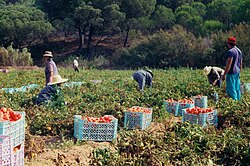

Tomato harvesting in Portugal
Produce can be damaged when exposed to extremes of temperature. Levels of tolerance to low temperatures are importance when cool storage is envisaged. All produce will freeze at temperatures between 0 and -2 degrees Celsius. Although a few commodities are tolerant of slight freezing, bad temperature control in storage can lead to significant losses.
Some fruits and vegetables are also susceptible to contaminants introduced after harvest by use of contaminated field boxes; dirty water used for washing produce before packing; decaying, rejected produce lying around packing houses; and unhealthy produce contaminating healthy produce in the same packages.
Losses directly attributed to transport can be high, particularly in developing countries. Damage occurs as a result of careless handling of packed produce during loading and unloading; vibration (shaking) of the vehicle, especially on bad roads; and poor stowage, with packages often squeezed into the vehicle in order to maximise revenue for the transporters. Overheating leads to decay, and increases the rate of water loss. In transport it can result from using closed vehicles with no ventilation; stacking patterns that block the movement of air; and using vehicles that provide no protection from the sun. Breakdowns of vehicles can be a significant cause of losses in some countries, as perishable produce can be left exposed to the sun for a day or more while repairs are carried out.
At the retail marketing stage losses can be significant, particularly in poorer countries. Poor-quality markets often provide little protection for the produce against the elements, leading to rapid produce deterioration. Sorting of produce to separate the saleable from the unsaleable can result in high percentages being discarded, and there can be high weight loss from the trimming of leafy vegetables. Arrival of fresh supplies in a market may lead to some existing, older stock being discarded, or sold at very low prices.
Avoiding loss

Losses can be avoided by following good practices as indicated above. There is also a wide range of post-harvest technologies that can be adopted to improve losses throughout the process of pre-harvest, harvest, cooling, temporary storage, transport, handling and market distribution. Recommended technologies vary depending on the type of loss experienced. However, all interventions must meet the principle of cost-effectiveness. In theory it should be possible to reduce losses substantially but in practice this may be prohibitively expensive. Especially for small farms, for which it is essential to reduce losses, it is difficult to afford expensive and work-intensive technologies. 

Assessing losses

There are no reliable methods for evaluating post-harvest losses of fresh produce. Any assessment can only refer to a particular value chain on a particular occasion and, even then, it is difficult to account for quality loss or to differentiate between unavoidable moisture loss and losses due to poor post-harvest handling and other factors described above. Accurate records of losses at various stages of the marketing chain are rarely kept, particularly in tropical countries where losses can be highest, making reliable assessment of the potential cost-effectiveness of interventions at different stages of the chain virtually impossible. The lack of such information may lead to misplaced interventions by governments and donors.

External Links

  • Washington State University Tree Fruit Research & Extension Center, Postharvest Information Network Article Database.

References

  1. ^ Mrema, C. G. and Rolle, S. R. (2002). Status of the postharvest sector and its contribution to agricultural development and economic growth. 9th JIRCAS International Symposium – Value Addition to Agricultural Product, pp. 13-20. [1].
  2. ^ World Resources Institute (1998). Disappearing Food: How Big are Postharvest Losses? [2]EarthTrends
  3. ^ FAO Prevention of post-harvest food losses: fruits, vegetables and root crops - a training manual [3]FAO Training Series 17/2, Rome, 1989
  4. ^ Kader, A. A. (2005) (PDF). Increasing Food Availability by Reducing Postharvest Losses of Fresh Produce [4]UC Davis
  5. ^ Lopez-Camelo, Andres. Manual for the preparation and sale of fruits and vegetables – from farm to market.[5]FAO, Rome 2004
  6. ^ FAO Prevention of post-harvest food losses: fruits, vegetables and root crops - a training manual [6]FAO Training Series 17/2, Rome, 1989
  7. ^ Kader, A. A. (2005) (PDF). Increasing Food Availability by Reducing Postharvest Losses of Fresh Produce [7]UC Davis
  8. ^ Lopez-Camelo, Andres. Manual for the preparation and sale of fruits and vegetables – from farm to market. [8]FAO, Rome 2004
  9. ^ Dixie, G.; Horticultural Marketing [9]FAO, Rome, 2005
  10. ^ Kadar, A.A. (2003). A Perspective on Postharvest Horticulture (1978-2003). HortScience, 38(5), pp. 1004-1008. [10]U.C. Davis.
  11. ^ Uwe Hoering (March 2012). "Loss and Waste. dandc.eu.

- Wikipedia 

POST-HARVEST LOSSES (GRAINS)

Grains may be lost in the pre-harvest, harvest and post-harvest stages. Pre-harvest losses occur before the process of harvesting begins, and may be due to insects, weeds and rusts. Harvest losses occur between the beginning and completion of harvesting, and are primarily caused by losses due to shattering. Post-harvest losses occur between harvest and the moment of human consumption. They include on-farm losses, such as when grain is threshed, winnowed and dried, as well as losses along the chain during transportation, storage and processing. Important in many developing countries, particularly in Africa, are on-farm losses during storage, when the grain is being stored for auto-consumption or while the farmer awaits a selling opportunity or a rise in prices.


Grain silos in Australia

Potential for loss

There is potential for loss throughout the grain harvesting and agricultural marketing chains. During stripping of maize grain from the cob, known as shelling, losses can occur when mechanical shelling is not followed up by hand-stripping of the grains that are missed. Certain shellers can damage the grain, making insect penetration easier. For crops other than maize, threshing losses occur as a result of spillage, incomplete removal of the grain or by damage to grain during the threshing. They can also occur after threshing due to poor separation of grain from the chaff during cleaning or winnowing. Incomplete threshing usually occurs in regions with high labour costs, particularly at harvest time, when labour is too scarce and expensive to justify hand-stripping after an initial mechanical thresh. Certain mechanical threshers are designed only for dry grain.
A wet season's paddy harvest may clog the screens and grain will be lost. Cleaning is essential before milling. On the farm, cleaning is usually a combination of winnowing and removal by hand of heavier items such as stones. Losses can be low when the operation is done carefully but high with carelessness. With correct equipment, cleaning losses should be low in mills, but grain may be separated together with dirt or, alternatively, dirt may be carried forward into the milling stages. In drying, grain that is dried in yards or on roads, as is common in parts of Asia, may be partially consumed by birds and rodents. Wind, either natural or from passing vehicles in the case of road drying, can blow grain away.
The main cause of loss during drying is the cracking of grain kernels that are eaten whole, such as rice. Some grains may also be lost during the drying process. However, failure to dry crops adequately can lead to much higher levels of loss than poor-quality drying, and may result in the entire harvest becoming inedible. Adequate drying by farmers is essential if grains are to be stored on-farm and poorly dried grains for the market need to be sold quickly to enable the marketing-processing chain to carry out adequate drying before the grains become spoilt. With a high moisture content, grain is susceptible to mould, heating, discoloration and a variety of chemical changes. Ideally, most grains should be dried to acceptable levels within 2–3 days of harvest. One of the problems in assessing levels of post-harvest loss is in separating weight loss caused by the very necessary drying operations from weight loss caused by other, controllable, factors.
Milling to remove the outer coats from a grain may take place in one or more stages. For paddy rice considerable mechanical effort is needed to remove these layers. Any weakness in the kernel will be apparent at this stage. Even with grain in perfect condition, correctly set milling and polishing machinery is essential to yield high processing outturns. Complete separation of edible from less-desired products is always difficult to achieve but, even so, there are significant differences in milling efficiency. In the case of rice, milling outturns can vary from 60% or less to around 67%, depending on the efficiency of the mill. Even a 1% increase in yield of whole grain rice can thus result in huge increases in national food resources.


Manual rice mill in Vietnam

Grains are produced on a seasonal basis. In many places there is only one harvest a year. Thus most production of maize, wheat, rice, sorghum, millet, etc. must be held in storage for periods varying from a few days up to more than a year. Storage therefore plays a vital role in grain supply chains. For all grains, storage losses can be considerable but the greatest losses appear to be of maize, particularly in Africa. Losses in stored grain are determined by the interaction between the grain, the storage environment and a variety of organisms.
Contamination by moulds is mainly determined by the temperature of the grain and the availability of water and oxygen. Moulds can grow over a wide range of temperatures, but the rate of growth is lower with lower temperature and less water availability. The interaction between moisture and temperature is important. Maize, for example, can be stored for one year at a moisture level of 15% and a temperature of 15 °C. However, the same maize stored at 30 °C will be substantially damaged by moulds within three months. Insects and mites (arthropods) can, of course, make a significant contribution towards the deterioration of grain, through the physical damage and nutrient losses caused by their activity.
The Black Rat (Rattus rattus)
They can also influence mould colonisation as carriers of mould spores and because their faecal material can be utilised as a food source by moulds. In general, grain is not infested by insects below 17 °C whereas mite infestations can occur between 3 and 30 °C and above 12% moisture content. The metabolic activity of insects and mites causes an increase in both the moisture content and temperature of infested grain. Another important factor that can affect mould growth is the proportion of broken kernels. There are about 1,700 species of rodents in the world, but only a few species contribute significantly to post-harvest losses. Three species are found throughout the world: the house mouse (Mus musculus), the black rat (Rattus rattus) and the brown rat while a few other species are important in Africa and Asia.
Actual loss

In Africa, post-harvest losses from harvest to market sale amount to around 10-20%. Approximately 40% of these losses occur during storage at the farm and market, 30% during processing (drying, threshing, and winnowing), 20% in transport from the field to the homestead/farm, and the remaining 10% during transport to market.

Loss assessment methods

An attempt should be made to approximate the magnitude of the value of losses before time is spent on trying to reduce them. If this value proves to be low, expenditure of appreciable resources on reducing losses may not be justified. However, despite efforts over the years to develop acceptable techniques for measuring grain losses, this remains an imperfect science. A particular problem with measurement is that grain does not follow a uniform sequence from producer to consumer. Harvested grain can be specially dried and treated for a family's consumption or for use as seed. Some of any harvest may be held for short-term storage, some more for long-term storage, and the rest may be sold either in one go or over a period of time, through a variety of different marketing channels. There are particular difficulties associated with accurately measuring on-farm storage losses over a long period when farmers are continually removing grain from stores to meet their own consumption needs. Further, the surplus generated by a farmer at any one harvest will dictate the quantity stored and the quantity sold, which, in turn, may influence loss levels. Given the lack of a consistent chain, care must be taken to avoid generalizing from particular measurements. "Inordinately high- and low-loss situations must be put into perspective rather than giving them overemphasis as has been the case in some instances."

The origin and justification of grain-loss estimates has thus never been particularly well- founded and attempts to measure losses suffer from the fact that it is an extremely complex and costly exercise to do well. To get round this problem the African Postharvest Losses Information System (APHLIS), was established in 2009. APHLIS generates weight loss data using an algorithm that refers to a postharvest loss profile (PLP) that is specific to the cereal crop, climate and scale of farming (smallholder or large scale) in question. The PLP is a set of loss figures, one for each link in the postharvest chain. Each PLP figure is the average of all those data available in the scientific literature for a particular crop (which include both quantitative weight loss figures and ‘informed guestimates’), under a particular climate, and at a particular scale of agriculture. Given data on production and certain other relevant seasonal data, APHLIS can provide weight loss estimates for the provinces of many countries in Sub-Saharan Africa. The data are provided in tables and as interactive maps. A further important feature of APHLIS is that it provides a version of its loss calculator that can be downloaded from the website as an Excel file. Users can change default values in the spreadsheet and make calculations of losses at any desired geographical scale below the level of ‘province’. With this calculator, users can go beyond estimation of losses at one link in the postharvest chain, e.g. just storage losses, which was the typical approach of the 1970s, and instead by substituting what figures they have for the default values in the PLP they can generate an estimate of cumulative losses from production, in other words they can see the changes in cereal grain supply that result from improving or deteriorating losses across the postharvest value chain. APHLIS thus provides data that are transparent in the way they are calculated, adjustable year by year according to circumstances, and upgradeable as more (reliable) data become available.

Attempts at loss reduction

There have been numerous attempts by donors, governments and technical assistance agencies over the years to reduce post-harvest losses in developing countries. Despite these efforts, losses are generally considered to remain high although, as noted, there are significant measurement difficulties. One problem is that while engineers have been successful in developing innovations in drying and storage these innovations are often not adopted by small farmers. This may be because farmers are not convinced of the benefits of using the technology. The costs may outweigh the perceived benefits and even if the benefits are significant the investment required from farmers may present them with a risk they are not prepared to take. Alternatively, the marketing chains may not reward farmers for introducing improvements. While good on-farm drying will lead to higher milling yields or reduced mycotoxin levels this means nothing to farmers unless they receive a premium for selling dry grains to traders and mills. This is often not the case.
Thus part of the problem with uptake may have been an overemphasis on technology, to the exclusion of socio-economic considerations. In the case of drying, it may be a more appropriate solution to strengthen the capacity of mills and traders to dry than attempt village-level improvements. There is thus a continual need to balance and blend technically ideal procedures and approaches with social, cultural, and political realities. Past on-farm storage interventions that have proved less than successful have included the promotion of costly driers in W. Africa that fell victim to termites when made with local wood or bamboo and were too expensive when constructed with sawn wood. In the 1980s, there was considerable enthusiasm for the introduction of ferro-cement and brick bins throughout Africa, but these were often found to be too complicated for farmers to construct, and too costly. Small Breeze block silos also experienced construction difficulties and were found to be not economically feasible. Storage cribs made of wood and chicken-wire were introduced by donors but rejected by farmers because sides made of chicken wire showed others the size of each farmer's harvest.
More positive achievements have been recorded in the Central African Republic, using a simple 1-tonne capacity structure that was found by farmers to be easy to construct and proved popular even without donor subsidies. Considerable success has been reportedly achieved with metal bins over the last 20 years in Central America and metal bins have been widely used for grain storage in Swaziland for half a century, drawing on the availability of local entrepreneurs who had been supplying metal water tanks. Replication of this success in other parts of Africa is very much in the pilot stage. Difficulties include the lack of local craftsmen to fabricate the bins; the need for grain stored in such bins to be dried to 14 °C, and problems with carrying out the necessary fumigation. Small-scale bins for use inside the home appear to be having more success than larger bins for outside use. A relatively new development is hermetically sealed bags, which appear to offer good possibilities to store a variety of quantities, although further socio-economic evaluation is still required. The Purdue Improved Cowpea Storage (PICS) bags are hermetically sealed bags that allow small-scale farmers/users to store cowpea without any use of chemicals.
References

  1. ^ Harris, Kenton L. and Carl J. Lindblad, eds. Postharvest Grain Loss Assessment Methods - A Manual of Methods for the Evaluation of Postharvest Losses [1]American Association of Cereals Chemists, 1976
  2. ^ Proctor, D.L., Grain Storage Techniques [2]FAO, Rome, 1994
  3. ^ Proctor, D.L., Grain Storage Techniques [3]FAO, Rome, 1994
  4. ^ African Post Harvest Losses Information System (APHLIS).
  5. ^ Greeley M. and G. W. Harman, Losses and the Economist. Chapter VIII in Kenton L. Harris and Carl J. Lindblad, eds. Postharvest Grain Loss Assessment Methods - A Manual of Methods for the Evaluation of Postharvest Losses [4], American Association of Cereals Chemists, 1976
  6. ^ Kenton L. Harris and Carl J. Lindblad, eds. Postharvest Grain Loss Assessment Methods - A Manual of Methods for the Evaluation of Postharvest Losses [5], American Association of Cereals Chemists, 1976
  7. ^ K. L. Harris, W. J. Hoover, C. J. Lindblad, and H. Pfost, An Overview of the Postharvest System: The Food Grain Supply Pipeline (Determining the Interrelationship and Relative Magnitude of Losses) in Kenton L. Harris and Carl J. Lindblad, eds. Postharvest Grain Loss Assessment Methods - A Manual of Methods for the Evaluation of Postharvest Losses. [6], American Association of Cereals Chemists, 1976
  8. ^ African Post Harvest Losses Information System (APHLIS).
  9. ^ Shepherd, Andrew W. (1993) Economic and marketing aspects of post-harvest handling of grains [7] FAO, Rome
  10. ^ Reining,C.C. Anthropological Signposts, Chapter 3 in Kenton L. Harris and Carl J. Lindblad, eds. Postharvest Grain Loss Assessment Methods - A Manual of Methods for the Evaluation of Postharvest Losses. [8] American Association of Cereals Chemists, 1976
  11. ^ Shepherd, Andrew W. (2012) Grain Storage in Africa: Learning from past experiences. Food Chain 2(2) 149-163.
  12. ^ [9 ]of the Swiss Agency for Development and Cooperation (SDC)
  13. ^ FAO, (2008). Household metal silos.[10], FAO, Rome
  14. ^ http://www.ag.purdue.edu/ipia/pics.

- Wikipedia 

Advantages and Disadvantages of Fasting for Runners

Author BY   ANDREA CESPEDES  Food is fuel, especially for serious runners who need a lot of energy. It may seem counterintuiti...