Blog List

Wednesday, 30 March 2016

RED RICE

Red rice, is a variety of rice that is colored red by its anthocyanin content. It is usually eaten unhulled or partially hulled, and has a red husk, rather than the more common brown. Red rice has a nutty flavor. Compared to polished rice, it has the higher nutritional value of rices eaten with the germ intact.
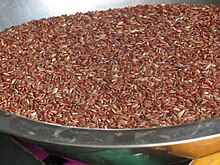

Red rice

Varieties
Varieties of red rice include:
  • Oryza longistaminata, also known as red rice
  • Oryza punctata, also known as red rice
  • Red rice, also known as weedy rice, a low-yielding rice variety that persists as a weed in fields of better-quality rice
  • Rakthashali, a rare rice variety
  • Thai Red Cargo rice, a non-glutinous long grain rice variety
  • Bhutanese red rice, a medium-grain rice grown in the Kingdom of Bhutan in the eastern Himalayas
  • Camargue red rice, a relatively new variety of rice cultivated in the wetlands of the Camargue region of southern France
  • Matta rice Kerala Matta rice, also known as Rosematta rice, Palakkadan Matta rice, Kerala Red rice, and Red parboiled rice, is an indigenous variety of rice grown in Palakkad District of Kerala. It is popular in Kerala and Sri Lanka, where it is used for idlies and appams, and eaten plain.

Dishes

  • Red Rice a traditional Gullah Lowcountry dish, similar to West African jollof rice.
  • Sekihan, literally "red bean rice", a Japanese traditional dish.

- Wikipedia 

SMUT (FUNGUS)

The smuts are multicellular fungi characterized by their large numbers of teliospores. The smuts get their name from a Germanic word for dirt because of their dark, thick-walled, and dust-like teliospores. They are mostly Ustilaginomycetes (of the class Teliomycetae, subphylum Basidiomycota) and can cause plant disease. The smuts are grouped with the other basidiomycetes because of their commonalities concerning sexual reproduction.
Smuts are cereal and crop pathogens that most notably affect members of the grass family (Graminaceae). Economically important hosts include maize, barley, wheat, oats, sugarcane and forage grasses. They eventually hijack the plants' reproductive systems, forming galls which darken and burst, releasing fungal teliospores which infect other plants nearby. Before infection can occur, the smuts need to undergo a successful mating to form dikaryotic hyphae (two haploid cells fuse to form a dikaryon).
Sugarcane Smut
Sugarcane smut or Ustilago scitaminea Sydow is caused by the fungus Sporisorium scitamineum; smut was previously known as Ustilago scitaminea. The smut 'whip' is a curved black structure which emerges from the leaf whorl, and which aids in the spreading of the disease. Sugarcane smut causes significant losses to the economic value of a sugarcane crop. Sugarcane smut has recently been found in the eastern seaboard areas of Australia, one of the world's highest-yielding sugar areas.
For the sugarcane crop to be infected by the disease, large spore concentrations are needed. The fungi uses its smut-whip to ensure that the disease is spread to other plants, which usually occurs over a time period of three months. As the inoculum is spread, the younger sugarcane buds just coming out of the soil will be the most susceptible. Because water is necessary for spore germination, irrigation has been shown to be a factor in spreading the disease. Therefore, special precautions need to be taken during irrigation to prevent spreading of the smut.
Another way to prevent the disease from occurring in the sugarcane is to use fungicide. This can be done by either pre-plant soaking or post-plant spraying with the specific fungicide. Pre-plant soaking has been proven to give the best results in preventing the disease, but post-plant spraying is a practical option for large sugarcane cultivations.
Corn Smut
Corn smut (Ustilago maydis) infects maize and is a delicacy in Mexico, where it was historically enjoyed by the Aztecs. It grows in the ears of the corn crops and converts the kernels into black, powdery fungal tissues. The smut is sold in the markets in Mexico while other parts of the world (including the United States) continue to reject it as an ingredient for food dishes. Corn smut is currently called huitlacoche by some Mexicans, and the Aztecs formerly called it cuitlacoche. Investigators have recently found that the amount of protein in corn smut is greater than that of the corn, and also greater than that of oats and clover hay.
Huitlacoche is used for some of the several recipes including soups, stews, steak sauces and crepes.
References

  1. ^ Schumann G. L., D'Arcy C. J,. 2006. Essential Plant Pathology. The American Phytopathological Society. St. Paul. Pp. 28-29.
  2. ^ Bakkeren, G. and Schirawski, J. 2008. Sex in smut fungi: Structure, function and evolution of mating-type complexes. Fungal Genetics and Biology, Vol. 45 (1) S15-S21
  3. ^ Waller, J.M. 1969. Sugarcane smut (Ustilago scitaminea) in Kenya: I. Epidemiology. Transactions of the British Mycological Society. Vol. 52 (1) 139-151.
  4. ^ Olufolaji, D.B. 1993. Evaluation of some relatively new fungicides for smut control in sugarcane. Crop Protection. Vol. 12 (4) 293-295.
  5. ^ McMeekin, D. 1999. Different perceptions of the Corn Smut fungus. Mycologist. 13 (4). 180-183.

- Wikipedia 

LIST OF WILD RICE DISEASES

This article is a list of diseases of cultivated wild rice (Zizania palustris).

Fungal Brown Spot is the only significant commercial disease of cultivated wild rice, it is found mostly in the cultivated wild rice fields of Minnesota.

Bacterial Disease
Bacterial diseases
Bacterial brown spotPseudomonas syringae pv. syringae
Bacterial leaf streakXanthomonas campestris
Pseudomonas coronafaciens pv. zizaniae
Fungal Disease
Fungal diseases
Anthracnose
Ergot
Fungal brown spot
Phytophthora crown and root rot
Scab
Fusarium spp.
Spot blotch
Stem rot
Sclerotium hydrophilum
Sclerotium oryzae
Stem smut
Zonate eye spot
References

  • Common Names of Diseases, The American Phytopathological Society.

- Wikipedia 

CAMARGUE RED RICE

Camargue red rice is a variety of red rice cultivated in the wetlands of the Camargue region of southern France.


grains of Camargue red rice.

History

Red wild rice had traditionally grown in the marshes of the Camargue.
Shortly after World War II vast swaths of salt marshes were desalinated. To boost the local economy, the previous production of salt was replaced by agriculture. Production of white rice was at its peak in the 1960s.
By the 1980s this white rice had cross-pollinated with red wild rice, giving birth to the current breed of Camargue red rice.


Camargue red rice
Description

Once the husk is removed, the bran is a brownish-red colour. It has an intense somewhat nutty taste and a naturally chewy texture.
References

  1. a b c d e f Steven Fallon, Michael Rothschild, France, Lonely Planet, 2000, p. 37 [1].
  2. ^ Rachel Bridge, My Big Idea: 30 Successful Entrepreneurs Reveal How They Found Inspiration, Kogan Page Publishers, 2010, p. 185 [2].
  3. a b Zoë Harpham, The Essential Rice Cookbook, Allen & Unwin, 2004, p. 12 [3]

- Wikipedia 

BASMATI

Basmati (pronounced IPA: [baːsmət̪iː] in South Asia) is a variety of long, slender grain aromatic rice which is traditionally from Indian Subcontinent. As of 2014, India supplies 65 percent of the overseas basmati rice market, while Pakistan accounts for the rest, according to the state-run Agricultural and Processed Food Products Export Development Authority. 


Brown regular rice (left) compared to brown basmati rice.

History and Etymology

"Basmati" derives from the Sanskrit word बासमती vasmati, meaning "fragrant". Basmati rice is believed to have been cultivated in the Indian Subcontinent for centuries. The earliest extant work to mention the basmati rice is Heer Ranjha (1766).
Basmati was introduced to the Middle East by Indian traders. Through cultural exchange, it remains not only an important part of various Indian/Pakistani cuisines, but now is also used extensively in Persian, Arabic and other Middle Eastern cuisines, as well. India and Pakistan are the exclusive growers and exporters of this type of rice.
Indian white basmati rice cooked.
Production and Cultivation

In India

The areas of basmati rice production in India are in the states of Uttar Pradesh, Punjab, Haryana, Rajasthan, Himachal Pradesh, Delhi, Uttarakhand, Madhya Pradesh and Bihar, India's total basmati production for the 2011/12 crop year that ended June was 5 million tonnes. In India, Haryana is the major basmati rice cultivating state, producing more than 60% of the total basmati rice produced in India.

In PakistanEdit

In Pakistan, 95% of the basmati rice cultivation takes place in the Punjab province, where total production was 2.47 million tonnes in 2010.
Aroma and Flavor

Basmati rice has a typical pandan-like (Pandanus amaryllifolius leaf) flavour caused by the aroma compound 2-acetyl-1-pyrroline. Basmati grains contain about 0.09 ppm of this aromatic chemical compound naturally, a level that is about 12 times more than non-basmati rice varieties, giving basmati its distinctive spicy fragrance and flavour. This natural aroma is also found in cheese, fruits and other cereals. It is a flavoring agent approved in the United States and Europe, and is used in bakery products for aroma.

Varieties and hybrids

There are several varieties of basmati rice. Traditional Indian types include basmati 370, basmati 385, and basmati Ranbirsinghpura (R.S.Pura)1121 Extra Long Grain Rice. Pakistani varieties of basmati rice are PK 385, Super Kernel Basmati Rice and D-98.
Scientists at Indian Agricultural Research Institute, Delhi used conventional plant breeding to produce a hybrid semi-dwarf plant which had most of the good features of traditional basmati (grain elongation, fragrance, alkali content). This hybrid was called Pusa Basmati-1 (PB1; also called "Todal", because the flower has awns), crop yield is up to twice as high as traditional varieties. Fragrant rices that are derived from basmati stock but are not true basmati varieties include PB2 (also called sugandh-2), PB3, and RS-10.
Approved Varieties
Indian Varieties

Dehradun, P3 Punjab, type III Uttar Pradesh, hbc -19 Safidon, 386 Haryana, Kasturi (Baran, Rajasthan), Basmati 198, Basmati 217, Basmati 370, Bihar, Kasturi, Mahi Suganda, Pusa (duplicate basmati), Pusa 1121.

Pakistani varietiesEdit

Basmati 370 (Pakki Basmati), Super Basmati (Kachi Basmati), cannabis basmati, Basmati Pak (Kernal), Basmati 385, Basmati 515, Basmati 2000 and Basmati 198.
Related Varieties

In the United States, a variety of rice based on Basmati called Texmati is grown.
In Kenya,  a rice variety called Pishori or Pisori is grown in the Mwea region.
Adulteration

Difficulty in differentiating genuine basmati from other types of rice and the significant price difference between them has led fraudulent traders to adulterate basmati rice with crossbred basmati varieties and long-grain non-basmati varieties. In Britain, the Food Standards Agency found in 2005 that about half of all basmati rice sold was adulterated with other strains of long-grain rice, prompting rice importers to sign up to a code of practice. A 2010 U.K. test on rice supplied by wholesalers found four out of 15 samples had cheaper rice mixed with basmati, and one had no basmati at all.
A PCR-based assay similar to DNA fingerprinting in humans allows adulterated and non-basmati strains to be detected, with a detection limit from 1% adulteration upwards with an error rate of ±1.5%. Exporters of basmati rice use "purity certificates" based on DNA tests for their basmati rice consignments. Based on this protocol, which was developed at the Centre for DNA Fingerprinting and Diagnostics, the Indian company Labindia has released kits to detect basmati adulteration.
Patent battle

In September 1997, a Texascompany, RiceTec, was granted U.S. Patent No. 5,663,484 on "basmati rice lines and grains". The patent secures lines of basmati and basmati-like rice and ways of analyzing that rice. RiceTec, owned by Prince Hans-Adam of Liechtenstein, faced international outrage over allegations of biopiracy. It had also caused a brief diplomatic crisis between India and the United States, with India threatening to take the matter to the WTO as a violation of TRIPS. Both voluntarily and due to review decisions by the United States Patent and Trademark Office, RiceTec lost or withdrew most of the claims of the patent, including, most importantly, the right to call their rice lines "basmati". A more limited varietal patent was granted to RiceTec in 2001 on claims dealing with three strains of the rice developed by the company
Glycemic index

According to the Canadian Diabetes Association, basmati rice has a "medium" glycemic index (between 56 and 69) opposed to regular white rice with a glycemic index of 89, thus making it more suitable for diabetics as compared to certain other grains and products made from white flour.

References

  1. a b Big money in "speciality rices. Food and Agriculture Organization, United Nations (2002)
  2. ^ Rice Sales From India to Reach Record as Iran Boosts Reserve. Bloomberg (February 13, 2014)
  3. ^ VP Singh (2000). Aromatic Rices. International Rice Research Institute. pp. 135–36. ISBN 978-81-204-1420-4.
  4. ^ Daniel F. Robinson (2010). Confronting Biopiracy: Challenges, Cases and International Debates. Earthscan. p. 47. ISBN 978-1-84977-471-0.
  5. ^ "Rice exports from India climbing to a record". http://www.bloomberg.com/news/2014-02-13/rice-exports-from-india-climbing-to-record-on-mideast-demand.html. http://www.bloomberg.com . External link in |website=, |publisher= (help);.
  6. ^ "India's to export record basmati rice in 2012/13 | Reuters".  In.reuters.com. July 6, 2012. Retrieved 2013-09-11.
  7. ^ Rice export: ‘Pakistan has potential of $4b but barely touches $1b’. The Express Tribune. February 8, 2012.
  8. ^ Global market: Pakistani basmati may slip down the pecking order. The Express Tribune. July 19, 2012.
  9. ^ S. Wongpornchai, T. Sriseadka, S. Choonvisase (2003). "Identification and quantitation of the rice aroma compound, 2-acetyl-1-pyrroline, in bread flowers (Vallaris glabra Ktze)". J. Agric. Food. Chem. 51 (2): 457–462. doi:10.1021/jf025856x.  PMID 12517110.
  10. ^ Fenaroli's Handbook of Flavor Ingredients, Sixth Edition, George A. Burdock (2009), CRC Press, ISBN 978-1420090772, p. 36
  11. ^ "Survey on Basmati Rice (PDF)multimedia.food.gov.uk. March 2004. Archived (PDF) from the original on May 30, 2014. Retrieved 2013-09-11.
  12. ^ Fiaz,, N; Khalid, F; Sarwar, MA (2013). "Whiff of Pearls. Rice Plus Magazine,ojs.irp.edu.pk.
  13. ^ Sanginga, P. C (2009). novation Africa: Enriching Farmers' Livelihoods.London: Earthscan. p. 391. ISBN 978-1-84407-671-0.
  14. ^ http://www.brc.org.uk/Downloads/Basmati_Code.pdf.
  15. ^ Rice, Tim (2010-01-29). "Probe finds fake basmati". This is Leicestershire. Retrieved 2013-09-11.
External Links


- Wikipedia 

Advantages and Disadvantages of Fasting for Runners

Author BY   ANDREA CESPEDES  Food is fuel, especially for serious runners who need a lot of energy. It may seem counterintuiti...