Blog List

Saturday, 9 April 2016

ANIMAL MIGRATION

Animal migration is the relatively long-distance movement of individuals, usually on a seasonal basis. It is found in all major animal groups, including birds, mammals, fish, reptiles, amphibians, insects, and crustaceans. The trigger for the migration may be local climate, local availability of food, the season of the year or for mating reasons. To be counted as a true migration, and not just a local dispersal or irruption  the movement of the animals should be an annual or seasonal occurrence, such as Northern hemisphere birds migrating south for the winter; wildebeest migrating annually for seasonal grazing; or a major habitat change as part of their life, such as young Atlantic salmon leaving the river of their birth when they have reached a few inches in size.

Overview


A Christmas Island red crab on its migration.
Migration can take very different forms in different species, and as such there is no simple accepted definition of migration. One of the most commonly used definitions, proposed by Kennedy is
Migratory behavior is persistent and straightened out movement effected by the animal’s own locomotory exertions or by its active embarkation upon a vehicle. It depends on some temporary inhibition of station keeping responses but promotes their eventual disinhibition and recurrence.
Migration encompasses four related concepts: persistent straight movement; relocation of an individual on a greater scale (both spatially and temporally) than its normal daily activities; seasonal ‘to-and-fro’ movement of a population between two areas; and movement leading to the redistribution of individuals within a population. Migration can be either obligate, meaning individuals must migrate, or facultative, meaning individuals can "choose" to migrate or not. Within a migratory species or even within a single population, often not all individuals migrate. Complete migration is when all individuals migrate, partial migration is when some individuals migrate while others do not, and differential migration is when the difference between migratory and non-migratory individuals is based on age or sex (for example).
The three main types of migration are pilotage, compass orientation, and true navigation.
While most migratory movements occur on an annual cycle, some daily movements are also referred to as migration. Many aquatic animals make a Diel vertical migration, travelling a few hundred metres up and down the water column, while some jellyfish make daily horizontal migrations, traveling a few hundred metres across a lake.
Irregular (non-cyclical) migrations such as irruptions can occur under pressure of famine, overpopulation of a locality, or some more obscure influence.
In Specific Group


Flocks of birds assembling before migration southwards.
Different kinds of animal migrate in different ways.
In Bird

Approximately 1,800 of the world's 10,000 bird species migrate long distances each year in response to the seasons. Many of these migrations are north-south, with species feeding and breeding in high northern latitudes in the summer, and moving some hundreds of kilometres south for the winter. Some species extend this strategy to migrate annually between the Northern and Southern Hemispheres. The Arctic tern is famous for its migration; it flies from its Arctic breeding grounds to the Antarctic and back again each year, a distance of at least 19,000 km (12,000 mi), giving it two summers every year. The average arctic tern will travel the equivalent of going around the Earth 60 times in their lifetime.

In Fish


Many species of salmon migrate up rivers to spawn.
Most fish species are relatively limited in their movements, remaining in a single geographical area and making short migrations for wintering, to spawn, or to feed. A few hundred species migrate long distances, in some cases of thousands of kilometres. About 120 species of fish, including several species of salmon, migrate between saltwater and freshwater (they are 'diadromous').
Forage fish such as herring and capelin migrate around substantial parts of the North Atlantic ocean. The capelin for example spawn around the southern and western coasts of Iceland; their larvae drift clockwise around Iceland, while the fish swim northwards towards Jan Mayen island to feed, and return to Iceland parallel with Greenland's east coast.
In the 'sardine run' billions of Southern African pilchard Sardinops sagax spawn in the cool waters of the Agulhas Bank and move northward along the east coast of South Africa between May and July.
In Insects


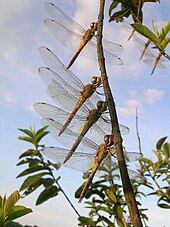
An aggregation of migratory Pantala flavescens dragonflies, known as globe skimmers, in Coorg, India
Some winged insects such as locusts and certain butterflies and dragonflies with strong flight migrate long distances. Among the dragonflies, species of Libellula and Sympetrum are known for mass migration, while Pantala flavescens,known as the globe skimmer or wandering glider dragonfly, makes the longest ocean crossing of any insect, between India and Africa. Exceptionally, swarms of the desert locust, Schistocerca gregaria, flew westwards across the Atlantic ocean for 4500 km during October 1988, using air currents in the Inter-Tropical Convergence Zone.
In some migratory butterflies, such as the monarch butterfly and the painted lady, no individual completes the whole migration. Instead the butterflies mate and reproduce on the journey, and successive generations travel the next stage of the migration.
In Other Animals
Mass migration occurs in mammals such as the Serengeti 'great migration', an annual circular pattern of movement with some 1.7 million wildebeest and hundreds of thousands of other large game animals including gazelles and zebra.
Wildebeest on the Serengeti 'great migration'
Migration is important in other mammals including Cetaceans, the whales, dolphins and porpoises. Long-distance migrations occur in some bats, notably the mass migration of the Mexican free-tailed bat between Oregon and southern Mexico.
Some reptiles and amphibians migrate.
Some crustaceans migrate, most spectacularly the Christmas Island red crab which moves en masse each year by the million.
Tracking Migrations
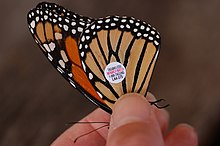
Scientists gather observations of animal migration by tracking their movements. Animals were traditionally tracked with identification tags such as bird rings for later recovery; no information was obtained about the actual route followed between release and recovery, and only a small fraction of tagged individuals were generally recovered. More convenient, therefore, are electronic devices such as radio tracking collars which can be followed by radio, whether handheld, in a vehicle or aircraft, or by satellite. Tags can include a GPS receiver, enabling accurate positions to be broadcast at regular intervals, but these are inevitably heavier and more expensive than devices without GPS. An alternative is the Argos Doppler tag, also called a 'Platform Transmitter Terminal' (PTT) which sends regularly to the polar-orbiting Argos satellites; using Doppler shift, the animal's location can be estimated, relatively roughly compared to GPS, but at lower cost and weight.
A migratory butterfly, a monarch, tagged for identification
Radio tracking tags can be fitted to insects including dragonflies and bees.
In Culture

Before the phenomenon of animal migration was understood, various folklore and erroneous explanations sprang up to account for the disappearance or sudden arrival of birds in an area. In Ancient Greece, Aristotle proposed that robins turned into redstarts when summer arrived. The barnacle goose was explained in European Medieval bestiaries and manuscripts as either growing like fruit on trees, or developing from goose barnacles on pieces of driftwood. Another example is the swallow, which was once thought, even by naturalists such as Gilbert White, to hibernate either underwater, buried in muddy riverbanks, or in hollow trees.

References

  1. a b c Hugh Dingle and V. Alistair Drake (2007). "What is migration?". BioScience 57 (2): 113–121. doi:10.1641/B570206.
  2. ^ National Geographic. Why Animals Migrate.
  3. ^ Attenborough, David (1990). The Trials of Life. London: Collins/BBCBooks. p. 123. ISBN 0-00-219940-8.
  4. ^ Kennedy, J. S. (1985). "Migration: Behavioral and ecological". In M., Rankin. Migration: Mechanisms and Adaptive Significance: Contributions in Marine Science. Marine Science Institute. pp. 5–26.
  5. ^ McLaren, I.A. (1974). "Demographic strategy of vertical migration by a marine copepod.". The American Naturalist 108 (959): 91–102. doi:10.1086/282887  JSTOR 2459738.
  6. ^ Hamner, W.M.; Hauri, I.R. (1981). "Long-distance horizontal migrations of zooplankton (Scyphomedusae: Mastigias).". Limnology and Oceanography 26 (3): 414–423. doi:10.4319/lo.1981.26.3.0414.
  7. ^ Wikisource-logo.svg Ernest Ingersoll (1920). "Migration". In Rines, George Edwin. Encyclopedia Americana.
  8. ^ Sekercioglu, C.H. (2007). "Conservation ecology: area trumps mobility in fragment bird extinctions". Current Biology 17 (8): 283–286. doi:10.1016/j.cub.2007.02.019. PMID 17437705.
  9. ^ Peter Berthold, Hans-Günther Bauer, Valerie Westhead (2001). Bird Migration: A General Survey. Oxford: Oxford University Press. ISBN 0-19-850787-9.
  10. ^ Cramp, S., ed. (1985). Birds of the Western Palearctic. pp. 87–100. ISBN 0-19-857507-6.
  11. ^ Harden Jones, F. R. Fish Migration: strategy and tactics. pp139–166 in Aidley, 1981.
  12. ^ Myers, George S. (1949). "Usage of Anadromous, Catadromous and allied terms for migratory fishes". Copeia 1949 (2): 89–97. doi:10.2307/1438482.
Further Reading
In General

  • Aidley, D.J. (1981) Animal migration, Cambridge University Press.
  • Baker, R.R. (1978) The Evolutionary Ecology of Animal Migration. Holmes & Meier Publishers.
  • Dingle, H. (1996) Migration: The Biology of Life on the Move. Oxford University Press.
  • Gauthreaux, S.A. (1980) Animal Migration, Orientation, and Navigation. Academic Press.
  • Milner-Gulland, E.J., J.M. Fryxell, and A.R.E. Sinclair (2011) Animal Migration: A Synthesis. Oxford University Press.
  • Rankin, M. (1985) Migration: Mechanisms and Adaptive Significance: Contributions in Marine Science. Marine Science Institute.
  • Riede, K. (2002) Global Register of Migratory Species. With database and GIS maps on CD.

In Specific Groups

  • Alerstam, T. (1990) Bird migration. Cambridge University Press.
  • Berthold, P. (2003) Avian migration. Springer.
  • Drake, V.A. and Gatehouse, A. G. (1995) Insect migration: tracking resources through space and time. Cambridge University Press.
  • Elphick, J. (1995) The atlas of bird migration: tracing the great journeys of the world's birds. Random House.
  • Greenberg, R. and Marra, P.P. (2005) Birds of Two Worlds: The Ecology and Evolution of Migration. Johns Hopkins University Press.
  • Harden Jones, F.R. (1968) Fish migration. St. Martin’s Press.
  • Lucas, M.C. and Baras, E. (2001) Migration of freshwater fishes. Blackwell Science.
  • McKeown, B.A. (1984) Fish migration. Timber Press.

For Children

  • Gans, R. and Mirocha, P. How do Birds Find their Way? HarperCollins. (Stage 2)
  • Marsh, L. (2010) Amazing Animal Journeys. National Geographic Society. (Level 3)

External Links


- Wikipedia 

Vitamins for B Positive Blood Type

In 1996, Peter J. D'Adamo's book "Eat Right 4 Your Type: The Individualized Diet Solution to Staying Healthy, Living Longer & Achieving Your Ideal Weight" introduced dieters to the Blood Type diet, a health and weight management plan based on your blood type: A, B, AB or O. Each blood group is instructed to eat certain foods and engage in specific types of exercise. According to D'Adamo, this is because you are genetically linked to your prehistoric ancestors through your blood type. People with type B blood -- whether B positive or B negative -- are supposedly descended from tribes that lived on the Eurasian plains. D'Adamo recommends type B individuals regularly take certain vitamin supplements for optimal health. However, the Mayo Clinic warns that no research studies or clinical trials exist to back up D'Adamo's blood type-based diet claims. In 2009, Dr. David L. Katz told "O, The Oprah Magazine" that following the Blood Type diet could result in nutritional deficiencies. The dietary supplements recommended by D'Adamo are not regulated by the Food and Drug Administration -- consult your doctor before beginning any supplement regimen.
Vitamins for B Positive Blood Type
Elderberry supplementation is recommended for B positive individuals. Photo Credit Hemera Technologies/Photos.com/Getty Images

Magnesium

According to D'Adamo, people belonging to the B blood group have a greater tendency for magnesium deficiency. This, D'Adamo says, can cause them to become overweight. He recommends supplementing daily with 200 mg to 300 mg of magnesium. Magnesium is essential for proper energy metabolism and for the regulation of other vitamins and minerals including calcium, vitamin D, zinc and potassium. However, ask your doctor before taking magnesium, since it can interfere with drugs including digoxin, diuretics, blood pressure drugs and antibiotics. It can also cause diarrhea, and should be avoided by people with kidney or heart disease.
Licorice
D'Adamo says people with B positive blood are particularly susceptible to stress-related digestive system disorders. Licorice -- an herb whose root may be useful in treating indigestion, gastric reflux and ulcers -- is recommended to help prevent stomach problems in type B individuals. The University of Maryland Medical Center reports that a typical dosage of licorice extract can range between 250 mg to 500 mg, taken up to three times daily. Licorice use can cause numbness and muscle pain, and should be avoided by anyone with cardiovascular problems, diabetes, high blood pressure and kidney or liver disease, as well as by anyone using insulin, laxatives, oral contraceptives, corticosteroids and ACE inhibitor drugs such as benazepril or enalapril. Check with your doctor before supplementing your diet with licorice.

Elderberry

Elderberry is a native Asian, African and European plant whose berries contain a high concentration of compounds that may have anti-viral and anti-inflammatory properties. Some scientific research indicates that supplementing with elderberry can help treat cold and flu symptoms and heal sinus infections. D'Adamo strongly recommends that type B blood group people supplement regularly with elderberry because they are supposedly the most susceptible of all blood types to bacterial and viral infections. However, don't start taking elderberry supplements until you've spoken to your doctor first: They may interfere with other medications, including immunosuppressants, diabetes drugs and diuretics.

Digestive System Enzymes

D'Adamo contends that people belonging to the B blood group need additional digestive enzymes and beneficial intestinal bacteria in order to ward off digestive problems. He markets a probiotic formula that, he claims, contains blood type B-friendly bacteria that supports both healthy digestion and intestinal tract health. These formulas aren't regulated by the FDA, and D'Adamo does not offer clinical trial evidence to support his claims. Talk to your doctor about the possible dangers before using any probiotic formula to treat digestive problems.
www.livestrong.com

What Are the Benefits of Okra for People With Diabetes?

Diabetes is the sixth leading cause of death in the United States. Diabetes contributes to the development of deadly conditions like cardiovascular disease and end-stage renal disease. Consuming a healthy diet can help those who have type 1 and 2 diabetes control their blood sugar, and help reduce the risk of developing type 2 diabetes. There are a number of diabetes-related benefits of adding okra to your healthy eating plan.

What Are the Benefits of Okra for People With Diabetes?
Close-up of okra for sale at a market. Photo Credit eye-blink/iStock/Getty Images

Glycemic Index

The glycemix index (GI) is a measurement of how quickly carbohydrates in foods turns to sugar in your blood. Regularly consuming low GI foods like okra can help even out roller coaster blood sugar levels and aid in weight control. Okra has a GI below 20, which is considered a "low GI" food.

Kidney Disease

Almost half of all cases of kidney disease are the result of diabetes. Keeping your blood sugar within a healthy range, treating high blood pressure and maintaining a normal body weight can reduce your risk of kidney disease. Additionally, regularly consuming okra can keep kidney disease at bay, according to study results published in the October 2005 "Jilin Medical Journal." In this study of diabetics, those who ate okra daily reduced clinical signs of kidney damage more than those that simply ate a diabetic diet.

Soluble Fiber

Nearly 50 percent of the fiber found in okra is in the form of soluble fiber. This type of fiber slows digestion, delaying and reducing the impact of carbohydrate-rich foods on blood sugar levels. Eating at least 25 g of fiber per day can help reduce high blood sugar levels. Soluble fiber may also keep your appetite under control, making weight loss easier.
www.livestrong.com

BIOLOGICAL DISPERSAL

Biological dispersal refers to both the movement of individuals (animals, plants, fungi, bacteria, etc.) from their birth site to their breeding site ('natal dispersal'), as well as the movement from one breeding site to another ('breeding dispersal'). Dispersal is also used to describe the movement of propagules such as seeds and spores. Technically, dispersal is defined as any movement that has the potential to lead to gene flow. The act of dispersal involves three phases: departure, transfer, settlement and there are different fitness costs and benefits associated with each of these phases. Through simply moving from one habitat patch to another, the dispersal of an individual has consequences not only for individual fitness, but also for population dynamics, population genetics and species distribution. Understanding dispersal and the consequences both for evolutionary strategies at a species level, and for processes at an ecosystem level, requires understanding on the type of dispersal, the dispersal range of a given species, and the dispersal mechanisms involved.


Wind dispersal of dandelion seeds.
Biological dispersal may be contrasted with geodispersal, which is the mixing of previously isolated populations (or whole biotas) following the erosion of geographic barriers to dispersal or gene flow (Lieberman, 2005; Albert and Reis, 2011).
Dispersal can be distinguished from animal migration (typically round-trip seasonal movement), although within the population genetics literature, the terms 'migration' and 'dispersal' are often used interchangeably.
Types of Dispersal
Some organisms are motile throughout their lives, but others are adapted to move or be moved at precise, limited phases of their life cycles. This is commonly called the dispersive phase of the life cycle. The strategies of organisms' entire life cycles often are predicated on the nature and circumstances of their dispersive phases.
Dispersal from parent population.
In general there are two basic types of dispersal:
Density-independent dispersal
Organisms have evolved adaptations for dispersal that take advantage of various forms of kinetic energy occurring naturally in the environment. This is referred to as density independent or passive dispersal and operates on many groups of organisms (some invertebrates, fish, insects and sessile organisms such as plants) that depend on animal vectors,wind, gravity or current for dispersal.

Density-dependent dispersal
Density dependent or active dispersal for many animals largely depends on factors such as local population size, resource competition, habitat quality, and habitat size.
Due to population density, dispersal may relieve pressure for resources in an ecosystem, and competition for these resources may be a selection factor for dispersal mechanisms.
Dispersal of organisms is a critical process for understanding both geographic isolation in evolution through gene flow and the broad patterns of current geographic distributions (biogeography).
A distinction is often made between natal dispersal where an individual (often a juvenile) moves away from the place it was born, and breeding dispersal where an individual (often an adult) moves away from one breeding location to breed elsewhere.
Costs and Benefits


Epilobium hirsutum - Seed head.
In the broadest sense, dispersal occurs when the fitness benefits of moving outweigh the costs.
There are a number of benefits to dispersal such as locating new resources, escaping unfavorable conditions, avoiding competing with siblings and avoiding breeding with closely related individuals which could lead to inbreeding depression.
There are also a number of costs associated with dispersal, which can be thought of in terms of four main currencies: energy, risk, time and opportunity. Energetic costs include the extra energy required to move as well as energetic investment in movement machinery (e.g. wings). Risks include increased injury and mortality during dispersal and the possibility of settling in an unfavorable environment. Time spent dispersing is time that often cannot be spent on other activities such as growth and reproduction. Finally dispersal can also lead to outbreeding depression if an individual is better adapted to its natal environment than the one it ends up in. In social animals (such as many birds and mammals) a dispersing individual must find and join a new group, which can lead to loss of social rank.
Dispersal Range

Dispersal range" refers to the distance a species can move from an existing population or the parent organism. An ecosystem depends critically on the ability of individuals and populations to disperse from one habitat patch to another. Therefore, biological dispersal is critical to the stability of ecosystems.

Environmental Constraints
Few species are ever evenly or randomly distributed within or across landscapes. In general, species significantly vary across the landscape in association with environmental features that influence their reproductive success and population persistence. Spatial patterns in environmental features (e.g. resources) permit individuals to escape unfavorable conditions and seek out new locations. This allows the organism to "test" new environments for their suitability, provided they are within animal's geographic range. In addition, the ability of a species to disperse over a gradually changing environment could enable a population to survive extreme conditions. (i.e. climate change).
As the climate changes, prey and predators have to adapt to survive. This poses a problem for many animals, for example the Southern Rockhopper Penguins. These penguins are able to live and thrive in a variety of climates due to the penguins' phenotypic plasticity. However, they are predicted to respond by dispersal, not adaptation this time. This is explained due to their long life spans and slow microevolution. Penguins in the subantarctic have very different foraging behavior than the subtropical waters, it would be very hard to survive and keep up with the fast changing climate because these behaviors took years to shape.
Dispersal Barriers
A dispersal barrier may mean that the dispersal range of a species is much smaller than the species distribution. An artificial example is habitat fragmentation due to human land use. Natural barriers to dispersal that limit species distribution include mountain ranges and rivers. An example is the separation of the ranges of the two species of chimpanzee by the Congo River.
On the other hand, human activities may also expand the dispersal range of a species by providing new dispersal methods (e.g., ships). Many of them become invasive, like rats and stinkbugs, but some species also have a slightly positive effect to human settlers like honeybees and earthworms.
Dispersal Mechanisms
Most animals are capable of locomotion and the basic mechanism of dispersal is movement from one place to another. Locomotion allows the organism to "test" new environments for their suitability, provided they are within the animal's range. Movements are usually guided by inherited behaviors.
The formation of barriers to dispersal or gene flow between adjacent areas can isolate populations on either side of the emerging divide. The geographic separation and subsequent genetic isolation of portions of an ancestral population can result in speciation.
Plant Dispersal Mechanisms


Burs are an example of a seed dispersion mechanism which uses a biotic vector, in this case animals with fur.

Seed dispersal is the movement or transport of seeds away from the parent plant. Plants have limited mobility and consequently rely upon a variety of dispersal vectors to transport their propagules, including both abiotic and biotic vectors. Seeds can be dispersed away from the parent plant individually or collectively, as well as dispersed in both space and time. The patterns of seed dispersal are determined in large part by the dispersal mechanism and this has important implications for the demographic and genetic structure of plant populations, as well as migration patterns and species interactions. There are five main modes of seed dispersal: gravity, wind, ballistic, water and by animals.

Animals Dispersals Mechanisms
Non-Motiles Animals
There are numerous animal forms that are non—motile, such as sponges, bryozoans, tunicates, sea anemones,  corals and oysters. In common, they are all either marine or aquatic. It may seem curious that plants have been so successful at stationary life on land, while animals have not, but the answer lies in the food supply. Plants produce their own food from sunlight and carbon dioxide-both generally more abundant on land than in water. Animals fixed in place must rely on the surrounding medium to bring food at least close enough to grab, and this occurs in the three-dimensional water environment, but with much less abundance in the atmosphere.
All of the marine and aquatic invertebrates whose lives are spent fixed to the bottom (more or less; anemones are capable of getting up and moving to a new location if conditions warrant) produce dispersal units. These may be specialized "buds", or motile sexual reproduction products, or even a sort of alteration of generations as in certain cnidaria.
Corals provide a good example of how sedentary species achieve dispersion. Corals reproduce by releasing sperm and eggs directly into the water. These release events are coordinated by lunar phase in certain warm months, such that all corals of one or many species on a given reef will release on the same single or several consecutive nights. The released eggs are fertilized, and the resulting zygote develops quickly into a multicellular planula. This motile stage then attempts to find a suitable substratum for settlement. Most are unsuccessful and die or are fed upon by zooplankton and bottom dwelling predators such as anemones and other corals. However, untold millions are produced, and a few do succeed in locating spots of bare limestone, where they settle and transform by growth into a polyp. All things being favorable, the single polyp grows into a coral head by budding off new polyps to form a colony.
Motile Animals

The majority of all animals are motile. Although motile animals can, in theory, disperse themselves by their spontaneous and independent locomotive powers, a great many species utilize the existing kinetic energies in the environment, resulting in passive movement. Dispersal by water currents is especially associated with the physically small inhabitants of marine waters known as zooplankton. The term plankton comes from the Greek, πλαγκτον, meaning "wanderer" or "drifter".

Dispersal by Dormant Stages

Many animal species, especially freshwater invertebrates, are able to disperse by wind or by transfer with an aid of larger animals (birds, mammals or fishes) as dormant eggs, dormant embryos or, in some cases, dormant adult stages. Tardigrades, some rotifers and some copepods are able to withstand desiccation as adult dormant stages. Many other taxa (Cladocera, Bryozoa, Hydra, Copepoda and so on) can disperse as dormant eggs or embryos. Freshwater sponges usually have special dormant propagules called gemmulae for such a dispersal. Many kinds of dispersal dormant stages are able to withstand not only desiccation and low and high temperature, but also action of digestive enzymes during their transfer through digestive tracts of birds and other animals, high concentration of salts and many kinds of toxicants. Such dormant-resistant stages made possible the long-distance dispersal from one water body to another and broad distribution ranges of many freshwater animals.

Quantifying Dispersal
Dispersal is most commonly quantified either in terms of rate or distance.
Dispersal rate (also called migration rate in the population genetics literature) or probability describes the probability than any individual leaves an area or, equivalently, the expected proportion of individual to leave an area.
The dispersal distance is usually described by a dispersal kernel which gives the probability distribution of the distance traveled by any individual. A number of different functions are used for dispersal kernels in theoretical models of dispersal including the negative exponential distribution, extended negative exponential distribution, normal distribution, exponential power distribution, inverse power distribution, and the two-sided power distribution. The inverse power distribution and distributions with 'fat tails' representing long-distance dispersal events (called leptokurtic distributions) are though to best match empirical dispersal data.
Consequences of Dispersal
Dispersal not only has costs and benefits to the dispersing individual (as mentioned above), but it also has consequences at the level of the population and species as well.
Most populations have a patchy spatial distribution. Dispersal, by moving individuals between different sub-populations, can increase the overall connectivity of the population, helping to minimize the risk of stochastic extinction, since if a sub-population goes extinct by chance, it is likely to be recolonized if the dispersal rate is high. Increased connectivity can also decrease the degree of local adaptation.
References

  1. a b Ronce, O. (2007). "How does it feel to be like a rolling stone? Ten questions about dispersal evolution". Annual Review of Ecology, Evolution, and Systematics 38: 231–253. doi:10.1146/annurev.ecolsys.38.091206.095611.
  2. a b c , D., Van Dyck, H., Bullock, J. M., Coulon, A., Delgado, M. D. M., Gibbs, M.; et al. (2012). "Costs of dispersal". Biological Reviews of the Cambridge Philosophical Society 87 (2): 290–312. doi:10.1111/j.1469-185X.2011.00201.x. PMID 21929715.
  3. ^ Dunning, J. B. J., Stewart, D. J., Danielson, B. J., Noon, B. R., Root, T. L., Lamberson, R.H. & Stevens, E. E. (1995). "Spatially explicit population models: current forms and future uses"  (PDF)Ecological Applications 5 (1): 3–11. doi:10.2307/1942045. JSTOR 1942045.
  4. ^ Hanski, I. & Gilpin, M. E., ed. (1997). Metapopulation biology : ecology, genetics and evolution. San Diego: Academic Press. ISBN 0-12-323446-8.
  5. ^ Hanski, I. (1999). Metapopulation Ecology. Oxford: Oxford University Press. ISBN 0-19-854065-5.
  6. ^ Lieberman (2005). "Geobiology and paleobiogeography: tracking the coevolution of the Earth and its biota". Palaeogeography, Palaeoclimatology, Palaeoecology 219: 23–33. doi:10.1016/j.palaeo.2004.10.012.
  7. ^ Lieberman, Bruce S. (2005). "Geobiology and paleobiogeography: Tracking the coevolution of the Earth and its biota". Palaeogeography, Palaeoclimatology, Palaeoecology219: 23. doi:10.1016/j.palaeo.2004.10.012.
  8. ^ James S. Albert; Roberto E. Reis (2011). Historical Biogeography of Neotropical Freshwater Fishes. University of California Press. p. 308. ISBN 978-0-520-26868-5.
  9. ^ Maguire Jr., B. (1963). "The passive dispersal of small aquatic organisms and their colonization of isolated bodies of water". doi:10.2307/1948560. JSTOR 1948560.
  10. ^ Nathan, R. (2001). "The challenges of studying dispersal"(PDF)Trends in Ecology & Evolution 16 (9): 481. doi:10.1016/S0169-5347(01)02272-8.
Further Reading

  • Ingold, C. T. (1971) Fungal spores: their liberation and dispersal Oxford, Clarendon Press 302 p. ISBN 0-19-854115-5.
  • Lidicker, W. Z. and R. L. Caldwell (1982) Dispersal and migration Stroudsburg, Pa. : Hutchinson Ross Pub. Co 311 p. ISBN 0-87933-435-5 (Dispersal of animals)
  • Bullock, J. M.; R. E. Kenward and R. S. Hails (editors) (2002) Dispersal ecology : the 42nd symposium of the British Ecological Society. Oxford, UK : Blackwell Science 458 p. ISBN 0-632-05876-5 (Animals and plants)
  • Lieberman, B. S. 2008. Emerging syntheses between palaeobiogeography and macroevolutionary theory. Proceedings of the Royal Society of Victoria 120: 51–57.
  • Turner M. G., Gardner R. H., O'Neill. 2001. Landscape Ecology: In theory and practice, pattern and process. New York (NY): Springer Science.
  • Levin, S. A. 1974. Dispersion and Population Interactions. The American Naturalist. 108:960, p. 207.
  • Clobert, J., E. Danchin, A. A. Dhondt and J. D. Nichols (eds.)(2001) "dispersal", Oxford University Press, Oxford.
  • Cousens, R., C. Dytham, R. Law (2008), Dispersal in plants: a population perspective, Oxford University Press, Oxford

- Wikipedia 

Advantages and Disadvantages of Fasting for Runners

Author BY   ANDREA CESPEDES  Food is fuel, especially for serious runners who need a lot of energy. It may seem counterintuiti...