Taxodium distichum (bald cypress, baldcypress, bald-cypress, cypress, southern-cypress, white-cypress, tidewater red-cypress, Gulf-cypress, red-cypress, or swamp cypress) is a deciduous conifer in the family Cupressaceae that grows on saturated and seasonally inundated soils of the Southeastern and Gulf Coastal Plains of the United States.
Description
Taxonomy
The closely related Taxodium ascendens (pond cypress) is treated by some botanists as a distinct species, while others classify it as merely a variety of bald-cypress, as Taxodium distichum var. imbricatum (Nutt.) Croom. It differs in shorter leaves borne on erect shoots, and in ecology, being largely confined to low-nutrient blackwater habitats. A few authors also treat Taxodium mucronatum as a variety of bald cypress, as T. distichum var. mexicanum Gordon, thereby considering the genus as comprising only one species.
Habitat
Range
Bald cypress is monoecious. Male and female strobili mature in one growing season from buds formed the previous year. The male catkins are about 2 mm (0.079 in) in diameter and are borne in slender, purplish, drooping clusters 7 to 13 cm (3 to 5 in) long that are conspicuous during the winter on this deciduous conifer. Pollen is shed in March and April. Female conelets are found singly or in clusters of two or three. The globose cones turn from green to brownish-purple as they mature from October to December. The cones are 13 to 36 mm (0.51 to 1.42 in) in diameter and consist of 9 to 15 four-sided scales that break away irregularly after maturity. Each scale can bear two irregular, triangular seeds with thick, horny, warty coats and projecting flanges. The number of seeds per cone averages 16 and ranges from two to 34. Cleaned seeds number from about 5600 to 18,430/kg (2,540 to 8,360/lb).

Seed production and dissemination
Some seeds are produced every year, and good seed crops occur at three- to five-year intervals. At maturity, the cone scales with their resin-coated seeds adhering to them, or sometimes entire cones, drop to the water or ground. This drop of mature seeds is often hastened by squirrels, which eat bald cypress seeds, but usually drop several scales with undamaged seeds still attached to each cone they pick. Floodwaters spread the scales or cones along streams and are the most important means of seed dissemination.
Seedling development
Germination is epigeal. Under swamp conditions, germination generally takes place on a sphagnum moss or a wet-muck seedbed. Seeds will not germinate under water, but some will remain viable for 30 months under water. On the other hand, seeds usually fail to germinate on better drained soils because of the lack of surface water. Thus, a soil saturated but not flooded for a period of one to three months after seedfall is required for germination.
After germination, seedlings must grow fast enough to keep at least part of their crowns above floodwaters for most of the growing season. Bald cypress seedlings can endure partial shading, but require overhead light for good growth. Seedlings in swamps often reach heights of 20 to 75 cm (8 to 29.5 in) their first year. Growth is checked when a seedling is completely submerged by flooding, and prolonged submergence kills the seedling.

Bald cypress is one of the few conifer species that sprouts. Thrifty sprouts are generally produced from stumps of young trees, but trees up to 60years old also send up healthy sprouts if the trees are cut during the fall or winter. However, survival of these sprouts is often poor and those that live are usually poorly shaped and do not make quality sawtimber trees. Stumps of trees up to 200 years old may also sprout, but the sprouts are not as vigorous and are more subject to wind damage as the stump decays. In the only report on the rooting of bald cypress cuttings found in the literature, cuttings from trees five years old rooted better than those from older trees.
Ecology
The seeds remain viable for less than one year, and are dispersed in two ways. One is by water; the seeds float and move on water until flooding recedes or the cone is deposited on shore. The second is by wildlife; squirrels eat seeds, but often drop some scales from the cones they harvest. Seeds do not germinate under water and rarely germinate on well-drained soils; seedlings normally become established on continuously saturated, but not flooded, soils for one to three months. After germination, seedlings must grow quickly to escape floodwaters; they often reach a height of 20–75 cm (up to 100 cm in fertilized nursery conditions) in their first year. Seedlings die if inundated for more than about two to four weeks. Natural regeneration is therefore prevented on sites that are always flooded during the growing season. Although vigorous saplings and stump sprouts can produce viable seed, most specimens do not produce seed until they are about 30 years old. In good conditions, Bald-cypress grows fairly fast when young, then more slowly with age. Trees have been measured to reach 3 m in five years, 21 m in 41 years, and 36 m in height in 96 years; height growth has largely ceased by the time the trees are 200 years old. Some individuals can live over 1,000 years. Determination of the age of an old tree may be difficult because of frequent missing or false rings of stemwood caused by variable and stressful growing environments.

In 2002, the Indiana Department of Natural Resources identified T distichum as a state protected plant with the status of Threatened.
Cultivation and uses
This species is a popular ornamental tree, grown for its light, feathery foliage and orange-brown to dull red fall color. In cultivation, it thrives on a wide range of soils, including well-drained sites where it would not grow naturally due to the inability of the young seedlings to compete with other vegetation. Cultivation is successful far to the north of its native range, north to southern Canada. It is also commonly planted in Europe, Asia and elsewhere with temperate to subtropical climates. It does, however, require hot summers for good growth; when planted in areas with cool summers oceanic climates, growth is healthy but very slow (some in northeastern England have only reached 4–5 m tall in about 50 years), and cones are not produced.

Timber.
Description


Taxodium distichum is a large slow-growing and long-lived tree typically reaching heights of 30–35 m (100–120 ft) and a trunk diameter of 1–2 m (3-6 ft). The bark is gray-brown to red-brown, thin and fibrous with a stringy texture, having a vertically interwoven pattern of shallow ridges and narrow furrows. The leaves are alternate and linear, with flat blades borne on the twig that are spirally arranged on the stem, but twisted at the base to lie in two horizontal ranks, 1–2 cm long and 1–2 mm broad. Unlike most other species in the family Cupressaceae, it is deciduous, losing its leaves in the winter months, hence the name 'bald'. It is monoecious (separate staminate and carpellate flowers are always found on the same plant), with male and female flowers forming on slender tassel-like structures near the edge of the branchlets. The male and female strobili are produced from buds formed in the late fall, with pollination in early winter, and mature in about 12 months. The seed cones are green maturing gray-brown, globular, and 2-3.5 cm in diameter. They have from 20 to 30 spirally arranged, four-sided scales, each bearing one or two (rarely three) triangular seeds. The number of seeds per cone ranges from 20 to 40. The cones disintegrate when mature to release the large seeds. The seeds are 5–10 mm long, the largest of any species in the cypress family, and are produced every year, but with heavy crops every three to five years. The seedlings have three to 9 (most often six) cotyledons.
The main trunks are surrounded by cypress knees.
The tallest known individual specimen, near Williamsburg, Virginia, is 44.11 m tall, and the stoutest known, in the Cat Island National Wildlife Refuge near Baton Rouge, Louisiana, has a diameter at breast height (DBH) of 521 cm. The oldest known specimen, located in Bladen County, North Carolina, is over 1,620 years old, making this one of the oldest living plants in eastern North America.


Taxonomy


The closely related Taxodium ascendens (pond cypress) is treated by some botanists as a distinct species, while others classify it as merely a variety of bald-cypress, as Taxodium distichum var. imbricatum (Nutt.) Croom. It differs in shorter leaves borne on erect shoots, and in ecology, being largely confined to low-nutrient blackwater habitats. A few authors also treat Taxodium mucronatum as a variety of bald cypress, as T. distichum var. mexicanum Gordon, thereby considering the genus as comprising only one species.
Habitat
Range

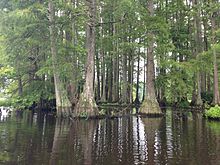
Bald cypress in Trap Pond State Park, Delaware.
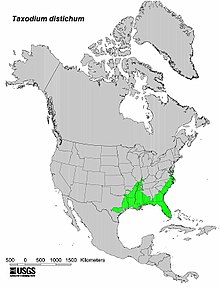
The native range extends from Delaware Bay south to Florida and west to East Texas and southeastern Oklahoma, and also inland up the Mississippi and Ohio Rivers north to southern Illinois and Indiana. Mature planted specimens are seen as far north as Pittsburgh, and Ottawa, Ontario.[11] In Ottawa, in the Central Experimental Farm Arboretum, an average winter may kill back a quarter to half of new growth. Ancient bald cypress forests, with some trees more than 1,700 years old, once dominated swamps in the southeast US. The largest remaining old-growth stands are at Corkscrew Swamp Sanctuary, near Naples, Florida. and in the Three Sisters tract along eastern North Carolina's Black River. The Corkscrew trees are around 500 years of age and some exceed 40 m in height. The Black River trees were cored in 1986 by University of Arkansas dendrologists with dates ranging back to 364 AD. In the northern and more inland part of its range from Delaware and Maryland to Williamsburg, Virginia, it is found in groups growing in swamps and is accompanied by other hardwoods. In the southern parts of its range from extreme southeastern Virginia, Virginia Beach south to Florida and west to Texas, bald cypress can be found growing with loblolly pine and live oak, and it may be heavily covered in Spanish moss. This can be observed in the far northern part of its range at First Landing State Park, Virginia Beach, Virginia. From eastern North Carolina down throughout Florida and over to southeast and south Texas, bald cypress may be accompanied in forests by dwarf palmetto.

Bald cypress range.
It is native to humid climates where annual precipitation ranges from about 760 mm (in Texas) to 1630 mm (along the Gulf Coast). Although it grows best in warm climates, the natural northern limit of the species is not due to a lack of cold tolerance, but to specific reproductive requirements; further north, regeneration is prevented by ice damage to seedlings. Larger trees are able to tolerate much lower temperatures and lower humidity.
In 2012 Scuba divers discovered an underwater forest several miles off the coast of Mobile, AL in 60 feet of water. The forest contains trees that could not be dated with radiocarbon methods since they are older than 50,000 years old, thus most likely lived in the early glacial interval of the last ice age. The forest contains trees so well-preserved that when they are cut, they still smell like fresh cypress. The team, which has not yet published their results in a peer-reviewed journal, is currently studying the site. It is estimated that they have less than two years before wood-burrowing marine animals destroy the submerged forest.

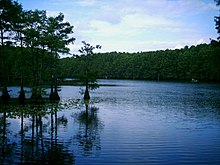
Bald cypress on the Texas side of Caddo Lake
Soils and topography
Most bald cypress trees grow on flat ground on alluvial soils, usually at elevations of less than 50 m above sea level, although some stands may occur at elevations of 500 m in Texas.
Bald cypress occurs mainly along riparian (riverside) wetlands normally subject to periodic flooding by silt-rich 'brownwater' rivers, unlike the related Taxodium ascendens, which occurs in silt-poor blackwater rivers and ponds. T. distichum tolerates minor salinity, but does not grow in brackish or saline coastal waters.
Reproduction and early growthBald cypress is monoecious. Male and female strobili mature in one growing season from buds formed the previous year. The male catkins are about 2 mm (0.079 in) in diameter and are borne in slender, purplish, drooping clusters 7 to 13 cm (3 to 5 in) long that are conspicuous during the winter on this deciduous conifer. Pollen is shed in March and April. Female conelets are found singly or in clusters of two or three. The globose cones turn from green to brownish-purple as they mature from October to December. The cones are 13 to 36 mm (0.51 to 1.42 in) in diameter and consist of 9 to 15 four-sided scales that break away irregularly after maturity. Each scale can bear two irregular, triangular seeds with thick, horny, warty coats and projecting flanges. The number of seeds per cone averages 16 and ranges from two to 34. Cleaned seeds number from about 5600 to 18,430/kg (2,540 to 8,360/lb).

Foliage in autumn just before shedding.
Seed production and dissemination
Some seeds are produced every year, and good seed crops occur at three- to five-year intervals. At maturity, the cone scales with their resin-coated seeds adhering to them, or sometimes entire cones, drop to the water or ground. This drop of mature seeds is often hastened by squirrels, which eat bald cypress seeds, but usually drop several scales with undamaged seeds still attached to each cone they pick. Floodwaters spread the scales or cones along streams and are the most important means of seed dissemination.
Seedling development
Germination is epigeal. Under swamp conditions, germination generally takes place on a sphagnum moss or a wet-muck seedbed. Seeds will not germinate under water, but some will remain viable for 30 months under water. On the other hand, seeds usually fail to germinate on better drained soils because of the lack of surface water. Thus, a soil saturated but not flooded for a period of one to three months after seedfall is required for germination.
After germination, seedlings must grow fast enough to keep at least part of their crowns above floodwaters for most of the growing season. Bald cypress seedlings can endure partial shading, but require overhead light for good growth. Seedlings in swamps often reach heights of 20 to 75 cm (8 to 29.5 in) their first year. Growth is checked when a seedling is completely submerged by flooding, and prolonged submergence kills the seedling.

Bald cypress swamp and Spanish moss at First Landing State Park in Virginia Beach, VA.
In nurseries, Taxodium seeds show an apparent internal dormancy that can be overcome by various treatments, usually including cold stratification or submerging in water for 60 days. Nursery beds are sown in spring with pretreated seeds or in fall with untreated seeds. Seedlings usually reach 75 to 100 cm (29.5 to 39.5 in) in height during their first (and usually only) year in the nursery. Average size of 1-0 nursery-grown seedlings in a seed source test including 72 families was 81.4 cm (32.0 in) tall and 1.1 cm (0.43 in) in diameter.
Control of competing vegetation may be necessary for a year or more for bald cypress planted outside of swamps. Five years after planting on a harrowed and bedded, poorly drained site in Florida, survival was high, but heights had increased only 30 cm (12 in), probably because of heavy herbaceous competition. Seedlings grown in a crawfish pond in Louisiana, where weed control and soil moisture were excellent through June, averaged 2.9 m (9.5 ft) and 3.5 cm (1.4 in) diameter at breast height (DBH) after five years. However, a replicate of the same sources planted on an old soybean field, where weed control and soil moisture were poor, resulted in the same DBH, but a smaller average seedling height of 2.1 m (6.9 ft). When planted in a residential yard and weeded and watered, they averaged 3.7 m (12 ft) tall three years later.
Vegetative reproductionBald cypress is one of the few conifer species that sprouts. Thrifty sprouts are generally produced from stumps of young trees, but trees up to 60years old also send up healthy sprouts if the trees are cut during the fall or winter. However, survival of these sprouts is often poor and those that live are usually poorly shaped and do not make quality sawtimber trees. Stumps of trees up to 200 years old may also sprout, but the sprouts are not as vigorous and are more subject to wind damage as the stump decays. In the only report on the rooting of bald cypress cuttings found in the literature, cuttings from trees five years old rooted better than those from older trees.
Ecology

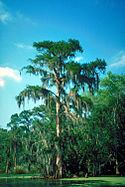
A bald cypress in the Atchafalaya Basin of Louisiana.
The seeds remain viable for less than one year, and are dispersed in two ways. One is by water; the seeds float and move on water until flooding recedes or the cone is deposited on shore. The second is by wildlife; squirrels eat seeds, but often drop some scales from the cones they harvest. Seeds do not germinate under water and rarely germinate on well-drained soils; seedlings normally become established on continuously saturated, but not flooded, soils for one to three months. After germination, seedlings must grow quickly to escape floodwaters; they often reach a height of 20–75 cm (up to 100 cm in fertilized nursery conditions) in their first year. Seedlings die if inundated for more than about two to four weeks. Natural regeneration is therefore prevented on sites that are always flooded during the growing season. Although vigorous saplings and stump sprouts can produce viable seed, most specimens do not produce seed until they are about 30 years old. In good conditions, Bald-cypress grows fairly fast when young, then more slowly with age. Trees have been measured to reach 3 m in five years, 21 m in 41 years, and 36 m in height in 96 years; height growth has largely ceased by the time the trees are 200 years old. Some individuals can live over 1,000 years. Determination of the age of an old tree may be difficult because of frequent missing or false rings of stemwood caused by variable and stressful growing environments.

Bald cypress knees in duckweed.
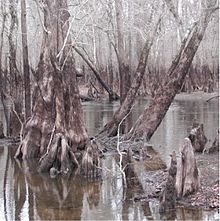
Bald cypress trees growing in swamps have a peculiarity of growth called cypress knees. These are woody projections from the root system project above the ground or water. Their function was once thought to be to provide oxygen to the roots, which grow in the low dissolved oxygen (DO) waters typical of a swamp (as in mangroves). However, evidence for this is scant; in fact, roots of swamp-dwelling specimens whose knees are removed do not decrease in oxygen content and the trees continue to thrive. Another more likely function is structural support and stabilization. Bald cypress trees growing on flood-prone sites tend to form buttressed bases, but trees grown on drier sites may lack this feature. Buttressed bases and a strong, intertwined root system allow them to resist very strong winds; even hurricanes rarely overturn them.

Bald cypress forest in winter, showing "knees" and (brown) high flood level, Lynches River, Johnsonville, South Carolina.
Many agents damage T. distichum trees. The main damaging (in some cases lethal) agent is the fungus Stereum taxodii, which causes a brown pocket rot known as "pecky cypress". It attacks the heartwood of living trees, usually from the crown down to the roots. A few other fungi attack the sapwood and the heartwood of the tree, but they do not usually cause serious damage. Insects such as the cypress flea beetle (Systena marginalis) and the bald cypress leafroller (Archips goyerana) (closely related to the fruit tree leafroller) can seriously damage trees by destroying leaves, cones or the bark. Nutrias also clip and unroot young bald cypress seedlings, sometimes killing a whole plantation in a short amount of time.
ConservationIn 2002, the Indiana Department of Natural Resources identified T distichum as a state protected plant with the status of Threatened.
Cultivation and uses
This species is a popular ornamental tree, grown for its light, feathery foliage and orange-brown to dull red fall color. In cultivation, it thrives on a wide range of soils, including well-drained sites where it would not grow naturally due to the inability of the young seedlings to compete with other vegetation. Cultivation is successful far to the north of its native range, north to southern Canada. It is also commonly planted in Europe, Asia and elsewhere with temperate to subtropical climates. It does, however, require hot summers for good growth; when planted in areas with cool summers oceanic climates, growth is healthy but very slow (some in northeastern England have only reached 4–5 m tall in about 50 years), and cones are not produced.
One of the oldest in Europe, was planted in the 1900s in the Arboretum de Pézanin, Burgundy, France.

Bald cypress has been noted for its high merchantable yields. In virgin stands, yields from 112 to 196 m³/ha were common, and some stands might have exceeded 1000 m³/ha. Bald cypress swamps are some of the world's most productive ecosystems.
The odorless wood of bald cypress, closely resembling that of Cupressus spp., has long been valued for its water resistance, thus is called 'wood eternal'. Still-usable prehistoric wood is often found in swamps as far north as New Jersey, and occasionally as far as Connecticut, although it is more common in the southeast. The somewhat-mineralized wood is mined from some swamps in the southeast, and is highly prized for specialty uses such as wood carvings. Pecky cypress, caused by the fungus Stereum taxodii is used for decorative wall paneling.
The bald cypress was designated the official state tree of Louisiana in 1963. It is considered by some to be a symbol of the southern swamps.
Cypress trees can be used in the making of shingles. Joshua D. Brown, the first settler of Kerrville, Texas, made his living producing shingles from cypress trees growing along the Guadalupe River of the Texas Hill Country. Shingles produced from cypress were also one of the main industries for early pioneers in Kissimmee, Florida (near Walt Disney World). One of the main bodies of water in the area, Shingle Creek, is named in homage of their importance to the growth of the city.
References- ^ Conifer Specialist Group (1998). Taxodium distichum. 2006. IUCN Red List of Threatened Species. IUCN 2006. www.iucnredlist.org. Retrieved on 12 May 2006.
- ^ "Taxodium distichum". Natural Resources Conservation Service PLANTS Database. USDA. Retrieved 8 December 2015.
- ^ a b c Farjon, A. (2005). Monograph of Cupressaceae and Sciadopitys. Royal Botanic Gardens, Kew. ISBN 1-84246-068-4.
- ^ Flora of North America: Taxodium distichum
- ^ a b c Gymnosperm Database: Taxodium distichum
- ^ a b c http://na.fs.fed.us/pubs/silvics_manual/volume_1/taxodium/distichum.htm
- ^ http://www.ldeo.columbia.edu/~adk/oldlisteast/Spp/TADI.html
- ^ USDA Plants Profiles: Taxodium distichum, Taxodium ascendens
- ^ Flora of North America: Taxodium
- ^http://www.pittsburghforest.org/userfiles/file/Lawrenceville%20Tree%20of%20the%20Month/LV_Tree_of_Month_03_Bald_Cypress.pdf.
- ^ Richard Hinchcliff (2007). For the Love of Trees. General Store Publishing. pp. 52–53. ISBN 978-1-897113-73-8.
- ^ Paul Ferguson (2008). "Searching for Methuselah" (PDF). Pocosin Press. pp. 1–3. Retrieved 21 April 2011.
- ^ "Primeval Underwater Forest Discovered in Gulf of Mexico". Live Science. Retrieved 11 July 2013.
- ^ Faulkner, Stephen P. 1982. Genetic variation of cones, seed and nursery-grown seedlings of baldcypress [Taxodium distichum (L.) Rich.] provenances. M.S. Thesis, Louisiana State University, Baton Rouge. 71 p.
- ^ a b Radford, Albert E., Harry E. Ahles, and C. Ritchie Bell. 1968. Manual of the vascular flora of the Carolinas. University of North Carolina Press, Chapel Hill. 1183 p.
- Wikipedia