Sandalwood is the name of a class of woods from trees in the genus Santalum. The woods are heavy, yellow, and fine-grained, and unlike many other aromatic woods, they retain their fragrance for decades. Sandalwood oil is extracted from the woods for use. Both the wood and the oil produce a distinctive fragrance that has been highly valued for centuries. Consequently, species of these slow-growing trees have suffered over-harvesting in the past century.

True Sandalwoods
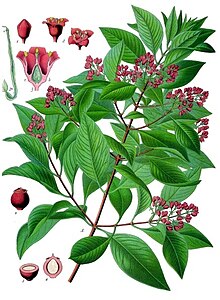
Sandalwoods are medium-sized hemiparasitic trees, and part of the same botanical family as European mistletoe. Notable members of this group are Indian sandalwood (Santalum album) and Australian sandalwood (Santalum spicatum) others in the genus also have fragrant wood. These are found in India, Nepal, Bangladesh, Pakistan, Sri Lanka, Australia, Indonesia, Hawaii, and other Pacific Islands.

Production
Producing commercially valuable sandalwood with high levels of fragrance oils requires Santalum trees to be a minimum of 15 years old (S. album) the age at which they will be harvested in Western Australia the yield, quality and volume are still to be clearly understood. Australia likely will be the largest producer of S. album by 2018, the majority grown around Kununurra, Western Australia. Western Australian sandalwood is also grown in plantations in its traditional growing area in the wheatbelt east of Perth, where more than 15,000 ha (37,000 acres) are in plantations. Currently, Western Australian sandalwood is only wild harvested and can achieve upwards of AU$16,000 per tonne, which has sparked a growing illegal trade speculated to be worth AU$2.5 million in 2012.

Fragrance

Sandalwood is mentioned in various suttas of the Pāli Canon. In some Buddhist traditions, sandalwood is considered to be of the padma (lotus) group and attributed to Amitabha Buddha. Sandalwood scent is believed by some to transform one's desires and maintain a person's alertness while in meditation. It is also one of the more popular scents used when offering incense to the Buddha and the guru.
Islam
In sufi tradition, sandalwood paste is applied on the sufi’s grave by the disciples as a mark of devotion. It is practiced particularly among the Indian Subcontinent disciples. In the Tamil culture irrespective of religious identity, sandalwood paste or powder is applied to the graves of sufis as a mark of devotion and respect.
Chinese and Japanese religions
Sandalwood, along with agarwood is the most commonly used incense material by the Chinese and Japanese in worship and various ceremonies. However, Taoists are forbidden from using sandalwood (as well as benzoin resin, frankincense, foreign produced) incense and instead either use agarwood, or better still Acronychia pedunculata, in worship.
Zoroastrians
Zoroastrians offer sandalwood twigs to the firekeeping priests who offer the sandalwood to the fire to keep the fire burning. Sandalwood is offered to all of the three grades of fire in the fire temple, including the Atash Dadgahs. Sandalwood is not offered to the divo, a homemade lamp. Often, money is offered to the mobad (for religious expenditures) along with the sandalwood. Sandalwood is called sukhar in the Zoroastrian community. The sandalwood in the fire temple is often more expensive to buy than at a Zoroastrian store. It is often a source of income for the fire temple.
Medicine
Sandalwood essential oil was popular in herbal medicine up to 1920–1930, mostly as a urogenital (internal) and skin (external) antiseptics. Its main component is santalol (about 75%). It is used in aromatherapy and to prepare soaps.
Technology
Due to its low fluorescence and optimal refractive index, sandalwood oil is often employed as an immersion oil within ultraviolet and fluorescence microscopy.
Distillation
Sandalwood is distilled in a four-step process, incorporating boiling, steaming, condensation, and separation. The process is known as steam distillation and is widely carried out industrially at Kannauj, India.
Food
Australian Aboriginals eat the seed kernels, nuts, and fruit of local sandalwoods, such as quandong (S. acuminatum).
References
Further Reading
External Links

Santalum paniculatum (ʻiliahi), Hawai's.
True Sandalwoods
Sandalwoods are medium-sized hemiparasitic trees, and part of the same botanical family as European mistletoe. Notable members of this group are Indian sandalwood (Santalum album) and Australian sandalwood (Santalum spicatum) others in the genus also have fragrant wood. These are found in India, Nepal, Bangladesh, Pakistan, Sri Lanka, Australia, Indonesia, Hawaii, and other Pacific Islands.

A closeup of sandal saplings.
- S. album is a threatened species indigenous to South India, and grows in the Western Ghat and a few other mountain ranges such as the Kalrayan and Shevaroy Hills. Although sandalwood trees in India, Pakistan, and Nepal are government-owned and their harvest is controlled, many trees are illegally cut down. Sandalwood oil prices have risen to $2,000 per kg recently. Red sanders is endemic in Seshachalam, Veliganda, Lankamala, and Palakonda hill ranges, distributed in districts of Kadapa, Chittoor and Kurnool in Rayalaseema region and parts of Nellore and Prakasam in Andhra Pradesh, Mysore region of Karnataka (formerly Mysore), and marayoor forest in Kerala, southern India is high in quality. New plantations were created with international aid in Tamil Nadu for economic exploitation. In Kununurra in Western Australia, Indian sandalwood is grown on a large scale.

Santalum album.
- S. ellipticum, S. freycinetianum and S. paniculatum, the Hawaiian sandalwood (ʻiliahi), were also used and considered high quality. These three species were exploited between 1790 and 1825 before the supply of trees ran out (a fourth species, S. haleakalae, occurs only in subalpine areas and was never exported). Although S. freycinetianum and S. paniculatum are relatively common today, they have not regained their former abundance or size, and S. ellipticum remains rare.
- S. spicatum is used by aromatherapists and perfumers. The concentration differs considerably from other Santalum species. In the 1840s, sandalwood was Western Australia’s biggest export earner. Oil was distilled for the first time in 1875, and by the turn of the 20th century, production of Australian sandalwood oil was intermittent. However, in the late 1990s, Western Australian sandalwood oil enjoyed a revival and by 2009 had peaked at more than 20,000 kg (44,000 lb) per year – much of which went to the fragrance industries in Europe. Although overall production has decreased, by 2011 a significant percentage of its production was heading to the chewing tobacco industry in India alongside Indian sandalwood – the chewing tobacco market being the largest market for both oils in 2012.
- Other species: Commercially, various other species, not belonging to Santalum species, are also used as sandalwood. Pterocarpus santalinus, Telugu: రక్తచందనము (raktachandanamu), Malayalam രക്തചന്ദനം (raktachandhanam), Tamil சிவப்புச்சந்தனம் (ciwappuchchandanam), red sanders, or red sandalwood, is a species of Pterocarpus native to India.
Various unrelated plants with similarly scented wood or oil include:
- Adenanthera pavonina - sandalwood tree, red or false red sandalwood
- Baphia nitida - camwood, also known as African sandalwood
- Eremophila mitchellii - sandalwood; false sandalwood (also sandalbox)
- Myoporum platycarpum - sandalwood; false sandalwood
- Myoporum sandwicense - bastard sandalwood, false sandalwood
- Osyris lanceolata - African sandalwood
- Osyris tenuifolia - east African sandalwood
Producing commercially valuable sandalwood with high levels of fragrance oils requires Santalum trees to be a minimum of 15 years old (S. album) the age at which they will be harvested in Western Australia the yield, quality and volume are still to be clearly understood. Australia likely will be the largest producer of S. album by 2018, the majority grown around Kununurra, Western Australia. Western Australian sandalwood is also grown in plantations in its traditional growing area in the wheatbelt east of Perth, where more than 15,000 ha (37,000 acres) are in plantations. Currently, Western Australian sandalwood is only wild harvested and can achieve upwards of AU$16,000 per tonne, which has sparked a growing illegal trade speculated to be worth AU$2.5 million in 2012.

Sandalwood leaf.
Sandalwood is expensive compared to other types of woods therefore to maximize profit sandalwood is harvested by removing the entire tree instead of sawing it down at the trunk close to ground level. This way wood from the stump and root, which possess high levels of sandalwood oil, can also be processed and sold.
UsesFragrance
Sandalwood oil, has a distinctive soft, warm, smooth, creamy, and milky precious-wood scent. It imparts a long-lasting, woody base to perfumes from the oriental, woody, fougère, and chypre families, as well as a fixative to floral and citrus fragrances. When used in smaller proportions in a perfume, it acts as a fixative, enhancing the longevity of other, more volatile, materials in the composite. Last but not least, sandalwood is a key ingredient in the "floriental" (floral-ambery), fragrance family – when combined with white florals such as jasmine, ylang ylang, gardenia, plumeria, orange blossom, tuberose etc.
Sandalwood oil in India is widely used in the cosmetic industry. The main source of true sandalwood, S. album, is a protected species, and demand for it cannot be met. Many species of plants are traded as "sandalwood". The genus Santalum has more than 19 species. Traders often accept oil from closely related species, as well as from unrelated plants such as West Indian sandalwood (Amyris balsamifera) in the family Rutaceae or bastard sandalwood (Myoporum sandwicense, Myoporaceae). However, most woods from these alternative sources lose their aroma within a few months or years.
Isobornyl cyclohexanol is a synthetic fragrance chemical produced as an alternative to the natural product.

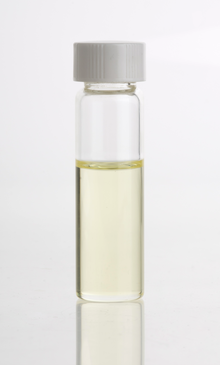
Sandalwood (S. album) essential oil.
Hinduism
Sandalwood paste is integral to rituals and ceremonies, to mark religious utensils, and to decorate the icons of the deities. It is also distributed to devotees, who apply it to their foreheads or the necks and chests. Preparation of the paste is a duty fit only for the pure, so is entrusted in temples and during ceremonies only to priests.

Sandalwood carved statue of lord Ganesha.
The paste is prepared by grinding wood by hand upon granite slabs shaped for the purpose. With the slow addition of water, a thick paste results (called kalabham "കളഭം" in Malayalam language and "gandha" ಗಂಧ in Kannada, which is mixed with saffron or other such pigments to make chandanam. Chandanam, further mixed with herbs, perfumes, pigments, and some other compounds, results in javadhu. Kalabham, chandanam, and javadhu are dried and used as kalabham powder, chandanam powder, and javadhu powder, respectively. Chandanampowder is very popular in India and is also used in Nepal. In Tirupati after religious tonsure, sandalwood paste is applied to protect the skin. In Hinduism and Ayurveda, sandalwood is thought to bring one closer to the divine. Thus, it is one of the most used holy elements in Hindu and Vedic societies.
BuddhismSandalwood is mentioned in various suttas of the Pāli Canon. In some Buddhist traditions, sandalwood is considered to be of the padma (lotus) group and attributed to Amitabha Buddha. Sandalwood scent is believed by some to transform one's desires and maintain a person's alertness while in meditation. It is also one of the more popular scents used when offering incense to the Buddha and the guru.
Islam
In sufi tradition, sandalwood paste is applied on the sufi’s grave by the disciples as a mark of devotion. It is practiced particularly among the Indian Subcontinent disciples. In the Tamil culture irrespective of religious identity, sandalwood paste or powder is applied to the graves of sufis as a mark of devotion and respect.
Chinese and Japanese religions
Sandalwood, along with agarwood is the most commonly used incense material by the Chinese and Japanese in worship and various ceremonies. However, Taoists are forbidden from using sandalwood (as well as benzoin resin, frankincense, foreign produced) incense and instead either use agarwood, or better still Acronychia pedunculata, in worship.
Zoroastrians
Zoroastrians offer sandalwood twigs to the firekeeping priests who offer the sandalwood to the fire to keep the fire burning. Sandalwood is offered to all of the three grades of fire in the fire temple, including the Atash Dadgahs. Sandalwood is not offered to the divo, a homemade lamp. Often, money is offered to the mobad (for religious expenditures) along with the sandalwood. Sandalwood is called sukhar in the Zoroastrian community. The sandalwood in the fire temple is often more expensive to buy than at a Zoroastrian store. It is often a source of income for the fire temple.
Medicine
Sandalwood essential oil was popular in herbal medicine up to 1920–1930, mostly as a urogenital (internal) and skin (external) antiseptics. Its main component is santalol (about 75%). It is used in aromatherapy and to prepare soaps.
Technology
Due to its low fluorescence and optimal refractive index, sandalwood oil is often employed as an immersion oil within ultraviolet and fluorescence microscopy.
Distillation
Sandalwood is distilled in a four-step process, incorporating boiling, steaming, condensation, and separation. The process is known as steam distillation and is widely carried out industrially at Kannauj, India.
Food
Australian Aboriginals eat the seed kernels, nuts, and fruit of local sandalwoods, such as quandong (S. acuminatum).
References
- ^ Asian Regional Workshop (1998). Santalum album. 2006. IUCN Red List of Threatened Species. IUCN 2006. www.iucnredlist.org. Retrieved on 2007-02-08.
- ^ Wagner, W. L., D. R. Herbst, and S. H. Sohmer (1990). Manual of the Flowering Plants of Hawaii. Honolulu: University of Hawaii Press.
- ^ Rock, J. F. (1913). The Indigenous Trees of the Hawaiian Islands. Honolulu.
- ^ "Illegal sandalwood trade growing in WA - ABC News (Australian Broadcasting Corporation)". Abc.net.au. 2012-10-30. Retrieved 2012-12-30.
- ^ Tony Page, Hanington Tate, Joseph Tungon, Michael Tabi and Phyllis Kamasteia (2012). "Vanuatu sandalwood: growers’ guide for sandalwood production in Vanuatu". (PDF). Australian Centre for International Agricultural Research. p. 47. Retrieved May 9, 2015.
- ^ "Sandalwood - spiritual".
- ^ http://www.accesstoinsight.org/search_results.html?cx=015061908441090246348%3Adj4lxnh4dda&cof=FORID%3A9%3BNB%3A1&ie=UTF-8&q=sandalwood&sa=Search
- ^ "Now, All roads lead to Mumbai's Mahim Dargah fair", dnaindia.com. 18 December 2011. Retrieved 21 April 2013. *Khubchandani, Lachman K. (1995). "The supernatural in nature Sindhi tradition". Indira Gandhi National Centre for the Arts. Retrieved 21 April2013. *Bayly, Susan (2004). Saints, Goddesses and Kings). Cambridge University Press. pp. 144–147. ISBN 9780521891035. Retrieved 21 April 2013.
- ^ The Ming Dynasty Taoist manual 《天皇至道太清玉冊》 states: 「降真香,乃祀天帝之靈香也。除此之外,沉速次之。信靈香可以達天帝之靈。所忌者,安息香、乳香、檀香,外夷所合成之香,天律有禁,切宜慎之。」 ["Acronychia pedunculata is the spiritual incense of offering to the Heavenly Emperor. Apart from this type, agarwood/aloeswood (Aquilaria malaccensis) then Aquilaria sinensis are the next best. It is believed that this spiritual incense can ascend to reach the spirit of the Heavenly Emperor. Those that are to be avoided are benzoin resin, frankincense, sandalwood, foreign produced incense that violate the Heavenly Law and so one must be careful to observe this."]
- ^ "The Good Oi" (PDF). www.fpc.wa.gov.au. The Forest Products Commission, Western Australia. Retrieved 18 November 2014.
- Plant Cultures: botany, history and use of sandalwood
- IUCN Threatened Species: Santalum album
- Plant Cultures: botany, history and use of sandalwood
- IUCN Threatened Species: Santalum album
Wikipedia


.JPG)