Blog List

Friday, 13 May 2016

LIGNITE

Lignite, often referred to as brown coal, is a soft brown combustible sedimentary rock formed from naturally compressed peat. It is considered the lowest rank of coal due to its relatively low heat content. It has a carbon content around 60–70%. It is mined all around the world and is used almost exclusively as a fuel for steam-electric power generation, but is also mined for its germanium content in China. As of 2014, about 12% of Germany's energy and, specifically, 27% of Germany's electricity comes from lignite power plants, while in Greece, lignite provides about 50% of its power needs.


Lignite and Lignite briquette.

Characteristics
Lignite is brownish-black in color and has a carbon content around 60–70%, a high inherent moisture content sometimes as high as 75%, and an ash content ranging from 6% to 19% compared with 6% to 12% for bituminous coal.
Strip mining lignite at Tagebau Garzweiler in Germany.
The energy content of lignite ranges from 10 to 20 MJ/kg (9–17 million BTU per short ton) on a moist, mineral-matter-free basis. The energy content of lignite consumed in the United States averages 15 MJ/kg (13 million BTU/ton), on the as-received basis (i.e., containing both inherent moisture and mineral matter). The energy content of lignite consumed in Victoria, Australia, averages 8.4 MJ/kg (6.5 million BTU/ton).
Lignite has a high content of volatile matter which makes it easier to convert into gas and liquid petroleum products than higher-ranking coals. Unfortunately, its high moisture content and susceptibility to spontaneous combustion can cause problems in transportation and storage. It is now known that efficient processes that remove latent moisture locked within the structure of brown coal will relegate the risk of spontaneous combustion to the same level as black coal, will transform the calorific value of brown coal to a black coal equivalent fuel, and significantly reduce the emissions profile of 'densified' brown coal to a level similar to or better than most black coals. However, removing the moisture increases the cost of the final lignite fuel.
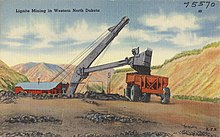
Lignite mining in Western North Dakota, United States (circa 1945)

Uses
Because of its low energy density and typically high moisture content, brown coal is inefficient to transport and is not traded extensively on the world market compared with higher coal grades. It is often burned in power stations near the mines, such as in Australia's Latrobe Valley and Luminant's Monticello plant in Texas. Primarily because of latent high moisture content and low energy density of brown coal, carbon dioxide emissions from traditional brown-coal-fired plants are generally much higher per megawatt generated than for comparable black-coal plants, with the world's highest-emitting plant being Hazelwood Power Station, Victoria. The operation of traditional brown-coal plants, particularly in combination with strip mining, can be politically contentious due to environmental concerns. An environmentally beneficial use of lignite can be found in its use in cultivation and distribution of biological control microbes that suppress plant disease causing microbes. The carbon enriches the organic matter in the soil while the biological control microbes provide an alternative to chemical pesticides.
Reaction with quaternary amine forms a product called amine-treated lignite (ATL), which is used in drilling mud to reduce fluid loss during drilling.
Geology
Lignite begins as an accumulation of partially decayed plant material, or peat. Burial by other sediments results in increasing temperature, depending on the local geothermal gradient and tectonic setting, and increasing pressure. This causes compaction of the material and loss of some of the water and volatile matter (primarily methane and carbon dioxide). This process, called coalification, concentrates the carbon content, and thus the heat content, of the material. Deeper burial and the passage of time result in further expulsion of moisture and volatile matter, eventually transforming the material into higher rank coals such as bituminous and anthracite coal.
Lignite deposits are typically younger than higher-ranked coals, with the majority of them having formed during the Tertiary period.
Resources

The Latrobe Valley in the state of Victoria, Australia, contains estimated reserves of some 65 billion tonnes of brown coal. The deposit is equivalent to 25% of known world reserves. The coal seams are up to 100 metres thick, with multiple coal seams often giving virtually continuous brown coal thickness of up to 230 metres. Seams are covered by very little overburden (10 to 20 metres).

Types
Lignite can be separated into two types. The first is xyloid lignite or fossil wood and the second form is the compact lignite or perfect lignite.
Although xyloid lignite may sometimes have the tenacity and the appearance of ordinary wood, it can be seen that the combustible woody tissue has experienced a great modification. It is reducible to a fine powder by trituration, and if submitted to the action of a weak solution of potash, it yields a considerable quantity of humic acid. Leonardite is an oxidized form of lignite, which is also contains high levels of humic acid.
Jet is a hardened, gem-like form of lignite used in various types of jewelry.
Production 
Lignite mined in millions of metric tons
Country19701980199020002010201120122013
 Chinan.a.24.345.547.7125.3136.3200.9
 East Germany261258.1280
 West Germany108129.9107.6
 Germany167.7169176.5185.4183
 Soviet Union145.0141.0137.3
 Russia87.876.176.477.973
 Kazakhstan2.67.38.45.5
 Uzbekistan2.53.43.83.8
 United States542.879.977.67173.471.670
 Polandn.a.36.967.659.556.562.864.366
 Turkeyn.a.14.544.460.969.772.66663
 Australian.a.32.946.067.372.17173.563
 Greece23.251.963.956.558.761.854
 Indian.a.5.014.124.237.742.343.545
 Czechoslovakia82.087.071.0
 Czech Republic50.143.846.643.540
 Slovakia3.72.42.42.3
 Yugoslavian.a.33.764.1
 Serbia and Montenegro35.5
 Serbia3841.13840
 Kosovo8.798.7
 Macedonia7.56.78.27.5
 Bosnia and Herzegovina3.45.66.36.3
 Slovenia3.744.14
 Montenegro1.922
 Romanian.a.26.533.72931.135.534
 Bulgarian.a.3031.526.329.437.132.5
 Albanian.a.1.42.13014920
 Thailandn.a.1.512.417.818.321.318.3
 Mongolian.a.4.46.65.18.58.39.9
 Canadan.a.69.411.210.39.79.5
 Hungaryn.a.22.617.3149.19.69.3
 North Korean.a.1010.67.26.76.86.8
Source: World Coal Association.  U.S. Energy Information Administration· 1970 data from World Coal (1987)
(n.a.) no data available, (–) country did not exist yet or does not exist anymore
Gallery 


References 


  1. a b c Kopp, Otto C. "Lignite" in Encyclopaedia Britannica
  2. ^ "Statistics on energy production in Germany 2014, Department of Energy (in german, lignite = "Braunkohle")" (PDF). 2014-10-01. Retrieved 2015-12-10.
  3. ^ Ghassemi, Abbas (2001). Handbook of Pollution Control and Waste Minimization. CRC Press. p. 434. ISBN 0-8247-0581-5.
  4. ^ George, A.M.. State Electricity Victoria, Petrographic Report No 17. 1975; Perry, G.J and Allardice, D.J. Coal Resources Conference, NZ 1987 Proc.1, Sec. 4.. Paper R4.1
  5. ^ "Hazelwood tops international list of dirty power stations". World Wide Fund for Nature Australia. Retrieved 2008-10-02.
  6. ^ "The Greens Won't Line Up For Dirty Brown Coal In The Valley". Australian Greens Victoria. 2006-08-18. Retrieved 2007-06-28.
  7. ^ "Greenpeace Germany Protests Brown Coal Power Stations". Environment News Service. 2004-05-28. Archived from the original on 2007-09-30. Retrieved 2007-06-28.
  8. ^ Jones, Richard; Petit, R; Taber, R (1984). "Lignite and stillage:carrier and substrate for application of fungal biocontrol agents to soil". Phytopathology 74: 1167–1170. doi:10.1094/Phyto-74-1167.
  9. ^ Blatt, H., Middleton, G. and Murray, R. (1972). Origin of Sedimentary Rocks. Prentice-Hall Inc., New Jersey. ISBN 0-13-642702-2.
  10. a b Department of Primary Industries, Victorian Government, Australia, ‘Victoria Australia: A Principle Brown Coal Province’ (Fact Sheet, Department of Primary Industries, July 2010).
  11. ^ Mackie, Samuel Joseph (1861). The Geologist Original from Harvard University: Reynolds. pp. 197–200.
  12. ^ Tan, K.H. 2003. Humic matter in soil and the environment: principles and controversies, CRC Press, 408pp.
  13. ^ "World Coal Association – Resources". World Coal Association. 2014. Retrieved 2015-12-22.
  14. ^ "Production of Lignite Coal".  U.S. Energy Information Administration. 2012. Retrieved 2015-12-23.
  15. ^ Gordon, Richard (1987). World coal: economics, policies and prospects. Cambridge: Cambridge University Press. p. 44. ISBN 0521308275 OCLC 506249066.

Wikipedia 

Exercises for Men in Their Late 40s

Most men in their 40s do not have the speed and endurance of fit men in their 20s, but they still can do challenging and diverse workouts. The American Heart Association recommends that healthy men do at least 150 minutes of moderate to vigorous cardiovascular exercise every week. You should also do three 20-minute weightlifting, stretching and body resistance training sessions every week to build muscle, lubricate your joints and boost flexibility.
Exercises for Men in Their Late 40s

Aerobic exercise helps men in their 40s maintain healthy hearts. Photo Credit ASIFE/iStock/Getty Images.

Cardiovascular Exercise

The heart of any 40- to 50-year-old man's fitness program should be cardiovascular exercise. Aim to raise your heart rate for at least 20 to 30 minutes. If high-impact workouts such as running, jumping rope and martial arts stress your joints and tendons, adopt a lower-impact workout such as climbing stairs, training on an elliptical machine, using a rowing machine or pedaling on a stationary cycle. You can make a low-impact workout more intense by speed-walking or hiking by adding a steady incline or hills to your route.

Strength Training

As men age, they gradually lose muscle mass. Men in their 40s can reverse this process by adopting a strength-training regimen. Lifting dumbbells, pumping hand weights, using resistance machines or doing calisthenics and floor work that use your own body weight as resistance builds muscle which raises your resting metabolic rate. Your body pumps more energy to your muscles, which makes you burn more calories around the clock. Target your upper body with pullups, biceps curls, triceps dips, standing flies and bench presses. Build lower body strength with squats, hamstring raises and lunges. Focus on your core by doing abdominal crunches while bicycling your legs or situps on an incline.


Flexibility Training

Getting fit and muscular does not always boost your flexibility. You need to stretch, bend and lubricate your joints to maintain your full range of motion as you age. After doing cardiovascular exercise, take time to do some forward bends, side stretches and overhead reaches. If you want more intense flexibility training, consider doing yoga poses. Power yoga, Ashtanga yoga and Bikram yoga are intense styles that also raise your heart rate and build muscle.

Deep Breathing

Reduce stress and the effects of aging by doing deep breathing exercises. In addition, breathing deeply while warming up for exercise gets your blood pumping and delivers oxygen to your muscles. Spend the first 10 minutes of your workout walking briskly or marching in place, and focus on inhaling deeply through your nose -- enough to fill your belly as well as your chest. Hold for a beat and then exhale deeply.
www.livestrong.com

Weight-Loss Breakfast Ideas

Breakfast is often described as one of the most important meals of the day. Breakfast--literally a break after a period of fasting--restores blood glucose levels that have declined during the night and ensures you have adequate energy to begin your day. A good breakfast can help stave off hunger and sustain energy levels throughout the morning, reducing your chances of suffering a mid-morning energy slump and associated sugar cravings. A healthy breakfast is often associated with weight loss and weight management. Numerous studies indicate that breakfast eaters are generally closer to their ideal weight than non-breakfast eaters.
Weight-Loss Breakfast Ideas
Eggs are an excellent breakfast food Photo Credit Max Oppenheim/Digital Vision/Getty Images.

Eggs

Eggs are rich in protein and essential fats which means they are satisfying to eat and keep you feeling fuller for longer. An average egg contains around 76 calories, 6.5 grams of protein and 5.6 grams of fat. Eggs cook very quickly and can be poached, scrambled, fried, boiled or made in to an omelet as preferred. If you want to save some fat calories, you can remove some of the yolks as this is the part of the egg that contains the majority of the fat. It is worth noting, however, that most of the vitamins contained in an egg is found in the yolk.

Oatmeal

Oatmeal is a low glycemic grain that provides slow releasing carbohydrate, soluble fiber and is also low in fat. The high fiber content of oatmeal means that it stays in your stomach for longer which promotes a feeling of fullness. When made with milk, oatmeal also provides essential protein and calcium--both important factors in weight loss. Oatmeal is very quick and easy to prepare and can be heated in a microwave to save time. You can also eat oatmeal cold by soaking the oats in milk overnight and then eating straight from the fridge the following morning. Serve with fresh fruit or a small amount of honey if you want a sweeter tasting oatmeal.

Smoothies

Smoothies can be prepared quickly and easily making them ideal for when you need a good breakfast in a hurry. Smoothies are also ideal if you find that you aren't very hungry first thing in the morning. To make a smoothie, pour around half a pint of water or milk into a blender, add soft fruits e.g. a banana, berries or similar, add some whey protein powder or natural yogurt and then blend until smooth. If you prefer you can use almond, rice or soya milk as your liquid base. You can spice up your smoothie by adding natural peanut or almond butter, frozen berries, honey, dry oats or any number of other ingredients but be aware that these can all increase the calorie content of your smoothie.

Breakfast Cereals

Breakfast cereals are quick to prepare, tasty and satisfying to eat. On the downside, many breakfast cereals contain so much sugar that they are broken down by your digestive system very quickly and can leave you hungry soon after consumption as your blood sugar levels initially rise very quickly and then fall even quicker! If you choose to consume breakfast cereals make sure you select products that are low in sugar, high in fiber, have undergone minimal amounts of processing and contain as few artificial additives as possible. Whole grain cereals such as unsweetened muesli are a good choice as are bran based cereals such as bran flakes and bran sticks. Even the healthiest breakfast cereals can be very calorie dense so you should endeavor to practice good portion control by measuring the amount of cereal you eat by using a cup to ensure you don't consume too much.
www.livestrong.com

COIR

Coir (pronunciation: /ˈkɔɪər/) is a natural fibre extracted from the husk of coconut and used in products such as floor mats, doormats, brushes, mattresses, etc. Coir is the fibrous material found between the hard, internal shell and the outer coat of a coconut. Other uses of brown coir (made from ripe coconut) are in upholstery padding, sacking and horticulture. White coir, harvested from unripe coconuts, is used for making finer brushes, string, rope and fishing nets.


A close-up view of coir fibre.

Etymology

The English word "coir" comes from the Malayalam word 'kayar'. it is pronounced (in English) coy-yer


Segregation of coir fibre.

History
Ropes and cordage made from coconut fibre have been in use from ancient times. Indian navigators who sailed the seas to Malaya, Java, China, and the Gulf of Arabia centuries ago used coir for their ship ropes. Arab writers of the 11th century AD referred to the extensive use of coir for ship ropes and rigging. 
A coir industry in the UK was recorded before the second half of the 19th century. During 1840, Captain Widely, in co-operation with Captain Logan and Mr. Thomas Treloar, founded the known carpet firms of Treloar and Sons in Ludgate Hill, England, for the manufacture of coir into various fabrics suitable for floor coverings.
Structure
Coir fibres are found between the hard, internal shell and the outer coat of a coconut. The individual fibre cells are narrow and hollow, with thick walls made of cellulose. They are pale when immature, but later become hardened and yellowed as a layer of lignin is deposited on their walls. Each cell is about 1 mm (0.04 in) long and 10 to 20 Âµm (0.0004 to 0.0008 in) in diameter. Fibres are typically 10 to 30 centimetres (4 to 12 in) long. The two varieties of coir are brown and white. Brown coir harvested from fully ripened coconuts is thick, strong and has high abrasion resistance. It is typically used in mats, brushes and sacking. Mature brown coir fibres contain more lignin and less cellulose than fibres such as flax and cotton, so are stronger but less flexible. White coir fibres harvested from coconuts before they are ripe are white or light brown in color and are smoother and finer, but also weaker. They are generally spun to make yarn used in mats or rope.
The coir fibre is relatively waterproof, and is one of the few natural fibres resistant to damage by saltwater. Fresh water is used to process brown coir, while seawater and fresh water are both used in the production of white coir.
Processing

Green coconuts, harvested after about six to 12 months on the palm, contain pliable white fibres. Brown fibre is obtained by harvesting fully mature coconuts when the nutritious layer surrounding the seed is ready to be processed into copra and desiccated coconut. The fibrous layer of the fruit is then separated from the hard shell (manually) by driving the fruit down onto a spike to split it (dehusking). A well-seasoned husker can manually separate 2,000 coconuts per day. Machines are now available which crush the whole fruit to give the loose fibres. These machines can process up to 2,000 coconuts per hour.

Brown Fibre

The fibrous husks are soaked in pits or in nets in a slow-moving body of water to swell and soften the fibres. The long bristle fibres are separated from the shorter mattress fibres underneath the skin of the nut, a process known as wet-milling. The mattress fibres are sifted to remove dirt and other rubbish, dried in the sun and packed into bales. Some mattress fibre is allowed to retain more moisture so it retains its elasticity for twisted fibre production. The coir fibre is elastic enough to twist without breaking and it holds a curl as though permanently waved. Twisting is done by simply making a rope of the hank of fibre and twisting it using a machine or by hand. The longer bristle fibre is washed in clean water and then dried before being tied into bundles or hanks. It may then be cleaned and 'hackled' by steel combs to straighten the fibres and remove any shorter fibre pieces. Coir bristle fibre can also be bleached and dyed to obtain hanks of different colours.

White Fibre
The immature husks are suspended in a river or water-filled pit for up to ten months. During this time, micro-organisms break down the plant tissues surrounding the fibres to loosen them — a process known as retting. Segments of the husk are then beaten by hand to separate out the long fibres which are subsequently dried and cleaned. Cleaned fibre is ready for spinning into yarn using a simple one-handed system or a spinning wheel.
Researchers at CSIR's National Institute for Interdisciplinary Science and Technology in Thiruvananthapuram have developed a biological process for the extraction of coir fibre from coconut husk without polluting the environment. The technology uses enzymes to separate the fibres by converting and solubilizing plant compounds to curb the pollution of waters caused by retting of husks.
Buffering
Because coir is high in sodium and potassium, it is treated before use as a growth medium for plants or fungi by soaking in a calcium buffering solution; most coir sold for growing purposes is pre-treated. Once any remaining salts have been leached out of the coir pith, it and the coir bark become suitable substrates for cultivating fungi. Coir is naturally rich in potassium, which can lead to magnesium deficiencies in soilless horticultural media.
Coir does provide a suitable substrate for horticultural use as a soilless potting medium. The material's high lignin content is longer lasting, holds more water, and does not shrink off the sides of the pot when dry allowing for easier rewetting. This light media has advantages and disadvantages that can be corrected with the addition of the proper amendment such as coarse sand for weight in interior plants like Draceana. Nutritive amendments should also be considered. Calcium and magnesium will be lacking in coir potting mixes, so a naturally good source of these nutrients is dolomitic lime which contains both. The addition of beneficial microbes to the coir media have been successful in tropical green house conditions and interior spaces as well. However, it is important to note that the microbes will engage in growth and reproduction under moist atmospheres producing fruiting bodies (mushrooms).
Bristle Coir

Bristle coir is the longest variety of coir fibre. It is manufactured from retted coconut husks through a process called defibring. The coir fibre thus extracted is then combed using steel combs to make the fibre clean and to remove short fibres. Bristle coir fibre is used as bristles in brushes for domestic and industrial applications.

Uses


Making coir rope in Kerala, India.

Red coir is used in floor mats and doormats, brushes, mattresses, floor tiles and sacking. A small amount is also made into twine. Pads of curled brown coir fibre, made by needle-felting (a machine technique that mats the fibres together), are shaped and cut to fill mattresses and for use in erosion control on river banks and hillsides. A major proportion of brown coir pads are sprayed with rubber latex which bonds the fibres together (rubberised coir) to be used as upholstery padding for the automobile industry in Europe. The material is also used for insulation and packaging.
The major use of white coir is in rope manufacture. Mats of woven coir fibre are made from the finer grades of bristle and white fibre using hand or mechanical looms. White coir also is used to make fishing nets due to its strong resistance to saltwater.
In horticulture, coir is a substitute for sphagnum moss because it is free of bacteria and fungal spores. Coir is also useful to deter snails from delicate plantings, and as a growing medium in intensive glasshouse (greenhouse) horticulture.
Coconut coir from Mexico has been found to contain large numbers of colonies of the beneficial fungus Aspergillus terreus, which acts as a biological control against plant pathogenic fungi.
Coir is also used as a substrate to grow mushrooms. The coir is usually mixed with vermiculite and pasteurized with boiling water. After the coir/vermiculite mix has cooled to room temperature, it is placed in a larger container, usually a plastic box. Previously prepared spawn jars are then added, spawn is usually grown in jars using substrates such as rye grains or wild bird seed. This spawn is the mushrooms mycelium and will colonize the coir/vermiculite mix eventually fruiting mushrooms.
Coir is an allergen, as well as the latex and other materials used frequently in the treatment of coir.
Coir can be used as a terrarium substrate for reptiles or arachnids.
Major producers

Total world coir fibre production is 250,000 tonnes (250,000 long tons; 280,000 short tons). This industry is particularly important in some areas of the developing world. India, mainly in Pollachi and the coastal region of Kerala State, produces 60% of the total world supply of white coir fibre. Sri Lanka produces 36% of the total brown fibre output. Over 50% of the coir fibre produced annually throughout the world is consumed in the countries of origin, mainly India. Together, India and Sri Lanka produce 90% of the coir produced every year.

Waste and byproducts

Coir fibres make up about a third of the coconut pulp. The rest, called peat, pith or dust, is biodegradable, but takes 20 years to decompose. Once considered as waste material, pith is now being used as mulch, soil treatment and a hydroponic growth medium.

References

  1. ^ Coconut
  2. a b Staff. "About Coir". Coir Board, Govt. of India. Retrieved 17 March 2013.
  3. ^ "Thomas Treloar 1818-1876". RootsWeb.
  4. ^ http://www.fao.org/economic/futurefibres/fibres/coir/en/
  5. a b c "http://www.madehow.com/Volume-6/Coir.html
  6. ^ "‘Clean' technology for coir fibre extraction". The Hindu. 2009-04-30.
  7. ^ Hunt, Robert; Ricciardi, Zac (2011-02-10). "Reusing Media: Coco Coir" Urban Garden Magazine (14).
  8. ^ Hyder, Naveen; Sims, James J.; Wegulo, Stephen N.. In Vitro Suppression of Soilborne Plant Pathogens by Coir. Department of Plant Pathology, University of Nebraska, 448 Plant Science Hall, Lincoln, NE 68583. 2008-11-19. URL:http://www.agrococo.com/Pathogen_Suppression.pdf. Accessed: 2009-08-17. (Archived by WebCite at http://www.webcitation.org/5j5breEfV).
  9. ^ "Nasobronchial Allergy and Pulmonary Function Abnormalities Among Coir Workers of Alappuzha" (PDF). Japi.org.
  10. ^ "Reptiles" 16. Fancy Publications. 2008: 66.
  11. ^ Jacobi, Michael (2011). Tarantulas. TFH Publications Inc. p. 93. ISBN 9780793844784.
  12. ^ Tom Woolley, Sam Kimmins, Paul Harrison, Rob Harrison. “Green Building Handbook Volume 1: A guide to building products and their impact on the environment”. Green Building Digest. Spon Press. 1997. ISBN 0-419-22690-7.

Wikipedia 

Hand Tool Essentials eBook By The Editors of Popular Woodworking

THE WOODWORKING DESIGN COLLECTION - ONLY 69 LEFT !

By The Editors of Popular Woodworking

Format: eBook 

Learning to work with hand tools takes a little guts, some basic dexterity and some background information. In today's shop, you supply the guts, anyone can learn the dexterity and the background is best gotten from a crusty German master cabinetmaker.
Now, if you don't have a crusty German master cabinetmaker hiding in the garage, we have something almost as good that should help you on your way. We've assembled 224 pages of the best writing we've done on hand tools at Popular Woodworking and Woodworking Magazine during the last 10 years and assembled it into a full-color and reasonably priced ($24.99) book that is now available directly from us and booksellers nationwide.

Hand Tool Essentials (Popular Woodworking Books) contains articles from all of our regular contributors during the last decade, including Lonnie Bird, David Charlesworth, Adam Cherubini, Don McConnell, Frank Klausz and magazine editor Christopher Schwarz.
The 43 chapters cover a wide range of topics, from how to assemble your first kit of hand tools at a flea market for less than $100 and tune them up, to advanced topics such as how to blend bench planes with power tools, how to make custom chisel handles and how to select an exotic infill handplane.

Not only is there a wide range of subject matter in the book, there's also a wide range of opinion on what are the best practices. We tried hard not to make this a dogmatic, you-must-work-this-way book. So you'll get a good dose of 18th century techniques and philosophy from Adam Cherubini, a firm understanding of the merits of wooden-bodied planes and spokeshaves from Don McConnell, and a modern hybrid of hand and power techniques from Lonnie Bird, David Charlesworth and Christopher Schwarz.

Here are some of the raw numbers on this book: We packed nine chapters in on sharpening, five on chisels, 10 on handplanes and five on sawing. In addition, we also squeezed in complete plans for a French-style workbench, an Arts & Crafts wall-hung tool cabinet, an English sawbench and a useful miter shooting board.

Armed with the complete picture of hand work in the modern shop, we think you'll be able to find the path that's best for you. And in some ways, that approach might be even better than the advice you'd get from an old German cabinetmaker.
SKUY3146
Author/Speaker/EditorThe Editors of Popular Woodworking
File TypePDF
FormateBook
ISBN 139781440313134

For further information log on website :

http://www.shopwoodworking.com/hand-tool-essentials-y3146?source=igodigital

Advantages and Disadvantages of Fasting for Runners

Author BY   ANDREA CESPEDES  Food is fuel, especially for serious runners who need a lot of energy. It may seem counterintuiti...