Blog List

Tuesday, 3 October 2017

Acacia Fiber vs. Psyllium

Author
by 

Acacia and psyllium are two dietary fiber supplements marketed for various purposes. Psyllium is most commonly used to relieve constipation, and acacia -- though less common -- appears effective for this purpose as well. As is true of other soluble fibers, both acacia and psyllium may help promote healthy weight, and psyllium can help lower cholesterol. Consult your doctor before taking supplements of any kind. All supplements have the ability to cause side effects.

Understanding Soluble Fiber

Soluble fiber is present in your diet in foods such as oat bran, beans and other legumes, as well as some fruits and vegetables. During digestion, soluble fiber attracts and absorbs water, mixing with it to form a gel-like substance that promotes digestive health. It's this quality that makes fiber supplements beneficial for constipation. Acacia and psyllium come from plants but are not found naturally in foods -- though they're sometimes added to them. Both are typically taken as a dietary supplement in powder form.
Advertisement
 

Both Relieve Constipation

Both acacia and psyllium are effective for relieving constipation, according to a study published in the "Journal of Pediatrics" in 2012. Researchers compared the effectiveness of the two fibers in children with chronic functional constipation -- a condition characterized by infrequent bowel movements. They found that both were equally effective at relieving constipation, with no noticeable difference between the two.

Both Promote Healthy Weight

Along with a healthy diet and exercise plan, both acacia and psyllium may help fight obesity. A study published in 2012 in the "Nutrition Journal" found acacia significantly reduces body fat percentage and BMI -- a measure of body fatness -- in healthy women. A similar study published in the "European Journal of Clinical Nutrition" in 2009 reported that psyllium reduced BMI, fasting blood sugar, waist circumference and triglycerides in people with Type 2 diabetes.

Dietary Fiber Recommendations

You can get the same benefits by eating a diet rich in fiber. Consume at least 20 grams of fiber from food, not supplements, recommends the Harvard School of Public Health. Most fiber foods contain a mixture of soluble and insoluble fiber -- the latter does not dissolve in water and helps add bulk to stool. If the current fiber content of your diet is low, increase it gradually to avoid digestive discomfort. A fiber-rich diet includes plenty of fruits, vegetables, grains and legumes.
For further information log on website :
http://www.livestrong.com/article/283152-acacia-fiber-vs-psyllium/

The Benefits of Acacia Fiber

Health Benefits, Uses, and More


acacia fiber powder
Rich in soluble fiber, acacia fiber is sourced from the sap of the Acacia senegal tree, a plant native to parts of Africa, Pakistan, and India. Also known as gum arabic and acacia gum, acacia fiber is said to offer a number of health benefits.
When used in powder form, acacia can be stirred into water. It's not gritty, doesn't thicken, and has a fairly mild taste, so it can be mixed into smoothies and other drinks.

Why Do People Use Acacia Fiber?

Due to its high soluble fiber content, acacia fiber is thought to help lower cholesterol levels, keep blood sugar in check, protect against diabetes, and aid in the treatment of digestive disorders such as irritable bowel syndrome (IBS). Soluble fiber (one of the main types of dietary fiber) dissolves in water and forms a gel-like substance in the intestines.
In addition, acacia fiber is said to suppress appetite, reduce gut inflammation, alleviate constipation, relieve diarrhea, and support weight loss efforts (by helping you stay full for longer).
Acacia fiber is also said to be a prebiotic (a non-digestible food ingredient in dietary fiber that can stimulate the growth of beneficial bacteria in the intestines). 

The Benefits of Acacia Fiber: Can It Help?

Although very few studies have tested the health effects of acacia fiber, there's some evidence that it may offer certain benefits.
Here's a look at some key findings from the available research:
1) Irritable Bowel Syndrome (IBS)
Free of substances (such as gluten and artificial sweeteners) that can be problematic for some people, acacia fiber is said to help relieve IBS symptoms. In a study published in World Journal of Gastroenterology in 2012, researchers determined that yogurt enriched with acacia fiber and the probiotic Bifidobacterium lactis (B.lactis) may help keep IBS symptoms in check. After consuming the yogurt twice daily for eight weeks, participants with both constipation- and diarrhea-predominant IBS showed an improvement in IBS symptoms and bowel habit satisfaction compared to those who took a control product.
2) High Cholesterol
When it comes to keeping your cholesterol in check, preliminary studies suggest that getting your fill of soluble fiber may have an impact. In a 2009 report published in Food and Chemical Toxicology, for instance, investigators analyzed the available research on acacia fiber and found that it appears to reduce cholesterol levels in rats.
3) Diabetes
Dietary fiber plays a role in regulating blood sugar. While there's little clinical research on acacia fiber and diabetes, preliminary research suggests that the fiber may help protect against certain diabetes-related complications. In an animal-based study published in Kidney & Blood Pressure Research in 2012, scientists performed tests on diabetic mice and determined that treatment with acacia fiber helped lower blood pressure. Given this finding, the study's authors suggest that acacia fiber may help shield people with diabetes from diabetic nephropathy (a type of kidney damage thought to result in part from poor control of diabetes and blood pressure).
4) Liver Health
Animal-based research indicates that acacia fiber may help guard against liver damage caused by acetaminophen (a drug used to relieve pain). For example, a 2003 study published in Pharmacology Research found that treating mice with acacia fiber prior to administering acetaminophen helped protect their livers from the drug's toxic effects. According to the study's authors, acacia fiber may help combat liver damage by reducing oxidative stress.

Possible Side Effects

When consuming any type of fiber-rich supplement, be sure to gradually increase your intake and get enough fluids to protect against side effects commonly associated with high doses of fiber, such as gas, bloating, constipation, and cramps.
Side effects that have been reported in studies include early morning nausea, mild diarrhea, and abdominal bloating during the first week. 
Due to a lack of research, little is known about the safety of long-term use of high doses of acacia fiber. Keep in mind that acacia fiber shouldn't be used as a substitute for standard care in the treatment of a health condition.
Supplements haven't been tested for safety and due to the fact that dietary supplements are largely unregulated, the content of some products may differ from what is specified on the product label. Also keep in mind that the safety of supplements in pregnant women, nursing mothers, children, and those with medical conditions or who are taking medications has not been established. You can get tips additional on using supplements here.

Where to Find It

Widely available for purchase online, acacia powder is sold in many natural-foods stores. Typically sold in powder form, acacia fiber is also available in tablet, capsule, or gum form. It's also found in food products such as breakfast cereals, grain-based bars, and baked goods. A natural emulsifier (it can mix substances that normally don't mix well together), acacia is also used as an ingredient in soft drinks, candy, and medications. 

The Bottom Line

While further research is needed to find out whether acacia can help treat various conditions, getting enough soluble fiber in your diet can promote health and protect against heart disease and diabetes.
Besides acacia, soluble fiber is found in such foods as oatmeal, nuts, apples, barley, beans, and blueberries.  A number of other natural substances are rich in soluble fiber. These include flaxseedcarobglucomannan, and psyllium.
If you're considering using acacia, talk to your health care provider before starting your supplement regimen. 
Sources:
Ali BH, Ziada A, Blunden G. Biological effects of gum arabic: a review of some recent research. Food Chem Toxicol. 2009 Jan;47(1):1-8.
Gamal el-din AM, Mostafa AM, Al-Shabanah OA, Al-Bekairi AM, Nagi MN. Protective effect of arabic gum against acetaminophen-induced hepatotoxicity in mice. Pharmacol Res. 2003 Dec;48(6):631-5.
Min YW, Park SU, Jang YS, et al. Effect of composite yogurt enriched with acacia fiber and Bifidobacterium lactis. World J Gastroenterol. 2012 Sep 7;18(33):4563-9. 
Nasir O, Umbach AT, Rexhepaj R, et al. Effects of gum arabic (Acacia senegal) on renal function in diabetic mice. Kidney Blood Press Res. 2012;35(5):365-72.
Disclaimer: The information contained on this site is intended for educational purposes only and is not a substitute for advice, diagnosis or treatment by a licensed physician. It is not meant to cover all possible precautions, drug interactions, circumstances or adverse effects. You should seek prompt medical care for any health issues and consult your doctor before using alternative medicine or making a change to your regimen.
For further information log on website :
https://www.verywell.com/the-benefits-of-acacia-fiber-89395

30 Energy Saving Improvements to Consider This Earth Day

Author
By 


    1. Upgrade Windows
    Outdated windows, doors and skylights are vacuums of valuable heat. If you have single paned windows or vintage wooden doors, upgrade to a modern insulated model and keep the heat inside where it belongs.
    3331746972_202a3b4ea4_z


    2. Outdoor Solar Motion Sensors
    There is no need to shine floodlights on the still darkness. These units charge themselves and illuminate only when motion is sensed.
    classy-caps-motion-sensor-light
    Classy Caps Solar Lighting Kits SKU: 10083723
    3. Install an Energy Monitor
    Install an energy monitor in your home and become a student of your consumption. These units track your power usage, project monthly bills and help you learn where you can save.
    4. Switch to Energy Efficient Light Bulbs
    Compact florescent light bulbs use 75% less energy than your average incandescent. Couple that with the fact that they last much longer and you’ll save more than you know.
    Ecoled LED bulb
    Ecoled PAR38 18 WATTS Bulb SKU 15037893

    Browse LED Light Bulbs

    5. Install Surge Protector
    Appliances and electronics that draw full-time power from part-time use can be regulated with some surge protectors. They can sense when the appliance is not in use and powers it down.
    shutterstock_219228961

    6. Use a Programmable Thermostat
    The key to efficiently regulating your home’s climate is a programmable thermostat. These units allow for customizable temperature ranges and heat and cool only when needed.
    thermostat
    Radimo Thermostat for Electric Floor Heating SKU 15012308

    7. Insulate ProperlyIt goes without saying but proper insulation in walls, floors, and ceilings is key in the fight against heat loss. You can have your heater on full blast all day long but without adequate insulation it’ll be gone before you know it.
    Also consider the insulation properties of your flooring material. If you’re in the market for a new floor, and concerned about energy efficiency, consider cork as a flooring option. One of it’s many benefits is it’s natural insulative properties that improve both acoustics and temperature stability.
    cork-flooring
    Evora Porto Tile Collection SKU 10084479

    Browse Cork Flooring 

    8. Seal the Leaks
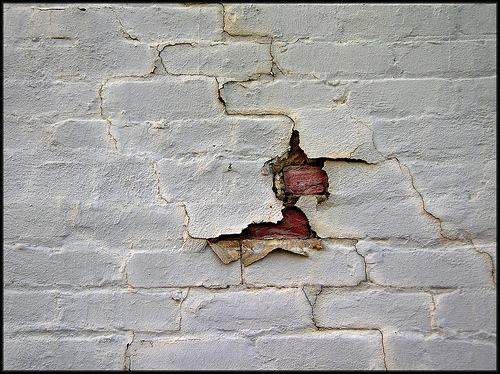
    If your house isn’t properly sealed, you’re fighting an uphill battle. Make sure all the loose cracks are filled and the joints on your heating/cooling equipment are tight. Experts refer to this as “tightening the thermal envelope.”
    brick peeling paint

    9. Trickler Shower Valves
    There is a large amount of lathering downtime when you shower where you don’t necessarily need a fully pressurized stream. Adding a trickler valve in your shower allows you to toggle back and forth between full and low streams and will help cut down on your bottom-line energy and water consumption.
    10. Energy Cinch Curtains
    If you can’t afford total window upgrades, Energy Cinch window curtains will act as an insulating barrier. Simple to hang, they act as a glorified curtain and cut heat loss by as much as 80%.

    11. Newer, Smarter Appliances
    Household appliances account for one-third of your energy consumption. If your appliances are wildly outdated, the standards have changed and chances are good that any upgrade to a newer system will be more energy efficient.
    12. Low Flow Toilets
    Less work and materials costs less money. By installing low-flow toilets you’ll see a decrease in most of your utilities. Good for your pocket book and Mother Nature.
    shutterstock_152121869

    13. Low Flow Showerhead
    Low-flow showerheads use a fraction of the water and will assist in trimming your water bill and subsequent energy bill. Averaging about 1.5 GPM, you’ll notice an expenditure decrease across the board.
    1-5-gpm-low-flow-commercial-shower-head-8

    14. Window Glaze
    If you can’t afford an overhaul on your current windows, consider getting them re-glazed. Often times the putty seal on older windows breaks down and a simple refresh will bring their insulating abilities back to life.
    15. Wood Burning Fireplace
    Avoid big purchases, installation fees and rising heating bills all together by returning to the old school and using a wood-burning fireplace. As long as your house is insulated properly, you can heat your house for the cost of a bundle of wood.
    16. Install Ceiling Fans
    Your average ceiling fan is a great way to save on power during the summer and winter months. In the summer, the direct breeze makes it feel cooler than it is and allows you to lay off the AC. As for the winter, because heat rises, the fans will help distribute the warm air that would otherwise be trapped near the ceiling.
    shutterstock_267625301

    17. Embrace Passive Solar Heat
    Whether you’re building a house from scratch or using what you’ve got, use your windows with smarts. Having more windows on the south face of your home and less on the north will use the natural patterns of the sun to maintain a more moderate temperature.
    18. Radiant Barriers 
    The final frontier between heat and heat loss is your attic ceiling. A radiant barrier is an aluminum foil-like reflective film that can supplement your insulation. Anything helps when it comes to keeping the heat in.
    19. Change Air Filter Regularly
    If your house has to fight a mucky air filter, it will need to work harder to achieve the same goal. Keeping your systems clean keeps them running efficiently; therefore, change your air filter regularly and reap the rewards.
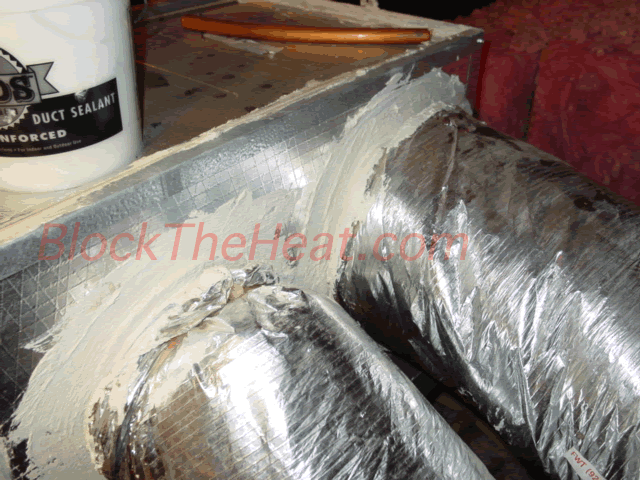
    20. Seal Heating and Cooling Ducts
    It’s in your best interest to ensure that your heating and cooling ducts are vacuum tight. Any loss of pressure or output can equal a big loss on your bank statement.
    DuctSeal14

    21. Energy Star Roofs
    Energy star roofs are special metal and asphalt surfaces that reflect the sun’s intense rays and keeps the surface temperature down as much as 100˚F. This diversion of heat allows for less heat to be transferred into your home.
    22. Use a Water Heater Blanket
    If you can’t afford to upgrade your water heater, find a water heater blanket. It wraps around your current water heater and prevents standby heat loss by as much as 45%.
    23. Geothermal Heat Pumps
    It’s a newer technology; geothermal heat pumps use the earth’s natural warmth to heat the contents and therefore don’t work as hard as the standard. When it works less, you save more.
    geothermalheatpump

    24. Solar Water Heaters
    Solar water heaters are a spectacular way to heat while saving on the energy bill because they’re powered by the sun’s natural light. They come in a wide variety but typically all have the same results – warm water for less money.
    25. Yearly HVAC Tune-up 
    Giving your heating and cooling systems a yearly tune-up is a great way to maintain efficiency and keep your energy bills as low as they’ll go.
    26. Energy Efficient Landscaping
    Much like strategically placed windows, the landscape surrounding your home can be manipulated to go to work for you. By planting leaved trees in front of windows, you can stay shaded in the summer and illuminated in the winter when the leaves are gone.
    tree-border-house

    27. Water Heater Timer
    If you’re like most people, you want hot water in the morning and at night – the rest of the day you’re away at work, school, etc. By installing a timer on your water heater, you can have the unit power down during the daytime lull so it’s not working when it doesn’t need to be.
    28. On Demand Water Heater
    When you’re in the market for a new water heater, consider the on demand variety. By upgrading to this high efficiency unit, you’ll notice a decrease in your water-heating bill by upwards of forty dollars.
    29. The Right Refrigerator
    It’s a little known fact that refrigerators with side-by-side refrigerator/freezer doors use roughly 15% more energy than top and bottom configurations. Likewise, water dispensers and ice-makers add to that total. When it comes to saving energy, consider these details upon your next appliance upgrade.
    shutterstock_94846621

    30. Home Energy Audit
    Thinking a bit more big picture, you may consider hiring a professional to perform a home energy audit. They will evaluate your home, your systems and your consumption trends and offer expert advice on areas of improvement. Often times you may not even know you have a problematic leak and the energy auditor will be able to identify the problem and offer a solution to maximize your energy efficiency and minimize your monthly bills.
    For further information log on website :
    https://www.builddirect.com/blog/30-things-you-can-do-to-your-home-today-to-save-energy/

    Acacia Hardwood Flooring: A Feast Of Options

    Author
    By 

    Acacia hardwood flooring is an immensely popular option for all kinds of spaces. But within that, there are more options still. Here’s what we mean by that.
    ***
    Among hardwood flooring options, acacia wood stands out as a versatile choice. This exotic wood can lend a dynamic look to any room, fitting in with many décor styles and interior designs. Discover how the stain and plank options, along with the wood’s natural grain, offer a feast of decorating inspiration for homeowners.

    About the acacia species

    Acacia wood has a historical and mystical reputation: The ancient Egyptians constructed coffins out of acacia wood, and some Biblical scholars believe acacia wood made up Noah’s ark, otherwise called “gopherwood” in some versions of the text.
    More than 1,000 species of acacia trees and shrubs exist. While most acacia species come from Australia, the red acacia variations can be typically found in Africa. Other acacia species grow in tropical and temperate regions. Dried acacia wood has a low moisture content, enabling the wood to resist warping or changing size.
    10acacia-lg
    Natural acacia hardwood flooring from BuildDirect.
    Acacia is a durable wood and a popular choice for furniture and flooring. Many people use acacia as a replacement for teak when they’re considering flooring options.
    One of the most popular species of acacia is Koa from Hawaii, a lovely golden or reddish-brown acacia. The Australian Blackwood acacia, also known as the Tasmanian Blackwood or the Acacia Blackwood, is another popular species of that originally came from Australia and Tasmania, but is now grown in South America and Africa.
    African acacia is typically a rich, dark brown. The tree grows large thorns to protect itself, infusing it with symbolic value over the years.

    Acacia wood grain patterns

    When you look for acacia flooring, you’ll notice many grain patterns and textures to choose from. Depending on the species, acacia wood can look strikingly different from one style of flooring to the next. Koa, for example, has a slightly wavy, interlocked grain pattern with a medium texture that sometimes verges on being coarse. Blackwood, however, has a mostly straight grain, only somewhat interlocked, and is typically uniform and fine.
    Species like Black Wattle often have a beautiful natural luster. Flooring preparation and styling will greatly affect the texture of acacia flooring. One popular example is hand-scraped acacia, bearing a slightly more rustic look. Some might prefer smooth acacia, a richness that emphasizes the beautiful patterns the wood grain creates.
    rooibos-red-acacia-10082295-rs-01_1000
    Mazama “Red Rooibos” acacia hardwood flooring featured in the Smooth Acacia Collection from BuildDirect.

    Color ranges for acacia flooring

    Since acacia wood comes in a variety of species, the flooring options available span a diverse color range. Natural acacia wood is typically a medium to dark brown, either red, gold, or tan. Acacia looks beautiful with a variety of stains as well.
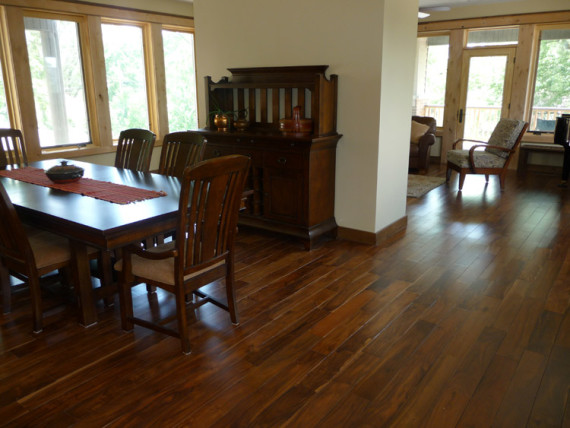
    Find acacia stained in black walnut or pekoe brown for a deep, rich hardwood look. Acacia wood flooring takes dark stains beautifully, deepening to attractive shades without losing the wood grain texture.
    Acacia also looks stunning with a red finish. The natural reds in the wood come out fully for a warm, strongly patterned look. Red-stained acacia wood flooring often ends up bearing a striking wood grain pattern. Since the heartwood and sapwood are often different shades of brown — the heartwood is usually darker — the colors in acacia flooring may vary within a single type of flooring, bringing out multiple shades of whatever color stain you can find on the floorboards.
    acacia-natural-lg-01
    Handscraped acacia hardwood flooring from BuildDirect.

    Popular ways to use acacia as flooring

    Acacia wood almost always conveys a warm spectrum of hues, a boost if you’re looking to brighten up your living room or upstairs hallway. With its hardness and durability, acacia wood works well in rooms that see a lot of foot traffic.
    You can get acacia in almost any plank size you want, an option that can open up your flooring choices for you. Although acacia wood is quite hard, you’ll find the wood makes a comfortable floor to walk on barefoot.
    oolong-brown-10082299-rs-01_1000
    “Oolong Brown” handscraped and stained acacia hardwood flooring from BuildDirect.
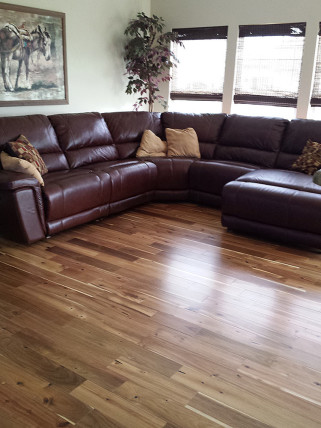
    Go for a vintage or shabby-chic look with hand-scraped acacia wood. The intentionally worn look of hand-scraped acacia will create a charming, rustic quality in your flooring. If you’re trying to evoke the natural feeling of a log cabin, make sure to get a hand-scraped acacia in a medium brown color with plenty of visible wood grain texture.
    Acacia is equally well-suited to chic, elegant rooms as well. Choose longer planks with wider widths — as much as seven inches — to get the most fashionable wood floor look in your home. Wide acacia planks showcase the elegant grain pattern in the wood, and the smooth polished planks will create a bold pattern that adds texture to your room. Long planks will keep the pattern from looking too choppy, adding a consistency to a floor that your guests will envy.
    Chai beige acacia hardwood flooring
    “Chai Beige” acacia hardwood flooring from BuildDirect.
    Acacia’s beautiful patterns also make this wood a lovely choice as a wood laminate in the bathroom or kitchen. Acacia itself is water-resistant, so while you may not want to place the wood in your bathroom with all its humidity, the right finish can make an easy transition to your kitchen.

    Enhancing your décor with acacia

    If you’ve chosen an acacia floor, consider making the flooring your room’s accent piece. Since the wood carries an exotic look, you’ll find your eye naturally drawn to the material.
    When decorating, use neutral colors that complement the acacia wood. Whether your design scheme is ultra-modern or vintage-inspired, you’ll get a distinctive look to your flooring. If you want a bit bolder décor, take inspiration from the texture of the acacia wood itself. Purchase furniture and decorations with designs and shapes that remind you of the patterns in your floor to tie the room together in a pleasing way.
    Acacia golden walnut mazama hardwood
    Mazama label acacia hardwood flooring “Golden Walnut” from BuildDirect.
    Since acacia is such a dynamic wood, you’ll find it a common choice for furniture. You may decide to enhance your kitchen with acacia cabinetry or pick up an acacia coffee table for the living room. Acacia also makes lovely bowls and plates, as it’s one of the types of wood that carries natural antibacterial properties.

    Versatile acacia wood flooring

    Acacia is known for its versatility in interior design options. Durable, water-resistant, and resilient, acacia allows you to enhance your living room, entryway, or kitchen with a unique visual element that only it can deliver.
    ***
    Resources: 
    http://www.agriculture.gov.au/abares/forestsaustralia/profiles/acacia-forest
    https://www.builddirect.com/blog/hardwood-flooring-product-profile-what-is-australian-acacia/
    https://www.builddirect.com/blog/hardwood-flooring-product-profile-what-is-african-acacia/
    http://thebasicwoodworking.com/acacia-wood-flooring-pros-and-cons/
    http://www.wood-database.com/lumber-identification/hardwoods/raspberry-jam/
    http://www.bruce.com/hardwood-basics.html
    http://www.homeflooringpros.com/blog-guides/hardwood-flooring-trends-for-2013/
    https://www.builddirect.com/Acacia-Hardwood-Flooring/Result_N_4294967289+4294966291+4294966069.aspx
    http://www.urbanara.co.uk/journal/buying-guide/acacia-wood/
    For further information log on website :
    https://www.builddirect.com/blog/acacia-hardwood-flooring-a-feast-of-options/

    Outdoor Lighting In Fall

    Author
    By 

    outdoor living space deck lighting umbrella
    A little light goes a long way, especially when it comes to lighting your home’s exterior and surrounding property. Not only does outdoor lighting beautify your home, it also makes it safer to navigate in the afterhours. In order to better brighten your home’s exterior, here are a few key lighting steps to keep in mind.

    Put convenient lighting first

    When you’re ready to light your home’s exterior, it’s important to put convenient lighting first. This means choosing lighting schemes that brighten your outdoor spaces where you need it most.
    If you’re unsure of where you need outdoor lighting, simply walk your property at night and pinpoint the dark spots. Adequate front and back porch lights are a must, so think sconce lights or overhead lights if you have an overhang. Motion sensing lights in your front, side, and backyard are also convenient and offer your home some security.

    Light your pathways

    Whether you have a substantial sidewalk that leads to your front door or you have a pathway that leads to your backdoor entrance, pathway lights are always a nice feature with many different styles. Additionally, most pathway light sets come in a solar-powered version, which means you won’t have to worry about wiring.
    outdoor lighting arbor path deck

    Think landscape lighting

    If you think your landscaping is beautiful during the day, you should try lighting it at night. When it comes to improving your landscaping and brightening your home at night, landscape lighting will definitely do the trick.
    Lighting your trees and bushes is a fairly straightforward process, but you may want to set your lights up and do a trial run before burying any wires. To create an appealing glow doesn’t mean you need to light every tree and shrub. Simply focus on your dominant landscape features to accent your home’s nighttime exterior.

    Don’t neglect the backyard

    Most homeowners concentrate on lighting their home’s front facing façade while completely neglecting their backyard. Sure, the front of your house accounts for curb appeal, but properly lighting your backyard allows you to enjoy the outdoors even after the sun goes down.
    Outdoor lighting in an outdoor living space
    For backyard decks and patios, a combination of sconce and eave lighting will provide plenty of brightness. If you’re going for a whimsical, non-traditional look, then stringing white Christmas lights across your porch overhang or in a nearby tree will make your backyard pop.

    Install a lighting timer

    Timing is everything, especially when it comes to keeping your home and your outdoor lighting as energy-efficient as possible. Installing a timer for your home’s exterior lighting will ensure your lights don’t stay on too late and send your electricity bill through the roof.
    Lighting timers are easy to program and they automatically turn on at dusk, so all you’ll need to do is decide what time you want your landscape lights and backyard lights to turn off. A good rule of thumb is to make sure your lights don’t stay on past your bedtime, or your neighbors’ bedtime for that matter.

    Life at home even when it gets dark

    Your home should be a welcoming place for you no matter what time of day it is, and no matter what time of year. By following the lighting steps above, you’ll have a home that’s bright and welcoming even after the sun goes down, and during a season when days are short and nights are long.
    For further information log on website :
    https://www.builddirect.com/blog/outdoor-lighting-in-fall/

    Advantages and Disadvantages of Fasting for Runners

    Author BY   ANDREA CESPEDES  Food is fuel, especially for serious runners who need a lot of energy. It may seem counterintuiti...