Blog List

Wednesday, 28 February 2018

Beat Those Wintertime Blues and Find Your Training Motivation

Author
Frank Campo is a USAT, RRCA and TrainingPeaks Level 2 certified coach and the founder/head coach of Prana Endurance Training. Athletes who want to improve their race times benefit the most from his personalized training programs. Frank currently lives in Tulum, Mexico and is fluent in English and Spanish which allows him to coach athletes throughout the world. Follow Coach Frank on Facebook and Instagram.

It’s that time of year again when it’s chilly outside and race season seems far off in the distance. Off-season has officially arrived. It’s the time when motivation dips and you can’t seem to get into your usual training groove. It seems like just about everybody can find an excuse to get out of a workout these days. We’ve all done it—and we all regret it.
To avoid the excuses from the start, set yourself up for success by working with a coach to develop a custom training plan just for you. Having a plan, even in these low months can be extremely motivating. Take the time to learn from your coach, ask questions to help you understand why certain workouts are incorporated into your schedule, and the purpose of each in your overall goals for the year. Knowing how that particular workout affects the others and what role it plays in ultimately meeting your goals is a huge motivator in and of itself.  
For the times when that’s not enough and you still find yourself offering excuses, well now’s the time to start anticipating them and crafting your plan of attack. Here are some common off-season training excuses and solutions to get you back out there:  
Excuse: I had a bad day at the office and I’m mentally and physically drained.
Solution: Move your workouts to early mornings. Not only will the cool air feel good, but now you will feel energized the rest of the day and have the evening to relax and prepare for your next workout.
Excuse: I have to watch my kids.
Solution: Investing in a running stroller, putting your bike on the trainer at home, or having the kids help keep your splits at the track are all great ways to get the family involved in your training. The kids will have a great time helping keep you on pace.
Excuse: I get injured when I workout. What’s the point?
Solution: First off, talk to your doctor to make sure you are clear to run before you start your comeback. Then, right away have your running form analyzed by a professional to make sure you are wearing the proper shoes. A number of running related pains and injuries are a direct result of running in the wrong shoes. Also be sure to incorporate cross training and strength conditioning to build a strong core and lower body strength.
Excuse: It’s too dark before and after work to train.
Solution: Get some more gear! There are great headlamps out on the market right now with progressive lighting that are powerful and lightweight. Invest in a reflective vest and warm, layered clothing to be sure you’re seen out there on the dark road and you’re toasty while you’re doing it.
Excuse: I’m too tired.
Solution: You likely need more sleep. Go to bed early. Give yourself time to relax in the evenings before going to bed to help ensure a better night’s rest. Shut off the electronics an hour before bedtime, read a book and drink some chamomile tea. Sleep is a valuable, and often overlooked, aspect of recovery.  
Excuse: It’s too cold.
Solution: It very well may be cold out there. But that’s just another reason to dress for your workout. People train in all types of weather just fine using some smart preparation before they head out the door. And once you start moving the cold air usually starts to feel good. If it’s truly too cold outside, then simply head indoors.  These indoor training workouts are great ways to stay on top of your fitness no matter what it looks like outside.
Don’t worry if you fall victim to one or two of these excuses during the off season. It happens to us all. Now is the best time to set yourself up mentally for a strong year and if hitting the snooze button once or twice helps, think of it as your reward for the amazing season you are starting to dream about.
For further information log on website :
https://www.trainingpeaks.com/blog/beat-those-wintertime-blues-and-find-your-training-motivation/

The Myth of Winter Base Training For Cyclists

Author
Jim Rutberg is a Pro Coach for Carmichael Training Systems, Inc. (CTS) and co-author of several books with Chris Carmichael, including "The Time-Crunched Cyclist, 2nd Ed." and "The Time-Crunched Triathlete". For information on personal coaching, training camps, and Endurance Bucket List events, visit http://trainright.com.

Traditional aerobic base training needs to go the way of the dodo. Long, moderate intensity rides are fun and good to incorporate into training, but even if you’re a pro it is a fool’s errand to devote the winter to low-intensity training in the hopes of building a stronger aerobic base. For the rest of us who are time-crunched amateur racers and enthusiasts, traditional base training is a waste of time.
The premise of aerobic base training is that accumulating a large volume of work at a low to moderate intensity will result in increased capillary density (greater perfusion of oxygenated blood into muscles) and greater mitochondrial density. The latter is important because more and bigger mitochondria in muscle cells increase your capacity to break down carbohydrate and fat into usable energy more quickly. Processing more fat and carbohydrate per minute through mitochondria increases maximum sustainable power or pace. It also means you can operate at a lower percentage of your VO2 max at your “all day” pace, which may help you rely on a higher percentage of fat for energy and conserve stored carbohydrate. Those sound like the exact goals of endurance training, so what’s the problem?

Doing Less With More Doesn’t Work

As an endurance athlete you have already habituated to a certain volume of weekly training hours, likely because that’s all you have available. Training the same number of weekly hours (because you don’t have the time to add more) at lower intensities produces a lower total workload than you have already adapted to. As a result, it won’t stress your aerobic system enough to stimulate a positive adaptation.
When base training works, it only works because increased training volume contributes to greater total workload (or at least greater focused workload) despite reduced intensity. These longer rides are slower because of the inverse relationship between intensity and duration. You can go harder for shorter durations, but as rides get longer sustainable intensity naturally decreases. When volume is held basically constant by your training availability, reduced intensity only results in reduced workload, and therefore reduced training stimulus.

You Don’t Need a Huge Aerobic Base Anyway

While time-crunched athletes struggle to build a big aerobic base, the good news is that most amateur and masters racers simply don’t need one to win or be competitive in criteriums, road, cyclocross, and mountain bike races lasting 45 minutes to 3 hours.
Your limiting factors are your power at lactate threshold, your power at VO2 max, and how long you can maintain those intensity levels. All three can be improved with a lower volume (8 to 10 hours a week)and higher intensity program that includes a mixture of 8 to 20 minute lactate threshold intervals and 1 to 4 minute maximum-intensity intervals, along with some endurance and recovery rides, of course.
The reason pros still need to spend a lot of time combining high volume with high intensity is that they need to make race winning moves after 200km of racing. Aerobic endurance is a limiting factor for them because of the power demands required in the final hour of much longer elite-level events. You’re not a pro and you can be completely prepared for the demands of your shorter events without a huge pro-style aerobic base.
Even ultra-distance competitors, like 100-mile mountain bike racers, 200-mile gravel racers, and Ironman triathletes, benefit more from training that elevates power/pace at LT and VO2 max compared to performing more volume at low intensity. In a well-trained endurance athlete more volume at low intensity will no longer result in greater mitochondrial density (they’ve already adapted to the intensity level required)1 (Dudley, 1982). To get faster they need to stimulate mitochondrial development with higher intensity efforts.2 (Burgomaster, 2005) Very long training sessions are still necessary, but more from an experiential standpoint than a physiological one.

Going Slow Makes You Slow

Focusing your training on a particular intensity for a block of time is the basis for periodization, and there are benefits to focusing time at several different intensities. In that sense, base training is just a block of low-intensity endurance training, and the only real problem is that it’s typically too long. For amateur athletes, two- to three-week endurance blocks can and should be incorporated into training throughout the year. That’s different than a single two to three month block of low-intensity riding, during which you will see your power and pace at lactate threshold and VO2 max decline significantly.
The old premise of periodization was that you needed the big base of aerobic fitness before you could handle the stress of higher workloads. Hence, the schedule of base training first, followed by lactate threshold training, and then race-specific high-intensity speed work. The more modern view is that the pathways to producing energy are intertwined and you can improve performance in either direction. For instance, Helgerud showed that high-intensity efforts are more effective for improving power at VO2 max than moderate-intensity training3(Helgerud, 2007). Researchers like Burgomaster, Gibala, and other have shown that these same short, high-intensity intervals improve oxidation of fat and carbohydrate by mitochondria to a similar degree as traditional, lower-intensity endurance training, but in a fraction of the training time. Practically what this means is that by working at the highest end of the intensity spectrum you can improve performance at all intensity levels below that, making it a very effective use of your limited training time. Similarly, lactate threshold workouts improve power at threshold and improve power for endurance intensities, too.

Base Training Was Never About Improving Fitness

There is some validity to the notion that too much intensity can lead to overtraining (better thought of as under-recovery) and increased risk of injury, so one school of thought is that a long period of lower intensity is safer than year-round structured training. There was a time when this was smart advice, but now that we have better tools for measuring and monitoring workload, fatigue, and recovery, the risks of pushing an athlete (or pushing yourself) over that edge is much lower. And for time-crunched cyclists, both the need for prolonged recuperation and the risk of overtraining are already reduced because your busy work and family schedules result in relatively low training volume and abundant time for recovery.
But perhaps the most pernicious reason the idea of base training is still around is that it has long been the refuge for athletes who just want to ride their bikes. Base training is largely unstructured, low-intensity cruising. In an effort to escape structure after a season of interval training, athletes fall back to the comfortable and antiquated idea of base training.
There’s a difference, however, between desiring less structure and needing less workload. If you want a break from intervals, that’s fine. Let your mood, the terrain, the wind, or the group you’re with dictate the intensity; just make sure there’s some intensity!
References
  1. Dudley, G. A., W.M. Abraham, and R. L. Terjung. (1982) Influence of exercise intensity and duration on biochemical adaptations in skeletal muscle.  J Appl Physiol. Oct; 53 (4):844-50.
  2. Burgomaster, Kirsten A., Scott C. Hughes, George J.F. Heigenhauser, Suzanne N. Bradwell, and Martin J. Gibala. (2005) Six Sessions of Sprint Interval Training Increases Muscle Oxidative Potential and Cycle Endurance Capacity in Humans. J Appl Physiol. Jun; 98 (6): 1985-90.
  3. Helgerud J, Høydal K, Wang E, Karlsen T, Berg P, Bjerkaas M, Simonsen T, Helgesen C, Hjorth N, Bach R, Hoff J. (2007) Aerobic high-intensity intervals improve VO2max more than moderate training. Med Sci Sports Exerc. 2007 Apr;39(4):665-71.
For further information log on website :
https://www.trainingpeaks.com/blog/the-myth-of-winter-base-training-for-cyclists/

Tuesday, 27 February 2018

Obsessions Only Cyclists Have

Author
Cycle thoughts
Yeah, I’m niche. Not really something to boast about yet we humans like to feel as if we’re forging our own paths, that we are remarkable in some small way, atypical, one of a few. We follow not crowds, only our own will, for yes I’m smart, in control, not one of them, all those others who look and behave just like me, nay, observe me closely, I’m different, I’m special goddamnit.
Cyclists are no different. As a collective, we’re often accused of being self-entitled or ego-led, self-important, self-aggrandising, and as such hate figures to some. Yet the truth is we’re not special, we’re no different to others based on our choice of transport.
We do have our quirks, obsessions that help define us, routines which bond us. Damn, we are special after all.

Weather

We hate headwinds, love tailwinds. We hate rain yet secretly rejoice when it rains on a rest day. We hate the cold. We hate the blazing heat. We check the weather more times than your average sailor and know more about the wind than most glider pilots.

Tyre pressure

Just what is the perfect tyre pressure? Harder than the tarmac we ride on? Or should I run a lower pressure for comfort and grip but risk pinch flats? What if it’s wet? Let some air out unscientifically. That’ll do.
Give the tyres a little squeeze with the official thumb test. Hmm. Better give that some more air. Just in case. I have two words for you all. Tyre drop. All of your tyre pressure questions and dilemmas solved.

Matching kit

Some of us will not leave the house unless our socks match our arm warmers, which must match the arms on the side of our sunglasses. We’ll then ride the bike that best matches the colour of our jersey.

Data

Speeding cyclistAverage speed lower than your last ride? Argh. Same route right? Same wind. Same air pressure. What did I eat the night before that was weighing me down? Shit, I’m getting old. Must train more. Drop everything and get on the bike. What? It’s midnight? Well I am getting slower.
Most cyclists fall foul of over analysis when it comes to data, myself included. Whatever metrics you’re using it’s likely you’ll infer anything, from being ready to race with the pros all the way down to being near death.

A clean chainset

Some folk clean their chainset after every ride. Many cyclists get a little obsessive and compulsive when it comes to their chainset. It won’t be long before a new show comes to a satellite channel near you, How Clean Is Your Chainset?
I’m in awe. Mine gets a scrub once a quarter. Yet there’s few things more satisfying than the first ride with a clean chainset, your bike riding like new.

Bar tape

Who would get anal about the size of the overlap on their bar tape? Who? Ha. You know their name. The obsession doubles if the rider has white bar tape and we all watch their vain attempt to keep it clean for at least one ride.

Tan lines
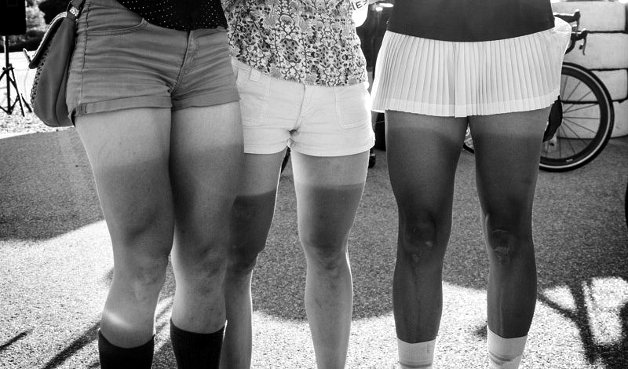
Cyclist tan lines
Me cycle? How did you know?
No, we don’t look funny. Even though we do. We spend way too many minutes inspecting our shorts and jerseys on a sunny day to ensure the new tan lines will match the old tan lines. I quite like the multi-tone look myself.

Strava

No further explanation required. You know who you are.

Bike noises

Argh. What the hell is that now? There’s nothing worse for some riders than an undetectable click or clank destroying the silence of their ride. This one really gets me. Especially after you’ve dismantled the bike piece by piece only for the noise to persist. Argh.

Not being overtaken

The most pathetic trait yet one many fall prey to. For the male of the species there’s an odd primal need to chase down a passing female rider for the male must never be overtaken by the female. Never! Yup, pretty pathetic.
I love it when you overtake a rider and before you know it the very same rider is sprinting past you, trying to look as nonchalant as possible even though they’re riding on the limit. You continue on your way without upping your speed and realise you are reeling in the rider again because they are tiring. Your turn to look nonchalant.

All the gear
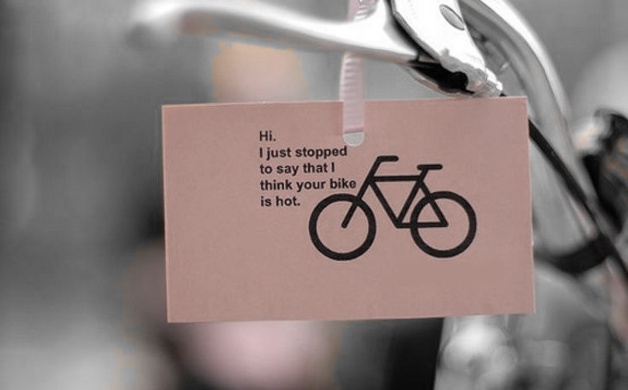
Hot bikeYou roll up to a new ride. A sportive. The rider next to you is wearing a skin suit, pointy hat and rides a time trial bike. He rubs warming emulsion onto his legs. Sips a protein-carbohydrate-electrolyte drink and inhales two gels just to be safe (true story!).
Attached to the tri-bars is a bar bag complete with a copy of Bradley Wiggins’s autobiography, three gas canisters, a spare chain and enough food to feed the entire sportive.

Bike weight

Must buy a seat with carbon seat stays. Carbon bottle holders. Is that stem carbon? Thin latex inner tubes. Tubeless. Carry less water. Wheel upgrade. Hmm, this frame is a little heavy. OK, new bike it is.

Routing

Must avoid A roads. And major roundabouts. Ooh, what is the surface like on that tiny road? Streetview time. Must find/avoid hills. How many metres must I climb? Must go near that coffee shop, that one with the massive portions. Must avoid those traffic lights. And THAT road. Eugh. End of ride must be downhill, with a tailwind. This last one is a personal must.

Socks for idiots

Why is it that my cycling socks have an L and R stitched into them? And why do I meticulously obey these instructions even though the one time I forgot it made no detectable difference?

Socks for fashionistas
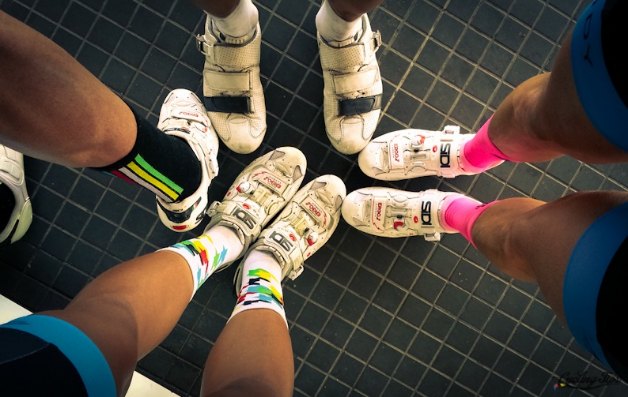
Cycling socks fashionYes, socks get two entries, that’s how important they are to the cyclist. Sock colours must match your bike and/or have elaborate patterns for yes, we cyclists are defined by our socks. Mine break all the rules. They’re grey and thick. Forget psychometric testing, just look at my cycling socks, they say all you need to know about me.

The right amount of layers

Don’t want to be too hot, nor too cold. Which is better? Too hot. Then why am I always cold? Autumn and spring bring cold mornings but warmer days and cool evenings. A cyclist’s clothing nightmare. Despite this I refuse to buy arm warmers which are, let’s be frank, the single most ridiculous thing in the world. Truth is we achieve perfectly balanced temperature control using the cyclist art form known as layering, which like Japanese paper folding Jedi origami masters, takes years to perfect.

Riding

Of course. We’re cyclists, we just have to ride. Everywhere. Just popping to the shops. On my bike. Nipping out for a post-ride recovery, hours later returning home buggered. Commuting by bike. Riding indoors when needs must. We’re avid leg movers, never knowingly resting. Pub? Just remember to take a strong lock for when you get the taxi home.

Cake and coffee

It’s all about the cake. Not the bike, not the ride. The ride is about the cake stop. Now I like a good cake and I like a good coffee, yet oddly I don’t like the cafe stop. That last word probably says why. Stop. I don’t like to stop when riding.

Not putting your foot down, ever

Two scenarios. The traffic lights, we either coast up to them slowly and pray they change to green or, if we have the skills, manage to track stand, on a road bike. A pretty impressive skill. Yes, we must never unclip. Clipping back in is a drama for some. That moment when you think you’re clipped in but you’re not. Ouch.
Scenario two. Hills. Steeper than the bill from your last night out, yet still you persist, straining every sinew, tearing your leg and arm muscles apart because you must never be beaten by the hill and put your foot down. I’m very guilty of this last one.

Tools and accessories

The bike industry knows we’re suckers. And we truly are. Ridiculously priced carbon bottle cages, titanium bolts, or clothing with ridges on to make you more aerodynamic at 15 mph. I rest my case. So it is that with each passing year the bike industry finds new ways to sell bike tools to us. Star shaped bolts, bottom brackets with weird teeth like fittings, a staggering array of cleats. What do you mean you’ve no idea what BCD you require for your new chainring?

Food / time ratio
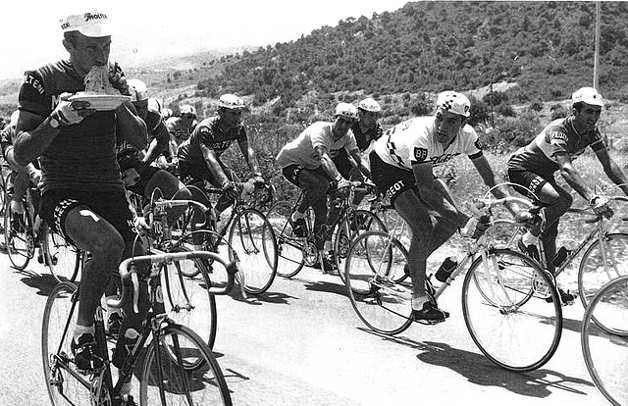
Eat on the bike, they said
How much food should I be eating per hour on the bike? Two bananas an hour? Three slices of soreen? How many nuts? 3 gels an hour? Vomit. We obsess because we do not want to meet the man with the hammer, the dreaded cycling bonk.

Miscellaneous bike bits

This has still got a bit of life left in it, you think, looking at the five year old bar tape, ragged and worn and smelly but not quite dead. Better hold on to it, just in case, you never know when this might come in handy. And so it begins. Your one person mission to amass more used and useless bicycle parts than ebay.
These well-worn brakepads? Looks like a millimeter of rubber is still left, better hold on to them, just in case. Hmm, this old wheel with a crack in the rim. Perhaps I’ll use the hub someday or need a spoke. Up the loft you trudge, knowing full well you’ll never see this wheel again!

Bikes

More bikes than we have toes. The winter bike. The commuter. The one for tailwinds. The shopper. The pub bike. The shiny one that’s too big. The Italian one that hurts our back. The one for that one day a year when it snows. The track bike for the nearest velodrome 222 miles away. A swiss army knife collection of bikes, even though we only ever use two of the tools at most.

Post-ride rest

Picture the scene. You’ve been cycling a superhuman amount of miles, about 30, and you feel near death. Time to rest. Still shivering from your ice bath, you take to the couch and raise your legs above your heart without quite understanding why but Cycling Weekly demanded you do it. A quick power nap follows.
Lo and behold anyone who suggests going for a nice Sunday afternoon walk. Do they not know you are a cyclist and you walk nowhere goddamnit. You tell them the story of Bradley Wiggins’s wife carrying the shopping from the car to the house to preserve poor Bradley’s energy. It’s a wonder you’ll have the energy to sign the divorce papers.
What about you, what quirks or obsessions are you willing to admit? Go on, no one’s judging. Much.
For further information log on website :
https://humancyclist.wordpress.com/2017/11/26/cycling-obsessions/

Hello Winter Bike. Please Forgive Me.

Author
Cycling in snow
Hello old friend. It’s been a while. What? Yes, it’s that time of year again. I know, I know. Brrr.
Her? The mistress? That was a mere summer fling, showing off in front of others, a lightweight frolic beneath the sun.
Nothing compares to you, ever dependable winter bike, bike number 1 once and forever. You’re the one who gets me through the hard times, little reward for your endeavours but hour upon hour of steady rolling through frozen landscapes, more mud than road.
Once little miss summer until usurped but look at you, still looking so glam, much better looking than her, the one with the matt finish, no flair there is there? You so well kept, ageing ever gracefully. They don’t make them like you nowadays.
Sure there’s a few nicks and wrinkles here, there and there, reminders of adventures past, that time you took me from London to Spain, or our first trip to big mountains. Some before we met, before I rescued you from a dusty garage, re-homed courtesy of the bicycle rescue centre, eBay.
What do you mean I could keep myself in better shape for you? I’m not too portly. Well maybe a little. The summer mistress break-up has taken its toll, recovery a heavy dose of biscuits and beers.
No, no, no, of course you’re not my rebound, I’m back for you and all those qualities little miss summer can’t provide. Comfort, sturdiness, carefree no matter the weather. Hard as nails, a bit of damp ground will not stop your thirst for adventure.

First winter bike ride

Our first outing is exciting, odd for but the briefest of moments as we get to know one another again. Familiarity may breed contempt, re-acquaintance devotion.
Of course you’re comfortable but it’s more than that, we know each others grooves, our lumps and bumps. We fit. Old school standard gearing matches the rhythm of my legs, comfortable yet racey. The geometry of days gone by understands that comfort and quick doesn’t require two different frames.
The roads are dry yet I do not regret choosing you. Sure, others may still be hanging out with their summer floozies, embarrassed by our presence, yet we stick with them and you make me a better person in the process.
The feeling of speed is blunted only for a few blocks, everything’s relative, sure 15 mph is the new 20 mph but now I can enjoy the journey in greater detail. No more clinging to the wheels of others, we forge our own paths, every ride a memory burned deep into this cyclist’s soul.
Sure every mile can’t be heaven. I remember to take things easier with you in the bends, braking earlier. The little quirk of yours when you refuse to move the front derailleur in cold weather. Yet it matters not if I’m stuck in the small ring for this is exactly where I belong, this is no malfunction, this is wisdom, gentle advice and guidance.
For we do not judge. You do not frown when I stop at the cafe, nor when I eat pies sat atop your saddle. You, the focal of attention, drawing strangers to us, they beguiled by your old school beauty.
Sunrise and sunset in the same ride. This is the winter bike romance. A relationship forged in hard times, the bond unbreakable. Until Spring anyway…
For further information log on website :
https://humancyclist.wordpress.com/2017/11/19/hello-winter-bike/

Why Do Cyclists Climb Mountains?

Author
Cycling up mountainsA strange addiction. Climbing to the skies, slow motion, pain, body revolting, hour after hour of mental questions. Why am I climbing this mountain?
We’re a strange bunch us cyclists. Speeding along dressed in tights, bottoms padded, riding great distances much to the bemusement of non-cyclists.
To them it’s unfathomable that riding up a mountain, a mountain for god’s sake, can be pleasurable. If only they knew.
What is it we find so appealing climbing over these hulking chunks of rock? The views we miss staring at our stem? The thrilling descent, cold and shivering, arms tired from constant braking. The pure mountain air, so thin near the summit we struggle to breathe?
The achievement perhaps? The first time maybe but what makes us return? Bragging rights? Surely not.
For me it’s the aura of the mountains, that feeling, that sense you get of being so small and insignificant against a monumental backdrop that has existed through the aeons, which, despite its frozen face is still alive, still growing, standing tall against the elements, constantly changing amidst the shadows as it reflects the skies, the view renewed morning, noon and night, isolated yet visible for miles around.
Spiritual. I may have missed my calling as a shaman.

What makes a good mountain climb?

Croix de fer summit cycling
Rider out of picture, on floor, fighting for breath
Yet not all mountains are equal. We all have a favourite mountain. Many defer to Ventoux, a climb I find so boring I prefer the mini lumps and bumps of Yorkshire. Yet ask me about summit views and Ventoux tops the lot. That view of Mont Blanc in the distance, spectacular, you, stood on a mountain separate to the ranges in the distance, views for miles.
I’ve not climbed a huge number of mountains, the famous Alpine climbs of the Tour de France, the mighty beasts of the Giro d’Italia, the mid-mountains of Majorca. The Pyrenees and climbs of the Vuelta Espania are missing from my collection, along with the hundreds of lesser known climbs still to be discovered, Romania or Slovakia perhaps. The Andes chain in South America. I can dream.
Even so it is difficult to point to a favourite climb. Each climb has its own personality, each a moment that challenges and inspires in equal measure. The horror gradients of Monte Zoncolan that scare your limbs into action, the shock of an ice cold tunnel on the summit of Passo Giau, or the crazy rollercoaster loops of Sa Calobra in Majorca.
The many variables mean no two climbs will feel the same. Heck, the same climb will change on different days, on different legs. When judging a climb we are not judging the mountain but the experience. Our experience.
Mountain weather can mean many experiences in just one climb, let alone repeat visits. The wind, rain and heat will add or detract from your experience. The animals you see, a fluffy fox on the Stelvio, a marmotte on Alpe du huez.
And then there’s that little variable that is you. And my oh my how we vary. How hard you climb, how tired you are, the climb where you ran out of food, or the one where you decided to chase the thin whippet up ahead with disastrous consequences.
The type of rider you are also plays a part too. Punchy or stamina based? Are you wearing enough clothes, too many? How big was your breakfast? All variables that will make or break the climb.
Not to mention the many different routes up a mountain. Most have two, some three, some more. How to choose? Just because a famous race tackles one side doesn’t mean it’s the best.
So the below is not necessarily a rank of climbs, but a rank of experiences.

Best mountain climbs

1. Zoncolan, Italy

Zoncolan climb cycling
It’s odd to me that the Zoncolan is top of the tree. A murderous climb, a leg breaker I almost didn’t ride as I thought it would be a sufferfest and nothing more. Yet the five hour round car trip was worth it. Body at peak fitness, I found my zen zone and rode this climb well within my limits, marvelling at the ever increasing gradient yet barely noticing the 1km stretch of 20%. The novelty of the narrow tunnels near the summit, the big reveal when leaving the darkness to a world full of views and mountains after climbing amongst the trees for so long. Elation.

2. Stelvio Pass (classic side), Swiss, Italian, Austrian borderlands

Hairpins on the Stelvio Pass
There’s a mystical beauty to this climb purely because it seems unfeasible that such a road could or should exist. The steady gradient of the Stelvio Pass demands you find a rhythm, a steady pace to winch your way up the incredible 48 hairpins, each twist and turn dropping your jaw ever nearer the floor. Beautiful, heart-achingly beautiful.

3. Beleach na ba, Scotland

Bealach na Ba cycling
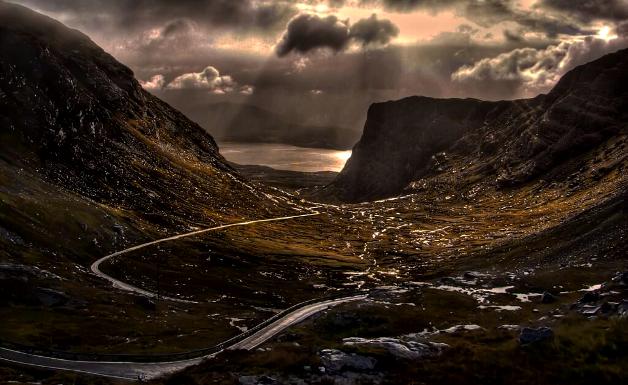
Beleach na ba is perhaps the UK’s only true mountain pass. Isolated, climbing towards the lonely coastal village of Applecross from Tornapress, this Scottish Goliath delivers incredible views, hairpins, steep gradients and a weather roulette. An oddity in the UK, I felt privileged to be able to climb so high on the single track road, to enjoy the views of the Cuillin mountains in the distance on the Isle of Skye. Magical.

4. Col du Glandon, French Alps

Col du Glandon summit cycling
Glandon hairpins
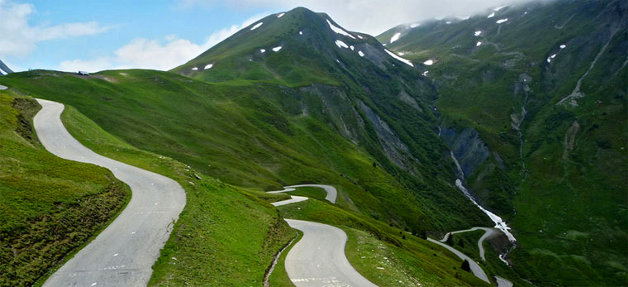
My visit to the French Alps was largely disappointing. True I prefer short and sharp climbs like those found in the UK rather than slow and steady mountain passes. Yet the Glandon stood out for me, following the Romanche valley, the scenery constantly changing, incredible views at the top of snow capped peaks and ice-cold turquoise lakes on the descent of the other side.

5. Sa Calobra, Mallorca

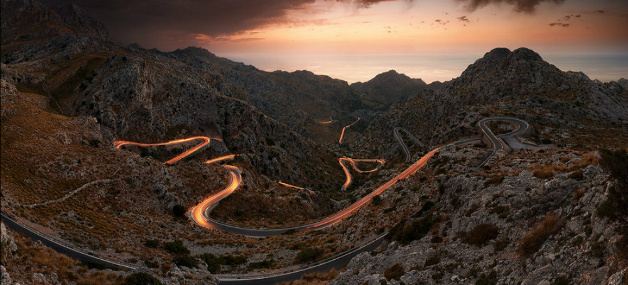
Sa ColobraThe Mallorcan mountain road designed by a child. Loop de loop, forever twisting and turning, a writhing road trying to escape its rocky captor. There’s not much in the way of views on Sa Calobra, this short climb is one to hit hard and spin around each successive corner ever quicker. You will no be able suppress a child-like grin when descending and climbing.

Top 5 worst mountain climbs

A bad climb sees us endure a variety of emotions not too dissimilar to the five stages of grief: denial (I’m fine, there’s not much further to go), anger (I hate myself, cycling and this bloody mountain), bargaining (Please, just please let it end), depression (the world is mad, I’m mad) and acceptance (I’m not enjoying this at all but it’s not like I’m ever giving up so might as well just get on with it). In fact, it’s quite likely we’ll run through this cycle at least four times a minute up a bad climb!
Also revealing was the fact I have no photos of these climbs – experiences I wanted to forget. Once again, these climbs are bad because of my experience rather than the climb per se.

1. Ventoux, France

Perhaps it was the 4am rise to ride 40 miles to the base of the climb? Or the impending illness that would strike just 24 hours later. Or the weather, too good, pleasant in fact, little sign of the heat and monster winds battled by those who have struggled up this mountain. Perhaps because this was my first true mountain climb? Or perhaps I never attacked the climb enough to suffer? Or maybe, just maybe Ventoux is boring.
Truth is I was disappointed with this climb. Perhaps the myths had raised my expectations. I do regret not riding harder, after all this is a climb to suffer, not enjoy, right? The one redeeming feature of Ventoux is the summit view. Incredible.

2. Alpe d’Huez, France

Historic for sure, plenty of hairpins too, yet not a climb for me. Too famous for its own good. Alpe d’Huez is busy with traffic, crappy views on the way up and the finish, ha what’s that all about? No real summit to speak of, just a big car park and an assortment of ugly ski chalets.
It probably, well most definitely, didn’t help that I was stopped by a traffic light on the way up. Ha. Nor the fact I was routed through a busy market near the top. Not when I was riding full gas. A climb that was not to be!

3. Col du Chaussy, French Alps

A case of one climb too many. Day 3 of climbing mountains. The whimsical hairpins of Lacets de Montvernier and the lovely Col d’Madeleine already making for heavy legs on a blisteringly hot day, with temperatures hitting 38c. Not the time for another climb.
Yet the Col du Chaussy called simply because it was on the way home. Sure I could have just rolled back but a left turn to climb to the skies once again was hard to resist. The sketchy route profile in my head reassured me this was just a little lump to be navigated on the way home. My body quickly disagreed.
Bonking within a mile or two, the remainder of the climb was spent slumped over the stem. You know you’re cooked when you find yourself constantly standing only to sit down exhausted moments later. And repeat. A twisting, turning ascent, levelling off, dipping, only to climb again, no end in sight on the single track road. Beam me up Scottie.

4. Puig Major, Mallorca

Another climb on tired legs. Day four of mountain climbing, another blisteringly hot day, another slog up a climb that never seemed to end. Few hairpins to relieve the monotony. I’m sure these climbs would be very different on fresh legs. Even the sight of the turquoise waters at the summit couldn’t cheer me. I hated myself, cycling, and the world goddamit. Exhausted.

5. Passo delle Erbe, Dolomites

There’s a theme here. Day four of climbing in the Dolomites. Legs not quite dead but very far from fresh. The day began well with a 40 minute descent, 40 minutes! This can mean only one thing. It’s a long way back home and the only way is up. This climb has stunning views of the Funes valley but I was long since shot by this point. A puncture near the summit confirmed what my legs already knew. It was not my day.
What about you, what do you love about riding up mountains and which would be your best or worst?
For further information log on website :
https://humancyclist.wordpress.com/2017/11/05/why-do-cyclists-climb-mountains/

The Melancholy Of Losing Form And Fitness

Author
Cycling tired
I used to be a contender. I could have taken that KOM. I was quicker goddammit and now look at me. Pathetic.
Slow with a tailwind, the merest incline induces a series of huffing and puffing and effing and blinding. Strava automatically marks my rides as private as a sign of a respect to my former self. Inner chimp has become inner chump. Yep, I’m most definitely outta shape.
Empty legs, head and heart. The unthinkable has happened. I’ve fallen out of love with cycling. Say what now? Surely not? The urge long lost, denial initially fuelled more riding. Perhaps I’ll just blast through it, I thought, kidding nobody. This lasted for two months before THAT ride.
It’s over.
Such relief.
Year end comes early for this cyclist. Autumn. Form falls faster than the leaves abandoning the trees. A failed hill climb season peters out and this cyclist has all but quit. Hibernation time.
I’ve been ‘on it’, truly on it, since January. Nine months of riding hard. Every week the same as the last. A turbo session or two, a couple of hard club rides, daily commutes interspersed with monthly trips to the likes of Belgium and the Dolomites.
Not forgetting the early season base miles, from absolutely brutal C2C ride in atrocious weather, to the jaunt to the Peak District when my legs fell off. Oh and ten straight weeks of metric century rides every weekend during the base mile munching months. Nuts.
Yet adventures past are quickly forgotten once you begin to slow. Decline is inevitable yet still surprises and frustrates each time. This year I peaked at the end of July, just when I should have been building for hill climb season. Bah. Physically and mentally I could take no more. The ‘season’ was over, not that I could admit that to myself. Denial.
At first you think it’s simply a bad ride. And then another. And another. Interval sessions become impossible and you barely complete the warm up. The thought of riding becomes as appetising as going to work.
Each time you go for a spin, you do so with the speeds and achievements of days gone by in your head, impossible targets since your body is now in decline. Frustration makes you ride like an idiot in a vain pursuit of previous peaks. You fail, plundering the last of your energy reserves in the process and preventing any hopes of recovery.
Everything about every ride is difficult. The cold. You’re always cold. Every road surface so jarring it’s like riding on the moon. Even the cake stop brings no joy, all this talk of cycling, get a life people!
Mentally you’re long gone. Riding is boring, a chore. Somebody mentions a ride and you splutter ready made excuses​ about your broken eyelash. Come on they say, it’s only 40 miles. Ugh. What previously would have been a quick spin now sounds very, very far when the walk to the bike shed is beyond your limits.

What now?

Depressed cyclists
It’s not you, it’s me
An existential crisis kicks in. Who am I? What is life without cycling? Lycra gone, you’re Clarke Kent bumbling about not superman flying through quiet country lanes.
You take a break but this only adds to your declining powers. What happened? I love cycling, I’ve done my time, this isn’t supposed to happen, not to me.
How to fill all this spare time? Don’t want to write about cycling, or read about riding, or talk about it, or watch it on TV. Yes, you were that obsessive.
We are defined by what we do. So now what?

A new normal

Without realising it you become normal again, not one of them mad cyclists. The thought of a turbo ride is akin to torture. You rediscover the taste of chips and booze. You remember what it is to be social, to be drunk and inevitably hungover, but hey that’s fine, you’re not riding today.
The only Lycra you wear is for fancy dress parties, the only bananas you eat are flambéed with rum and served in pancakes. Sure, you’re still drinking electrolytes, they’re great for hangovers.
No longer do you open Strava daily. Oh no. Better not look at all those buggers enjoying rides whilst you’re sat on the couch in your underwear drinking a beer. It’s almost lunch time.
Game over. You feel guilty every time you walk past your bike. You’ve got the bike blues and need a break. How long, you cannot say. You’ll know when it’s time to return, when the legs and head are rested, you know, when you’re really, really, really slow.
Until then.
For further information log on website :
https://humancyclist.wordpress.com/2017/10/22/losing-form/

Advantages and Disadvantages of Fasting for Runners

Author BY   ANDREA CESPEDES  Food is fuel, especially for serious runners who need a lot of energy. It may seem counterintuiti...