Blog List

Thursday, 12 May 2016

Definition of Healthy Lifestyle

Definition of Healthy Lifestyle
Healthy lifestyle Photo Credit Jupiterimages/Pixland/Getty Images
A healthy lifestyle leaves you fit, energetic and at reduced risk for disease, based on the choices you make about your daily habits. Good nutrition, daily exercise and adequate sleep are the foundations for continuing good health. Managing stress in positive ways, instead of through smoking or drinking alcohol, reduces wear and tear on your body at the hormonal level. For a longer and more comfortable life, put together your plan for a healthy lifestyle and live up to it.

Eating

Definition of Healthy Lifestyle
Diet should contain mostly whole grains, fruits, vegetables and fat-free or low-fat dairy products. Photo Credit Digital Vision./Digital Vision/Getty Images
Your cardiovascular, musculoskeletal, immune and other body systems depend on a continual supply of nutrients to feed cell growth and metabolism. To get the dozens of essential forms of protein, vitamins, carbohydrates, minerals and fats, you need to eat a varied diet. According to the guidelines established by the U.S. Department of Agriculture, your diet should contain mostly whole grains, fruits, vegetables and fat-free or low-fat dairy products. Consume lean meats such as chicken and turkey, along with legumes, eggs and healthy nuts. Limit your portion sizes at meals to control your weight and your risk for cardiovascular and other diseases through your lifestyle.

Exercising

Definition of Healthy Lifestyle
Exercise Photo Credit Siri Stafford/Digital Vision/Getty Images
Calories accompany the nutrition in foods, and if you don’t expend them all, you’ll gain weight. Carrying extra weight increases your risk for heart disease, type 2 diabetes and cancer. Your lifestyle should support a constant healthy weight, so remain active daily. The U.S. Department of Health and Human Services outlined the Physical Fitness Guidelines for Americans, and these guidelines focus on muscle strengthening exercise, such as weight lifting, along with aerobic exercise, such as walking or running. The guidelines suggest working toward completing 150 hours of exercise a week, but inactive adults should build to this gradually under the supervision of their doctor. You should also include exercise, such as yoga to improve flexibility.

Sleeping

Definition of Healthy Lifestyle
Sleep Photo Credit Visage/Stockbyte/Getty Images
Daily metabolism perpetuates the decline and rejuvenation of cellular tissue, and the body’s self-repair takes place when you are asleep. Memory consolidation and appetite regulation also occur during this time of reduced physical activity. The National Sleep Foundation considers seven to nine hours of sleep a nightly criterion for a healthy lifestyle.

Reducing Stress

Definition of Healthy Lifestyle
Reduce stress. Photo Credit Visage/Stockbyte/Getty Images
Your body responds to everyday stress with a release of hormones that prepares you to react. If you don’t relieve this state through relaxation, the effects build and can create muscular pain, headaches, sleep disturbances and other symptoms. A lifestyle that includes regular stress management breaks this cycle before it can progress to unhealthy levels. The U.S. Department of Health and Human Services suggests limiting some of your activities to make time for relaxation. Achieve physical release through stretching, massage, yoga or enjoyable exercise. Connect with friends and family to relieve mental pressures, and take time out to read, pursue a hobby or experience another activity that makes you feel good.
www.livestrong.com

Fish, Flax and Borage Oils

Fish, flax and borage oils all contain essential fatty acids, or EFAs, but they are not created equal and differ in their health benefits. Fish oil is rich in omega-3 fatty acids, flaxseed oil contains both omega-3 and omega-6 fatty acids, whereas borage oil is rich in omega-6 fatty acids. Alpha linolenic acid, or ALA, is the primary omega-3 fatty acid found in flax oil that needs to be converted in the body to have optimal health benefits. Gamma linolenic acid, or GLA, is the omega-6 fatty acid found in borage oil and is readily available for your body to utilize in its native form. Eicosapentaenoic acid and docosahexaenoic acid, known as EPA and DHA, respectively, are the omega-3 fatty acids found in fish oil and tend to have the greatest health benefits.
Fish, Flax and Borage Oils

Fish, flax and borage oils have similar yet different health benefits. Photo Credit three sorts of oil image by Tomo Jesenicnik from <a href='http://www.fotolia.com'>Fotolia.com</a>.

Fish Oil

The EPA and DHA found in fish oil are readily available to your body to utilize. These constituents of omega-3 help decrease inflammation and pain in conditions like rheumatoid arthritis and dysmenorrhea, or painful periods, and are known to improve cardiovascular health and reduce cholesterol levels.

Flax Oil

When it comes to flax oil, also known as linseed oil, your body has to convert its ALA into EPA and then to DHA to have any nutritional value, and can really only do so if your body is healthy. The body is not very efficient at converting ALA into DHA and EPA. The enzyme needed for its conversion can be blocked by alcohol, tobacco, stress, high levels of omega-6 fatty acids and becomes less efficient as you age. Flax oil can, however, be a good dietary source of soluble fiber that may be beneficial in promoting regular bowel movements. Flax oil also needs to be converted by the body into GLA in a similar manner.


Borage Oil

Borage oil is one of the most abundant sources of gamma linolenic acid, or GLA, an omega-6 fatty acid mostly found in plant-based oils. Although most Americans obtain an excess of linoleic acid through diet, it's often not converted to GLA due to diets rich in sugar, alcohol or trans fats from processed foods, as well as smoking, pollution, stress, aging, viral infections, and other conditions such as diabetes. This is a reason to supplement with borage oil, or GLA, as it may help improve diabetic neuropathy, rheumatoid arthritis, osteoporosis, premenstrual syndrome, eczema, and aid in cancer treatment, according to the University of Maryland Medical Center based on several clinical studies.

Comparisons

Whereas EPA and DHA help to reduce inflammation, omega-6 fatty acids may promote inflammation. Fish oil, therefore, is the preferred fatty acid supplement for those individuals with inflammatory diseases. Flaxseed oil can be used to improve skin conditions, counter constipation and perhaps inhibit cancer growth. Borage oil is mainly prescribed for PMS and menopausal symptoms, although research supports fish oil for these conditions.

The Bottom Line

Borage and fish oils do not require conversion; they are available to the body in their native forms. If you are a vegan or vegetarian, your best bet is to supplement with flax and borage oils and incorporate a healthy lifestyle and good diet. In general, the intake ratio of omega-6 to omega-3 fatty acids should ideally be between 1:1 and 4:1, as found in research through The Center for Genetics, Nutrition and Health in Washington, DC. Essential fatty acid deficiency and omega-6 and omega-3 imbalance has been linked to serious health conditions such as cardiovascular events, cancer, insulin resistance, asthma, lupus, schizophrenia, depression, accelerating age, stroke, obesity, diabetes, arthritis, attention deficit hyperactivity disorder, and Alzheimer's disease, among others.
www.livestrong.com

Healthy Morning Breakfast Drinks to Help with Weight Loss

Healthy Morning Breakfast Drinks to Help with Weight Loss
Healthy Morning Breakfast Drinks to Help with Weight Loss Photo Credit Aram David/Demand Media
Perhaps your morning hours are hectic, or you do not feel particularly hungry when you wake. If you are trying to lose weight, however, breakfast is key. Eating breakfast prevents hunger later, increases your energy and puts you on track to make smarter food choices throughout your day. Consider whipping up a tasty, healthful and quick breakfast drink to start your morning on the right foot.

PB and Banana

Healthy Morning Breakfast Drinks to Help with Weight Loss
Photo Credit Aram David/Demand Media
Peanut butter and other nut butters, such as almond, cashew and soy nut butter, are loaded with protein, which helps you feel fuller for a longer period. Blend 2 tbsp. of your favorite nut butter with a medium banana, 6 oz. of fat-free milk and 1 tbsp. honey for a breakfast drink that is low in calories but high in protein, nutrition and flavor.

Oatmeal Smoothie

Healthy Morning Breakfast Drinks to Help with Weight Loss
Photo Credit Aram David/Demand Media
You've probably eaten oatmeal for breakfast, but you might not have ever considered drinking it. Oatmeal contains soluble fiber, which slows digestion and helps you feel satiated until lunch time. Scoop three heaping tablespoons of uncooked oats into a cup of apple juice. Add a frozen banana or a cup of vanilla yogurt and a drizzle of light maple syrup. Blend it all together for a sweet, satisfying breakfast beverage.

Drink Your Veggies

Healthy Morning Breakfast Drinks to Help with Weight Loss
Photo Credit Aram David/Demand Media
Green smoothies are chock-full of vitamins, high in fiber, naturally low in calories and sweet enough to please the pickiest palate, making them an ideal breakfast drink when you are trying to shed pounds. In addition, the combinations are endless. Blend three parts fresh fruit with two parts leafy green vegetables in a blender juicer, adding fresh fruit juice if the mix requires more liquid. Try combinations such as apples and pears with kale or bananas and berries with spinach.

Sip Some Squash

Healthy Morning Breakfast Drinks to Help with Weight Loss
Photo Credit Aram David/Demand Media
Another vegetable-based breakfast beverage idea is to use pumpkin in a smoothie. These orange gourds are fat-free, low in calories, fiber rich and scrumptious. Blend 1/2-cup canned or pureed pumpkin with a cup of milk and a few ice cubes. Stir in 2 tsp. brown sugar or sugar substitute, 1/4 tsp. cinnamon and a dash of nutmeg. It will taste like you are sipping a slice of pumpkin pie.
www.livestrong.com

The Jeff Miller Woodworking Collection

THE WOODWORKING DESIGN COLLECTION - ONLY 69 LEFT !
Format: Bundle 
Learn tool and body mechanics basics, design and more in this collection of books, videos and articles featuring Chicago-based woodworker Jeff Miller. You'll expand your design vocabulary and technique approaches for building beds, incorporating graceful curves in your work for an organic look and more from an award-winning woodworker. (Includes Jeff's best-selling book, Chairmaking & Design!)


Foundations of Better Woodworking by Jeff Miller

Hardcover Book
In The Foundations of Better Woodworking, craftsman, teacher and noted woodworking author Jeff Miller clearly lays out these basic concepts, helping you understand:
  • Foundations of Better Woodworking by Jeff Miller
  • Hardcover Book
  • In The Foundations of Better Woodworking, craftsman, teacher and noted woodworking author Jeff Miller clearly lays out these basic concepts, helping you understand:
  • How proper body position and mechanics improve your ability to cut precise joints, as well as add to your efficiency and safety
  • Just what it means to cut to a line
  • How the wood works, so you can avoid such problems as tear out, splitting and warping - whether you use hand tools, machinery or both
  • How woodworking tools actually cut and work, so you to use them more easily, effectively and accurately
Follow the advice in this book and you'll build the foundation for making significant advances as a woodworker. Your time in the shop will be more rewarding, and your results more satisfying.

Foundations of Better Woodworking with Jeff Miller

DVD
If you're like most woodworkers, you spend a lot of time tuning and adjusting your tools to get the absolute best performance. But if you really want to learn flawless woodworking techniques you also need to tune yourself. That's right. Improving the way you use your tools-whether hand tools or power tools-can be critical to the quality of your woodworking. 
In this dynamic 90+ minute woodworking video you'll discover:
  • Which eye you use to lay out and line up a cut can affect whether your dovetails are perfect or too loose.
  • How you can tell when a tool is correctly sharpened by the sound it makes.
  • What burn marks on the wood, as well as the smell of the burn, can tell you important things about using table saws and other tools.
  • How you apply pressure and control each tool not only affects the ease and efficiency of a cut but the safety of each woodworking operation too.

Using the Versatile Chisel with Jeff Miller

DVD
The chisel is a simple tool, but is essential in any shop. Using one effectively depends on proper care and sharpening, understanding the wood and using the tool in relation with your body.
With Jeff Miller's expert instruction, you'll learn:
  • The specific function of a variety of chisels
  • Techniques for fast and effective sharpening
  • How to cut accurate dovetails
  • Effective clamping and setup techniques forgetting a clean chop
  • The behavior of grain direction and the influence the chisel has on the cut
  • How to properly square a hole
  • And much more!
Chairmaking & Design by Jeff Miller

Paperback Book
The Chairmaking & Design book includes 7 elegant chair patterns and tips. Build your skill set with straightforward plans and methods for making the designs and adding the finishing touches. Charimaking & Design was the 1998 Stanley Award winner for best woodworking book.

Design & Techniques for Building Curvy Furniture with Jeff Miller

DVD
A graceful arch. The gentle sweep of a rocker. These small details change a piece's design from merely functional to simply fabulous, and guarantee that your work will elicit compliments and just a little bit of envy.
You'll learn:
  • A variety of methods to lay out curves with simple tools
  • Techniques for patterns that make working with curves easier
  • How to wield the best tools for defining and refining curves
  • Methods for creating 3D curves
  • How to laminate pieces using forms to create strong but flexible components-and how to clean off the glue
  • Tips for cutting solid joinery on curved pieces
  • And much more!
Beds: Outstanding Projects from One of America's Best Craftsmen by Jeff Miller

Paperback Book
Expand your Shaker-style, pencil post, bunk beds, and other design knowledge with 9 different beds.
Jeff includes a chapter on general construction strategies for building any bed design making these projects accessible to any skill level woodworker. Beds features clear step-by-step instructions to build each bed and exploded, measured drawings that show every detail. Jeff makes it easy to get started with cut lists. 
Complementary Curves by Jeff Miller

Digital Download
Make a graceful table with Jeff Miller's step-by-step instructions. Most of the challenge in making the Complementary Curves table is in the preparation. Explore this great introduction to bent lamination and build a project that is less complicated then it appears.
Contemporary Cabriole Legs by Jeff Miller

Digital Download
Jeff integrates cabriole legs as a new approach to a traditional design element. In this modern translation of historic cabriole legs he focuses on an organic approach to the connection between the apron and the legs. Enjoy this detailed article with step-by-step instructions for Jeff's contemporary cabriole leg design.
Great Woodshops: Designs of Note by Christopher Schwarz

Digital Download
Want to know more about the popular furniture maker, Jeff Miller? Find out how he started out in a music career and finally found his calling as a furniture maker?
Christopher describes Jeff's work as a balancing act "between solid and ephemeral, old and new, traditional and funky". Jeff Miller pushes himself and his forms; he is constantly testing the boundaries in a graceful, informed style 
Perfect Shoulders by Jeff Miller

Digital Download
While Jeff was contemplating cutting tenon shoulders for some more complicated chair designs he discovered and resurrected old tools that pervious furniture making generations had already invented. Follow Jeff's step-by-step directions for making some 18th-century tools that will make your 21st-century work easier.
Slat-back Chair by Jeff Miller

Digital Download
This project covers all the basics of chair making; curves, angles, comfort and structure. Jeff Miller also goes beyond the basics with sophisticated joinery. Make your own slat-back chair.
Follow Jeff Miller's instructions on:
  • Shapely Legs
  • Angled Mortises
  • Curve Creation
  • Cut Laminations Strips
  • Slat Glue-up
  • Chair Assembly
  • Finishing Touches and more!
SKUJEFF-MILLER-WOODWORK-COLLECTION
FormatBundle
For further details log on website :

http://www.shopwoodworking.com/the-jeff-miller-woodworking-collection?source=igodigital

Wednesday, 11 May 2016

PINE

pine is any conifer tree in the genus Pinus, /ˈpns/, of the family Pinaceae. Pinus is the sole genus in the subfamily Pinoideae. The Plant List compiled by the Royal Botanic Gardens, Kew and Missouri Botanical Garden accepts 126 species names of pines as current, together with 35 unresolved species and many more synonyms.
Pine tree
Pinus densiflora Kumgangsan.jpg
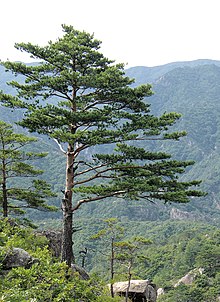
Japanese red pine (Pinus densiflora), North Korea
Scientific classification
Kingdom:Plantae
Division:Pinophyta
Class:Pinopsida
Order:Pinales
Family:Pinaceae
Genus:Pinus
L.
Subgenera
  • Subgenus Strobus
  • Subgenus Ducampopinus
  • Subgenus Pinus
See Pinus classification for complete taxonomy to species level. See list of pines by region for list of species by geographical distribution.
Etymology

The modern English name pine derives from Latin pinus which some have traced to the Indo-European base *pīt- ‘resin’ (source of English pituitary). In the past (pre-19th century) they were often known as fir, from Old Norse fura, by way of Middle English firre. The Old Norse name is still used for pines in some modern north European languages, in Danish fyr, in Norwegian fura/fure/furu, Swedish fura/furu, Dutch vuren, and German Föhre, but in modern English, fir is now restricted to fir (Abies) and Douglas-fir (Pseudotsuga).

Taxonomy, nomenclature and codification

Pines are gymnosperms. The genus is divided into three subgenera, which can be distinguished by cone, seed, and leaf characters:
  • Pinus subg. Pinus, the yellow, or hard pine group, generally with harder wood and two or three needles per fascicle
  • Pinus subg. Ducampopinus, the foxtail or pinyon group
  • Pinus subg. Strobus, the white, or soft pine group, generally with softer wood and five needles per fascicle

Distribution


A Khasi pin in Benguet, Philippines.
Most regions of the Northern Hemisphere (see List of pines by region) host some native species of pines. One species (Sumatran pine) crosses the equator in Sumatra to 2°S. In North America, various species occur in regions at latitudes from as far north as 66°N to as far south as 12°N.
Various species have been introduced to temperate and subtropical regions of both hemispheres, where they are grown as timber or cultivated as ornamental plants in parks and gardens. A number of such introduced species have become invasive and threaten native ecosystems.
Huangshan pine (Pinus hwangshanensis), Anhui, China.

Description


Ancient Pinus longaeva, Nevada, USA

Pine trees are evergreen, coniferous resinous trees (or, rarely, shrubs) growing 3–80 m (10–260 ft) tall, with the majority of species reaching 15–45 m (50–150 ft) tall. The smallest are Siberian dwarf pine and Potosi pinyon, and the tallest is a 81.79 m (268.35 ft) tall ponderosa pine located in southern Oregon's Rogue River-Siskiyou National Forest.
The bark of most pines is thick and scaly, but some species have thin, flaky bark. The branches are produced in regular "pseudo whorls", actually a very tight spiral but appearing like a ring of branches arising from the same point. Many pines are uninodal, producing just one such whorl of branches each year, from buds at the tip of the year's new shoot, but others are multinodal, producing two or more whorls of branches per year. The spiral growth of branches, needles, and cone scales are arranged in Fibonacci number ratios. The new spring shoots are sometimes called "candles"; they are covered in brown or whitish bud scales and point upward at first, then later turn green and spread outward. These "candles" offer foresters a means to evaluate fertility of the soil and vigour of the trees.
Pines are long-lived, typically reaching ages of 100–1,000 years, some even more. The longest-lived is the Great Basin bristlecone pine, Pinus longaeva. One individual of this species, dubbed "Methuselah", is one of the world's oldest living organisms at around 4,600 years old. This tree can be found in the White Mountains of California. An older tree, now cut down, was dated at 4,900 years old. It was discovered in a grove beneath Wheeler Peak and it is now known as "Prometheus" after the Greek immortal.
Bark chips.

Foliage
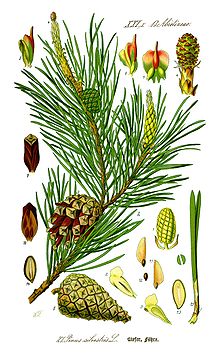

Illustration of needles, cones, and seeds of Scots pine (Pinus sylvestris).
Pines have four types of leaf :
  • Seed leaves (cotyledons) on seedlings, born in a whorl of 4–24.
  • Juvenile leaves, which follow immediately on seedlings and young plants, 2–6 cm long, single, green or often blue-green, and arranged spirally on the shoot. These are produced for six months to five years, rarely longer.
  • Scale leaves, similar to bud scales, small, brown and non-photosynthetic, and arranged spirally like the juvenile leaves.
  • Needles, the adult leaves, which are green (photosynthetic), bundled in clusters (fascicles) of 1–6, commonly 2–5, needles together, each fascicle produced from a small bud on a dwarf shoot in the axil of a scale leaf. These bud scales often remain on the fascicle as a basal sheath. The needles persist for 1.5–40 years, depending on species. If a shoot is damaged (e.g. eaten by an animal), the needle fascicles just below the damage will generate a bud which can then replace the lost leaves.

Cones

Pines are mostly monoecious, having the male and female cones on the same tree, though a few species are sub-dioecious with individuals predominantly, but not wholly, single-sex. The male cones are small, typically 1–5 cm long, and only present for a short period (usually in spring, though autumn in a few pines), falling as soon as they have shed their pollen. The female cones take 1.5–3 years (depending on species) to mature after pollination, with actual fertilization delayed one year. At maturity the female cones are 3–60 cm long. Each cone has numerous spirally arranged scales, with two seeds on each fertile scale; the scales at the base and tip of the cone are small and sterile, without seeds. The seeds are mostly small and winged, and are anemophilous (wind-dispersed), but some are larger and have only a vestigial wing, and are bird-dispersed (see below). At maturity, the cones usually open to release the seeds, but in some of the bird-dispersed species (e.g. whitebark pine), the seeds are only released by the bird breaking the cones open. In others, the seeds are stored in closed ("serotinous") cones for many years until an environmental cue triggers the cones to open, releasing the seeds. The most common form of serotiny is pyriscence, in which a resin binds the cones shut until melted by a forest fire.

Ecology
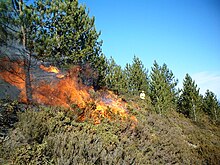

A prescribed fire in a European black pine (Pinus nigra) woodland, Portugal.
Pines grow well in acid soils, some also on calcareous soils; most require good soil drainage, preferring sandy soils, but a few (e.g. lodgepole pine), will tolerate poorly drained wet soils. A few are able to sprout after forest fires (e.g. Canary Island pine). Some species of pines (e.g. bishop pine), need fire to regenerate, and their populations slowly decline under fire suppression regimes. Several species are adapted to extreme conditions imposed by elevation and latitude (e.g. Siberian dwarf pine, mountain pine, whitebark pine and the bristlecone pines). The pinyon pines and a number of others, notably Turkish pine and gray pine, are particularly well adapted to growth in hot, dry semi-desert climates.
The seeds are commonly eaten by birds, such as grouse, crossbills, jays, nuthatches, siskins, woodpeckers, and squirrels. Some birds, notably the spotted nutcracker, Clark's nutcracker and Pinyon jay, are of importance in distributing pine seeds to new areas. Pine needles are sometimes eaten by some Lepidoptera (butterfly and moth) species (see list of Lepidoptera that feed on pines), the Symphytan species pine sawfly, and goats.


Logging Pinus ponderosa, Arizona, USA.

Use


Pine cone.

Pines are among the most commercially important tree species valued for their timber and wood pulp throughout the world. In temperate and tropical regions, they are fast-growing softwoods that will grow in relatively dense stands, their acidic decaying needles inhibiting the sprouting of competing hardwoods. Commercial pines are grown in plantations for timber that is denser, more resinous, and therefore more durable than spruce (Picea). Pine wood is widely used in high-value carpentry items such as furniture, window frames, panelling, floors and roofing, and the resin of some species is an important source of turpentine.
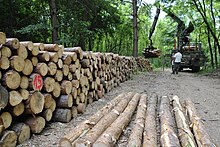

Pinus sylvestris prepared for transport, Hungary.
Many pine species make attractive ornamental plantings for parks and larger gardens with a variety of dwarf cultivars being suitable for smaller spaces. Pines are also commercially grown and harvested for Christmas trees. Pine cones, the largest and most durable of all conifer cones, are craft favorites. Pine boughs, appreciated especially in wintertime for their pleasant smell and greenery, are popularly cut for decorations. A number of species are attacked by nematodes, causing pine wilt disease, which can kill some quickly. Pine needles are also used for making decorative articles like baskets, trays, pots, etc. This Native American skill is now being replicated across the world. Pine needle handicrafts are made in the US, Canada, Mexico, Nicaragua and India. Pine needles serve as food for various Lepidoptera. See List of Lepidoptera that feed on pines.
Tongue and groove solid pine flooring
Because pines have no insect or decay resistant qualities after logging, they are generally recommended for construction purposes as indoor use only (ex. indoor drywall framing). This wood left outside can be expected to last no more than 12–18 months depending on the local climate. It is commonly referred to by several different names which include North American timber, SPF (spruce, pine, fir) and whitewood.
Farming
When grown for sawing timber, pine plantations can be harvested after 30 years, with some stands being allowed to grow up to 50 (as the wood value increases more quickly as the trees age). Imperfect trees (such as those with bent trunks or forks, smaller trees, or diseased trees) are removed in a "thinning" operation every five to ten years. Thinning allows the best trees to grow much faster, because it prevents weaker trees from competing for sunlight, water, and nutrients. Young trees removed during thinning are used for pulpwood, while most older ones are good enough for saw timber.
The final wood quality can be improved by pruning small branches at ages 5, 7, and 9. Pruning usually goes up to a height of 6 metres (20 ft). This results in smooth timber with no knots, which is considerably more valuable. 
A 30-year-old commercial pine tree grown in good conditions will be about 0.3 metres (1.0 ft) in diameter and about 20 metres (66 ft) high. After 50 years, the same tree will be about 0.5 metres (1.6 ft) in diameter and 25 metres (82 ft) high, and its wood will be worth about 7 times as much as the 30-year-old tree. 
Trees are planted 3 to 4 metres apart, or about 1000 per hectare (100,000 per square kilometer).
Food
Some species have large seeds, called pine nuts, that are harvested and sold for cooking and baking. They are an essential ingredient of Pesto alla genovese.
Edible seeds of the Korean pine (Pinus koraiensis).
The soft, moist, white inner bark (cambium) found clinging to the woody outer bark is edible and very high in vitamins A and C. It can be eaten raw in slices as a snack or dried and ground up into a powder for use as an ersatz flour or thickener in stews, soups, and other foods, such as bark bread. Adirondack Indians got their name from the Mohawk Indian word atirú:taks, meaning "tree eaters".
Biomedical
A tea made by steeping young, green pine needles in boiling water (known as "tallstrunt" in Sweden) is high in vitamins A and C.
Pine has been listed as one of the 38 substances used to prepare Bach flower remedies, a kind of alternative medicine promoted for its effect on health. However, according to Cancer Research UK, "there is no scientific evidence to prove that flower remedies can control, cure or prevent any type of disease, including cancer".
Notes

  1. ^ Sunset Western Garden Book, 1995:606–607
  2. ^ "The Plant List Version 1.1". Retrieved 15 December 2015.
  3. ^ "Where Are You From? - Credo Reference". credoreference.com.
  4. a b Burton Verne Barnes; Warren Herbert Wagner (January 2004). Michigan Trees: A Guide to the Trees of the Great Lakes Region. University of Michigan Press. pp. 81–. ISBN 0-472-08921-8.
  5. ^ "Pinus ssp. (tree), General Impact". Global Invasive Species Database. Invasive Species Specialist Group. 13 March 2006. Retrieved 2 March 2011.
  6. ^ Fattig, Paul (2011-01-23). "Tallest of the tall" Mail Tribune (Medford, Oregon). Retrieved 2011-01-27.
  7. ^ Ryan, Michael; David M. Richardson (December 1999). "The Complete Pine". BioScience 49 (12): 1023–1024. doi:10.2307/1313736. 
  8. ^ "The Pine Plantation Rotation" (PDF). Forests NSW. Retrieved April 2016.
  9. ^ Frank A. Roth II, Extension Forester. "Thinning to improve pine timber". (PDF). University of Arkensas Division of Agriculture. Retrieved April 2016.
  10. ^ D. S. Vohra (1 June 2004). Bach Flower Remedies: A Comprehensive Study. B. Jain Publishers. p. 3. ISBN 978-81-7021-271-3. Retrieved 2 September 2013.
  11. ^ "Flower remedies". Cancer Research UK. Retrieved September 2013.

References

  • Farjon, A. 1984, 2nd edition 2005. Pines. E. J. Brill, Leiden. ISBN 90-04-13916-8.
  • Little, E. L., Jr., and Critchfield, W. B. 1969. Subdivisions of the Genus Pinus (Pines). US Department of Agriculture Misc. Publ. 1144 (Superintendent of Documents Number: A 1.38:1144).
  • Richardson, D. M. (ed.). 1998. Ecology and Biogeography of Pinus. Cambridge University Press, Cambridge. 530 p. ISBN 0-521-55176-5.
  • Sulavik, Stephen B. 2007. Adirondack; Of Indians and Mountains, 1535-1838. Purple Mountain Press, Fleischmanns, NY. 244 p. ISBN 1-930098-79-0 ISBN 978-1-930098-79-4.
  • Mirov, N. T. 1967. The Genus Pinus. Ronald Press, New York (out of print).
  • Classification of pines
  • Gymnosperm Database - Pinus

Bibliography

  • Mirov, N. T.; Stanley, R. G. (1959). "The Pine Tree". Annual Review of Plant Physiology 10: 223. doi:10.1146/annurev.pp.10.060159.001255.
  • Philips, Roger. Trees of North America and Europe, Random House, Inc., New York ISBN 0-394-50259-0 1979.,

Wikipedia 

Advantages and Disadvantages of Fasting for Runners

Author BY   ANDREA CESPEDES  Food is fuel, especially for serious runners who need a lot of energy. It may seem counterintuiti...