Blog List

Monday, 3 April 2017

Blog: Getting it right with non-woodfuels

Blog: Getting it right with non-woodfuels
Blog: Getting it right with non-woodfuels, by Kevin Lindegaard
By Kevin Lindegaard, MD Crops for Energy and WHA Director.
From the name Wood Heat Association you’d be forgiven for thinking that we just cover woodfuels such as woodchip, pellets and logs. However, the remit of the WHA also includes the production of heat using straw, energy grasses such as Miscanthus and a myriad of other non-woody forms of biomass including pellets made from waste coffee grounds and briquettes made from bracken.
Many non-wood fuels are cheaper than their woody counterparts and are widely available in the UK. It’s quite possible that existing biomass system owners might like the idea of cutting their fuel costs by switching to using alternative fuels if woodfuel prices begin to rise. Also, developers of new projects might wish to consider cheaper non-wood fuels to assist the economic outlook of their scheme now that Renewable Heat Incentive (RHI) tariffs have been significantly reduced. It’s really important to consider all the options but also be aware of the issues of making such a choice.
At the WHA we encourage best practice and want to see an industry that delivers exemplary projects providing hassle free renewable heat to the user. In this blog we will deal with some of the crucial issues of non-wood fuels. Follow these pointers and you’ll be able to make an informed choice that takes into consideration your supply, your facilities and your lifestyle.
First things first – alternative fuels usually have poorer fuel qualities than woody fuels. For instance herbaceous fuels such as straw and Miscanthus have higher ash contents and lower ash melting points than woody fuels. Hence, there will be more frequent ash removal and typically more maintenance required. The table below indicates the relative amount of ash produced from 100 tonnes of fuel. The user would need to be geared up to handle and store the quantities involved. The larger quantities and the fact that ash is a useful fertiliser means that alternative fuels are generally most suited for farming scenarios.
Table 1: Ash content of different fuels and the relative amount of ash produced from 100 tonnes of fuel.
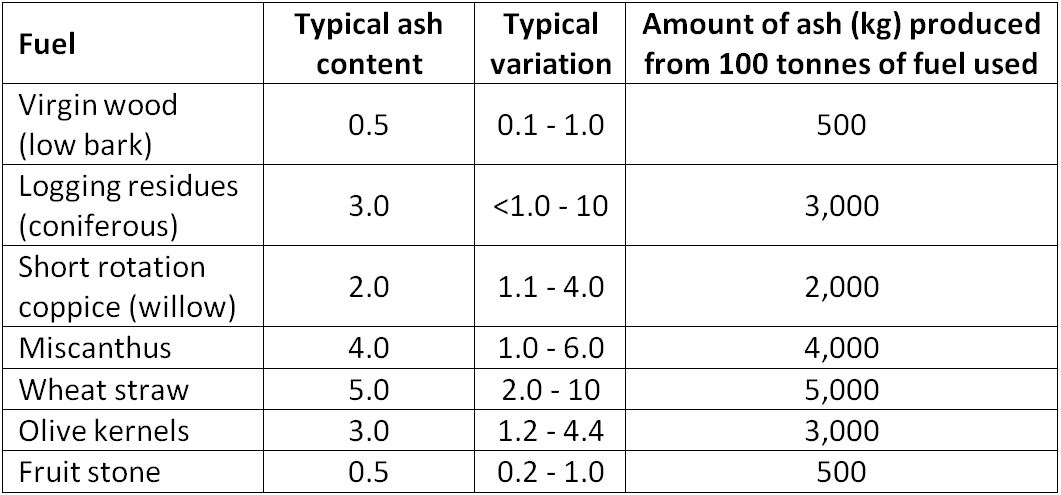
Blog: Getting it right with non-woodfuelsFigures from Solid Biofuels – Fuel specifications and classes Part 1 General Requirements. British Standard BS EN 14961-1:2010.
Blog: Getting it right with non-woodfuelsFurthermore, herbaceous fuels in bale and chip forms have a comparatively low bulk density. This means you’ll need more storage space and usually a bigger boiler – the reason for the latter is that the fluffy nature of the fuel means that you can’t physically get sufficient fuel into the combustion area to achieve the rated value of the boiler. As a result if your heat demand is 150 kW then you are likely to require a 200 kW boiler to meet the peak load when using Miscanthus chips. (Compressed fuels such as Miscanthus or coffee ground pellets and bracken briquettes do not have this issue).
Matching the fuel of choice to your boiler is absolutely critical to the success of your project. Get it wrong and you will affect the warranty of your boiler and potentially shorten its life or be constantly replacing parts. Your boiler will need to be sufficiently robust to deal with the higher acidity of certain alternative fuels (for instance Miscanthus and straw have much higher levels of chlorine and sulphur than woody fuels). If your boiler is compliant to a wide range of fuels and you want to switch it’s a good idea to contact your installer. Some boilers have been designed to allow users to modify settings to enable simple fuel switching whereas others will require an engineer to visit and make the necessary changes.
Blog: Getting it right with non-woodfuelsThere are several boilers in the UK market that are compliant with alternative fuels. Many of these are available from WHA installer members. It really makes sense to do your homework and see if you can visit existing boilers and get some useful feedback from experienced users. Going to see boilers that have been in operation with a certain fuel for a number of years will increase your confidence in a system. Getting impartial third party advice and insight from an independent consultant can also pay dividends.
If you are intending to get your project accredited under the RHI you will need to make sure that the boiler has an RHI emissions certificate for the chosen fuel. Don’t take an installers word for it – make sure they provide you with this documentation before you sign a contract. Unfortunately many excellent boilers that are compatible for use with non-wood fuels don’t have the necessary certification. In this situation if you are really keen on a particular system and your non-wood fuel choice then you can organise an in situ emissions test using a specialist company. This can be quite costly and you would want to be confident that the system could achieve the emissions thresholds for particulates and nitrogen oxides (NOx) before you commit to this.
Blog: Getting it right with non-woodfuelsAnother requirement of the RHI is to show that you are sourcing your fuel from a sustainable source and can demonstrate that the lifecycle greenhouse gas emissions are 60% below the EU fossil fuel average. The Biomass Suppliers List caters for woodfuels but up until now anyone using non-wood fuels has had to self-report which can be a relatively expensive and time consuming exercise. However, this gap should be filled by the launch of the Sustainable Fuel Register (SFR) which will be the first industry led, self-sustaining approved supplier list. The SFR is a joint initiative of WHA members Farm Energy Centre and Crops for Energy and once fully up and running (which is anticipated to be in the autumn of 2016) will be a subscription service with a small annual fee which takes into account quantity of fuel produced, traded or consumed. The SFR website is open for expressions of interest.
Blog: Getting it right with non-woodfuelsFinally, if you’re a farmer you might wish to supply your own fuel. An arable farmer would need around 25-35 hectares of cereals to supply a project requiring 100 tonnes of straw. Alternatively they would need to plant around 8 hectares of Miscanthus to produce the same quantity. There is a significant benefit to self-supply using energy crops. Once the crop is planted the farmer will be insulated against future price rises and as long as the crop is well tended should remain viable for 20 years.
So there you have it – our quick guide to getting it right with alternative fuels. If you have your eyes open to these important issues you will be well on the way to embarking on a successful and rewarding project.
Note: The Board of Directors of the WHA will each month publish a blog on topics related to the biomass heating industry. The views expressed in this blog post are those of the author(s) and do not necessarily reflect the views or policies of the WHA/REA. 

For further information log on website :
http://www.woodheatassociation.org.uk/getting-it-right-with-non-woodfuels/

Northwestern Ontario First Nations see $100 million in new aboriginal business


There are about 17,000 First Nations people working in Canada’s forest products sector. Maybe that’s why it shouldn’t be a big surprise that the investments we’re making in Northwestern Ontario represent $100 million in new business for six First Nations partners.
A Memorandum of Agreement (MOA) was officially signed in Thunder Bay, Ontario, on February 10th, 2015, that sets out a framework for negotiating business contracts related to these investments.
Contracting aboriginal businesses
Originally signed in June 2013, the agreement has yielded contracts for a number of services including:
  • Construction at Resolute’s sawmills,
  • Transportation for hauling chips, biomass and lumber from the sawmills,
  • Yard service to manage the loading and unloading of logs, lumber and by-products, and
  • Harvest and delivery work.

Ramping up activities in Northwestern Ontario
We’ve been busy in Northwestern Ontario. There’s the construction of a new sawmill in Atikokan, the upgrade and restart of the idled Ignace sawmill, the production capacity increase at our Thunder Bay sawmill, and the addition of a wood pellet plant at the Thunder Bay site.
To date, we’ve invested C$90 million in these operations. And we expect these investments to create 200 new Resolute jobs and another 200 woodlands operations jobs, in addition to significant indirect employment.
But this agreement goes beyond numbers. It truly underscores the commitment Resolute and its operating communities are making to work together to create jobs and economic opportunity for Northwestern Ontarians.
Supporting First Nation economic goals
“Speaking for all Chiefs here today, this agreement is ground-breaking and incredibly important to our First Nations,” Chief Earl Klyne of the Seine River First Nation said at the signing, adding: “It reflects a balanced approach to sustainability, not only supporting environmental goals, but the social and economic goals of the region as well.”
In attendance at the signing were Chief Windego of Nigigoonsiminikaaning First Nation, Chief White Cloud of Lac des Milles Lacs First Nation, Richard Garneau, president and chief executive officer of Resolute, Chief Klyne of Seine River First Nation, Chief Mainville of Couchiching First Nation, Chief Henderson of Mitaanjigamiing First Nation, Chief Jordan of Lac La Croix First Nation.
Signaling an upturn for local forestry operations
MPP for Thunder Bay-Atikokan and Minister of Natural Resources and Forestry, Bill Mauro was also there and reminded attendees not only of Resolute’s proactive work with area First Nations communities and businesses, but also about the broader positive signs of such an investment. “These relationships are beneficial for both Aboriginal communities and for Resolute in signaling an upturn for local forestry operations,” he said.
Michael Gravelle, MPP for Thunder Bay-Superior North and Minister of Northern Development and Mines seconded this notion and added that, “Resolute has made significant investments in Northwestern Ontario at a time when there are growing signs of recovery in the forest products sector. As the sawmills ramp up their activity, these operations will help encourage the future prosperity of our Aboriginal communities.”
Front left to right: Chief Will Windigo, Nigigoonsiminikaaning First Nation, Chief Judy White Cloud, Lac des Milles Lacs First Nation, Richard Garneau, President and Chief Executive Officer of Resolute Forest Products, Chief Earl Klyne, Seine River First Nation, Chief Sara Mainville, Couchiching First Nation, Chief Janice Henderson, Mitaanjigamiing First Nation, and Chief Norman Jordan, Lac La Croix First Nation

For further information log on website :
http://borealforestfacts.com/?p=521

8 things to know about the boreal forest and carbon

High carbon stock forests around the world have an important part to play in the capture, storage and release of carbon in the fight against global warming. 
When people talk about greenhouse gas (GHG) emissions, one of the most maligned gases is carbon dioxide. Excess carbon in the atmosphere is not good, but carbon is one of the essential gases that make life on earth possible. Forests both store and release significant amounts of carbon as part of a natural cycle. And good forest management not only reduces a forest’s potential as a carbon source, it can also increase the effect of its carbon storage capacity.
  1. The boreal forest is a carbon source and sink
Carbon moves in and out of the atmosphere through a natural process called the carbon cycle. This is where carbon gets exchanged among oceans, soil, rocks and plant life. Forests actually contain a tremendous amount of carbon. In fact, there’s more carbon in living trees and plants, as well as in a forest’s organic matter and soil, than there is in the atmosphere.[i]
 Some years, forests hold more carbon than they release. When they capture more CO2, they are called carbon sinks. But carbon is part of a ‘catch and release’ cycle, and with that much carbon, these same sinks can sometimes become major carbon sources. For example, trees can burn or fall prey to insects and ultimately decompose. In either case, they release the carbon they once held back to the air.
  1. Forestry supports carbon sequestration
The process of capturing CO2 from the atmosphere and storing it for a long time is called sequestration. Trees store carbon by converting CO2 into plant material through photosynthesis, which uses the energy from the sun and releases oxygen.
When a tree is harvested and milled into lumber, a small amount of that carbon escapes, but most of it remains trapped within the cellular structure of the wood, effectively prolonging the effect of sequestration.
Replacing dying or low productivity stands can improve a forest’s ability to capture and store carbon and contribute to climate change mitigation. This can be done by planting tree mixes that are more resilient and protecting young sprouts from damage after harvest.[ii]
  1. Forest fires and insects release more carbon than harvesting
Less than 0.5% of managed forests are harvested annually in Canada, according to Natural Resources Canada (NRCan). And these areas regenerate so that there is substantial new storage of carbon occurring in any given year.
The amount of carbon released into the atmosphere from harvesting activity is small when compared to the amount released by forest fires through combustion and insect infestations that kill trees and cause premature decomposition. On average, areas affected by forest fires, for example, are 2.5 times larger than areas harvested, according to NRCan, representing a significant amount of carbon that goes up in smoke.[iii]
  1. The boreal forest holds a lot of carbon, but tropical forests hold more
For a long time, the boreal was thought to sequester more carbon than tropical forests. This was based on an understanding of global airflow that has since been revised. (Researchers at the National Centre for Atmospheric Research in Colorado studied measurements made by aircraft and concluded that existing climate models were underestimating the carbon absorption of tropical forests.[iv])
A recent NASA study estimates that tropical forests annually absorb 1.4 billion metric tons of carbon dioxide out of a total global absorption of 2.5 billion metric tons. Researchers say that this is more than the amount absorbed by the boreal forest in Canada, Siberia and other northern regions.
  1. Deforestation in tropical forests emits carbon
Countries in which tropical forests are found can be less stringent when it comes to sustainability practices. Slash and burn harvesting is common, where all the trees are cut and only select wood is removed, with the rest left to decompose. This generates a tremendous amount of methane, which is one of the worst gases when it comes to global warming potential, trapping 56 times more heat than carbon emissions over its first 20 years in the atmosphere.[v] 
  1. There are many ways to measure carbon storage
The boreal forest’s potential as a carbon sink is widely accepted, but what is not clear is exactly how much carbon is actually stored. That’s because measuring carbon storage is not straightforward; results differ depending on the approach. Canada, for example, estimates forest carbon stocks, changes in carbon stocks, and emissions of non-CO2 greenhouse gases in its managed forests using the National Forest Carbon Monitoring, Accounting and Reporting System.
If you look at the absolute carbon stored in the boreal, there is a substantial amount. But if you look at a forest’s capacity to sequester carbon over time, the tropical forest has more potential. Effectively, there is little agreement on what makes a high carbon stock forest. One way to gain perspective is to develop a consensus among researchers so that studies can be compared and uncertainties addressed.[vi] 
  1. There are many ways to maximize carbon sequestration
Besides supporting more research, the Canadian government is looking at a number of strategies to optimize the carbon storage potential of its forests. One study shows that a mix of strategies – depending on location – can maximize carbon sequestration potential over the long term. The combination of the “better utilization” approach (increasing the utilization of wood harvested and ensuring that a higher percentage of residues are used as fiber inputs and/or in bioenergy production), along with promoting the development of products that can store carbon for longer, was by far the most effective strategy for most Canadian forest locations.
  1. Lowering harvest volumes is not always a good way to improve carbon sequestration
Simply reducing harvest volumes in Canadian forests is not the only way to improve a forest’s carbon sequestration potential.[vii] This is an idea supported on a global scale by the United Nations International Panel on Climate Change. This U.N. report explains that the largest GHG emission mitigation benefit, in the long term, comes not from reducing harvest volumes but from adopting a sustainable forest management strategy aimed at maintaining or increasing forest carbon stocks, while producing an annual yield of timber, fiber or energy from the forest.[viii]

For further information log on website :
http://borealforestfacts.com/?p=550

Safeguarding Caribou


Boreal Forest
Addressing the conservation of woodland caribou in Canada: A work in progressWoodland caribou is an emblematic species of the boreal forest. It is such a national symbol in Canada that it is featured on the 25 cents piece and has been for decades. Due to the observed decline of populations of woodland caribou over several years of monitoring in several regions in Canada, the species was added to the Canadian government’s list of threatened species in 2002 . Since that time, the country’s provinces, First Nations, communities and the forest products industry have collaborated to take action for the long-term recovery and survival of this noble creature.
Three quarters of the caribou’s territory has already been safeguarded
  • In Quebec, 76 percent of the caribou’s range is off limits to harvesting
  • In Ontario, 77 percent of the caribou’s range is off limits to harvesting
Caribou, Predators and Habitat ChangeCaribou protect themselves from predators, such as wolves, coyotes and bears, by spreading out over large areas of land. While you might find two to three moose per square kilometer (250 acres) in the boreal, you’ll generally find just one to two caribou per tract of 100 square kilometers (25,000 acres).
This strategy of spreading the population over vast regions makes it much less likely that a caribou will encounter a predator, which allows the species to grow and propagate without having to constantly be on the lookout to avoid or escape being hunted. In many cases, caribou fall victim to wolves, coyotes and bears who are actually hunting for bigger game, like moose. Woodland caribou, unlike their tundra dwelling relatives, don’t assemble in large herds that make it easy for wolves to hunt. In addition, because of their smaller size, compared to moose, they don’t offer as much of a meal when they do happen to be caught.
When tracts of forest are harvested, low vegetation, herbs and new trees quickly colonize the fertile and newly open area. This type of ground cover provides a rich and abundant source of forage, which attracts several herbivores species, such as moose. As a consequence of the influx of moose, wolves, coyotes and bears also find their way to the area in order to hunt. As the number of predators increases, the likelihood of one of them running into a caribou also goes up, which eventually leads to reduced caribou populations.
Resolute protects land to increase caribou habitatIn order to ensure that caribou habitat remains safe and abundant well into the future, Resolute is promoting forest management practices that target large tracts of land while leaving sufficient forested areas to meet the caribou’s habitat requirements. The areas identified for caribou conservation must be large enough to allow caribou to rely on their dispersion strategy to reduce encounters with predators. In addition to this approach, we have also supported several initiatives to set aside additional territory, some of which are currently under discussion as part of the Canadian Boreal Forest Agreement (CBFA).
Up to now, Resolute has made the following contributions in land toward the conservation of woodland caribou habitat:
  • In Northeastern Ontario, the Company, along with CBFA partners, supports a proposal for an additional caribou conservation area covering almost 8,348 square kilometres on the Abitibi River Forest (3,223 square miles).
  • In Northwestern Ontario, predecessor companies of Resolute Forest Products contributed some of their tenure lands for the creation of Wabakimi Provincial Park, which covers an area of 8,920 square kilometers, and is one of the largest parks in the province.
  • In Quebec, Resolute was among the first companies to propose and implement an action plan for caribou. The Company also contributed to the government process to identify protected areas suitable for caribou protection.

Safeguarding caribou with sound management
With over 75% of the caribou range located north of the managed forest, we rely on numerous strategies, best practices and guidelines developed specifically for caribou conservation to provide suitable habitat for woodland caribou within the 25% of the range that falls in the managed forest. Ontario’s Caribou Conservation Plan is one example of a government guideline supporting caribou sustainability. These strategies, which are built into our forest management plans, focus on providing habitat for caribou across the landscape on a long-term basis, and minimizing disturbances to caribou populations by using the following guidelines:
  • The development of road management strategies in each forest management plan identifies the location of roads, building techniques and closing procedures with caribou conservation in mind.
  • Areas that are important to caribou, such as caribou calving lakes, are prioritized for protection.
  • Conifer regeneration, which will result in suitable caribou habitat in the future, is prioritized in accordance with habitat protection decisions.
  • Harvest operations across the landscape are scheduled over time, in order to minimize overall disturbance levels for caribou populations.
The 150-Year PlanPerhaps the most widespread approach to harvesting, is known as a “dynamic caribou habitat scheduling,” where areas in which an optimal harvesting sequence can be carried out over a span of 100 to 150 years are identified, so that suitable caribou habitat is constantly maintained in a caribou population range. By applying this technique, large areas of suitable habitat are continuously maintained for caribou across the landscape. These caribou “deferrals” move over in the region where and when previously harvested areas have acquired the desirable caribou habitat attributes. It is only when the caribou have other areas in which to safely move, that those previously deferred areas can be harvested. This approach concentrates harvest operations in defined areas, in order to minimize disturbance levels at any given time for caribou populations across the broader range of the species.
Looking ForwardResolute has clearly expressed its commitment to sustaining woodland caribou populations with a combination of sustainable forest management practices, conservation of caribou habitat and the application of dynamic habitat scheduling in harvested areas to minimize disturbance and maintain sufficient caribou habitat across the landscape. Our company will continue to prioritize the conservation of this noble creature and national symbol well into the future, while also seeking additional partners and innovative approaches to further benefit woodland caribou populations across Canada.

For further information log on website :
http://borealforestfacts.com/?p=500

Five Burning Questions about Forest Fires


Forest fires
Canada’s fire season runs from April to October and already we’ve seen 4 million hectares of forest burn, an area about the size of Switzerland. Most of this has occurred in British Columbia, Alberta and Saskatchewan. In Ontario and Quebec, where Resolute’s operations are concentrated, we’ve seen moderate to low fire activity that is considerably below the ten-year average.[1]
While certainly a threat to public safety and property, forest fires have an important role to play in the life of a forest. Here are five answers to the big questions surrounding wildland fires:
  1. How do fires start?
Lightning is often the cause of wildland fires in more remote regions during the summer when dry conditions can persist. But Natural Resources Canada (NRCan) estimates that more than half of a season’s fires can be attributed to human causes like a spark from machinery to carelessness in the form of unattended campfires, discarded cigarettes and uncontrolled yard waste burns.[2] But for Canada’s boreal forest, the main ignitor is lightning.
  1. How do they spread so quickly?
Beyond a source of ignition, wildland fires also need dry fuel and hot, dry, windy weather. And to continue to burn, they need heat, oxygen, and fuel (this is known as the fire triangle). Once ignited, fires can move quickly – up to 23 kph by some estimates.[3] And depending on the amount and type of fuel available, the weather and the topography, a fire can continue to spread. The heat from the existing burn causes the moisture in the adjacent fuel to evaporate so that it becomes easier to ignite. Wind provides the flames with oxygen and pushes the fire across a landscape at a faster rate. A large fire will also create a wind of its own, sometimes as much as 10 times faster than the ambient wind, which will propel embers high into the air to start fires in other areas.[4]
  1. Are all fires as dramatic as the images we see in the news?
No. There are essentially three different types of fires. The ones you see most often in images and news reports are called crown fires because they burn up to the top of a tree. These ones are considered most dangerous. Surface fires burn fuel elements like dried leaves, branches and pine needles on the forest floor. They tend to be easier to control and put out. The last one, the ground fire, is a subsurface fire that can even occur underground where there are deep accumulations of dead vegetation that have become dry enough to burn. These ones tend to smoulder for long periods.
  1. What is the role of fire in forest ecology?
In a word, it’s about diversity. And particularly for the boreal, which is composed of everything from pure deciduous to mixed deciduous-coniferous to pure coniferous. Decay doesn’t occur as quickly under the boreal’s cool temperate conditions as it might in warmer, more humid climates so fire is a natural way to convert the branches, logs and leaves on the ground to a mineral-rich ash. This releases and recycles nutrients.
The gaps in the forest created by fire also allow sun to penetrate and stimulate the growth of pioneer species like aspen, white birch, jack pine and lodgepole pine. If fire does not occur in this same forest over the next 100 years, black spruce will flourish in the shade these pioneer species provide.
And as birds carry seeds to new areas, a patchwork of vegetation develops, populated by different species at various levels of maturity. By rearranging vegetation, fires support the formation of diverse ecosystems that are home to a variety of populations of insects, mammals and birds.
  1. When is a fire simply allowed to burn?
It generally comes down to whether the fire poses a risk to human life and property. For most of the 20th century, forest fires were seen as a destructive force that needed to be suppressed. And we were generally successful. But we’ve since come to understand that fire, like wind and water, is just another element of the ecosystem. Today’s forest fire strategies range from putting out a fire to actually setting fires on purpose (these are known as prescribed burns and are used to eliminate potential fuel sources).
Agencies responsible for fire suppression in an area have a number of tools available to them to assess the risk to humans and property. As NRCan explains, high-priority areas for protection include residential areas, high-value commercial forests and recreational sites. Low-priority sites are generally wilderness parks and remote forests of limited economic value—although protection of rare habitat, culturally significant areas and similar values will influence suppression decisions.[5]

For further information log on website :
http://borealforestfacts.com/?p=604

Celebrating International Day of Forests


Welcome to Boreal Forest Facts, a new digital resource launched on the United Nations’ International Day of Forests 2014. As the global community spotlights the environmental, social and  economic contributions of forests to a healthy and vibrant planet, we at Resolute welcome the opportunity to showcase Canada’s role as a global leader in sustainable forest management.
Canada’s forestry laws and regulations are among the most stringent in the world – that’s not just our opinion, but the results of a 2005 study conducted by Yale University. At over 5.7 million km², Canada’s boreal region is more than eight times the size of France – truly a wonder of the natural world and home to millions of acres of trees and wetlands, along with thousands of animal, bird, plant and insect species. More than 2.5 million Canadians call the region home – and at 12 percent of our nation’s manufacturing GDP, we can leave nothing to chance. We must set the standard for leadership in sustainability.
Here at Boreal Forest Facts, friends of the boreal forest can join the conversation around several key areas, such as:
    • Canada’s world-leading forestry practices;
    • The importance of collective action on climate change, and Resolute’s leadership in reducing our own greenhouse gas emissions; and
    • The need to engage communities, First Nations and governments in discussions of the Canadian Boreal Forest Agreement (CBFA). 
This site will also provide an ongoing look into our sustainability efforts as we continue to work with our environmental and economic partners.
Those partners include First Nations communities, many of whom have depended on the boreal forest for millennia.
We must work together to ensure the sustainability of the boreal forest for generations to come. Welcome to Boreal Forest Facts, and thank you for joining us in this critical effort.

For further information log on website :
http://borealforestfacts.com/?p=447

HERBICIDES: DO WE REALLY NEED TO USE THEM? …And 5 other important questions about glyphosate and reforestation


Although instances of their use have dropped significantly over the years, herbicides remain an important tool for regenerating harvested timberlands. Here’s why.
After the trees are harvested and an area is prepared for reforestation, the nutrient-rich soil and ample sunlight provide ideal conditions not only for timber regeneration, but for the growth of many other plant species. Herbicides help keep certain “pioneer” species like Canada blue-joint grass, raspberry, and trembling aspen from overtaking newly-planted tree seedlings like spruce and pine species.
Areas are typically only sprayed once, and most often that is during the first five years postharvest, either prior to or after planting seedlings.
Ensuring the health and safety of employees and neighbors is critical for Resolute and others conducting regeneration activities. Environmental considerations are also at the forefront of our approach to the sustainable and responsible management of the forests under our care. The spray program is one of the tools that we use to ensure the success of our regeneration initiatives and is conducted in compliance with government approved forest management plans. Spraying is only conducted where necessary, and only approved herbicides are applied by experienced and qualified experts.
Natural regeneration versus herbicide use 
Since all of the areas that are harvested in Canada must be promptly regenerated, managing pioneer species is a recurring challenge. And there are different methods of dealing with it. Some of these spaces are naturally regenerated and some re-grow with the help of herbicides. In Ontario in 2013, for example, 46% of the harvested areas regenerated without the use of herbicides.
  1. If some areas regenerate without it, isn’t that proof it’s unnecessary? 
The objective is to regenerate to a specific standard. Different areas see varying amounts of success depending on the method of control used. And many different methods have been tried, including laying down mulch mats, bringing in grazing livestock and even developing an indigenous fungus as a microbial biocontrol agent.[1]But the fact is, nothing is as effective as herbicides.
And if herbicides are not used, some areas see reduced crop growth and even outright crop failure. Just like a vegetable garden in your yard, if a competing species is left unchecked, it can overwhelm the seed crop. This happened in Nova Scotia forests where herbicide use was banned. A survey published in 2007 based on 101 plantations surveyed in the summer of 2005 found that most (87%) of their conifer plantations in the area failed outright and nearly all (97%) failed to meet the generally accepted regeneration standards 6-8 years after harvest.[2]
As a simplifying generalization, there are no alternatives that are as cost-effective, efficient or reliable as modern chemical herbicides in many forest regeneration scenarios. In fact, when the environmental impacts and risks of various site preparation techniques are weighed, herbicides can be far less dangerous than site preparation with large machinery, fires and manual brush clearing.
  1. Why must herbicides be applied aerially? Wouldn’t it be better to have crews apply it at ground level?
The areas scheduled for herbicide application average around 200 ha per day and are typically very remote. Aerial application of these products is not only economical, it is better than sending crews in, which can be disruptive to an area that is regenerating. As for accuracy, technologically advanced systems are used to minimize risks of drift outside of the target areas. And legislative requirements and guidance systems ensure that water-bodies next to aerially treated sites are protected by standing timber buffers.
In Ontario, Resolute only conducts aerial applications. We rely exclusively on helicopters, which increases the control over spray areas as compared to a fixed wing plane and provides precision when working with smaller areas.
  1. What is the most common herbicide used? What are its effects?
There are a few different types, but the most common active ingredient is glyphosate. Herbicides with glyphosate are some of the most thoroughly tested in the world. Their history of safe use is supported by one of the most extensive worldwide human health, crop residue and environmental databases ever compiled on a herbicide product.
Glyphosate is particularly effective at controlling competing vegetation in plantations of conifer trees, the dominant commercial tree species harvested throughout the boreal in Canada.
It also has a relatively favorable environmental behavior profile, which means that it doesn’t linger in soils, vegetation or water, it doesn’t accumulate in animals, and it has a very low potential to leach into ground water. It also has a relatively low innate toxicity to humans and wildlife.
  1. But is it really safe?
Based on the extensive body of scientific literature and studies, as well as information we have received from Health Canada, we believe that glyphosate-based herbicides are safe. They have an excellent fifty-plus year safety record, and their use has been approved by Health Canada.
In a recent re-evaluation of the use of glyphosate-based herbicides, Health Canada concluded that “products containing glyphosate do not present unacceptable risks to human health or the environment when used according to the proposed label directions.”
Over 800 studies have demonstrated that glyphosate does not cause cancer, birth defects, DNA damage, nervous system effects, immune system effects, endocrine disruption or reproductive problems. In addition, numerous field studies on this topic have been undertaken in Canadian forest ecosystems. What they found is perhaps best understood in terms of what glyphosate does NOT do:
  • It does NOT kill all other plants to create a single-species forest plantation.
  • It does NOT poison birds, fish, aquatic invertebrates, small mammals, large mammals or amphibians.
  • And it does NOT cause a reduction in soil microbial populations or significantly impair their function. [3] In fact, some studies even recommend the use of this treatment to create foraging conditions that support woodland caribou over moose.[4]
  1. What about the recent comments published by the World Health Organization’s International Agency for Research on Cancer?
The International Agency for Research on Cancer (IARC) of the World Health Organization (WHO) rated glyphosate as “probably carcinogenic to humans,” the same category (2A) they use to classify sunshine, aloe vera, cell phones, coffee and being a barber.
Health Canada addressed this announcement in their re-evaluation decision published on April  13, 2015:
The WHO’s International Agency for Research on Cancer (IARC) recently assigned a hazard classification for glyphosate as “probably carcinogenic to humans”. It is important to note that a hazard classification is not a health risk assessment. The level of human exposure, which determines the actual risk, was not taken into account by WHO (IARC). Pesticides are registered for use in Canada only if the level of exposure to Canadians does not cause any harmful effects, including cancer.
  1. Can you eat blueberries that have been sprayed with glyphosate? 
In the consultation documents from Health Canada, it was found that products containing glyphosate acid are unlikely to affect your health when used according to label directions and that dietary risks from food and water are not of concern.
The recommendation to avoid eating berries in posted areas after spraying with a glyphosate-based herbicide does not necessarily reflect a high level of risk, but rather is invoked as a simple extra precaution with no substantial down-side, according to Natural Resources Canada.[5] In following years, berries can be picked and eaten. Even without washing the fruit, the presence of the substance naturally diminishes at an exponential rate to approximately 50% of the initial value after 13 days and to 4% of the initial value after 61 days. [6]One study found that, a year after treatment with glyphosate, regrowth was normal and there was no effect on blueberry yield the season following treatment. [7], [8]
A recent survey of blueberry farmers in Maine showed that 76% of the growers surveyed use herbicides, such as glyphosate for weed management. In fact, a significant portion of growers who self-identified as “no-spray” or organic used the herbicides glyphosate and sethoxydim, (30% and 15%, respectively)[9]showing that some farmers may not consider herbicides as “pesticides,” as they are often less toxic to vertebrate wildlife and human beings than insecticides and fungicides.[10]
Resolute continues to monitor the research. We believe, however, that our use of herbicides as part of our sustainable forest management strategy is appropriate and evidence-based. It is also important to remember that Ontario’s forest management regimes and regulations are among the most stringent in the world and that Resolute supports and complies with them.

For further information log on website :
http://borealforestfacts.com/?p=593

About Resolute Forest Products, A Sustainable Forest Products Company


As a Canadian-based company with a long heritage in the boreal forest, we embrace our responsibility to preserve and renew the natural resources in our care, and to balance environmental, social, and economic sustainability.

For further information log on website :
http://borealforestfacts.com/?p=108

Non-wood fiber paper versus wood fiber: Which is better?


Bamboo
The environmental impacts of making paper from ‘tree-free’ fiber sources can be similar and even higher than using wood pulp. Here’s why.
There’s a popular notion that paper made from non-forest sources like hemp, bamboo or kenaf offers a more sustainable alternative to paper made from wood pulp. In other words, if you choose tree-free paper you’re protecting the environment. But that’s an oversimplification of a fairly complex equation.
Most studies comparing the environmental impacts of paper made from wood and non-wood raw materials have found that the impacts are broadly similar, and in some cases even higher for crop based fibers, depending on what you consider. Simply put, relying on crops to produce paper and pulp is not a panacea, and avoiding the use of wood is not necessarily the best way to protect forests.
By working with a crop instead of a forest, we are replacing one raw material for another. Even the use of polypropylene or polyester to make ‘plastic’ paper must account for its raw material, i.e. petroleum, which carries important environmental costs – many of which are significantly higher than wood-derived paper.
It’s important to consider all aspects of working with a raw material – from how much water it takes to grow and make into paper, to how much energy goes into creating it, and what other useful products it can produce.
Fiber crops like bamboo, kenaf and hemp are used around the world, but the overall impact can be problematic if one is arguing that these are better than using wood fiber. This bears out even as we examine just a few factors. Here are four:
  1. Fiber crops need more water. Forests are cultivated over several years and are more resistant to variations in rainfall. Crops, however, can require a lot of water. Kenaf, for example, needs five inches of water a month. As for processing, a non-wood crop’s shorter fiber requires more water for processing. Since most of the water used in processing – whether for wood-fiber or non-wood fiber – is treated and returned to the environment, it’s not so much a matter of consumption as it is about water sensitivity. As such, non-wood fiber processing is not a good option in low water areas.
  2. Fiber crops use more energy to grow. Non-wood fiber crops are often cited as offering a better yield than their wood counterparts when comparing the energy used to process. And depending on circumstances, this can be the case. But crops require more inputs. The harvesting and cultivation of a crop is more intense than that of a forest because it happens more frequently. There is also a greater reliance on fertilizer, which is energy-intensive. In fact, one measure finds that up to 50% of the energy consumed for agricultural production is associated with the manufacture and distribution of fertilizers.
  3. Wood offers energy for the process and creates other products. Non-wood fibers have the advantage in mechanical pulping where they require less energy than wood fibers, but in chemical pulping, working with forest products has a number of strengths. Specifically, it has a lower reliance on fossil fuel generated electricity than non-wood fiber pulping. In fact, energy derived from wood’s liquor recovery typically produces about 50% of a North American pulp and paper mill’s energy needs. And pulping wood this way also yields other products such as tall oil and turpentine.
  4. Forests are a better use of land. Even a heavily managed tree plantation offers better habitat value, biodiversity, water quality protection and soil carbon storage than an agricultural crop. That’s because all of the harvesting, replanting, fertilization and even pesticide application is being done only once every several years. But in agriculture, this happens annually. Studies have shown that proximity to native forests is the biggest determinant of species richness (one measure of biodiversity represented by the number of plant and animal species in a given area), which means that managed forests have a big biodiversity advantage over agricultural areas .
  5. Annual crops can only be harvested once a year. A constant, year-round supply of fiber is a primary concern for paper mills, which is difficult to guarantee with non-wood fiber crops that are generally harvested just once a year. Developing storage capacity requires additional land, energy and resources, which would be significant considering that most non-wood fiber sources are high in volume and low in density when compared with wood.
Finally, there is a great irony to the use of crops in an effort to thwart deforestation. To save a tree, one might think it is best to derive paper from a crop. But tree harvesting in the U.S. is not depleting its forests. Rather, net tree growth has exceeded removal for over six consecutive decades. For the U.S., the greatest danger to forests remains land conversion , while in Canada agriculture urban development, transportation, recreation and hydroelectricity are the main deforestation drivers . In other words, if the demand for tree-free paper were to increase, forests may need to be cut down to convert timberland into farmland that will grow crops to make paper.

For further details log on website :
http://borealforestfacts.com/?p=539

Advantages and Disadvantages of Fasting for Runners

Author BY   ANDREA CESPEDES  Food is fuel, especially for serious runners who need a lot of energy. It may seem counterintuiti...