Blog List

Wednesday, 7 June 2017

Interesting Facts About Hornets or Large Wasps With Paper Nests

Author
Linda Crampton

Linda Crampton is a science teacher with an honors degree in biology. She loves to study nature and write about animals and plants.
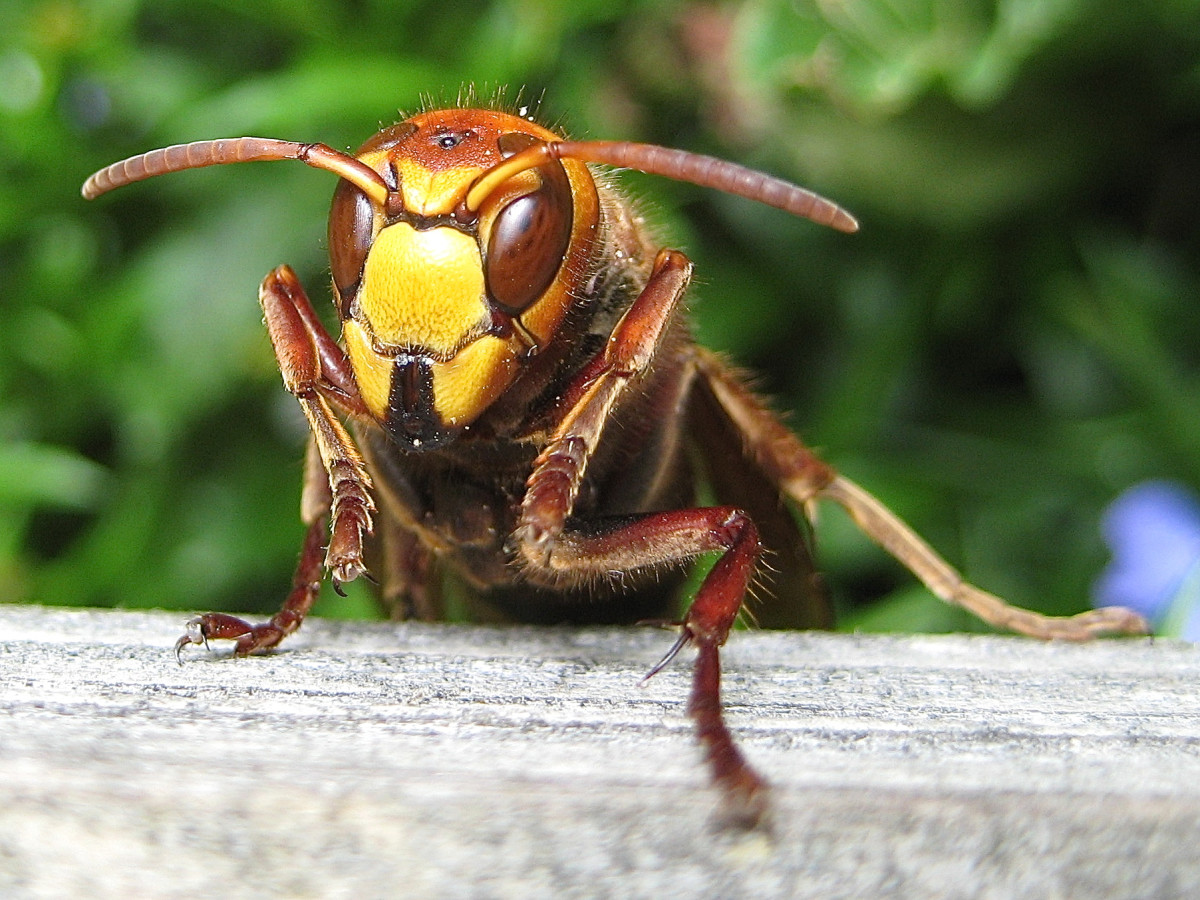
A European hornet
A European hornet | Source

What are Hornets?

Hornets are large and interesting wasps with complex behaviors. They are social insects and live in highly organized colonies. The colony builds an intricate nest from a papery substance made when the hornets chew wood and mix it with their saliva. The resulting structure is a wonderful feat of engineering and is both lightweight and strong.
Hornets eat plant matter and are also predators of other insects. They will sting humans if they're disturbed, but most are not aggressive at other times. While the sting of some species is no more dangerous than the sting of a common wasp, in other species the sting is very painful and may also be dangerous.
Hornets are widespread and are found in Asia, Europe, Africa and North America. At the moment, one species of hornet is creating a serious problem for humans. The Asian hornet or Asian predatory wasp is native to China but has colonized other countries as an invasive species. The species is of great concern since it kills bees. A group of Asian hornets can rapidly destroy a honeybee colony, sometimes within a few hours.
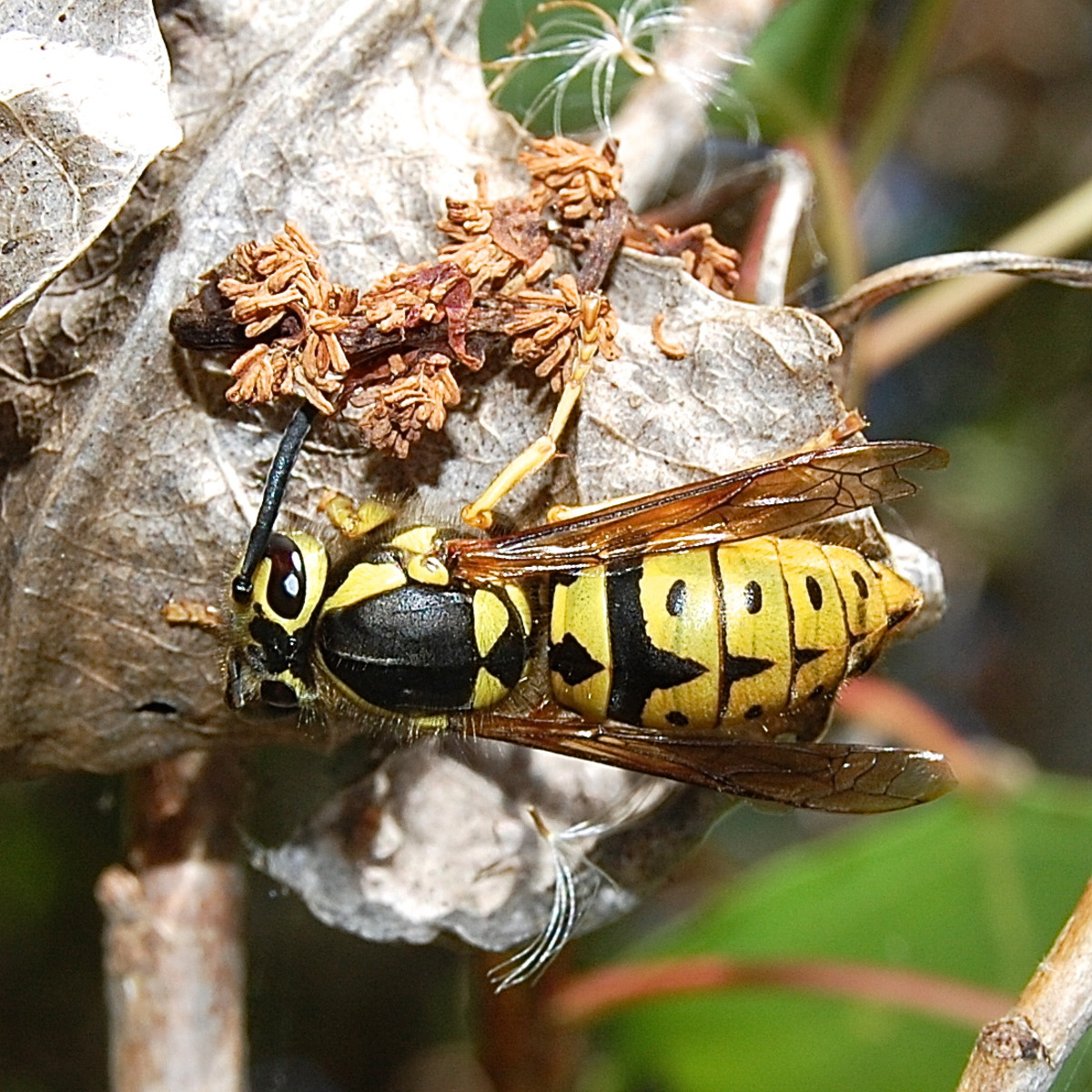
A western yellow jacket queen (Vespula pensylvanica) in North America: yellow jackets are a type of wasp but aren't hornets.
A western yellow jacket queen (Vespula pensylvanica) in North America: yellow jackets are a type of wasp but aren't hornets. | Source

What's the Difference Between a Hornet and a Wasp?

  • A hornet is a type of wasp!
  • The insect family called the Vespidae contains hornets, yellow jackets or yellowjackets (which are the most familiar type of wasp for many people), paper wasps, potter wasps and pollen wasps.
  • Hornets aren't native to North America, but the European hornet has been introduced to the continent.
  • The bald-faced hornet of North America is actually a type of yellow jacket, although it has black and white markings instead of the black and yellow markings of the common yellow jacket wasps.
  • True hornets belong to the genus Vespa. (The genus is the first part of the scientific name for a living thing.)
A hornet nest
A hornet nest | Source

Hornet Nests

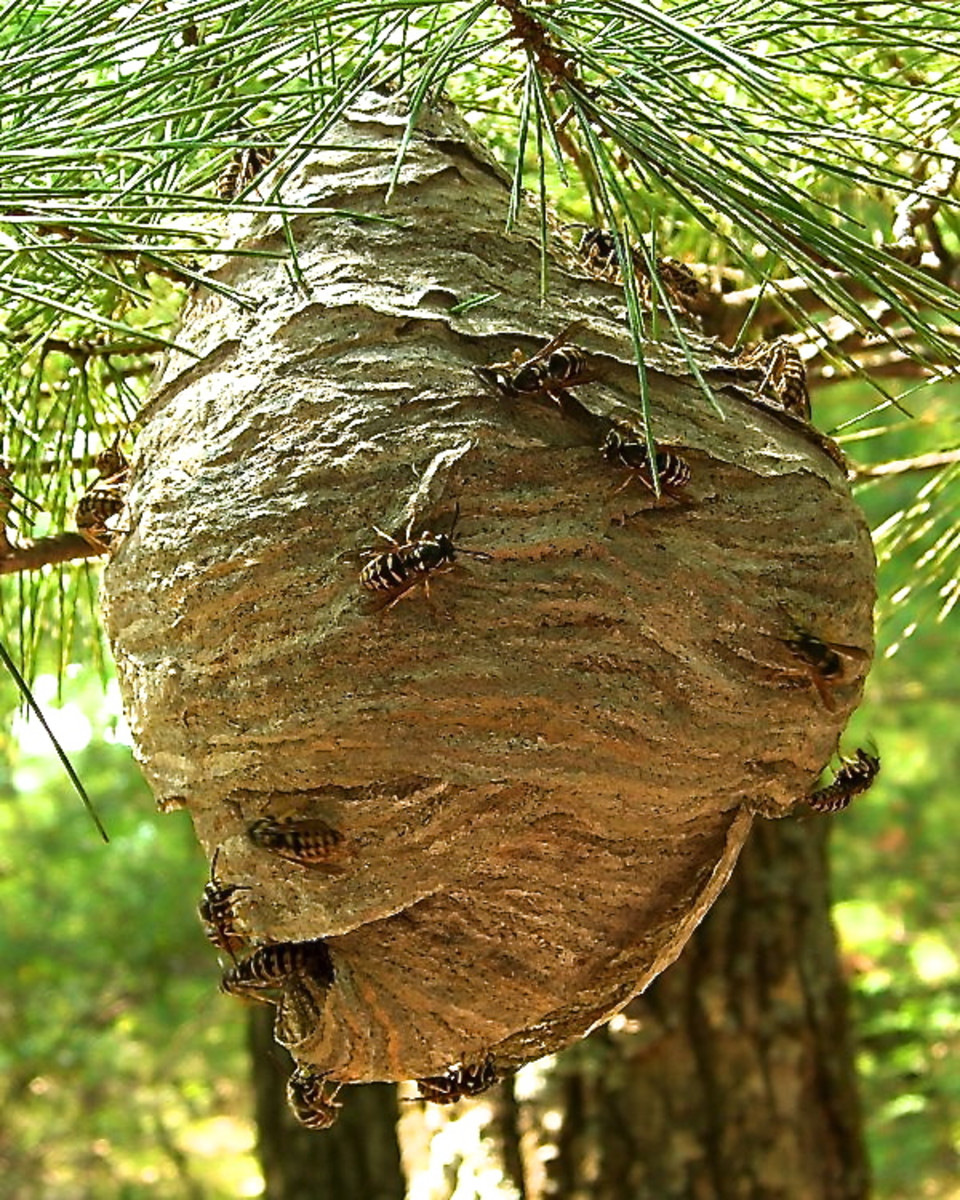
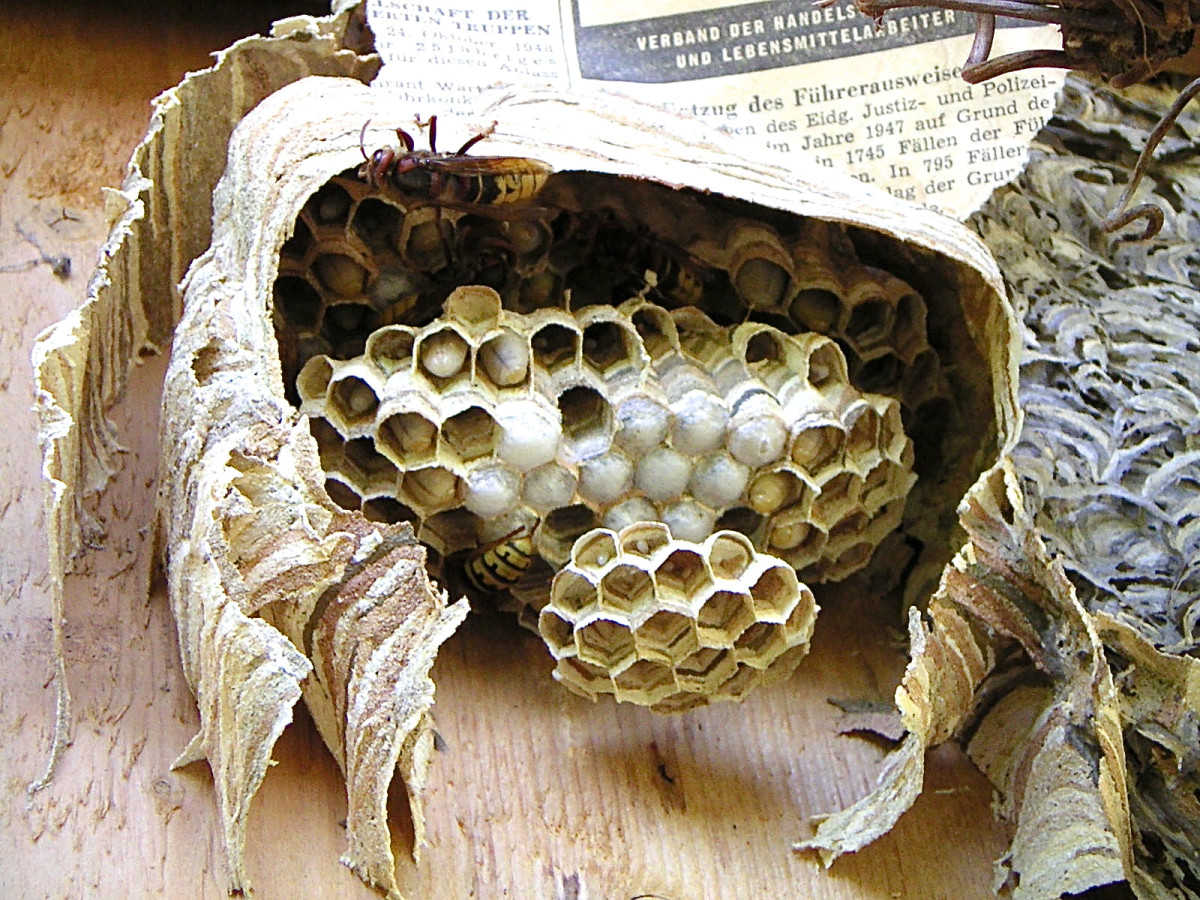
Hornet nests are aerial and are found in treetops, under roofs or decks, in sheds or garages, in hollow tree trunks or in other areas that are raised off the ground. The nest is large and is shaped like a football. It contains horizontal combs, which hang in tiers and are connected to each other. Each comb contains many chambers or cells for eggs and larvae. The nest is often surrounded by layers of papery material that insulate the structure.
Some nests are free-hanging and have a stalk called a petiole which attaches the nest to an object such as a tree branch. Other nests are built in an enclosed space that provides support for the nest.
Some people like to collect hornet nests so that they can examine and admire their intricate structure, but it's very important to do this after all the hornets have left at the end of the season. Despite their larger size, most hornet species (but not all of them) are less aggressive than the common yellow jacket wasps, which are classified in the same family as hornets but in a different genus. However, all hornets will become aggressive if their nest is being attacked.
A hornet nest that has been broken open and partially rebuilt, showing the horizontal combs and the papery outer layers of the nest
A hornet nest that has been broken open and partially rebuilt, showing the horizontal combs and the papery outer layers of the nest | Source

The Colony

The only member of the hornet colony that reproduces is the queen. Most hornets in the colony are workers. The worker hornets make the nest (after it has been started by the queen and the workers have developed from the eggs that she laid). Workers also feed the young and protect the colony from danger. The males mate with new queens and die soon afterwards. There are only a few males in a colony.
In temperate climates, a hornet nest is inhabited for only one year. The worker bees, the males and the season's queen die in the autumn. The new queens survive. They leave the nest and spend the winter hiding under loose tree bark, in the soil or even in a building.
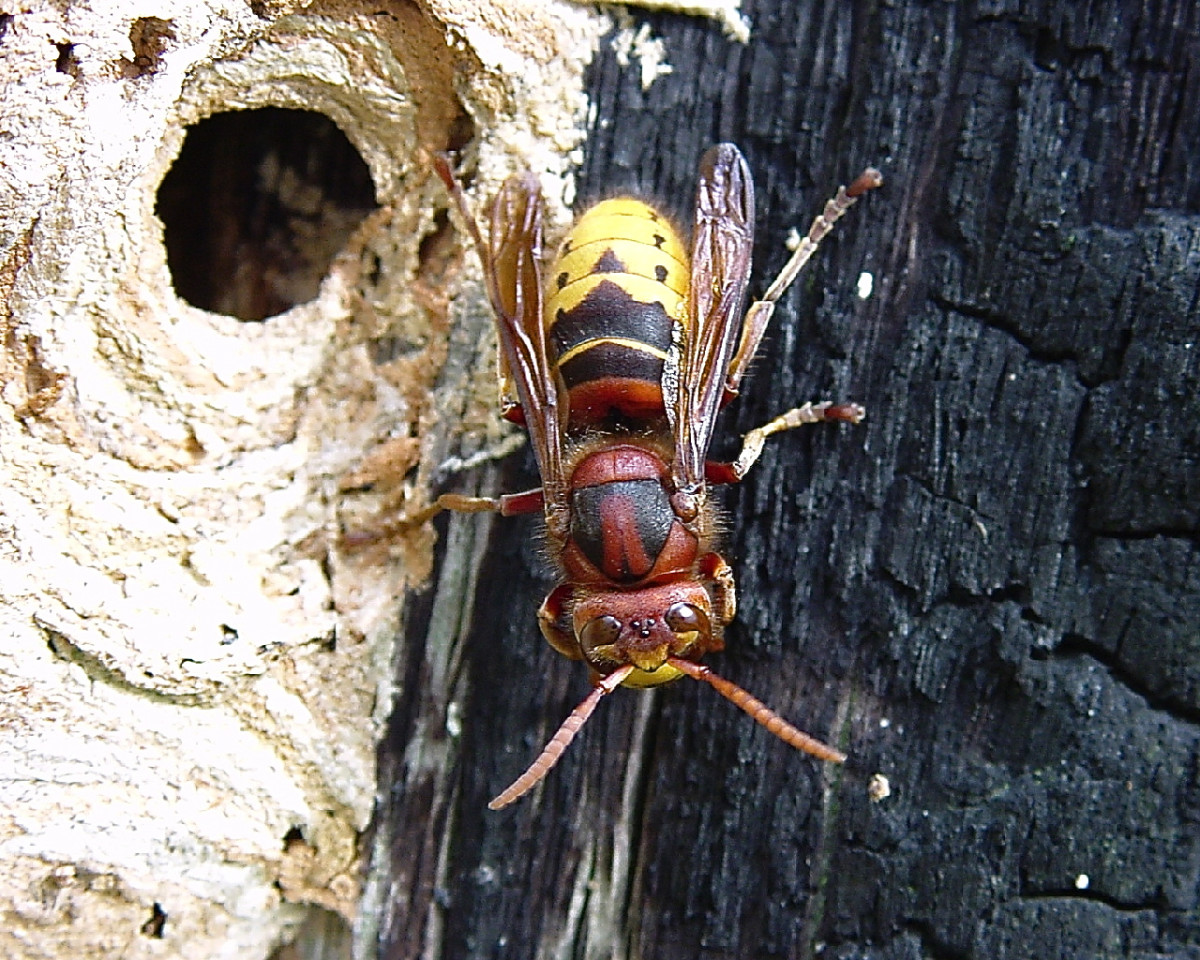
Another European hornet
Another European hornet | Source

The European Hornet (Vespa crabro)

In the spring, the new queens of the European hornet emerge from their winter hiding places and find a place to build a nest. They chew wood and mix it with saliva to form a light but strong construction material which is similar to paper mache.
The nest is generally built in an area that provides support for the nest instead of being free-hanging. Nests can be found in hollow cavities in tree trunks and in attics, barns and sheds. They may even be built in cavities in walls.

European Hornets Guarding Their Nest Entrance

The Queen, Larvae, Pupae and Workers

  • The European hornet queen makes the first cells of the nest and lays a fertilized egg in each one. After about five to eight days, the eggs hatch into young forms of hornet known as larvae or grubs.
  • The queen feeds the larvae a paste made of her saliva and insects that she has chewed. She also continues to make new cells and to lay eggs.
  • At about two weeks of age, each larva makes a silk cap to fit over the top of its cell. Inside the sealed cell the larva turns into a pupa.
  • Inside the pupa, the young hornet changes into an adult worker bee. The worker then emerges from its cell and takes over the jobs of building the nest and feeding the larvae.
  • The larvae release a sweet secretion which the workers eat. The secretion contains amino acids as well as sugars. It provides the workers with energy and encourages them to keep feeding the grubs.
  • Once enough workers have emerged from the pupae, the queen's sole job is to lay eggs.
  • European hornets fly during the night as well as during the day to collect food.
  • The workers sometimes damage trees because they strip the bark to get to the sap. They can also damage fruit crops. However, they may help humans by killing harmful insects.

European Hornets Feeding on Tree Sap in North America

The Drones and New Queens

  • In late summer males (or drones) are produced from unfertilized eggs.
  • In the fall new queens develop from fertilized eggs.
  • The new queens leave the colony and mate with males from other colonies.
  • The queens store the sperm in their bodies until it's needed to fertilize eggs in the spring. They find a place to hide and become dormant over the winter. When the sperm starts to become active in the spring, fertlization begins. The queen is able to produce a new colony from the stored sperm.
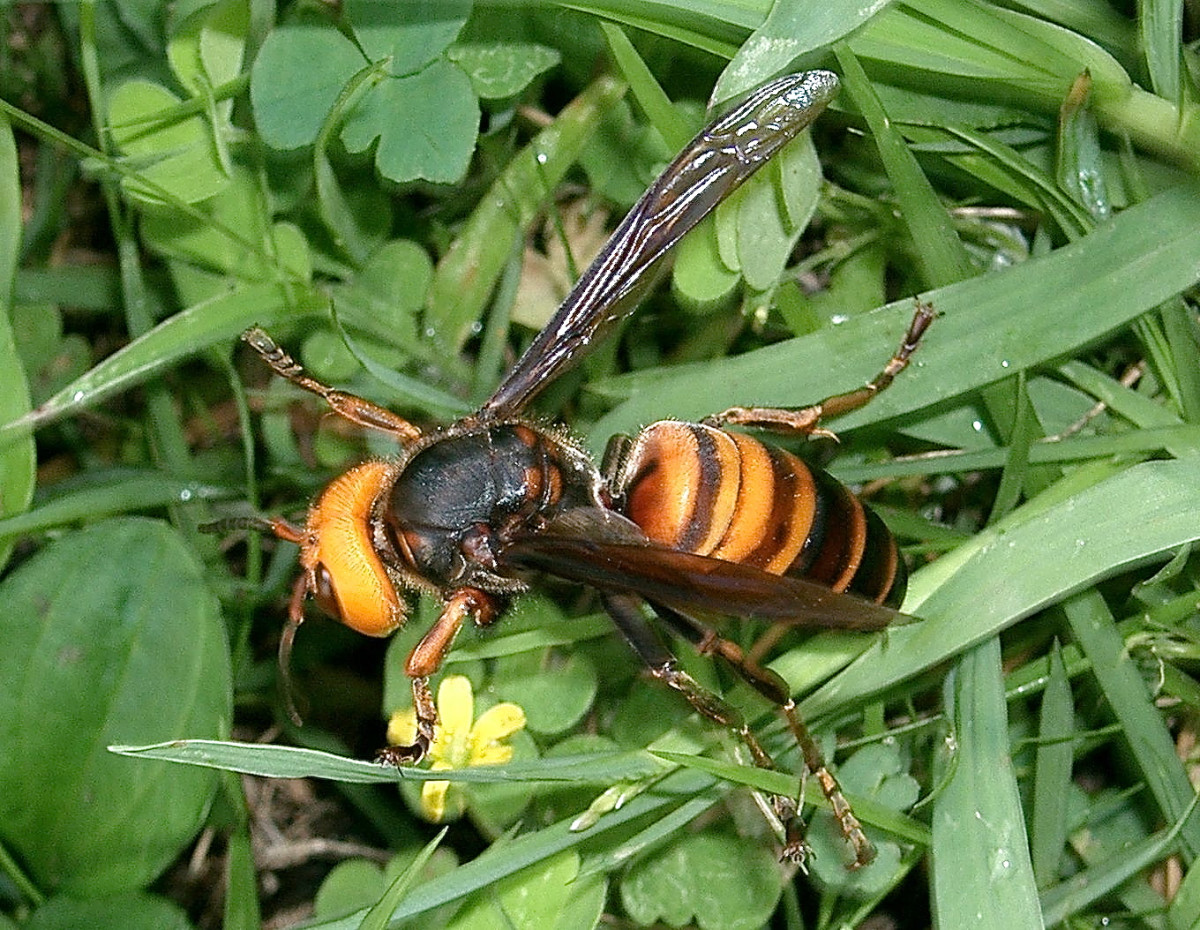
Japanese Giant Hornet
Japanese Giant Hornet | Source
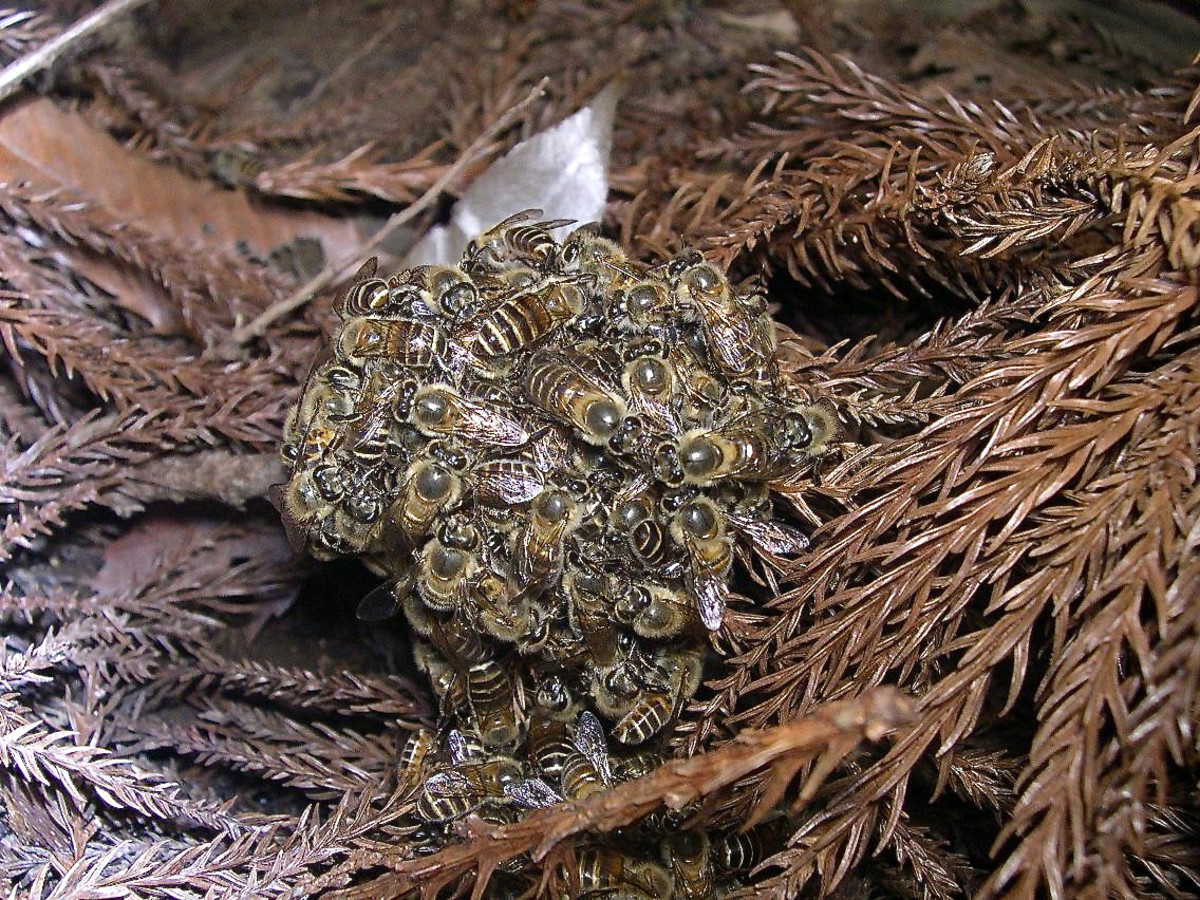
Japanese honeybees in a ball around two hornets: the ball heats and kills the hornets
Japanese honeybees in a ball around two hornets: the ball heats and kills the hornets | Source

The Asian Giant Hornet (Vespa mandarinia)

The largest hornet in the world is the Asian giant hornet, or Vespa mandarinia. It has a body length of about two inches, a wingspan of about three inches and a stinger that is about a quarter of an inch long. The Japanese giant hornet is a subspecies of the Asian giant hornet and has the scientific name Vespa mandarinia japonica.
Native bees in Japan have developed a fascinating way to defend themselves against the much larger hornets. When a hornet scout finds a honeybee colony, it releases communication chemicals called attack pheromones. If the scout returns to its own colony, the pheromones will attract the other hornets and trigger their attack on the bees.
The honeybees can detect the pheromones released by the hornet scout. They allow the hornet to approach and lure it into their hive. The bees then surround and cover the unfortunate hornet, forming a "bee ball".
The honeybees in the bee ball vibrate their wing muscles rapidly, raising the temperature around the hornet to as high as 115°F (46°C). The crowd of bees also releases a large amount of carbon dioxide. The combination of high temperature and high carbon dioxide concentration kills the scout, preventing it from communicating with its colony. Bees introduced to Japan from another country (such as European honeybees) haven't developed the overheating behavior and are often slaughtered by attacking hornets.

Honeybees Kill a Japanese Giant Hornet Scout

Asian Giant Hornets and Humans

The sting of the Asian giant hornet is very painful for humans and is potentially dangerous. The venom is powerful and contains chemicals that can destroy human tissue and interfere with nerve action. A significant number of Japanese people die from giant hornet stings every year.
Some people in Japan like to eat giant hornets in either a raw or fried form. The secretion produced by the larvae to attract workers is known as vespa amino acid mixture, or VAAM. It gives the workers energy and is the basis of a Japanese sports drink, which contains synthetic chemicals similar to those in the larval secretion.
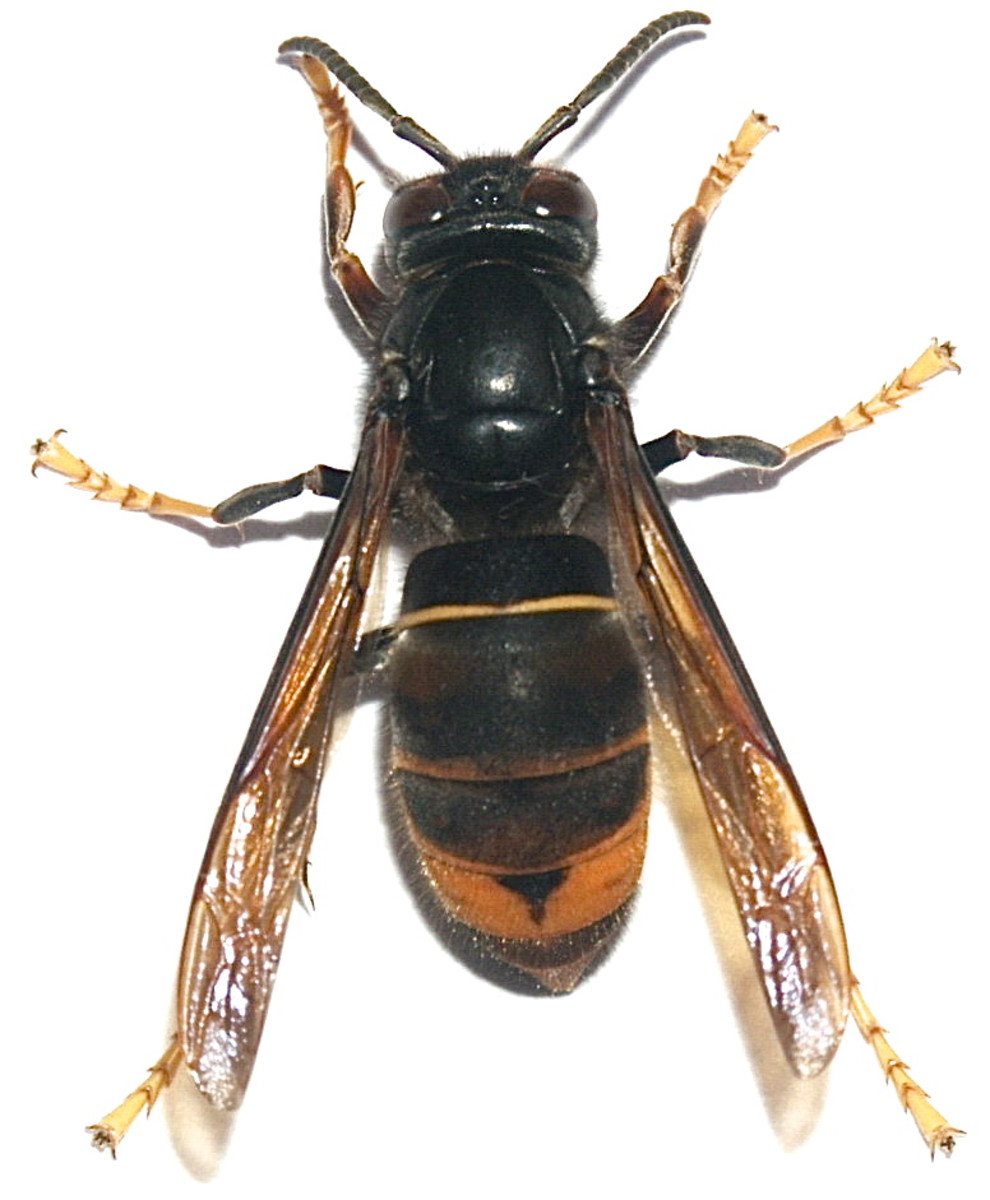
The Asian Hornet or Vespa velutina
The Asian Hornet or Vespa velutina | Source

The Asian Hornet (Vespa velutina)

The Asian hornet is sometimes called the Asian predatory wasp or the yellow-legged hornet. It's not the same insect as the Asian giant hornet. The common names of hornets can be confusing, so it's always a good idea to check the scientific name when reading or hearing about the insects.
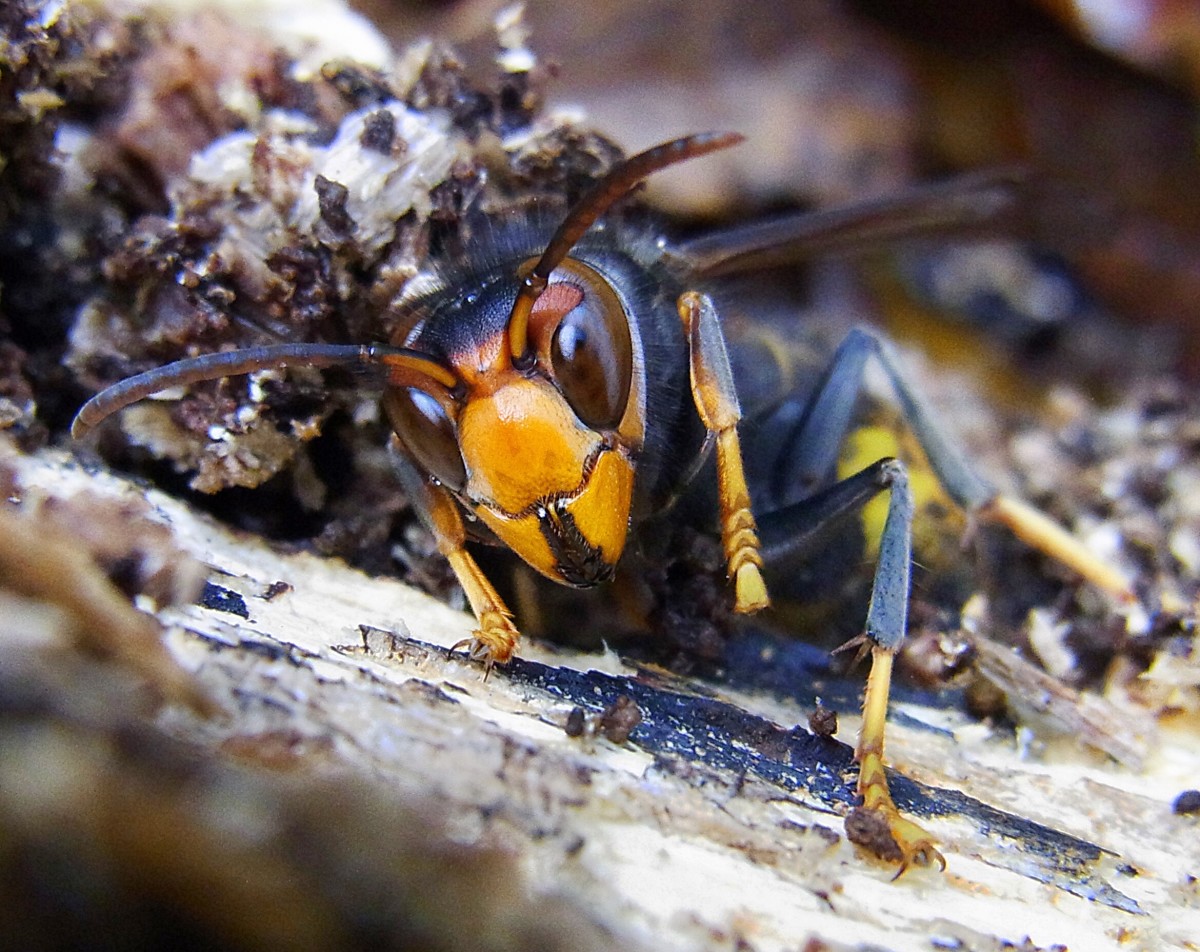
The Asian hornet can be recognized by its generally dark body, the orange coloration on the rear half of its abdomen, the yellow or orange bands on the abdomen, the orange face and the yellow legs. The insect is believed to have entered France in a shipment of Chinese pottery in 2004 and has spread to other European countries.
In France, the Asian hornet builds its nests in tall trees, under decks, in sheds or in garages. The hornet attacks bees to provide food for its larvae. The chewed bees provide a protein-rich meal for the grubs. The hornet rips a bee's body apart, removing the head, legs and wings. The thorax (the section in front of the abdomen that bears the wings and contains the wing muscles) makes a high-quality food.

The Asian Hornet or Asian Predatory Wasp

An Invasive Hornet

The Asian hornet is native to China but is now found in France, Belgium, Spain, Portugal and Italy. It has also been discovered in Japan and Korea. It hasn't arrived in Britain yet, but a plan of attack is ready in case it does.
The main concern about the insect is its threat to honeybees. Although Asian hornet venom isn't considered to be especially toxic to humans, because each hornet is large it releases more venom than many other stinging insects. Stings from multiple hornets have hospitalized people in France.
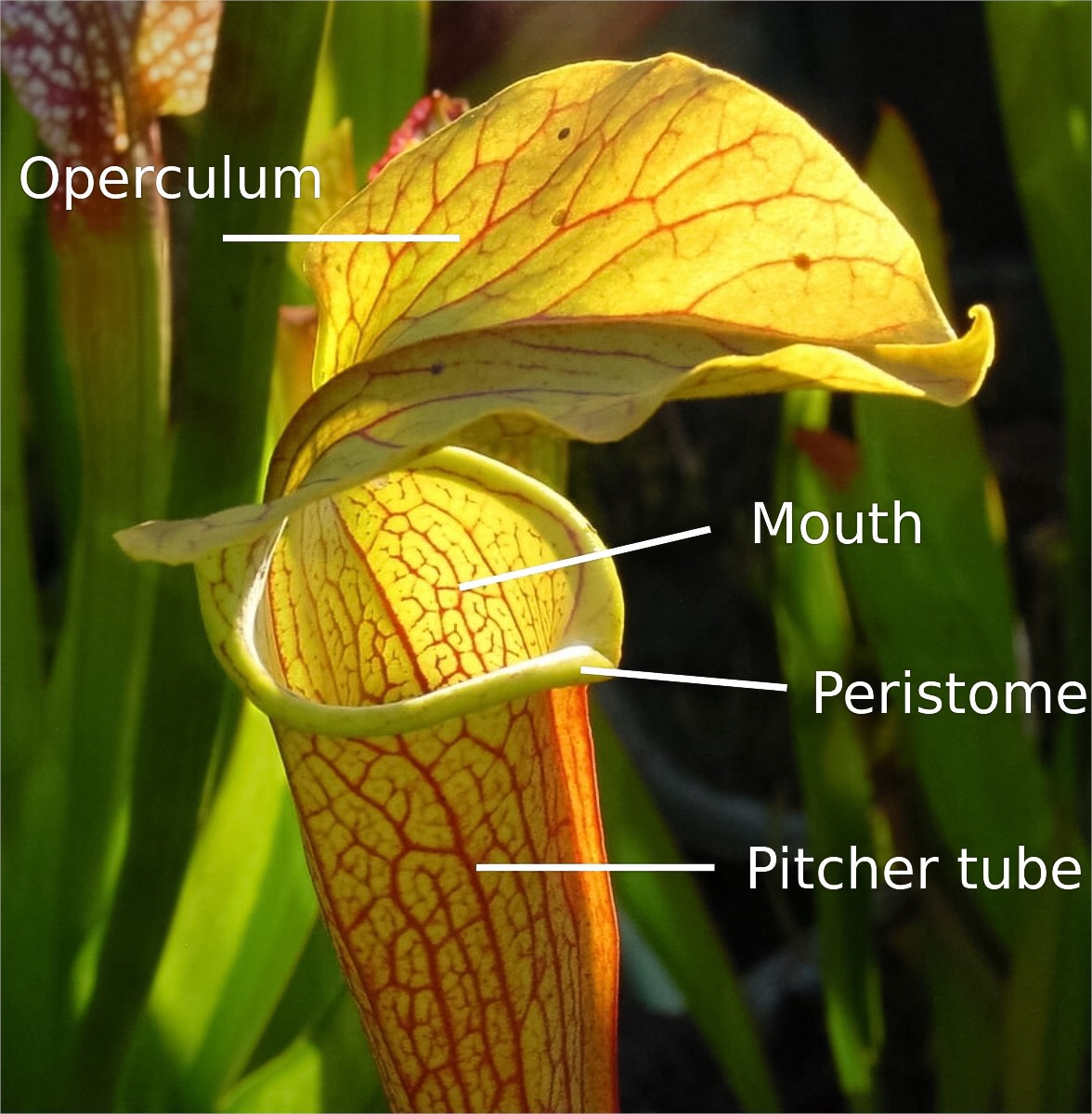
A species of Sarracenia, which is a type of pitcher plant
A species of Sarracenia, which is a type of pitcher plant | Source

Using Pitcher Plants to Catch Hornets

It has recently been discovered that a particular species of pitcher plant growing in the Nantes Botanical Garden in France traps Asian hornets. The plant doesn't catch European hornets, other wasps or bees. It belongs to the genus Sarracenia and is native to eastern North America.
Pitcher plants are carnivorous. They make food by photosynthesis like other plants, but they also trap and digest insects to obtain nitrogen. They often live in bogs, where the soil is generally low in nitogen.
Pitcher plants have long leaves that form a tube. There are nectaries on the lip of the tube. Like those in flowers, the nectaries on the leaves produce a sweet secretion that attracts insects. Pitcher plants may also release pheromones, which are chemicals that attract insects. When the insects land on the slippery rim of the tube, they fall into it. The plant then digests them with powerful secretions.
It has been suggested that pitcher plants could be used to destroy the Asian hornet. The plants might be helpful, as long they don't cause problems themselves. Realistically, though, a huge number of pitcher plants would be needed in order to control the hornet colonies. It's also been suggested that the pitcher plant chemicals that attract the hornets could be used in an artificial trap, which might work better. The problem is that we need to learn how to make the attractant chemicals synthetically.
The face of an Asian hornet or predatory wasp that was observed hiding under bark in France
The face of an Asian hornet or predatory wasp that was observed hiding under bark in France | Source

The Problem of Introduced Animals

Hornets are fascinating creatures. A study of the different hornet types and their lives reveals a common observation about life on Earth. An animal species that has inhabited an area for a long time has developed features that help it survive successfully in that environment. However, If the species is moved to a new environment and interacts with creatures that it's never encountered before - or if it doesn't encounter its usual predators - problems may develop.
Honeybee populations around the world are already in trouble due to a variety of stresses. Hopefully the spread of the Asian hornet through Europe can be stopped, removing one source of pressure for the local honeybees.
For further details log on website :
https://dengarden.com/pest-control/Interesting-Facts-About-Hornets-Large-Wasps-With-Paper-Nests

Types of Lawn Grubs

Author
Frank Sturm
Frank Sturm considers himself an avid New England adventurer and has 15 years of experience in the lawn care industry.

Before trying to exterminate grubs in your lawn, it's vital to understand how the major species differ. Prior to applying insecticides, you should ask yourself: "Before I treat these lawn grubs, what am I dealing with?" and "How will this insecticide affect the grub population?"
The grubs covered in this article all have similar characteristics: They're some of the most established species across the United States. However, they also differ in unique ways.
Understanding these similarities and differences is important for homeowners and insecticide manufacturers. They help the latter develop broad-spectrum products that manage all types of lawn grubs in one application. In turn this helps homeowners save money because they only have to purchase one insecticide.
So, why are we going to devote an entire article to the types of lawn grubs if homeowners can purchase one product to manage all of them? Because it's dangerous to apply grub killer to insects you know little about. You wouldn't blindly shoot into the forest to catch dinner because you could hit a bystander. The same concept applies when treating a lawn. By blindly distributing pesticides onto your property, you may accidentally apply the wrong type of product or too much of the chemical. This could damage the environment while having little to no effect on the grubs you wish to kill. Therefore I always recommend educating yourself on the type of chemicals you plan on using.

What grub species are you most familiar with?

See results

How Are the Four Types of Lawn Grubs Similar?

Picture the following: It's a warm Saturday night in June and you've just begun to relax in your hammock with a cold drink in hand. It's been a stressful week, so you deserve this moment of peace. As your breathing slows and your eyes drift in and out sleep you suddenly hear what sounds like a hundred bees buzzing around you. Have no fear though, they aren't attacking, and they're not bees.
What you're hearing is actually the sound of beetles mating. Many adult beetles become active right after sunset during warm, dry weather. After taking flight, they search for a mate. During this particular evening, the action is happening in your backyard. The next day, and over the course of the next month, females will lay upwards of 50 eggs roughly three to nine inches deep into your lawn.
It's a Grub Life: All lawn grubs have a similar life cycle. Most grub eggs hatch in mid-July to mid-August and immediately begin feeding on the roots of turf and surrounding plants. They then molt into their second and third instar (stages) sometime before the ground freezes. Once they sense the soil beginning to harden, they bury deeper to stay warm. As spring nears and the ground thaws, mature grubs crawl to the surface and feast again on your lawn's roots for a short time. They finally pupate and molt into adult beetles, which are the ones you hear flying around your backyard.
It's important to remember these two facts about grubs:
  1. All grubs feast on plant roots from roughly July until the ground freezes, and then they molt into beetles as the weather warms.
  2. Grubs don't care where they feed. Just because these pests have never attacked a lawn before, doesn't mean they won't attack it at some point. Lawns have no natural barriers to protect themselves from many insects including grubs. The only way to manage these aggressive populations is to apply a preventive control prior to their feeding regimen. Applying a curative pesticide (which is much stronger than a preventive one) after they've matured may also work as long as they haven't grown too much.
The following sections describe the different types of lawn grubs. I decided not to discuss how to distinguish grubs based on examining the larvae's backside because they're often hard to identify this way without a microscope.

Types of Major Grub Species

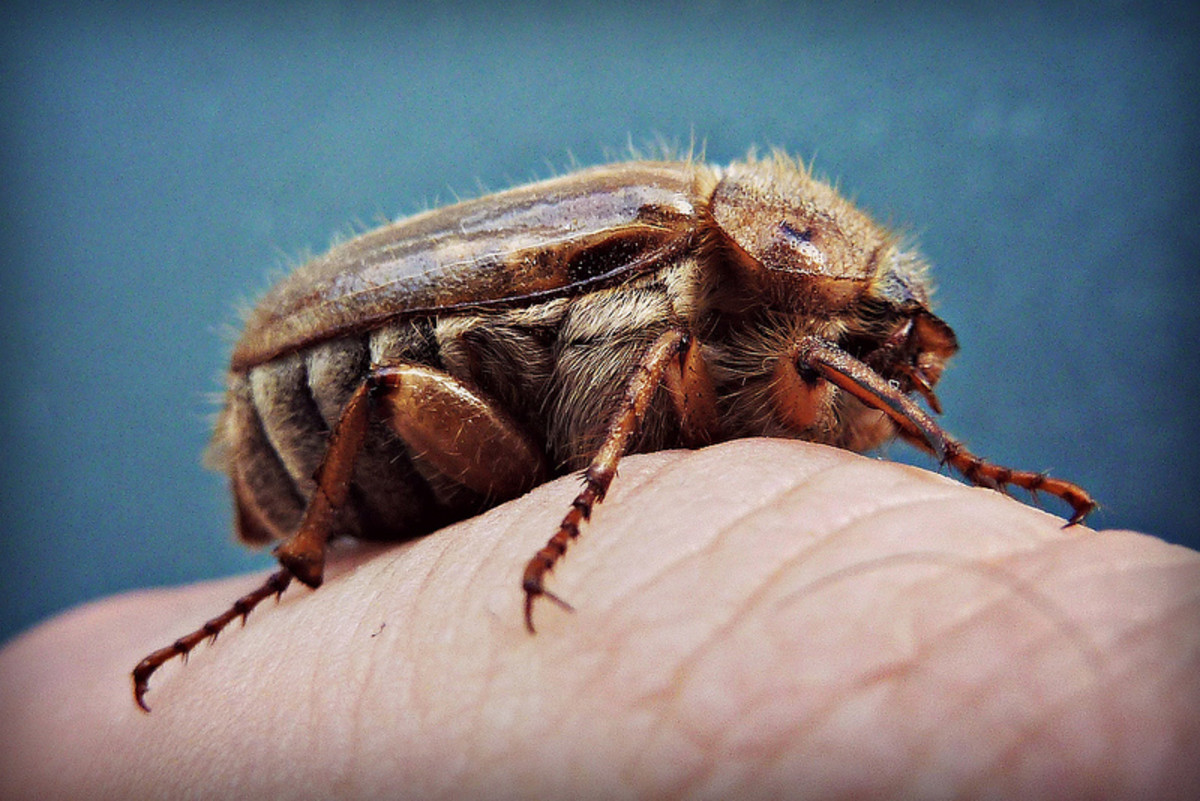
The adult form of the European Chafer.
The adult form of the European Chafer. | Source

European Chafer

History: Originally from Europe, these lawn grubs were first detected in Newark, New York in the 1940s. Eventually, they spread and became one of the most common grub species east of the Mississippi.
Adult description: European Chafer grubs have a medium sized, oval body that's reddish, brown or copper in color. They have a slightly dark head, look similar to the June Beetle and grow to roughly a 1/2 inch.
Mating season: These grubs begin mating between mid-June and late July after the sun sets. Females lay around 20 to 30 eggs over the course of a month or so.
Life cycle: European Chafers live roughly one year. Eggs hatch around mid-July - although weather patterns can alter this timeline. From there, European Chafers continue to molt and feed until the ground begins to freeze. Before the soil hardens, grubs burrow deeper to stay warm and then emerge in the spring to feed again on grass roots. Finally, they molt into adults and take flight for mating season as the summer nears.
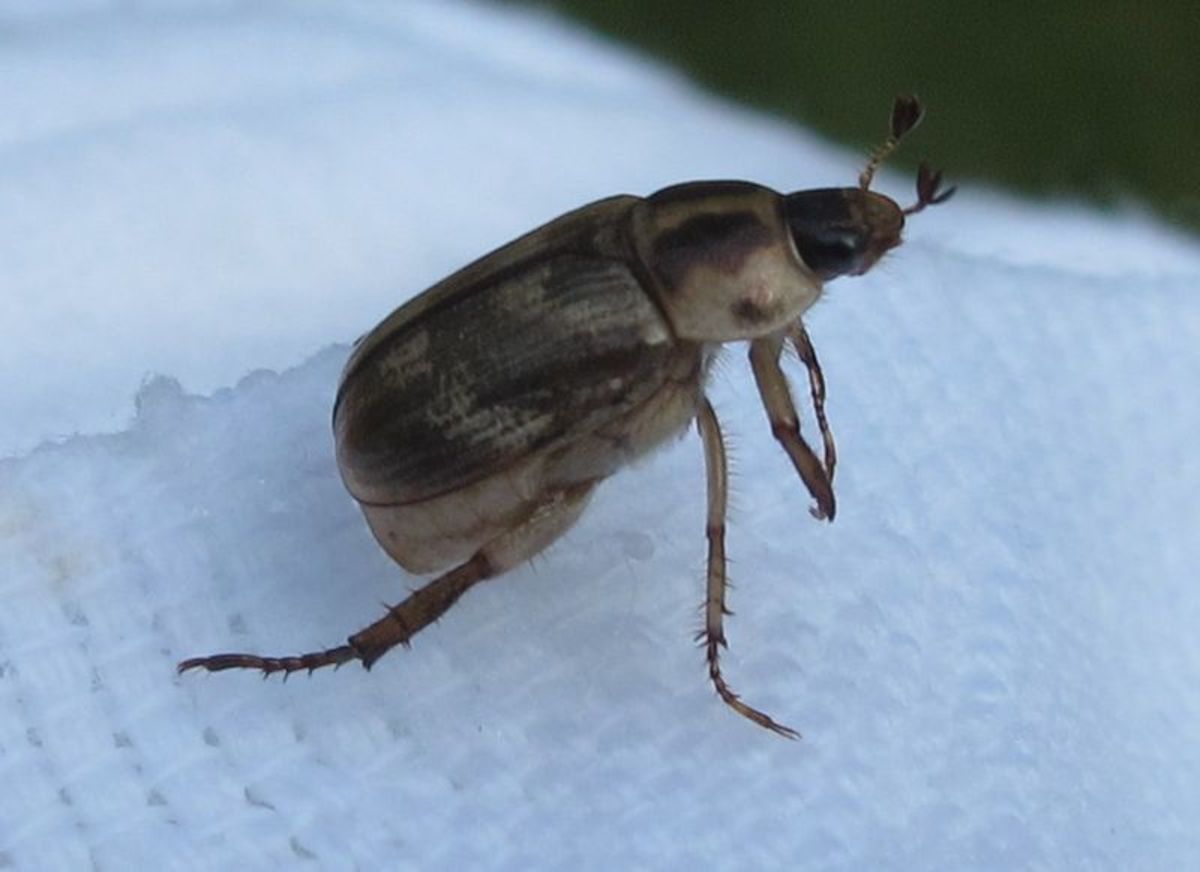
This is the adult form of the Oriental Beetle. Notice its funky antenna.
This is the adult form of the Oriental Beetle. Notice its funky antenna. Source

Oriental Beetle

History: The Oriental Beetle is native to Japan and invaded American soil in the early 20th century. It was first detected during the 1920s in Connecticut.
Adult description: Adults are gray with black splotches.
Mating season: Similar to their counterparts, the Japanese Beetle and European Chafer, adult Oriental Beetles emerge in late June and become active in July.
Life cycle: These lawn grubs have a life cycle almost identical to the European Chafer. After mating in mid-summer, females lay their eggs in the soil. Eggs typically hatch about 14 days later, and larvae begins to immediately feed on grass roots. It takes about 17 to 25 days for a grub to molt into its second instar and around 18 to 45 to mature into its third. Most grubs hibernate while in their third instar, although some studies suggest they've so as early as their second instar.
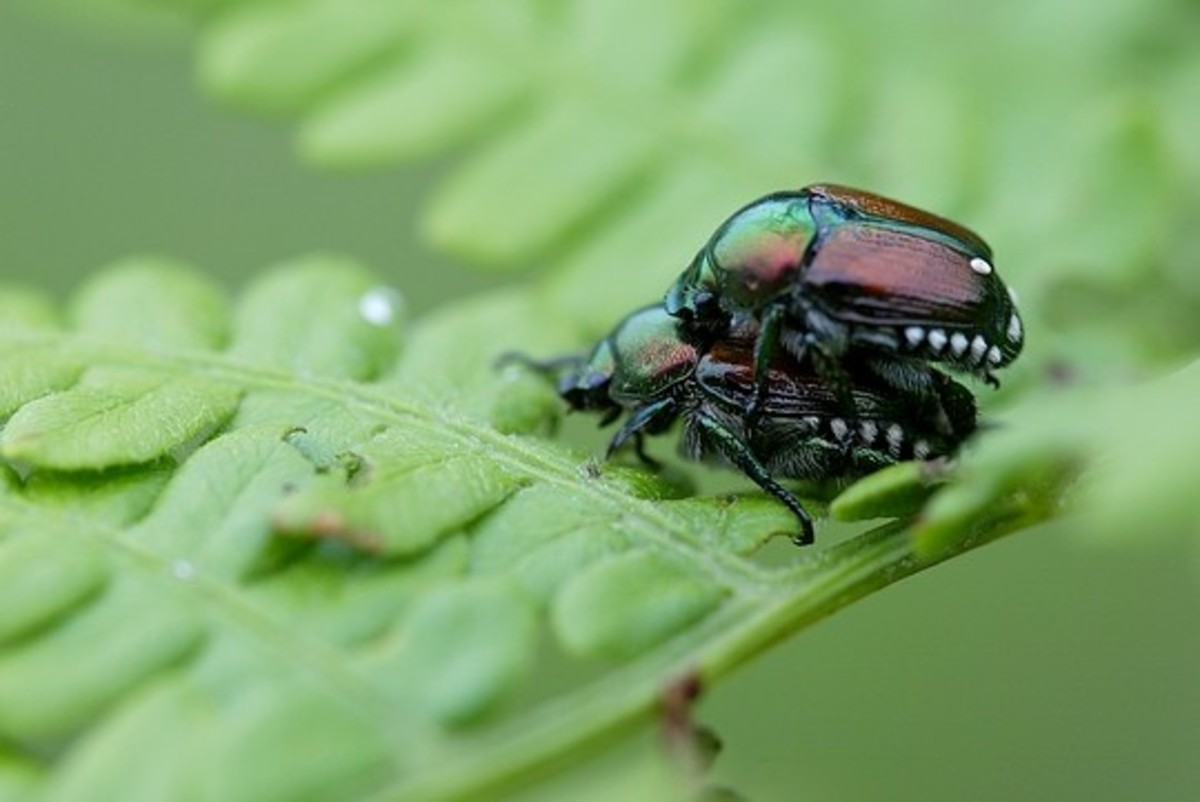
Ever wonder what those Japanese beetles do under the stars during the warm summer?
Ever wonder what those Japanese beetles do under the stars during the warm summer? Source
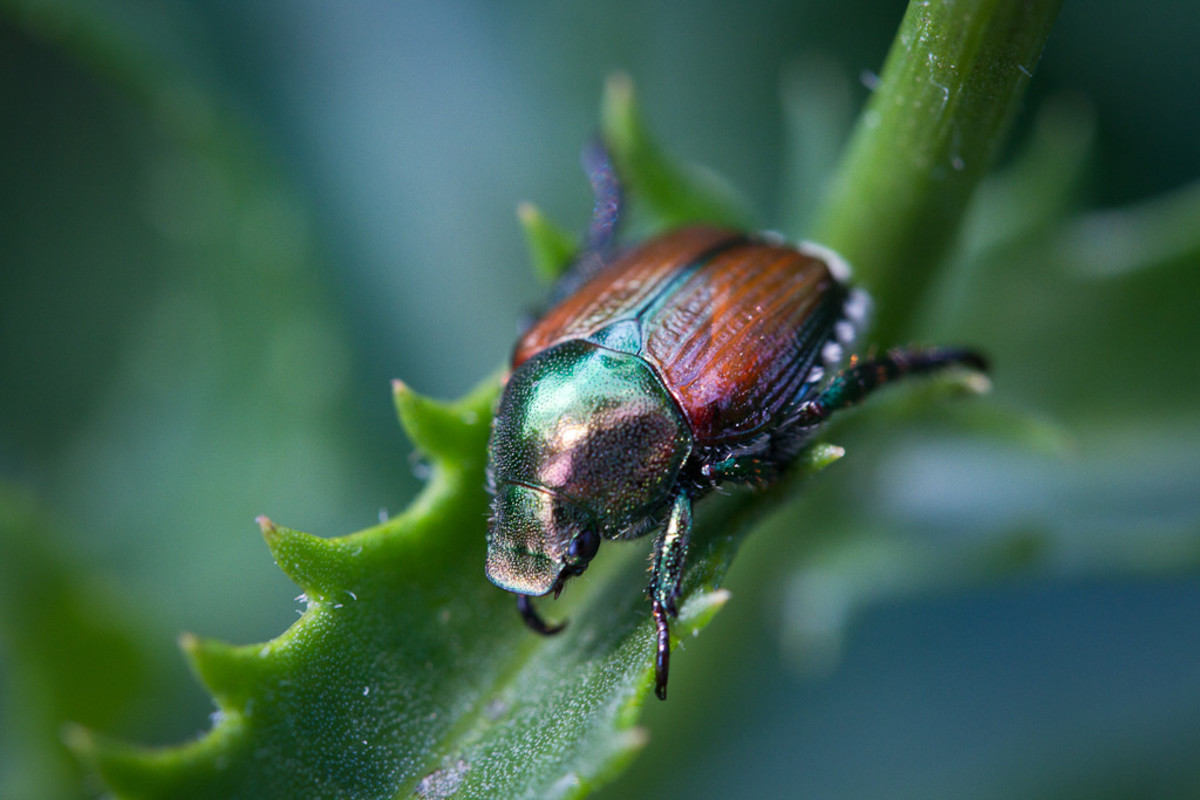
The adult form of the Japanese beetle resting on a likely food source.
The adult form of the Japanese beetle resting on a likely food source. | Source

Japanese Beetle

History: A native to Japan, the Japanese Beetle was first detected near Riverton, New Jersey in 1916. In 1918 USDA and New Jersey authorities attempted but failed to exterminate the Japanese Beetle. In 1932 the beetles were found as far west of St. Louis, Missouri and Illinois. By 1967 19 states in the eastern U.S. were home to the critters. Currently they reside in every state east of the Mississippi except Florida.
Adult description: Japanese beetles are 7/16 inch in length. Their body has that iconic metallic green hue and oval shape with copper wings.
Mating season: These grubs mate after the sun sets between mid-June to late July. Females lay around 20 to 30 eggs over the course of a month or so.
Life cycle: Japanese Beetles' life cycle is almost identical to the European Chafer. After mating in mid-summer, females lay their eggs in the soil. Eggs typically hatch about 14 days after being placed into the ground, and the larvae begins to immediately feed on the roots of grasses and plants. It takes about 17 to 25 days for grubs to molt into their second instar and around 18 to 45 to mature into their third. Most grubs hibernate while in their third instar.

Asiatic Garden Beetle

History: Like its cousin the Japanese and Oriental Beetles, the Asiatic Beetle is also native to Japan. It was first found in New Jersey in 1922.
Adult description: Adults have a brown-red hue and are about 3/8 inches in length.
Mating season: Adults become active in July and August and are more active at night than during the day. When the sun rises, they burrow down into the soil next to plants or foliage. At night they emerge and search for a mate. After mating females lay eggs in clusters of 40 or more. Eggs hatch about two weeks later, and larvae begin to feed similar to the other grub species we previously mentioned.
Life cycle: The Asiatic Beetle burrows into the soil during the winter and feeds for a short time in the spring on the roots of plants. It then emerges, pupates in late May and early June and molts into an adult in late June and early July.

Knowledge is Power

There are many types of lawn grubs that damage properties. While a variety of pesticides exist that take out all of the grubs mentioned in one application, it's always important to understand what you're trying to manage. The more you know, the better you'll be able to keep your lawn grub-free, the environment safe and you and your family healthy.

References

"Asiatic Beetle". (n.d.). Asiatic garden beetle. Retrieved from http://extension.unh.edu/resources/representation/Resource000542_Rep564.pdf
Childs, R. (2011, 10). Asiatic garden beetle. Retrieved from http://extension.umass.edu/landscape/fact-sheets/asiatic-garden-beetle
Cranshaw, W. (2014, 01 08). Japanese beetle. Retrieved from http://www.ext.colostate.edu/pubs/insect/05601.html
"EUROPEAN CHAFERS" 7.12. (2004, 07). European chafers, japanese beetles and their damage to lawns . Retrieved from http://www.ccerensselaer.org/Libraries/Hort_Lawn_Fact_Sheets/Grubs_In_Lawns.sflb.ashx
Hazzard, R., Vittum, P., Bishop, B., Seagraves, M., & Hazelrig, A. (n.d.). Scarab beetle: Japanese, oriental and asiatic garden beetles. Retrieved from http://extension.umass.edu/vegetable/articles/scarab-beetle-japanese-oriental-and-asiatic-garden-beetles
Shetlar J., D. (1991). Control of japanese beetle adults and grubs in home lawns. Retrieved from http://ohioline.osu.edu/hyg-fact/2000/2001.html
Shetlar, D., & Niemczyk, H. D. (1999). Asiatic garden beetle. Retrieved from http://bugs.osu.edu/bugdoc/Shetlar/factsheet/turf/Asiaticgardenbeetle.htm
United States Department of Agriculture. (2010, 05).Japanese beetle program manual for airports. Retrieved from http://www.aphis.usda.gov/import_export/plants/manuals/domestic/downloads/japanese_beetle.pdf
For further details log on website :
https://dengarden.com/pest-control/What-are-the-Types-of-Grubs-in-Your-Lawn

The Facts About How Ladybugs Help Humans

Author
toknowinfo

All About Ladybugs

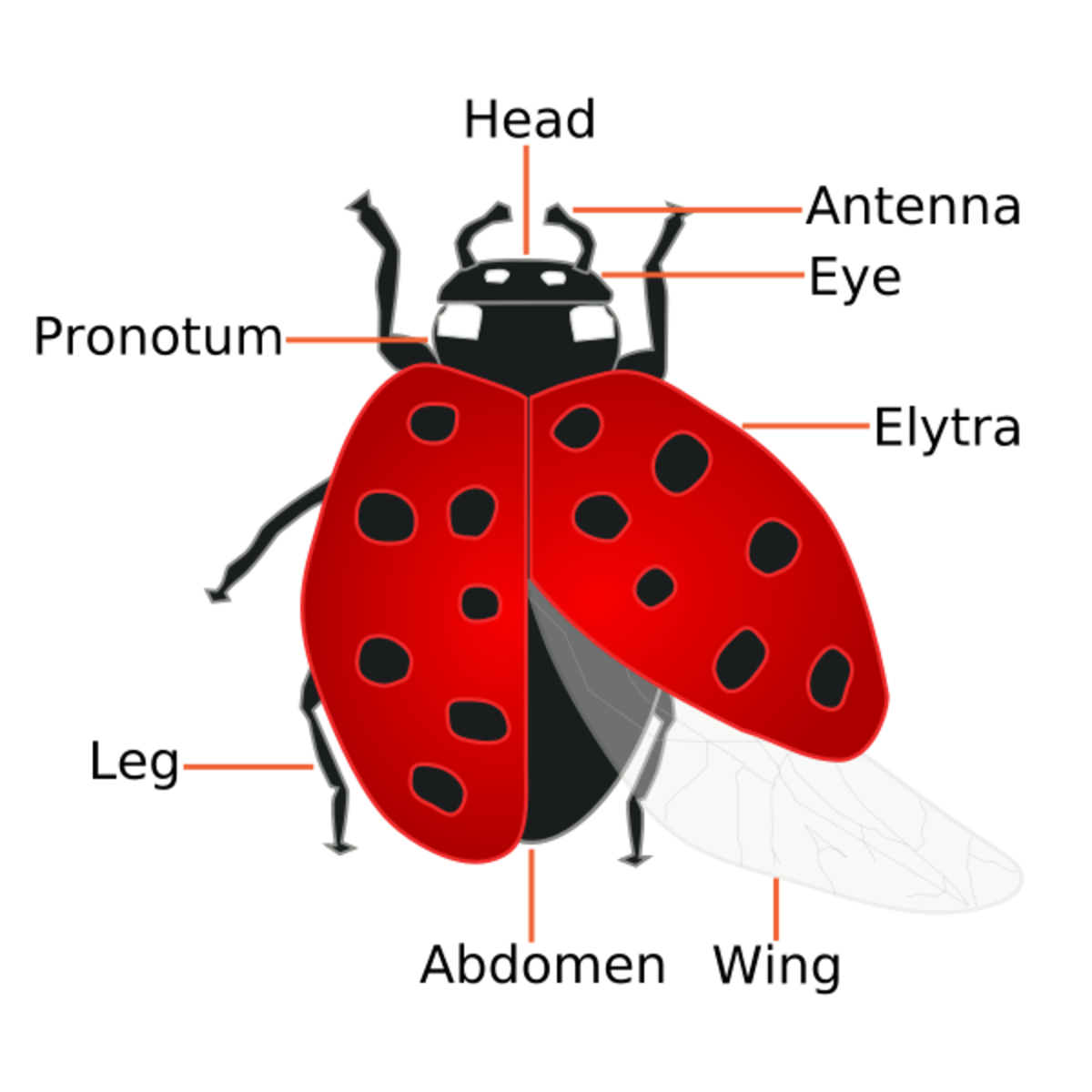
Anatomy of a ladybug
Anatomy of a ladybug | Source

Ladybugs Are Beetles, Not Bugs

Ladybugs live all over the world. There are about 5,000 species and over 450 are native to North America. Also called ladybirds, or ladybeetles. They are part of the Coccinellide (scientific name) or beetle family, which means little sphere. Ladybugs live on every continent except Antarctica.
These tiny winged insects can be as small a 1 millimeter or 1/16th nches to10 millimeters or 3/8th inches long. Ladybugs also come in a variety of colors. They are usually red, orange or yellow and have little black spots on the back top of their body and on their wing cover. The ladybug has a shell known as a caraspace, which is hard shell where we see their spots and coloring. Their head is very tiny and includes their mouth parts, antennae, which are their feeler, and compound eyes, which help them see better. The ladybug’s mouth has strong jaws called mandibles. Their antennae help ladybugs with their sense of smell, and help them find their prey and their mate. With their antennae, the ladybug can also touch and taste.
The pronotum, is between the head and the wings, which usually have grayish spots on it, and is part of the thorax. The thorax, which is the middle section of their body includes three pairs of legs. The wings are attached to the thorax also. A ladybug’s abdomen hold the digestive system, and reproductive and excretory organs. Ladybugs have black legs. They have a round, oval like shape and for an insect are not very intimidating looking, yet they are predatory bugs.
Ladybugs have two sets of wings. Only one pair is used for flying. The other pair protect their flight wings, and are very strong, designed to protect their back wings. When ladybugs are not flying, the rear wings, which they use for flying, are covered by a pair of wings called elytra. The elytra open up when they fly, which allows their flight wings to move.

Ladybugs Help Humans

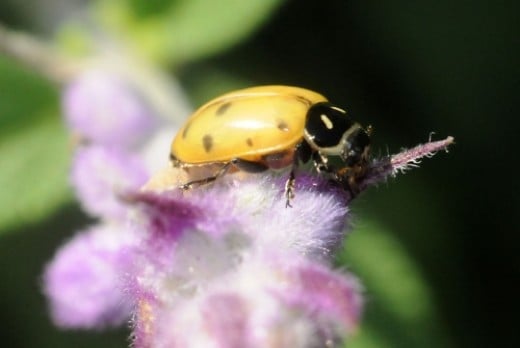
Ladybugs are beneficial to man because they feed on pests that destroy plants.
Ladybugs are beneficial to man because they feed on pests that destroy plants. | Source

Ladybugs Are Beneficial Insects to Man

The number of spots on a ladybug, typify the type of ladybug, but there are no differences between the number of spots these small insects have.
Ladybugs are considered a beneficial insect to man because they eat many bugs that are known to eat plants and destroy crops.
The blood of a ladybug is yellow and has a very strong smell that acts as a repellent, to predators. Birds are the number one threat to ladybugs. But ladybugs can play dead until the threat from the predators pass.
Just like beetles, ladybugs go through a complete meamorphosis with separate egg, larval, pupal, and adult stages. The eggs and larvae of ladybugs look similar to clusters of small orange footballs. They can lay anywhere from a few eggs to several dozen eggs. They usually lay their eggs on leaves near an area where the larvae have easy access to food sources. Eggs hatch within 3 to 5 days.When the eggs hatch, they look like small black alligators that have orange spots. These insects are very fast moving and they have a huge appetite. The larvae eat aphids and other soft bodied bugs for about 2 to 3 weeks. They can grow to about ½ inches in length within a two to three week period. After the larvae have grown to full size, they attach themselves to a plant leaf or a stem of a plant by their tail. They then begin a metamorphosis, where the skin of the larvae splits down its back and exposes the pupa. The pupa is roughly about the size of an adult ladybug, but it is all protected and wrapped up, until it becomes an adult. They pupate, usually on the upper portion of a leaf, as they turn into an adult ladybug within 7 to 10 days. Females are usually larger than males.
From the larvae to the adults, all enjoy a diet of insects that are small and soft bodied. During the pupal stage, a ladybug can eat bout 400 medium size aphids. Ladybugs live for about a year, but some can live up to three years. Within a year they will usually devour over 5,000 aphids. Larvae consume about 25 aphids a day. Adult ladybugs consume about 50 aphids a day. Their voracious appetite helps them play a vital role in the management of pests that attack agriculture.

How Ladybugs Are Helpful

From orchards to crops, from houseplants to fields of gardens, it is the ladybugs who help control the pest that would otherwise destroy these plants. Ladybugs are used as biological pest management.They protect the garden from the parasitic insects and help reduce the use of harmful pesticides that would be used to eliminate the invading bugs that eat plants.

Some people buy ladybugs to save their plants from bug infestation. Before you spend money using this alternative to pesticides there are a few things you should know:
  • Ladybugs bought for this purpose will work better in greenhouses, where they can’t fly away as easily.,In the outside garden, ladybugs will naturally fly away. This happens because the ladybugs are usually kept refrigerated, which puts these insects in a kind of winter hibernation called a diapause. When they arrive at your home and released, they awaken from their groggy state from the cold refrigeration and instinctively fly away to look for food.
  • If you do buy ladybugs, look for the kind that the vendor says are preconditioned. All this means is that the ladybugs have been fed before they are shipped. This may increase the likelihood that they will stay around your plants in the garden when released.
  • Be sure to buy ladybugs that are native to your area.
  • It is important to release the ladybugs when there is just the right population of bugs for them to eat. If you release them before there are enough pests around, the ladybugs will fly away in search of more food. If there are too many aphids, the ladybugs will stay, but may not be able eat enough of the bugs to stop plant damage. It is best to release the bugs when the aphid population is not to few and not too many.
  • Spray your plants lightly to make the leaves moist and release the ladybugs in the evening. These insects will most likely sleep on the leaves for the night and be ready to feed on the aphids during the day, encouraging them to stay around your garden.
You will get the best results if you buy ladybugs for your greenhouse plants.
Ladybugs are usually found on flowering plants, peas, clover, alfalfa, and beans (legumes).
It is believed that ladybugs are as colorful as they are to keep away predators. In nature predators instinctively avoid certain markings and special colors because they know these colors can signify poisonous or bad tasting animals. The predators learn to avoid these colors and the species who have these markings and colors are safe from being eaten by these enemies. The color warning is known as aposematism. Ladybugs are associated with a bad taste. 

A Ladybug Takes Off in Slow Motion

Ladybugs in Outerspace

In autumn, ladybugs may consume pollen in addition to aphids, because pollen helps supply fat for the colder winter season, while they hibernate. During the winter, ladybugs may fly in mass into mountain canyons and over winter under leaves or bark that has fallen. They will return to the valleys in the spring. Hundreds will live at the base of a tree, fence or underneath a rock, logs, underground covering, and in buildings. They also can hide out inside out of the way places in people’s homes like attics or voids within walls, until the cold weather passes. In the spring, ladybugs usually mate.

Ladybugs are attraced to flowers that are umbrella shaped like dill, fennel, cilantro, angelica, caraway, yarrow, tansy, and wild carrot, geraniums, coreopsis, dandelions.

:Ladybugs are very sensitive to insecticides.

In 1999, NASA sent four ladybugs into space with some aphids to see what happens in zero gravity. Scientists know that ladybugs climb up stalks to eat aphids. Gravity helps the aphids fall off the stalk to escape the ladybugs. In space, scientists wanted to see if aphids could get away without the help of gravity. By the end of the mission, the ladybugs did survive and were able to eat the aphids in space. They named the four ladybugs after the Beatles, John, Paul, Ringo, and George.

Ladybugs got their name during the middle ages. People prayed to the Virgin Mary, as they helplessly watched their crops be overrun by swarms of plant eating infesting insects. Ladybugs came, ate the bugs and people dedicated the tiny beetles to the Virgin Mary, calling them the bug of our lady, which eventually got shortened to ladybug.

Interesting Ladybug Facts

  • Ladybugs naturally defend themselves by secreting an odor from the fluid from the joints in their legs. This fluid is very distasteful to their predators.
  • After handling ladybugs, people should avoid putting their hands to their eyes to avoid any allergic reactions.
  • Though most ladybugs eat insects, a few species eat plants and are considered pests.
  • The French call ladybugs 'les betes du bon Dieu', which means creatures of God. In Australia people long ago, would ask ladybugs for good weather. The Swiss had the custom of telling their children that babies were brought by ladybugs, and caled them God’s little fairy. In Germany, they are called Marienkafer or Mary's beetles. People would count the spots on ladybugs, and believed that less than seven spots would mean a big crop harvest. Other parts of Europe had the folktale that if a ladybug crawled across a young woman’s hand, within a year, she would be married. In the United States, Delaware, New Hampshire, Massachusetts, Tennesse, and Ohio call the ladybug, their official state insect. In Great Britain, ladybugs are called ladybirds.
  • When a ladybug flys, they beat their wings 85 times per second. As they get older, their spots fade. A ladybug’s wings are made from chitlin, which is the same material our fingernails are made from
  • The spotted wing covers on ladybugs are made from a material called chitin, the same as our fingernails.
  • Ladybugs tend to do most of their flying in the warmest part of the afternoon.

A scientist named Paul Brakefield at the University of Cambridge in the United Kingdom has studied ladybugs that had two spots for decades to learn why ladybugs come in different colors. Going back to 1980, 90% of the ladybugs who lived near the coast were red with black spots, known as nonmelanic. 10% had black with red spots, known as melanic. He found that the more inland the bugs lived, th greater the population had black with red spots. He believed that this occurred due to an adaptation that helps the darker shell stay warm, where the temperatures might be cooler inland. The redder color protects the ladybugs from getting too hot near the shore. There is a protein that accounts fro the difference of color, and the genetic switch is not complicated within the species. But scientists can not explain how the sun or temperature affect the color of the ladybugs. Brakefield believes this has to do with a warming climate trend. 2004 was the last year there were enough ladybugs to do this study.

Brakefield has been studying ladybugs for decades and seen many generations of these small beetles. Over time, the population of two spotted ladybugs has been significantly reduced due to competiton from the Japanese Harlequin Ladybug. Asian ladybugs were imported around 1994, from Russia, Japan, Korea, China, and other countries. They have overpopulated some areas, and reduced the population of some species that are native to the United States by competing for the same food. Some of the Asian beetles have become a nuisance, as they congregate inside buildings on cold days and interfere with the quality of life for people. Sometimes these Asian beetles can taint the grapes that are used for wine with their noxious odor. Another species of ladybug is called the Mexican Bean Beetle, which feeds on bean crops, and is considered a pest to plants.
For further details log on website :
https://dengarden.com/gardening/Ladybugs-Facts

Everything You Need to Know About Wood Boring Beetles

Author
Lorelai Petunia Vano

Woodboring beetles are species and families of insects, whose larval (in most cases) or adult forms feed off and destroy wooden materials. The larval stages of these beetles, who cause most of the damage, are commonly known as woodworms. The families of the longhorn beetles, bark beetles and weevils, and metallic flat borers are the most rich in species. While humans perceive these insects as a useless nuisance, they actually play a very important part in forest ecology. As they usually feast on dead or dying trees, they serve as primary decomposers of trees and recyclers of, the relatively hard to decay, wood matter. However, larvae of wood boring insects are also a very common house pest that damage furniture, building structures or decorations. Because most destruction is caused by the larval stage of these animals, in this article I will be referring to them as woodworms.
Source

What Causes Woodworm?

There are factors that can increase one's chances of woodworm infestation.
  • Woodboring beetles can fly. Their flight is limited to some extent, but still enough to fly through open windows, as any other bug would do.
  • Bigger risk of acquiring these pests is old or second hand furniture. There is a possibility that furniture has been previously used in an infested household or stored in a place with other potentially infested furniture. To lower these chances, inspect closely any furniture that goes in your property.
  • High humidity resulting from poorly ventilated spaces.
Source

Types of Woodworm and How to Spot Them

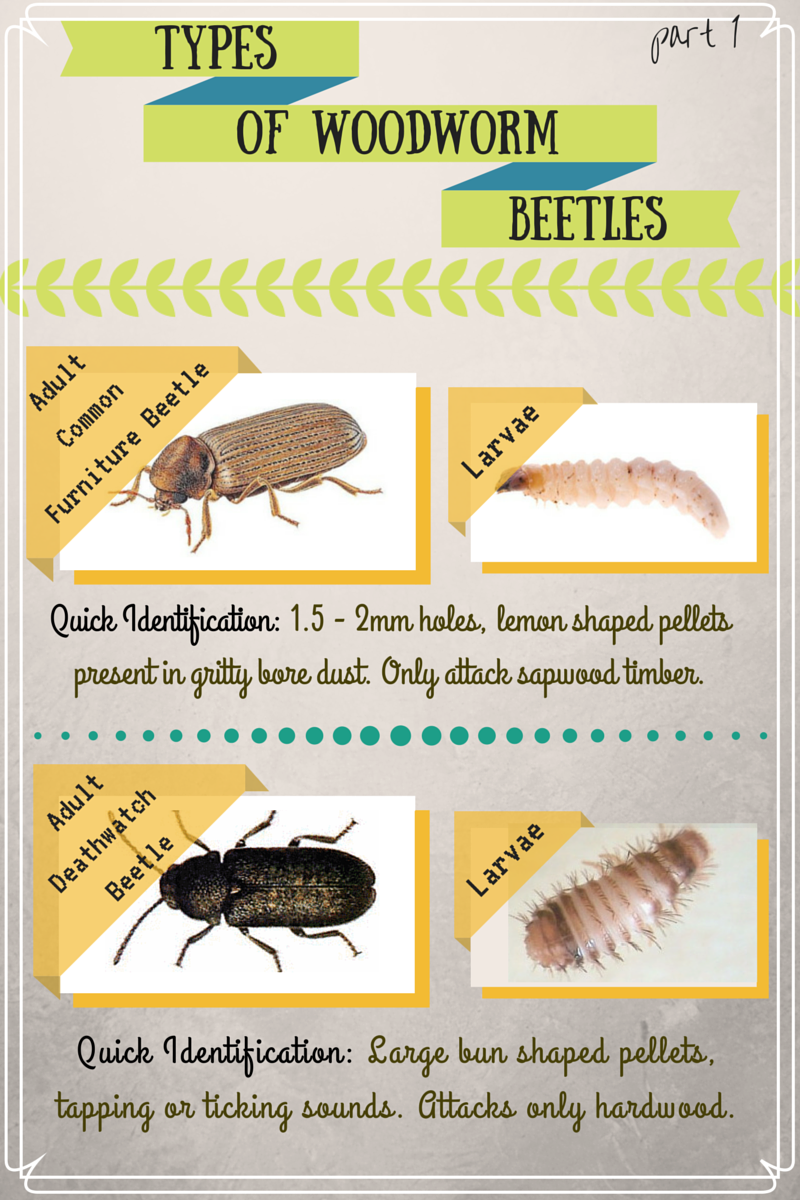
Common Furniture Beetle (Anobium punctatum)

The adults don't feed on wood, they only reproduce. Damage is caused by their larvae, also known as woodworm. Adults are 2.7 – 4.5 mm in length, while larvae are 1mm long, C-shaped in creamy white colour. Their life cycle is about 3-4 years long and due to that fact, evidence of infestation holes might take years to manifest. The common furniture woodworm attacks only seasoned sapwood timber. Usually it does not attack heartwood timbers. Because of their love for sapwood, some building regulations declare that more than 25% of sapwood should not be used, so that building's structure could not be substantially damaged. 

Life Cycle: Insects emerge from May to August and mate. Lay eggs in cracks, crevices, end grain, old exit holes; eggs are white and lemon-shaped. Starts feeding on wood straight from egg for a continuous period of 3 or more years. Larvae reach up to 6mm in length. Development takes below surface of wood. They emerge in pupal stage which takes between 6 - 8 weeks.

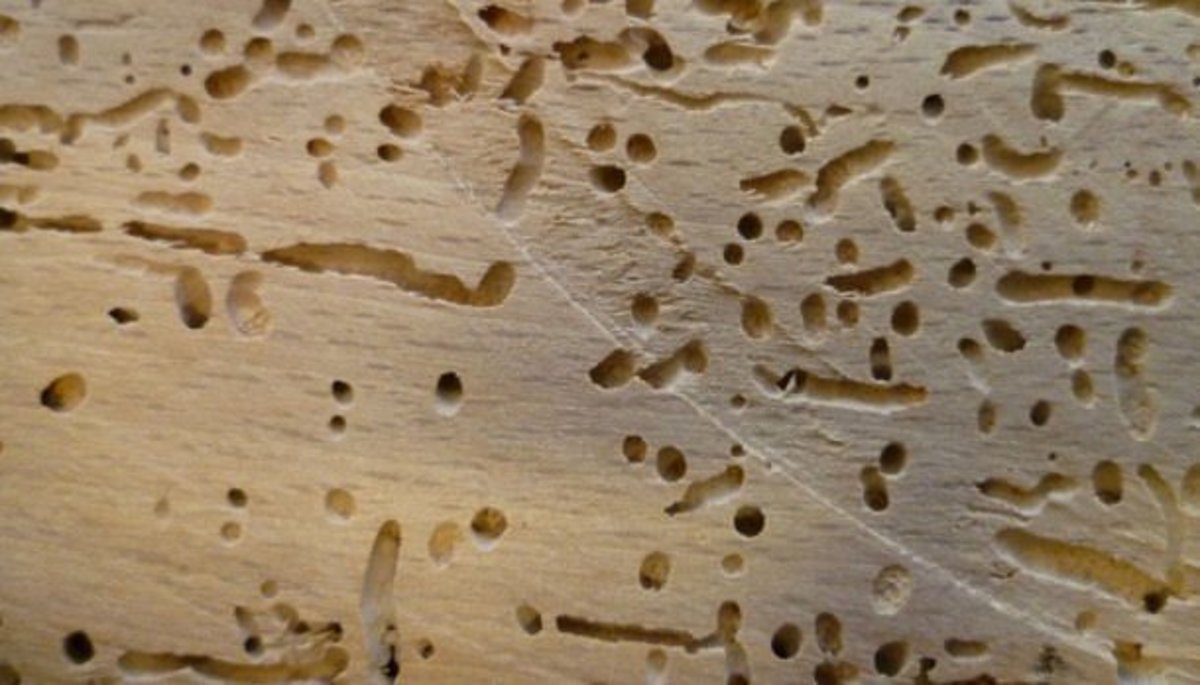
Woodworm Signs: Round exit holes, around 1.5 – 2 mm in diameter. Short tunnels, lemon shaped pellets present in gritty bore dust.

Source

Death-Watch Beetle (Xestobium rufuvillosum)

The larvae of the death watch beetle prefers to munch on sapwood and heartwood of hardwoods, usually oak, which have partly decayed or damp. The adult beetle is 7mm long, while its larvae are up to 11mm in length. The name of this wood boring insect comes from the ticking/banging sound that the male makes banging his head against the wood, in order to attract females. Thus the mating call can be heard in a quiet infested house.

Life Cycle: The adults appear from March to June and lay their white lemon-shaped eggs 20 days after mating. They prefer cracks and crevices for the purpose. The larvae crawl inside the wood prior to boring it and continue to feed on it and grow for up to 12 - 14 years. In the pupa stage they develop below wood surface around July – August, but pre-emergent adults will wait in pupa chamber until the next year. They can often be found on or beneath infested material during this emergence period, because they need high temperatures to fly.

Woodworm Signs: Exit holes are round around 3mm in diameter. These woodworms bore extensive tunnels towards the centre of wood, due to this sometimes the damages are much more extensive than they appear on the outside. Bore dust in bun-shaped and contains pellets that are visible to the naked eye.

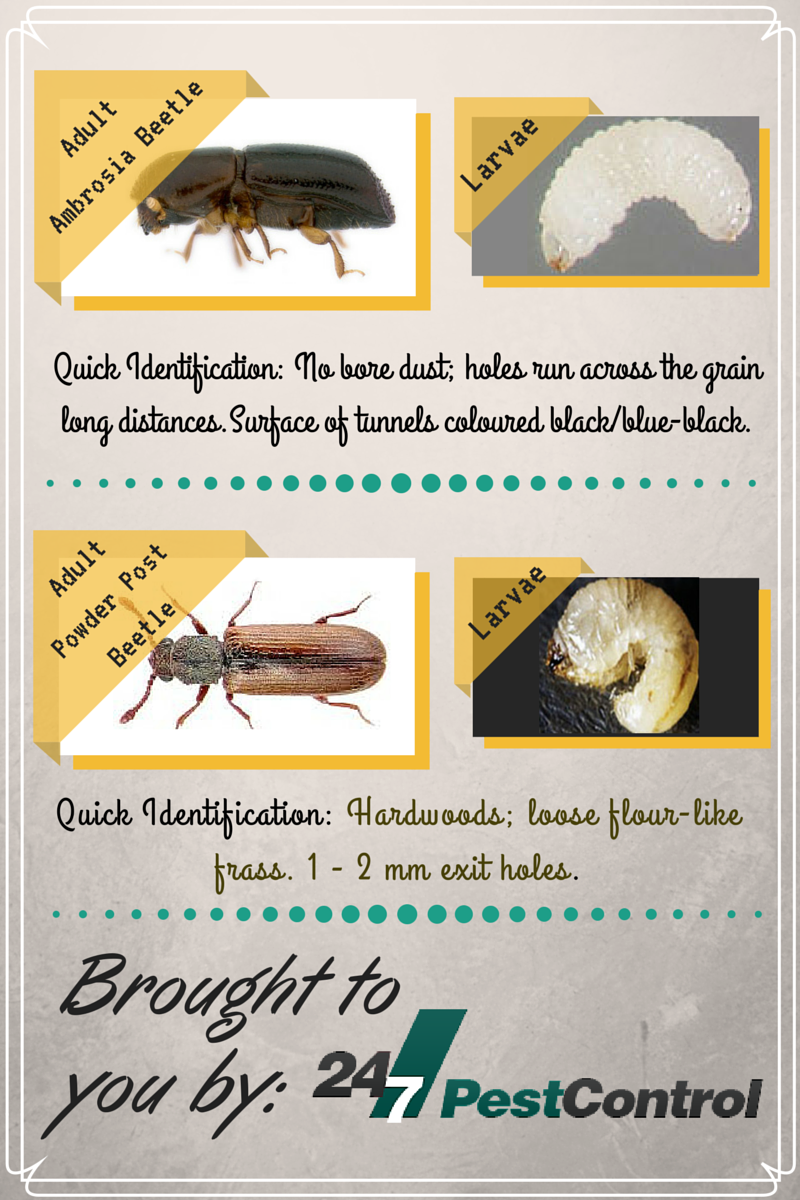
Ambrosia Beetle (Platypodinae, Scolytinae)

Ambrosia beetles are of the weevil subfamilies Platypodinae and Scolytinae, which live in symbiosis with ambrosia fungi. These beetles attack dead trees or freshly cut logs in the forests. Unlike most wood boring insects, ambrosia adults do the tunnelling in which they release spores and cultivate fungal gardens, their only source of nutrition. The fungus is the damage maker, as it penetrates wood tissue, digests it and concentrates its nutrients on and near the surface of the beetle gallery. Ambrosia insects usually live off sapwood and/or heartwood of dying or recently dead trees. They cannot infest seasoned timber and they do not need any treatment.

Life Cycle: Varies according to the exact species of Ambrosia beetles. 

Woodworm Signs: Surface of tunnels are coloured black or blue-black. Holes vary in size depending on the species, but the majority run across the grain in long distances. There's no bore dust.
Source

Old House Borer Beetle (Hylotrupes bajulus)

Old house borers, also known as house longhorn beetle, are a species of wood boring beetles from the family Cerambycidae (longhorn beetles) and are distinctive because of their habit to re-infest the same wooden material they emerged from. They are brown to black in colour, covered with grayish “hair” on the upper side of their bodies and have shiny spots that resemble eyes. The name of these beetles is quite misleading, because they tend to be found in new houses. Partly because new home constructions may be using wood infected with the beetle's eggs, which can be explained by the fact that these “new house” beetles look for higher resin content that is found in wood less than 10 years old. Old house borers prefer new softwoods, particularly pine. Larvae being the ones causing damage, they can take up to 30 years to become adults, depending on the moisture content of the wood and the environment. They create severe tunnellings that can lead to structural collapse if not caught early.

Life Cycle: Adult beetles emerge (and are most active) around July – September. In this period, they lay up to 200 white spindle-shaped eggs in a fan shaped pattern in cracks of wood. Larvae feed on sapwood usually for more than four years, causing extensive damage and reaching up to 30mm in length. Pupal stage takes about 3 weeks before emerging as an adult.

Woodworm Signs: Large oval exit holes, around 6 – 10 mm in diameter, leaving course powdery frass around the hole vicinity. Tunnels may not be individually identifiable and have ridges on the surface. Internal damage is more severe than external in most cases.

Powder Post Beetle (Lyctus brunneus)

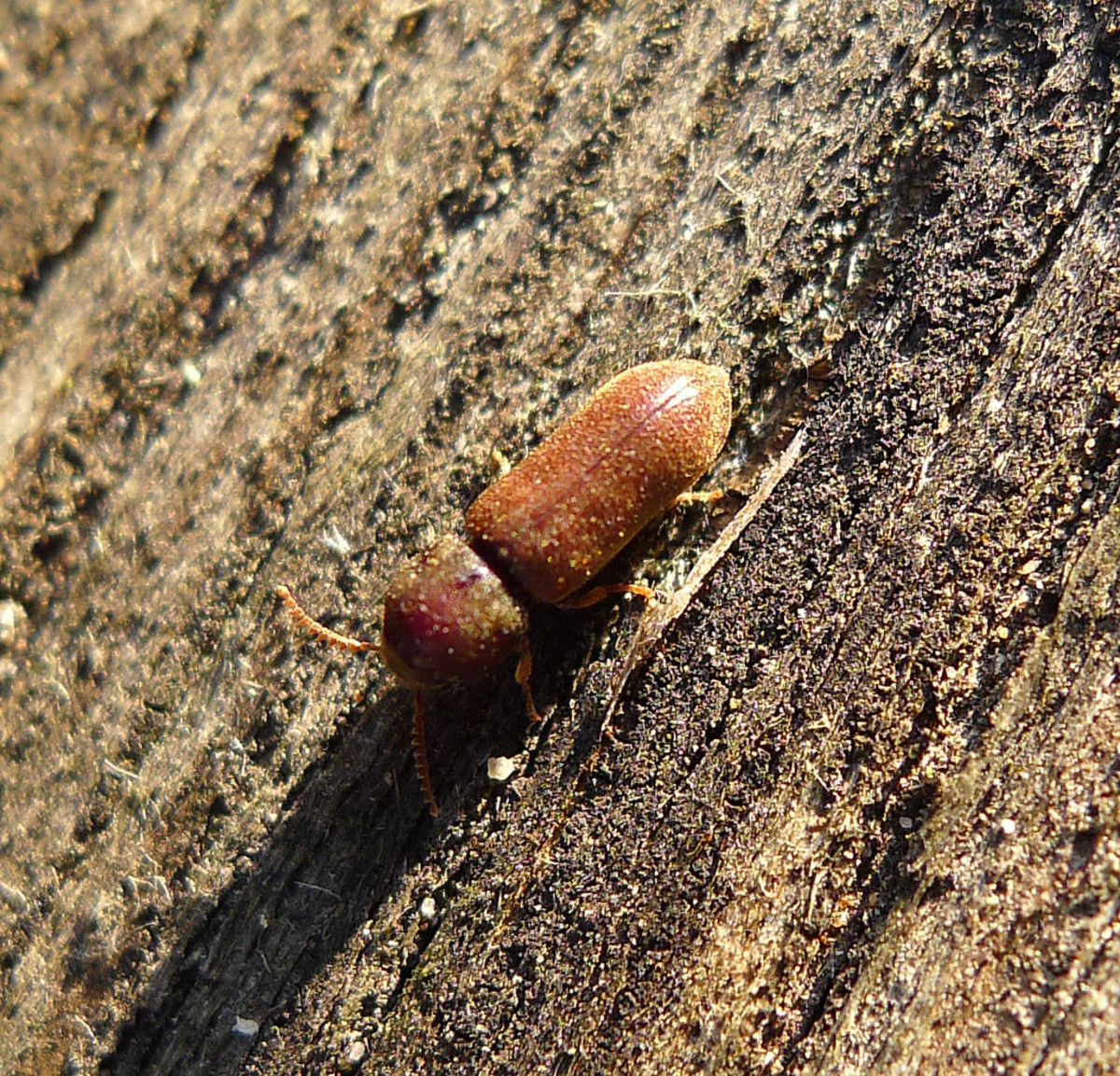
Powderpost beetles are a group of 70 species of wood boring beetles from the family Lyctinae. They from one superfamily (Bostrichoidea) along with the common furniture beetles, death watch beetles, spider beetles and others. Their name originates from the fact that their larvae feed on wood, and if not caught on time, they can turn what once was wood into a mass of fine powder. Thus being considered notorious pests. Their larvae are white, C-shaped and do not attack wood older than 15 years. Depending on the species, they prefer hardwood or sapwood, but one thing is sure: they mainly munch on high starch content material. Items that can be infested include tools or tool handles, furniture, books, toys, bamboo, frames, flooring and structural timbers.

Life Cycle: Their life cycle takes 1 – 2 years outdoors and 8 – 10 months indoors. Adults emerge in July to August when outdoors, if indoors they emerge any time. Laying their, white, elongated with tail, eggs inside open vessels. Hatching takes about 2-3 weeks. Larvae feed and bore along the grain in the beginning. In pupal stage they tend to look white, more like a beetle less than a larva. 

Woodworm Signs: Tunnels filled with loose flour-like dust. Exit holes (commonly called “shot holes”) are 1 – 3 mm (depending on species) in diameter and are often mistaken for common furniture beetle.

Wood Boring Weevil (Pentarthrum huttoni, Euophryum confine)

These beetles are part of the Curculionidae family of “true weevils” or “snout” beetles, which is the third largest animal family with over 40 000 species! (also includes the ambrosia beetle) The wood boring weevils are recognised by their distinctive long snout and antennae with small clubs. Beyond that description, their appearance varies in accordance to their woodboring lifestyle. Adults range from 1 to 40 mm in length. They attack any wood that is decayed and prefer it damp (like the Pentarthrum huttoni beetle needs 100% humidity). Damage is caused by both larvae and adults, both of which are present in the infested area.

Life Cycle: Adults live up to 16 months, feeding on wood along with larvae. They lay their white eggs on the surface or just below it. The larvae are curved in shape, white and bore extensively along the grain for about 8 – 9 months. Pupa develops right below the surface.

Woodworm Signs: Tunnels along the grain often exposed or just below surface. Exit holes are round but with ragged edges. Coarse bore dust with a 'gritty' feel is present. The damage of these insects is always occurs along with fungal decay, which in most cases is the primary concern and more damaging.
For further information log on website :
https://dengarden.com/pest-control/Everything-You-Need-to-Know-About-Wood-Boring-Beetles

Advantages and Disadvantages of Fasting for Runners

Author BY   ANDREA CESPEDES  Food is fuel, especially for serious runners who need a lot of energy. It may seem counterintuiti...