Blog List

Thursday, 25 February 2016

ANIMAL GLUE

An animal glue is an adhesive that is created by prolonged boiling of animal connective tissue.
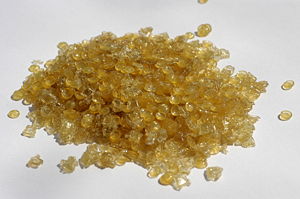
Animal glue in granules
These protein colloid glues are formed through hydrolysis of the collagen from skins, bones, tendons, and other tissues, similar to gelatin. The word "collagen" itself derives from Greekκόλλα kolla, glue. These proteins form a molecular bond with the glued object.
Stereotypically, the animal in question is a horse, and horses that are put down are often said to have been "sent to the glue factory". However, other animals are also used, including rabbits and fish.
History

Early Uses

Animal glue has existed since ancient times, although its usage was not widespread. There is evidence that the Neanderthals used glues in their paints to guard their works from moisture, and some horse tooth glues can be dated back nearly 6000 years, but no written records from these times can prove that they were fully or extensively utilized.
The first known written procedures of making animal glue were written about 2000 BC. Between 1500–1000 BC, it was used for wood furnishings and mural paintings, found even on the caskets of Egyptian Pharaohs. Evidence is in the form of stone carvings depicting glue preparation and use, primarily utilized for the pharaoh’s tomb’s furniture. Egyptian records tell that animal glue would be made by melting it over a fire and then applied with a brush.
Greeks and Romans later used animal and fish glue to develop veneering and marquetry the bonding of thin sections or layers of wood. Animal glue, known as taurokolla in Greek and gluten taurinum in Latin, were made from the skins of bulls in antiquity. Broken pottery might also be repaired with the use of animal glues, filling the cracks to hide imperfections.
About 906–618 BC, China utilized fish, ox, and stag horns to produce adhesives and binders for pigments. Animal glues were employed as binders in paint media during the Tang Dynasty. Records indicate that one of the essential components of lampblack ink was proteinaceous glue. Ox glue and stag-horn glues bound particles of pigments together, acting as a preservative by forming a film over the surface as the ink dried. The Chinese, such as Kao Gong Ji, also researched glue for medicinal purposes.
Reemergence
The use of animal glue, as well as other types of glues, largely vanished after the Roman Empire until about 1500 AD – 1700 AD, when wooden furniture started to surge as a craft. During the medieval ages, fish glue remained a source for painting and illuminating manuscripts. Since the 16th century, hide glue has been used in the construction of violins.
Native Americans would use hoof glue primarily as a binder and as a water-resistant coating by boiling it down from leftover animal parts and applying it to exposed surfaces. They occasionally used hide glue as paint to achieve patterns after applying pigments and tanning to hides. Hoof glue would be used for purposes aside from hides, such as a hair preservative. The Assiniboins preferred longer hair, so they would plaster the strands with a mixture of red earth and hoof glue. It would also be used to bind feathers and equipment together.
Glue Industries

The first commercial glue factory opened in Holland circa 1700, manufacturing animal glue from hides. The United States’ first glue factory opened in 1899, established by the Milwaukee Tanning Industry. The L.D. Davis company thrived producing animal glue during the Great Depression after shifting its focus from stenciling, selling to local box makers and other users; L.D. Davis' animal glue formula for bookbinding remains in production. During the 18th and 19th centuries, ranchers disposed of old animals- horses in particular –to glue factories. The advent of synthetic adhesives heralded the collapse of the animal glue industry.

Modern Uses
Today, animal glues are sparsely industrialized, but still used for making and restoring objects, paintings, illuminated parchment manuscripts, and other artifacts. Gelatin a form of animal glue, is found in many contemporary products, such as gelatin desserts, marshmallows and pharmaceutical capsules and is used to reinforce sinew wrappings, wood, leather, bark, and paper.
This adhesive is mostly used as glue, sizing, or varnish, although it is not as frequently used as other adhesives because it is water-soluble. Other aspects, such as difficulty of storage in a wet state, requirement for fresh raw materials (the animal skin cannot be rotten or grease-burned), make this product more difficult to find and use. Factories now produce other forms of adhesives, as the process for animal glue is complex and tricky to follow. Animal glues will also darken with age and shrink as they dry, giving them the potential to harm wood, paper, or works of art. Too much handling and too many changes in temperature or humidity could cause further harm. Some companies, such as those in Canada, still produce animal, hide and hoof glues from horses. Recently, animal glue has been replaced by other adhesives and plastics, but remains popular for restoration.
Types and Uses

Animal glue was the most common woodworking glue for thousands of years until the advent of synthetic glues such as polyvinyl acetate (PVA) and other resin glues in the 20th century. Today it is used primarily in specialty applications such as lutherie, pipe organ building, piano repairs, and antique restoration. Glass artists take advantage of hide glue's ability to bond with glass, applying hide glue to glass. As the glue hardens it shrinks, chipping the glass.
It has several advantages and disadvantages compared to other glues. The glue is applied hot, typically with a brush or spatula. Glue is kept hot in a glue pot, which may be an electric unit built for the purpose, a double boiler, or simply a saucepan or crock pot to provide a warm water bath for the container of glue.
Most animal glues are soluble in water, useful for joints which may at some time need to be separated. Alcohol is sometimes applied to such joints to dehydrate the glue, making it more brittle and easier to crack apart.
Specific types include hide gluebone gluefish gluerabbit skin glue.

Hide Glue

Hide glue is used in woodworking. It may be supplied as granules, flakes, or flat sheets, which have an indefinite shelf life if kept dry. It is dissolved in water, heated and applied warm, typically around 60°C (140°F). Warmer temperatures quickly destroy the strength of hide glue. Commercial glue pots, simple water baths or double boilers may be used to keep the glue hot while in use. As hide glue cools, it gels quickly. At room temperature, prepared hide glue has the consistency of stiff gelatin, which is in fact a similar composition. Gelled hide glue does not have significant strength, so it is vital to apply the glue, fit the pieces, and hold them steady before the glue temperature drops much below 50°C (120°F). All glues have an open time, the amount of time the glue remains liquid and workable. Joining parts after the open time is expired results in a weak bond. Hide glue's open time is usually a minute or less. In practice, this often means having to heat the pieces to be glued, and gluing in a very warm room, though these steps can be dispensed with if the glue and clamp operation can be carried out quickly.
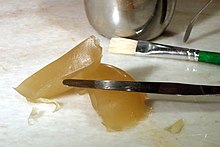

Hide glue at room temperature
Where hide glue is in occasional use, excess glue may be held in a freezer, to prevent spoilage from the growth of microorganisms. Hide glue has some gap filling properties,malthough modern gap-filling adhesives such as epoxy resin are better in this regard.
Hot hide glue
Hide glue that is liquid at room temperature is also possible through the addition of urea. An example of this type of mixture is Old Brown Glue,  created by W. Patrick Edwards, the director of the American School of French Marquetry. In stress tests performed by Mark Schofield of Fine Woodworking Magazine, liquid hide glue compared favourably to hot hide glue in average strength of bond. "However, any liquid hide glue over six months old can be suspect because the urea eventually hydrolyzes the protein structure of the glue and weakens it – even though the product was 'protected' with various bactericides and fungicides during manufacture."
Production

Animal hides are soaked in water to produce "stock." The stock is then treated with lime to break down the hides. The hides are then rinsed to remove the lime, any residue being neutralised with a weak acid solution. The hides are heated, in water, to a carefully controlled temperature around 70 degrees Celsius. The 'glue liquor' is then drawn off, more water added, and the process repeated at increasing temperatures.
The glue liquor is then dried and chipped into pellets.
Properties
The significant disadvantages of hide glue – its thermal limitations, short open time, and vulnerability to micro-organisms – are offset by several advantages. Hide glue joints are reversible and repairable. Recently glued joints will release easily with the application of heat and steam. Hide glue sticks to itself, so the repairer can apply new hide glue to the joint and reclamp it. In contrast, PVA glues do not adhere to themselves once they are cured, so a successful repair requires removal of the old glue first – which usually requires removing some of the material being glued.
Hide glue creates a somewhat brittle joint, so a strong shock will often cause a very clean break along the joint. In contrast, cleaving a joint glued with PVA will usually damage the surrounding material, creating an irregular break that is more difficult to repair. This brittleness is taken advantage of by instrument makers. For example, instruments in the violin family require periodic disassembly for repairs and maintenance. The top of a violin is easily removed by prying a palette knife between the top and ribs, and running it all around the joint. The brittleness allows the top to be removed, often without significant damage to the wood. Regluing the top only requires applying new hot hide glue to the joint. If the violin top were glued on with PVA glue, removing the top would require heat and steam to disassemble the joint (causing damage to the varnish), then wood would have to be removed from the joint to ensure no cured PVA glue was remaining before regluing the top.
Hide glue also functions as its own clamp. Once the glue begins to gel, it pulls the joint together. Violin makers may glue the center seams of top and back plates together using a rubbed joint rather than using clamps. This technique involves coating half of the joint with hot hide glue, and then rubbing the other half against the joint until the hide glue starts to gel, at which point the glue becomes tacky. At this point the plate is set aside without clamps, and the hide glue pulls the joint together as it hardens.
Hide glue regains its working properties after cooling if it is reheated. This property can be used when the glue's open time does not allow the joint to be glued normally. For example, a cello maker may not be able to glue and clamp a top to the instrument's ribs in the short one-minute open time available. Instead, the builder will lay a bead of glue along the ribs, and allow it to cool. The top is then clamped to the ribs. Moving a few inches at a time, the maker inserts a heated palette knife into the joint, heating the glue. When the glue is liquefied, the palette knife is removed, and the glue cools, creating a bond. A similar process can be used to glue veneers to a substrate. The veneer and/or the substrate is coated with hot hide glue. Once the glue is cold, the veneer is positioned on the substrate. A hot object such as a clothes iron is applied to the veneer, liquefying the underlying glue. When the iron is removed, the glue cools, bonding the veneer to the substrate.
Hide glue joints do not creep under loads. PVA glues create plastic joints, which will creep over time if heavy loads are applied to them.
Hide glue is supplied in many different gram strengths, each suited to specific applications. Instrument and cabinet builders will use a range from 120 to 200 gram strength. Some hide glues are sold without the gram strength specified. Experienced users avoid this glue as the glue may be too weak or strong for the expected application.
Hoof Glue

Hoof glue is also used today in woodworking, specifically cabinetry.

Rabbit Skin Glue

Rabbit-skin glue is more flexible when dry than typical hide glues. It is used in the sizing or priming of oil painters' canvases. It also is used in bookbinding and as the adhesive component of some recipes for gesso and compo.

- Wikipedia 

VENEER HAMMER

veneer hammer is a woodworking tool used in applying veneer.

Description and Use
A veneer hammer is used in conjunction with hot hide glue in applying veneer to a substrate. The term "veneer hammer" is somewhat misleading, as the "hammer" is used more like a squeegee than a hammer. The hot hide glue is applied to the substrate, then the veneer is laid onto the glued surface. The hammer itself has a dull blade, approximately three inches wide, on one side of the head, and a square shaped face on the other side. This head is connected to a standard handle, much like a regular hammer. The small square face is designed to push down on, exerting force to the blade side of the head.
The veneer is pushed into the glue with the wide blade, and the hammer is pushed or pulled, forcing out the excess hide glue. The sheer bulk of the metal head helps to cool the glue, causing it to grab and hold the veneer in place. The glue cures as it cools. The procedure is to work from the center, out towards the edges, forcing the hot excess glue out from under the veneer.
Often workers will apply the glue to the face of the veneer as well, using it as a lubricant for the hammer. By applying glue, therefore moisture, on both side of the veneer, the worker also avoid the curling of the veneer. This surface glue can be easily removed, using a cabinet scraper or cold water.
In areas where a good bond is not achieved, the glue can be reheated with a common household iron and reactivated. The veneer can be forced into the reactivated glue using the veneer hammer, and the area where the bond was poor, will become properly adhered to the substrate.
Workers often make their own veneer hammer, often having a wider "blade" than the commercially available ones. The blade can be made from metal or wood .The important factor is that the shape of the blade be somewhat tapered, permitting the required force to be applied directly under the blade.
The process is centuries old, possibly dating back to Egyptian times, as examples of veneered work have survived from that era.
- Wikipedia 

MULTILAMINAR WOOD VENEER

Multilaminar wood veneer uses plantation wood to reproduce decorative effects which are typical of quality wood species (often protected and rare). This aids the preservation of biodiversity and complies with the principles of Sustainable forest management.
Large sheets of veneer are produced on a machine similar to a lathe, these are dyed, spread with suitable adhesives, then compressed and bonded into thick (typically 70 cm) logs which are then sliced to create the end product. If the sheets are compressed between platens with an undulating surface, the slice will cross several layers to produce a patterned effect. Many different designs can be obtained by varying the platens, the dyes and the stacking order.
Although the product may be considered sustainable, it does have a relatively high carbon footprint, due to the numerous dyeing, laminating, pressing and slicing operations.
- Wikipedia 

FURNITURE

Furniture is the mass noun for the movable objects intended to support various human activities such as seating (e.g., chairs, stools and sofas) and sleeping (e.g., beds). Furniture is also used to hold objects at a convenient height for work (as horizontal surfaces above the ground, such as tables and desks), or to store things (e.g., cupboards and shelves). Furniture can be a product of design and is considered a form of decorative art. In addition to furniture's functional role, it can serve a symbolic or religious purpose. It can be made from many materials, including metal, plastic, and wood. Furniture can be made using a variety of woodworking joints which often reflect the local culture.


A dining table with two chairs

Archeological research shows that Neolithicpeople used stone to build cupboards, dressers, beds, shelves and seats. Ancient funiturefrom the 8th-century BC includes tables and serving stands. The furniture of the Middle Ages was usually heavy, oak and ornamented. Furniture design expanded during the Italian Renaissanceof the fourteenth and fifteenth century. The seventeenth century, in both Southern and Northern Europe, was characterized by opulent, often gilded Baroque designs. The nineteenth century is usually defined by revival styles. The first three-quarters of the twentieth century are often seen as the march towards Modernism. One unique outgrowth of post-modern furniture design is a return to natural shapes and textures.

History

Furniture has been a part of the human experience since the development of non-nomadic cultures. Evidence of furniture survives from the Neolithic Period and later in antiquity in the form of paintings such as the wall Murals discovered at Pompeii : sculpture and examples have been excavated in Egypt and found in tombs in Ghiordes in modern-day Turkey.

Neolithic Period

A range of unique stone furniture has been excavated in Skara Braea , Neolithic village located in Orkney. The site dates from 3100–2500 BC and due to a shortage of wood in Orkney, the people of Skara Brae were forced to build with stone, a readily available material that could be worked easily and turned into items for use within the household. Each house shows a high degree of sophistication and was equipped with an extensive assortment of stone furniture, ranging from cupboards, dressers and beds to shelves, stone seats, and limpet tanks. The stone dresser was regarded as the most important as it symbolically faces the entrance in each house and is therefore the first item seen when entering, perhaps displaying symbolic objects, including decorative artwork such as several Neolithic Carved Stone Balls also found at the site.


Skara Brae house Orkney Scotland-evidence of home furnishings i.e. a dresser containing shelves.


Classical World

Ancient furniture has been excavated from the 8th-century BC Phrygian tumulus the Midas Mound, in Gordion,  Turkey. Pieces found here include tables and inlaid serving stands. There are also surviving works from the 9th-8th-century BC Assyrian palace of Nimrud. The earliest surviving carpet, the Pazyryk Carpet was discovered in a frozen tomb in Siberia and has been dated between the 6th and 3rd century BC. Recovered Ancient Egyptian furniture includes 3rd millennium BC beds discovered at Tarkhan as place for the deceased, a c. 2550 BC gilded bed and two chairs from the tomb of Queen Hetepheres I, and many examples (boxes, beds, chairs) from c. 1550 to 1200 BC from Thebes. Ancient Greek furniture design beginning in the 2nd millennium BC, including beds and the klismos chair,  is preserved not only by extant works, but by images on Greek vases. The 1738 and 1748 excavations of Herculaneum and Pompeii revealed Roman furniture, preserved in the ashes of the 79 A.D. eruption of Vesuvius, to the eighteenth century.

Early Modern Europe


Florentine cassone from the 15th century

The furniture of the Middle Ages was usually heavy, oak and ornamented with carved designs. Along with the other arts, the Italian Renaissance of the fourteenth and fifteenth century marked a rebirth in design, often inspired by the Greco-Roman tradition. A similar explosion of design, and renaissance of culture in general, occurred in Northern Europe, starting in the fifteenth century. The seventeenth century, in both Southern and Northern Europe, was characterized by opulent, often gilded Baroque designs that frequently incorporated a profusion of vegetal and scrolling ornament. Starting in the eighteenth century, furniture designs began to develop more rapidly. Although there were some styles that belonged primarily to one nation, such as Palladianism in Great Britain or Louis Quinze in French furniture, others, such as the Rococo and Neoclassicism were perpetuated throughout Western Europe.

18th Century

During the eighteenth century the fashion was set in England by the French art. In the beginning of the century the Boulle cabinets were at the peak of their popularity and Louis XIV was reigning in France. In this era most of the furniture had metal and enamelled decorations in it and some of the furniture was covered in inlays of marbles lapis lazuli, and porphyry and other stones. 

19th Century

The nineteenth century is usually defined by concurrent revival styles, including Gothic, Neoclassicism, Rococo, and the EastHaven Movement. The design reforms of the late century introduced the Aesthetic movement and the Arts and Crafts movement. Art Nouveau was influenced by both of these movements.


The furniture maker by Ludwig Deutsch

Early North American

This design was in many ways rooted in necessity and emphasizes both form and materials. Early American chairs and tables are often constructed with turned spindles and chair backs often constructed with steaming to bend the wood. Wood choices tend to be deciduous hardwoods with a particular emphasis on the wood of edible or fruit bearing trees such as Cherry or Walnut.

Modernism

The first three-quarters of the twentieth century are often seen as the march towards Modernis. Art Deco, De Stijl, Bauhaus, Wiener Werkstätte, and Vienna Secession designers all worked to some degree within the Modernist idiom. Born from the Bauhaus and Art Deco/Streamline styles came the post WWII "Mid-Century Modern" style using materials developed during the war including laminated plywood, plastics and fiberglass. Prime examples include furniture designed by George Nelson Associates, Charles and Ray Eames, Paul McCobb, Florence Knoll, Harry Bertoia, Eero Saarinen, Harvey Probber, Vladamir Kagan and Danish modern designers including Finn Juhl and Arne Jacobsen. Postmodern design, intersecting the Pop art movement, gained steam in the 1960s and 70s, promoted in the 80s by groups such as the Italy-based Memphis movement. Transitional furniture is intended to fill a place between Traditional and Modern tastes.


Red and Blue Chair (1917), designed by Gerrit Rietveld

Ecodesign

Great efforts from individuals, governments, and companies has led to the manufacturing of products with higher sustainability known as Ecodesign. This new line of furniture is based on environmentally friendly design. Its use and popularity are increasing each year.


Stainless Steel Table with FSC Teca Wood - Brazil Ecodesign

Contemporary

One unique outgrowth of post-modern furniture design is Live edge, heralding a return to natural shapes and textures within the home.

ASEAN History
Asian furniture has a quite distinct history. The traditions out of India,China, Pakistan, Indonesia (Bali and Java) and Japan are some of the best known, but places such as Korea, Mongolia, and the countries of South East Asia have unique facets of their own.
Sendai-dansu for kimono, zelkova wood, note the elaborate ironwork, handles on side for transportation, and lockable compartment
The use of uncarved wood and bamboo and the use of heavy lacquers are well known Chinese styles. It is worth noting that Chinese furniture varies dramatically from one dynasty to the next.
Traditional Japanese furniture is well known for its minimalist style, extensive use of wood, high-quality craftsmanship and reliance on wood grain instead of painting or thick lacquer. Japanese chests are known as Tansu, known for elaborate decorative iron work, and are some of the most sought-after of Japanese antiques. The antiques available generally date back to the Tokugawa era and Meiji era.
Types of wood to make furniture

All different type of woods have unique signature marks, that can help in easy identification of the type. There are hardwoods and softwoods. Both are used in furniture manufacturing, and each have their own specific uses. Most commonly, quality furniture is made out of hardwood which is made from oak, maple, mahogany, teak, walnut, cherry and birch. High quality wood will have been air dried to rid it of its moisture.

- Wikipedia 

WOOD VENEER

In woodworking, veneer refers to thin slices of wood, usually thinner than 3 mm (1/8 inch), that typically are glued onto core panels (typically, wood, particle board or medium-density fiberboard) to produce flat panels such as doors, tops and panels for cabinets, parquet floors and parts of furniture. They are also used in marquetry . Plywood consists of three or more layers of veneer, each glued with its grain at right angles to adjacent layers for strength. Veneer beading is a thin layer of decorative edging placed around objects, such as jewelry boxes. Veneer is also used to replace decorative papers in Wood Veneer HPL. Veneer is also a type of manufactured board.


Wood veneer RCA Dimensia console TV set
Veneer is obtained either by "peeling" the trunk of a tree or by slicing large rectangular blocks of wood known as flitches. The appearance of the grain and figure in wood comes from slicing through the growth rings of a tree and depends upon the angle at which the wood is sliced. There are three main types of veneer-making equipment used commercially:
  • A rotary lathe in which the wood is turned against a very sharp blade and peeled off in one continuous or semi-continuous roll. Rotary-cut veneer is mainly used for plywood, as the appearance is not desirable because the veneer is cut concentric to the growth rings.
  • A slicing machine in which the flitch or piece of log is raised and lowered against the blade and slices of the log are made. This yields veneer that looks like sawn pieces of wood, cut across the growth rings; such veneer is referred to as "crown cut".
  • A half-round lathe in which the log or piece of log can be turned and moved in such a way as to expose the most interesting parts of the grain, creating a more textured feel and appearance; such veneer is commonly referred to as "rift cut."
Each slicing processes gives a very distinctive type of grain, depending upon the tree species. In any of the veneer-slicing methods, when the veneer is sliced, a distortion of the grain occurs. As it hits the wood, the knife blade creates a "loose" side where the cells have been opened up by the blade, and a "tight" side.
Historically veneers were also sawn but this is more wasteful of wood. Veneering is an ancient art, dating back to the ancient Egyptians who used veneers on their furniture and sarcophagi During the Roman Empire, Romans also used veneered work in mass quantities.
Producing wood veneers

The finest and rarest logs are sent to companies that produce veneer. The advantage to this practice is twofold. First, it provides the most financial gain to the owner of the log. Secondly, and of more importance to the woodworker, it greatly expands the amount of usable wood. While a log used for solid lumber is cut into thick pieces, usually no thinner than 1 1/8 inches (3 cm), veneers are cut as thin as 1/40 of an inch (0.6mm). Depending on the cutting process used by the veneer manufacturer, very little wood is wasted by the saw blade thickness, known as the saw kerf. Accordingly the yield of a rare grain pattern or wood type is greatly increased, in turn placing less stress on the resource. Some manufacturers even use a very wide knife to "slice off" the thin veneer pieces. In this way, none of the wood is wasted. The slices of veneer are always kept in the order in which they are cut from the log and are often sold this way.

Types of Veneers

There are a few types of veneers available, each serving a particular purpose.
  • Raw veneer has no backing on it and can be used with either side facing up. It is important to note that the two sides will appear different when a finish has been applied, due to the cell structure of the wood.
  • Paper backed veneer is as the name suggests, veneers that are backed with paper. The advantage to this is it is available in large sizes, or sheets, as smaller pieces are joined together prior to adding the backing. This is helpful for users that do not wish to join smaller pieces of raw veneers together. This is also helpful when veneering curves and columns as the veneer is less likely to crack.
  • Phenolic backed veneer is less common and is used for composite, or manmade wood veneers. Due to concern for the natural resource, this is becoming more popular. It too has the advantage of being available in sheets, and is also less likely to crack when being used on curves.
  • Laid up veneer is raw veneer that has been joined together to make larger pieces. The process is time-consuming and requires great care, but is not difficult and requires no expensive tools or machinery. Veneers can be ordered through some companies already laid up to any size, shape or design.
  • Reconstituted veneer is made from fast-growing tropical species. Raw veneer is cut from a log, and dyed if necessary. Once dyed, the sheets are laminated together to form a block. The block is then sliced so that the edges of the laminated veneer become the “grain” of the reconstituted veneer.
  • Wood on Wood Also called 2-ply is a decorative wood veneer face with a utility grade wood backer applied at an opposing direction to the face veneer.

Advantages of using veneers
Compared to wood, one of the primary advantages of using veneer is stability. While solid wood can be prone to warping and splitting, because veneer is made of thin layers of wood glued together, the chances of splitting or cracking are reduced. Further, the glue used provides additional strength, making the end result stronger than natural wood.
Some projects built using wood veneer would not be possible to construct using solid lumber, owing to expansion and contraction caused by fluctuation of temperature and humidity. Another advantage of veneer is sustainability-furniture made with wood veneer uses less wood than the same piece of furniture made with solid wood. Further, veneer may also be more readily available than solid wood as exotic hardwood lumber can be scarce and very expensive.
Ecological Characteristics

  • Recyclability and renewability: Wood has the least impact on total energy use, greenhouse gasses, air and water pollution, solid waste and ecological resource use. Seventy percent less energy is required in the use of wood compared with any other building materials.
  • Sustainability: Using veneer extends the use of a piece of timber. The wood that might be used in one solid piece a few visible cm wide can cover a far greater area when used as a veneer.
  • Toxicity: Nontoxic; veneer stores carbon and also maximises the use of harvested wood.

Buying Veneers

Wood veneers are typically sold by the square foot. With the ability to join veneers, even small pieces are usable, resulting in very little waste. Many sources sell small packets of veneers that are sequence matched and are ideal for small projects. These make experimenting and practicing much more economical. It is also possible to buy plywood and other substrates with veneered faces for larger projects consisting of casework.

- Wikipedia 

I-JOIST

An engineered wood joist , more commonly known as an I-joist, is a product designed to eliminate problems that occur with conventional wood joists. Invented in 1969, the I-joist is an engineered wood product that has great strength in relation to its size and weight. The biggest notable difference from dimensional lumber is that the I-joist carries heavy loads with less lumber than a dimensional solid wood joist. As of 2005, approximately 50% of all wood light framed floors used I-joists. I-joists were designed to help eliminate typical problems that come with using solid lumber as joists. The advantage of I-joists is they will not bow, crown, twist, cup, check or split as would a dimensional piece of lumber. I-joists' dimensional soundness and little or no shrinkage help eliminate squeaky floors.


A partially constructed floor built with I-joists

Design and Manufacture

An I-joist has two main parts, the web and flange. The web is sandwiched between a top and bottom flange, creating the “I” shape. The flange can be made from laminated veneer lumber or solid wood finger-jointed together for ultimate strength. It is grooved on one side to receive the web. The web is typically made from plywood laminated veneer lumber, or oriented strand board. After sizing the webs and flanges, they are assembled with water-resistant glue by pressing the web into the top and bottom flange. After assembly, the I-joist is end-trimmed and heat-cured or left at room temperature to reach approximately equilibrium moisture content. Sizes vary according to the I-joist's intended load and span. Depths can range from 9.25 to 24 inches (235 to 610 mm) and reach up to 80 feet (24 m) in length, although 40 to 42 feet (12 to 13 m) is more common. The intended use for an I-joist is for floor and roof joists, wall studs and roof rafters in both residential and commercial construction.

Installation
I-joists require correct installation. The most common mistake is misplacing or improperly sizing holes in the web, which can compromise the joist's strength, potentially leading to structural failure.
Common mistakes made with installing I-joists include cutting or chiseling the flange, improperly sized joist hangers, improper nailing and wrong-sized nails. The rim joist depth must match the I-joist size. Mismatches can strain the joist.
A similar situation occurs where the I-joist crosses a main beam. Installing squash blocks (2x4 materials 1/16 inch higher than the I-joist) alongside the I-joists transfers the load from the I-joist onto the beam. Missed nails and glue setting too fast can lead to an uneven or squeaky floor.
Safety

The lightweight nature of I-joists makes them more vulnerable to fire than dimensional lumber. A report by Underwriters Laboratories found that structural assemblies composed of I-joists fail significantly sooner under fire conditions than those composed of dimensional lumber. Fire-induced failures of lightweight trusses and I-joists have led to the deaths of several firefighters.

- Wikipedia 

What to Eat & Not to Eat on a Gluten-Free Diet

If you have celiac disease or gluten intolerance, your body is unable to properly digest gluten, a protein in wheat and some other grains. If this is the case, consuming gluten can result in diarrhea, cramping and bloating -- and you may have to follow a gluten-free diet to remain symptom-free. Understanding which foods contain gluten can help you know what you can and cannot eat.


What to Eat & Not to Eat on a Gluten-Free Diet
Breads and rolls. Photo Credit DAJ/amana images/Getty Images

Choose Gluten-Free Grains

Wheat is forbidden on a gluten-free diet because it contains gluten. You cannot eat wheat products such as white or wheat bread, pretzels, pasta or wheat-containing breakfast cereals. Other gluten-containing grains to avoid include rye, triticale, bulgur, barley, couscous and durum. You can have gluten-free grains such corn, flax, amaranth, millet, quinoa and all forms of rice. You can use nut and soy flours as alternatives to wheat flour if you are baking.

Know Which Foods Are Naturally Gluten-Free

You can have most products that do not contain grains. A gluten-free diet allows all fresh fruits and vegetables and all frozen and canned fruits and vegetables as long as they contain no sauce. Breaded vegetables are off-limits, according to New York University Langone Medical Center. You can have milk, cheese and cream cheese, tofu, fresh meat, poultry and fish and eggs. Nuts and peanuts are naturally gluten-free as well. Avoid breaded meats, poultry and fish.

Watch for Unexpected Gluten-Containing Foods

Some foods, such as sauces and marinades, can unexpectedly contain small amounts of gluten. NYU Langone Medical Center warns that you need to avoid teriyaki sauce, soy sauce and malt vinegar on a gluten-free diet. Many meat marinades and fruits in thickened sauces contain gluten. Use gluten-free foods instead to flavor your foods. You can have mustard, herbs and other vinegars on a gluten-free diet. Beer and some nondairy beverages, such as soy and rice milk, have gluten, but you can have distilled alcohol.

Other Considerations

Some foods, such as yogurt and oats, are unlikely to contain gluten, but they may. Only consume varieties of such products if their labels claim that they are free of gluten. The U.S. Food and Drug Administration regulates labeling claims for the food industry and sets strict standards on when foods may carry gluten-free labels. Some people choose to follow a gluten-free diet before being diagnosed with gluten sensitivity or celiac disease, but NYU Langone Medical Center explains that clinical researchers have not uncovered any benefits to doing this.

www.livestrong.com

How to Lose Weight on a Gluten Free Diet

A gluten-free diet is for people who have celiac disease, a wheat allergy or gluten sensitivity. Gluten is a protein found in the endosperm of wheat, barley and rye. Any foods made with these grains are off limits. Celiac disease and wheat allergy are the more severe conditions, and but all can cause gastrointestinal pain, diarrhea and bloating. This stems from the body having an adverse reaction to the gluten protein. The way to lose weight on a gluten-free diet is similar to any diet, except you need to be very aware of what you are eating.


How to Lose Weight on a Gluten Free Diet
Include gluten-free foods in your diet. Photo Credit AndreaAstes/iStock/Getty Images

Step 1

Stock up on foods that are gluten-free, high in nutrients and low in fat. Fruits, vegetables, seeds, nuts, lean beef, chicken breasts, fish, beans and low-fat dairy products are examples. Purchase gluten-free grains as well, like amaranth, brown rice, basmati rice, buckwheat and quinoa.
Step 2
Reduce your total intake of calories to lose weight. Track your intake for one day with the help of an online resource like the Daily Plate. Subtract 500 calories from this number to promote 1 pound of weight loss every week. For example, if your current daily intake is 2,400 calories, your new intake will be 1,900.

Step 3

Eat breakfast as soon as you get up to lift your metabolism and increase your energy levels. Prepare something that is nutrient-dense and gluten-free. A cup of yogurt with buckwheat cereal and seeds mixed in is an example

Step 4

Continue to eat meals every two to three hours to keep your metabolism high and appetite suppressed. Balance each meal with carbs and protein and use gluten-free ingredients. A salad with a chicken breast, chopped vegetables and a pear is a balanced meal.

Step 5

Be mindful when eating out. Ask to have your food prepared without butter or excess oil. Choose baked, broiled and steamed whenever possible and avoid anything that is breaded.

Step 6

Perform cardiovascular exercise to burn calories and reduce your weight. Choose a type of cardio that you enjoy, like fast-paced walking, running, biking, swimming, elliptical training or in-line skating. Exercise for 45 to 60 minutes on three alternating days of your weight training.

Step 7

Spend three days a week in the weight room building muscle. Do full body exercises like bench presses, shoulder presses, back extensions, triceps dips, curls and squats. Aim for 10 to 12 repititions and do three or four sets. Keep your rest breaks under 60 seconds to keep your heart rate elevated.
www.livestrong.com

Gluten Intolerance Symptoms in Adults

Approximately 1 in every 133 Americans suffers from an autoimmune condition called celiac disease, reports the National Foundation for Celiac Awareness. For people with celiac disease, consuming the protein contained in wheat, barley and rye damages the villi in the small intestine and can lead to long-term permanent problems including malnutrition, cancer, additional autoimmune conditions and reduced bone density. You do not have to be diagnosed with celiac, the most extreme form of gluten intolerance, to have a reaction to gluten. An unknown number of people suffer many uncomfortable symptoms as a result of consuming gluten. These symptoms may be digestive in nature, but may also manifest in a myriad of other ways and vary in severity.

Gluten Intolerance Symptoms in Adults
Rice is a gluten-free food. Photo Credit rice image by kuhar from Fotolia.com

Psychological and Reproductive

Gluten intolerance can sometimes manifest as unexplained infertility. People also report headaches and brain fog when they are intolerant to gluten. Trouble concentrating, irritability, fatigue -- sometimes due to anemia -- and mood swings are other symptoms.

Skin

Gluten intolerance can cause rashes, rosacea, eczema and canker sores. A specific type of rash, called dermatitis herpetiformis, characterized by itchy, blistering patches of skin is an indication that you have celiac disease, the most severe form of gluten intolerance. Everyone with this condition has celiac, but not everyone with gluten intolerance or celiac disease will develop it.

Neurological and Bone Health

Gluten intolerance can also cause joint pain and tingling in the arms and legs. Nerve damage and poor balance are other indicators of possible gluten intolerance. Gluten intolerance, particularly celiac-based, can cause early onset osteoporosis and contribute to tooth enamel erosion and discoloration.

www.lifestrong.com

DOVETAIL JOINT

dovetail joint or simply dovetail is a joinery technique most commonly used in woodworking joinery (carpentry) including furniture, cabinets, car-case construction, log buildings and traditional timber framing. Noted for its resistance to being pulled apart (tensile strength), the dovetail joint is commonly used to join the sides of a drawer to the front. A series of pins cut to extend from the end of one board interlock with a series of tails cut into the end of another board. The pins and tails have a trapezoidal shape. Once glued, a wooden dovetail joint requires no mechanical fasteners.


A finished dovetail joint.

The dovetail joint probably pre-dates written history. Some of the earliest known examples of the dovetail joint are in furniture entombed with mummies dating from First Dynasty Of ancient Egypt as well the tombs of Chinese emperors. The dovetail design is an important method of distinguishing various periods of furniture.


Dovetailed woodworking joints on a Romanian church.

Methods
The dovetail joint is very strong because of the way the ‘tails’ and ‘pins’ are shaped. This makes it difficult to pull the joint apart and virtually impossible when glue is added. This type of joint is used in box constructions such as drawers, jewellery boxes, cabinets and other pieces of furniture where strength is required. It is a difficult joint to make manually, requiring skilled workmanship. There are different types of dovetail joint and when cut accurately they are very impressive and attractive. The joint is strong especially when used with a good quality glue such as PVA (woodworkers adhesive) or cascamite. The marking out and cutting procedure is outlined below.
The angle of slope varies according to the wood used. Typically the slope is 1:6 for softwoods and a shallower 1:8 slope for hardwoods. Often a slope of 1:7 is used as a compromise.
Types of Dovetail

Through Dovetail


A through dovetail joint

The photograph at the top of this page shows a through dovetail (also known as plain dovetail) joint, where the end grain of both boards is visible when the joint is assembled. Through dovetails are common in carcass and box construction. Traditionally, the dovetails would have often been covered by a veneer. However, dovetails have become a signature of craftsmanship and are generally considered a feature, so they are rarely concealed in contemporary work. When used in drawer construction, a through (or blind, mitred, or lapped) dovetail joint is sometimes referred to as an "English dovetail.
Use for:
  • Carcass and box construction

Half-blind dovetail
half-blind dovetail is used when the craftsman does not wish end grain to be visible from the front of the item. The tails are housed in sockets in the ends of the board that is to be the front of the item so that their ends cannot be seen.
A half-blind dovetail joint
Half-blind dovetails are commonly used to fasten drawer fronts to drawer sides. This is an alternative to the practice of attaching false fronts to drawers constructed using through dovetails.
Use for:
  • Attaching drawer fronts

Secret mitered dovetail
The secret mitred dovetail joint (also called a mitred blind dovetailfull-blind dovetail, or full-blind mitred dovetail) is used in the highest class of cabinet and box work. It offers the strength found in the dovetail joint but is totally hidden from both outside faces by forming the outer edge to meet at a 45-degree angle while hiding the dovetails internally within the joint.
A secret mitred dovetail joint
Use for:
  • Fine cabinet or box work where strength is required without a visible joint
The mitred corner dovetail joint is very similar in design, but it has just a single dovetail and is used for picture frames and other similar joins.
Secret double-lapped dovetail

The secret double-lapped dovetail is similar to the secret mitred dovetail, but presents a very thin section of end grain on one edge of the joint.
Use for:
  • Carcass and box construction to hide the dovetails completely from view

Sliding dovetails
The sliding dovetail is a method of joining two boards at right angles, where the intersection occurs within the field of one of the boards, that is not at the end. This joint provides the interlocking strength of a dovetail. Sliding dovetails are assembled by sliding the tail into the socket. It is common to slightly taper the socket, making it slightly tighter towards the rear of the joint, so that the two components can be slid together easily but the joint becomes tighter as the finished position is reached. Another method to implement a tapered sliding dovetail would be to taper the tail instead of the socket. When used in drawer construction, a "stopped sliding dovetail" that doesn't extend across the full width of the board is sometimes referred to as a "French dovetail."
A sliding dovetail joint

Use for:
  • Joining shelves to cabinet sides
  • Joining cabinet bottoms to sides
  • Joining horizontal partitions to shelves
  • Joining adjacent sections of expandable table frames
  • Joining drawer fronts to sides
  • Joining front rails of web frames to cabinet sides
  • Joining neck and body in violins and some guitars

Non- woodworking dovetails


Cast iron dovetail joints in The Iron Bridge
Dovetails are most commonly, but not exclusively, used in woodworking. Other areas of use are:
  • Dovetail slides for example on a lathe.
  • Attaching turbine blades to the shaft in jet engines and other applications.
  • Clockmaking: dovetailing a new tooth, when replacing broken teeth in clock gears.
  • Masonry : dovetail construction is regarded a major step forward in the design of lighthouses meant for particularly dangerous areas; the Eddystone Lighthouse and Fastnet Lighthouse are examples of the durable quality of dovetail masonry.
  • 3d printing : dovetail is commonly used to overcome physical object print size limitation of a 3D printer.

- Wikipedia 

Advantages and Disadvantages of Fasting for Runners

Author BY   ANDREA CESPEDES  Food is fuel, especially for serious runners who need a lot of energy. It may seem counterintuiti...