The coconut is known for its great versatility as seen in the many uses of its different parts and found throughout the tropics and subtropics. Coconuts are part of the daily diets of many people. Coconuts are different from any other fruits because they contain a large quantity of "water" and when immature they are known as tender-nuts or jelly-nuts and may be harvested for drinking. When mature, they still contain some water and can be used as seednuts or processed to give oil from the kernel, charcoal from the hard shell and coir from the fibrous husk. The endosperm is initially in its nuclear phase suspended within the coconut water. As development continues, cellular layers of endosperm deposit along the walls of the coconut, becoming the edible coconut "flesh".When dried, the coconut flesh is called copra. The oil and milk derived from it are commonly used in cooking and frying; coconut oil is also widely used insoaps and cosmetics. The clear liquid coconut water within is potable. The husks and leaves can be used as material to make a variety of products for furnishing and decorating. The coconut also has cultural and religious significance in many societies that use it.
 A cut coconut shell
Historical evidence favors the European origin of the name "coconut", for no name is similar in any of the languages of India, where the Portuguese first found the fruit; and indeed Barbosa, Barros, and Garcia, in mentioning the Tamil/Malayalam name tenga, and Canarese narle, expressly say, "we call these fruits quoquos", "our people have given it the name of coco", and "that which we call coco, and the Malabars temga".
 A dehusked coconut shell from Ivory Coast showing the face-like markings at the base
Origin
The origin of the plant is the subject of debate. O.F. Cook was one of the earliest modern researchers to draw conclusions about the location of origin of Cocos nucifera based on its current-day worldwide distribution. He hypothesized that the coconut originated in the Americas, based on his belief that American coconut populations predated European contact and because he considered pan-tropical distribution by ocean currents improbable. Thor Heyerdahl later used this hypothesis of the American origin of the coconut to support his theory that the Pacific Islanders originated in South America.However, more evidence exists for an Indo-Pacific origin either around Melanesia and Malesia or the Indian Ocean.The oldest fossils known of the modern coconut dating from the Eocene period from around 37 to 55 million years ago were found in Australia and India. However, older palm fossils such as some of nipa fruit have been found in the Americas. Since 1978, the work on tracing the probable origin and dispersal of Cocos nucifera has only recently been augmented by a publication on the germination rate of the coconut seednut and another on the importance of the coral atoll ecosystem.Briefly, the coconut originated in the coral atoll ecosystem — without human intervention — and required a thick husk and slow germination to survive and disperse.
 Fallen immature nuts, Thrissur,Kerala, India
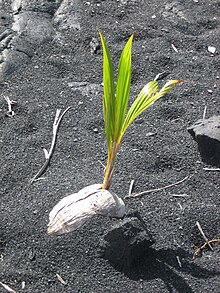 Coconut germinating on Black Sand Beach, Island of Hawaii
Distribution
The coconut has spread across much of the tropics, probably aided in many cases by seafaring people. Coconut fruit in the wild are light, buoyant and highly water resistant, and evolved to disperse significant distances via marine currents. Specimens have been collected from the sea as far north as Norway. In the Hawaiian Islands, the coconut is regarded as a Polynesian introduction, first brought to the islands by early Polynesian voyagers from their homelands in Oceania. They have been found in the Caribbean and the Atlantic coasts of Africa and South America for less than 500 years, but evidence of their presence on the Pacific coast of South America predates Christopher Columbus's arrival in the Americas.They are now almost ubiquitous between 26°N and 26°S except for the interiors of Africa and South America.
Natural Habitat
Coconut palms require warm conditions for successful growth, and are intolerant of cold weather. Some seasonal variation is tolerated, with good growth where mean summer temperatures are between 28 and 37 °C (82 and 99 °F), and survival as long as winter temperatures are above 4–12 °C (39–54 °F); they will survive brief drops to 0 °C (32 °F). Severe frost is usually fatal, although they have been known to recover from temperatures of −4 °C (25 °F). They may grow but not fruit properly in areas with insufficient warmth, such as Bermuda.
Pests
The fruit may also be damaged by eriophyid coconut mites (Eriophyes guerreronis). This mite infests coconut plantations, and is devastating: it can destroy up to 90% of coconut production. The immature seeds are infested and desapped by larvae staying in the portion covered by the perianth of the immature seed; the seeds then drop off or survive deformed. Spraying with wettable sulfur 0.4% or with neem-based pesticides can give some relief, but is cumbersome and labor-intensive.
Production and Cultivation
Coconut palms are grown in more than 90 countries of the world, with a total production of 62 million tonnes per year (table). Most of the world production is in tropical Asia, with Indonesia, the Philippines and India accounting collectively for 73% of the world.
Cultivation
 Coconut plucking in Kerala, India
 A wall made from coconut husk
 Making a rug from coconut fiber
 A cut coconut shell
Historical evidence favors the European origin of the name "coconut", for no name is similar in any of the languages of India, where the Portuguese first found the fruit; and indeed Barbosa, Barros, and Garcia, in mentioning the Tamil/Malayalam name tenga, and Canarese narle, expressly say, "we call these fruits quoquos", "our people have given it the name of coco", and "that which we call coco, and the Malabars temga".
 A dehusked coconut shell from Ivory Coast showing the face-like markings at the base
Origin
The origin of the plant is the subject of debate. O.F. Cook was one of the earliest modern researchers to draw conclusions about the location of origin of Cocos nucifera based on its current-day worldwide distribution. He hypothesized that the coconut originated in the Americas, based on his belief that American coconut populations predated European contact and because he considered pan-tropical distribution by ocean currents improbable. Thor Heyerdahl later used this hypothesis of the American origin of the coconut to support his theory that the Pacific Islanders originated in South America.However, more evidence exists for an Indo-Pacific origin either around Melanesia and Malesia or the Indian Ocean.The oldest fossils known of the modern coconut dating from the Eocene period from around 37 to 55 million years ago were found in Australia and India. However, older palm fossils such as some of nipa fruit have been found in the Americas. Since 1978, the work on tracing the probable origin and dispersal of Cocos nucifera has only recently been augmented by a publication on the germination rate of the coconut seednut and another on the importance of the coral atoll ecosystem.Briefly, the coconut originated in the coral atoll ecosystem — without human intervention — and required a thick husk and slow germination to survive and disperse.
 Fallen immature nuts, Thrissur,Kerala, India
Domestication
Coconuts could not reach inland locations without human intervention (to carry seednuts, plant seedlings, etc.) and it was early germination on the palm (vivipary) that was important,rather than increasing the number or size of the edible parts of a fruit that was already large enough. Human cultivation of the coconut selected, not for larger size, but for thinner husks and increased volume of endosperm, the solid “meat” or liquid “water” that provides the fruit its food value. Although these modifications for domestication would reduce the fruit’s ability to float, this ability would be irrelevant to a cultivated population. Coconut germinating on Black Sand Beach, Island of Hawaii
Distribution
The coconut has spread across much of the tropics, probably aided in many cases by seafaring people. Coconut fruit in the wild are light, buoyant and highly water resistant, and evolved to disperse significant distances via marine currents. Specimens have been collected from the sea as far north as Norway. In the Hawaiian Islands, the coconut is regarded as a Polynesian introduction, first brought to the islands by early Polynesian voyagers from their homelands in Oceania. They have been found in the Caribbean and the Atlantic coasts of Africa and South America for less than 500 years, but evidence of their presence on the Pacific coast of South America predates Christopher Columbus's arrival in the Americas.They are now almost ubiquitous between 26°N and 26°S except for the interiors of Africa and South America.
Natural Habitat
Coconut palms require warm conditions for successful growth, and are intolerant of cold weather. Some seasonal variation is tolerated, with good growth where mean summer temperatures are between 28 and 37 °C (82 and 99 °F), and survival as long as winter temperatures are above 4–12 °C (39–54 °F); they will survive brief drops to 0 °C (32 °F). Severe frost is usually fatal, although they have been known to recover from temperatures of −4 °C (25 °F). They may grow but not fruit properly in areas with insufficient warmth, such as Bermuda.
Pests
The fruit may also be damaged by eriophyid coconut mites (Eriophyes guerreronis). This mite infests coconut plantations, and is devastating: it can destroy up to 90% of coconut production. The immature seeds are infested and desapped by larvae staying in the portion covered by the perianth of the immature seed; the seeds then drop off or survive deformed. Spraying with wettable sulfur 0.4% or with neem-based pesticides can give some relief, but is cumbersome and labor-intensive.
Production and Cultivation
Coconut palms are grown in more than 90 countries of the world, with a total production of 62 million tonnes per year (table). Most of the world production is in tropical Asia, with Indonesia, the Philippines and India accounting collectively for 73% of the world.
Cultivation
Coconut trees are hard to establish in dry climates, and cannot grow there without frequent irrigation; in drought conditions, the new leaves do not open well, and older leaves may become desiccated; fruit also tends to be shed.The extent of cultivation in the tropics is threatening a number of habitats, such as mangroves; an example of such damage to an ecoregion is in the Petenes mangroves of the Yucatán.
Harvesting
In some parts of the world (Thailand and Malaysia), trained pig-tailed macaques are used to harvest coconuts. Training schools for pig-tailed macaques still exist both in southern Thailand and in the Malaysian state of Kelantan.Competitions are held each year to find the fastest harvester.
Traditional areas of coconut cultivation in India are the states of Kerala, Tamil Nadu, Karnataka,Puducherry, Andhra Pradesh, Goa, Maharashtra, Odisha, West Bengal and the islands of Lakshadweepand Andaman and Nicobar.Various terms, such as copra and coir, are derived from the native Malayalam language. In Kerala, the coconut tree is called "Thengu" also termed as kalpa vriksham, which essentially means all parts of a coconut tree is useful some way or other. In Tamil Nadu, a coconut tree is called as "Thennai maram" and tender coconut is called as "Ilaneer" in the native language.
 Coconut plucking in Kerala, India
The coconut cultivars grown in Oman are generally of the drought-resistant Indian "West Coast tall" (WC Tall) variety. Unlike the UAE, which grows mostly non-native dwarf or hybrid coconut cultivars imported from Florida for ornamental purposes, the slender, tall Omani coconut cultivars are relatively well-adapted to the Middle East's hot dry seasons, but need longer to reach maturity. The Middle East's hot, dry climate favors the development of coconut mites, which cause immature seed dropping and may cause brownish-gray discoloration on the coconut's outer green fiber.
Cooking
The various parts of the coconut have a number of culinary uses. The seed provides oil for frying, cooking, and making margarine. The white, fleshy part of the seed, the coconut meat, is used fresh or dried in cooking, especially in confections and desserts such asmacaroons. Desiccated coconut or coconut milk made from it is frequently added to curries and other savory dishes. Coconut flour has also been developed for use in baking, to combat malnutrition.Coconut chips have been sold in the tourist regions of Hawaii and the Caribbean. Coconut butter is often used to describe solidified coconut oil, but has also been adopted as a name by certain specialty products made of coconut milk solids or puréed coconut meat and oil.
Coconut Water
Coconut water serves as a suspension for the endosperm of the coconut during its nuclear phase of development. Later, the endosperm matures and deposits onto the coconut rind during the cellular phase. It is consumed throughout the humid tropics, and has been introduced into the retail market as a processed sports drink. Mature fruits have significantly less liquid than young, immature coconuts, barring spoilage. Coconut water can be fermented to produce coconut vinegar.
Coconut Milk
Coconut milk, not to be confused with coconut water, is obtained primarily by extracting juice by pressing the grated coconut white kernel or by passing hot water or milk through grated coconut, which extracts the oil and aromatic compounds. It has a total fat content of 24%, most of which (89%) is saturated fat, with lauric acid as a major fatty acid. When refrigerated and left to set,coconut cream will rise to the top and separate from the milk. The milk can be used to produce virgin coconut oil by controlled heating and removal of the oil fraction.
Coconut Oil
Another byproduct of the coconut is coconut oil. It is commonly used in cooking, especially for frying. It can be used in liquid form as would other vegetable oils, or in solid form as would butter or lard.
Toddy and Nectar
The sap derived from incising the flower clusters of the coconut is drunk as neera, also known as toddy or tuba (Philippines), tuak(Indonesia and Malaysia) or karewe (fresh and not fermented, collected twice a day, for breakfast and dinner) in Kiribati. When left to ferment on its own, it becomes palm wine. Palm wine is distilled to produce arrack. In the Philippines, this alcoholic drink is calledlambanog or "coconut vodka".
Beauty Product
Coconuts are used in the beauty industry in moisturisers and body butters because coconut oil, due to its chemical structure, is readily absorbed by the skin. The coconut shell may also be ground down and added to products for exfoliation of dead skin. Coconut is also a source of lauric acid, which can be processed in a particular way to produce sodium lauryl sulfate, a detergent used in shower gels and shampoos.The nature of lauric acid as a fatty acid makes it particularly effective for creating detergents and surfactants.
Coconut is an indispensable ingredient in Indonesian cooking. Coconut meat, coconut milk and coconut water are often used in main courses, desserts and soups throughout the archipelago. In the island of Sumatra, the famous Rendang, the traditional beef stew from West Sumatra, chunks of beef are cooked in coconut milk along with other spices for hours until thickened. In Jakarta, "Soto Babat" or beef tripe soup also uses coconut milk. In the island of Java, the sweet and savoury "Tempe Bacem" is made by cooking tempeh with coconut water, coconut sugar and other spices until thickened. "Klapertart" is the famous Dutch-influenced dessert from Manado, North Celebes, that uses young coconut meat and coconut milk. In 2010, Indonesia increased its coconut production. It is now the world's second largest producer of coconuts. The gross production was 15 million tonnes.A sprouting coconut seed is the logo for Gerakan Pramuka Indonesia, the Indonesian Scouting organization. It can be seen on all the scouting paraphernalia that elementary (SMA) school children wear as well as on the scouting pins and flags.
The Philippines is the world's largest producer of coconuts; the production of coconuts plays an important role in the economy. Coconuts in the Philippines are usually used in making main dishes, refreshments and desserts. Coconut juice is also a popular drink in the country. In the Philippines, particularly Cebu, rice is wrapped in coconut leaves for cooking and subsequent storage; these packets are called puso. Coconut milk, known as gata, and grated coconut flakes are used in the preparation of dishes such as laing, ginataan, bibingka, ube halaya, pitsi-pitsi, palitaw, buko and coconut pie. Coconut jam is made by mixing muscovado sugarwith coconut milk. Coconut sport fruits are also harvested. One such variety of coconut is known as macapuno. Its meat is sweetened, cut into strands and sold in glass jars as coconut strings, sometimes labeled as "gelatinous mutant coconut". Coconut water can be fermented to make a different product—nata de coco
Cultivars
Coconut has a number of commercial and traditional cultivars. They can be sorted mainly into tall cultivars, dwarf cultivars and hybrid cultivars (hybrids between talls and dwarfs). Some of the dwarf cultivars such as Malayan dwarf has shown some promising resistance to lethal yellowing while other cultivars such as Jamaican tall is highly affected by the same plant disease. Some cultivars are more drought resistant such as West coast tall (India) while others such as Hainan Tall (China) are more cold tolerant. Other aspects such as seed size, shape and weight and copra thickness are also important factors in the selection of new cultivars.
.jpg)
Coir
Coir (the fiber from the husk of the coconut) is used in ropes, mats, door mats, brushes, sacks, caulking for boats, and as stuffing fiber for mattresses. It is used in horticulture in potting compost, especially in orchid mix.
Coconut Fronds
The stiff mid-ribs of coconut leaves are used for making brooms in India, Indonesia (sapu lidi), Malaysia, the Maldives and the Philippines (walis tingting). The green of the leaves (lamina) are stripped away, leaving the veins (wood-like, thin, long strips) which are tied together to form a broom or brush. A long handle made from some other wood may be inserted into the base of the bundle and used as a two-handed broom. The leaves also provide material for baskets that can draw well water and for roofing thatch; they can be woven into mats, cooking skewers, and kindling arrows, as well. Two leaves (especially the younger, yellowish shoots) woven into a tight shell the size of the palm are filled with rice and cooked to make ketupat. Dried coconut leaves can be burned to ash, which can be harvested for lime.

Husks and Shells
The husk and shells can be used for fuel and are a source of charcoal. Activated carbon manufactured from coconut shell is considered extremely effective for the removal of impurities. The coconut's obscure origin in foreign lands led to the notion of using cups made from the shell to neutralise poisoned drinks. The cups were frequently engraved and decorated with precious metals.
 A wall made from coconut husk
Coconut Trunk
Coconut trunks are used for building small bridges and huts; they are preferred for their straightness, strength, and salt resistance. In Kerala, coconut trunks are used for house construction. Coconut timber comes from the trunk, and is increasingly being used as an ecologically sound substitute for endangered hardwoods. It has applications in furniture and specialized construction, as notably demonstrated in Manila's Coconut Palace.
Religion
A coconut (Sanskrit: narikela) is an essential element of rituals in Hindu tradition. Often it is decorated with bright metal foils and other symbols of auspiciousness. It is offered during worship to a Hindu god or goddess. Irrespective of their religious affiliations, fishermen of India often offer it to the rivers and seas in the hopes of having bountiful catches. Hindus often initiate the beginning of any new activity by breaking a coconut to ensure the blessings of the gods and successful completion of the activity. The Hindu goddess of well-being and wealth, Lakshmi, is often shown holding a coconut. In the foothills of the temple town of Palani, before going to worship Murugan for the Ganesha, coconuts are broken at a place marked for the purpose. Every day, thousands of coconuts are broken, and some devotees break as many as 108 coconuts at a time as per the prayer. In tantric practices, coconuts are sometimes used as substitutes for human skulls.In Hindu wedding ceremonies, a coconut is placed over the opening of a pot, representing a womb. Coconut flowers are auspicious symbols and are fixtures at Hindu andBuddhist weddings and other important occasions. In Kerala, coconut flowers must be present during a marriage ceremony. The flowers are inserted into a barrel of unhusked rice (paddy) and placed within sight of the wedding ceremony. Similarly in Sri Lanka, coconut flowers, standing in brass urns, are placed in prominent positions.
 Making a rug from coconut fiber
Other Uses
The leftover fiber from coconut oil and coconut milk production, coconut meal, is used as livestock feed. The dried calyx is used as fuel in wood-fired stoves. Coconut water is traditionally used as a growth supplement in plant tissue culture/micropropagation.The smell of coconuts comes from the 6-pentyloxan-2-one molecule, known as delta-decalactone in the food and fragrance industries.
-wikipedia


 Indianhealthyrecipes.com


.JPG)


borassus_flabellifer.JPG)